NUMERICAL ANALYSIS AND MULTI-PRECISION
COMPUTATIONAL METHODS APPLIED TO THE
EXTANT PROBLEMS OF ASIAN OPTION PRICING AND
SIMULATING STABLE DISTRIBUTIONS AND UNIT
ROOT DENSITIES
L
iang Cao
A Thesis Submitted for the Degree of PhD
at the
University of St Andrews
2014
Full metadata for this item is available in
Research@StAndrews:FullText
at:
http://research-repository.st-andrews.ac.uk/
Please use this identifier to cite or link to this item:
http://hdl.handle.net/10023/6539
This item is protected by original copyright
Numerical Analysis and Multi-Precision
Computational Methods Applied to the Extant
Problems of Asian Option Pricing and Simulating
Stable Distributions and Unit Root Densities
Liang Cao
This thesis is submitted in partial fulfilment for the degree of
PhD Economics and Finance
at the
University of St Andrews
Numerical Analysis and Multi-Precision
Computational Methods Applied to the Extant
Problems of Asian Option Pricing and Simulating
Stable Distributions and Unit Root Densities
This thesis is submitted for the degree of
PhD Economics and Finance
Liang Cao
University of St Andrews
July 2014
Abstract
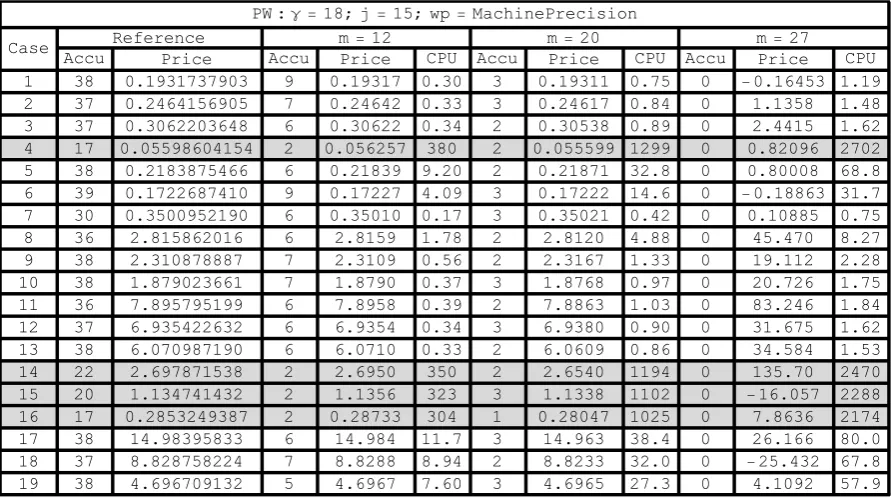
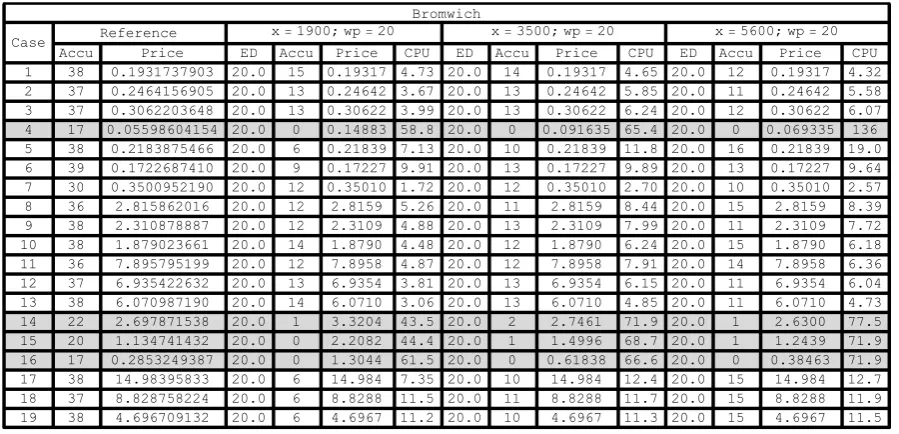
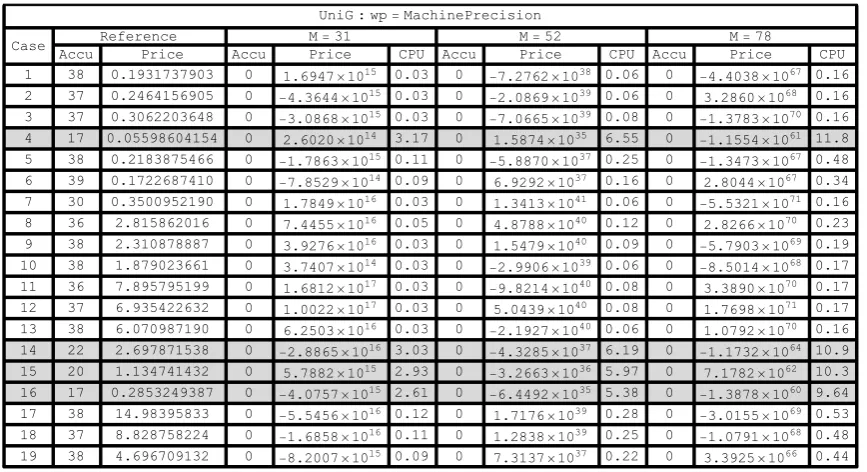
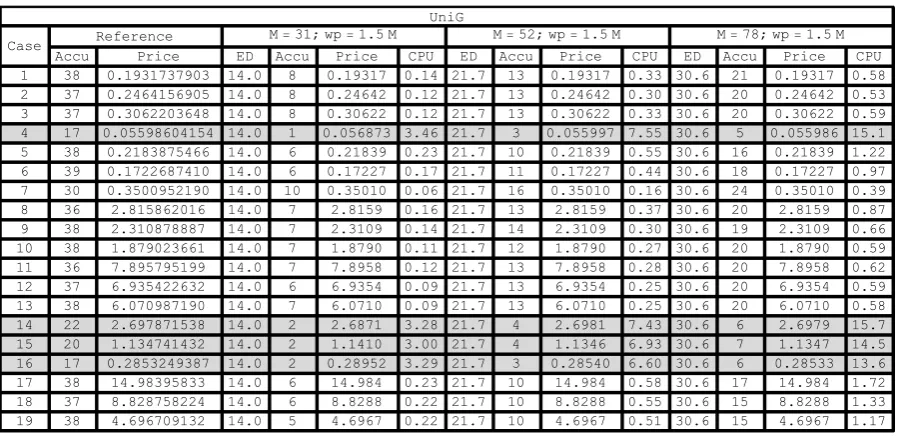
This thesis considers new methods that exploit recent developments in computer technology to address
three extant problems in the area of Finance and Econometrics. The problem of Asian option pricing has
endured for the last two decades in spite of many attempts to find a robust solution across all parameter
values. All recently proposed methods are shown to fail when computations are conducted using
standard machine precision because as more and more accuracy is forced upon the problem, round-off
error begins to propagate. Using recent methods from numerical analysis based on multi-precision
arithmetic, we show using the Mathematica platform that all extant methods have efficacy when
computations use sufficient arithmetic precision. This creates the proper framework to compare and
contrast the methods based on criteria such as computational speed for a given accuracy. Numerical
methods based on a deformation of the Bromwich contour in the Geman-Yor Laplace transform are
found to perform best provided the normalized strike price is above a given threshold; otherwise
This thesis considers new methods that exploit recent developments in computer technology to address
three extant problems in the area of Finance and Econometrics. The problem of Asian option pricing has
endured for the last two decades in spite of many attempts to find a robust solution across all parameter
values. All recently proposed methods are shown to fail when computations are conducted using
standard machine precision because as more and more accuracy is forced upon the problem, round-off
error begins to propagate. Using recent methods from numerical analysis based on multi-precision
arithmetic, we show using the Mathematica platform that all extant methods have efficacy when
computations use sufficient arithmetic precision. This creates the proper framework to compare and
contrast the methods based on criteria such as computational speed for a given accuracy. Numerical
methods based on a deformation of the Bromwich contour in the Geman-Yor Laplace transform are
found to perform best provided the normalized strike price is above a given threshold; otherwise
methods based on Euler approximation are preferred.
The same methods are applied in two other contexts: the simulation of stable distributions and the
computation of unit root densities in Econometrics. The stable densities are all nested in a general
function called a Fox H function. The same computational difficulties as above apply when using only
double-precision arithmetic but are again solved using higher arithmetic precision. We also consider
simulating the densities of infinitely divisible distributions associated with hyperbolic functions. Finally,
our methods are applied to unit root densities. Focusing on the two fundamental densities, we show our
methods perform favorably against the extant methods of Monte Carlo simulation, the Imhof algorithm
and some analytical expressions derived principally by Abadir. Using Mathematica, the main
1. Candidate’s declarations:
I, Liang Cao, hereby certify that this thesis, which is approximately 78000 words in length, has been written by me, that it is the record of work carried out by me and that it has not been submitted in any previous application for a higher degree.
I was admitted as a research student in March 2009 and as a candidate for the degree of PhD Economics and Finance in March 2010; the higher study for which this is a record was carried out in the University of St Andrews between 2009 and 2014.
Date signature of candidate
2. Supervisor’s declaration:
I hereby certify that the candidate has fulfilled the conditions of the Resolution and Regulations appropriate for the degree of PhD Economics and Finance in the University of St Andrews and that the candidate is qualified to submit this thesis in application for that degree.
Date signature of supervisor
3. Permission for electronic publication: (to be signed by both candidate and supervisor)
In submitting this thesis to the University of St Andrews I understand that I am giving permission for it to be made available for use in accordance with the regulations of the University Library for the time being in force, subject to any copyright vested in the work not being affected thereby. I also understand that the title and the abstract will be published, and that a copy of the work may be made and supplied to any bona fide library or research worker, that my thesis will be electronically accessible for personal or research use unless exempt by award of an embargo as requested below, and that the library has the right to migrate my thesis into new electronic forms as required to ensure continued access to the thesis. I have obtained any third-party copyright permissions that may be required in order to allow such access and migration, or have requested the appropriate embargo below.
The following is an agreed request by candidate and supervisor regarding the electronic publication of this thesis:
Add one of the following options:
(i) Access to printed copy and electronic publication of thesis through the University of St Andrews.
Date signature of candidate signature of supervisor
i
TABLE OF CONTENTS
Chapter 1: Introduction
... 1
1. Motivation ... 1
2. Overview ... 6
Chapter 2: Comparing New and Extant Numerical and Analytical Methods of
Asian Option Pricing
... 9
1. Introduction ... 9
1.1. Literature review ... 9
1.2. Motivation ... 13
2. Preliminary Material on Asian Options ... 15
2.1. The stock price ... 15
2.2. European options ... 15
2.3. Asian options ... 17
2.4. Pricing formulae for geometric Asian options ... 18
2.5. Black-Scholes equation ... 19
3. Numerical and Analytical Methods ... 21
3.1. Preliminaries ... 21
3.2. German and Yor's Laplace transform ... 25
3.3. Numerical inversion algorithms ... 30
3.4. Asymptotic method ... 46
3.5. PDE method ... 48
3.6. Spectral series expansion ... 52
ii
3.8. Turnbull and Wakeman's approximation ... 58
3.9. Milevsky and Posner's reciprocal gamma approximation ... 59
4. Numerical Results ... 61
4.1. Experiment design ... 61
4.2. Reference prices of nineteen Asian option cases ... 63
4.3. Numerical results of the Euler method ... 64
4.4. Numerical results of the Post-Widder method ... 66
4.5. Numerical results of Bromwich integration ... 68
4.6. Numerical results of the Gaver-Wynn-Rho algorithm ... 71
4.7. Numerical results for the fixed Talbot method ... 73
4.8. Numerical results of the unified Gaver-Stehfest algorithm ... 75
4.9. Numerical results of the unified Euler algorithm ... 77
4.10. Numerical results for the unified Talbot algorithm ... 79
4.11. Numerical results of the Laguerre method ... 81
4.12. Numerical results of the spectral series expansion ... 84
4.13. Numerical results of constructive complex analysis ... 86
4.14. Numerical results of TW, RG, PDE and asymptotic method ... 88
4.15. Numerical results of Monte Carlo simulation ... 89
5. Conclusion ... 91
Chapter 3: A Comparison of Various Methods for Computing Stable
Distributions and Infinitely Divisible Distributions Associated with Hyperbolic
Functions
... 93
1. Introduction ... 93
iii
2.1. Brownian motion ... 97
2.2. Brownian bridge... 98
2.3. Brownian meander and excursion ... 99
3. Infinitely Divisible Distributions Associated with Hyperbolic Functions ... 101
3.1. Definition of distributions ... 101
3.2. Properties of 𝐶𝐶
𝑡𝑡, 𝑆𝑆
𝑡𝑡and 𝑇𝑇
𝑡𝑡... 102
3.2. Laws of 𝐶𝐶̂
𝑡𝑡, 𝑆𝑆̂
𝑡𝑡and 𝑇𝑇�
𝑡𝑡... 107
4. Numerical Experiments with
𝐶𝐶
𝑡𝑡, 𝑆𝑆
𝑡𝑡and 𝑇𝑇
𝑡𝑡... 112
4.1. Computing the density of 𝐶𝐶
𝑡𝑡... 112
4.2. Computing the density of 𝑆𝑆
𝑡𝑡... 117
4.3. Computing the density of 𝑇𝑇
𝑡𝑡... 122
5. Stable Distributions ... 126
5.1. The Definition of 𝑆𝑆
(
𝛼𝛼
,
𝛽𝛽
,
𝜇𝜇
,
𝜎𝜎
)
... 126
5.2. The Definition of 𝑆𝑆
1(
𝛼𝛼
,
𝛽𝛽
1,
𝜇𝜇
,
𝜎𝜎
1)
... 127
5.3. Generation of stable random variables 𝑆𝑆
1(
𝛼𝛼
,
𝛽𝛽
1)
... 129
5.4. Special functions related to stable distributions... 130
5.5. Densities of various stable distributions ... 131
6. Numerical Experiments with Stable Distributions ... 141
6.1. Computing the density 𝑔𝑔
𝑚𝑚,𝛼𝛼... 141
6.2. Computing the density 𝑓𝑓
𝑚𝑚,𝛼𝛼of generalized one-sided stable distribution 𝐹𝐹
𝑚𝑚,𝛼𝛼142
6.3. Computing the density 𝑓𝑓
𝛼𝛼of one-sided stable distribution 𝐹𝐹
𝛼𝛼... 146
6.4. Computing the density 𝑓𝑓
𝛼𝛼,𝛽𝛽of two-sided stable distribution 𝐹𝐹
𝛼𝛼,𝛽𝛽... 150
7. Conclusion ... 153
iv
1. Introduction and Motivation ... 155
2. Unit Root Problem in AR(1) Model ... 160
2.1. Stationary case ... 160
2.2. Nonstationary case ... 161
2.3. Limiting distributions... 163
2.4. Test unit root hypothesis ... 165
3. Simulate the Distributions of
S
1T,
S
2T,
S
3Tand
S
4T... 167
4. Computing the Distribution of
S
3from the Characteristic Function... 172
4.1. Imhof's formula for 𝑆𝑆
3... 172
4.2. Evaluating the characteristic function associated with 𝑆𝑆
3... 173
4.3. Computing the distribution function of 𝑆𝑆
3... 174
4.4. Computing the probability density of 𝑆𝑆
3... 177
5. Joint Density of
U
and
V
... 185
5.1. The Laplace transform of the joint distribution
(
𝑈𝑈
,
𝑉𝑉
)
... 186
5.2. Computation of the density 𝑓𝑓
𝑉𝑉(
𝑣𝑣
)
... 187
5.3. Computation of the density 𝑓𝑓
𝑈𝑈(
𝑢𝑢
)
... 188
5.4. Computation of the joint density 𝑓𝑓
𝑈𝑈,𝑉𝑉(
𝑢𝑢
,
𝑣𝑣
)
... 193
6. Joint Density of
R
and
S
... 199
6.1. Standardized quadratic forms ... 199
6.2. Formulae for joint density 𝑓𝑓
𝑅𝑅,𝑆𝑆(
𝑟𝑟
,
𝑠𝑠
)
... 200
6.3. Formulae for joint distribution function 𝐹𝐹
𝑅𝑅,𝑆𝑆(
𝑟𝑟
,
𝑠𝑠
)
... 204
7. Generating Densities of Unit Root Statistics ... 206
7.1. Transformation between 𝑓𝑓
𝑈𝑈,𝑉𝑉(
𝑢𝑢
,
𝑣𝑣
)
and 𝑓𝑓
𝑅𝑅,𝑆𝑆(
𝑟𝑟
,
𝑠𝑠
)
... 206
7.2. Generating the density of 𝑆𝑆
3from 𝑓𝑓
𝑈𝑈,𝑉𝑉(
𝑢𝑢
,
𝑣𝑣
)
... 208
v
7.4. Generating the density of 𝑆𝑆
4from 𝑓𝑓
𝑈𝑈,𝑉𝑉(
𝑢𝑢
,
𝑣𝑣
)
... 217
7.5. Generating the density of 𝑆𝑆
4from 𝑓𝑓
𝑅𝑅,𝑆𝑆(
𝑟𝑟
,
𝑠𝑠
)
... 222
8. Conclusion ... 227
Chapter 5: Conclusion
... 229
1. Contributions of the Thesis ... 229
1.1. Chapter 2 ... 229
1.2. Chapter 3 ... 230
1.3. Chapter 4 ... 231
1.4.
Mathematica
code ... 232
2. Suggestions for Further Work ... 233
Appendices ... 235
Bibliography ... 237
Mathematica
Code ... 241
1. Code in Chapter 2 ... 241
2. Code in Chapter 3 ... 286
Chapter 1
Introduction
1. Motivation
The Laplace transform is an integral transform which is widely used in finance and econometrics to, for
example, characterize the Asian option price, define probability distributions and represent the joint
density related to unit root distributions. This thesis seeks to apply state-of-the-art methods of Laplace
transform inversion and other numerical methods in an explicit multi-precision computing environment
to examine three problems that have endured in various fields: the problem of pricing an Asian option;
the problem of computing and simulating stable distributions and densities (we also consider other
infinitely divisible distributions associated with hyperbolic functions); and the problem of computing
and simulating unit root densities in Econometrics.
Let fHtL be a real-valued function of a real variable t>0. The Laplace transform of fHtL is defined as
(1.1)
f
` HsL=Ù
0 ¥
e-s t f HtLât
where s is a complex variable. It transforms the function fHtL in time domain to the function f`HsL in
complex domain by integration with the kernel e-s t.
Assume the above Laplace transform is well-defined and analytic for ReHsL>0. This ensures the region
of convergence of f
`
HsL covers the right half plane. This assumption is natural for a large class of
applications, but can be generalized for others by making a change of variables. Then, the inverse
Laplace transform also known as Bromwich integral is given by
(1.2)
fHtL= 1 2ΠiÙa-i¥
a+i¥
es t f`HsLâs
where the integration is done along a vertical line s=a such that all singularities of f`HsL are to the left of
the contour path. This keeps the contour path in the region of convergence of f
` HsL.
where the integration is done along a vertical line s=a such that all singularities of f`HsL are to the left of
the contour path. This keeps the contour path in the region of convergence of f`HsL.
The Laplace transform can be applied in many areas. In finance, it is difficult to evaluate an Asian
option because the payoff of the Asian option depends on the average price of the underlying stock over
a prespecified period. The distribution of the average is too complicated to be characterized analytically.
Turnbull and Wakeman (1991) approximate the distribution of the average analytically by matching the
first two moments to the lognormal distribution, while Milevsky and Posner (1998) match them to the
reciprocal gamma distribution. The problem with analytical approximations is that there is no reliable
error estimates (Linetsky, 2004).
Geman and Yor (1993) have derived a closed-form expression for the Laplace transform of the
normalized Asian call price:
(1.3)
C` HΛ,qL=Ù0¥e-ΛhCHΝLHh,qLâh= Ù0 1H2qL
e-xxHΜ-ΝL2-2H1-2q xLHΜ+ΝL2+1
âx
ΛHΛ-2-2ΝLGHHΜ-ΝL2-1L
where Μ = 2Λ + Ν2 and the normalized interest rate Ν, the normalized maturity h, and the normalized
strike price q are given by
(1.4)
Ν = 2Hr-∆L Σ2 -1
h= Σ
2
4 HT-tL
q= Σ
2
4SHtL9K T-Ù0
t
SHuLâu=
where r is the constant risk-free interest rate, ∆ is the constant dividend yield, Σ is the constant volatility,
K is the strike price, T is the time to maturity, and SHtL is the stock price at present time t. Ù0tSHuLâu
divided by t stands for the realized average price over the time interval @0,tD. The process of numerically
inverting the Geman and Yor (1993) Laplace transform will lead to the normalized Asian call price from
which the Asian call price can be computed with ease. As we shall explain in Chapter 2, the Asian put
option price is related to the call price by the notion of “put-call parity”. Fu, Madan and Wang (1999)
and Craddock, Heath and Platen (2000) discuss and compare various inversion algorithms for the
problem of Asian option pricing. They show inversion of the Laplace transform encounters numerical
difficulties for low volatility and short maturity, and therefore do not recommend it as a method of
pricing an Asian option. But, they have not considered the factor of computation precision which
determines the round-off errors. Also, given that computers has now become much more powerful than a
where r is the constant risk-free interest rate, ∆ is the constant dividend yield, Σ is the constant volatility,
K is the strike price, T is the time to maturity, and SHtL is the stock price at present time t. Ù0tSHuLâu
divided by t stands for the realized average price over the time interval @0,tD. The process of numerically
inverting the Geman and Yor (1993) Laplace transform will lead to the normalized Asian call price from
which the Asian call price can be computed with ease. As we shall explain in Chapter 2, the Asian put
option price is related to the call price by the notion of “put-call parity”. Fu, Madan and Wang (1999)
and Craddock, Heath and Platen (2000) discuss and compare various inversion algorithms for the
problem of Asian option pricing. They show inversion of the Laplace transform encounters numerical
difficulties for low volatility and short maturity, and therefore do not recommend it as a method of
pricing an Asian option. But, they have not considered the factor of computation precision which
determines the round-off errors. Also, given that computers has now become much more powerful than a
decade ago, the conclusion would be different.
The infinitely divisible distributions of non-negative random variables Ct, St and Tt can be characterized
by Laplace transforms (Pitman and Yor, 2003): for t ³0,
(1.5)
EAe-ΛCtE=Ù
0 ¥
e-Λx fCtHxLâx=J
1
cosh 2Λ N
t
EAe-ΛStE=Ù
0 ¥
e-Λx fStHxLâx=K
2Λ sinh 2Λ O
t
EAe-ΛTtE=Ù
0 ¥
e-Λx fTtHxLâx=K
tanh 2Λ 2Λ O
t
The laws of Ct and St occur naturally in the study of Brownian motion and Bessel processes (Yor, 1997,
§18.6 cited in Pitman and Yor, 2003). The distribution of C12 arises when studying the Dickey-Fuller
distributions. Analytical formulae have been derived for the density of Ct for general t (Biane, Pitman
and Yor, 2001), the density of St for general t (Biane and Yor, 1987 cited in Biane, Pitman and Yor,
2001), the densities of C1 and S1 (Devroye, 2009a), and the density of S12 (Tolmatz, 2002). Note the
formula for the density of St is intractable other than t=1. Also, the formula for the density of Tt is not
available. If the Laplace transforms of Ct, St and Tt can be inverted numerically, the densities of Ct, St
and Tt for general t will be obtained.
The stable distributions are a class of distributions such that a linear combination of two i.i.d. stable
random variables has the same distribution up to location and scale parameters. There are many types of
stable distributions including SHΑ, Β,Μ,ΣL, S1HΑ, Β1,Μ,Σ1L, the generalized one-sided stable
distribution Fm,Α, the one-sided stable distribution FΑ and the two-sided stable distribution FΑ,Β. The first
two stable distributions can be conveniently described by their characteristic functions. While, Fm,Α, FΑ
and FΑ,Β discussed in the paper by Schneider (1987) are defined by some probability density gm,Α, the
Laplace transform and the Fourier transform respectively. Let fΑ be the density of FΑ. The Laplace
transform of fΑ is given by
(1.6) Ù0
¥
e-Λx f
ΑHxLâx=e-Λ
Α
Let fm,Α be the density of Fm,Α. Schneider (1987) obtains the Laplace transform of fm,Α which can be
expressed in terms of the Fox function. In the special case of m=1, 2, the Laplace transform of fm,Α has
a closed-form expression.
Let fm,Α be the density of Fm,Α. Schneider (1987) obtains the Laplace transform of fm,Α which can be
expressed in terms of the Fox function. In the special case of m=1, 2, the Laplace transform of fm,Α has
a closed-form expression.
For m=1,
(1.7) Ù0
¥
e-Λx f1,ΑHxLâx=e -JΛ
bN
Α
where b=J Α
GH1-ΑLN 1Α
.
For m=2,
(1.8) Ù0
¥
e-Λx f2,ΑHxLâx= 2 GHΒLI
Λ
bM
12 KΒ 2I
Λ
bM 1
2Β
where Β = 1
1+Α and KnHzL is the modified Bessel function of the second kind.
The distribution SHΑ, Β,Μ,ΣL can be computed or simulated by Mathematica 9.0 built-in function
StableDistribution@ D. The distribution S1HΑ, Β1, 0, 1L can be simulated by a recipe proposed by
Chambers, Mallows and Stuck (1976). Schneider (1987) derives Fox function representations and series
expansions for the densities fm,Α, fΑ and fΑ,Β where fΑ,Β is the density of FΑ,Β. Alternative series
expansions for fΑ,Β can be found in the Feller’s (1970, p.583) text. Penson and Gorska (2011) show the
density fΑ for rational Α =lk can be written as a finite sum of generalized hypergeometric functions.
Schneider (1986) and Garoni and Frankel (2002) give special function representations for the special
cases of fΑ,Β, which correct f23,0 and recover f12,0 discussed by Zolotarev (1954). The density fΑ,Β can
also be computed by numerical inversion of the Fourier transform. By numerical inversion of the
associated Laplace transforms, we can obtain the densities fm,Α and fΑ. But, the complete relations
between SHΑ, Β,Μ,ΣL, S1HΑ, Β1,Μ,Σ1L, Fm,Α, FΑ and FΑ,Β has been lacking, and is therefore worth
studying.
When studying the first order autoregressive time series under a unit root, the so-called Dickey-Fuller
distributions of random variables S3 and S4 are of interest to many researchers. As the limiting cases of
unit root statistics S3T and S4T with the notation used in Tanaka (1996), S3 and S4 can be expressed in
(1.9)
S3=
U
V
S4=
U
V
with
(1.10)
U =Ù01wHtLâwHtL= 1 2Aw
2H1L-1E
V=Ù01w2HtLât
where wHtL is a standard Brownian motion with t Î@0, 1D. The distributions of S3 and S4 were first
approximated by Monte Carlo simulation with finite samples (Fuller, 1976 cited in Tanaka, 1996, p.17),
but the approximations are usually poor especially on the tails. The distribution of S3 was computed
numerically from the associated characteristic function (Tanaka, 1996). However, the problem of
computing the Dickey-Fuller distributions properly remains unsolved. We notice that the densities of S3
and S4 can be constructed from the joint density fU,VHu,vL of HU,VL provided that the joint density is
readily available.
White (1958, p.1193) have derived the Laplace transform of HU,VL
(1.11)
fHΑ, ΒL=E@expH- ΑU- ΒVLD
=Ù0¥Ù-¥12e-Αu- Βv fU,VHu,vLâuâv
=eΑ2 cosh 2Β + Α 2Β
sinh 2Β
-12
As we can see, the joint density fU,VHu,vL is embedded in the above Laplace transform which is
two-dimensional. Theoretically, numerical inversion of two-dimensional Laplace transforms will result in the
joint density fU,VHu,vL. But this needs to be verified by numerical experiments.
Nonetheless, numerical inversion of Laplace transforms is non-trivial. It involves a lot of effort, very
careful selection for inversion parameters, and specification for computation precision. In general, the
difficulty of the inversion mainly depends on the Laplace transform to be inverted and inversion
algorithm used. The inversion algorithms to be considered in this thesis include the Euler method (Euler)
and the Post-Widder method (PW) proposed by Abate and Whitt (1995); the Laguerre method
(Laguerre) suggested by Abate, Choudhury and Whitt (1996); the Bromwich integral (Bromwich)
applied by Shaw (1998); the fixed Talbot method (FT) and the Gaver-Wynn-Rho algorithm (GWR)
presented by Abate and Valkó (2004); and three inversion routines in the unified framework (Abate and
Whitt, 2006): the unified Gaver-Stehfest algorithm (UniG), the unified Euler algorithm (UniE), and the
unified Talbot algorithm (UniT). Among them, UniG, UniE and UniT can be combined to form nine
different two-dimensional inversion algorithms (Abate and Whitt, 2006): UniTG, UniTT, UniEG,
UniET, UniTE, UniGT, UniGG, UniEE and UniGE with first operator, say T, applying to the outer loop
and the second operator, say G, applying to the inner loop.
Nonetheless, numerical inversion of Laplace transforms is non-trivial. It involves a lot of effort, very
careful selection for inversion parameters, and specification for computation precision. In general, the
difficulty of the inversion mainly depends on the Laplace transform to be inverted and inversion
algorithm used. The inversion algorithms to be considered in this thesis include the Euler method (Euler)
and the Post-Widder method (PW) proposed by Abate and Whitt (1995); the Laguerre method
(Laguerre) suggested by Abate, Choudhury and Whitt (1996); the Bromwich integral (Bromwich)
applied by Shaw (1998); the fixed Talbot method (FT) and the Gaver-Wynn-Rho algorithm (GWR)
presented by Abate and Valkó (2004); and three inversion routines in the unified framework (Abate and
Whitt, 2006): the unified Gaver-Stehfest algorithm (UniG), the unified Euler algorithm (UniE), and the
unified Talbot algorithm (UniT). Among them, UniG, UniE and UniT can be combined to form nine
different two-dimensional inversion algorithms (Abate and Whitt, 2006): UniTG, UniTT, UniEG,
UniET, UniTE, UniGT, UniGG, UniEE and UniGE with first operator, say T, applying to the outer loop
and the second operator, say G, applying to the inner loop.
2. Overview
This thesis investigates a series of methods for numerically inverting Laplace transforms and applies
them to various problems. The inversion technique is also compared with other methods such as Monte
Carlo simulation, PDE method, analytical formulae and so on. We write Mathematica code for each
method. The numerical experiments are conducted in Mathematica 9.0 on a HP ProBook 4520s laptop
equipped with 2.4GHz Intel Core i3-370M processor and 3GB DDR3 RAM.
Chapter 2 deals with the problem of Asian option pricing. Inversion algorithms such as Euler, PW,
Laguerre, Bromwich, FT, GWR, UniG, UniE, and UniT are used to invert the Geman and Yor (1993)
Laplace transform. All computations are done with arbitrary-precision arithmetic rather than
machine-precision arithmetic where the latter is used by Fu, Madan and Wang (1999) and Craddock, Heath and
Platen (2000). Hence, the round-off errors can be controlled properly: round-off errors do not propagate
when one increases parameter values of the inversion algorithms. Eventually, by specifying appropriate
parameter values for each method we find all inversion algorithms achieve the same result. The matched
result can be computed to have high accuracy so that we can use it as the reference price to check the
accuracy of each method with its parameter settings. By manipulating the parameter settings for a
method, we can also see how the accuracy changes with different parameter values. It is found that the
truth of difficulties with numerical inversion for Asian option pricing is that the accuracy of the
algorithm drops and the computation time increases when the volatility is low and the maturity is short.
But we can regain the accuracy by increasing both the parameter values of the algorithm and the
computation precision at the cost of extra computation time.
In addition to numerical inversion, we consider many other methods for pricing an Asian option. These
methods include Monte Carlo simulation, analytical approximations (Turnbull and Wakeman, 1992;
Milevsky and Posner, 1998), PDE method (Rogers and Shi, 1995; Ve e , 2001; 2002), asymptotic
expansions (Shaw, 2002), spectral expansions (Linetsky, 2004) and constructive complex analysis
In addition to numerical inversion, we consider many other methods for pricing an Asian option. These
methods include Monte Carlo simulation, analytical approximations (Turnbull and Wakeman, 1992;
Milevsky and Posner, 1998), PDE method (Rogers and Shi, 1995; Ve e , 2001; 2002), asymptotic
expansions (Shaw, 2002), spectral expansions (Linetsky, 2004) and constructive complex analysis
(Schröder, 2008). With the reference prices, the accuracy of all methods can be verified.
Chapter 3 investigates various methods for computing infinitely divisible distributions and stable
distributions. Following Biane, Pitman and Yor (2001), we derive the formula for the density of St for
general t using Mathematica. The exact relations between different types of stable distributions are
established. Inversion algorithms UniG, UniE and UniT are applied to numerically inverting the Laplace
transforms associated with the infinitely divisible distributions and stable distributions with the yielded
results compared with those of analytical formulae. We show that UniG is a universal method for the
densities of St, Ct and Tt for general t>0, while UniE and UniT only work for the densities of St and Ct
for integer t >0 though they can compute the density of Tt for general t>0. When only the density of Tt
is concerned, UniE and UniT become superior to UniG in terms of the speed. With regard to the
computations of fm,Α and fΑ, UniE, UniT and UniG are all able to invert their Laplace transforms with
UniT faster than the other two.
Chapter 4 studies the unit root distributions S3 and S4 arising in AR(1) model with S3 =UV and
S4 =U V , and seeks to compute the densities of S3 and S4 in a numerical way rather than based on
the approximations of Monte Carlo simulation. Following Tanaka (1996), we compute the density of S3
from the associated characteristic function using Imhof’s (1961 cited in Tanaka, 1996, p.196) formula.
However this method cannot be applied to the computation of the density of S4. Then, we attempt to
construct the densities of S3 and S4 from the joint density fU,VHu,vL. Given the original two-dimensional
Laplace transform of HU,VL, we reduce it to a one-dimensional Laplace transform of fU,VHu,vL with
respect to v. It is shown that the reduced Laplace transform can be inverted by UniG. With the numerical
results of fU,VHu,vL, we are able to generate not only the densities of S3 and S4 but also the density of
almost any unit root distribution which can be expressed in terms of U and V only. In addition, Abadir
(1995) proposes analytical formulae for the joint density fR,SHr,sL of HR,SL with R= 2 U and
S=2V. We establish a relation between fU,VHu,vL and fR,SHr,sL, and demonstrate fR,SHr,sL can also be
used for the generation of unit root distributions. By comparing results computed from fU,VHu,vL and
those computed from fR,SHr,sL, we find that using fU,VHu,vL is better than using fR,SHu,vL.
Chapter 4 studies the unit root distributions S3 and S4 arising in AR(1) model with S3 =UV and
S4 =U V , and seeks to compute the densities of S3 and S4 in a numerical way rather than based on
the approximations of Monte Carlo simulation. Following Tanaka (1996), we compute the density of S3
from the associated characteristic function using Imhof’s (1961 cited in Tanaka, 1996, p.196) formula.
However this method cannot be applied to the computation of the density of S4. Then, we attempt to
construct the densities of S3 and S4 from the joint density fU,VHu,vL. Given the original two-dimensional
Laplace transform of HU,VL, we reduce it to a one-dimensional Laplace transform of fU,VHu,vL with
respect to v. It is shown that the reduced Laplace transform can be inverted by UniG. With the numerical
results of fU,VHu,vL, we are able to generate not only the densities of S3 and S4 but also the density of
almost any unit root distribution which can be expressed in terms of U and V only. In addition, Abadir
(1995) proposes analytical formulae for the joint density fR,SHr,sL of HR,SL with R= 2 U and
S=2V. We establish a relation between fU,VHu,vL and fR,SHr,sL, and demonstrate fR,SHr,sL can also be
used for the generation of unit root distributions. By comparing results computed from fU,VHu,vL and
those computed from fR,SHr,sL, we find that using fU,VHu,vL is better than using fR,SHu,vL.
Chapter 2
Comparing New and Extant
Numerical and Analytical Methods
of Asian Option Pricing
1. Introduction
1.1. Literature review
Asian options are financial derivatives whose payoffs are based on the average price of the underlying
asset over some prescribed period of time. Owing to the averaging feature, Asian options are widely
used in the stock market, the foreign exchange market and the commodity market. There are several
reasons why they are popular. First, the companies with sales in foreign currency are faced with the
unanticipated changes in the exchange rate between the foreign currency and the home currency. Asian
options provide them with an option of using the average foreign exchange rate to avoid the foreign
exchange risk. Second, it may be possible for large market participants to manipulate the prices in thinly
traded markets such as the crude oil market and the gold market. But it is much harder for them to
manipulate the average price with the existence of Asian options. Thirdly, Asian options are usually
cheaper than the ordinary options because the volatility of the average price is lower than the volatility of
the price itself.
Asian options receive their name Asian because they were first priced in Tokyo by David Spaughton and
Mark Standish of Bankers Trust who were there in 1987 on business developing ‘the first commercially
used pricing formula for options linked to the average of crude oil’ (Wilmott, 2006, p.427). There are
many types of Asian options depending on whether the option is a call or a put, where the average price
is used, what type the average is, and how to sample the underlying price over a time period. The
average price can be used either in place of the underlying price (an average price option) or in place of
the strike price (an average strike option). The average can be arithmetic or geometric. The sampling can
also be continuous or discrete. In this chapter, we mainly focus on the valuation of the continuously
sampled arithmetic average price call option (or continuous arithmetic Asian call in short) because it is
the case of greatest importance in terms of being type of Asian option that is traded most. It has also
been the type of Asian option most focused on in the academic literature.
Asian options receive their name Asian because they were first priced in Tokyo by David Spaughton and
Mark Standish of Bankers Trust who were there in 1987 on business developing ‘the first commercially
used pricing formula for options linked to the average of crude oil’ (Wilmott, 2006, p.427). There are
many types of Asian options depending on whether the option is a call or a put, where the average price
is used, what type the average is, and how to sample the underlying price over a time period. The
average price can be used either in place of the underlying price (an average price option) or in place of
the strike price (an average strike option). The average can be arithmetic or geometric. The sampling can
also be continuous or discrete. In this chapter, we mainly focus on the valuation of the continuously
sampled arithmetic average price call option (or continuous arithmetic Asian call in short) because it is
the case of greatest importance in terms of being type of Asian option that is traded most. It has also
been the type of Asian option most focused on in the academic literature.
The problem of pricing arithmetic Asian options has interested many researchers for more than two
decades as there are no closed-form formulae for them. The arithmetic average is not lognormally
distributed (McDonald, 2006, p.593) when the stock price follows geometric Brownian motion as in the
traditional framework in finance, the Black-Scholes framework, following from assumptions laid out by
Black and Scholes (1973). See, e.g. McDonald (2006, pp.649-650) or some other similar textbook. In
contrast to arithmetic average, the geometric average is lognormally distributed since the product of
lognormal random variables is also lognormal (McDonald, 2006, p.593). Therefore, closed-form
formulae exist for geometric Asian options.
The continuous arithmetic Asian call options were in the past valued using Monte Carlo simulation with
the control variate method, which is a variance reduction technique, by Kemna and Vorst (1990), where
they notice the continuous geometric Asian call serves as a quality control variate. Boyle, Broadie and
Glasserman (1997) further improve the equation for the control variate estimate of which the variance
can be minimized. Although Monte Carlo method is straightforward for path-dependent options such as
Asian options, it is often computationally expensive. Also, discretely sampling a continuous time process
results in the discretization bias (Broadie, Glasserman and Kou, 1999). Then, analytical approximations
are used in the valuation of Asian options. Turnbull and Wakeman (1991) approximate the distribution
of the arithmetic average by matching the first two moments to the lognormal distribution. Later,
Milevsky and Posner (1998) match them to the reciprocal gamma distribution. Analytical
approximations are fast but have no reliable error estimates (Linetsky, 2004).
An important contribution is made by Geman and Yor (1993) who derive a closed-form expression for
the Laplace transform of the continuous arithmetic Asian call price. The call price Ct,THKL can be
expressed as
An important contribution is made by Geman and Yor (1993) who derive a closed-form expression for
the Laplace transform of the continuous arithmetic Asian call price. The call price Ct,THKL can be
expressed as
(1.1)
Ct,THKL= e-rHT-tL
T I
4SHtL
Σ2 MCH
ΝLHh,qL
with SHtL the stock price at time t, K the strike price, T the time to maturity, r the constant risk-free
interest rate, and Σ the constant volatility. The normalized interest rate Ν, the normalized maturity h, and
the normalized strike price q are given by
(1.2)
Ν = 2Hr-∆L Σ2 -1
h= Σ
2
4 HT-tL
q= Σ2
4SHtL9K T-Ù0
t
SHuLâu=
where ∆ is the constant dividend yield, and Ù0tSHuLâu divided by t stands for the realized average price
over the time period @0,tD. The Laplace transform of the normalized Asian call price CHΝLHh,qL with
respect to h is given by
(1.3)
C`HΛ,qL=Ù0¥e-ΛhCHΝLHh,qLâh
= Ù0 1H2qL
e-xxHΜ-ΝL2-2H1-2q xLHΜ+ΝL2+1
âx
ΛHΛ-2-2ΝLGHHΜ-ΝL2-1L
where Μ = 2Λ + Ν2 .
The Geman-Yor Laplace transform C`HΛ,qL makes it possible to price Asian options by numerical
inversion of the Laplace transform. Geman and Eydeland (1995) first invert the Geman-Yor Laplace
transform using the fast Fourier transform (FFT). Shaw (1998, p.208) evaluates the Geman-Yor Laplace
transform in Mathematica revealing that C` HΛ,qL can be expressed in terms of the Kummer confluent
hypergeometric function as discussed below. He further exploits built-in Mathematica function
NIntegrate@ D and inverts C`HΛ,qL based on the Bromwich integral (which is the contour integral involved
in Laplace transform inversion as discussed below). Fu, Madan and Wang (1999) price Asian options
using the Euler method and the Post-Widder method, which are two inversion algorithms proposed by
Abate and Whitt (1995). They compare and contrast numerical inversion methods with Monte Carlo
simulation, and find that numerical inversion techniques encounter numerical difficulties for low
volatility and short maturity, or specifically for Σ2HT-tL<0.01. Craddock, Heath and Platen (2000)
investigate and compare different approaches to the numerical inversion of the Geman-Yor Laplace
transform, and draw a similar conclusion that numerical inversion methods can be extremely
time-consuming and unreliable when the normalized strike price q is small, i.e. q<0.03. There are a number
of important inversion algorithms in the numerical analysis literature that have not yet been applied to
Asian option pricing. These methods include the Laguerre method proposed by Abate, Choudhury and
Whitt (1996); the Gaver-Wynn-Rho algorithm and the fixed Talbot algorithm by Abate and Valkó
(2004); and the unified Gaver-Stehfest algorithm, the unified Euler algorithm, and the unified Talbot
algorithm by Abate and Whitt (2006). One of the contributions of this thesis is to apply these algorithms
to Asian option pricing. Given they are currently the most effective algorithms for Laplace transform
inversion, it is not surprising that we are able successfully to apply them to Asian option pricing,
yielding computational methods that are competitive with, and sometimes supersede, the currently best
extant methods in the literature.
The Geman-Yor Laplace transform C`HΛ,qL makes it possible to price Asian options by numerical
inversion of the Laplace transform. Geman and Eydeland (1995) first invert the Geman-Yor Laplace
transform using the fast Fourier transform (FFT). Shaw (1998, p.208) evaluates the Geman-Yor Laplace
transform in Mathematica revealing that C` HΛ,qL can be expressed in terms of the Kummer confluent
hypergeometric function as discussed below. He further exploits built-in Mathematica function
NIntegrate@ D and inverts C`HΛ,qL based on the Bromwich integral (which is the contour integral involved
in Laplace transform inversion as discussed below). Fu, Madan and Wang (1999) price Asian options
using the Euler method and the Post-Widder method, which are two inversion algorithms proposed by
Abate and Whitt (1995). They compare and contrast numerical inversion methods with Monte Carlo
simulation, and find that numerical inversion techniques encounter numerical difficulties for low
volatility and short maturity, or specifically for Σ2HT-tL<0.01. Craddock, Heath and Platen (2000)
investigate and compare different approaches to the numerical inversion of the Geman-Yor Laplace
transform, and draw a similar conclusion that numerical inversion methods can be extremely
time-consuming and unreliable when the normalized strike price q is small, i.e. q<0.03. There are a number
of important inversion algorithms in the numerical analysis literature that have not yet been applied to
Asian option pricing. These methods include the Laguerre method proposed by Abate, Choudhury and
Whitt (1996); the Gaver-Wynn-Rho algorithm and the fixed Talbot algorithm by Abate and Valkó
(2004); and the unified Gaver-Stehfest algorithm, the unified Euler algorithm, and the unified Talbot
algorithm by Abate and Whitt (2006). One of the contributions of this thesis is to apply these algorithms
to Asian option pricing. Given they are currently the most effective algorithms for Laplace transform
inversion, it is not surprising that we are able successfully to apply them to Asian option pricing,
yielding computational methods that are competitive with, and sometimes supersede, the currently best
extant methods in the literature.
The value of the continuous arithmetic Asian option can be characterized by a partial differential
equation (PDE) (see Wilmott, 2006, p.431). Hence, the price of an Asian option can be found by solving
the partial differential equation. Rogers and Shi (1995) derive a one-dimensional PDE for both fixed and
floating strike Asian options, but this PDE is difficult to solve numerically (Ve e , 2002). Ve e (2001;
2002) provides an alternative one-dimensional PDE for both continuous and discrete arithmetic Asian
options. Ve e claims that his PDE can be easily implemented to give very fast and accurate results.
Other methods include asymptotic method for low volatility proposed by Shaw (2002), spectral
expansion by Linetsky (2004), and constructive complex analysis by Schröder (2008). Among them,
Shaw (2002) approximates the Mellin transform of the Laplace transform by exploiting an asymptotic
expansion of the quotient of Gamma functions. Linetsky (2004) attacks the pricing problem directly by
using an identity in law between the integral of geometric Brownian motion and the state of a
one-dimensional diffusion process, and developing spectral expansion for the Asian put price. The Asian call
price can be recovered by using the put-call parity. Schröder (2008) develops a two-stage approach to the
valuation of Asian options which first expresses the normalized Asian call price as a single contour
integral in terms of Hermite functions, and then represents the integral by series and asymptotic
expansions with error estimates.
Other methods include asymptotic method for low volatility proposed by Shaw (2002), spectral
expansion by Linetsky (2004), and constructive complex analysis by Schröder (2008). Among them,
Shaw (2002) approximates the Mellin transform of the Laplace transform by exploiting an asymptotic
expansion of the quotient of Gamma functions. Linetsky (2004) attacks the pricing problem directly by
using an identity in law between the integral of geometric Brownian motion and the state of a
one-dimensional diffusion process, and developing spectral expansion for the Asian put price. The Asian call
price can be recovered by using the put-call parity. Schröder (2008) develops a two-stage approach to the
valuation of Asian options which first expresses the normalized Asian call price as a single contour
integral in terms of Hermite functions, and then represents the integral by series and asymptotic
expansions with error estimates.
1.2. Motivation
The papers by Fu, Madan and Wang (1999) and Craddock, Heath and Platen (2000) are of central
importance in the literature because they have become seen as the benchmark in terms of an
experimental design that any method of Asian option pricing can be evaluated against. That said, their
own experiments were conducted in a fixed machine-precision computing environment and, as we shall
see, this can be severely limiting. As we demonstrate below, this is because there comes a point where
the round-off errors in calculations begin to propagate when more and more accuracy is forced upon the
pricing problem. Another two types of errors which are not properly handled are truncation errors and
discretization errors. The truncation errors occur when an infinite series is truncated, while the
discretization errors arise when an integral is approximated by the trapezoidal rule. A fact which both
papers fail to notice is that the round-off errors may rise correspondingly in the machine-precision
computing environment when one tries to increase algorithm parameters to reduce truncation errors and
discretization errors. In other words, the accuracy of the results is improved consistently with the
truncation size only when the round-off errors and the discretization errors are controlled.
Regarding the computation time, Fu, Madan and Wang (1999) and Craddock, Heath and Platen (2000)
conclude that numerical inversion of the Geman-Yor Laplace transform is unreliable and
time-consuming, especially for low volatilities and short maturities. This is true when machine-precision
arithmetic is used and the computations are done with outdated computing software and a fifteen-year
old computer. But, the results may be different when we use the more powerful CPU and the ultimate
application for computations, Mathematica.
This chapter draws a comparison of various numerical and analytical methods for Asian option pricing.
These methods include numerical inversion, the PDE method by Ve e (2002), asymptotic method by
Shaw (2002), spectral expansion by Linetsky (2004), constructive complex analysis by Schröder (2008),
the Turnbull and Wakeman (1991) approximation, the Milevsky and Posner (1998) approximation, and
Monte Carlo simulation. The algorithms considered for numerical inversion cover the Euler method, the
Post-Widder method, Bromwich integration, the Gaver-Wynn-Rho algorithm, the fixed Talbot
algorithm, the unified Gaver-Stehfest algorithm, the unified Euler algorithm, the unified Talbot
algorithm, and the Laguerre method. We use Mathematica 9.0 to perform numerical experiments, and
write Mathematica codes for these methods (with the exception of asymptotic method). All
computations are done with arbitrary-precision arithmetic on a laptop equipped with 2.4GHz Intel Core
i3-370M processor and 3GB DDR3 RAM.
This chapter draws a comparison of various numerical and analytical methods for Asian option pricing.
These methods include numerical inversion, the PDE method by Ve e (2002), asymptotic method by
Shaw (2002), spectral expansion by Linetsky (2004), constructive complex analysis by Schröder (2008),
the Turnbull and Wakeman (1991) approximation, the Milevsky and Posner (1998) approximation, and
Monte Carlo simulation. The algorithms considered for numerical inversion cover the Euler method, the
Post-Widder method, Bromwich integration, the Gaver-Wynn-Rho algorithm, the fixed Talbot
algorithm, the unified Gaver-Stehfest algorithm, the unified Euler algorithm, the unified Talbot
algorithm, and the Laguerre method. We use Mathematica 9.0 to perform numerical experiments, and
write Mathematica codes for these methods (with the exception of asymptotic method). All
computations are done with arbitrary-precision arithmetic on a laptop equipped with 2.4GHz Intel Core
i3-370M processor and 3GB DDR3 RAM.
The rest of this chapter is organized as follows. Section 2 defines Asian options in more detail and states
the basic problem of Asian option pricing we consider (in the Black-Scholes framework). Section 3
considers various approaches to Asian option pricing both methods that already exist in the literature and
new methods we propose that apply recent state-of-the-art work relevant to our problem. In Sections 2
and 3, there are many methods to consider and so, by necessity, these sections are long. But they have to
be if we want our treatment to be taxonomic and encompassing. One contribution of this thesis is in
collecting and in some cases recognizing, and then organizing in one place, relevant methods for Asian
option pricing from the Finance and Computational Statistics literature. A second contribution is to
provide dedicated Mathematica code to implement each and every method that is discussed. The first
key conclusion is that in a fixed machine-precision environment, all methods have their drawbacks in
some regions of the parameter space. This result is widely known (and indeed this is the reason why the
Asian option pricing problem has been so enduring) but here we provide the reason why this is so.
Turning the problem on its head, we then show in a multi-precision environment, where the computing
precision is allowed to vary in accordance with the method in hand, that all methods have efficacy
provided the computing precision is large enough. This is our second key conclusion. Comparing and
contrasting the various methods then becomes, properly, an exercise in assessing them on other criteria,
such as the speed of computation to achieve a given accuracy. Some results are reported in Section 4.
Section 5 concludes.
2. Preliminary Material on Asian Options
2.1. The Stock price
In the Black-Scholes option-pricing model, the stock price is assumed to follow the geometric Brownian
motion (Black and Scholes, 1973 cited in McDonald, 2006, pp.649)
(2.1)
âSHtL
SHtL = Α ât+ Σ âWHtL
where SHtL is the stock price, âSHtL the instantaneous change in the stock price, Α the expected return on
the stock, Σ the volatility of the stock, and WHtL the value of a Brownian motion at time t.
Brownian motion is a continuous stochastic process which has the following properties (McDonald,
2006, p.650):
è WH0L=0. Brownian motion always starts at the origin.
è WHt+sL-WHtL is normally distributed with mean zero and variance s. Mathematically,
WHt+sL-WHtL~ s NH0, 1L where NH0, 1L is a standard normal distribution.
è WHt+s1L-WHtL and WHtL-WHt-s1L are independently distributed for s1,s2>0. è WHtL is continuous everywhere.
Brownian motion WHtL is a martingale which means E@WHt+sL WHtLD=WHtL. The process WHtL is also
called a diffusion process.
In the risk-neutral pricing, (2.1) is written as (see McDonald, 2006, p.661):
(2.2)
âSHtL
SHtL =rât+ Σ âW
HtL
where r is the risk-free interest rate, and WHtL is another Brownian motion. If the stock pays dividends at
the continuous rate ∆, we should replace r with r- ∆.
The geometric Brownian motion is a stochastic differential equation (SDE). The solution to it is given by
(see McDonald, 2006, p.596)
(2.3)
St =S0eJ
r-∆-1
2Σ
2Nt+ΣWHtL
=S0eJ
r-∆-1
2Σ
2Nt+Σ t Z
where Z is a standard normal random variable, i.e. Z~NH0, 1L. Equation (2.3) implies the stock price
follows a lognormal distribution.
2.2. European options
European options can only be exercised at expiration. There are two types of European options: call
options and put options. A call option gives the buyer the right but not the obligation to buy the
underlying stock for the strike price. While, a put option gives the owner the right but not the obligation
to sell the underlying stock for the strike price.
European options can only be exercised at expiration. There are two types of European options: call
options and put options. A call option gives the buyer the right but not the obligation to buy the
underlying stock for the strike price. While, a put option gives the owner the right but not the obligation
to sell the underlying stock for the strike price.
Let SHtL be the stock price at time t, K be the strike price, and T be the time to maturity. The payoff of a
call option is
(2.4) Call payoff =HSHTL-K, 0L+
where Hx, 0L+ denotes the maximum of 0 and x.
The payoff of a put option is
(2.5) Put payoff =@K-SHTL, 0D+
Then, the price of the option can be obtained by discounting the payoff of the option to the current time.
The famous Black-Scholes formula is derived by Black and Scholes (1973) and Merton (1973) for
pricing European options. McDonald (2006, Ch.12) shows the Black-Scholes formula is a limiting case
of the binomial formula for the price of a European option. The price of a European call option on a
stock is given by the Black-Scholes formula
(2.6)
CHS,K,Σ,r,T,∆L=S e-∆TNHd
1L-K e-r TNHd2L
where
(2.7)
d1 =
lnHSKL+Jr-∆+1
2Σ
2NT
Σ T
d2 =d1- Σ T
The Black-Scholes formula has six input parameters: S the current price of the stock, K the strike price
of the option, r the continuously compounded risk-free interest rate, ∆ the continuously compounded
dividend yield on the stock, Σ the volatility of the stock, and T the time to maturity of the option. NHxL is
the cumulative normal distribution function of the standard normal distribution.
The Black-Scholes formula for a European put option is
(2.8)
PHS,K,Σ,r,T,∆L =K e-r TNH-d2L-S e-∆TNH-d1L
where d1 and d2 are the same as those in the Black-Scholes formula for a European call option.
The Black-Scholes call price is related to the Black-Scholes put price by the put-call parity (see
McDonald, 2006, p.378)
The Black-Scholes call price is related to the Black-Scholes put price by the put-call parity (see
McDonald, 2006, p.378)
(2.9)
PHS,K,Σ,r,T,∆L=CHS,K,Σ,r,T,∆L+K e-r T-S e-∆T
2.3. Asian options
An Asian option is a path-dependent option of which the payoff depends on the average price of the
underlying asset over some period of time. There are many types of Asian options depending on whether
the option is a call or a put, whether the average is arithmetic or geometric, whether the average is
continuously sampled or discretely sampled, and whether the average is used in place of the stock price
or the strike price.
Assume the stock price St is evenly sampled N+1 times over the time interval @0,TD. The time period is
then h=TN. McDonald (2006, p.446) defines the discretely sampled arithmetic average as
(2.10)
AdHTL= 1
N+1Úi=0
N S
i h
and the discretely sampled geometric average as
(2.11)
GdHTL=HS0´Sh´ × × × ´SN hL 1
N+1
Suppose SHtL is the stock price at time t. If the average is continuously sampled, Wilmott (2006, p.431)
shows the continuously sampled arithmetic average over the period @0,tD is
(2.12)
AcHtL=
1
t Ù0
t
SHΤLâ Τ
and continuously sampled geometric average over the period @0,tD is
(2.13)
GcHtL=expI
1
t Ù0
t
logSHΤLâ ΤM
The arithmetic average is commonly used in practice. Since the sum of lognormal variables is not
lognormally distributed given that the stock price follows a lognormal distribution, options based on the
arithmetic average have no closed-form solutions. Although the geometric average is less common in
derivatives markets, it has computational convenience. There are closed-form formulae for options based
on the geometric average.
When the average is used in place of the stock price, the option is called average price option. When the
average is used in place of the strike price, the option is called average strike option. Let AHTL be the
arithmetic average, GHTL the geometric average, ST the stock price at maturity, and K the strike price.
Here are eight basic types of Asian option