Mobile Robot Indoor Autonomous Navigation with
Position Estimation Using RF Signal Triangulation
Leonimer Flávio de Melo1, João Mauricio Rosário2, Almiro Franco da Silveira Junior2
1Department of Electrical Engineering, State University of Londrina (UEL), Londrina, Brazil; 2Mechanical Engineering Faculty, State University of Campinas (UNICAMP), Campinas, Brazil.
Email: [email protected]
Received November 2nd, 2012; revised December 3rd, 2012; accepted December 15th, 2012
ABSTRACT
In the mobile robotic systems a precise estimate of the robot pose (Cartesian [x y] position plus orientation angle theta) with the intention of the path planning optimization is essential for the correct performance, on the part of the robots, for tasks that are destined to it, especially when intention is for mobile robot autonomous navigation. This work uses a ToF (Time-of-Flight) of the RF digital signal interacting with beacons for computational triangulation in the way to provide a pose estimative at bi-dimensional indoor environment, where GPS system is out of range. It’s a new technol- ogy utilization making good use of old ultrasonic ToF methodology that takes advantage of high performance multicore DSP processors to calculate ToF of the order about ns. Sensors data like odometry, compass and the result of triangula- tion Cartesian estimative, are fused in a Kalman filter in the way to perform optimal estimation and correct robot pose. A mobile robot platform with differential drive and nonholonomic constraints is used as base for state space, plants and measurements models that are used in the simulations and for validation the experiments.
Keywords: Mobile Robotic Systems; Path Planning; Mobile Robot Autonomous Navigation; Pose Estimation
1. Introduction
The mobile robotics is a research area that deals with the control of autonomous vehicles or half-autonomous ones. In mobile robotics area one of the most challenger topic is keep in the problems related with the operation (loco- motion) in complex environments of wide scale, that if modify dynamically, composites in such a way of static obstacles as of mobile obstacles. To operate in this type of environment the robot must be capable to acquire and to use knowledge on the environment, estimate a inside environment position, to have the ability to recognize obstacles, and to answer in real time for the situations that can occur in this environment. Moreover, all these functionalities must operate together. The tasks to per- ceive the environment, to auto-locate in the environment, and to move across the environment are fundamental pro- blems in the study of the autonomous mobile robots [1].
The planning of trajectory for the mobile robots, and consequently its better estimative of positioning, is rea- son of intense scientific inquiry. A good path planning of trajectory is fundamental for optimization of the interre- lation between the environment and the mobile robot. A great diversity of techniques based in different physical principles exists and different algorithms for the
localiza-tion and the planning of the best possible trajectory [2]. The localization in structuralized environment is helped, in general, by external elements that are called landmarks (or markers). Landmarks can be active or pas- sive, natural or artificial. It is possible to use natural landmarks that already existing in the environment for the localization. Another possibility is to add intention- ally to the environment artificial landmarks for guide the localization of the robot. Active landmarks, also called beacons, are typically transmitters that emit unique sig- nals and are placed about the environment [3].
ments [4].
First the kinematic and dynamic model used for simu-lations and for implementing a control strategy in order to achieve the best performance of robot embedded con-trol system is presented. After presenting the concon-trol ar-chitecture system, including supervisory, communication and embedded robot control system, it’s important to situate the reader in the context of our experiments and researches. Then, the trajectory embedded control is pre-sented after the technique being adopted here for trian-gulation with digital RF signal beacons. After all, the data fusion using Kalman Filter is shown, for best robot pose estimative and rout corrections. At the end of this paper, we present some initial experimental results and a few conclusions.
2. Kinematics for Mobile Robots with
Differential Traction
This work focus on the study of the mobile robot plat- form, with differential driving wheels mounted on the same axis and a free castor front wheel, whose prototype used to validate the proposal system, is depicted in Fig- ures 1 and 20 which illustrate the elements of the plat- form.
Assuming that the robot is in one certain point
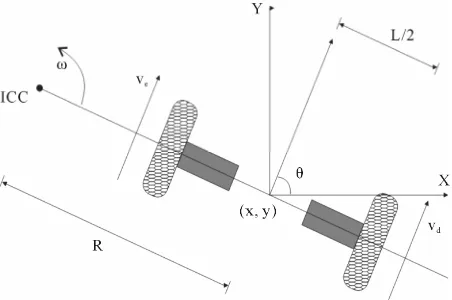
x y,directed for a position throughout a line making an angle theta with x axis, as illustrated in the Figure 2.
[image:2.595.311.537.87.237.2]Through the manipulation the control parameters ve and vd, the robot can be lead at different positionings. The determination of the possible positionings to be reached, once given the control parameters, is known as direct kinematics problem for the robot. As illustrated in the Figure 2, in which the robot is located in position
x y, ,
, we have for the trigonometrical relations of the system,
sin , cos ,
ICCx R y R (1) where ICC is the robot instantaneous curvature center.
As ve and vd are time functions and if the robot is in the pose
x y, ,
in the time t, and if the left and right wheel has ground contact speed ve and vd respectively, [image:2.595.318.539.307.402.2]Figure 1. Illustrative mobile robot platform and elements.
Figure 2. Direct kinematics for differential traction in mo- bile robots.
then, in the time t t t the position of the robot is given by
cos sin 0
sin cos 0
0 0 1
x
y
x
y
x t t x ICC
y t t y ICC
ICC ICC (2)
The Equation (2) describes the motion of a robot ro- tating a distance R about its ICC with an angular velocity given by ω [2]. Different classes of robots will provide different expressions for R and ω [5].
The forward kinematics problem is solved by integrat- ing Equation (2) from some initial condition
x y0, ,0 0
,it is possible to compute where the robot will be at any time t based on the control parameters v te
and
dv t . For the special case of a differential drive vehicle, it is given by Equation (3).
0 0 01 cos d ,
2 1
sin d ,
2 1 d . t d e t d e t d e
x t v t v t t t
y t v t v t t t
v t v t t L
(3) [image:2.595.60.289.598.717.2]
sin ,
2
cos ,
2 2
, d e
d e d e
d e d e
d e
d e d e
d e v v
L t
x t v v
v v L
v v v v
L t L
y t v v
v v L v v
t v v L
(4)
where
x y, ,
t0
0,0,0
. Given a goal time t and goal position
x y, . The Equation (4) solves for vd and vebut does not provide a solution for independent control of θ. There are, in fact, infinity solutions for vd and ve from Equation (4), but all correspond to the robot mov- ing about the same circle that passes through (0, 0) at t = 0 and
x y, at t = t; however, the robot goes around the circle different numbers of times and in different direc- tions.3. The Control Architecture System
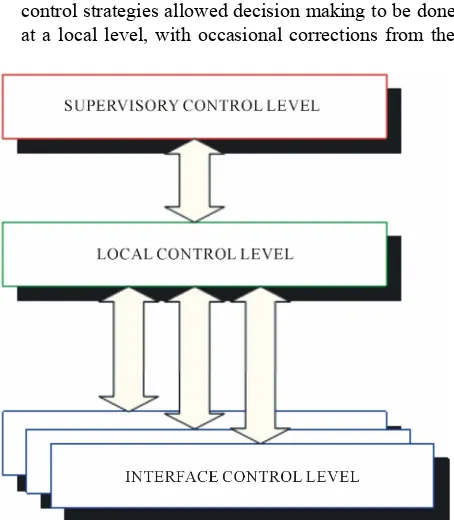
The control architecture system can be visualized at a logical level in the blocks diagram in Figure 3.
The system was divided into three control levels, or- ganized in the form of different degrees of control strate- gies. The levels can be described as:
Supervisory control level: This represents a high level of control. In this level it was possible to carry out the supervision of one or more mobile robots, through the execution of global control strategies.
Local onboard control level: In this level control was processed by the mobile robot embedded soft- ware implemented in a multicore DSP processor. The control strategies allowed decision making to be done at a local level, with occasional corrections from the
Figure 3. Illustrative mobile robot platform and elements.
supervisory control level. Without communication with the supervisory control level, the mobile robot just carried out actions based on obtained sensor data and on information previously stored in its memory.
[image:3.595.308.538.389.720.2] Interface control level: This was restricted to strate- gies of control associated with the interfaces of the sensor and actuators. The strategies in this level were implemented in hardware, through FPGA (Field- Programmable Gate Array) device.
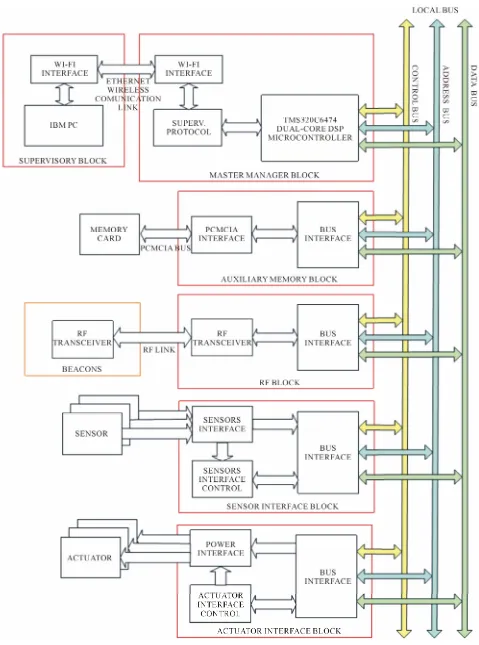
Figure 4 depicts the control architecture with more details, with the levels controls implemented on the mo- bile robot platform.
Architecture, from the point of view of the mobile ro- bot, was organized into several independent blocks, con- nected through the local bus that is composed by data, address and control bus (Figure 5). A master block man- ager operates several slave blocks. Blocks associated with the interfaces of sensors and actuators, communica- tion and auxiliary memories were subjected to direct control from the block manager. The advantage of using a common bus was the facility to expand the system. Inside the limitations of resources, it was possible to add new blocks, allowing an adapted configuration of the robot for each task.
[image:3.595.60.287.459.719.2]Control Architecture Blocks Description
Supervisory control block: It’s the high level of control. In this block is managed the supervision of one or more mobile robots, through the execution of global control strategies. Is implemented in an IBM PC platform and is connected with the local control level, in the mobile ro- bot, through Ethernet wireless WI-FI link. This protocol uses IEEE 802.11a standard for wireless TCP/IP LAN communication. It guarantees up to 11 Mbps in the 2.4 GHz band and requires fewer access points for coverage of large areas. Offers high-speed access to data at up to 100 meters from base station. 14 channels available in the 2.4 GHz band guarantee the expansibility of the sys- tem with the implementation of control strategies of mul- tiple robots.
Master manager block: It’s responsible for the treat- ment of all the information received from other blocks, for the generation of the trajectory profile for the local control blocks and for the communication with the ex- ternal world. In communication with the master manager block, through a serial interface, a commercial platform was used, which implemented external communication using an Ethernet WI-FI wireless protocol. The robot was seen as a TCP/IP LAN point in a communication net, al- lowing remote supervision through supervisory level. It’s implemented with Texas Instrument TMS320C6474 multi- core digital signal processor, a 1.2 GHz device delivering up to 10,000 million instructions per second (MIPs) with highest performing.
Sensor interface block: Is responsible for the sensor acquisition and for the treatment of this information in digital words, to be sent to the master manager block. The implementation of that interface through FPGA al- lowed the integration of information from sensors (sensor fusion) locally, reducing manager block demand for processing. In same way, they allowed new programming of sensor hardware during robot operation, increasing sensor treatment flexibility.
Actuator interface block: This block carried out speed control or position control of the motors responsi- ble for the traction of the mobile robot. The reference signals were supplied through bus communication in the form of digital words. Derived information from the sensor was also used in the controller implemented in FPGA. Due to integration capacity of enormous hard- ware volume, FPGA was appropriate to implement state machines, reducing the need for block manager process- ing. Besides the advantage of the integration of the hardware resources, FPGA facilitated the implementation and debugging. The possibility of modifying FPGA pro- gramming allowed, for example, changes in control strategies of the actuators, adapting them to the required tasks.
Auxiliary memory block: This stored the information of the sensor, and operated as a library for possible con- trol strategies of sensors and actuators. Apart from this, it came with an option for operation registration, allowing a register of errors. The best option was an interface PCMCIA, because this interface is easily accessible on the market, and being a well adapted for applications in mobile robots, due to low consumption, little weight, small dimensions, high storage capacity and good immu- nity to mechanical vibrations.
RF beacons communication block: It allowed the es- tablishment of a bi-directional radio link for beacons data communication. The objective, at the first moment, is establish communication with all beacons in the envi- ronment, not at same time, but one by one, recognizing the number of active beacons and their respective codes. At second moment, this RF communication block sends a determinate code and receive back the same code, trans- mitted from respective beacon. The RF ToF is calculated by DSP processor. To implement this block was used a low power UHF data transceiver module BiM-433-40.
[image:5.595.311.535.487.705.2]4. Trajectory Embedded Control
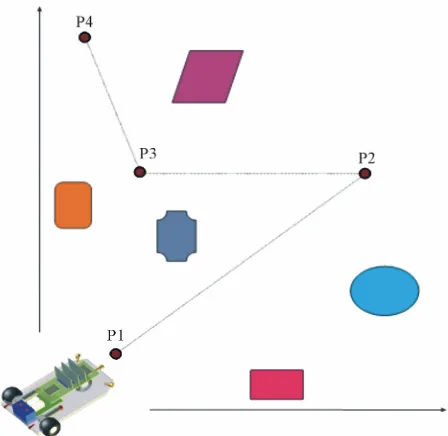
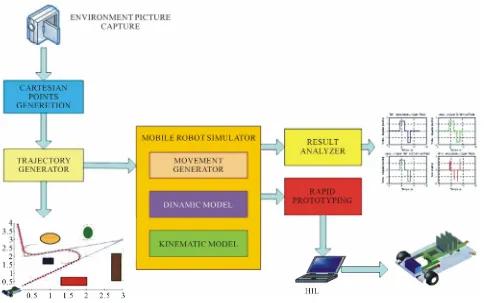
Figure 6 illustrates an example of an environment with some obstacles where the robot must navigate. In this environment, the robot is located initially in the P1 point and the objective is to reach the P4 point. The supervi- sory generating system of initial Cartesian points, must then supply to the module of embedded trajectory gen- eration, the Cartesian points P1, P2, P3 and P4, which are the main points of the traced route. Figure 7 presents a general vision of the trajectory generator system.
Figure 6. Example of an environment with some obstacles where the robot must navigate.
Figure 7. General vision of the trajectory generator system.
The use of the system begins with the capitation of main points for generation of the mobile robot trajectory. The idea is to use a system of photographic video camera that catches the image of the environment where the mo- bile robot will navigate. This initial system must be ca- pable to identify the obstacles of the environment and to generate a matrix with some strategically points that will serve of input for the system of embedded trajectory generation [7]. The mobile robot embedded control sys- tem receives initially, through the supervisory system, a trajectory to be executed. These data are loaded in the robot memory that is sent to the module of trajectory generation. At a time the robot starts to execute the tra- jectory, the dynamic data are returned to the embedded controller, who, with the measurements and sensing, makes the comparisons and due corrections in the trajec- tory.
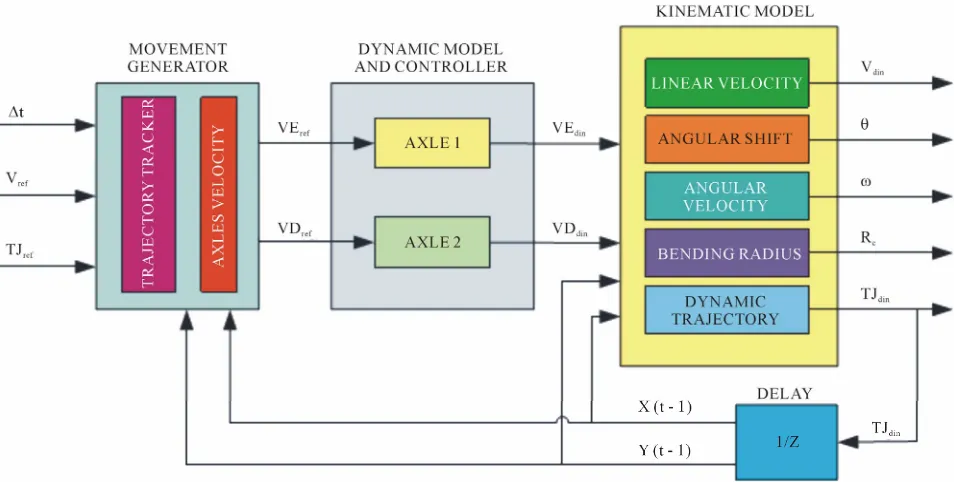
The trajectory embedded control system of the mobile robot is formed by three main blocks. The first one is called movements generation block.
The second is the block of the controller and dynamic model of the mobile robot. Third is the block of the ki- nematic model. Figure 8 illustrates the mobile robot con- trol strategy implemented into Matlab Simulink blocks and then loaded in the embedded memory of the DSP processor by HIL (hardware-in-the-loop) technique.
The mobile robot embedded control is implemented
with kinematic model presented at Section 2, the dyna- mic model for axles control and the movement generator modules. Figure 9 illustrates the blocks diagram repre- senting those modules.
The input system variables are:
∆t is the period between one pose point and another.
TJref, is the reference trajectory matrix given by su- pervisory control block with all the trajectory dots pose coordinates
x y, ,
. Vref, is the robot linear velocity dynamics informed by supervisory control block so that robot can accom- plish one particular trajectory.
The embedded system output variables are:
TJdin, that is the robot dynamic trajectory matrix, given in Cartesian coordinate format.
Vdin, is the dynamic linear velocity of the robot. Rc, is the mobile robot ICC.
θ, is the orientation angle.
ω, is the angular velocity vector.
5. Position Estimation with RF Signal ToF
Figure 8. Mobile robot control strategy implemented into Matlab Simulink.
[image:7.595.60.537.479.720.2]
embedded control system, located in the mobile robot, and the beacons, that are located in strategically points in the environment, are composed of a frame formed for five quaternary codes.
5.1. Communication Protocol
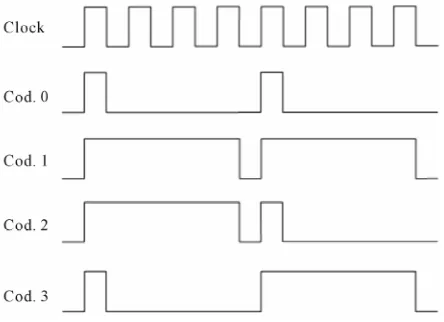
The timing diagram shown in the Figure 10 illustrates as each one of the codes in function of clock signal is formed.
Each half clock period correspond to a time about 896 µs. Each code has a time period composed of 8 clocks cycles, that is 14.336 ms. Table 1 AC depicts in a logic way the formation of the codes.
[image:8.595.62.284.333.494.2]Each code is configured by a logic signals sequence, each one with a determined period. Table 2 shows how each logic signal of each code is composed. The idea is to mount a quaternary codifier using binary logic levels, associates in such way that the logic levels alternate and the total period of each code is the same.
[image:8.595.58.286.534.621.2]Figure 10. Communication protocol codes.
Table 1. Logic formation of each code.
Code Logic sequency
C0 AC + BL + AC + BL C1 AL + BC + AL + BC C2 AL + BC + AC + BL C3 AC + BL + AL + BC Table 2. The timing of the logic codes.
Logic signal Meaning Duration Time
AC Logic “1” short duration 0.5 clock 0.896 ms AL Logic “1” long duration 3.5 clock 6.272 ms BC Logic “0” short duration 0.5 clock 0.896 ms BL Logic “0” long duration 3.5 clock 6.272 ms
The codification implemented was conceived here aiming the minimizing of the errors, such as the trans- mission of the one exactly signal level is transmitted without transitions of level for long time periods. In this case, the receiver tends to put out of the way and to per- form the reading out the correct point, originating errors. In this way, RF transmission of the codes is sufficiently robust and trustworthy, practically extinguishing errors of signal decoding signal inside the area of system range. 5.2. The Communication Frame
The communication frames used between the mobile robot and the beacons are composed for five quaternary codes. The Figure 11 illustrates an example of a com- munication protocol frame. As each code has a period about 14.336 ms, the all frame has transmission time about 71.68 ms.
The maximum number of possible combination is given by
5
4 1024.
e
N
Each beacon has its own address, composed by five codes. In this way, the system is able to deal with up to 1024 beacons, with their own individual address. 5.3. The RF Link
The coded signal is transmitted in RF modulated by BASK-OOK technique. The carrier signal frequency is about 433.92 MHz (UHF band). The RF link uses a half- duplex channel between mobile robot and beacons. The mobile robot control system is previously programmed with quantity and address of each beacon. Figure 12 depicts an example of environment configuration of the communication between the robot and beacons.
5.4. Beacon Transceiver System
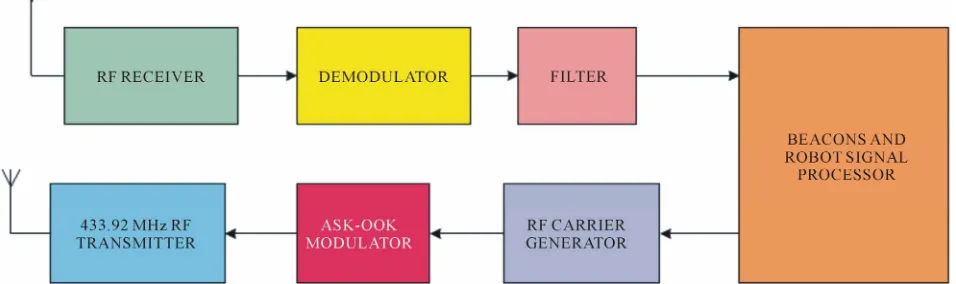
The beacon embedded system is composed basically by two modules. One is responsible for RF signal receive and make all the concerned computation. This module has a 16F630 PIC microcontroller, operating at 4 MHz clock frequency. The other one is the RF signal transmit- ter. This module is equipped with 12F635 microcontrol- ler and also operates at 4 MHz. The system is able to operate in autonomous way, been programmed with spe- cific address. In other hand, the mobile robot must be programmed with de amount and the address of all op- erative beacons inside the navigating environment. Fig- ure 13 depicts the block diagram of the RF transceiver at mobile robot and at beacons.
[image:8.595.57.286.651.735.2]C2 C0 C1 C3 C0
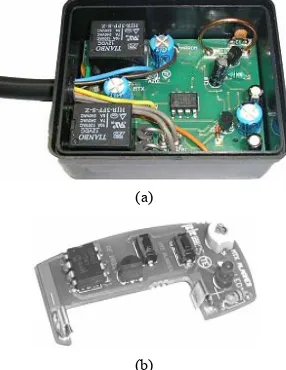
Figure 14 shows the beacons RF transceiver modules. The transmission module (Figure 14(b)) is able to func- tion in asynchronous independent way, emitting an ad- dress code frame in a certain period of predetermined time, or synchronous way commanded by the reception and control module (Figure 14(a)). In the first case, a battery 12V A23 model is used which allows autonomy of more than 3 months of continuous use, due to ultra low power energy consumption given by the embedded microcontroller with nanowatt technology. In second case the power supply and transmission command are made by the reception control module, illustrated in the Figure 14(a). This second one is the mode utilized by this work.
As much the mobile robot, as each one of the beacons, has a transceiver control system com-posed by reception module and transmission module. As the objective of our system is to provide a triangulation between the mobile robot position and the beacons, the transmission modules work in synchronous way. It is assumed that the module of control of reception-transmission of the mobile robot has been previously loaded with the amount of existing beacons in the environment and with its respective ad- dresses codes. The functioning of the system goes to the following procedure:
1) The mobile robot emits a address code-frame for first beacon. In this instant it sends an interrupt control signal to the central processing unit for triggering and starts a timer counter. The robot then, waits the return of the signal. This return must occur in up to 100 ms.
2) If the signal returns, means that the beacon recog- nized the code and sent back the same code. In this in- stant is sent a signal to the robot embedded central proc- essing unit for stops the timer and calculation of the sig- nal return delay time, which could be about ns.
3) If the signal was not returned, means that the bea- con is out of area reach or occurred some error in signal transmission-reception.
4) Increment the number of beacon and go to the loop
first item.
The distance between the robot and a certain m beacon is computed with base of the delay time in the reception of the same transmitted code. The total elapsed time be- tween the code final transmission, sent by the robot, and the reception of the same code, sent back to the beacon, can be calculated by
, is pm rs q pr
T t t t t t (6) where tis is the travel signal time between leaves robot transmitter and reach beacon reception, tpm is the proc- essing signal time by the beacon, trs is the signal return elapse time, tq is the frame code period and tpris the processing time of the sent back signal received by robot.
[image:9.595.310.537.350.525.2]It’s well known that RF signal cover one meter in about 3.3 ns because its velocity is about 0.3 m/ns in air. We can consider that the linear speed of the robot is so small that the displacement of the robot could be consid- ering as being zero during the time T. In this way, the distance in meters between the mobile robot and the beacon m can be given by
[image:9.595.60.538.576.718.2]Figure 12. An example of environment beacons arrange- ment and the communication system.
0.3
, 2 is rs m
t t
d (7) where tis and trs are given in ns. The elapsed time T is computed with a 64 bits timer of the Texas Instrument TMS320C6474-1200 dual core robot embedded proces- sor. The instruction cycle time of it is about 0.83 ns (1.2 GHz clock Device), allowing timer calculations in order of ns, essential for our case of study. The times tpm and tpr are determined empirically and tq = 71.68 ms. In this way, the covered distance between the robot and beacon m should be done by
0.3
. 2
pm rm q m
T t t t
d (8) The Algorithm 1 depicts the computation method for distance d calculation using RF ToF.
6. Triangulation
Triangulation refers to the solution of constraint equa- tions relating the pose of an observer to the positions of a set of landmarks. Pose estimation using triangulation methods from known landmarks has been practiced since ancient times and was exploited by the ancient Romans in mapping and road construction during the Roman Em- pire. The simplest and most familiar case that gives the technique its name is that of using bearings or distance measurements to two (or more) landmarks to solve a planar positioning task, thus solving for the parameters of a triangle given a combination of sides and angles. This type of position estimation method has its roots in antiq- uity in the context of architecture and cartography and is important today in several domains such as survey sci- ence.
Although a triangular geometry is not the only possi- ble configuration for using landmarks or beacons, it is
the most natural [2]. Although landmarks, beacons and robots exist in a three-dimensional world, the limited accuracy associated with height information often results in a two-dimensional problem in practice; elevation in- formation is sometimes used to validate the results. Thus, although the triangulation problem for a point robot should be considered as a problem with six unknown parameters (three position variables and three orientation variables), more commonly the task is posed as a two- dimensional (or three-dimensional) problem with two- dimensional (or three-dimensional) landmarks [8].
Depending on the combinations of sides (S) and angles (A) given, the triangulation problem is described as “side-angle-side” (SAS), and so forth. All cases permit a solution except for the AAA case in which the scale of the triangle is not constrained by the parameters. In prac- tice, a given sensing technology often returns either an
(a)
[image:10.595.351.494.305.490.2](b)
angular measurement or a distance measurement, and the landmark positions are typically known. Thus, the SAA and SSS cases are the most commonly encountered. More generally, the problem can involve some combina- tion of algebraic constraints that relate the measurements to the pose parameters. These are typically nonlinear, and hence a solution may be dependent on an initial position estimate or constraint [9]. This can be formulated as
1, 2, , n
,x F m m m (9) where the vector x expresses the pose variables to be estimated (normally, for 2D cases
x y
), and1, 2, , n
m m m
m is the vector of measurements to be used. In the specific case of estimating the position of an oriented robot in the plane, this becomes
1 1 2 2 1 2 3 1 2
, , , , , , , , , n n n
x F m m m
y F m m m
F m m m
(10)
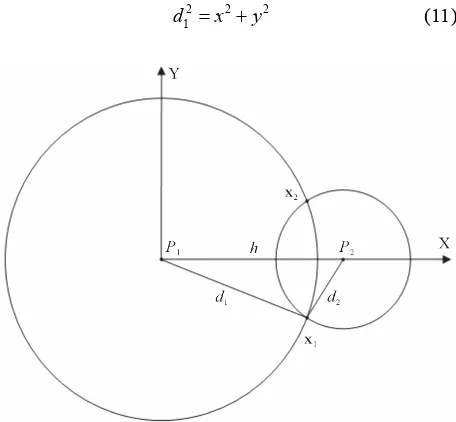
If only the distance to a landmark is available, a single measurement constrains the robot’s position to the arc of a circle. Figure 15 illustrates perhaps the simple’s train- gulation case.
A robot at an unknown location x1 senses two beacons P1 and P2 by measuring the distances d1 and d2 to them. This corresponds to our case of study in which active beacons at known locations emit a signal and the robot obtains distances based on the time delay to arrive at the robot. The robot must lie at the intersection of the circle of radius d1 with center at P1, and with the circle or ra- dius d2 with center at P2. Without loss of generality we can assume that P1 is at the origin and that P2 is at
h,0 . Then we have2 2 2
1
[image:11.595.59.287.497.708.2]d x y (11)
Figure 15. Simple triangulation example. A robot at an un- known location x1.
and
22 2
2 .
d h x y (12) A small amount of algebra results in
2 2 2 1 2 2
h d d
x
h
(13)
and
2
2 2 2
2 2 2 1 2
1 1 ,
2
h d d
y d x d
h
(14)
resulting in two solutions x1 and x2.
In a typical application, beacons are located on walls, and thus the spurious (in our example, the x2) solution can be identified because it corresponds to the robot’s being located on the wrong side of (inside) the wall. Al- though distances to beacons provide a simple example of triangulation, most sensors and land-marks result in more complex situations [10]. The situation for two beacons is illustrated in Figure 16(a). The robot senses two known beacons and measures the bearing to each beacon relative to its own straight ahead direction. This obtains the dif- ference is gearing between the directions to the two bea- cons and constrains the true position of the robot to lie on that portion of the circle shown in Figure 16(a). We can note that the mathematics admits two circular arcs, but one can be excluded based on the left-right ordering of the beacon directions [11]. The loci of points that satisfy the bearing difference is given by
2 2
1 1 2 2 1 2cos
h d d d d (15) where d1 and d2 are the distances from the robot’s current position x to beacons P1 and P2, respectively. The visibil- ity of a third beacon, like can be seen at Figure 16(b), gives rise to three nonlinear constraints on d1, d2 and d3: by
2 2
1 1 2 1 2
2 2
2 1 3 1 3
2 2
3 2 3 2 3
2 cos
2 cos
2 cos
h d d d d h d d d d h d d d d
(16)
which can be solved using standard techniques to obtain d1, d2 and d3. Knowledge of d1, d2 and d3 leads to the robot’s position [1].
(a)
[image:12.595.93.251.86.421.2](b)
Figure 16. Location estimative of the mobile robot based on beacons triangulation. (a) Triangulation with two beacons; (b) Triangulation with three beacons.
point away from the line joining the beacons (e.g., a point that forms an equilateral triangle with respect to the external beacons). On the other hand, if the robot is lo- cated on the line joining the beacons, the position can only be constrained to lie somewhere on this (infinite) line.
6.1. Triangulation with RF Beacons
In our case of study the beacon’s position at 2D envi- ronment are known and thus, the distances between the beacons. If the N beacons are positioned at points
x ys1, s1
, xs2,ys2
, ,
xsN,ysN
and the robot’s posi-tion is given by x
x y, , then, the Equation (16), that express the robot triangulation with three beacons, yields
2 2
2
1 1 1
2 2
2
2 2 2
2 2
2
3 3 3
s s
s s
s s
d y y x x d y y x x d y y x x
(17)
where the robot’s position x
x y, can be inferred by numerical methods.6.2. Some Triangulation Results
It’s our choice to make triangulation using a set of tree active environment beacons at a time. In this way, the embedded robot control computes distances d1, d2, d3 from beacons b1, b2, b3 respectively. When those meas- urements are done, it calculates the robot position esti- mative, based in Equations (16) and (17). Then, it takes next tree actives beacons, such as b2, b3, b4 with their respective robot distances, for next triangulation. The triangulation keeps in loop reaching last beacon, return to first one and go on.
We noted that, when mobile robot positions was taken in this way, and when the robot get so close form some beacon, at least less then tree meters, the position estima- tive get corrupt by this near beacon.
That’s because timer counter becomes imprecise for the short distance that results some ns of ToF. Figure 17 depicts a robot trajectory inside a indoor 20 × 21 m en- vironment that triangulation calculus was taken in period of 10 s each one. It does madden in this way, for better robot position estimative visualization.
In the way to fix the robot position estimative when it’s at some beacon nearly, the embedded control simply discards distance measurement from beacons that are less than four meters from robot. That’s why it’s important more than four beacons at indoor environment and best arrangement of them, taking into account obstacles and environment own particularities. Figure 18 illustrates the robot position estimative when this methodology is ap- plied. We can note here that position estimative is now more consistent.
7. Data Fusion
The question of how to combine data of different sources generates a great quantity of research in the academics
[image:12.595.309.538.530.705.2]ambient and at the research laboratories. In the context of the mobile robotic systems, the data fusing must be af- fected in at least three distinct fields: arranging meas- urements of different sensors, different positions, and different times.
Here is presented the data fusion methodology that uses Kalman Filter to combine sensors measurements and beacons distance triangulation to have best next pose estimation and correct actual robot localization.
Kalman Filter
To control a mobile robot, frequently it is necessary to combine information of multiple sources. The informa- tion that comes from trustworthy sources must have greater importance about those one collected by less trustworthy sensors.
A general way to compute the sources that are more or less trustworthy and which weights must be given to the data of each source, making a weighed pounder addition of the measurements, are known with Kalman Filter [12]. It is one of the methods more widely used for sensorial fusing in mobile robotics applications [13]. This filter is frequently used to combine data gotten from different sensors in a statistical optimal estimate. If a system can be described with a linear model and the uncertainties of the sensors and the system can be modeled as white Gaussian noises, then the Kalman Filter gives an optimal estimate statistical for the casting data. This means that, under certain conditions, the Kalman Filter is able to find the best estimative based on correction of each individual measure [14]. Figure 19 depicts the particular schematic
for Kalman Filter localization [15].
The Kalman Filter consists of the stages follow pre- sented in each time step, except for the initial step. It is assumed, for model simplification, that the state transi- tion matrix and the observation function E remain constant in function of the time. Using the plant model and computing a system state estimate in the time
k1
based in robot position knowledge in the instant of time k, is had how the system evolves in the time with the input control u
k :
ˆ 1 ˆ .
[image:13.595.310.537.207.430.2]x k x k K k (18)
Figure 18. Robot position estimative by triangulation with best beacons position.
[image:13.595.59.540.473.718.2]In some practical equations the input u
k is not used. It can also, to actualize the state certainty as ex- pressed for the state covariance matrix P
through the displacement in the time, as:
1
T
.P k k P k Q k (19) Equation (19) expresses the way which the system state knowledge gradually decays with passing of the time, in the absence of external corrections. The Kalman gain can be express as
1
1
T 1
1 ,
E i
K k P k R k (20) but, how it didn’t compute P k
1
, this can be com- puted by
T
T
11
1 E E 1 E i 1 ,
K k
P k k P k k R k
(21)
Using this matrix, an estimate of revised state can be calculated that includes the additional information gotten by the measurement. This involves the comparison of the current sensors data z k
1
with the data of the fore- seen sensors using it state estimate. The difference be- tween the two terms:
1
1
st
ˆ( 1
, t
r k z k h x k k p (22) or, at the linear case
1
1
Eˆ
1
r k z k x k k (23) is related as the innovation. If the state estimate is perfect, the innovation must be not zero only which the sensor noise. Then, the state estimate actualized is given by
ˆ 1 ˆ 1 1 1 ,
x k x k k K k r k (22) and, the up-to-date state covariance matrix is given by
1
1
E
1
,P k I K k P k k (23) where I is the identity matrix.
8. Experimental Results
Here is presented some experimental results of the pro- posed system. A mobile robot prototype showed in Fig- ure 20 was used as a platform for implementation the hardware and the software above described.
We can see at Figure 21 the result of EKF pose esti- mative applied in the robot’s trajectory that have train- gulation measurements marked by yellow crosses. In this experimental result we allocate four beacons, one in each corner, about two meters high. In the middle of the room, there was a camera for registering the true robot’s trajec- tory in the way to comparison.
[image:14.595.310.537.86.260.2]The ellipses delimit the area of uncertainty in the esti-
[image:14.595.310.536.287.489.2]Figure 20. Experimental mobile robot prototype.
Figure 21. The result of EKF pose estimative applied at irregular curvilinear trajectory.
mates. It can be observed that these ellipses are bigger in the trajectory curves extremities, because in these points the calculus of position by triangulation get some loses.
The average quadratic error varies depending on the chosen trajectory. It can be noticed that the pose estima- tive improves for more linear trajectories and with high frequency of on-board RF beacons triangulation meas- urements.
Figure 22. Robot navigation in multiple rooms environment.
compromise the well function of all control embedded system.
9. Conclusions
The use of ToF of the RF signal interacting with RF beacons for computational triangulation in the way to provide a pose estimative at bi-dimensional indoor envi- ronment was validated, with those first experimentation works. Even though we are collecting the first positive results in this way, they are encouraging us to keep re- searching and improving the system in this direction. This is a relativity cheap implementation system that provides grates results for mobile robot indoor navigation, where GPS system is out of range. In this way, this work brings an important alternative for traditional ultrasonic navigation technology, with low cost implementation RF digital transceiver beacon system. These are now possi- ble because of high performance robot embedded multi- core DSP processors to calculate ToF of the order about ns.
Sensors data like odometry, compass and the result of triangulation Cartesian estimative, was fused in a Kal- man filter in the way to perform optimal estimation and correct robot pose. Once given the nonlinearity of the system in question, the use of the EKF became necessary. It does not have therefore, at beginning, theoretical guarantees of optimality nor of convergence of this method. Therefore, it was implemented a kinematic and dynamic model at embedded control system that allows, underneath of next conditions of the reality, to verify the performance of this technique. Among others parameters
that were looked to realistic model the increasing error in the measure of the position of a beacon to the measure meets that in the distance between the robot and it in- creases. This effect also was introduced in the estimate of the observation covariance matrix to allow a more co- herent performance of the filter. A factor extremely im- portant is the characterization of the covariance’s matri- ces of the present’s signals in the system.
The results of the simulations associated with experi- mental validations confirm that this technique is valid and promising so that the mobile robots, in autonomous way, can be able to correct its own trajectory. The con- sistency of the data fusing relative to the odometry and compass sensing of the mobile robot and the result of RF beacons triangulation is obtained even after inserted dis- turbances in the system. The presented method does not make an instantaneous absolute localization, but succes- sive measurements show that the estimative state con- verges for the real state of the robot.
REFERENCES
[1] M. Thielscher, “Reasoning Robots, the Art and Science of Programming Robotic Agents,” Springer, Netherlands, 2005.
[2] G. Dudek and M. Jenkin, “Computational Principles of Mobile Robotics,” Press Syndicate of the University of Cambridge, Cambridge, 2000.
[4] C.-F. Juang and Y.-C. Chang, “Evolutionary-Group- Based Particle-Swarm-Optimized Fuzzy Controller with Application to Mobile-Robot Navigation in Unknown En- vironments,” IEEE Transactions on Fuzzy Systems, Vol. 19, No. 2, 2011, pp. 379-392.
[5] H.-S. Shim, J.-H. Kim and K. Koh, “Variable Structure Control of Nonholonomic Wheeled Mobile Robot,” IEEE International Conference on Robotics and Automation, Vol. 2, 1995, pp. 1694-1699.
[6] Y. L. Zhao and S. L. BeMent, “Kinematics, Dynamics and Control of Wheeled Mobile Robots,” IEEE Interna- tional Conference on Robotics and Automation, Vol. 1, May 1992, pp. 91-96.
[7] N. MacMillan, R. Allen, D. Marinakis and S. Whitesides, “Range-Based Navigation System for a Mobile Robot,”
Conference on Computer and Robot Vision (CRV), 2011, pp. 16-23.
[8] H. Gonzalez-Banos and J.-C. Latombe, “Robot Naviga- tion for Automatic Model Construction Using Safe Re- gions,” Experimental Robotics VII, Lecture Notes in Con- trol and Information Sciences, Vol. 271, 2001, pp. 405-
[9] M. Kam, X. X. Zhu and P. Kalata, “Sensor Fusion for Mobile Robot Navigation,” Proceedings of the IEEE, Vol. 85, No. 1, 1997, pp. 108-119.
[10] A. N. Tikhonov and V. Y. Arsenin, “Solutions of Ill-Posed Problems,” Wiston, Washington DC, 1977.
[11] M. Thielscher, “Reasoning Robots. The Art and Science of Programming Robotic Agents,” Springer, Netherlands, 2005.
[12] R. E. Kalman, “A New Approach to Linear Filtering and Prediction Problems,” Journal of Basic Engineering, Vol. 82, No. 1, 1960, pp. 35-45 [13] J. J. Leonard and H. F. Durrant-Whyte, “Mobile Robot
Localization by Tracking Geometric Beacons,” IEEE Transactions on Robotics and Automation, Vol. 7, No. 3,
1991, pp. 376-382.
[14] G. Dudek, M. Jenkin, E. Milios and D. Wilkes, “Reflec- tions on Modelling a Sonar Range Sensor,” 1996. [15] R. Siegwart and I. R. Nourbakhsh, “Introduction to Auto-