
Spatiotemporal Cattle Data—A Plea for Protocol
Standardization
Dean M. Anderson
1*, Rick E. Estell
1, Andres F. Cibils
21United States Department of Agriculture, Agricultural Research Service, Las Cruces, USA; 2Department of Animal and Range
Sci-ences, New Mexico State University, Las Cruces, USA. Email: *[email protected]
Received December 11th, 2012; revised January 15th, 2013; accepted January 24th, 2013
ABSTRACT
It was not until the end of the 1990’s that animal born satellite receivers catapulted range cattle ecology into the 21st
century world of microchip technology with all of its opportunities and challenges. With the global navigation satellite
system (GNSS), insight about how cattle use a landscape is being revealed from previously unknown temporal and spa-
tial behaviors. The most common system to date for studying ungulate movement is the global positioning system
(GPS). With its use has come a clarity and completeness in documenting spatial and temporal data in new and exciting
ways that offer almost unlimited possibilities to better understand and manage economic and societal returns from ani-
mal dominated landscapes. However, its use on free-ranging cattle is not without challenges, some of which are yet to
be optimally solved. To maximize the usefulness of GNSS data, consideration must be given to: 1) developing a stan-
dardized protocol for reporting and analyzing research that facilitates interpretation of results across different ecosys-
tems; 2) develop optimum ranges over which to collect satellite fixes depending upon the particular behaviors of inter-
est; and 3) concurrently develop electronic hardware and equipment platforms that are easily deployed on animals and
that are light, robust, and can be worn by cattle for extended periods of time without human intervention (e.g., changing
batteries). Once data are collected, appropriate geographic information system (GIS) based models should be used to
produce a series of products that can be used to implement flexible management strategies, some of which may support
methodologies that are yet to be commercialized and adopted into future plant-animal interface management routines.
Keywords:
Cattle Behavior; Animal Tracking; GPS
1. Introduction
Free-ranging animal behavior is challenging to study and
manage in light of the more than 68 factors that have
been shown to influence it [1]. Obtaining both accurate
and precise cattle behavior data is essential to understand
and subsequently manage free-ranging animals. Of the
40 different behaviors cattle can engage in [2], 95% of
them can be classified into one of four main activities:
foraging, walking, standing, or lying [3]. Foraging is
probably of greatest interest to most land stewards be-
cause of the impact it has on animal dominated land-
scapes, especially when these landscapes are required to
supply goods and services beyond providing adequate
nutrition for free-ranging animals. Therefore, studying
animal-to-animal variability is basic to understanding
free-ranging animal behavior [4].
The official study of animal behavior did not become
part of agricultural college curricula until the late 1950’s
[5]; however, the importance of behavior was recognized
in husbandry texts dating back to the 1800’s [6]. Focused
livestock behavior research in the USA began in the
1920’s. Early studies such as those of Sheppard [7] and
Cory [8] relied entirely on eyesight and hand written re-
cordings to document the behaviors observed. Thereafter,
sight and stop-watches remained the sole tools for docu-
menting free-ranging animal behavior for many years [9].
Today observation still remains a powerful and useful
tool for documenting free-ranging animal behavior [10-
16]; however, it has limitations especially during periods
of darkness [3] and following extended periods of con-
tinuous observation when fatigue can accentuate ob-
server bias [17]. Furthermore, the mere presence of an
observer can impact both wildlife [18] and domestic
animal [19,20] behaviors. The question then becomes
“how is the observer influencing the observation?” The
answer to this question is not trivial and frequently is not
provided by researchers who do not describe protocols to
minimize its potential bias in behavioral studies [21].
an observer and the animal being observed. Observing
from parked vehicles [22], horseback [23] or platforms
positioned above the ground [24] have been used.
Though sampling methods exist for observational data
[25], there is as yet no tool available that can overcome
human inefficiency when multitasking [26], a prerequi-
site for observing and recording data from more than one
animal at a time.
Furthermore, to overcome human sight limitations,
binoculars [27] as well as night vision technologies [28,
29], video recordings [30] and even lasers [31] have been
employed. As early as the 1950’s, electronics were used
to track wildlife [32]. Because of their lead, wildlife re-
searchers established many of the guidelines used through-
out the 20th century for tracking domestic animals. One
of the earliest attempts to augment observations of cattle
behavior with electronics was a biotelemetry system de-
veloped by Australian researchers in the 1970’s [33]. For
a complete discussion of electronics in wildlife tracking
the reader is directed to texts by Kenward [34] and Mill-
spaugh and Marzluff [35]. Currently no textbooks exist
to assist range-animal ecologists in developing protocols
for monitoring free-ranging livestock using 21st century
technologies. This review traces the application of the
global navigation satellite system (GNSS) [36,37] for
tracking free-ranging cattle with a focus on its
imple-mentation and the challenges range animal scientists face
when deploying GNSS to study free-ranging cattle be-
haviors.
2. A Satellite Based Technology
The GNSS can be traced back to 1966 as described in the
Woodford/Nakamura Report [38,39]. Of the several sat-
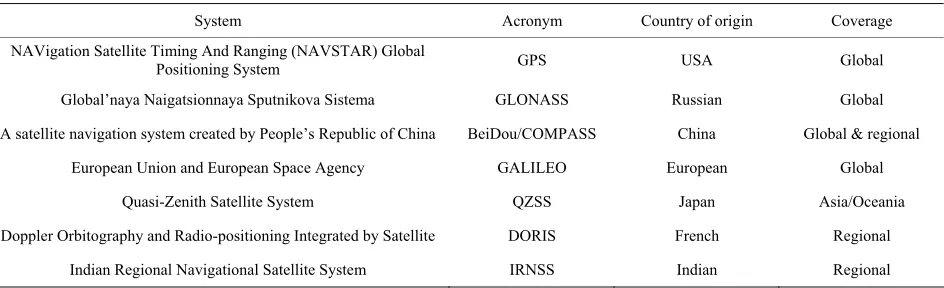
ellite-based systems being used or developed today [40,
41]; (see
Table 1
) the most familiar tracking system is
the NAVigation Satellite Timing And Ranging (NAVS-
TAR) System [42] commonly referred to as the global
positioning system (GPS) [43].
Contrary to some versions of GPS, this utility was de-
veloped initially for both military and civilian users [37].
The technology is robust with respect to electric trans-
mission lines [44] yet GPS signals are very weak at the
surface of the earth making them susceptible to interfer-
ence and jamming [45] as well as potentially being vul-
nerable to spoofing [46].
Research using GPS-based telemetry systems for
tracking animals began in 1991 [47]. Six years later,
cows were monitored for the first time using this tech-
nology [48]. Since 1997, at least 99 studies have been
reported in which GNSS devices have been used to
monitor free-ranging cattle behavior (
Table 2
). Being
able to characterize animal behavior data within a spatial
as well as a temporal context with respect to peers and
the landscape is a major benefit provided by GNSS data
[16,49]. In addition to monitoring spatial and temporal
information, GNSS technology has been combined with
other electronics to monitor free-ranging animal health
[50] and numerous other behaviors associated with for-
aging and moving [51]. Most studies employing GNSS
have attached the devices directly to the free-ranging
animal; however, cows can be successfully tracked by a
person moving with cattle that carries a GPS unit [52-
54].
3. GNSS Devices
Applying GNSS technology to free-ranging animals is
expensive and remains a major challenge when designing
studies to track free-ranging cattle [56]. A sheep was the
first domestic ruminant on which a GNSS device was
deployed at a cost exceeding $47,000 per unit in 2011
US dollars [55]. The first commercially available GPS
units could cost between $2500 and $5000 [47]. In 2012
the price of individual GNSS devices ranged between
$500 and >$3000 per animal, with low cost units typi-
cally being non-commercial tracking devices not spe-
cifically designed for tracking animals [57].
Most biologists/ethologists and technicians are not
skilled in reading electronic schematics or performing
electronic assembly, let alone attending to electronic
maintenance. However, for those with this expertise on
their team and 4 to 5 hours of time that can be devoted to
build a GNSS tracking device, the Clark animal tracking
system (ATS) [58] may be the most user friendly pack-
age currently available, since a detailed bill of materials
is available at http://clark.nwrc.ars.usda.gov/collars/.
Other hand built GNSS tracking devices have been de-
scribed in the literature [57,59] but instructions for their
assembly are less detailed than that provided for the
Clark ATS. An alternative to purchasing devices specifi-
cally built to track free-ranging animals is to purchase a
commercial GNSS device designed for recreational pur-
poses that can be attached to an equipment platform de-
signed to be worn by free-ranging animals. Several re-
searchers [30,48,57,60-67] have adapted various models
of Garmin GNSS products while the Magellan 315 has
also been successfully used [68]. Several researchers
have also used GNSS devices incorporated into elec-
tronic systems manufactured either by individuals [69] or
university departments or research organizations with
electronic/computer engineering expertise [16,70-81].
For those who choose to use commercial equipment de-
signed specifically for free-ranging animals, a number of
companies are listed on the World Wide Web. To date,
the company whose products have been used most often
to monitor cattle (
Table 2
) is headquartered in Newmar-
Table 1. The global navigation satellite system (GNSS).
System Acronym Country of origin Coverage
NAVigation Satellite Timing And Ranging (NAVSTAR) Global
Positioning System GPS USA Global
Global’naya Naigatsionnaya Sputnikova Sistema GLONASS Russian Global
A satellite navigation system created by People’s Republic of China BeiDou/COMPASS China Global & regional
European Union and European Space Agency GALILEO European Global
Quasi-Zenith Satellite System QZSS Japan Asia/Oceania
Doppler Orbitography and Radio-positioning Integrated by Satellite DORIS French Regional
Indian Regional Navigational Satellite System IRNSS Indian Regional
based on GNSS technology [82].
One of the greatest advantages of on-site assembly of
GNSS devices vs. commercial products is reduced “down-
time” during equipment failure. When commercial equip-
ment fails, it normally cannot be repaired on site and
must be returned to the manufacturer. This can interfere
with data collection. One method to address equipment
failure is to have back-up units available for deployment
when GNSS devices fail. Though it increases the initial
cost of a project, this approach seems reasonable; yet
none of the studies reported in
Table 2
specifically indi-
cated this was a part of their experimental protocol.
Though GNSS equipment failure may not occur when
devices are deployed on free-ranging animals [83], this is
the exception rather than the rule (see
Table 2
). Future
GNSS animal tracking manuscripts should publish fail-
ure rates as well as reasons or suspected reasons for fail-
ure. This information will assist future behavior-based
GNSS research to develop protocols that can minimize
data loss as well as providing information useful to com-
mercial companies seeking to manufacture more robust
models of their equipment [42,84]. Resolving equipment
failures quickly is important because incomplete GNSS
data sets result in poor statistical inferences [85]. How-
ever, it has been suggested that GNSS data sets with
<10% missing data can be safely analyzed to determine
habitat-selection [86].
4. Number of Cattle to Instrument
No studies to date have been conducted to determine
exactly how many animals within a group need to be
instrumented to accurately describe the group behavior
being investigated. Differences exist even among identi-
cal twin dairy cattle [4] so it is no surprise that more than
one GPS instrumented animal is needed to accurately
describe behaviors such as grazing within a group of cat-
tle [87]. Animal to animal variability exists in wildlife
species [88] as well as domestic cattle [12] and this vari-
ability may be quite large depending on the individual
animal behaviors of interest. Therefore, research is need-
ed to determine what percentage of a herd should be in-
strumented to accurately describe herd behavior [79].
Cattle behave gregariously in groups, which has been
cited as justification for instrumenting only a few ani-
mals [89]; however, very large discrepancies in behavior
among individual(s) within a herd have been reported
[49]. The problem of adequate sample size has been ex-
acerbated by satellite tracking technology because of the
expense of GNSS units [90]. Though determining num-
ber of animals to instrument will probably always be
linked to cost and though a sample size of 6 to 12 sub-
jects should be considered low, this number may be
suitable for well-planned experiments based on correla-
tional evidence [91]. As few as four steers grazing a 0.16
ha irrigated paddock were able to accurately categorize
grazing, ruminating and idling with observation periods
between 15 and 30 minutes [92]. Management recom-
mendations regarding watering location have been advo-
cated based on GNSS data from only two cows [93].
However, it is safe to assume that most foraging animals
only behave “normally” when held in groups [94].
Significant error can be introduced by characterizing
landscape utilization patterns with data from only a few
animals. Location errors were found to increase from
10% when four of five cows were used in a model to
40% when only a single cow was used [49]. Therefore, it
might be concluded that many of the studies in
Table 2
Table 2. Ranking of 99 free-ranging cattle studies beginning in 1997 through 2012 that have employed global navigation sat- ellite system (GNSS) technology. Blank cells indicate data not provided by the author(s) and could not be calculated from manuscript.
Materials and Methods
Total GNSS Device
Fix rate
R
eferen
ce [#]
Study location Paddock size
Herd composition Herd si
ze
Ca
ttle
instr
ume
nte
d
Inst
rum
ent
s
Inst
rum
ent
fai
lu
re
How instr
ume
nte
d c
attle
c
hose
n
1
Time between down
-load
s
Model
Atta
ch
me
nt
3
Devi
ce m
ass
Manufactur
er
2
(Min./fix) Correct
ed
4
Ba
tte
ry
lif
e
Analysis Tools Accur
acy
ha No. No. No. No. or (%) Days kg Days m
48 Cow/calf pairs 16 7 a GPS receiverVP-On Core a 2 a Visual Basic &
Intergraph’s MGE product
suite 1 - 2
210 6 Cows 7 7 5
49 paddocks 16 each 0.378
Cow/calf pairs
+ steers 8 + ≤16 7 58 (29) b GPS_2000 b < 1 5 to 360 a 10
ArcView GIS V 3.0 within 895%
23
48˚21'29"N; 109˚34'31"W & 48˚21'29"N;
109˚34'31"W
245 & 330 Cow/calf pairs 159 81 7 to 12 Variable a 3 to 7 b 2200 b 5 to 30 Chi-square procedures 5 to 12
180 11943˚˚43'W; 29'N >825 Cow/calf pairs 40 6 15 (19 to 79) on 2 of 6 collars a 21 b b 1.15 20 a 1.9 ± S.E. 0.24
69 465.5 A cow 1 1 1 b 2 to 5 c Prototype III V. 2 c 0.5 to 1 b
156 31.3858397.40944˚˚N; W 40.5 to 43.1 Cow/calf pairs & steers
11 & 16 4 or 5 & 3 19 to 41 ≈60 b 2000 b 2.5 & 5 a 7 to 14 & 4 to 6 dissertationSee
165 2 & 3 Steers 4 & 6 to 8 2 or 3 15 b GPS 2200 b 5 MINITAR® Statistical Software
191 cattle Beef 16 or 17 18 b 5 ArcGIS
202 11943˚˚43'W; 29'N 810 Cows 120 treatment 4 per 6 b 2000 b 10 REPEATED
with the MIXED procedure of
SAS
154 3884˚˚02'N; 36'W 2 to 3 Sub-set 126 b GPS_2200 b 5 a Two way repeated measures
0.02- advertised horizontal
159 10948˚20'42"N; ˚35'59"W 337 Cow/calf pairs 160 9 6 a 8 to 22 b 2000 b 5, 10 & 20 a Sufficient Mixed model ANOVA 5 - 12
101 143˚˚25'N; 26'E Cows 14 b >0.5 d GeoExplorer II d 5.5 0.167 a Discriminate analysis PROC
DISCRIM & SAS 8.1
2 to 5
68 Cows
15 14
13 c 1 e 315 b
104 3884˚˚02'N; 36'W 2 to 3 Cows & steers 126 b GPS_2200 b 5 a SAS Proc MIXED published 0.002 = horizontal
172 3383˚˚24'N; 29'W 14.20 & 17.52 Cow/calf pairs 20 & 20 3 & 3 a 8 b GPS 2200 LR b 5 a
Nonparametric PROC UNIVARIATE
(SAS) 3
60 f GPS 18 LVC e 3.4 4 c 7 < 3
Continued
211 USA = 119˚43'W;
43˚29'N; Israel = 35˚35'E; 32˚55'N
USA = 825 to 859; Israel = 28
Cows & cow/calf pairs
USA = 40; Israel = not given
USA = 6;
Israel = 7 16 a b USA = 2000; Israel = 2200
LR b USA =
1.15; Israel =
1.35 USA = 5;
Israel = 5 USA = a; Israel = b discriminationRegression &
160 10948˚˚21'42"N; 35'46"W 78 to 176 Cows 5 to 7 a ≈14 b 2000 b 15 a 3 to 10 fixed model Mixed & ANOVA
± 7
164 2 to 3 Cows 36 15 42 a 20 b GPS_2000 b 0.95 5 a Kernal home range
168 3235˚˚55'N; 35'E 27.5 & 28.2 Cows 41 4 to 6 12 17 to 25 b 2200 b 5 ArcView 3.2
70 Cows 14 8 57 Up to (33) f eTrex b + belt ≈ 1.8 0.033 b < 1 Mean = 1.8
176 ≈435 to 1476 Cows & stockers 4 Numerous 3 to 74 g L 400 b 15 c 54
DataTraxTM,
ArcViewTM
3.3 & 9.1, Hawth’s Analysis Tools 3.21
±8
181 11943˚28'30.77"N; ˚40'29.77"W 13 to 14 cows Dry 20 12 60 a 7 b 2200 b 10 a Microsoft Qbasic 4.1 ± 0.39
103 14˚25'N;
3˚26'E 29,800 Cows 194 12 6 b 0.5 d GeoExplorer II d 0.4 0.167 a 0.5 ArcGIS 3.2 & SAS 8.1 2 to 5
205 11937˚04'N; ˚43'W 193 Cows 8 to 14 a b 2200 LR & 3300 LR b 15 a ANOVA & KRESS
Modeler ≤ 2
157 10948˚˚21'47"N; 36'29"W 123 to 167 cows Dry 133 to 214 4 to 6 35 a 4 b 2000 b 10 a ≤ 4 Categorical modeling 5 to 7
167 5.91 Cattle 11 4 30 6 h GPS plus-4 b 0.233 40 GIS software Open source “Open Jump” 10 61 12.1 Cows 15 12 f GPS 18 LVC e 0.33 c 4.5 ArcMap < 3
177 4 a b & g 3300 LR & L 400 b 15 c & d 70 GPS Host & DataTraxTM ± 5
182 11943˚˚29.4'N; 42.7'W >800 Cow/calf pairs 60 4 per 20 20 a 15 b 2200 b 5 a 5.5
187 13116˚49'S; ˚13'E 900 to 5700 2 to 4 per paddock ≈180 b 60 ≈180
Home Range extension for ArcView & ArcGIS 9.1 & Kernel analysis
96 10632˚˚43.263"W; 34.297"N 466 Cows c 0.717 to 0.883 b K-means classifier
208 14520˚30'S; ˚58'E 1530 Cows & cow/calf
pairs 183 12 7 (25) a 56 g L 400 b 30 Sptial Analyst in ArcMap 9.1
161 10948˚˚21'47"N; 36'29"W 258 & 329 cows Dry 195 18 9 4 a 40 b 2200 b 10 a PROC MIXED & % time Within 7
162 11046˚37'N; ˚36'W 600 Cow/calf pairs 42 to 59 4 to 5 9 a 27 to 29 b 2200 b 15 a square Latin Within 7
158 48˚21'47"N; 109˚36'29"W 258 to 359
Dry cows 160
4 to 8 per group, total = 45
28 a 64 b 2200 b 10 a 7
166 10534˚˚15'36"N; 24'36"W 146 & 219 Pregnant cows 77 & 88 16 19 d 5 to 7 b 3300 b a ArcView 3.3, 9.0 & PROC MIXED
173 Heifers ≈600 18 3 1 b 3300 b 5 & 15 a 3 to 5
174 10029˚˚15'0.02"N; 5'54.01"W 1211 Cows 9 12 b 3300 LR b 5 a ArcView ≤ 5
183 Ranch A = 76; Ranch B = 193; Ranch C = 400
Cows A =15 B = 40 to 70, C = 70
A = 15, B = 5 to 8, C = 8
(11 to 100)
A = 1, B = 24 to 30, C = 21
A = ? B & C = b
A = unknown, B = 2200 LR,
Continued
184 12 Cows 6 paddocks × 15 cows = 90
1 per paddock 7
Technical challenges
14 per
paddock g AGTraXTM b 10 ArcGIS 9.1 & SAS GLM procedures
186 1358˚˚21'E; 42'N 18 calves Heifer 28 h GPS Plus 2 b 0.25 b SAS MixedArcMap &
188 11943˚29'N; ˚43'W 829 to 864 Cow/calf pairs 60
3 paddocks × 4 cows
= 12 20 (9) a 15 b 2200 LR b 5 e
Global Mapper v. 6.06 & Idrisi32 v. 32.22
190 1 Heifers 6 to 8 3 43 7 b 5 Excel, Minitab 15 & ArcGIS
71 long. 150.3897125; lat. −23.213914 1.25
Bulls &
cows 18 & 36 18 (50 to
100) (20 to 44) 0.083 i FleckTM b 0.0167
89 1.5 Dairy cows 60 3 5 e g TU 400 b 1 ANOVA & chi-squared goodness-of-fit
Within 5
62 5310˚˚37'N; 12'E 180 Cows 74 3 4 ≈304 f Venture eTrex b 2.1 5
ArcView 3.1 & multiple linear regression
72 150˚13'E;
23˚8'S 7 Cows 6 (2 to 6)
lost fixes 3.65 i FleckTM 2 b 0.0042
Gamma probability
density function
212 Cows 21 - 23 b 3300 LR b 5
155 3532˚˚35'E; 55'N 22 & 34 Cows & steers 24 & 18 b & j
b = 2200; 3300 j = not
given b b = 5 j = 1
Multiple regression 7
63 animals Herded Cows & bulls 45 to 250 10 7 f eTrex Legend f 0.25 0.63 to 0.75 OziExplorerSoftware TM 15
179 3383˚˚24"N; 29"W Cow/calf pairs 20 15 to 18 83 a 13 to17 b 2200 LR b 5 a ArcView GIS 3.2 and SAS PROC MIXED 3
73 7 6 4 i FleckTM b 0.004
Hidden Markov Model
& long-term prediction algorithm
74 15023˚˚13'E; 8'S 21 Cows 36 3 i FleckTM b 0.004
194 Cows & cow/calf pairs
2 to 20 cows per
herd
6 30 5 to 7 b 2200 LR and 3300 LR b 5 ArcGIS
75 Heifers 27 21 i FleckTM b Paired t-test
197 2781˚˚09'N; 12'W 19.0 to 22.1 Cows 1 to 4 per paddock (0 to 24) 5 b GPS_2200 b 0.95 15 a
ArcView & Animal Movement Extension
< 5
209 14620˚34'S; ˚07'E 93 to 117 Steers 3 a 42 g L 400 b 30 & 60 2 × 2 factorial
163 10632˚32'N; ˚48'W 1002 to 3770 Cow/calf Cows & pairs
7/group total = 21
1 per group &
total = 3 a 8 to 10 k & b WTI GPS
500 b & 3300 b 30 & 10 a
Repeated measure of PROC MIXEDWithin 7
77 40˚18'S;
175˚50'E 0.5 Heifers 20 8 40 6 l b ≤ 10 6 to 8 4.7 static
78 11 Cow/calf pairs 50 12 24 6 d Lassen iQ b 1.28 10 b 4 to 6 4.7 static
169 3235˚˚55'N; 35'E 76 to 135 Cows 17 9 to 11 50 4 b 2200 b 5 ArcView 9.1
170 50˚N; 114˚W Cattle 9 b ≈127 b 60
ArcView 9.2/ & Hawth’s
Spatial Analysis Tools
Continued
64 1˚26'S; 35˚12'E
Herded animals
Cows &
bulls 6
GPS inadvertently
switched off, < (1)
f eTrex Legend f of cattle <0.01% mass
0.25 0.63 to 0.75
OziExplorerTM
Software 15
175 2899˚˚56"N; 51"W 948 to 3882 Cows 1000 cows & 7000
stockers 4 (1) f 70 g & b Not given & 3300 LR or
3300 S b 15 a 14 to 28 ArcGIS 9 and Hawth’s
Tools ± 5
178 paddocks 12 each1.1
Dairy cows
17 out of
180 17 9 b b
1 or movements
> 4 m
MINITAB 15 for Windows
185 4293˚˚00'N; 25'W 12.1 Cows 6 paddocks ×
15 cows = 90
1 per
paddock 7 ≈(7) paddock14 per g AGTraXTM b 10 ArcGIS 9.1 & SAS MIXED procedures
7.7 ± S.D. 1.32
189 117.71045.130˚N; ˚W 56.4 to 101.2 Cows 10 a 12 b 0.0167 6.25 Microsoft®,
Excel®, Global Mapper®, &
ArcMap®
193 1200 to 2300 & steers Heifers 20 b 3300 L b 20 & a 10 or 30 daily cycle
Hawth’s Tools v. 3.26 in ArcGIS 9.2
Mean = 37
196 0.51 to 0.58 Dairy cows 64 64 (100) <1 m Trackstick IITM b 0.0167 Proc mixed
SAS
30 species Mixed Multiple 5 Descriptive 3 f Astro 220 DC 20 & g 0.17 0.05 14 MapSource, Garmin’s ArcGIS 9.3
65 14˚38’E; 50˚02’N 2.3
Cows & cow/calf pairs
15 15 f Foretrex 201 h 2.4 1 Cluster analysis (CLARA method) & R 2.6.0
1.5 to 7.8 m/min
static
79 14731˚˚31’E; 17’S Steers 360 3 1 11 n UNEtracker II b
ArcGIS & Microsoft Excel
99% within 20
80 Steers 220 6 3 10 n UNEtracker II b 5 b ArcGIS, Microsoft
Excel & Hawths
Tools
213 14142˚59’N; ˚24’E 2.2 to 2.8 Cow/calf pairs 10 2 20 (2.8 to 3.9) b 10 o b 10 ArcGIS 9.0 & one-way ANOVA’s
215 Cow/calf pairs 10 a l Clark ATS b 5 ESRI® ArcMApTM
9.3 & Hawths analysis Tools v 3.27
& Global Mapper v 9.03
57 4293˚˚00’N; 25’W 2.02 Cows 15 15 15 (80) in 4 da,
harness not
electronics 8 e GPS 18 LVC e 3.4 0.33 c 4.5 ArcMap
195 12 Cows 10 2 0.0167
198 10632˚˚37’N; 40’W 2425 Cows 6 7 b 3000 b 5 a ARCGIS 9.1
199 Cows 14 p Tellus Basic 5H2D v 2.0 p
200 2373 Cattle 500 26 to 52 ≈50 ≈114 to 155
76 15023˚13’S; ˚23’E ≈7.6 Steers 32 32 32 ≈43 2 j FleckTM 3 b 0.033 2
Matlab 7.7, ArcGis 9.3 Hawth’s Analysis Tools 3.27
204 42˚00’N; 93˚25’W
6 × 12.1
paddocks Cows 95 1 to 2 per
paddock 2 Successive 14 g & q AgTraX &
Prototype b 10 b ArcGIS 9.1 Static evaluation
206 4.4 & 6.2 Cow/calf
pairs 14 14 7 g b 3
Continued
207 29˚18’S;
115˚7’E 21.5 to 64 Heifers 217 2 per paddock
= 6
3 (10 to 16) a g WildTrax b 5 14
ArcMap 9.2 & repeated- measures-
Genstat
106 48 to 322 Heifers 36 8 22 r Terminal GPRS- b 0.35 60 ≈50 within 2099%
95 3335˚˚01'N 5'E; 1.5 Cows 100 4 4 g 4 b 3300 LR b 5 b
ArcGIS 9.X with discriminant and partition analysis using
JMP v 7.0.2 software
216 Cow/calf pairs 10 a 7 p Clark ATS b
16 10632˚˚41'W; 34'N 433 Cow/calf pairs 30 & 12 5 & 12 40 only 2 devices per
year had
≥ (90) useful data
h 2 to 3 s prototype Custom c 0.017 b 1 to 3 Python 2.6 & ArcGIS 9.3, SAS 9.2
81 13.5 to 125.2 Cows & cow/calf pairs
2 to 3 (10.9) a 5 to 14 t prototype Custom b 1.65 10 procedure MIXED
66 3051˚˚05'S; 40'W 3.0 to 5.2 Heifers 174 f eTrex i Trackmaker
Pro® Software
192 4 Cows 14 8 57 8 b 0.133
67 Two herds 7 Technical failures i 1 f Astro 220 DC 20 & g 0.17 0.05
Garmin’s MapSource, ArcGIS 9.3, &
GraphPad Instat ver. 3.1
140 29˚15'N; 100˚5'W 29˚19'N; 99˚42'W 34˚15'N; 105˚24'W
Cows with & without calves
24 10
6 < (2.5) 21 21
60 b 3300 b 5 a ArcGIS 9.1 < 5
201 10632˚32'N; ˚48'W Cows breed 2 per a b 3300 b 10 & 15
214 10534˚˚15'36"N; 24'36"W 146 Cow/calf pairs 18 18 18 g 7 b 3300 LR 2200 & b 5 a 30 ArcGIS 9.0 & SAS Cluster and Disc
1How instrumented cattle chosen: a = Randomly; b = Selected; c = Lead cow; d = Availability; e = Carefully chosen; f = Chute cut; g = Not random; h = Docile disposition; i = Based on leadership; 2Manufacturer: a = Motorola; b = Lotek; c = Future Segue; d = Trimble; e = Magellan; f = GarminTM; g = Blue Sky TelemetryTM; h = Vectronie-Aerospace GmbH; i = CSIRO; j = Trilogical; k = Wildlife Track Inc.; l = Custom; m = Telespial Systems; n = University of New England; o = ATF Co. Ltd.; p = Televilt; q = Ames Laboratory; r = Telespor; s = MIT Computer Science and Artificial Intelligence Lab; t = Engineering Ser- vices Group; 3Attachment: a = Hand-made girth harness; b = Neck collar; c = Neck Saddle; d = Canvas backpack; e = Shoulder harness; f = Handmade collar taped to cowbell; g = Harness; h = Girth Strap; i = Halter mount; 4Fix rate corrected: a = DPGS; b = None; C = WAAS; d = EGNOS; e = Lotek N4 v.1.1895 software.
requirements but the number of location fixes recorded
per unit of time can be reduced with software that will
“power down” the electronics when animals are not
moving [96]. Recently a hybrid system was developed
that employs a kinetically powered network of primary
and secondary nodes powered by the movement of an
animal’s neck. When these systems are combined with
GPS technology at specific locations, termed “hotspots”,
autonomous monitoring of free-ranging animals (reindeer
were the test subjects) may be economically feasible over
landscapes
≤ 2000 km
2[97]. Future GNSS studies to
determine the correct ratio of instrumented to non-in-
strumented animals required to accurately characterize
the behavior of interest among various landscapes are
needed.
5. Methods of Attaching GNSS Devices to
Cattle
recommendations have not been specifically reported for
cattle, GNSS data collection should be delayed at least a
few hours following instrumentation to allow animals to
adjust to the equipment. Again observation of the animal
after it is instrumented is necessary to determine the op-
timum time necessary for each animal’s personality to
accept wearing the equipment package. In sheep a 16 h
period between instrumenting an animal and the onset of
data collection appears to be adequate [102].
Regardless of the GNSS device used, the predominant
method employed for deploying GNSS devices on cows
has been neck collars (
Table 2
). However, girth har-
nesses or backpacks [48] and various shoulder harness
platforms have also been used [57,60,61,65,66,101,103].
Each equipment platform design has its own merits as
well as challenges. Equipping cows with neck collars is
an art in terms of placing the correct tension on the collar.
If the tension is too tight, skin abrasion can occur, but a
loose collar may slide over the cow’s head during graz-
ing or get caught on objects in the landscape. Further-
more, tension can affect the data quality if the electronics
package contains motion sensors capable of measuring
side-to-side and/or up and down movement of the head
and neck [104]. Mounting “differences” have been found
to affect sensor counts among collars [49]; this suggests a
protocol be developed for calibrating individual collars.
Magnetometer signals can differ based on hardware ori-
entation [51]. To address proper collar tension on cattle it
may be possible to use a neck collar composed of elastic
material that would stretch yet remain tight during de-
ployment to eliminate skin abrasion yet prevent slippage.
In a stretch design the belt material would have to be
capable of wicking sweat and moisture away from the
animal’s skin to minimize abrasion. An adjustable slip
noose collar has been designed for use on domestic
lambs and several wildlife species [105].
If a collar rotates such that the GNSS antenna is not
pointed skyward, GNSS fixes can be lost [24,70]. Even
though some non-skyward orientations of antennas may
allow GPS fixes to be captured, it will be less efficient
[106]. Most collar designs position the heaviest compo-
nents (usually the batteries) on either side of the neck to
act as counter balances [24,70] or allow batteries to
freely slide on a belt as the battery hangs below the ani-
mal’s neck [16] to help stabilize the GNSS antenna in a
skyward position. Another technique to help keep the
GPS antenna pointed skyward has been to attach a dense
foam rubber pad in the shape of an open “V” to the top of
the equipment box hanging below the cow’s neck to
prevent rotation [77]. When the collar is adjusted to the
proper tension, the cow’s neck fits into this “V” and re-
duces the tendency of the collar to swing from side-
to-side or rotate. The combination of head halters with
wide neck belts or saddles has also been used success-
fully to deploy GPS antenna on free-ranging cattle [16,
24,107].
The use of GPS tags in wildlife research [91], termed
bio-logging [108], is increasing and packaging GNSS
into ear tags for use on free-ranging cattle is currently
being advertised as a commercial reality. Reducing en-
ergy consumption [109], the need to reduce battery mass
[110] of an ear tag, and designing an antenna that is ro-
bust and always able to receive the GNSS signal [111]
are just three of the challenges. The earliest attempts to
place electronics in ear tags to be worn by cattle were not
successful because the studs used to attach a 113 g tag to
the cattle’s ear pinna were too short and caused abrasion;
however, by increasing the stud length to 3.81 cm and
drilling holes through the nylon washer that held the ear
tag in place, ear damage was eliminated [112]. More re-
cent research found ear tags weighing between 227 g and
250 g could only be tolerated for three to five days if
placed close to a cow’s head [110]. Reducing the mass
and increasing length of the button studs allowed feedlot
cattle to tolerate a 114 g tag for up to four weeks. How-
ever, for long term deployment ear tags should probably
not exceed 25 g [112].
6. Accuracy or Precision
Accuracy is not a fundamental characteristic of a dataset
but must be derived from outside itself; therefore, col-
lecting more GNSS data may not necessarily improve
accuracy but could actually decrease accuracy [113].
Furthermore, differential correction of GPS data (DGPS)
also contains errors with accuracy degrading at an ap-
proximate rate of 1 m for each 150 km distance the GPS
unit is from the reference station [114]. Not only do
methods for correcting GNSS data differ [115] but static
and dynamic accuracies differ [116,117].
It is ironic that most free-ranging animal studies in
which GNSS data are collected focus on the temporal
and spatial data of moving cattle yet accuracy figures
reported by most researchers refer to static accuracy
(
Table 2
). Furthermore, not all collars, even from the
interval of 15 s can result in 2.3 to 3.8 fixes per minute (P
< 0.001) depending on landscape terrain/obstructions, yet
differences in open terrain were negligible [123]. Meas-
ures of accuracy can be means or counts and accuracy
specifications should always state the metric used. This
relationship is complex because GNSS positions exist in
three dimensions yet knowing most locations in 2D (a
flat map) is adequate [124] (
Table 3
).
However, if 3D information is desired, then root mean
square (rms) vertical, twice the distance of the root mean
square (2drms) or spherical error probable (SEP) would
be a more appropriate set of statistics to consider. Most
often when accuracy is stated (e.g. 5 m), it is most likely
a circular error probability (CEP) which assumes GNSS
errors are Gaussian and have a circular distribution [124].
However, the shape of error distributions is a function of
how many satellites are being tracked and where they are
located in the sky. A more circular error pattern occurs
when more satellites are in view, whereas fewer satellites
create a more elliptical pattern and a corresponding
higher horizontal dilution of precision (HDOP). Both
autonomous and differential global positioning system
(DGPS) errors are approximately Gaussian, but because
GNSS errors are correlated in time, a stationary receiver
will produce errors that for one period of time may tend
to be in one direction and at a later period of time may be
in a different direction [124]. This is because the GNSS
signal is non-stationary [113]. The positional dilution of
precision (PDOP) is based on the number as well as the
geometry of the satellites available to the GNSS device;
the lower the PDOP number, the more accurate the GPS
fix. As more satellite systems (
Table 1
) [36,125] come
on line, the error distributions will become more circular
[124] which will benefit data accuracy and analyses.
Furthermore, GNSS users who require real-time data will
benefit from receivers using both GPS and GLONASS
data to lower PDOP. Using both GPS and GLONASS at
mid-latitudes can lower PDOP more than 15% and at
latitudes above 55
˚
PDOP could be lowered by as much
as 30% using both systems [41].
Unfortunately, many authors use precision and accu-
racy interchangeably when discussing GNSS though sta-
tistically they are distinctly different. Today we can track
animals with a precision never before possible using
GNSS [42]; however, determining GNSS accuracy re-
mains largely undocumented or possibly inappropriately
documented. The GNSS devices used in the studies listed
in
Table 2
usually either restated accuracy provided by
[image:10.595.57.543.494.689.2]the manufacturer (most likely a static accuracy) or re-
stated accuracy cited in previous research using the same
model GNSS device. Only a few researchers have at-
tempted to determine GNSS accuracy of their devices
[118,122,126] and it was static accuracy they evaluated
and unfortunately static and dynamic accuracy are dif-
ferent [117]. Furthermore, most commercial suppliers
provide only static accuracy values [127]. The static ac-
curacy of GNSS devices has been reported to be between
0.01 m [128] and 15 m [129]. On May 2, 2000 at 12:00
AM when selective availability was deactivated, accu-
racy of GPS data improved substantially [130] and to-
gether with differential correction location error has now
been decreased from 80 m to 4 m [131]. Earlier methods
Table 3. Global Navigation Satellite System (GNSS) measures of horizontal accuracy in meters and their relationship for circular, Gaussian, and error distributions (adapted from [124]).
Statistics1
Root mean square dimensionalities2 Percent horizontal accuracy used in the cell phone industry3
USA Japan
CEP4 = rms
1 = rms2 = 67 = 95 = 68 = 98 =
1 0.85 1.19 1.26 2.08 1.28 2.37 CEP
1.18 1 1.41 1.49 2.45 1.51 2.80 rms1
0.84 0.71 1 1.06 1.74 1.07 1.99 rms2
0.79 0.67 0.95 1 1.64 1.01 1.88 67
0.48 0.41 0.58 0.61 1 0.62 1.14 95
0.78 0.06 0.93 0.99 1.62 1 1.85 68
0.42 0.36 0.5 0.53 0.88 0.54 1 98
1How to make conversions using this table. Horizontal statistics are the product of multiplying the vertical statistics by the appropriate cell value; an example: rms2 = rms1 × 1.41; 2The square root of the one dimensional mean rms1 or North error and for rms2, the horizontal error representing the square root of the mean of the squared horizontal error; 2 drms is twice the horizontal rms, i.e., 2 drms = 2 × rms2; 3Refers to the radii of circles, centered at the antenna position con- taining between 67 and 98 percent of the points in a scatter plot; 4Circular Error Probable (CEP) refers to the radius of a circle, centered at the antenna position,
that employed triangulation of Very High Frequency
(FHV) radio signals were in the range of 70 to 600 m
[126,132]. Reporting only the static accuracy of GNSS
devices is not totally correct since the major reason for
instrumenting cattle with GNSS devices is to improve
our understanding of their dynamic behaviors [133].
Furthermore, stationary collars may be as much as 33%
more successful at acquiring fixes than when deployed
on animals [134].
Though literature exists that describes how dynamic
testing of GNSS devices can be accomplished [116,117],
the testing of GNSS devices to be deployed on cattle
using this equipment will probably not be possible for
most ethologists. This quandary may have a relatively
simple solution. One approach would be to “etch” a pat-
tern into the soil surface or place something on the sur-
face that could be followed to delineate a pattern with
straight and curved segments (similar to a typical cattle
route). This pattern could be replicated in any ecosystem
for evaluating dynamic aspects of GNSS devices. The
length of this pattern would be based on the number of
GNSS fixes per unit of time. The devices could be car-
ried along the route either on foot or by an all-terrain
vehicle at a realistic walking speed for moving cattle (e.g.
≤3.2 km/hr; 2 miles/hour). This speed can be used to
gather cattle on the Jornada Experimental Range and
probably represents a maximum walking rate of travel
for cattle except for brief periods when they may run for
very short distances. The number of times required to
traverse the route would depend on a number of factors,
especially those influenced by the geometry of the satel-
lites in the sky and the rate at which GNSS fixes were
being recorded. If tree cover is a concern when actual
data collection takes place, tests should be performed
under both open and closed canopies. This protocol
would provide a measure of dynamic instrument-to-in-
strument precision among the devices to be deployed on
free-ranging animals. Furthermore, it would be possible
to calculate each instrument’s dynamic accuracy by
comparing the instrument’s data to data obtained using
survey grade GPS equipment to document the path’s
spatial location on the landscape.
Recent publications suggest the dynamic behaviors of
walking and foraging by cattle can be determined at
GNSS fix rates of <5 min [16,72,101]. Currently this is a
concern because most commercial GNSS devices have a
maximum fix rate of ≥5 min (
Table 2
). The reason for
the 5 min maximum fix rate among many commercially
available GNSS units for free-ranging animals is unclear
but most likely arose from the inability of wildlife re-
searchers to easily recapture animals to change batteries
and/or download data stored in memory. The need for an
increased GNSS fix rate for livestock studies may change
this industry norm. In the future it may be possible to
deploy GNSS devices for longer periods by using solar
[107,135] or kinetic [136] energy to recharge batteries,
though this is not presently a commercially practical re-
ality. Furthermore, data storage, once a challenge, is of
little concern today due to the ability to periodically
wirelessly transmit data back to a base station or to store
data on the animal using memory cards with substantial
memory [135].
7. GNSS Data, Maps and Analysis
The intent of this review is not to delve into the intrica-
cies of combining GNSS data with geographical Infor-
mation systems (GIS) data. However, scale and resolu-
tion must be considered when designing research in-
volving GNSS data. If GNSS data are to be plotted on
maps it is currently possible to purchase aerial satellite
photography with spatial resolution of 300 mm and with
images available in a number of spectral bands (
Table 4
).
If satellite spatial resolution is not adequate, cameras
fixed to remote controlled helicopters [137] or unmanned
aerial vehicles [138] can produce images with 1 mm and
30 to 60 mm resolution, respectively. The key is to de-
termine the scale necessary to evaluate the GNSS data
required to answer the question(s) being addressed and to
then plan research protocols accordingly.
Currently there is no off-the-shelf solution that com-
bines GNSS data with a GIS package, thus supporting
the need for providing adequate methodology detail
[139]. One of the most important uses of GNSS data is to
guide a researcher’s interpretation of what has taken
place on a landscape. Yet there remains a scale-depend-
ence of movement behavior that requires further refine-
ment [85].
Analysis of GNSS data after collecting it may be the
most poorly addressed aspect when using GNSS tech-
nology to monitor free-ranging cattle behavior. The fol-
lowing example helps to focus on this challenge. Prior to
analysis of GPS cow data to address pre- and post-
weaning foraging, walking and standing a questionnaire
was mailed to colleagues representing the following dis-
ciplines: animal science, computer science, computer
engineering, ecology, GIS, modeling, range science, ro-
botic engineering and statistics asking them to suggest
how the data should be analyzed and why they recom-
mended the tool(s) they did [16]. Of the 45 returned re-
sponses (n = 132), 28 different opinions were offered
regarding the most appropriate approach for analysis.
Table 4. The spectral bands and resolution possible from various commercially available satellite images.
Satellite bands at NadirNumber of 1 Resolution (m) Reference
ALOS [Advanced Land Observation Satellite] 4 10 http://www.jaxa.jp/projects/sat/alos/index_e.html
ASTER[Advanced Spaceborne Thermal
Emission & Reflection Radiometer] 14 15 to 90 http://asterweb.jpl.nasa.gov/obtaining_data.asp
CARTOSAT-1 Visible region 2.5 http://www.isro.org/satellites/cartosat-1.aspx
CBERS-2 [China/Brazil Earth Resources
Satellite] 5 20 to 60
http://crepad-cbers.cec.inta.es/catalogo/index.php? SESSION_LANGUAGE=EN
FORMOSAT-2 [Previously called Rocsat-2] 5 2 to 8 http://www.nspo.org.tw/en/
GEOEYE-1 5 0.41 to 1.65 http://www.geoeye.com/CorpSite/
GEOEYE-2 Assume 5 0.25 2 http://www.geoeye.com/CorpSite/
IKONOS 5 0.82 to 3.2 http://www.geoeye.com/CorpSite/
LANDSAT 7 + ETM 3 4 15 to 90 http://landsat.gsfc.nasa.gov/about/landsat7.html
PLEIADES-1 5 0.5 http://smsc.cnes.fr/PLEIADES/GP_systeme.htm
QUICKBIRD 5 0.61 to 2.44 http://www.digitalglobe.com/
RAPIDEYE [Five consellation of satellites] 5 6.5 http://www.rapideye.net/about/index.htm
SPOT-5 [Système Pour l’Observation
de la Terre] 5 2.5 to 5 http://www.astrium-geo.com/
WORLDVIEW-1 Panochromatic 0.55 http://www.digitalglobe.com/
WORLDVIEW-2 8 0.46 to 1.8 http://www.digitalglobe.com/
1The point on the celestial sphere that is located 90˚ directly below the observer; 2Currently the highest commercial resolution allowed by US regulations is 0.5 m or 19.5 inches ground resolution; 3Sensing takes place among seven bands: Aster, Long-wave infrared or thermal IR = 8.125 to 11.650 µm and Landsat-7, Band 6 = 10.4 to 12.5 µm, Band 7 = 2.09 to 2.35 µm, and Band 8 = 0.52 to 0.9 µm.
sults from this questionnaire suggest that guidelines need
to be developed to ensure that optimal analyses of geo-
spatial data from GNSS are employed in future animal
tracking studies. This may require adding a geospatial
statistician to the team at the onset of the study. This is
especially important since successive Euclidean distances
are significantly correlated when time intervals between
successive fixes were <120 m [140]. Here sequential
observations are not independent in time or space but are
autocorrelated; therefore, movement rates should be
evaluated in terms of temporal autocorrelated functions
[141]. Probably one of the best analytical approaches for
analyzing GNSS data is to sample at the most frequent
rate possible and then subsample data over longer inter-
vals if autocorrelation is of concern with the particular
statistics being used [140].
8. Implications
Some of the published literature on tracking free-ranging
cattle using GNSS technology is noticeably incomplete
and does not provide adequate information to replicate
the study or accurately apply the findings to animal hus-
bandry practices (see
Table 2
). To correct this deficiency
it is essential that those who use GNSS understand its
capabilities as well as its limitations. By addressing these
ambiguities experimental protocols will be more com-
plete. The result will be experimental protocols that can
be easily adapted or modified when applied to new loca-
tions and will result in information pertinent for manag-
ing animal dominated landscapes. Because tracking cattle
using GNSS technology is still evolving, it would be
prudent to set some minimum standards for reporting all
future GNSS protocols in which free-ranging animals are
to be monitored. At a minimum the standards should
include the following information:
State the geographical coordinates where the study
was conducted.
Specify the datum used to manipulate the raw or cor-
rected fixes.
Identify number and kind of GNSS devices deployed
and the particular fix rate chosen.
Provide information on the dynamic accuracy of the
devices deployed.
Describe how and why particular animals were cho-
sen for instrumentation.
Furnish reasons for the particular ratio of instru-
Discuss “equipment death” and the factor(s) causing
the devices to fail.
Prepare detail on the resolution and scale used when
plotting GNSS fixes.
Include a description of the statistical package(s) used
and why they were used.
Document challenges as well as positive experiences
with electronics and platforms.
9. The Future
It is not the livestock producers who have been reluctant
to adopt new ideas such as the use of GNSS but rather
the development of appropriate technologies for moni-
toring live animals that has lagged [142]. Commerciali-
zation of GNSS technology to transform free-ranging
animal agriculture into precision animal agriculture is a
fast approaching reality [143]. Most likely the products
will contain a mix of terrestrial as well as satellite based
systems [144]. Just as agronomy has melded GNSS into
precision agriculture, it soon will be possible to realize
site specific management of animal dominated land-
scapes using GNSS [145]. Controlling animals using
virtual fencing [76,107], providing a basis for security,
and tracking diseases [146] are just three of the many
applications GNSS technology can provide animal agri-
culture.
10. Conclusion
Melding GNSS with GIS data promises to be one of the
most exciting future research directions for free-ranging
animal studies; however, this task will be challenging
[147]. Use of GNSS offers many exciting opportunities
for increasing our understanding of animal behavior as
well as how best to manage free-ranging cattle. However,
standardized protocols [148,149] and reporting methods
[150] need to be immediately established and adopted for
both domestic livestock as well as for wildlife research
[151]. The complexity of integrating electronics and
animal behavior requires functional multiple disciplinary
teams to implement not only GNSS studies [152] but also
scientifically based management. To ensure consistency
among GNSS studies or management procedures, proto-
cols must contain adequate documentation to eliminate
the possibility of any ambiguity that could arise because
of lack of detail [153].
11. Disclaimer
Mention of a trade name does not constitute a guarantee,
endorsement, or warranty of the product by the United
States Department of Agriculture-Agriculture Research
Service or New Mexico State University over other prod-
ucts not mentioned.
REFERENCES
[1] D. M. Anderson, “Geospatial Methods and Data Analysis for Assessing Distribution of Grazing Livestock,” Pro- ceedings of the 4th Grazing Livestock Nutrition Confer- ence Western Section American Society of Animal Science, Estes Park, 9-10 July 2010, pp. 57-92.
[2] R. J. Kilgour, “In Pursuit of ‘Normal’: A Review of the Behavior of Cattle at Pasture,” Applied Animal Behaviour Science, Vol. 138, No. 1, 2012, pp. 1-11.
doi:10.1016/j.applanim.2011.12.002
[3] R. J. Kilgour, K. Uetake, T. Ishiwata and G. J. Melville, “The Behavior of Beef Cattle at Pasture,” Applied Animal Behaviour Science, Vol. 138, No. 1, 2012, pp. 12-17. doi:10.1016/j.applanim.2011.12.001
[4] J. Hancock, “Studies of Grazing Behavior in Relation to Grassland Management I. Variations in Grazing Habits of Dairy Cattle,” Journal of Agricultural Science, Vol. 44, No. 4, 1954, pp. 420-433.
doi:10.1017/S0021859600045287
[5] S. E. Curtis and K. A. Houpt, “Animal Ethology: Its Emer- gence in Animal Science,” Journal of Animal Science, Vol. 57, No. 2, 1983, pp. 234-247.
[6] W. Youatt, “Cattle: Their Breeds, Management, and Dis- eases with an Index,” Grigg & Elliot, Philadelphia, 1836. [7] J. H. Sheppard, “The Trail of the Short Grass Steer,”
North Dakota Agricultural Experiment Station Bulletin, No. 154, 1921, 8 pages.
[8] V. L. Cory, “Activities of Livestock on the Range,” Texas Agricultural Experiment Station Bulletin, No. 367, 47 pages. [9] D. B. Johnstone-Wallace and K. Kennedy, “Grazing Ma- nagement Practices and Their Relationship to the Behav- ior and Grazing Habits of Cattle,” The Journal of Agri- cultural Science, Vol. 34, No. 4, 1944. pp. 190-197. doi:10.1017/S0021859600023649
[10] J. N. Reppert, “Forage Preference and Grazing Habits of Cattle at the Eastern Colorado Range Station,” Journal of Range Management, Vol. 13, No. 2, 1960, pp. 58-65. doi:10.2307/3895123
[11] W. E. Pinchak, M. A. Smith, R. H. Hart and J. W. Wag- goner Jr., “Beef Cattle Distribution Patterns on Foothill Range,” Journal of Range Management, Vol. 44, No. 3, 1991, pp. 267-275. doi:10.2307/4002956
[12] L. D. Howery, F. D. Provenza, R. E. Banner and C. B. Scott, “Differences in Home Range and Habitat Use among Individuals in a Cattle Herd,” Applied Animal Be- haviour Science, Vol. 49, No. 3, 1996, pp. 305-320. doi:10.1016/0168-1591(96)01059-3
[13] H. Zuo and M. S. Miller-Goodman, “An Index for De- scription of Landscape Use by Cattle,” Journal of Range- land Management, Vol. 56, No. 2, 2003, pp. 146-151. doi:10.2307/4003898
[14] T. M. Ballard and W. C. Krueger, “Cattle and Salmon I: Cattle Distribution and Behavior in Northeastern Oregon Riparian Ecosystem,” Rangeland Ecology and Manage- ment, Vol. 58, No. 3, 2005, pp. 267-273.
doi:10.2111/1551-5028(2005)58[267:CASICD]2.0.CO;2
“Cattle Grazing Distribution and Efficacy of Strategic Mineral Mix Placement in Tropical Brazilian Pastures,”
Rangeland Ecology and Management, Vol. 61, No. 6,
2008, pp. 656-660. doi:10.2111/08-137.1
[16] D. M. Anderson, C. Winters, R. E. Estell, E. L. Fredrick- son, M. Doniec, C. Detweiler, D. Rus, D. James and B. Nolen, “Characterizing the Spatial and Temporal Activi- ties of Free-Ranging Cows from GPS Data,” The Range- land Journal, Vol. 34, No. 2, 2012, pp.149-161.
doi:10.1071/RJ11062
[17] R. Rosenthal, “Experimenter Effects in Behavioral Re- search,” Halsted Press, New York, 1976.
[18] R. Manor and D. Saltz, “Impact of Human Nuisance Dis- turbance on Vigilance and Group Size of a Social Ungu- late,” Ecological Applications, Vol. 13, No. 6, 2003, pp. 1830-1834. doi:10.1890/01-5354
[19] P. H. Hemsworth, G. J. Colemann, J. L. Barnett and S. Borg, “Relationship between Human-Animal Interactions and Productivity of Commercial Dairy Cows,” Journal of Animal Science, Vol. 78, No. 11, 2000, pp. 2821-2831. [20] S. Waiblinger, X. Boivin, V. Pedersen, M.-V. Tosi, A. M.
Janczak E. K. Visser and R. B. Jones, “Assessing the Human-Animal Relationship in Farmed Species: A Criti- cal Review,” Applied Animal Behaviour Science, Vol. 101, No. 3, 2006, pp. 185-242.
doi:10.1016/j.applanim.2006.02.001
[21] G. M. Burghardt, J. N. Bartmess-LeVasseur, S. A. Brow- ning, K. E. Morrison, C. L. Stec, C. E. Zachau and T. M. Freeberg, “Perspectives-Minimizing Observer Bias in Be- havioral Studies: A Review and Recommendations,” Ethology, Vol. 118, No. 6, 2012, pp. 511-517.
doi:10.1111/j.1439-0310.2012.02040.x
[22] H. E. Grelen and G. W. Thomas, “Livestock and Deer Activities on the Edwards Plateau of Texas,” Journal of Range Management, Vol. 10, No. 1, 1957, pp. 34-37. doi:10.2307/3893953
[23] D. W. Bailey, R. Welling and E. T. Miller, “Cattle Use of Foothills Rangeland near Dehydrated Molasses Supple- ment,” Journal of Range Management, Vol. 54, No. 4, 2001, pp. 338-347. doi:10.2307/4003101
[24] G. J. Bishop-Hurley, D. L. Swain, D. M. Anderson, P. Sikka, C. Crossman and P. Corke, “Virtual Fencing Ap- plications: Implementing and Testing an Automated Cat- tle Control System,” Computers and Electronics in Agri- culture, Vol. 56, No. 1, 2007, pp. 14-22.
doi:10.1016/j.compag.2006.12.003
[25] J. Altmann, “Observational Study of Behavior: Sampling Methods,” Behaviour, Vol. 49, No. 3-4, 1974, pp. 227- 266. doi:10.1163/156853974X00534
[26] A. Spink, C. Cole and M. Waller, “Multitasking Behav- ior,” Annual Review of Information Science and Tech- nology, Vol. 42, No. 1, 2009, pp. 93-118.
doi:10.1002/aris.2008.1440420110
[27] P. N. Lehner, “Handbook of Ethological Methods,” Gar- land STPM Press, New York, 1979.
[28] C. Lavers, K. Franks, M. Floyd and A. Plowman, “Ap- plication of Remote Thermal Imaging and Night Vision Technology to Improve Endangered Wildlife Resource
Management with Minimal Animal Distress and Hazard to Humans,” Journal of Physics: Conference Series, Vol. 15, No. 16, 2005, pp. 207-212.
doi:10.1088/1742-6596/15/1/035
[29] N. L. Allison and S. Destefano, “Equipment and Tech- niques for Nocturnal Wildlife Studies,” Wildlife Society Bulletin, Vol. 34, No. 4, 2006, pp. 1036-1044.
doi:10.2193/0091-7648(2006)34[1036:EATFNW]2.0.CO ;2
[30] M. Moritz, E. Soma, P. Scholte, N. Xiao, L. Taylor, T. Juran and S. Kari, “An Integrated Approach to Modeling Grazing Pressure in Pastoral Systems: The Case of the Logone Floodplain (Cameroon),” Human Ecology, Vol. 38, No. 6, 2010, pp. 775-789.
doi:10.1007/s10745-010-9361-z
[31] J. S. Fehmi and E. A. Laca, “A Note on Using a Laser- Based Technique for Recording of Behavior and Location of Free-Ranging Animals,” Applied Animal Behaviour Science, Vol. 71, No. 4, 2001, pp. 335-339.
doi:10.1016/S0168-1591(00)00194-5
[32] C. D. Le Munyan, W. White, E. Nybert and J. J. Christian, “Design of a Miniature Radio Transmitter for Use in Ani- mal Studies,” Journal of Wildlife Management, Vol. 23, No. 1, 1959, pp. 107-110.doi:10.2307/3797755
[33] P. E. Petrusevics and T. W. Davisson, “A Biotelemetry System for Cattle Behaviour Studies,” Proceedings Insti- tution of Radio and Electronics Engineers (IREE),” Vol. 36, 1975, pp. 72-76.
[34] R. E. Kenward, “A Manual for Wildlife Radio Tracking,” Academic Press, San Diego, 2001.
[35] J. J. Millspaugh and J. M. Marzluff, “Radio Tracking and Animal Populations,” Academic Press, New York, 2001. [36] B. Hofmann-Wellenhof, H. Lichtenegger and E. Wasle,
“GNSS Global Navigation Satellite Systems GPS, GLO- NASS, Galileo & More,” Springer Wien, New York, 2008. [37] N. Bonnor, “A Brief History of Global Navigation Satel-
lite Systems,” The Journal of Navigation, Vol. 65, No. 1, 2012, pp. 1-14. doi:10.1017/S0373463311000506
[38] B. Parkinson and S. T. Powers, “The Origins of GPS, Part 2: Fighting to Survive Five Challenges, One Key Tech- nology, the Political Battlefield and a GPS Mafia,” GPS World, Vol. 21, No. 6, 2010, pp. 8-18.
[39] S. T. Powers and B. Parkinson, “The Origins of GPS and the Pioneers Who Launched the System, Part 1,” GPS World, Vol. 21, No. 5, 2010, pp. 30-32.
[40] S. Cojocaru, E. Birsan, G. Batrinca and P. Arsenie, “GPS- GLONASS-GALILEO: A Dynamical Comparison,” Jour- nal of Navigation, Vol. 62, No. 1, 2009, pp. 135-150. doi:10.1017/S0373463308004980
[41] T. A. Springer and R. Dach, “Innovation: GPS, GLON- ASS and More,” GPS World, Vol. 21, No. 6, 2010, pp. 48-54.
![Table 3. Global Navigation Satellite System (GNSS) measures of horizontal accuracy in meters and their relationship for circular, Gaussian, and error distributions (adapted from [124])](https://thumb-us.123doks.com/thumbv2/123dok_us/7735523.706707/10.595.57.543.494.689/navigation-satellite-measures-horizontal-accuracy-relationship-gaussian-distributions.webp)
