ScholarWorks @ Georgia State University
ScholarWorks @ Georgia State University
Sociology Dissertations Department of Sociology
Fall 11-8-2012
Neighborhood Social Interaction in Public Housing Relocation
Neighborhood Social Interaction in Public Housing Relocation
Christopher W. Pell
Georgia State University
Follow this and additional works at: https://scholarworks.gsu.edu/sociology_diss
Recommended Citation Recommended Citation
Pell, Christopher W., "Neighborhood Social Interaction in Public Housing Relocation." Dissertation, Georgia State University, 2012.
https://scholarworks.gsu.edu/sociology_diss/67
This Dissertation is brought to you for free and open access by the Department of Sociology at ScholarWorks @ Georgia State University. It has been accepted for inclusion in Sociology Dissertations by an authorized
by
CHRISTOPHER WILLIAM PELL
Under the Direction of Lesley Reid
ABSTRACT
Nationwide, housing authorities demolish public housing communities and relocate the
existing residents in an attempt to create more favorable neighborhood environments and to
promote safer and more efficacious social interactions for public housing residents. Yet, studies
of public housing relocation do not find strong evidence of beneficial social interaction occurring
between relocated residents and new neighbors. Despite increased safety and relative increase in
neighborhood economic standing, studies find relocated residents socialize outside of their new
neighborhoods or else limit existing neighborhood interactions as compared to living in public
housing communities. This raises the question of why relocated residents either do or do not
choose to interact with their new neighbors within their new residential settings. In an effort to
answer this question, I have conducted a study focused on neighborhood social interactions using
neighborhoods and the study of prior relocation endeavors. I argue that neighborhoods do
pro-vide important social landscapes for attempting to benefit public housing residents, though more
research and a different framework of analysis are needed in order to manifest theorized
out-comes of relocation for all residents involved. I then employ the use of both quantitative survey
data from 248 relocated residents and qualitative in-depth interview data from 40 relocated
resi-dents to provide further insight into social interaction patterns after relocation from Atlanta’s
public housing. This research finds that prior to relocation residents in public housing
communi-ties differed in terms of their ideal zones of action and preferred levels of inclusion and
engage-ment in the neighborhood setting and in terms of their surrounding community scene. By
exam-ining these different ideal-types of residents in detail, I argue that prior to moving the residents, a
better fit between resident and neighborhood can be constructed by housing authorities such that
more beneficial social interaction outcomes can be achieved overall in the relocation process.
by
CHRISTOPHER WILLIAM PELL
A Dissertation Submitted in Partial Fulfillment of the Requirements for the Degree of
Doctor of Philosophy
in the College of Arts and Sciences
Georgia State University
Copyright by Christopher William Pell
by
CHRISTOPHER WILLIAM PELL
Committee Chair: Lesley Reid
Committee: Erin Ruel
Donald C. Reitzes
Electronic Version Approved:
Office of Graduate Studies
College of Arts and Sciences
Georgia State University
DEDICATION
For my mother - who said I had to do this.
For my Nana - who always believed I could finish.
For my daughters - who grew so much as these words were written.
For my wife - who held my hand through every step and stumble I took.
ACKNOWLEDGEMENTS
I wish to give my thanks first to Dr. Lesley Reid, for guiding me diligently in the process
of transforming social research into a readable manuscript. She, along with Dr. Erin Ruel, and
Dr. Deirdre Oakley were awesome mentors and comrades in the undertaking of a research
pro-ject of such epic proportions. Together, we and the student members of the Georgia State
Uni-versity Urban Health and Well-Being Initiative shared in an amazing experience, which
contin-ues to document and impact the lives of approximately 400 residents from Atlanta’s former
pub-lic housing communities. Thanks also to the Dan E. Sweat Dissertation Committee for providing
me a fellowship which in part supported my research. Also, thanks to Dr. Danya Keene for
al-lowing me to take part in her post-doctoral research, an experience without which I could not
have completed this dissertation. Many thanks go to the residents who took part in the study as
well; I will never forget the times I spent with you. Lastly, I would like to thank all those who
supported me throughout the journey including my own neighborhood friends (Beauregard,
Mi-chael, Josh, and Chelsea), the Georgia State University staff, my cohort, my athletes, and most of
TABLE OF CONTENTS
ACKNOWLEDGEMENTS ... v
LIST OF FIGURES ... x
CHAPTER OVERVIEW ... 3
CHAPTER 2: INTERACTION, NEIGHBORHOOD, AND PUBLIC HOUSING RELOCATION ... 9
INTRODUCTION ... 9
NEIGHBORHOOD EFFECTS MODELS ... 9
CONCENTRATED DISADVANTAGE MODELS ... 14
THE EMERGENCE AND SIGNIFICANCE OF DECONCENTRATION POLICY . 17 MTO STUDY FINDINGS ... 22
CRITIQUES OF NEIGHBORHOOD EFFECTS AND CONCENTRATED DISADVANTAGE MODELS ... 25
CRITIQUES OF POVERTY DECONCENTRATION POLICY ... 27
FOCUS ON SOCIAL INTERACTION BETWEEN NEIGHBORS ... 31
CONCLUSION ... 34
CHAPTER 3: DRAMATURGY AND THE STAGING OF NEIGHBORHOOD INTERACTION ... 36
INTRODUCTION ... 36
DRAMATURGICAL PERSPECTIVE ... 45
DRAMATURGICAL STUDY OF SOCIAL INTERACTION IN RELOCATION .... 58
CONCLUSION ... 64
CHAPTER 4: METHODS ... 65
INTRODUCTION ... 65
QUANTITATIVE METHODS ... 69
BACKGROUND ON KEY QUANTITATIVE VARIABLES ... 70
VARIABLES AND MEASURES ... 75
QUALITATIVE METHODS ... 85
ANALYTICAL TECHNIQUE ... 92
CONCLUSION ... 95
CHAPTER 5: QUANTITATIVE FACTORS IN NEIGHBORHOOD SOCIAL INTERACTION ... 97
INTRODUCTION ... 97
T-TESTS: VARIABLE CHANGE ACROSS RELOCATION ... 98
MEAN COMPARISONS ON INDEPENDENT VARIABLE GROUPS ... 100
LINEAR REGRESSION ANALYSIS ... 102
FINDINGS ... 102
DISCUSSION ... 106
CHAPTER 6: EXPLAINING PATTERNS IN NEIGHBORHOOD SOCIAL
INTERACTION ... 110
INTRODUCTION ... 110
OPEN CODING ... 111
AXIAL CODING ... 121
THEORETICAL STATEMENTS ... 176
CONCLUSION ... 179
CHAPTER 8: CONCLUSION AND NEW DIRECTIONS ... 184
INTRODUCTION ... 184
KEY FINDINGS ... 185
THEORETICAL PROPOSITIONS ... 192
DISCUSSION ... 196
PROJECT ACCOMPLISHMENTS, LIMITATIONS, AND IMPLICATIONS ... 199
CONCLUSION ... 203
REFERENCES ... 205
APPENDICES ... 223
APPENDIX A ... 223
LIST OF TABLES
Table 1: Descriptive Frequencies ... 71
Table 2:Hypotheses to Be Tested ... 75
Table 3:Variable Names and Definitions ... 77
Table 4:Missing Data on Dependent Variables ... 81
Table 5: Missing Data on Independent Variables ... 82
Table 6:Sub-Sample Demographic Frequencies ... 88
Table 7:Pre-Move to Post-Move Paired T-Tests ... 98
Table 8:Mean Level of Change in Neighborhood Social Interaction ... 100
Table 9:Regression of Change in Help Given ... 104
Table 10: Regression of Change in Help Received ... 105
Table 11: Neighboring Interactions Open Coding ... 114
Table 12: Place-Based interactions Open Coding ... 116
LIST OF FIGURES
Figure 1: General Neighborhood Effects Model... 11
Figure 2: General Concentrated Disadvantage Model ... 14
CHAPTER 1: INTRODUCTION
Neighborhoods are a central component of daily life. We are both connected to and
af-fected by the elements of our neighborhood’s physical landscape, the individuals and families
that serve as our neighbors, and the social interactions we share or avoid within the
neighbor-hood setting. In the present day, neighborneighbor-hood social interaction may consist of talking with
neighbors, playing with local children, sharing information and resources in the community, or
watching over someone’s house while they are away. For some individuals, interactions such as
these are a given part of their daily routine; for others, interaction with neighbors is a rarity or
even an unwanted occurrence. To social scientists focused on issues of the neighborhood,
inter-action in the neighborhood setting is a key to differences in life outcomes for all residents, but
especially those living in disadvantaged areas (Sampson, Morenoff, and Gannon-Rowley 2002;
Wilson 1987). In this dissertation, I examine the processes affecting neighborhood social
interac-tion for a specific group of people, relocated public housing residents. My goals in studying
neighborhood social interaction in public housing relocation are the following: to better
under-stand the processes underlying neighborhood social interaction in relocation; to advance the use
of a dramaturgical framework in studies of neighborhood interaction; and to provide information
beneficial to the policy makers and housing officials charged with relocating individuals from
public housing into new neighborhoods.
Theories of neighborhood social interaction flourish in research on public housing and
have shaped national housing policy for decades (Mayer and Jencks 1989; Goering 2003a). The
engineering of beneficial social interaction outcomes has manifested into nationwide
deconcentration strategies, working to relocate public housing residents into less-disadvantaged
more incentive and opportunity to take part in beneficial social interaction, offsetting potential
increases in employment, education, and health and decreases in welfare dependency and
expo-sure to crime (Rosenbaum and Kaufman 1991; Goering 2003a). However, some studies reveal
social interaction patterns for relocated residents either remained the same or decline, despite
sit-uational gain in incentive and opportunity for interaction (Hanratty, McLanahan, and Pettit 2003;
Ladd and Ludwig 2003; Katz, Kling, and Liebman 2003; Goering 2003b). This raises important
questions concerning why predicted social interaction patterns have not occurred between
relo-cated residents and new neighbors. By providing answers to these questions, this study will
ad-vance theory on neighborhood interaction to better inform housing policy.
Current research addressing outcomes of public housing relocation argues social
interac-tion itself must become the focus of study if engineering beneficial outcomes is ever going to
occur (Ladd and Ludwig 2003). Most studies concerned with neighborhood social interaction
conceptualize social interaction as individuals’ self-reports of how often they engage in
particu-lar interactions with a particuparticu-lar network of actors (Curley 2010). Social interaction data
meas-ured in this way is useful for determining change in levels of social interaction and regressing
selected outcomes on effects of interaction (Curley 2010). Yet, this data is not capable of
an-swering why individuals either interact or choose inaction in the face of incentive and
opportuni-ty. I propose through this study to shift the theoretical conceptualization of social interaction to
focus on why interaction either does or does not occur after relocation versus whether or not it
occurs.
I answer this research question by examining longitudinal public housing data collected
in Atlanta, Georgia from 2008 – 2010. I examine pre-move and post-move survey data from a
of change in social interaction exist for the relocated residents. I then apply a dramaturgical
framework to in-depth interview data collected from a random sub-sample of 40 residents.
Influ-enced by the theoretical works of Goffman (1959), the dramaturgical framework specifically
ad-dresses components of actors, setting, and scene existing in the interview data and helps to
ex-pose how stage-based elements, including role-play, scripting, boundary-work, sense of
commu-nity and stigma effect outcomes of social interaction between relocated residents and their new
neighbors. Using this framework, I address the rational actions and interpretive meanings
relo-cated residents employ when dealing with key elements of neighborhood social interaction:
ac-tors (neighbors), setting (neighborhood), and scene (community). By attending to relocated
resi-dents’ perceptions and choices concerning these three elements, I provide an answer to why
so-cial interaction either does or does not occur for relocated residents in new neighborhoods. The
coding of interview data consists of grounded theory methods, where I transform interview data
into concepts, indicators, and variables capable of theoretical analysis. I then apply the
dramatur-gical frame to the variable constructs to answer the research question of why relocated residents
either do or do not engage in social interaction with neighbors in new neighborhoods.
CHAPTER OVERVIEW
In Chapter 2, I begin by explaining why neighborhood social interaction is thought to be
important and how it became a central concept in public housing research and policy. Looking
first at the fields of neighborhood effects and concentrated disadvantage, I examine how over
time neighborhood social interaction came to be the focal point for research concerned with how
neighborhoods affect residents’ life outcomes (Sampson et al. 2002; Wilson 1987). I detail this
literature to explain how the concept of neighborhood social interaction evolves and merges into
neighborhood effects and concentrated disadvantage models (Mayer and Jencks 1989; Ellen and
Turner 1997; 2003). I use these critiques to segue into the topic of the emergence and
signifi-cance of deconcentration policy. Here, I give a brief overview of the Gautreaux Program and the
Moving to Opportunity for Fair Housing (MTO) study (Rosenbaum and Kaufman 1991;
Rosen-baum 1995; Goering 2003a; 2003b).
After introducing how theories on neighborhood interaction have been translated into
policy, I present the MTO study findings related specifically to neighborhood social interaction
(Goering and Feins 2003). I examine how social interaction patterns for relocated residents either
remained the same or declined after relocation and I argue for focusing research on why social
interaction either does or does not change (Hanratty et al 2003; Katz et al. 2003). I conclude
Chapter 2 arguing for a study focused on residents’ perspectives concerning why interaction
be-tween relocated residents and new neighbors does or does not occur. I argue that gaining the
res-idents’ perspective is necessary to understanding unpredicted outcomes in the neighborhood
so-cial interaction occurring in deconcentration strategies like MTO.
In Chapter 3, I address how to best focus on why interaction either does or does not occur
between relocated residents and new neighbors. Here, I pull away from studies of neighborhoods
and public housing to focus on the study of social interaction in general. I begin by detailing both
the rational and interpretive approaches to analyzing social interaction (Thomas 1923; Mead
1934; Blumer 1969; Homans 1958; Coleman 1990; Alexander 1988). Through explaining these
two approaches, I discuss how both residents and new neighbors develop shared definitions of
situation necessary for engaging in social interaction. I then examine existing public housing
re-search investigating why social interaction does or does not occur between relocated residents
inter-action in public housing relocation: place attachment, community attachment, and attachment to
kinship/friendship groups (Kleit and Manzo 2006; Tester, Ruel, Anderson, Reitzes, and Oakley
2011; Clampet-Lundquist 2010) I argue that these three areas of research complement each other
and I suggest a framework using the dramaturgical perspective is needed to address how each
element relates to the social interaction of relocated residents.
Concluding Chapter 3, I detail how Goffman’s (1959) dramaturgical framework can be
applied to better study neighborhood social interaction in public housing relocation and to further
neighborhood effects and concentrated disadvantage models. I apply Goffman’s (1959) concepts
of personal fronts, impression management, decorum, role-play, and stigma to the situation of
public housing relocation to question why relocated residents either do or do not engage in social
interaction with new neighbors. I argue this research question is best answered by applying
grounded theory methods and a dramaturgical framework to a study of public housing relocation
in Atlanta, Georgia.
In Chapter 4, I detail the Atlanta, Georgia public housing relocation study and the
meth-odology I use to address both survey and in-depth interview data collected from the study. I
begin with a presentation of the background literature used to formulate the expectations and
hy-potheses connected to both the survey and in-depth interview data. I then present the two
por-tions of the study, beginning with the survey data. I explain first how I use the survey data to
es-tablish whether change in interaction either does or does not occur for the study sample across
relocation. In this section, I provide descriptive characteristics of the sample and detail how I
handle the data prior to and during analysis. I explain how I use the survey data to measure social
interaction in the forms of the social support measures, giving help to and receiving help from
I conclude Chapter 4 with a review of diagnostics, analysis techniques, reporting procedures,
study limitations, demographic breakdowns, participant profiles, and descriptive frequency tables
for both the survey and in-depth interview portions of the study.
In Chapter 5, I report the findings of the quantitative survey data gathered from a
sam-ple of 248 residents in the Atlanta, Georgia public housing relocation study to establish if change
in neighborhood social interaction either does or does not occur for these residents. I begin by
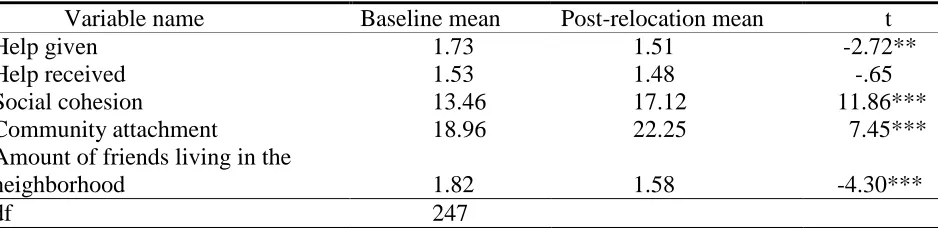
reporting t-test comparisons from baseline to post-move for the dependent and independent
vari-ables to examine significant change in mean scores after relocation. Next, I report bivariate
analysis of categorical variables to examine the mean scores on the dependent variables for
dif-ferent groups of relocated residents. Last, I report linear regression results to examine the
associ-ations between the dependent variables and reported social interactions of giving and receiving
social support. I find that reports of social interaction in the form of giving help to neighbors
de-cline for this sample, while report of receiving help are not significantly changed. The social
in-teraction of giving help to neighbors holds a significant positive association with presence of
children in the household and amount of friends living in the neighborhood, while the social
in-teraction of receiving help from neighbors holds a significant positive association with age,
pres-ence of children, and community attachment. I conclude Chapter 5 with a discussion of these
findings in relation to the larger research question and explain how the quantitative section helps
to inform the analysis of the depth interviews, which will attempt to establish why social
in-teraction either does or does not occur for these residents after relocation.
In Chapter 6, I analyze in-depth interviews from a sub-sample of 40 residents chosen
from the larger Atlanta, Georgia public housing relocation study. In this chapter, I use grounded
explain why social interaction either does or does not occur after relocation from public housing
for these residents (LaRossa 2005). Through the residents’ perceptions about neighbors, place,
and community, I establish how the residents’ levels of engagement and inclusion, zones of
ac-tion, integration and need fulfillment affect whether or not they participate in neighborhood
so-cial interaction. Also, I examine the effects that stigma and the staging of neighborhood
interac-tion have on the relocated residents’ interacinterac-tions with new neighbors. Through this analysis, I am
able to explain how the use of the dramaturgical framework bridges the theoretical gaps in the
neighborhood effects and concentrated disadvantage models. The use of the dramaturgical
framework reveals how elements of role-play, boundary work, and developing sense of
commu-nity work to influence whether or not relocated residents will engage in social interaction with
their new neighbors.
In Chapter 7, I extend the analysis of the in-depth interviews from the axial coding into
the stage of selective coding (LaRossa 2005). Through the selective coding stage of the grounded
theory methods, I establish that different ideal type resident groups exist and that they experience
relocation from public housing differently. I argue that during relocation a mismatch can occur
between the ideal type residents and best-fit neighborhoods and that this mismatch can lead to
limited social interaction between neighbors. I conclude by arguing housing policy can improve
neighborhood social interaction for residents by aiming to meet the differential needs of these
ideal type resident groups prior to relocation.
In Chapter 8, I close the study by discussing the combined analysis from Chapter 5
through Chapter 7 and illuminating residents’ differential accounts for why neighborhood social
interaction either does or does not occur after relocation. I then use the analysis of residents’
conclude Chapter 7 by re-emphasizing that relocated residents are not a uniform group of
indi-viduals. I also suggest that future studies should use interactional-level data, wherein residents’
new neighbors are incorporated to determine where inconsistency and discrepancy occur in
indi-viduals’ accounts of neighborhood social interaction (Tach 2009; Curley 2010).
PROJECT GOALS
In this dissertation, I examine the underlying processes affecting neighborhood social
in-teraction for a specific group of people, relocated public housing residents. My goals in studying
neighborhood social interaction in public housing relocation are the following: to better
under-stand the processes underlying neighborhood social interaction in relocation; to bridge the
theo-retical gap in neighborhood effects and concentrated disadvantage models; to advance the use of
a dramaturgical framework in studies of neighborhood interaction; and to provide information
beneficial to the policy makers and housing officials charged with relocating individuals from
public housing into new neighborhoods.
As a key component of my projected goals, I aim to advance the models of neighborhood
effects and concentrated disadvantage. As Chapter 2 explains in greater detail, the models of
neighborhood effects and concentrated disadvantage have been intertwined over time to support
the demolition of public housing and the removal of public housing residents in a variety of mass
relocation projects. Critique exist that these models lack sufficient explanation as to the
mecha-nisms that determine why neighborhood interaction and/or isolation occur in any given
neigh-borhood (Ellen and Turner 1997; 2003). One goal of this dissertation is to provide a new
CHAPTER 2: INTERACTION, NEIGHBORHOOD, AND PUBLIC HOUSING
RELO-CATION
INTRODUCTION
Neighborhood social interaction is a central topic throughout research on public housing
and key ideas on social interaction in neighborhoods have propelled decades of change in public
housing policy nationwide. In this Chapter, I explain how neighborhood social interaction came
to be a focal point in public housing and present an argument for extending social interaction
re-search in the study of public housing relocation. I begin by addressing the development of the
neighborhood effects and concentrated disadvantage models, the enactment of deconcentration
policies, critiques of models and policy, and research outcomes for mobility experiments related
to neighborhood interaction. Through these points, I present how public housing policy predicts
relocation will increase neighborhood interaction, but research findings do not agree (Hanratty,
McLanahan, and Petit 2003; Katz, Kling, Liebman 2003). I conclude the chapter arguing what is
needed is a better understanding of why social interaction either does or does not occur in the
neighborhood setting versus whether or not interaction occurs.
NEIGHBORHOOD EFFECTS MODELS
For most individuals, the neighborhood serves as the background to daily interaction
throughout most of childhood, adolescence, and even into adulthood. Some people never move
from the neighborhood they were born and raised in, while others experience a multitude of ways
people can communally cohabit and interact. Taken for granted by most, the neighborhood and
the residents form web of opportunities. For some individuals, the neighborhood is a safe haven,
a restful retreat after the workday, a place to play after school, or a place where neighbors share
head, a possible daily threat to health, or even a place to avoid. Within the spectrum of
neighbor-hoods, a vast range of social interactions with neighbors exists. Social interactions could involve
sharing recipes or stories from vacation or discussing recent news with neighbors, could involve
weekend sleepovers and swimming pool parties for birthdays for children, and could involve
preparing food for Sunday brunch at the seniors’ center. Social interactions in the neighborhood
could also involve ducking to avoid gunfire, confronting gangs and drug addicts, feeding
ne-glected children, even extreme isolationism. For people residing in any neighborhood long
enough, the social interaction witnessed most often can become normalized until alternate
pat-terns of neighborhood social interaction become obscured by daily routine.
Neighborhood effects research argues neighborhood characteristics cause real and lasting
impact on people’s lives in terms of opportunities and outcomes (Rosenbaum and Kaufman
1991; Sampson, Morenoff, Gannon-Rowley 2002). The neighborhood effects perspective argues
organized forms of social interaction affect outcomes like crime, health, employment, and
educa-tion at both the neighborhood-level and individual-level (Sampson and Groves 1989; Sampson et
al. 2002). Declines or deficits in organized interaction increase the likelihood of delinquency and
crime (Skogan 1986; Krohn 1986) effect school efficacy and student attendance (Lee, Dedrick,
and Smith 1991; Ainsworth 2002) decrease weak-tie networks beneficial to job searches (Bellair
1997; Granovetter 1973) decrease the likelihood of attaining social and political power and
in-crease the likelihood of social and physical disorder and poor health at the neighborhood-level
(Bursik 1988; Sampson and Groves 1989).
In neighborhood effects models, the neighborhood environment matters because it is the
locus of organized social interaction; the characteristics of the neighborhood affect the likelihood
individual-level outcomes (Sampson and Groves 1989; Sampson et al. 2002). Current models of
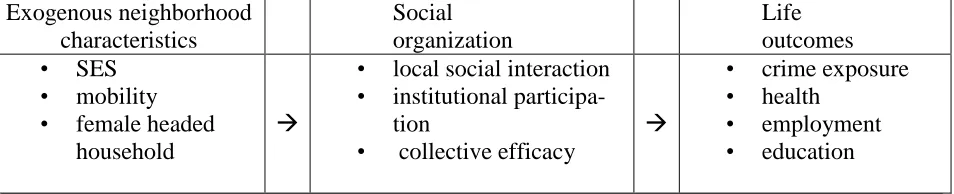
neighbor-hood effects generally consist of three parts: exogenous neighborneighbor-hood characteristics, such as
SES level, residential mobility rate, unemployment rate, female-headed households, and welfare
dependency; mediating social organization outcomes, such as informal social interaction,
partici-pating in formal organizations, and collective efficacy; and life outcomes, such as rates of mental
health, delinquency, crime, employment, and education (see Figure 1). This general form of
neighborhood effects modeling originated from turn of the century social ecology models of
neighborhood growth and models of social disorganization, arguing tenure and residential
mobil-ity have a significant effect on residents’ participation and attachment to the communmobil-ity (Park,
Burgess, and McKenzie 1925; Shaw and McKay 1942; Kasarda and Janowitz 1974).
Exogenous neighborhood characteristics Social organization Life outcomes • SES • mobility • female headed
household
-
• local social interaction • institutional
participa-tion
• collective efficacy
-
• crime exposure • health
[image:24.612.70.547.354.451.2]• employment • education
Figure 1: General Neighborhood Effects Model
From the ecological perspective, neighborhood characteristics persist over time as a
func-tion of stability; where community structures hold constant, good areas remain good and bad
ar-eas remain bad, but change in community structure changes a neighborhood’s character. The
premise of neighborhood characteristics shifting because of mobility and tenure eventually took
root in the field of criminology, solidifying as social disorganization (Shaw and McKay 1942).
One variant of neighborhood disorganization research argues rapid change in neighborhood
make-up increases the rates of offending at the aggregate level (Bursik and Webb 1982). Similar
quickly, existing institutions and agencies undergo radical alteration and can be lost completely;
during a destabilized interim, crime is most likely to occur (Bursik and Webb 1982). This
argu-ment on why some neighborhoods thrive where others fail connects issues of spatial distribution
of crime, gangs, and bad neighborhoods to questions on how local community interactions are
organized (Bursik and Webb 1982) and supports other neighborhood effects research focusing
specifically on how neighborhood interactions mediate the effects of neighborhood
characteris-tics on life outcomes (Sampson et al. 2002).
Neighborhood effects researchers argue a mediating variable must exist between
neigh-borhood characteristics and social outcomes, or else poor areas would automatically correlate
with crime-filled areas (Kornhauser 1978). Sampson and Groves (1989) argue the mediator
be-tween neighborhood characteristics and rates of crime is the level of interaction and social
organ-ization, and the ability to instill and enforce shared values at the neighborhood-level. Their study
reveals the exogenous variables in the neighborhood effects model (including SES, residential
stability, heterogeneity, family disruption, and urbanization) independently and interactively
causes changes in local kinship and friendship groups and in levels of participation in local
insti-tutions. Through this work, Sampson and Groves (1989) extend the neighborhood effects model
to incorporate social interaction as a mediating factor to account for why changes in
neighbor-hood characteristics might affect crime outcomes.
In neighborhood effects models, social interaction and organization of a neighborhood
af-fect crime in two ways. First, forming neighborhood social ties increases the ability to spot
strangers and enact in guardianship when necessary, decreasing potential for crime (Skogan
1986). Second, high-density networks, where community members know each other and
researchers consider interaction in the neighborhood central to outcomes of crime (Sampson and
Groves 1989) .
Social interaction is also considered a central to health and education outcomes.
Neigh-borhood effects models examine how health care differs by community and link the social
organ-ization levels of neighborhoods to family health management and child well-being (Sampson
1992) stroke mortality (Nesser, Tyroler, and Cassel 1971) and low birth weight (Morenoff 2003;
Burka, Brenna, Rich-Edwards, Raudenbush, and Earls 2003). Likewise, neighborhood effects
models also examine how social interaction mediates neighborhood effects on adolescent school
behaviors (Bowen, Bowen, and Ware 2002) school dropout rates (Leventhal and Brooks-Gunn
2000) and school efficacy and educational outcomes (Lee et al. 1991; Ainsworth 2002; Garner
and Raudenbush 1991). Neighborhood effects models promote social interaction as the key
me-diating factor between the effects of neighborhood characteristics on individual-level outcomes
and link levels of social interaction to the neighborhoods’ relative level of advantage.
Neighborhood effects models suggest a decrease in local social interaction is the result of
a decrease in a neighborhood’s relative level of advantage. As social interaction and organization
decrease, neighborhood- and individual-level outcomes are negatively affected. The connections
between neighborhood characteristics, social interaction, and life outcomes are useful for
exam-ining social patterns for groups of individuals across different neighborhoods, but they cannot
explain interaction in terms of the strategies and actions used by specific individuals within
neighborhoods. Neighborhood effects models can examine increases and declines in social
CONCENTRATED DISADVANTAGE MODELS
As neighborhood effects models gained prominence through the late 1980s and early 90s,
social researchers began incorporating models of concentrated disadvantage into neighborhood
effects literature, forming an overlapping argument for why neighborhood matters (Mayer and
Jencks 1989; Sampson et al. 2002). Concentrated disadvantage models are an extension of
Wil-son’s (1987) theory of concentrated poverty. WilWil-son’s theory of concentrated poverty addresses
how and why poor African Americans came to be living in concentrated clusters experiencing
negative life outcomes. The model of concentrated disadvantage addresses environment specific
macro-level causes for individual-level declines in social interaction. Within poor African
Amer-ican neighborhoods, interaction declines due to a decrease in local jobs and middle-class black
residents, and an increase in political, social, geographic, and economic isolation. According to
concentrated disadvantage models, decreased social interaction mediates both the decreases in
levels of employment, education, and health and the increases in levels of welfare dependency
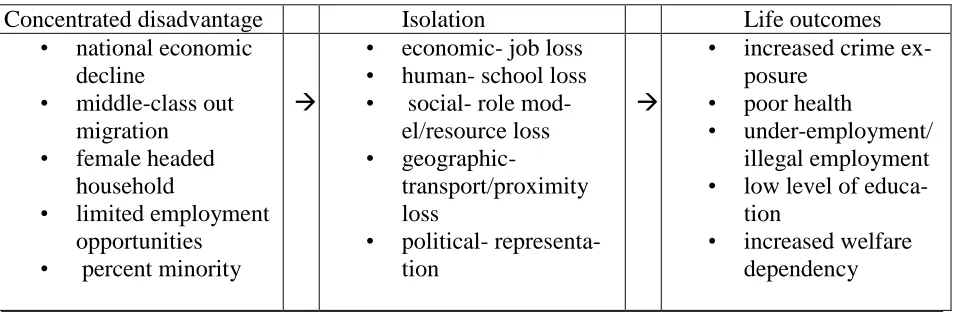
and exposure to delinquency and crime (see Figure 2).
Concentrated disadvantage Isolation Life outcomes
• national economic decline
• middle-class out migration • female headed
household
• limited employment opportunities • percent minority
-
• economic- job loss • human- school loss • social- role
mod-el/resource loss • geographic-
transport/proximity loss
• political- representa-tion
-
• increased crime ex-posure
• poor health
• under-employment/ illegal employment • low level of
educa-tion
[image:27.612.70.548.461.617.2]• increased welfare dependency
Figure 2: General Concentrated Disadvantage Model
Wilson’s theory of concentrated poverty is a response to Lewis’ (1969) culture of poverty
poverty due to living in ghettos and receiving welfare for multiple generations. Culture of
pov-erty blames poor African Americans for both their continued povpov-erty and the compounded
dis-advantages they face in terms of limited education, limited employment opportunities, poor
health, and over-exposure to crime. Further, the culture of poverty stance suggests poor African
Americans know no other way of surviving, and prefer the disadvantaged state of being. Wilson
(1987) discounts the culture of poverty argument for ignoring poverty-causing forces operating
at the social-structural level of society.
Wilson (1987; 1996) argues the combined effects of economic downturn, increased
growth of service sector jobs, and middle-class African American migration to the suburbs
re-sults in inner-city areas where nearly all residents are black, jobless, living well below the
pov-erty line, and both geographically and socially isolated. As social and economic changes took
root in America, middle class African Americans relocated from the all-black ghettos to the
mostly-white suburbs following the job market and fair housing laws. This, Wilson (1987)
ar-gues, removed the economic and social resource bases supporting much of the ghetto community
in terms of educational funding and support, support for local businesses, political
representa-tion, positive role modeling, and social networks. As shifts to the economic and social structures
of ghetto neighborhoods occurred, community incidence of joblessness, female headed
house-holds, out of wedlock births, and welfare receipt each increased significantly, as did incidence of
and exposure to gang and drug related crimes.
Further, Wilson (1987) argues the remaining residents in ghetto neighborhoods became
geographically isolated from outside areas, without resources or role models, leading to
commu-nity detachment from mainstream patterns of behavior. Long-term estrangement from
activity, and downplayed social norms such as work and marriage. Wilson (1987) theorizes these
events caused startling increases in concentrated poverty, joblessness, welfare receipt, criminal
activity, and female-headed households within poor African Americans neighborhoods across
the 1970s and 80s. Where Lewis (1969), Moynihan (1965), and others construe African
Ameri-can poverty as the result of impoverished culture, Wilson (1987) sees ghetto culture as the result
of poverty-engendering socio-structural forces operating in African American communities
na-tionwide.
Since 1989, neighborhood effects and concentrated disadvantage models have become
nearly inseparable in housing research (Mayer and Jencks 1989; Sampson et al. 2002). This
fu-sion arises from the placement of social interaction as the intermediary force between
macro-level forces and individual-macro-level outcomes. Over time, neighborhood researchers extended the
models of concentrated poverty into models of concentrated disadvantage, to signify the overall
importance of multiple deleterious exogenous variables in the model, including but not limited to
poverty, or low SES (Sampson, Raudenbush, and Earls 1997). Taken together neighborhood
ef-fects and concentrated disadvantage models reveal a great deal about social interaction in
de-cline. Change in characteristics of SES, available jobs, residential stability, middle-class
out-migration, and female-headed households, and percent minority are thought to have a significant
effect upon social isolation and ability to organize, affecting outcomes of joblessness, welfare
dependency, delinquency, crime, health, and education for neighborhood residents. Like
neigh-borhood effects models however, models of concentrated disadvantage are criticized, in part
concerning the models’ emphasis on social interaction as mediation between exogenous
THE EMERGENCE AND SIGNIFICANCE OF DECONCENTRATION POLICY
Though critiqued for exclusive focus on concentrated poverty (Mayer and Jenks 1989),
the narrow research agenda utilized in neighborhood effects and concentrated disadvantage
models explains why neighborhoods matter, especially for disadvantaged groups of people
(Sampson et al. 2002). From the synthesized findings, neighborhood effects researchers argue
impoverished neighborhoods across the nation face persistent negative outcomes, including the
continued inequality based on class and racial segregation, geographic isolation, and bundled
so-cial problems operating at the neighborhood-level (Sampson et al. 2002). Further, Sampson et al.
(2002) argue because patterns of concentrated poverty and affluence increased over the last two
decades, similar neighborhood effects consistently appear for concentrations of poor African
Americans regardless of geographic level of operationalization (i.e. census tract, neighborhood,
or community).
Jargowsky (1997) argues every major city has neighborhoods with concentrations of
poor, black residents containing some form of government public housing. Since the 1960s, the
housing authorities have created policy and programs to address racial segregation and
concen-trated disadvantage in public housing; most notable are the Gautreaux Program, MTO, and
HOPE VI (Goering 2003a). These programs employ a variety of strategies to either permanently
relocate residents to less segregated, less disadvantaged areas or temporarily relocate residents in
order to demolish and renovate the existing public housing into mixed-income and mixed-use
neighborhoods. Sampson et al. (2002) deem poverty deconcentration studies and mobility
exper-imentation programs as highly relevant to research on how and why the residents of specific
the question becomes what effect does relocation through mobility experiments have on
resi-dents’ levels of neighborhood social interaction?
Looking at changes in interaction for populations of poor, black residents relocated out of
highly disadvantaged neighborhoods two points must be addressed. First, poor African
Ameri-cans historically and currently are hyper-segregated from middle class and affluent African
Americans and from whites of all socioeconomic levels (Massey and Denton 1993). The
contin-ued segregation isolates poor African Americans to areas with low quality schools, limited
healthcare, job limitations, higher environmental hazards, health risks, and violent crime
(Mas-sey and Denton1993; Lareau 1987; Bullard and Feagin 1991; Rosenbaum 1995). Further,
pat-terns of social isolation based on race and class have increased over time (Mayer and Jenks
1989). Neighborhood effects and concentrated disadvantage models predict the combined effect
of intensified segregation from other races and classes along with prolonged economic, social,
and geographic isolation decreases the likelihood of beneficial social interaction taking place at
neighborhood- and individual-level (Sampson et al. 2002; Wilson 1996).
Second, racial and economic segregation establishes differences in the form and function
of social interaction, manifesting specific individual-level outcomes. Noted differences emerge
in terms of parenting styles, community gathering, work patterns, and attitudes towards
educa-tional attainment (Lareau 1987; Ogbu 1978; McPherson, Smith-Lovin, and Brashears 2006;
Pe-terson and Krivo 2000). Research on segregation suggests economic and racial isolation affects
adolescents especially in terms of dropout rates, pregnancy rates, and childhood IQ (Crane 1991;
Brooks Gunn, Duncan, Klebanov, and Sealand 1993; Jenks and Mayer 1990). For adults in
eco-nomic and racial isolation, social interaction supporting daily survival can be costly and create
expecta-tions, interaction with friends and kin can diminish valuable time and energy, stretching residents
beyond limits (Miller-Cribs and Farber 2008; Dominguez and Watkins 2003). Social interaction
for economically and racially segregated African Americans is therefore a specific experience,
dissimilar from social interaction occurring in mainstream studies.
Further, the population of income poor African Americans residing in government-run
public housing is a unique subset of the larger population of disadvantaged African Americans.
Apart from being resource poor, both the environment of public housing and its residents are
highly stigmatized by outsiders and considered ghetto underclass (Venkatesh 2008). The stigma
of living in public housing stems from a culture of poverty mentality. Outsiders view public
housing residents as rejecting mainstream paths to gainful employment and self-dependency,
helplessly imbedded in a system of poverty, with no ability or desire to get out of ghettos and
disadvantaged neighborhoods (Lewis 1969). This stigmatization is a critical determinant of the
level of social interaction of public housing residents, past and present.
In the minds of most people, American public housing is gang-infested and drug-filled,
riddled with junkies, prostitutes, and welfare mothers (Waquant 2007; Venkatesh 2008). In
re-ality, most individuals use public housing as a safety net from ending up homeless, or as a step
out of homeless shelters, and spend on average 3.5 years on federal housing rosters before
transi-tioning into other housing options (HUD 2003). Overall, less than 30% of residents live in public
housing for more than 9 years and over 45% reside there for 3 years or less (HUD 2003). Despite
the statistics and lived reality of residents, the notoriety of housing projects like Robert Taylor
Homes and Cabrini Green Homes in Chicago perpetuate ideas of all public housing projects
Negative beliefs about public housing lead many researchers to predict living within
ghetto neighborhood conditions decreases social interaction; they believe residents seek to avoid
risks from exposure to gangs, drugs, and violent crime (Morenoff and Sampson 1997; Sampson,
Morenoff, and Earls, 1999; Elliot et al. 1996; Boardman, Finch, Ellison, Williams, and Jackson
2001). At the individual-level, stereotyped and over-generalized depictions of life in public
hous-ing can compound the pressures for residents livhous-ing in isolated and disadvantaged
neighbor-hoods. Individuals revealing their public housing address stand to lose decent employment,
edu-cation, health services, police protection, and even friendship and mate selection (Massey and
Denton 1993; Waquant 2007). At the structural-level, negative depictions of life in public
hous-ing can compound pressure for residents, if such views lead to deconcentration policy geared
to-wards the removal of disadvantaged neighborhoods.
Housing authorities utilize poverty deconcentration strategies to systematically relocate
public housing residents out of original neighborhoods and into new or redeveloped
neighbor-hoods (Goering 1986; 2003a). The populations affected by deconcentration strategies are
majori-ty poor, black residents with female head of households with limited access to living-wage
em-ployment, quality education for themselves and their children, quality health care, or resource
amenities such as nearby grocery stores, libraries, churches, or community centers (Goering
1986; 2003a; Massey and Denton 1993; Bullard and Feagin 1991; Patillo 1998; Sampson et al.
2002). The models of neighborhood effects and concentrated disadvantage argue public housing
populations have low levels of social interaction due to low perceived and real safety, high fear
of crime, and limited community resources (Wilson 1987; 1996; Sampson et al. 2002). Building
on Granovetter‘s (1973) strength in weak ties argument, Sampson et al. (2002) argue social
con-stituent actors and their social networks. For example, resource poor residents with limited weak
ties will have limited access to job referrals outside the neighborhood (Bellair 1997; Ioannides
and Datcher 2004; Sampson et al. 2002). The policy implication of this argument is relocating
residents from concentrations of high poverty and isolation into areas with lower amounts of
crime and racial and economic segregation, should increase residents’ incentive to engage in
so-cial interaction. Also residents’ new neighbors should have more resources and benefiso-cial weak
ties, offsetting favorable outcomes such as increased employment, education, resource
attain-ment (Goering 2003a; Sampson et al. 2002).
The best-known attempts at enacting poverty deconcentration policy are the Moving to
Opportunity for Fair Housing (MTO) and Housing Opportunities for People Everywhere (HOPE
VI) which grew out of a civil rights era desegregation project known as the Gautreaux Program
(Goering 2003a). As relates to questions of declines in interaction, the three programs produced
different results. The Chicago-based, Gautreaux Program revealed promising outcomes in
de-creased isolation, but the five-city MTO study and the HOPE VI projects, now enacted in
multi-ple cities, produced less conclusive findings on interaction (Rosenbaum and Kaufman 1991;
Rosenbaum 1995; Goering 2003b). In part, these differences may be due to the voluntary nature
of the Gautreaux Program and the restrictions placed upon residents on where they could or
could not move (Rosenbaum and Kaufman 1991; Rosenbaum 1995; Goering 2003a).
Though critiqued on study implementation, the MTO study is considered the most
rigor-ous of the three mentioned mobility experiments, in terms of experimental design (Goering
2003b; Ellen and Turner 2003; Sampson et al. 2002; Curley 2010). As a key component of MTO
design, researchers focus on social interaction of residents to determine if increased
network-ing, and increased attainment of resources (Goering 2003a; Rosenbaum, Harris, and Denton
2003; Hanratty et al. 2003; Ladd and Ludwig 2003; Katz et al. 2003; Leventhal and
Brooks-Gunn 2003). The focus on interaction outcomes in the MTO design makes this mobility
experi-ment a good starting point for discussing social interaction in relocation. A closer examination of
MTO findings illuminates the complexities of addressing changing social interaction with the
enactment of nation-wide policy.
MTO STUDY FINDINGS
The MTO experiment examines relocation in five cities, focusing on six core sets of
out-comes for participants: educational achievement; employment, earnings, and welfare;
neighbor-hood, school, and housing conditions; rates of delinquency, deviant peer behavior, and criminal
behavior; safety and exposure to violence; and physical and mental health status (Goering
2003a). The study hypothesized relocation from high poverty to low poverty neighborhoods
would cause gains in education, employment, earnings, neighborhood and housing conditions,
and safety and health, while decreasing welfare use, exposure to crime, and youth delinquency
(Goering 2003a). Based on the Gautreaux Program findings, researchers predicted low social
iso-lation and low hostility in the form of stigmatization and racism in MTO (Rosenbaum 1995;
Rosenbaum et al. 2003). Goering (2003a) explains that decreases in isolation and stigma,
cou-pled with safer neighborhood conditions are expected create better paths to engaging in positive
social interaction for residents.
Looking at the MTO outcomes, clear, positive improvement does occur, most notably in
terms of neighborhood satisfaction and safety. Significant increases in neighborhood satisfaction,
perceptions of safety, and significant decreases in fear of crime and perceived social disorder
in quality of housing occur (Rosenbaum et al. 2003) and access to neighborhood resources and
institutions, such as daycares increase in some cases (Hanratty et al. 2003). Crime rates for the
participants also decrease in receiving neighborhoods (the exception to this being higher property
crimes in some neighborhoods) (Hanratty et al. 2003).Youth criminal victimization significantly
decrease (Katz et al. 2003). Likewise, male youth involvement in delinquency and arrests for
vi-olent crime decrease significantly (Ludwig, Ladd, and Duncan 2003). Researchers attribute the
increases in property crime conviction for youth to higher policing and arrest for property crimes
in higher SES census tracts, not higher incidence of crime (Ladd and Ludwig 2003). For MTO
analysts, establishing safer environments for residents is one path towards improving social
in-teraction.
As well, the combined neighborhood effects of better housing, perceived safer
neighbor-hoods, and decreased exposure to crime does manifest into significant effects on health.
Consist-ently, adults report a significant decrease in anxiety and fear related to the increased safety of the
neighborhood (Ladd and Ludwig 2003). Katz et al. (2003) also found significant increases in
adult self-report health due to lack of injury from violence and decreased asthma attacks. While
youth report fewer injuries requiring emergency care, no reports occur of physical health
im-provements for children (Katz et al. 2003; Leventhal and Brooks-Gunn 2003). In terms of mental
health, while girls report a harder time adjusting to the move, boys report less anxiety and
de-pression and less need of adult assistance (Leventhal and Brooks-Gunn 2003). For MTO
re-searchers, better physical and mental health is also expected to promote increases in social
inter-action in the new neighborhoods (Goering 2003a).
However, not all residents report better health and social outcomes; adolescent girls
Brooks-Gunn 2003). Leventhal and Brooks-Gunn (2003) suggest the lack of integration and
higher delinquency for adolescent girls moving to the suburbs is due to increased awareness of
differing social class brought on by the move from high poverty to low poverty. Where boys
make friends and new networks quickly, girls isolate themselves. These findings raise questions
for researchers about the age and gender differences in social interaction outcomes (Leventhal
and Brooks-Gunn 2003).
Overall, researchers expect social isolation to decrease because of relocation from the
concentrated disadvantage of traditional housing projects into safer, healthier environments
(Goering 2003a). By improving neighborhood conditions and the relative economic status of the
neighbors, MTO researchers expect the opportunities and incentives for local social interaction
and weak tie formation to increase (Sampson et al. 2002; Goering 2003a). However, in terms of
adults’ social interaction, the LA study found decreases in church attendance and fewer numbers
of kin and friends living in the neighborhood for MTO movers, as compared to Section 8 and
control groups (Hanratty et al. 2003). The LA researchers argue social involvement does not
in-crease or dein-crease overall but instead remains outside of the neighborhood area like prior to
relo-cation (Hanratty et al. 2003). Katz et al. (2003) report similar non-significant impacts of
reloca-tion on adult isolareloca-tion, explaining pre-existing extra-local friend groups remain constant
throughout the relocation. The LA study reports relocated children have similar levels of
interac-tion as compared to the control group; however findings reveal girls in the study have higher
mental health concerns, decreases in expectations for the future, increases in behavioral problems
such as substance use, and increases in delinquent peer characteristics (Hanratty et al. 2003).
These findings cause concern to researchers expecting decreases in isolation and increases in
CRITIQUES OF NEIGHBORHOOD EFFECTS AND CONCENTRATED DISADVANTAGE
MODELS
Both neighborhood effects and concentrated disadvantage models receive criticism
re-garding theoretical premise, methodology, and policy application. The first criticism of both
models is theoretical arguments focus on concentrated poverty at the expense of other areas of
interest, like concentrations of affluence or middle class. Mayer and Jencks (1989) warn the
sup-posed connections between affluent neighborhoods and individual-level outcomes suggest
inter-action in the neighborhood is always mutually beneficial for all actors involved. While
acknowl-edging the potential positive effect interaction with affluent neighbors can have in terms of
polit-ical power, institution building, and attaining resources, Mayer and Jencks (1989) warn social
interaction with affluent neighbors can also disadvantage low-income neighbors when resources
are already scarce. Mayer and Jencks (1989) argue when scarcity occurs affluent neighbors may
use economic, social, and political power advantages to horde resources or exclude poorer
neighbors from important decision making processes (Mayer and Jenks 1989). Likewise,
re-search on mixed-income developments shows when residents team up with larger entities to
en-act neighborhood change, less affluent neighbors are underserved and minimally included in the
process while affluent community stakeholders can experience a variety of benefits (Fraser and
Kick 2007).
Research outside of the neighborhood fields offers similar critiques. Conflict theorists
criticizing social capital explain social interaction potentially has negative outcomes, and argue
any beneficial outcome generated for one group using social capital, necessarily manifests at the
expense of some other undisclosed social group (or groups), and therefore generates negative
social and political power to keep waste dumps out of their neighborhoods, the dumps will
even-tually be placed in less organized neighborhoods with no power to stop the process (Bullard
1990; Bullard and Wright 1993). Similarly, some research suggests group interaction may not be
beneficial to group members should membership encourage or demand risk-taking behavior or
increase likelihood of injury, such as with local gangs (Gordon 1967; Mcllwaine 2001).
A second branch criticism of neighborhood effects and concentrated disadvantage
mod-els focuses on methodology and argues the connections made between neighborhood
characteris-tics and individual-level outcomes may not even exist. First, Ellen and Turner (1997) argue
neighborhood effects research faces multiple methodological challenges and offers limited data
to back up causal claims. They argue no consensus exists on specific neighborhood
characteris-tics affecting specific outcomes. Second, Grannis (1998) claims the definition of the
neighbor-hood is highly subjective; data collected at the census tract-level have little to no correlation with
perceived neighborhood boundaries. Third, Greenbaum (2008) argues no model distinction exists
concerning how the benefits or costs from organized social interaction parse out within the
neighborhood, meaning the rewarded or burdened parties for attaining resources remain unclear.
Fourth, Sampson et al. (2002) argue that neighborhood effects and concentrated disadvantage
models suffer from a lack of standardization in methods, decreasing generalization strength and
continued theoretical development. Ellen and Turner (1997; 2003) suggest neighborhood effects
research needs more focus on why, how, and for whom neighborhood matters.
A third branch of criticism argues neighborhood effects and concentrated disadvantage
models influenced social policy before critical testing of the theoretical models was complete
(Meyers and Jenks 1989). In the early 1990s, national mobility programs emerged to contend
and HOPE VI programs developed in part because of neighborhood effects research and ideas on
social capital, isolation, concentration of poverty, and social interaction (Goering 2003a). In turn,
the outcomes of both programs began to reshape the models of neighborhood effects and
concen-trated disadvantage (Sampson et al. 2002). While Sampson et al. (2002) suggest the best way to
study changes in neighborhood outcomes and social interaction is examining data collected from
mobility experiments like MTO, critics warn promoting policy based on incomplete models,
without considering alternative strategies geared at affected individuals, can have unseen
nega-tive consequences (Mayer and Jencks 1989).
CRITIQUES OF POVERTY DECONCENTRATION POLICY
Poverty deconcentration in the United States is an outgrowth of the court-mandated
Gautreaux program of Chicago, forcing housing authority officials to enact relocation strategies
whereby public housing residents could volunteer to move to less-segregated areas (Goering
1986; Rosenbaum 1995). Begun in the late 1960s, the program was hailed as a success for
providing public housing residents with homes in safer, less-impoverished, and less-segregated
surroundings without resulting in significant racist backlash from whites receiving white,
mid-dle-class neighbors (Goering 1986; Rosenbaum 1995). The so-called success of the Gautreaux
program eventually became the arguing point for programs like MTO, HOPE VI, and a number
of other similar removal and relocation strategies aimed at public housing residents (Goering
2003a). However, while desegregation attempts and poverty deconcentration strategies in the
United States have achieved some of their goals, no achievement has occurred in increasing
em-ployment and earnings and decreasing use of federal assistance. Continuation of public housing
demolition and the relocation of its residents, despite these failures, generate criticisms for
opponents of poverty deconcentration (Goering 2003b; Boston 2005; Joseph 2006; Greenbaum
2008; Goetz 2010).
One of the first key criticisms of poverty deconcentration efforts is resident placement. In
the Gautreaux program, residents’ new neighborhoods were carefully selected to insure resident
moved out of high poverty areas and into cooperative neighborhoods (Goering 1986). More
re-cent relocation programs are less successful at actually relocating residents away from poverty
concentrations (Goetz 2010; Boston 2005; Leventhal, Fauth and Brooks-Gunn 2005; Oakley
2008; Oakley and Burchfield 2009). For the multiple sites of MTO and HOPE VI, reports
con-sistently show residents do move out of the most impoverished regions, but only relocate to
sub-urb areas if forced to, and even then would move again within a two year period (Goetz 2010;
Boston 2005; Leventhal, Fauth and Brooks-Gunn 2005). Further, when not forced to move to
suburb locations, on average relocated residents from all programs move within 3-5 miles of
their original neighborhoods (Goetz 2010; Fischer 2003; Kingsley, Johnson, and Pettit 2003;
Goetz 2003; Trudeau 2006; Reed 2006; Oakley 2008; Oakley and Burchfield 2009). Therefore,
instead of moving away from impoverished and segregated areas, relocated residents move to
similar neighborhoods or move to the suburbs briefly then move back to low-income, segregated
neighborhoods. While the areas are less-impoverished than the original public housing
neighbor-hoods, the areas are found to be becoming poorer over time (Goetz 2010). This pattern of
reloca-tion is also considered a prime reason as to why no significant increases in children’s schooling
occur, due to parents either keeping their children in the same schools after relocating or moving
them into similar low-funded schools systems (Ferryman, Briggs, Popkin, and Rendon 2008).
Orfield (1989) suggests this pattern of relocation occurs in poverty deconcentration policy
loca-tions instead of researchers actively designating the areas where residents would relocate to.
Re-searcher attempts at “pure science” have not been successful, in part due to reRe-searchers
attempt-ing dual poverty deconcentration programs, such as MTO and HOPE VI, in the same city
simul-taneously (Shroder 2001; Curley 2005).
A second criticism of poverty deconcentration policy is relocation did not affect key
out-comes of interest (Goering 2003b). In the MTO study, reports of children’s education outout-comes
are limited, and no impacts are reported on employment and earnings or receipt of public
assis-tance (Hanratty et al. 2003; Ladd and Ludwig 2003; Goering 2003b). For HOPE VI similar
non-findings are reported in terms of employment, earnings, and income (Goetz 2010;
Clampet-Lundquist 2004; Curley 2006; Goering 2003b; Rubinowitz and Rosenbaum 2000). In fact, some
report greater financial insecurity due to increased housing costs experienced in relocation
(Goetz 2010; Barrett, Geisel, and Johnson 2006). With health and safety, both MTO and HOPE
VI reports reveal some lower mental health concerns amongst adults and lower mortality, but
some reports reveal declines in health as compared to non-moving groups (Leventhal and
Brooks-Gunn 2003; Boston 2005; Manjarrez, Popkin and Guernsey 2007). With delinquent
be-havior amongst youths, no significant decreases occur in MTO, but increases in property crime
occur for boys and increases in delinquent peers occur for girls (Leventhal and Brooks-Gunn
2003). Combined, these facts argue public housing relocation can cause more, not less, struggle
for residents dependent upon public housing assistance.
Concerning social interaction and social networking, poverty deconcentration policies
in-crease isolation and diminish social networks residents depended upon for daily survival
(Clampet-Lundquist 2007). While reports from the Gautreaux Program reveal low social
signifi-cant change in neighborhood interaction or slight decreases (Rosenbaum 1995; Hanratty et al.
2003; Katz et al. 2003). Reports from multiple HOPE VI projects reveal relocated residents are
not likely to interact with new neighbors, report fewer neighboring behaviors (such as talking for
more than 10 minutes or watching a neighbors child), and have fewer supportive relationships
after relocating (Goetz 2003; Clampet-Lundquist 2004; Barret et al. 2006; Curley 2006). Studies
also find youth are more isolated after relocation, and though they are more likely than adults to
make new friendship networks youth are unlikely to interact with adults in new neighborhoods or
view adults as role models (Gallagher and Bajaj 2007; Clampet-Lundquist 2007).
Poverty deconcentration policy therefore arguably diminishes social networks, decreases
mechanisms of social support, decreases safety, and disrupts access to social resources
(Greenbaum, Hathaway, Rodriguez, Spalding, and Ward 2008; Clampet-Lundquist 2010; Curley
2009; Keene 2010). Despite early MTO findings suggesting relocation to suburban areas would
significantly increase the chances adults would have college educated friends or friends earning
$30,000 or more, critics argue relocation instead increases isolation and feelings of loss of place,
home, and community among relocated residents (Shroder 2001; Greenbaum et al. 2008;
Clampet-Lundquist 2010; Kleit and Manzo 2006; Keene 2010). Findings also suggest receiving
neighbors can overtly denied neighborhood interaction with relocated residents and when
neigh-borhood interaction does occur the effort mostly falls to the relocated residents themselves
(Greenbaum et al. 2008; Tach 2009). Further, Fraser and Kick (2007) argue when new neighbors
include relocated residents in social networking and neighborhood organization, the relocated
residents are only included in superficial decision making and the decisions made tend to only
FOCUS ON SOCIAL INTERACTION BETWEEN NEIGHBORS
Critiques of programs such as MTO and HOPE VI support the argument for researchers
needing to achieve a better understanding of why beneficial neighborhood interaction is expected
to occur between neighbors in public housing relocation (Ellen and Turner 2003; Ladd and
Lud-wig 2003). In programs like MTO and HOPE VI, the expectation is relocated residents will
in-teract with more-educated and affluent neighbors and will model their actions and
life-expectations after the new neighbors (Goering 2003a). When these predicted outcomes did not
manifest, despite incentive and opportunity for interaction, researchers began to examine both
methodological and theoretical explanations to account for their findings (Rosenbaum et al.
2003; Ladd and Ludwig 2003; Ellen and Turner 2003; Hanratty et al. 2003). Looking at MTO
findings, Rosenbaum et al. (2003) examines processes working as facilitators and barriers to
res-idents’ adjustment to neighborhoods. These researchers examine resres-idents’ perceptions of how
they were treated upon moving in and residents’ feelings of geographic strain upon kin and
friendship groups (Rosenbaum et al. 2003). In Chicago, both MTO and Section 8 movers express
low-hostility and general welcoming receptions in new neighborhoods, and both groups report
similar levels of interaction with friends living outside of the neighborhood (Rosenbaum et al.
2003) The research team equates this finding with no geographic strain (Rosenbaum et al. 2003).
At the individual-level no reports of overt barriers to social interaction exist to explain why no
social interaction gains emerged when incentive to interact exist.
In part, while residents report feeling at home in their neighborhood and feeling the
neighborhood is a good place to live, they do not feel living in the neighborhood is important and
do not plan to stay in the neighborhood long (Rosenbaum et al. 2003). These findings, along with