
http://www.scirp.org/journal/ojem ISSN Online: 2332-1814
ISSN Print: 2332-1806
DOI: 10.4236/ojem.2017.53009 Jul. 31, 2017 93 Open Journal of Emergency Medicine
Emergency Physicians Awareness of Computed
Tomography Indication in Traumatic Brain
Injury: A Questionnaire-Based Study
Hassan Bukhari
Department of Surgery, Medical College, Umm Al-Qura University, Makkah, KSA
Abstract
Minor head injury (MHT) is one of the most common causes of all trauma admissions and it is still controversial to manage adequately. Although the in-cidence of clinically significant traumatic brain injury is low in this group, the consequences of missing clinically important problem are potentially life threatening. Early diagnosis of intracranial hematoma by computed tomo-graphy scan (CT) followed by early surgery is very important in the treatment of such patients. Thus, there has been a tendency to use high levels of diag-nostic imaging in these conditions. There are many decision rules for the use of computed tomography (CT) for patients with minor head injury. This sur-vey is to determine the awareness and utilization rates of these head CT rules among our emergency physicians (EP). Questionnaire was randomly sent to EPs from different ministry of health hospitals in Makkah. Our participants were asked about their awareness of such rules and their applications in their careers. Data were collected and analyzed by SPSS V16.0. The awareness and utilization rate of clinical decision rules among 91 ER physicians who re-sponded were 54.4% and 42.2% respectively. The barriers to utilize such rules were the working environment and increased chances of getting lawsuits, which were 55.4% and 61.7% respectively. 91.1% of those physicians would like to receive guidance on how to apply such rules in their daily practices. There is a misunderstanding of the definition of minor head injury, despite the high number of head traumas, which led to request more CT scan. This will be a burden on the healthcare system and will lead to more radiation ex-posure. More educations regarding head CT rules will result in better utilizing of our resources and reduction in radiation risks.
Keywords
Minor Head Injury, Head CT Scan, Canadian CT Head Rule How to cite this paper: Bukhari, H. (2017)
Emergency Physicians Awareness of Com-puted Tomography Indication in Traumatic Brain Injury: A Questionnaire-Based Study. Open Journal of Emergency Medicine, 5, 93-101.
https://doi.org/10.4236/ojem.2017.53009
Received: June 25, 2017 Accepted: July 28, 2017 Published: July 31, 2017
Copyright © 2017 by author and Scientific Research Publishing Inc. This work is licensed under the Creative Commons Attribution International License (CC BY 4.0).
http://creativecommons.org/licenses/by/4.0/
DOI: 10.4236/ojem.2017.53009 94 Open Journal of Emergency Medicine
1. Introduction
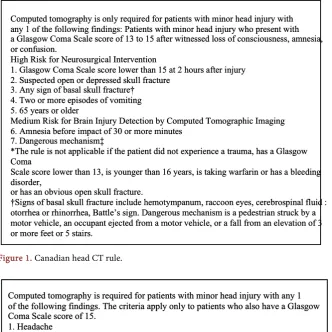
An estimated 1.7 million people sustain a Traumatic Brain Injury (TBI) annually are seen in the United States’ emergency rooms and 80% of them are classified as minimal or minor head injury where they are treated and released from an emergency department [1]. TBI is defined as a patient with a history of loss of consciousness, amnesia, or disorientation and a Glasgow Coma Scale (GCS) score of 13 - 15 [2]. Most patients with minimal head injuries who are not suf-fered from the mentioned symptoms are rarely requiring admission to hospital and can be discharged home [2]. However, there are 10% of those patients who will develop deterioration in their conditions by intracranial hematoma and only 1% will require neurosurgical intervention [3]. Therefore, an early diagnosis of intracranial hematoma by Computed tomography (CT) and early interventions in such patients are critical and important [2]. Computed tomography (CT) scan is an essential diagnostic tool in Emergency room due to its easy accessibilities with high accurate diagnostic approach. Moreover, CT scan is an integral rule to triage and manage patients with traumatic head injury because the consequences of missing a clinically important problem are potentially life threatening. There-fore, there is an increase in the number of CT scans requested at an astonishing rate by emergency physicians (ERs) more than any other department. For exam-ple, in 10 large Canadian hospitals, the use of CT scan has increased 165%, from 30% to 80%, especially for minor head injury patients [1]-[9]. Routine scanning results in increased in radiation exposure, and in large health care expenditures, especially when 90% of CT scans are negative for clinically important brain in-jury. So, reliance on clinical judgment could reduce CT use, but the cost will be missing in 20% of patients with intracranial injury [5][8][9]. Furthermore, stu-dies and articles which have strongly suggested that all patients with minor head injury should undergo CT scan; it would eventually leads to a greater than 300% increase in the use of CT scan for Canadian and European patients with minor head injury [2]. Under these circumstances, the use of CT scan for minor head injury should be justified. Substantial potential for improving the efficiency of managing minor head trauma appears possible through the applications of clin-ical decision rules. A clinclin-ical decision rule is derived from original research and is defined as a decision making tool that incorporates 3 or more variables from the history, examination, or simple tests [9]. Several clinical decision rules are developed such as Canadian CT Head Rule (CCHR) “Figure 1”, New Orleans CT Head Criteria (NOCC) “Figure 2” and guidelines from the National Institute for Clinical Excellence (NICE) [9]. This study aims to measure the emergency physicians’ awareness toward indications of CT scanning in TBI according to CCHR and/or NOC by using a designed questionnaire with a short clinical sce-nario.
2. Materials and Methods
DOI: 10.4236/ojem.2017.53009 95 Open Journal of Emergency Medicine
Figure 1. Canadian head CT rule.
Figure 2. New Orleans criteria.
Hospital, Alnoor Specialist Hospital and Kind Faisal Hospital in Makkah, Saudi Arabia, from September 2015 to December 2015. The hospitals mentioned pre-viously are the major emergency care hospitals in Makkah with state-of-art emergency practice.
2.1. Study Design
A self-reported based questionnaire was developed by the researchers through literature search (for validated questions), input from colleagues and from ex-perts in the field of emergency medicine. The questionnaire was pretested on 10 participants (data not included in the results) before it was finalized.
DOI: 10.4236/ojem.2017.53009 96 Open Journal of Emergency Medicine level of experience. Third, a clinical scenario of patient with mild head injury as-sesses the clinical judgment of the targeted physicians and it was focusing on the indication of head CT scan specifically. The case scenario was given to our par-ticipants about a minor head injury, which is a 23-year-old male was playing football got struck to the temporal region with a ball during the game. He fell down to the ground with a brief 5 - 10 seconds loss of consciousness then he was helped up on his feet by other players. He was complaining of a headache, dizzi-ness, and nausea without vomiting, and he could not recall the event of injury and he denied neck pain. He was brought to the emergency department for as-sessment. Primary survey was completely normal. The patient is alert, oriented and GCS is 15 but could not recall the event.
2.2. Subject Selection
The study involved 91 participants working as ED physicians at the above men-tioned hospitals. The selection of participants was random by using simple nu-merical method (alphabetical).
2.3. Data Analysis
The data was entered on Statistical Package for Social Sciences (SPSS) version 21. Proportions were calculated for all variables of interest and chi-square test was used. A p-value of <0.05 was considered statistically significant throughout the study.
3. Results
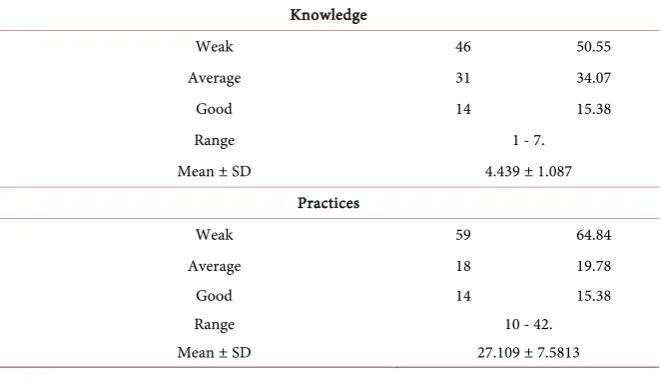
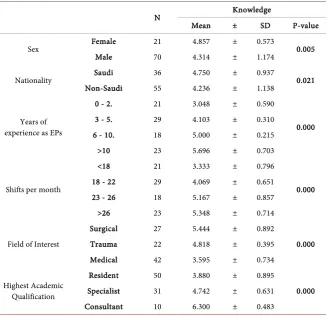
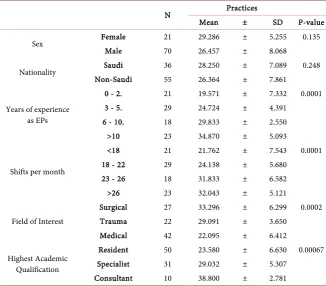
DOI: 10.4236/ojem.2017.53009 97 Open Journal of Emergency Medicine take less than 22 shifts per month. He is complaining of mild headache and nausea. About 54% of our participants answered our question as minor head in-jury, 36.7% answered that the case as a moderate head inin-jury, 7.8% described the case as severe head injury while 1.1% described it a massive head injury. Re-garding the management for this patient, 24% of our participants would admit this patient for observation while 63.7% would order head CT scan. About 5% would consult a neurosurgeon and lastly 6.6% would discharge the patient with instructions. Regarding exposure to trauma patients, 45% of our participants are used to see less than 10 patients suffering from head injury per month, 13.5% are used to see between 10 - 15 cases of head injuries while 41.6% are used to see 15 cases or more of head injuries per month. About the question “how frequent would you request head CT scan in case of trauma patients”, the answers were as follow: 5.5% of them will always request head CT scan, 23% mostly request, 18.7% sometimes request and 4.4% rarely request head CT scan for trauma pa-tients. Almost half of the participants will request head CT scan whenever they suspect head injury. Our EPs were asked whether they have ever heard about any clinical decision rules for minor head trauma or not. 54% had answered yes while 45.6% had answered no. For those who answered with yes, they were also asked what clinical decision rule they are using. Most commonly used guideline was Canadian CT Head Rule in more than 42%. Second most common used rule was CT in Head Injury Patients (CHIP). Interestingly, almost 19% indicates that they are using their own experience. The application of any clinical decision rule was assessed in our survey and the result showed that 43% of our participants are always applying clinical decision rule into their practice and 44% most of the times. When we assessed knowledge and practice, majority were weak with 50% and 65% respectively (Table 1). By using Chi-square t-test, there were statistically significant differences between knowledge and sex, nationality, years of expe-rience, duty load, field of interest and highest academic qualifications (Table 2). In contrast, practice was statistically significant with sexes and nationality (p =
Table 1. More than 50% of participants were weak in both knowledge and practice.
Knowledge
Weak 46 50.55
Average 31 34.07
Good 14 15.38
Range 1 - 7.
Mean ± SD 4.439 ± 1.087
Practices
Weak 59 64.84
Average 18 19.78
Good 14 15.38
Range 10 - 42.
DOI: 10.4236/ojem.2017.53009 98 Open Journal of Emergency Medicine
Table 2. Descriptive statistical analysis of study variables versus knowledge.
N Knowledge
Mean ± SD P-value
Sex Female 21 4.857 ± 0.573 0.005
Male 70 4.314 ± 1.174
Nationality Saudi 36 4.750 ± 0.937 0.021
Non-Saudi 55 4.236 ± 1.138
Years of experience as EPs
0 - 2. 21 3.048 ± 0.590
0.000
3 - 5. 29 4.103 ± 0.310
6 - 10. 18 5.000 ± 0.215
>10 23 5.696 ± 0.703
Shifts per month
<18 21 3.333 ± 0.796
0.000
18 - 22 29 4.069 ± 0.651
23 - 26 18 5.167 ± 0.857
>26 23 5.348 ± 0.714
Field of Interest
Surgical 27 5.444 ± 0.892
0.000
Trauma 22 4.818 ± 0.395
Medical 42 3.595 ± 0.734
Highest Academic Qualification
Resident 50 3.880 ± 0.895
0.000 Specialist 31 4.742 ± 0.631
Consultant 10 6.300 ± 0.483
0.135, 0.248) respectively, while other factors did not show any significant rela-tions (Table 3). In our study, the awareness and utilization rate of clinical deci-sion rules between ER physicians were 54.4% and 42.2% respectively, while 45.6% of ER physicians are unaware of any clinical decision rules. However, 91.1% of those physicians would like to receive guidance on how to learn more about one of these guidelines. Our scenario supports our findings.
4. Discussion
DOI: 10.4236/ojem.2017.53009 99 Open Journal of Emergency Medicine
Table 3. Descriptive statistical analysis of study variables versus practice.
N Practices
Mean ± SD P-value
Sex Female 21 29.286 ± 5.255 0.135
Male 70 26.457 ± 8.068
Nationality Saudi 36 28.250 ± 7.089 0.248
Non-Saudi 55 26.364 ± 7.861
Years of experience as EPs
0 - 2. 21 19.571 ± 7.332 0.0001
3 - 5. 29 24.724 ± 4.391
6 - 10. 18 29.833 ± 2.550
>10 23 34.870 ± 5.093
Shifts per month
<18 21 21.762 ± 7.543 0.0001
18 - 22 29 24.138 ± 5.680
23 - 26 18 31.833 ± 6.582
>26 23 32.043 ± 5.121
Field of Interest
Surgical 27 33.296 ± 6.299 0.0002
Trauma 22 29.091 ± 3.650
Medical 42 22.095 ± 6.412
Highest Academic Qualification
Resident 50 23.580 ± 6.630 0.00067 Specialist 31 29.032 ± 5.307
Consultant 10 38.800 ± 2.781
When we compared our survey with the above-mentioned studies, we found that there are discrepancies and varieties between our result and the other stu-dies (Table 4). In survey from China, fear of malpractice was the leading ob-stacle for the use of CCHR by 48.5%, followed by “pressure from administration to order more examinations” and “lack of knowledge about the radiation risk of CT”, which were 29.5% and 27% respectively. In our study, the two most com-mon limiting factors were the working environment and the possible increases in the risk of lawsuits by 55.4% and 61.7% respectively. However, 90% of our respondents believe that by utilizing the rules, there will be an improved usage of resources and patients will gain more benefits. Since the physician-patients rela-tionship getting increasingly difficult, ordering CT scans for minor diseases is not uncommon practice [11]. That would explain the increasing numbers of head CT scans requested for minor head trauma as to confront patients and to avoid malpractice. In some setting, defensive medicine accounts for 1 out of 5 examinations [12]. The international survey conclude that the awareness of CCHR was highest in Canada and lowest in United States and that would be ex-plained by the application of different rules as “it is the most commonly cited reason” [10]. For instance, most of physicians who participate in the survey from United Kingdom are using National Institute for Clinical Excellence (NICE).
5. Conclusion
DOI: 10.4236/ojem.2017.53009 100 Open Journal of Emergency Medicine
Table 4. Comparison between or study and the Chinese [5] and International [10]
stu-dies.
Our survey The Chinese survey The international survey
Male gender 77% 70.9% 71%
Awareness of CCHR 54.4% 41.7% USA AU UK CA
31% 82% 66% 86% Utilization rate 42.2% 24.7% 12% 32% 21% 57%
head injury, which led to request more CT scans despite head injury being one of the most common system involved in trauma. This will be a burden on the healthcare system and will lead to more radiation exposure. Our study also showed that working environment makes utilization of head CT rules difficult to follow and would increase numbers of lawsuits. These two factors are considered limiting reason for not applying the commonly used guidelines in minor head injury. Definitely, extra educational efforts should be conducted to improve the utilization of resources, reduce risk of radiation and DO NO harm to patients.
Limitations
There are some limitations to this study. Sample size was small with few num-bers of consultants. We believe it should be a national survey to get better valid results.
References
[1] Faul, M., Xu, L., Wald, M.M. and Coronado, V.G. (2010) Traumatic Brain Injury in the United States: Emergency Department Visits, Hospitalizations and Deaths 2002-2006. Centers for Disease Control and Prevention, National Center for Injury Prevention and Control, Atlanta.
[2] Stiell, I.G., Wells, G.A. and Vandemheen, K. (2001) The Canadian CT Head Rule for Patients with Minor Head Injury. Lancet, 357, 1391-1396.
https://doi.org/10.1016/S0140-6736(00)04561-X
[3] Galbraith, S. (1976) Misdiagnosis and Delayed Diagnosis in Traumatic Intracranial Haematoma. BMJ, 1, 1438-1449. https://doi.org/10.1136/bmj.1.6023.1438
[4] Larson, D.B., Johnson, L.W. and Schnell, B.M. (2011) National Trends in CT Use in the Emergency Department: 1995-2007. Radiology, 258, 164-173.
https://doi.org/10.1148/radiol.10100640
[5] Huang, X., Zhou, J.C., Pan, K.H. and Zhao, H.C. (2013) Awareness and Use of the Canadian Computed Tomography Head Rule for Mild Head Injury Patients among Chinese Emergency Physicians. Pakistan Journal of Medical Sciences, 29, 951-956. https://doi.org/10.12669/pjms.294.3469
[6] Miller, E.C., Derlet, R.W. and Kinser, D. (1996) Minor Head Trauma: Is Computed Tomography Always Necessary? Annals of Emergency Medicine, 27, 290-294. https://doi.org/10.1016/S0196-0644(96)70261-5
DOI: 10.4236/ojem.2017.53009 101 Open Journal of Emergency Medicine 9-15. https://doi.org/10.1227/00006123-199301000-00002
[8] Haydel, M.J. (2005) Clinical Decision Instruments for CT Scanning in Minor Head Injury. JAMA, 294, 1551-1553. https://doi.org/10.1001/jama.294.12.1551
[9] Stiell, I.G., Clement, C., Rowe, B.H., et al. (2005) Comparison of the Canadian CT Head Rule and the New Orleans Criteria in Patients with Minor Head Injury.
JAMA, 294, 1115-1518. https://doi.org/10.1001/jama.294.12.1511
[10] Eagles, D., Stiell, I.G. and Clement, C.M. (2008) International Survey of Emergency Physicians’ Awareness and Use of the Canadian Cervical-Spine Rule and the Cana-dian Computed Tomography Head Rule. Academic Emergency Medicine, 15, 1256- 1261. https://doi.org/10.1111/j.1553-2712.2008.00265.x
[11] Wong, A.C., Kowalenko, T. and Roahen-Harrison, S. (2011) A Survey of Emergency Physicians’ Fear of Malpractice and Its Association with the Decision to Order Computed Tomography Scans for Children with Minor Head Trauma. Pediatric
Emergency Care, 27, 182-185. https://doi.org/10.1097/PEC.0b013e31820d64f7
[12] Swensen, S.J. (2012) Patient-Centered Imaging. American Journal of Medicine, 125, 115-117. https://doi.org/10.1016/j.amjmed.2011.06.002
Submit or recommend next manuscript to SCIRP and we will provide best service for you:
Accepting pre-submission inquiries through Email, Facebook, LinkedIn, Twitter, etc. A wide selection of journals (inclusive of 9 subjects, more than 200 journals)
Providing 24-hour high-quality service User-friendly online submission system Fair and swift peer-review system
Efficient typesetting and proofreading procedure
Display of the result of downloads and visits, as well as the number of cited articles Maximum dissemination of your research work
Submit your manuscript at: http://papersubmission.scirp.org/
![Table 4. Comparison between or study and the Chinese [5] and International [10] stu-dies](https://thumb-us.123doks.com/thumbv2/123dok_us/7733206.706253/8.595.207.538.102.192/table-comparison-study-chinese-international-stu-dies.webp)
