Munich Personal RePEc Archive
A model for estimation of the demand
for on-street parking
Madsen, Edith and Mulalic, Ismir and Pilegaard, Ninette
Technical University of Denmark, Technical University of Denmark,
Technical University of Denmark
16 December 2013
A model for estimation of the demand for
on-street parking
Edith Madsen, Ismir Mulalic and Ninette Pilegaard
Technical University of Denmark
December 16, 2013
Abstract
This paper presents a stylized econometric model for the demand for on-street parking with focus on estimation of the elasticity of de-mand with respect to the full cost of parking. The full cost of parking consists of a parking fee and the cost of searching for a vacant parking space (cruising). The cost of cruising is usually unobserved. Ignoring this issue implies a downward bias of the elasticity of demand with re-spect to the total cost of parking since the cost of cruising depends on the number of cars parked. We also demonstrate that, even when the cost of cruising is unobserved, the demand elasticity can be identi…ed by extending the econometric model to include the spatial interaction between the parking facilities. We illustrate the model with on-street parking data from Copenhagen and …nd indications of a somewhat greater parking demand elasticity than is usually reported in the lit-erature.
Keywords: on-street parking, demand estimation.
JEL classi…cation: C51, R41, L91.
1
Introduction
Cities around the world use parking policies to regulate the demand for on-street parking and, to some extent, also the level of urban congestion. It is therefore of relevance to estimate the sensitivity of the demand for on-street parking to cost. The full cost of parking (the generalised cost of parking) consists of a parking fee and in addition the cost of searching for a vacant parking space (cruising). The cost of cruising is typically unobserved,1 but
ignoring it biases the estimate of the demand elasticity because the cost of searching for a vacant parking space depends on the number of cars parked, i.e. the demand for parking. This paper proposes a solution to this problem. We formulate an econometric model with both parking fees and cruising for parking as arguments for the demand elasticity for parking. We show how this demand elasticity can be identi…ed, even in situations where cruising for parking is unobserved, when the model is extended to include spatial interaction between the parking facilities.
The economic literature has shown a growing interest for regulatory park-ing policies. Verhoef et al. (1995) analyse di¤erent parkpark-ing policies as a substitute to road pricing and …nd that the use of parking fees is superior to physical restrictions on parking space supply. Fosgerau & de Palma (2013) show that workplace parking charging schemes can be used as a substitute for the time-varying toll to reduce urban congestion. Moreover, it is typically argued, that parking should be priced at its opportunity cost, just like any other commodity. Arnott et al. (2005) identify a potential triple dividend from optimal parking pricing: reduced cruising for parking, reduced conges-tion (travel time savings), and the use of parking revenues to lower other taxes (reduced deadweight loss caused by tax distortions). However, in real life parking facilities are often underpriced (Small & Verhoef, 2007). This underpricing leads to cruising for parking which is a pure loss from a social welfare perspective (Shoup (2005) and Calthrop & Proost (2006)). Arnott & Inci (2006) argue that parking pricing (especially hourly parking fees)
1One exception is Van Ommeren et al. (2012) that examines cruising for parking.
has also the downside that it can increase congestion by implying shorter parking durations and thus increase tra¢c congestion by increasing parking turnover. Arnott et al. (2012) examine the optimal level of curbside parking capacity when both urban transport and curbside parking are underpriced and consider the situation where there is garage parking as alternative to the curbside.
Despite the comprehensive treatment of parking pricing, including the dependence of the costs of cruising on the number of cars parked, in the the-oretical urban economics literature (see e.g. Anderson & de Palma (2004)), there is a rather surprising absence of accurate empirical estimates of the e¤ect of the cost of parking on the demand for parking. This e¤ect is im-portant as it is required for a rigorous welfare analysis of a parking policy. Several studies estimate the price elasticity of demand for parking ignoring the cost of cruising (see e.g. Kelly & Clinch (2009) and Hensher & King (2001)). Hence, there is a knowledge gap between the theoretical and empir-ical literature. This paper goes some way toward …lling this gap.
Many cities collect citywide parking data which usually includes the oc-cupancy rates (the number of cars parked divided by the number of parking spaces) and the parking fees.2 In this paper, we illustrate our model with
data provided by the city of Copenhagen, covering on-street parking in the city of Copenhagen, which is a high-density area with strong parking capacity constraints as often present in high-density metropolitan areas and historical city centres. This paper provides a framework to clarify the identi…cation of the e¤ect of the cost of parking consistent with the underlying economic theory. The framework is suitable for the parking data often collected. We discuss also the implications for estimation. We show that if only parking fees are observed, the e¤ect of the cost of parking cannot be identi…ed using a reduced form parking demand equation. In addition the e¤ect of the parking fee is always less than the e¤ect of the cost of parking in absolute value. We also show that the e¤ect of the cost of parking can be identi…ed, even if the
2See e.g. Institute of Transportation Engineers (2012), Puget Sound Regional Council
cost of cruising is unobserved, by extending the econometric model to include the spatial interaction between the parking facilities (streets). If both the costs of searching for parking and the parking fees are observed the e¤ect of the cost of parking can be estimated using instrumental variable techniques. The next section introduces an econometric model for the demand for on-street parking; Section 3 presents the empirical illustration and Section 4 concludes.
2
An econometric model of the demand for
parking
In this section we specify an econometric model for the demand for on-street parking. First, in Section 2.1, we describe a very simple model without spatial interactions. Then, in Section 2.2, we consider an extension of the model that takes the spatial interaction into account.
For both models, the demand for on-street parking is described in terms of the occupancy rate, i.e. the number of parked cars relative to the number of legal parking lots. The supply of parking lots is assumed to be constant and thus, the occupancy rate re‡ects the demand for on-street parking. There is no modelling of external factors a¤ecting the demand for parking by e.g. a¤ecting the overall tra¢c demand or number of cars. In this way, the model proposes a partial description without interaction with other sectors. We also simplify by ignoring the e¤ect on the demand for on-street parking of other parking alternatives (e.g. private parking houses). We suggest that this e¤ect is small and thus of little importance, see Section 3.1.
2.1
A simple model
parking spaces) be given by
Oit = i+ cit+"it (1)
cit = pit+S(Oit) (2)
where cit is the total cost of parking in street i at period t, i is a
street-speci…c …xed e¤ect, and"itis an idiosyncratic error term. The costcitconsists
of a direct cost pit (a parking fee) and an indirect cost,S(Oit), that re‡ects
the searching costs (cruising) and depends on the occupancy rateOit. In line
with the literature we assume that the searching cost functionS( )is increas-ing in the occupancy rate, see e.g. Anderson & de Palma (2004). Altogether equations (1)-(2) express that an increase in the parking fee reducesOit and
thus increases the number of vacant parking spaces; this in turn implies a lower cruising time and by that a lower cost of searching. The speci…cation highlights the fact that the cost of searching, and by that the cost cit, is an
endogenous variable in the parking demand equation.
In our dataset, we do not have any information on searching in terms of time and costs and therefore we will specify the functional relationship between the searching costs and the occupancy rate in order to arrive at a reduced form equation for Oit (see below). It is important to note that if
we did have information on searching then the total cost of parking cit could
be calculated and a valid instrument for cit would be the parking fee pit.
Consequently, the parameter could be estimated by IV estimation.
to a change in demand. We …nd that this assumption is reasonable in most empirical applications to on-street parking. Typically, these adjustments are a result of some political decisions rather than demand reactions.3
In order to obtain a reduced form equation for the parking demand in terms of the occupancy rate Oit we need to specify how the searching costs
depend on the occupancy rate. We assume that the costs of searching are linear in the occupancy rate:
S(Oit) = a+bOit whereb >0 (3)
Using(3)it is straightforward to show that the reduced form equation implied by equations (1)-(2) is
Oit = ~i+ ~pit+ ~"it (4)
where ~i = ( i+a )=(1 b ), ~ = =(1 b ) and ~"it ="it=(1 b ). For
< 0 then ~ 2 ] ;0] since b > 0 such that the parameter corresponding to pit in the reduced form equation is less than in absolute value. The
parameter describes the total e¤ect of increasing the parking fee. The direct e¤ect is that it will decrease the demand for parking and the indirect e¤ect is that this in turn will decrease the searching cost which will increase the demand for parking. The larger the value ofb the smaller the absolute value of the total e¤ect. From this reduced form equation it is not possible to identify the parameter in the demand equation and the parameters a and
b in the searching cost function separately. However, if the costs of searching are piecewise linear in the occupancy rate then all parameters are identi…ed if there are streets where the occupancy rate is below a threshold value of the occupancy rate where the cost of searching is zero (see Appendix A).
Obviously, the assumption about the searching cost being linear in the occupancy rate is strong and a more realistic assumption would be that the marginal cost of searching is increasing in the occupancy rate. This could for example be modelled as S(O) = c=(1 O)wherec >0as done in Anderson & de Palma (2004). However, this will lead to a more complicated reduced
3This is reasonably to be the case for our illustrative example from the city of
form equation for the occupancy rate which is not useful in empirical work.
2.2
Spatial interaction between the parking facilities
The framework in Section 2.1 assumes that the demand for parking in a speci…c street is independent of the cost of parking in all other streets. This assumption is obviously not likely to hold in practice since the demand for parking in a speci…c street expectedly will also depend on the cost of parking in neighboring streets. We now extend the model to allow for this. More formally, we assume that the demand for parking in streetidepends on both the cost of parking in street i and on the cost of parking in neighboring streets j 6=i. As before, the cost of parking consists of a parking fee and a searching cost which is increasing in the occupancy rate. The demand for parking in street iat time t is now given by:
Oit = i+ cit+
X
j6=i
wijcjt+"it (5)
cjt = pjt+S(Ojt) (6)
The parameter corresponding to the term Pj6=iwijcjt in equation (5)
de-scribes how the demand for parking in a speci…c street is a¤ected by the costs of parking in neighboring streets. The spatial weights wij for j 6=i are
prespeci…ed and each weight de…nes the exact neighboring e¤ect of a speci…c street. We use the following geographically derived weights:
wij = exp ( dij) (7)
where dij is the the shortest route distance between streets i and j, and
>0 is a speci…ed constant (not a parameter that can be estimated). The weights are exponentially decreasing in the distance and approaches zero as the distance increases. We use the minimax normalization of the weights (a common scaling of all weights) and note that this normalization preserves the symmetry such that wij =wji. For a more extensive discussion of spatial
weights, see e.g. Anselin (1988) and Upton & Fingleton (1985).
the demand for parking in di¤erent streets as given by the spatial weights and the model parameters. The model implies the following own and cross elasticities with respect to the total parking cost:
eii
@Oit
@cit
=Oit cit
= cit
Oit
(8)
eij
@Oit
@cjt
=Oit cjt
= wij
cjt
Oit
(9)
Intuitively, we would expect >0 such that all other streets are substitutes for parking in one particular street. Everything else equal, the closer two streets are located to each other the higher the substitution e¤ect is, i.e
eij > eik for dij < dik since wij > wik. It is important to note that the
di¤erence in substitution e¤ect between two di¤erent streets is determined by the parameter which is prespeci…ed and not estimated. In this study, the parameter is set at 10. This implies that spatial weights are close to zero (<0.1) for streets more than 0.5 kilometres away. The need to specify the spatial structure a priori is obviously a limitation in all spatial models, see Gibbons & Overman (2012) for a discussion of this.
As our dataset does not contain information on searching time or search-ing cost, equations(5)-(6)cannot by used directly in estimation. Instead our approach is to impose assumptions on the relationship between the searching cost and the occupancy rate and use that to reach a reduced form equation that can be estimated. As equation (3) in Section 2.1 we assume that the costs of searching are linear in the occupancy rate, i.e. S(O) =a+bO. Using this, equations (5)-(6) can be written as (in matrix notation):
Ont = ~n+ ~pnt+ ~Wnpnt+ WnOnt+ ~"nt (10)
where the n-vector ~n have elements ( i +a +a Pj6=iwij)=(1 b ),
pa-rameters are de…ned as ~ = =(1 b ), ~ = =(1 b ) and = b~, the weight matrix Wn has elements wij and zeros in the diagonal, and the error
term ~"nt is iid N 0;~ 2
In with ~ 2
= 2
=(1 b )2
across t = 1; :::; T. This is the standard Spatial Durbin Model (SDM) with …xed e¤ects ~n,
WnOnt, see e.g. LeSage & Pace (2009). Like in the simple framework of
Section 2.1 the parameters of main interest, and in equation(5), do not appear as parameters in the SDM model and as before we have that when
<0; >0and b > 0then ~ 2] ;0] and ~ 2[0; [. Therefore estimates of
~ and ~will underestimate the marginal e¤ects of increasing parking costs
and . However, the parameters ; and b can be obtained as functions of the parameters ~;~ and and hence the parameters and in the demand for parking equation (5) can be estimated. See Appendix B for details.
Estimation of equation (10) is performed by maximum likelihood as de-scribed in Lee (2004). In addition, Lee (2004, 2007) investigates the sources of identi…cation and various reasons of failure to identify the model parame-ters in di¤erent versions of spatial autoregressive (SAR) models. It is shown that in case the exogenous regressors (in our casepntandWnpnt) and the
spa-tially lagged regressor are colinear the source of identi…cation will be coming from the covariance structure of the error terms. This in turn implies that the covariance structure of the error term in equation(10) must be correctly speci…ed. In our case we assume that the elements in the error term are independent acrossi; t with constant variance. Obviously, identi…cation that relies on variation in exogenous variables is more appealing since assumptions imposed on the error term such as constant variance are somewhat arbitrary. The problem is discussed in a recent paper by Gibbons & Overman (2012) and is similar to the identi…cation problem in models where the outcome vari-able depends on some expected value of the outcome varivari-able, the re‡ection problem, see Manski (1993).
3
Empirical illustration
This section of the paper presents an illustration of the application of the econometric model. We use parking data from the city of Copenhagen. With this it is in principle possible to test the model and estimate demand elasticity of parking with respect to the full cost.
Section 3.1 describes the parking market in the city of Copenhagen. It also includes a discussion of a number of key assumptions that underlie the identi…cation of the model and the interpretation of its parameters. The data set provided by the city of Copenhagen for the analysis is described in Section 3.2 and estimation results are discussed in Section 3.3. We discuss our …ndings on the parking price elasticity, relate our result to the estimates provided by the existing literature and conclude the section by discussing the results obtained from estimation of a standard spatial model with street-speci…c …xed e¤ects.
3.1
Parking in the city of Copenhagen
About two-third of the parking spaces in the city of Copenhagen are on-street an hence this is the dominating way of parking (Københavns Kom-mune (2012)). The city of Copenhagen has, as many other larger cities, a long history of paid parking (both for publicly provided as well as privately provided parking places). In 1990 the city of Copenhagen initiated a new system for payments for parking, where the central city was divided into dif-ferent zones. The principles of this system is still used today. The purpose with the system was to reduce the tra¢c and the number of parked cars in the city, especially commuting in cars to workplaces in central Copenhagen (Københavns Kommune, 2009). In the zonal system all on-street parking is charged a fee depending on the duration of the parking, time of the day and the location of the zone. The zones closest to the historical city center are more expensive. Many other European cities use similar systems where payment for on-street parking varies across zones and time-intervals.
was to reduce cruising for parking. In the following years the city authori-ties increased the parking fees by 1 DKK a year (in nominal terms) without taking into account the development in the occupancy rates and hence not as a reaction on the demand.4
At present the zonal system covers three zones: red is the city center with few residents and many shops, restaurants and o¢ces, green and blue have more residents. These zones has been in use since 2007.
3.2
The data
The data used in the empirical analysis is provided by the city of Copenhagen. The data is census data and covers the years 2008-2011 with semi-annual census (in April and September, starting with September 2008). In total we have 6 census and for each census there are three daily counts (at 12:00, 17:00 and 22:00). The census covers the central Copenhagen (the four parking zones). For all streets in this area we know the number of legal parking spaces as well as the number of occupied spaces, for each of the three daily counts. We do not have information about cruising costs or cruising time. Furthermore, we do not have information about alternative parking (e.g. private parking houses and workplace parking).
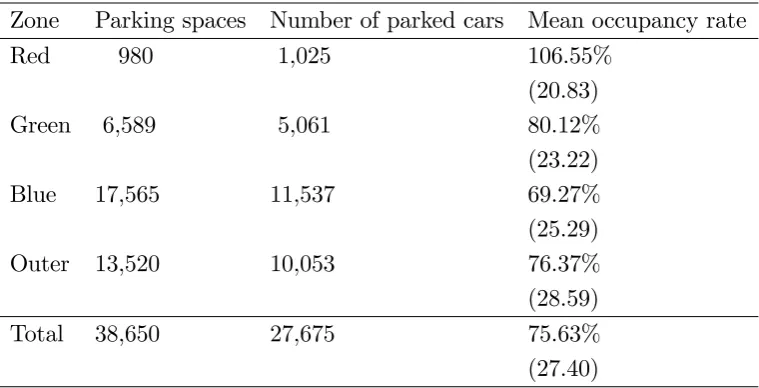
Table 1 shows the number of parking lots, the number of parked cars, and the mean occupacy rates for the four parking zones (772 streets) recorded in April 2011. The number of parking spaces and the distribution among the zones are almost the same in the three years that we consider.
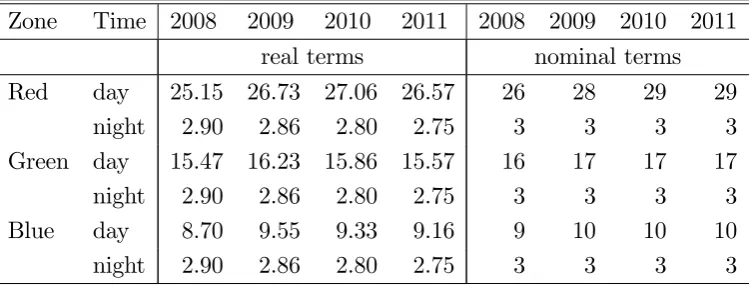
The parking fees for the zones are shown in Table 2. The parking fee for the red zone (the city center) is almost three times as high as for the blue zone. Outside the three zones (the outer) there are generally no fees for parking. We also see that the real prices have been almost constant for the years 2008-2011. This obviously represents a limitation for the econometric analysis.
4Special rules apply for residents in a parking zone such that residents are able to park
close to their homes on very favorable conditions. The price of a resident parking permit is about e 90 per year per car. The parking permit is connected to a speci…c car and
Table 1: Parking on-street, April 2011
Zone Parking spaces Number of parked cars Mean occupancy rate Red 980 1,025 106.55%
(20.83) Green 6,589 5,061 80.12% (23.22) Blue 17,565 11,537 69.27% (25.29) Outer 13,520 10,053 76.37% (28.59) Total 38,650 27,675 75.63% (27.40)
Notes: std. dev. are in paranthesis; censoring O=130%, 772 streets.
In the empirical analysis we have reduced the dataset in two ways. First, the three di¤erent time counts represent di¤erent tra¢c situations. For ex-ample, in the Danish National Travel Survey we see many shoppers and short term parkers at noon while residents are more dominating after work hours. For the following empirical analysis we choose to use the …gures from the noon count (12:00 am). Second, the dataset provides the number of occu-pied spaces as well as the number of legal parking spaces for each street. With this information we can calculate the occupancy-rate for each street. Note that the occupancy rate can be above 100%. This is possible since the number of legal parking lots is rarely physically marked and thus it is possible to deviate from the estimated number depending on the size of the cars and the density of the standard size of parked cars. Because of this we accept an occupancy rate above 100% in our dataset but choose to censor the occupancy rates above 130%.5
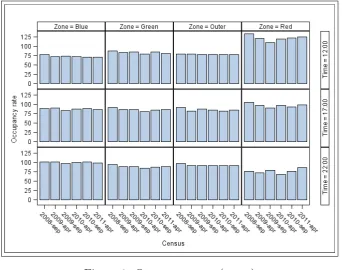
Figure 1 shows that the mean occupancy rate for red zone (central Copen-hagen) is above 100% which indicates that there is generally no excess supply
5This rule of censoring occupancy rates above 130% is based on the
Table 2: Parking fees (DKK/hour)
Zone Time 2008 2009 2010 2011 2008 2009 2010 2011 real terms nominal terms Red day 25.15 26.73 27.06 26.57 26 28 29 29
night 2.90 2.86 2.80 2.75 3 3 3 3 Green day 15.47 16.23 15.86 15.57 16 17 17 17 night 2.90 2.86 2.80 2.75 3 3 3 3 Blue day 8.70 9.55 9.33 9.16 9 10 10 10 night 2.90 2.86 2.80 2.75 3 3 3 3
Notes: 1 DKK = 0.13e.
of parking places in the zone, i.e. empty spots will generally be …lled im-mediately and thus cruising for parking is present. For the green and blue zones as well as for the outer zone we also …nd very high occupancy rates at all times of the day indicating little or no excess supply and potentially cruising for parking. We also note that the occupancy rates are highest in the red zone at the 12.00 am (noon) count implying that crusing for parking is present in the data we use in our analysis.
3.3
Empirical results
We now describe the empirical results. We …rst present our …ndings on the parking price elasticity. Next, we discuss the results obtained from estimation of a standard spatial model with street-speci…c …xed e¤ects.
First, we estimate the simple model with the reduced form equation for the demand for on-street parking based on (4) in terms of the occupancy rate with the parking fee as explanatory variable as well as street-speci…c …xed e¤ect. Since the supply of on-street parking has been constant in the period of the observation, we interpret the e¤ect of the parking fee on the occupancy rate as a demand e¤ect.
Figure 1: Occupancy rate (mean)
cost sensitivity and the shoppers are more dominating among the parkers at noon.
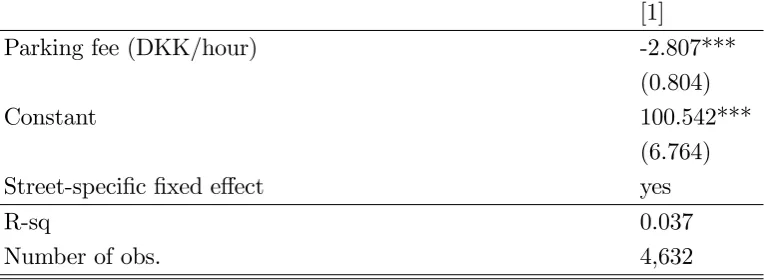
Table 3 shows the estimation results. As we expected, an increase in the parking fee decreases demand for on-street parking. The parameter as-sociated with the parking fee (e) is estimated to 2:807. The parameter estimate is tight and indicates a plausible e¤ect. The 95% con…dence in-terval is estimated to be from 4:383 to 1:234. Moreover, an F-test on the joint signi…cance of the included street-speci…c …xed e¤ect indicates that the e¤ects are signi…cant (F(771;3859) = 14:94). It means that demand for on-street parking varies across streets in the city of Copenhagen, i.e. the de-mand for on-street parking in a speci…c street is a¤ected by the time-invariant factors such as e.g. street attributes (e.g. one-way tra¢c), number of resi-dential units, the distance to the location of shopping and leisure activities, the number of residence parking permits, supply of public transport, etc.
The estimation result allows us to derive the parking fee elasticity.6 Notice
6The parking fee elasticity is de…ned as"O;p= @O @p p O =e
Table 3: Simple model for on-street parking in terms of the occupancy rate [1]
Parking fee (DKK/hour) -2.807*** (0.804)
Constant 100.542***
(6.764) Street-speci…c …xed e¤ect yes
R-sq 0.037
Number of obs. 4,632
Notes: dependent variable is the occupancy rate (%); censoring O=130%; *** indicates that estimates are signi…cantly di¤erent from zero at the 0.01 level; standard errors are in parentheses.
here that the parking fee elasticity is di¤erent from the elasticity of demand with respect to total cost of parking, since the total cost of parking consists of a parking fee and the cost of cruising. The parking fee elasticity in the red zone (the historical city center) at the sample average of the occupancy rate in the red zone (106:55%) and the parking fee of26DKK/hour (see Table 2) is 0:69, i.e. raising the parking fee in the red zone by 1% reduces demand for on-street parking in the historical city center by 0:69%. The parking fee elasticity for the blue zone at the sample averages of the occupancy rate in the blue zone (69:27%) and the parking fee of 10 DKK/hour is 0:41. However, these are underestimates of the parking demand elasticity because, as shown in section 2.1, the parameter corresponding to the parking fee in the reduced form equation (e) is less than the parameter corresponding to the total cost of parking ( )in absolute value.
a range from 0:6to 0:1for the parking demand elasticities (de…ned in his study as the percent change in demand of the percent change of parking costs or parking fees), with 0:3 being the most frequently cited value (see also TCRP (2005)). Kelly and Clinch (2009) report the average price elasticity of parking demand (where parking cost is de…ned as a parking fee per hour) of 0:29. Moreover, the interpretation of the parking fee elasticity strongly depends on the assumption with respect to the level of residential parking, because the estimate of the parking fee elasticity depends on the ratio of the average parking fee and the average occupancy rate. This occupancy rate is highly a¤ected by the amount of residential parking as a large number of parking spaces can be more or less permanently occupied by users with resident parking permits. Unfortunately, the information on the share of cars parked using the residential parking permit in the city of Copenhagen is not available. Based on some Danish experienced practitioners’ best guesses (di¤erent analyses conducted by the Municipality of Copenhagen and the bordering municipality Frederiksberg) this share is expected to be in the range of 10 30%. The parking fee elasticity is then closer to 1. This is also in line with the usual …ndings. Hensher and King (2001) propose parking price elasticity (the percent change in the probability of choosing to park in a given area of a one percent increase in the hourly parking fee) in the range from 1:02 to 0:48. Our …ndings indicate, that due to the cruising bias, the parking demand elasticity (the car drivers’ response to an increase in the total cost of parking) is most likely larger than proposed in the literature.
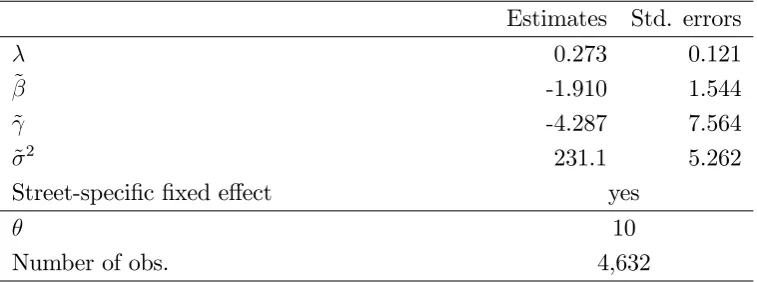
Estimation of the reduced form spatial model in equation(10) is in prin-ciple straight forward, see Section 2.2. However, in practice it turns out to be di¢cult because in our data set the parking fees at a given point in time are the same within a speci…c parking zone. This means that for streets where the distance to streets in other zones is large the variables pit and
P
j6=i!ijpjt are proportional. In our analysis where we have chosen = 10
this is the case for streets where the distance to other zones is greater than
Table 4: Spatial Durbin model for on-street parking in terms of the occupancy rate
Estimates Std. errors 0.273 0.121
~ -1.910 1.544
~ -4.287 7.564
~2
231.1 5.262 Street-speci…c …xed e¤ect yes
10 Number of obs. 4,632
Notes: dependent variable is the occupancy rate (%), censoring O=130%, 772 streets.
possible to estimate the corresponding parameters ~ and ~ precisely. Table 4 shows the results from the estimation. We see that the point estimate of
~ has the correct sign but the precision is poor. Moreover, the point
esti-mate of ~ has the wrong sign and again precision is poor. The cause of this …nding is the colinearity between pnt and Wnpnt. As shown in Appendix B
estimates of the parameters of interest b; and can be recovered from the parameter estimates in Table 4. However, given the wrong sign of ~ and the poor precision of estimates of ~ and ~ this is not feasible. Altogether, given the problems with the estimation of the spatial model caused by the limited variation in the exogenous variables we …nd that the results of our empirical analysis of the spatial model are not very informative. Obviously it would be of interest to perform the analysis using a data set with the appropiate amount of variation across time and across units in future work.
4
Conclusion
identi…cation of the e¤ect of the cost of parking (consisiting of the costs of searching for parking (cruising) and a parking fee) on the demand when the cost of searching is unobserved.
We illustrate the model using on-street data from the city of Copenhagen for the years 2008-2011. Limitations in the data prevents us from estimating the elasticity properly but our illustrations suggest that the parking demand elasticity is most likely larger than the one proposed in the literature.
Our …ndings have a number of implications. First it demonstrates that parking fees can potentially be a useful policy instrument to organize the parking market and to reduce the external costs of tra¢c such as congestion (cruising), air pollution, and other relevant local environmental externalities. It also demonstrates that, in line with the literature (see Arnott et al., 1991), a spatially di¤erentiated parking fee is necessary to induce the optimal park-ing pattern. Second, the proposed empirical methodology can be useful for the estimation of other similar reduced form demand equation describing the demand with the constrained capacity. In particular the reduced form de-mand equation resulting from a bottleneck model is a good example (see e.g. Arnott et al. (1993)). Finally, the proposed methodology makes it possible to make a straightforward extension of the demand model to include spatial interactions. In this way many of the identi…cation problems in applied spa-tial economics can be avoided.
Acknowledgement 1 The authors thank Mogens Fosgerau, Jos Van
5
Appendices
5.1
Appendix A
Assume now that the costs of searching are piecewise linear in the occupancy rate
S(Oit) =
0 if Oit<
a+bOit if Oit
(A.1)
It means that the cost of searching is zero when the occupancy rate is less than a threshold value (e.g. = 70%) and linear and increasing for values above . This might be a more realistic assumption than having the costs being linear in the occupancy rate since if the occupancy rate is low then there will be empty parking spaces and the cost of searching is zero. The threshold value at re‡ects that if the occupancy rate is above this level then it is more likely that all spaces are occupied which implies cruising. Note also that, as emphasised by Arnott & Inci (2006), given perfect information about parking spaces and optimal pricing of parking, cruising time is (close to) zero.
The reduced form for the eq.(A.1) is now given by
Oi =
i+ pi if pi ( i)=
i+a
1 b + 1 b pi if pi <( i)=
(A.2)
In this case all parameters are identi…ed if there are streets where the occu-pancy rate is less than . This identi…cation strategy utilises the fact that the expression is non-linear in the exogenous variable. The di¢culty is re-lated to the correct censoring of the occupancy rate. The threshold value should be selected at the level at which the cost of searching turns to zero.
5.2
Appendix B
equation (10). The following holds:
b =
~
= ~ 1 + =(~~)
= ~ ~ 1 + =(~~)
References
Anderson, S.P. and A. de Palma. 2004. The economics of pricing parking. Journal of Urban Economics 55, 1-20.
Anselin, L. 1988. Spatial Econometrics: Methods and Models. Kluwer Aca-demic, Dordrecht.
Arnott, R., A. de Palma and R. Lindsey. 1993. A Structural Model of Peak-Period Congestion: A Tra¢c Bottleneck with Elastic Demand. The American Economic Review, vol.83(1), pp. 161-179.
Arnott, R., T. Rave and R. Schöb. 2005. Alleviating Urban Tra¢c Conges-tion. Cambridge, MA, MIT Press.
Arnott, R. and E. Inci. 2006. An integrated model of downtown parking and tra¢c congestion. Journal of Urban Economics 60, 418-442.
Arnott, R., E. Inci and J. Rowse. 2012. Downtown Curbside Parking Capac-ity, CESifo Working Paper No. 4085.
Arnott, R., A. de Palma and R. Lindsey. 1991. A temporal and spatial equi-librium analysis of commuter parking. Journal of Public Economics 45, 301-335.
Felsburg Holt & Ullevig. 2009. Tennyson street study area – parking analysis. Prepared for City and County of Denver. http://www.denvergov.org/Portals/706/documents/Tennsyson%2038th-45th%20Parking%20Analysis%20Oct%2009.pdf (accessed 18/11/2012).
Fosgerau, M. and A. de Palma. 2013. The dynamics of urban tra¢c conges-tion and the price of parking. Journal of Public Economics, forthcoming.
Gibbons, S. and H. Overman. 2012. Mostly pointless spatial econometrics. Journal of Regional Science, vol. 51(2), pp. 172-191.
Glazer, A. and E. Niskanen. 1992. Parking fees and congestion. Regional Science and Urban Economics, 22, 123-132.
Hensher, D.A. and J. King. 2001. Parking demand and responsiveness to sup-ply, pricing and location in the Sydney central business district. Trans-portation Research A 35 (3), pp. 177–196.
Institute of Transportation Engineers. 2012. Parking Occupancy - Inde-pendent Variables. http://www.ite.org/parkinggeneration/variables.asp (accessed 18/11/2012).
Kelly, J. and J.P. Clinch. 2009. Temporal variance of revealed preference on-street parking price elasticity. Transport Policy 16, pp. 193-199.
Københavns Kommune, 2012. Københavns kommunes parkeringsinforma-tion. www.kk.dk/borger/byogtra…k/parkering (accessed 18/11/2012).
Københavns Kommune, 2009. Adfærdsregulering af tra…kken og parkeringen. Notat 10-03-2009, Teknik- og miljøforvaltningen.
Lee, L. 2004. Asymptotic distribution of quasi-maximum likelihood estima-tors for spatial autoregressive models. Econometrica 72(6), 1899-1925.
Lee, L. and J. Yu. 2010. Estimation of spatial autoregressive panel data models wih …xed e¤ects, Journal of Econometrics 154, 165-185.
LeSage, J. and R. K. Pace. 2009. Introduction to Spatial Econometrics. Chap-man and Hall.
Manski, C. F. 1993. Identi…cation of endogenous social e¤ects: The re‡ection problem. Review of Economic Studies 60, 531–542.
Marsden, G. 2006. The evidence base for parking policies—a review. Trans-port Policy 13, pp. 447-457.
NYC Department of Transportation. 2009. PARK Smart Greenwich Village Pilot Program – Results. http://www.nyc.gov/html/dot/downloads/pdf/parksmart_gv_results _july09.pdf (accessed 18/11/2012).
Puget Sound Regional Council. 2012. Parking Inventory. http://www.psrc.org/data/transportation/parking-inventory/ (ac-cessed 18/11/2012).
Seattle Department of Transportation. 2011. Citywide paid parking study and 2011 rates. Technical re-port. http://www.seattle.gov/transportation/parking/docs/ ParkingStudyTechRep-…nal.pdf (accessed 18/11/2012).
Shoup, D.C. 2005. The high cost of free-parking. Planners Press, Chicago.
Small, K.A. and E. T. Verhoef. 2007. The economics of urban transportation. Routledge.
TCRP, 2005. Parking Prices and Fees: Traveler Response to Transporta-tion System Changes. Transit Cooperative Research Program Report 95. Transportation Research Board, Washington DC.
Van Ommeren, J.N., D. Wentink and P. Rietveld. 2012. Evidence on cruising for parking. Transportation Research Part A, vol. 46, 1, pp 123-130.