Akaroa2: Exploiting Network Computing by
Distributing Stochastic Simulation
G. C. Ewing and K. Pawlikowski
Department of Computer Science
D. McNickle
Department of Management
University of Canterbury Christchurch, New Zealand [email protected]
Abstract. In this paper we discuss an application of network comput-ing in the area of stochastic simulation. We focus on main programmcomput-ing issues associated with designing of the latest version of AKAROA2, a simulation package in which network computing is applied in a practical and user-friendly way. This implemention is based on Multiple Repli-cations In Parallel (MRIP) scenario of distributed simulation, in which multiple computers of a network operate as concurrent simulation engines generating statistically equivalent simulation output data, and submit-ting them to global data analysers responsible for analysis of the final results and for stopping the simulation. The MRIP scenario can achieve speedup equal to the number of processors used.
Keywords: distributed computing, distributed simulation, stochastic simulation
1
Introduction
The number of computer networks, and computers in these networks, has been growing exponentially. This has already led to creation of vast computing re-sources, linked by networks, but distributed all over the world. We observe a shift toward a new computing paradigm: from traditional, centralised comput-ing of tasks on scomput-ingle computers to network computcomput-ing [Computer Technology Research Co., 1998]. The latter means a network operating as a single virtual distributedcomputer. Network computing is a challenging research area [Clark et al., 1996]. Its results will certainly have significant impact on future computing practise, enabling high performance computing based on distributed computing resources of local area networks.
research and practise of Computer Science [Buchholz et al., 1997], Operations Research and Management, Manufacturing and Telecommunications. Our cur-rent interest is focused on network computing for simulating queuing and in-ventory processes. Such simulation studies are typically very computationally intensive and require large computing resources. Speeding up such performance evaluation studies by direct adoption of ideas taken from parallel processing, ie. by distributing a simulation model over multiple processors (a Single Repli-cation in Parallel, or SRIP, scenario of stochastic simulation [Pawlikowski et al., 1994]) has well-known limitations [Bagrodia, 1996] and its applications are strongly model-dependent. Although, in some instances, this approach can give quite significant speedup of simulation processes, it does not shorten the lengths of simulation runs since they depend on the assumed precision requirements of the final simulation results.
At the beginning of 1990s a new scenario of stochastic simulation, known as Multiple Replication in Parallel (MRIP) was independently proposed and implemented by research teams at Purdue [Rego and Sunderam, 1992], [Sun-deram, 1991] and at Canterbury [Pawlikowski, 1992]. In this scenario, multiple computers of a local area network cooperate as simulation engines: they execute statistically independent simulations of the same model, and submit their (raw) output data to global data analysers responsible for analysis of performance measures. Global analysers control the precision of the final results and, as such, are responsible for determining the time during which simulation engines are active.
As experimentally documented (for example, see [Ewing et al., 1997; Paw-likowski et al., 1998]), by running stochastic simulation in MRIP scenario, one can achieve speedup equal to the number of processors used as simulation en-gines, providing that the number of these engines does not exceed some, usually very large, number and an appropriate method of simulation output data anal-ysis is used. Unlike SRIP, the speed obtainable by MRIP is independent of the structural properties of the simulation model.
We designed a simulation package Akaroa, able to automatically generate and control processes activated during parallel stochastic simulation in MRIP scenario [Yau and Pawlikowski, 1993]. Since then our research activities in this area have been focused on: designing a more efficient and user-friendly version of Akaroa, development of a methodology for automatic coverage analysis (ie. qual-ity analysis of methods used for determining precision of distributed estimators), and increasing functionality of Akaroa by including other-than-mean estimators. The research has an interdisciplinary character, involving both computer science and statistics-related problems. Our work led us, for example, to discovery of a truncated Amdahl’s rule governing speedup of sequential stochastic simulation if it is run in the MRIP scenario [Pawlikowski and McNickle, 1998].
the implementation of a methodology [Pawlikowski et al., 1998a] proposed by us for ensuring the statistical correctness of distributed estimators used by Akaroa2.
2
Akaroa2 Architecture and User Interface
Akaroa2 is a re-designed and improved version of the original Akaroa (Akaroa1), described in [Yau et al., 1993]. Like Akaroa1, Akaroa2 is written in object-oriented C++ and runs on Unix workstations connected by a local area net-work. It offers fully automated parallel execution of ordinary simulation pro-grams, automated analysis of simulation output data and automated stopping of simulation when the final results reach the required precision.
2.1 Architecture
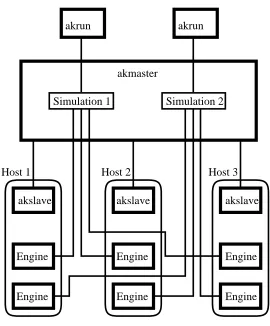
The Akaroa2 system consists of several components which can run as separate Unix processes on different computers of a network. The most important of these are known as akmaster, akslave, akrun and the simulation engines. Simulation engines are processes launched on multiple processors of a LAN, which generate streams of simulation output data in parallel.
Figure 1 illustrates The relationships between these components. In this fig-ure, each bold-outlined box represents one Unix process, and the connecting lines represent TCP/IP stream connections.
akmaster
akslave
Engine
Engine
Engine
Engine
Engine
Engine akslave akslave Simulation 1 Simulation 2
[image:3.612.229.364.361.524.2]Host 1 Host 2 Host 3 akrun akrun
Fig. 1. Akaroa2 architecture, showing two simulations in progress, each simulation having three engines running on separate network hosts.
running simulations, performs global analysis of the data produced by simulation engines, and makes simulation stopping decisions.
Akslaveprocesses run on hosts which are to run simulation engines. The sole function of the akslave is to launch simulation engine(s) on its host as directed by the akmaster. The akslave processes have been introduced because other methods of launching remote processes on various Unix machines (for example, by using rsh) tend to be slow and unreliable. The akslave has been carefully designed to accurately report whether the process launch was successful, and if not, to indicate the reason for failure.
The akrun program is used to initiate a simulation. Arguments to akrun specify the name of the simulation program to be run and any arguments to be passed to it, the relative precision and confidence level required of the results, the number of simulation engines to be launched, and various other options.
When akrun is used to start a simulation, it first contacts the akmaster process. The host’s name and port number of the akmaster process at this host is obtained from a file in the user’s home directory that the akmaster process has earlier created. The akrun process sends its arguments to the akmaster, which creates a new data structure for managing the simulation and assigns it a unique ID number. The simulation ID is reported to the user via the akrun process, so that it may be used in subsequent status enquiries.
For each simulation engine requested, the akmaster chooses a host from among those hosts on the LAN which are running akslave processes. It instructs the akslave on that host to launch an instance of the user’s simulation program, passing on any specified arguments.
The akslave process passes the host name and port number of the akmaster to the engine in an environment variable. The first time the simulation program calls one of the Akaroa2 library routines, the engine opens a connection to the akmaster process and identifies the simulation to which it belongs, so that the akmaster can associate the connection with the appropriate simulation data structure.
The Akaroa2 library code in the engine then creates a local data analyser for locally generated simulation output data, one for each analysed performance measure. If the simulation is declared as a simulation of steady-state behaviour of a system, then each local analyser initially monitors the length of thetransient stageof simulation, discarding all observations until it judges that the simulation has reached steady-state. It then enters theestimation stage, in which a selected analysis method is used to estimate a given performance measure and its sta-tistical precision. While Akaroa1 could be used for mean value analyses only, Akaroa2 has been extended to also allow analysis of proportions and quantiles [Lee et al,. 1998; Lee et al. 1998a].
variance is calculated from the the local estimates using the formulas
ˆ
µ= 1
n
N X
i=1
niµˆi (1)
ˆ
σ2(ˆµ) = 1
n2
N X
i=1
n2
iσˆi2(ˆµi) (2)
where ˆµi is the local estimate of the mean from enginei, ˆσ2i(ˆµi) is the local estimate of the variance of ˆµi, ni is the number of observations from engine i,
N is the number of engines andn=PNi=1ni.
There is one global analyser for each estimated performance measure. When-ever a new global estimate is calculated, the relative half-width of its confidence interval at an assumed confidence level is computed, and compared with the requested precision. When the precision of all analysed performance measures is within that requested, the akmaster instructs all the simulation engines to terminate and sends the final global estimates to the akrun process, which in turn reports them to the user.
Additional messages can pass between the various processes from time to time in response to important events, such as the success or failure of launching a simulation engine, or the unexpected loss of an engine. These messages ulti-mately arrive at the akrun process (or akgui – see section 2.4) which started the simulation, where they are reported to the user.
Random Numbers. Under MRIP, each engine should use pseudo-random numbers (PRNs) independent from those used by other engines. Consequently, in Akaroa2, random number generation is not left to the user’s simulation pro-gram. Instead, the akmaster process maintains a single PRN generator for each simulation, and distributes numbers from it to the engines as required.
Since the credibility of any performance evaluation study based on stochastic simulation depends on the quality of the PRNs used in the simulation, careful attention has been paid to the choice of PRN generators. Currently Akaroa2 uses 25 multiplicative congruential generators with modulusM = 231−1 whose multipliers are taken from the top of the list of over 200 generators recommended in [Fishman and Moore, 1986], plus another 25 whose multipliers are the inverses (modM) of the first ones. The latter generators have the same statistical prop-erties as the former ones, since they generate the same sequence of numbers but in the opposite order. More generators can easily be added if needed.
The akmaster process concatenates these 50 sequences into one sequence with a total length of about 1011numbers. This number of PRNs has so far been sufficient in our (computationally intensive) quality evaluation of the distributed estimators used in Akaroa2; see section 3.
receives a tuple (k, i, n) representing a segment of the total sequence of numbers of length n, beginning at number i of the sequence generated by multiplier
Ak. The engine has its own local generic PRN generator and a copy of the table of multipliers. It initialises the generator by setting x = Aik (mod M) and generates numbers locally until all n assigned numbers have been used, whereupon it requests a new block from the akmaster.
Interprocess Communication. Akaroa1 used UDP/IP datagrams to commu-nicate between processes. Since the UDP protocol does not guarantee reliable packet delivery, Akaroa1 spent much effort attempting to deal with issues of packet loss and duplication. The system tended to be unreliable and difficult to manage – if a process failed to respond within an arbitrary timeout, it was hard to tell whether it had died or was simply taking longer than usual to respond due to host and network loading.
In Akaroa2, all interprocess communication is via TCP/IP stream connec-tions, which provide reliable, sequenced, non-duplicated delivery of messages. This has greatly simplified the communication subsystems of Akaroa2, and made it possible to provide much more accurate information to the user about the state of the system. If a simulation process unexpectedly dies, for example, the user is immediately notified and can take appropriate action.
A slight disadvantage to the use of stream connections is that many Unix systems impose a limit to the number of connections that a single process can have open at once. This should not be a significant limitation under Solaris unless the user wishes to run more than about 1000 simulation engines at a time (i.e. to distribute a simulation over more than 1000 computers of a local area network).
2.2 Programming Interface
One of the design goals of the Akaroa1 was that it should be possible to adapt a pre-existing simulation program to run under Akaroa with as little modification as possible. Akaroa2 also aims for this goal and meets it as well as, and perhaps even slightly better than, Akaroa1.
Any simulation program which produces a stream of observations, and is written in C or C++ or can be linked with a C++ library, can be converted to run under Akaroa2 by adding as little as one procedure call to the code. In the simplest case, at the point where the program generates an observation, the observation is passed to Akaroa2 by making the call
AkObservation(value)
The AkObservation routine is part of the Akaroa2 library with which the simulation program is linked. This library contains the code for analysing ob-servations to produce local estimates and communicating them to the akmaster process.
AkDeclareParameters(n)
where n is the number of parameters that are to be observed. Then, when an observation is generated, the parameter number is passed as an extra argument to AkObservation:
AkObservation(i, value)
A final consideration is the stopping criterion. If the program being converted had some means of limiting the length of the simulation, for example by imposing a maximum amount of simulated time or a maximum number of observations, this should be removed, so that the program continues to generate observations indefinitely. The Akaroa2 system will stop the simulation itself when the required precision has been reached.
Extensibility. Akaroa2 has been designed so that analysis of new parameters, as well as new methods of analysis, can be easily added. Analysis of observations collected during simulations is carried out in the engine by instances a C++ class ParameterAnalyser. Akaroa2 comes with two subclasses of this class for mean value analysis: SpectralParameterAnalyser and BatchMeansParameter-Analyser. A user can define a new subclass of ParameterAnalyser and add it to the Akaroa2 library. The new analysis method can then be used in the same way as the built-in ones.
Modelling Library. The Akaroa2 library includes a collection of modelling classes which can optionally be used in the construction of a simulation model. These include class Queue for modelling queues of other objects, class Process for constructing process-oriented simulation models, and class Resource for coordinating concurrent access to shared resources.
C++ templates are used where appropriate to provide flexibility while re-taining type-safety. For instance, the Queue type is parameterised with the type of objects that it is to contain [Ewing et al., 1997a].
2.3 Shell Command Interface
Once the simulation program is compiled, the same executable may be used in two different ways:stand-alone modeandMRIP mode.
The primary purpose of stand-alone mode is for debugging the simulation program. Debugging techniques such as writing diagnostic output and using a source-level debugger are much easier to apply in this mode than they are in MRIP mode.
purau% akrun -n 3 mm1 0.5 Simulation ID = 10152
Simulation engine started: host = s435, pid = 13786 Simulation engine started: host = s441, pid = 16416 Simulation engine started: host = s450, pid = 14261
Param Estimate Delta Conf Var Count Trans 1 0.2054 0.0096 0.95 2.141e-05 13236 828
In this example, 3 simulation engines were used (on hosts s435, s441 and s450). In the output, Estimate and Delta are the final estimate of the parameter and the half-width of its confidence interval; Var is the variance of the estimate; and Count and Trans are the total number of observations collected and the number discarded in the transient phase, respectively.
There are many other optional arguments to akrun for specifying the desired precision and confidence, the analysis method, checkpoint spacing (i.e. how fre-quently local estimates are submitted to the global analyser), and various inter-nal settings of the nethods of ainter-nalysis. Different values of these may be specified for different parameters if desired.
Theakstatprogram is used to enquire about the status of the Akaroa2 system. Information can be retrieved about the hosts running akslaves, the simulations running, the engines running, and the most recent global and local estimates of each parameter being estimated.
Theakaddprogram can be used to add new engines to an existing simulation, to replace any which are unexpectedly lost for some reason, or to further speed up the simulation.
2.4 Graphical User Interface
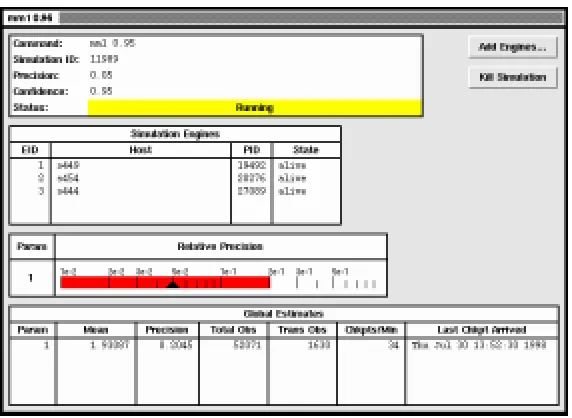
A graphical user interface, akgui, is being developed as an alternative to the shell command interface provided by akrun, akstat and akadd. An example of the interface presented by akgui is shown in Figure 2.
3
Coverage Analysis
In order to assess the effectiveness of different methods of similation output data analysis (SODA), one has to perform exhaustive experimental studies of their statistical correctness in simulations of analytically tractable systems. This al-lows the comparison of experimental (approximate) results with the exact ones. One of the main quality criteria used for assessing the quality of methods of SODA in stochastic simulation is the coverage, defined as the experimental con-fidence level of the final concon-fidence intervals produced by a given method (i.e. the proportion of the final confidence intervals which include the theoretical value of the estimated parameter).
Fig. 2.Akgui window showing the status of a running simulation.
ensure credibility of the final results. Such a methodology for conducting sys-tematic analysis of coverage of methods of SODA used in sequential stochastic simulation has been formulated in [Pawlikowski et al., 1998a]. Its main feature is the conviction that by executing a predetermined number of simulation runs one cannot produce reliable estimates of coverage and so, because of that, cov-erage should be analysed sequentially, following similar steps as those applied in sequential stochastic simulation. This means that coverage analysis should be continued until the estimate of coverage reaches the required level of precision.
Additionally, the methodology proposed in [Pawlikowski et al., 1998a] takes into account that:
1. To obtain a credible value of coverage at a level of confidence as high as, for example, 95%, one has to observe sufficiently manybad confidence intervals, i.e. confidence intervals that do not contain the theoretical value.
2. Simulation runs used in coverage analysis should not be too short.
Ideally, the confidence interval of coverage of a given method of SODA should cover the confidence level assumed at the outset of simulation runs. In practice, this criterion is hardly met by any method of SODA, so, making this requirement weaker, we accept the method for practical applications if the confidence interval of its coverage is sufficiently close to the confidence level assumed.
the requested confidence level, then the method of SODA may tend to stop the simulation too late and waste computing resources.
We have put this methodology into practice and applied it in fully automated studies of the coverage of selected methods of mean value analysis and quantiles [Pawlikowski et al., 1998a; Lee et al., 1998; Lee et al., 1998a]. The assumed ref-erence set of basic, analytically tractable models used in these analyses included four queueing models (M/M/1, M/D/1, M/H/1 and an open queueing network with a feedback connection). These models were studied under a wide range of traffic intensities and using various numbers of simulation engines.
Simulation practitioners know that unusually short simulation runs produce highly unreliable results and, as such, should be rejected. They happen from time to time, since, due the stochastic nature of the processes being simulated, the stopping criteria are sometimes met by chance earlier than they should be. So that the results from unusually short runs did not bias the coverage values obtained, we adopted the followingfiltering rule:
When the required number B of bad confidence intervals is collected, the mean ¯L and standard deviationσ(L) of the simulation run lengths executed so far should be calculated, and the results from the runs of length shorter thanLmin= ¯L−σ(L) should be discarded.
Such studies are very computationally intensive. For example, in the coverage analysis of one version of the method of Spectral Analysis used for estimating precision of mean values, we conducted simulations of each of the four reference models mentioned above, at nine different traffic levels and using three different numbers of simulation engines. This required executing a total of 108 coverage experiments. Each experiment typically required, on average, about 5000 simu-lation runs to meet the stopping criteria. Thus, the total number of simusimu-lation runs performed during one coverage study of one method of SODA (of many needing to be considered) was over 0.5 million.
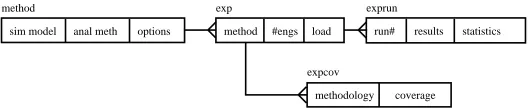
To manage the considerable volume of data generated by these experiments, we used an Ingres relational database structured as shown in Figure 3. The central, and largest, component of this database is the exprun relation, which contains a tuple for every simulation run, recording the results of that run plus some performance statistics concerning the internal operation of Akaroa2. We kept the results of every run so that we could analyse the results in different ways without having to re-run the experiments, which would have been very time-consuming.
We developed automated scripts to extract information from the database and produce plots and tables of coverage and speedup versus selected experi-mental conditions. These scripts were initially implemented in Tcl [Ousterhout, 1994], and later in Python [van Rossum, 1997].
4
Conclusions
exp
#engs load method
method
sim model anal meth options
exprun
run# results statistics
expcov
[image:11.612.165.429.72.128.2]methodology coverage
Fig. 3.Database schema for coverage experiment results.
being developed in the Department of Computer Science at the University of Canterbury in Christchurch, New Zealand. Akaroa2 automatically distributes simulation models (no skills of parallel programming are needed) over a num-ber of computers linked by a local area network, and control the progress of simulation until the required precision of the final results is reached.
From the user’s point of view, distributed stochastic simulation in the MRIP scenario appears to be a very attractive application of network computing. It makes good use of the distributed computing power of processors linked by a local area network, significantly speeding up simulation experiments of dynamic stochastic systems regardless of the internal structure of their models, and this is done in a way which remains transparent for users.
Our research activities in the project are continuing. They are currently aimed at increasing the functionality of Akaroa2. We are also investigating the possibility of formulating MRIP scenarios in areas of scientific computation other than stochastic simulation.
5
Acknowledgements
Partial financial support for this research has been provided by the University of Canterbury (Grant U6301).
6
References
R. L. Bagrodia (1996). “Perils and Pitfalls of Parallel Discrete Event Simulation”. In Proc. 1994 Winter Simulation Conf. WSC’94, IEEE Press, 1996, pp. 136-143. P. Buchholz et al. (1997). “Report on the Performance Evaluation Techniques and
Tools Group”. In Proc. Int. Workshop on System Performance Evaluation -Origins and Directions(Schloss Dagstuhl, Germany, Sept. 1997), Int. Research Center for Computer Science, Schloss Dagstuhl, 1997.
(See also:http://www.ani.univie.ac.at/dagstuhl97)
D. Clark et al. (1996) “Strategic Directions in Networks and Telecommunications”. ACM Computing Surveys (Special Issue on Strategic Directions in Computing Research),28: 1996, no.4, pp. 679-690.
G. Ewing, D. McNickle and K. Pawlikowski (1997). “Multiple Replications in Parallel: Distributed Generation of Data for Speeding up Quantitative Stochastic Sim-ulation”. InProc. of 15th IMACS World Congress on Scientific Computation, Modelling and Applied Mathematics, Berlin, August 1997, pp. 379-402. G. Ewing, K. Pawlikowski and D. McNickle (1997a). Akaroa 2.4.2. Technical Report
TR-COSC 07/97, Department of Computer Science, University of Canterbury, Christchurch, New Zealand.
G. S. Fishman and L. R. Moore III (1986). “An Exhaustive Analysis of Multiplicative Congruential Random Number Generators with ModulusM= 231−1”.SIAM J. Sci. Stat. Comput.,7: 1986, pp. 24-45.
J. Ousterhout (1994). Tcl and the Tk Toolkit.Addison-Wesley, 1994.
K. Pawlikowski (1990). “Steady-State Simulation of Queueing Processes: A Survey of Problems and Solutions”.ACM Computing Surveys,2: 1990, 123-170.
K. Pawlikowski and V. Yau (1992). “An Automatic Partitioning, Runtime Control and Output Analysis Methodology for Massively Parallel Simulations”. InProc. of the European Simulation Symp. ESS’92, Dresden, 1992, SCS, pp. 135-139. K. Pawlikowski, V. Yau and D. McNickle (1994). “Distributed Stochastic
Discrete-Event Simulation in Parallel Times Streams”. InProc. of the Winter Simulation Conf. WSC’94, IEEE Press, 1994, pp. 723-730.
K. Pawlikowski, G. Ewing and D. McNickle (1998). “Performance Evaluation of In-dustrial Processes in Computer Network Environments”. InProc. of European Conf. on Concurrent Engineering ECEC’98, Erlangen, Germany, April 1998, pp. 129-135.
K. Pawlikowski, D. McNickle and G. Ewing (1998a). “Coverage of Confidence Intervals in Sequential Steady-State Simulation”. Simulation Practice and Theory, 6: 1998, pp. 255-267.
K. Pawlikowski and D. McNickle (1998). “Distributed Stochastic Simulation and Am-dalh’s Law”. Submitted.
V. J. Rego and V. S. Sunderam (1992). “Experiments in Concurrent Stochastic Simula-tion: the EcliPSe Paradigm”.J. Parallel and Distributed Computing,14: 1992, pp. 66-84.
G. van Rossum (1997). Python Reference Manual.Corporation for National Research Initiatives (CNRI), 1895 Preston White Drive, Reston, Va 20191, USA. Avail-able from:http://www.python.org
Jong-Suk R. Lee, D. McNickle and K.Pawlikowski (1998). “Confidence Interval Estima-tors for Coverage Analysis in Sequential Steady-state Simulation”. Submitted. Jong-Suk R. Lee, D. McNickle and K.Pawlikowski (1998a). “Sequential Estimation of
Quantiles”. Tech. Rep. TR-COSC 03/98, Department of Computer Science, University of Canterbury, Christchurch, New Zealand.
V. S. Sunderam and V. J. Rego (1991). “EcliPse: A System for High Performance Concurrent Simulation”.Software-Practise and Experience,11: 1991, pp. 1189-1219.