Analysis on the Mindbugs in Information Technology
Service Management Project Implementation
*
Jiangping Wan1,2, Dan Wan1
1Faculty of Business Administration, South China University of Technology, Guangzhou, China
2Institute of Emerging Industrialization Development, South China University of Technology, Guangzhou, China
E-mail: scutwjp@126.com, [email protected]
Received May 6,2011; revised May 26, 2011; accepted June 5, 2011
Abstract
J. N. Warfield identified and classified the mindbugs (cognitive barriers), and put forward the process-based work program of complexity, and argued that the complexity could be managed through design. The eleven kinds of common mindbugs are figured out among the twenty five kinds of mindbugs with questionnaire. The relationship between the six root risk factors of implementation of the information technology service management (ITSM) project and these common mindbugs are also identified. It is found that the influence of mindbugs of habit is most serious in the ITSM project because the implementation of ITSM project would change the original work habits and methods of people. Finally, some recommendations are put forward to mitigate the root risk factors.
Keywords:Complexity, Mindbugs, Root Risk Factors, Information Technology Infrastructure Library (ITIL), Information Technology Service Management (ITSM), Project Management
1. Introduction
Warfield identified and classified the mindbugs (cogni-tive barriers), and put forward the process-based work program of complexity, and argued that the complexity could be managed through design. The approaches to manage complexity are design processes, design working environment, special roles trained for managing com-plexity, leadership and quality control with foresight etc. The science of generic design should clarity the methods to manage complexity through design [1-2].
Now the IT service management (ITSM) project has been concerned deeply by the industry. ITSM is a proc-ess-oriented and customer-centric approach. It enhances IT organizational service delivery, service level and the ability by integrating IT service and organizational busi-ness [3-6].
This paper is organized in the following: Section 2 is literature review, including, mindbugs and its classifica-tion, and ITSM and its research. Section 3 is identifica-tion of mindbugs in P. R. China. Secidentifica-tion 4 is the rela-tionship between the root risk factors and the mindbugs. Section 5 includes risk mitigation recommendations.
Finally, Section 6 is conclusions.
2. Literature Review
2.1. The Identification and Classification of Mindbugs
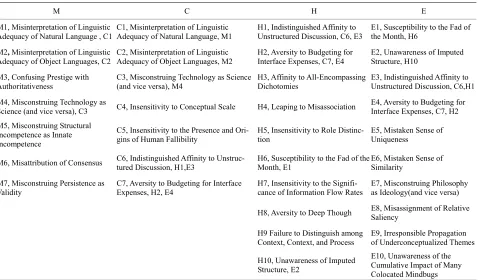
Warfield have tried to identify and name each distinctive origin of one or more behaviorally-related symptoms (as “mindbugs” to bring the language in line with contem-porary computer languages) [1]. So far, twenty-five mindbugs have been identified. These are envisaged as falling within four categories: Mindbugs of Minsinter-pretation: those where concepts are misconstrued or mis-attributed, because of faulty interpretation, Type M; Mindbugs of Clanthink: those where concepts are very widely perceived to be correct, but which are demonstra-bly incorrect, Type C; Mindbugs of Habit: those which involve ingrained behavior, evinced with essentially no conscious thought, Type H; and mindbugs of Error: just plain mistakes, Type E. It can be summary in Table 1
(where a mindbugs is at least assigned to more than one type, the several types are separately acknowledged).
There are nine mindbugs in the following to be se-lected for study in software process improvement [2]:
185
confusing Prestige with Authoritativeness (M3), Mis-construing Structural Incompetence as Innate Incompe-tence (M5), Misattribution of Consensus (M6), Miscon-struing Persistence as Validity (M7), Leaping to Misas-sociation (H4), Insensitivity to Role Distinction (H5), Insensitivity to the Significance of Information Flow Rates (H7), Aversity to Deep Though (H8), and Failure to Distinguish among Context, Context, and Process (H9). The first four mindbugs are in the type of minsin-terpretation, and others of habit. The research found that the most common mindbugs of SPI is Misattribution of Consensus (M6), and the finding was consistent with literature review and investigation on spot. It is sug-gested to resolve the mindbugs in Type M, including M6 in the first place, then framebreak and remodel to re-solve the mindbugs of Type H in software process im-provement.
2.2. IT Service Management
ITSM based on Information Technology Infrastructure Library (ITIL), which integrates the best practices of global IT management and forms the normative truth standard to reduce effectively cost and improve the qual-ity of service, is applied widely in the world [3]. ITIL, which was developed by the Central Computer and Telecommunications Agency (CCTA, merged with the OGC) of the UK government in the middle of 1980s, is a
set of service management standard library which fo-cuses on IT industry. In the past 20 years, the content of ITIL has been updated and renewed. Today the OGC has enacted the ITIL 3.0. ITIL emphasizes on managing IT service from organization business and customer desires, and realizes the integration of service management proc-esses and organization business. The module of service management plays a role of “glue” which makes an or-ganic connection between the business perspective and the technology.
[image:2.595.61.539.440.720.2]Reference [4] presents an in-depth case study of the implementation. It indicates that the commitment of sen-ior management is crucial to the project’s success as is a project champion and the recognition of the need for an appropriate change management strategy to transform the organizational culture to a service-oriented focus. Maintaining close and forthright relationships with mul-tiple vendors facilitates technology transfer to in-house staff while a benefits realization plan is a valuable tool for tracking and communicating tangible and intangible project benefits to the project stakeholders. An effective project governance and execution process further con-tributes to the implementation success. Reference [5] is concluded that if the organization wishes to successfully implement ITSM’s customer satisfaction model, it should eliminate the misunderstandings of IT service objectives first, while the adoption of knowledge supporting struc-ture of ITSM can play a multiplier effect.
Table 1. The identification and classification of mindbugs.
M C H E
M1, Misinterpretation of Linguistic Adequacy of Natural Language , C1
C1, Misinterpretation of Linguistic Adequacy of Natural Language, M1
H1, Indistinguished Affinity to Unstructured Discussion, C6, E3
E1,Susceptibility to the Fad of the Month, H6
M2, Misinterpretation of Linguistic Adequacy of Object Languages, C2
C2, Misinterpretation of Linguistic Adequacy of Object Languages, M2
H2, Aversity to Budgeting for Interface Expenses, C7, E4
E2, Unawareness of Imputed Structure, H10
M3, Confusing Prestige with Authoritativeness
C3, Misconstruing Technology as Science (and vice versa), M4
H3, Affinity to All-Encompassing Dichotomies
E3, Indistinguished Affinity to Unstructured Discussion, C6,H1
M4, Misconstruing Technology as
Science (and vice versa), C3 C4, Insensitivity to Conceptual Scale H4, Leaping to Misassociation
E4, Aversity to Budgeting for Interface Expenses, C7, H2
M5, Misconstruing Structural Incompetence as Innate Incompetence
C5, Insensitivity to the Presence and Ori-gins of Human Fallibility
H5, Insensitivity to Role Distinc-tion
E5,Mistaken Sense of Uniqueness
M6, Misattribution of Consensus C6, Indistinguished Affinity to Unstruc-tured Discussion, H1,E3 H6, Susceptibility to the Fad of the Month, E1 E6,Similarity Mistaken Sense of
M7, Misconstruing Persistence as Validity
C7, Aversity to Budgeting for Interface Expenses, H2, E4
H7, Insensitivity to the Signifi-cance of Information Flow Rates
E7, Misconstruing Philosophy as Ideology(and vice versa)
H8, Aversity to Deep Though E8, Misassignment of Relative Saliency
H9 Failure to Distinguish among Context, Context, and Process
E9, Irresponsible Propagation of Underconceptualized Themes
H10,Unawareness of Imputed Structure, E2
Reference [6] identifies the risk factors which result in the failure of ITSM project implementation, and they are sorted in accordance with the importance degree of the risk. The most critical twenty risk factors are also identi-fied in the following: (R1) The seniors of the enterprise are impolitic when making decision. (R2) No enough and effective communication among all the related people. (R3) The core members or project managers of external IT company have not relevant experience. (R4) The ex-ecutive managers don’t attach importance to the project. (R5) Design process without basing on business demand. (R6) Vague responsibility definition is among staffs of two sides. (R7) Process mission and objectives are not clear. (R8) The business demand analysis is not suffi-cient. (R9) It doesn’t reach a consensus on business process between external IT company and the enterprise. (R10) Customer demands change frequently. (R11) Ob-jectives of the project are not clear. (R12) The mobility of employees in the enterprise is serious. (R13) The company and the client are not consentaneous on the service level. (R14) The business strategy of enterprise is not clear. (R15) The resources which the project needs are not sufficient. (R16) It will produce the sector sepa-ratism phenomenon when the enterprise sector conflicts are coming up. (R17) External IT company staffs have not the excellent execution power. (R18) The order of the process implementation is improper. (R19) IT infra-structure planning and design of the enterprise are un-reasonable. (R20) The project scale is too large, which increases the management complexity. Then, interpretive structural model (ISM) is applied to determine the twenty risk factors’ causal relationship, and ISM of risk factors of the ITSM project implementation is estab-lished. Finally, six root risk factors are identified: R11, R2, R4, R14, R12 and R19. How to solve the six root risk factors effectively? It is the key to implementation of IT service management project.
3. Identification of Mindbugs in P. R. China
3.1. Questionnaire Design and Reclaiming Situation
As mindbugs is a psychological term, which means its concept is abstract and its definition is somewhat esoteric, it is very difficult to understand the meaning for lacking enough education, therefore the survey object is nar-rowed to people in colleges and universities. Since this study is essentially exploratory research, plus the human, financial, material and time constraints, it is acceptable to choose students studying in the South China Univer-sity of Technology as the respondents. From June 2007 to January 2008, we received a total of 79 questionnaires,
of which 58 were valid. 38 undergraduates were sur-veyed, accounting for 65.5% and the rest was graduates.
3.2. Reliability and Validity Analysis
We use Cronbach’s α coefficient to examine the ques-tionnaire’s internal consistency reliability. It is 0.874, indicating the internal consistency of measurements in this study is very good. All items adopt the mindbugs by Warfield and the content of the items can well reflect the subject of the survey, so this scale meets the require-ments of content validity. In order to ensure that the purpose and contents of the questionnaire can be accu-rately understood by the respondents, we explained the content of some items which are difficult to understand before sending out the questionnaires, so this scale satis-fies the requirements of face validity. Responding to the purpose of this study, the questionnaire can obtain peo-ple’s attitude towards mindbugs existence, so this scale also basically meets the construct validity.
3.3. Descriptive Statistics
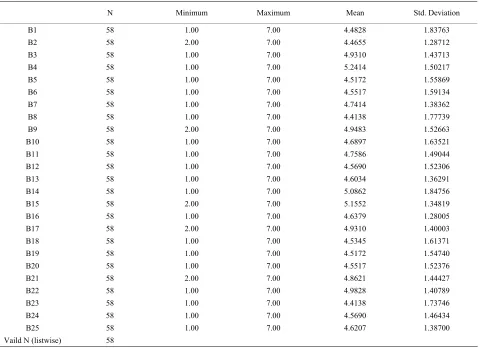
The results of descriptive statistics of the survey data with 7 levels Likert scale is illustrated in Table 2.
From the results, we can see that:
1) The maximum mean is 5.24 and the minimum is 4.41, which means there are few people strongly denying the existence of these 25 mindbugs in our country.
2) All the means exceed 4, which indicates that people can feel these mindbugs in some degree.
3) We have to choose the ones whose population mean is deduced to be more than 5 in order to find out the mindbugs that people are generally aware of,. Next we will analyze the relationship between the root risk factors of ITSM projects’ implementation and these widely ac-cepted these mindbugs.
3.4. One-Sample T-Test
The precondition of T test is that the sample being tested is subject to normal distribution. The use of one-Sample KS process of SPSS software helps us arrive at the con-clusion that the sample data of these 25 mindbugs is subject to normal distribution, indicating that the sample data meets the requirements for T tests.
Original hypothesis H0: the population mean = 5;
Al-ternative hypothesis H1: the population mean ≠ 5. Given
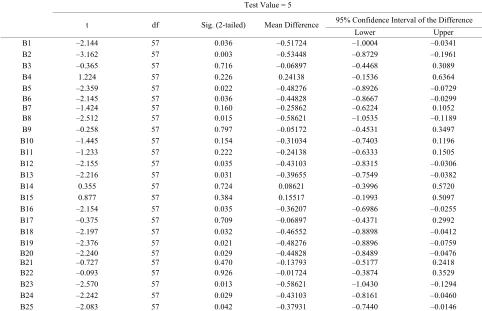
95% confidence degree, that is, the significance level α = 0.05. And then SPSS software is used for one-Sample T Test analysis for these data, and the results are illustrated in Table 3.
187
[image:4.595.61.541.96.444.2]
Table 2. The results of descriptive statistics of the mindbugs’ survey data.
N Minimum Maximum Mean Std. Deviation
B1 58 1.00 7.00 4.4828 1.83763
B2 58 2.00 7.00 4.4655 1.28712
B3 58 1.00 7.00 4.9310 1.43713
B4 58 1.00 7.00 5.2414 1.50217
B5 58 1.00 7.00 4.5172 1.55869
B6 58 1.00 7.00 4.5517 1.59134
B7 58 1.00 7.00 4.7414 1.38362
B8 58 1.00 7.00 4.4138 1.77739
B9 58 2.00 7.00 4.9483 1.52663
B10 58 1.00 7.00 4.6897 1.63521
B11 58 1.00 7.00 4.7586 1.49044
B12 58 1.00 7.00 4.5690 1.52306
B13 58 1.00 7.00 4.6034 1.36291
B14 58 1.00 7.00 5.0862 1.84756
B15 58 2.00 7.00 5.1552 1.34819
B16 58 1.00 7.00 4.6379 1.28005
B17 58 2.00 7.00 4.9310 1.40003
B18 58 1.00 7.00 4.5345 1.61371
B19 58 1.00 7.00 4.5172 1.54740
B20 58 1.00 7.00 4.5517 1.52376
B21 58 2.00 7.00 4.8621 1.44427
B22 58 1.00 7.00 4.9828 1.40789
B23 58 1.00 7.00 4.4138 1.73746
B24 58 1.00 7.00 4.5690 1.46434
B25 58 1.00 7.00 4.6207 1.38700
Vaild N (listwise) 58
1) A total of 14 hypothetical P values are less than 0.05, so the original hypothesis H0 should be rejected.
The total mean of these 14 samples is not 5. Meanwhile noting that the confidence interval range of the discrep-ancy is less than 0, which indicates that the total mean of these samples will be less than 5 (a little support), it is clear that these mindbugs corresponding to these as-sumptions has not been universally accepted by people. But it is not to deny the existence of these mindbugs, but merely point out that these mindbugs have not been uni-versally supported. These 14 mindbugs are as follows: Affinity to All-Encompassing Dichotomies (B1), Aversity to Budgeting for Interface Expenses (B2), Insensitivity to the Presence and Origins of Human Fallibility (B5), In-distinguished Affinity to Unstructured Discussion (B6), Irresponsible Propagation of Underconceptualized Themes (B8), Leaping to Misassociation (B12), Failure to Dis-tinguish among Context, Content, and Process (B13), Misconstruing philosophy as ideology (B16), Miscon-struing technology as science (B18), Misinterpretation of Linguistic Adequacy of Natural Language (B19),
Misin-terpretation of Linguistic Adequacy of Object Languages (B20), Susceptibility to the Fad of the Month (B23), Unawareness of the Cumulative Impact of Many Colo-cated mindbugs (B24), Unawareness of Imputed Struc-ture (B25).
2) The other 11 hypothetical P values are over 0.05, so there is not enough evidence to reject the original hy-pothesis H0 and basically they can be accepted, which
means the population means these 11 samples are ap-proximately equal to 5. Therefore, the mindbugs which the 11 hypothesis correspond to are universally accepted. The 11 mindbugs are listed below in the descending or-der, shown as Table 4.
3.5. Comprehensive Analysis of the Survey
It can be concluded from this survey:
1) People in China don’t strongly oppose to these 25 mindbugs and generally recognize the existence of 11 mindbugs.
would be as follows: confusing prestige with authorita-tiveness, misconstruing persistence as validity, misattri-bution of consensus, mistaken sense of uniqueness, in-sensitivity to role distinction. These 5 mindbugs have the greatest impact on people’s everyday life and are most likely to lead to some erroneous behavior.
3) In Table 4, each of the 11 mindbugs elicited fall into one type in terms of the original classification by Professor Warfield, indicating that the conclusion of this
survey is reasonable by excluding those falling into mul-tiple types of mindbugs, so we can analyze the relation-ship between the mindbugs and the root risk factors clearly.
[image:5.595.56.538.219.530.2]4) In Table 4, there are 4 mindbugs of misinterpreta-tion, only 1 of clanthink, three of habit and three of error. Further more, it can be calculated from the data in the table that the respective means of these types are as fol-lows: mindbugs of misinterpretation is 5.1034; mindbugs
Table 3. One-sample T-test.
Test Value = 5
95% Confidence Interval of the Difference t df Sig. (2-tailed) Mean Difference
Lower Upper
B1 –2.144 57 0.036 –0.51724 –1.0004 –0.0341
B2 –3.162 57 0.003 –0.53448 –0.8729 –0.1961
B3 –0.365 57 0.716 –0.06897 –0.4468 0.3089
B4 1.224 57 0.226 0.24138 –0.1536 0.6364
B5 –2.359 57 0.022 –0.48276 –0.8926 –0.0729
B6 –2.145 57 0.036 –0.44828 –0.8667 –0.0299
B7 –1.424 57 0.160 –0.25862 –0.6224 0.1052
B8 –2.512 57 0.015 –0.58621 –1.0535 –0.1189
B9 –0.258 57 0.797 –0.05172 –0.4531 0.3497
B10 –1.445 57 0.154 –0.31034 –0.7403 0.1196
B11 –1.233 57 0.222 –0.24138 –0.6333 0.1505
B12 –2.155 57 0.035 –0.43103 –0.8315 –0.0306
B13 –2.216 57 0.031 –0.39655 –0.7549 –0.0382
B14 0.355 57 0.724 0.08621 –0.3996 0.5720
B15 0.877 57 0.384 0.15517 –0.1993 0.5097
B16 –2.154 57 0.035 –0.36207 –0.6986 –0.0255
B17 –0.375 57 0.709 –0.06897 –0.4371 0.2992
B18 –2.197 57 0.032 –0.46552 –0.8898 –0.0412
B19 –2.376 57 0.021 –0.48276 –0.8896 –0.0759
B20 –2.240 57 0.029 –0.44828 –0.8489 –0.0476
B21 –0.727 57 0.470 –0.13793 –0.5177 0.2418
B22 –0.093 57 0.926 –0.01724 –0.3874 0.3529
B23 –2.570 57 0.013 –0.58621 –1.0430 –0.1294
B24 –2.242 57 0.029 –0.43103 –0.8161 –0.0460
[image:5.595.59.539.560.723.2]B25 –2.083 57 0.042 –0.37931 –0.7440 –0.0146
Table 4. Universally accepted mindbugs.
Mindbugs Type Mean
Confusing Prestige with Authoritativeness (B4) M 5.2414
Misconstruing persistence as validity (B15) M 5.1552
Misattribution of Consensus (B14) M 5.0862
Mistaken Sense of Uniqueness (B22) E 4.9828
Insensitivity to Role Distinction (B9) H 4.9483
Misconstruing Structural Incompetence as Innate Incompetence (B17) M 4.9310
Aversity to Deep Thought (B3) H 4.9310
Mistaken Sense of Similarity (B21) E 4.8621
Irresponsible Propagation of Underconceptualized Themes (B11) E 4.7586
Insensitivity to Conceptual Scale (B7) C 4.7414
189
of clanthink is 4.7414; mindbugs of habit is 4.8563; mindbugs of error is 4.8678. So, it is concluded that in people’s mind, mindbugs of misinterpretation are the most serious, those of clanthink are the least, while the habit and the error mindbugs are in the same degree.
5) In Table 2, the first three mindbugs all belong to the misinterpretation type, therefore this type is quite serious in China.
4. The Relationship between the Root Risk
Factors and the Mindbugs
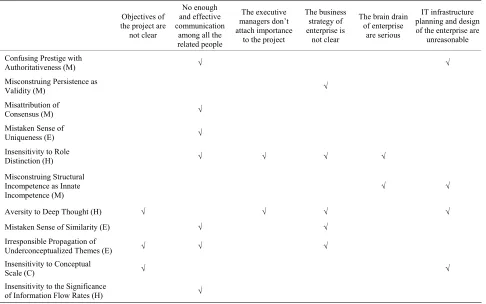
We investigated 15 IT experts who have been in IT in-dustry for 10 years, and also have some knowledge of psychology with questionnaire. The conclusions on the relationship between the root risk causes and mindbugs are illustrated in Table 5. The cell marked “√” repre-sents that mindbugs in one row will lead to the risk fac-tors in the corresponding column.
It can be concluded from Table 5 that:
1) “Confusing Prestige with Authoritativeness” would relate to two root risk factors, they are no enough and effective communication among all the related people and unreasonable IT infrastructure planning and design of the enterprise. If an enterprise is over-dependent on an external IT company’s past reputation in the IT industry
and let the IT company totally control the ITSM project, the enterprise would spend very little effort in the ITSM projects, which obviously would bring about the lack of adequate communication between the both sides.
2) “Misconstruing Persistence as Validity” would re-late to the business strategy of enterprise is not clear. If a wrong or vague enterprise business strategy is widely accepted by the staff for a long time, it will be consid-ered as a proper strategy and be implemented.
3) “Misattribution of Consensus” would relate to no enough and effective communication among all the re-lated people. In team communication, if some team members are reluctant to oppose to those ideas which have been endorsed by the whole team, they would avoid to put forward their own ideas and opinions, which would result in a lack of communication among team members. Further more, it will very likely to generate a common wrong idea on which all members of the team seem to achieve a consensus.
[image:6.595.57.543.419.723.2]4) “Mistaken Sense of Uniqueness” would relate to no enough and effective communication among all the re-lated people. Members in the ITSM project implementa-tion team seem to incline to view themselves as unique, so they are not willing to discuss the project implementa-tion plan with other members, leading to a lack of active communication in the team.
Table 5. The relationship between the root risk factors and the recognized mindbugs in China.
Objectives of the project are
not clear
No enough and effective communication
among all the related people
The executive managers don’t attach importance
to the project
The business strategy of enterprise is
not clear
The brain drain of enterprise
are serious
IT infrastructure planning and design of the enterprise are
unreasonable
Confusing Prestige with
Authoritativeness (M) √ √
Misconstruing Persistence as
Validity (M) √
Misattribution of
Consensus (M) √
Mistaken Sense of
Uniqueness (E) √
Insensitivity to Role
Distinction (H) √ √ √ √
Misconstruing Structural Incompetence as Innate
Incompetence (M) √ √
Aversity to Deep Thought (H) √ √ √ √
Mistaken Sense of Similarity (E) √ √
Irresponsible Propagation of
Underconceptualized Themes (E) √ √ √
Insensitivity to Conceptual
Scale (C) √ √
Insensitivity to the Significance
5) “Insensitivity to Role Distinction” would relate to four root risk factors, namely, No enough and effective communication among all the related people, the execu-tive managers don’t attach importance to the project, the mobility of employees in the enterprise is serious, the business strategy of enterprise is not clear. In the ITSM project, if the involved staff are not clear about the re-sponsibilities of each role, a series of problems will oc-cur, including that the information transfer among indi-vidual roles is not good, that the seniors are not aware of the importance of their own position and attach little importance to the ITSM project in their work, that no-body will be in charge of the organization business strategy and that staff in the enterprise don’t understand the function of each role and frequently change work posts.
6) “Misconstruing Structural Incompetence as Innate Incompetence” would relate to unreasonable IT infra-structure planning and design of the enterprise and the mobility of employees in the enterprise is serious. Per-haps it is because that the organization structure itself has shortcomings, the staff in certain position within the en-terprise can’t bring themselves in play, resulting in more serious enterprise brain drain.
7) “Aversity to Deep Thought” would relate to four root risk factors: unclear project objectives, the business strategy of enterprise is not clear, the executive managers don’t attach importance to the project and unreasonable IT infrastructure planning and design of the enterprise. If members of the ITSM project don’t think deeply about the ITSM, it can affect the entire project in the following aspects: the objectives of the project are not clear; the seniors also won’t recognize the importance of ITSM project; nobody thinks seriously about the organization business strategy; before the implementation of ITSM project, it is seldom considered that whether the existing IT infrastructure planning can or can not satisfy the re-quirements of ITSM project.
8) “Mistaken Sense of Similarity” would relate to the business strategy of enterprise is not clear and no enough and effective communication among all the related
peo-ple. If the ITSM project team members treat the ITSM projects as other IT projects, such as the ERP project, they may discreetly copy other IT projects’ solutions to the ITSM projects without discussing with other team members. It is possible to enterprises to follow suit of other enterprises when developing organization’s busi-ness strategy. However in reality each enterprise is dif-ferent, so it is wrong to not have a clear understanding about the organization business strategy.
9) “Irresponsible Propagation of Underconceptualized Themes” would relate to the following three root risk factors: unclear project objectives, the business strategy of enterprise is not clear, no enough and effective com-munication among all the related people. If a prestigious expert within the company disseminate some misconcep-tions, such as unclear project objectives and vague or-ganization business strategy, then employees are very likely to easily accept these misconceptions. If ITSM project team members take in a certain team member and believe he must be right, it will reduce the exchange with other team members.
10) “Insensitivity to Conceptual Scale” would relate to unclear project objectives and unreasonable IT infra-structure planning and design of the enterprise. As the size of the project is too large, the project sponsors and managers can not grasp the scope of the project and thus can not identify clear project objectives.
11) “Insensitivity to the Significance of Information Flow Rates” would relate to No enough and effective communication among all the related people. Too fast or too slow information transmission will affect the effects of communication.
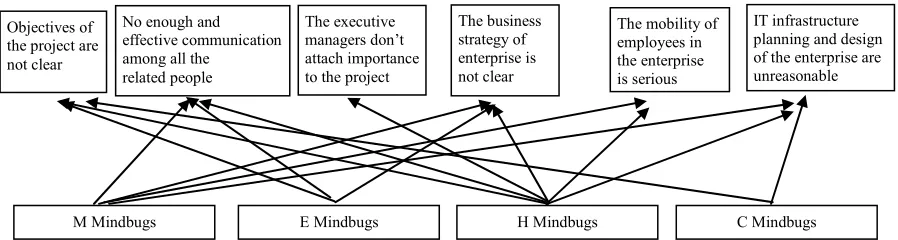
The relationship can also be illustrated in Figure 1. It can be concluded in the following:
1) In ITSM projects’ implementation, mindbugs of habit is the most serious one which would lead to six root risk factors. Therefore, ITSM projects’ implementation team members need to remove the old and create the new, eliminate the obsolete thinking in mind and have the courage to accept new concepts of ITSM.
2) Mindbugs of misinterpretation is the second most
The mobility of employees in the enterprise is serious Objectives of
the project are not clear
No enough and effective communication among all the
related people
The executive managers don’t attach importance to the project
The business strategy of enterprise is not clear
IT infrastructure planning and design of the enterprise are unreasonable
[image:7.595.74.523.586.706.2]M Mindbugs E Mindbugs H Mindbugs C Mindbugs
191
serious, which would lead to four root risk factors. Therefore, ITSM implementation team members should reach a consensus on some concepts. Through arranging ITSM training for the relevant personnel, the misconcep-tions of the team members can be clarified.
3) Mindbugs of error and mindbugs of clanthink can respectively lead to three and two root risk factors. Thus, ITSM project manager need to pay close attention to it to prevent the team members from doing damage to the project due to momentary errors, and to promote team members boldly put forward their own personal benefi-cial opinion basing on cooperation within the team.
5. Risk Mitigation Recommendations
According to the relationship between the root risk fac-tors and the mindbugs, the risk mitigation recommenda-tions can be established.
1) In order to avoid unclear project objectives, the rec-ommendations are in the following: before the imple-mentation of ITSM projects, make sure to have deep thoughts about all aspects of the project; right concep-tions about the enterprise business and ITSM should be carried through to the employees; the scope of the project should be controlled.
2) In order to avoid no enough and effective commu-nication among all the related people, the recommenda-tions are as follows: do not just leave the external IT company to deal with ITSM project, the company should keep informed of the project conditions in time; in the ITSM project team discussion, team members should be encouraged to put forward their own point of view; co-operation should be promoted within the team while re-ducing the individualism; clarify the responsibilities of each role in the project, and facilitate the correct trans-mission of information; the differences of ITSM projects and other IT projects must be clearly aware; do not heav-ily rely on an individual point of view, share opinions with other team members; control the speed of informa-tion transmission so that recipients of informainforma-tion can efficiently access them.
3) In order to avoid the executive managers don’t at-tach importance to the project, the recommendations are as follows: clarify the responsibilities of the senior man-ager role; senior manman-ager should understand the differ-ences of ITSM projects and other IT projects in a strate-gic view.
4) In order to avoid the business strategy of enterprise is not clear, the recommendations are as follows: due to the changes in the economic environment, the corporate long-standing business strategy may no longer be suit-able for enterprise development and should be reinvented; senior leaders should be responsible for business strategy; senior leaders should have in-depth and long-term
think-ing about the organization’s business strategy plannthink-ing; do not just follow suit other company’s business strategy, in stead, companies should establish and maintain their unique competitive advantage; corporate staff should not indiscreetly presume the organization’s business strategy passed on by a prestigious person, but rather to take the ones established by the senior manager as a standard.
5) In order to avoid the serious brain drain in the en-terprise, the recommendations are as follows: clarify responsibilities of each post, so that employees can per-form their duties in the posts and make continuous pro-gress; if the existing organizational structure is not suit-able for the development of employees, then it should be re-adjusted.
6) In order to avoid the unreasonable IT infrastructure planning and design of the enterprise, the recommenda-tions are as follows: the enterprise should not stubbornly believe the existing IT infrastructure is reasonable; the existing IT infrastructure planning should be re-adjusted to meet the company’s future business development needs; a more rational IT infrastructure planning should be developed through in-depth analysis; balance the economy and efficiency trade-off, so that the size of the IT infrastructure could be controlled in a reasonable range.
7) Customer satisfaction model of ITSM, knowledge supporting structure of ITSM of [5] are helpful to risk mitigation and avoidance.
6. Conclusions
The eleven kinds of common mindbugs are figured out among the twenty five kinds of mindbugs with question-naire. The relationship between the root risk factors of implementation of the ITSM project and these mindbugs are analyzed Of course, there are many limits in our study, 1) 79 questionnaires were too few and were mainly in our students in SCUT, in our understanding, But even more data were collected. The mindbugs were identitied to be challengeable. New approaches should be considered. 2) We just run one-sample T-test without comprehensive analysis of survey. Some necessary hy-pothesizes should be also pre-presented. 3) Due to the length of article, we couldn’t discuss in greater depth and more specific perspective just as in [5]. 4) Killer assump-tions by Prof. Warfield will be considered in another paper in some detail (to be apppeared). Although there is a long way to go, it is sure that the research will helpful for both ITSM theories construction and ITSM practices’ improvement.
7. Acknowledgements
Chen Ji, Mr. Zhuo Zhixing and my student Wang Yun-feng hard working.
8. References
[1] J. N. Warfield, “Mentomology: The Identification and Classification of Mindbugs,” September 1995.
http://mars.gmu.edu:8080/dspace/bitstream/1920/3199/1/ Warfield%20_20_20_A1b.pdf,1995
[2] J. P. Wan, “Research on Software Product Support Struc-ture,” Journal of Software Engineering and Applications, Vol. 2, No. 3, 2009, pp. 174-194.
doi:10.4236/jsea.2009.23025
[3] J. van Bon, M. Picper and A. der Veen, “Foundations of IT Service Managementbased on ITIL,” Van Haren
Publish-ing, Zaltbommel, 2005.
[4] W. G. Tan and A. Cater-Stel, “Implementing IT Service Management: A Case Study Focusing on Critical Success Factors,” Journal of Computer Information Systems, Vol. 50, No. 2, 2009, pp. 1-12.
[5] J. P. Wan, H. Zhang and D. Wan, “Evaluation on Infor-mation Technology Service Management Process with AHP,” Technology and Investment, Vol. 2, No. 1, 2011, pp. 38-46. doi:10.4236/ti.2011.21005