SELF-REGULATION OF INTERNET USAGE BY
*Inocencia M.
Public Administration Department, Southern Leyte State University, Maasin City Campus, Philippines
ARTICLE INFO ABSTRACT
In this paper
adaptive behavior that is found between the human development index and Specifically, the study determined the emergence of the self
human development index.
development index on internet usage and synergy of interacting agents, the synergy
the number of connections was drawn using the statistical software and finally identified the three clusters with equal frequency.
can have a that for a quick agents.
self - regulation would provide less time to social network sites.
control accessing for internet usage when they know that they could not get any benefit from using it. However, it ad
the extent of internet usage and because of this ambivalence to self the internet users to the urge to access connections of internet. Copyright © 2019, Inocencia M. Cañon and Michael Malachy
License, which permits unrestricted use, distribution, and
INTRODUCTION
The Internet has verified as one of the most outstanding creations of man because it is said to be the eighth wonder of the world (Sathiaseelan, 2013). Internet usage is one of the very core of human progress that influences development of man across the nations of the world (Hettiarachchi, 2018). twenty-first century signaled the pace of innovation and technology due to the Internet. From microchips to cloud computing, huge data knowledge to web things, engineering science to artificial intelligence, the world is at the sting of a technological bang that might increase the gap between the economic powerhouses and laggards. Through the utilization of the Internet, the interaction between people bec
and quick. Trade became universal and digital, communication is fast and Internet economies began to emerge (Macdougald, 2011). The emergence, and expansion of the global networks of computing resources known as the Internet are also as vital as human development is prevailing.
consistent access to the Internet has changed the way people lived. In particular, Internet usage expand rapidly that the number of internet users doubled from late 1999 up to the current (Bradshaw, 2001).
*Corresponding author: Inocencia M. Cañon,
Public Administration Department, Southern Leyte State University, Maasin City Campus, Philippines
ISSN: 0975-833X
Article History:
Received 04th July, 2019
Received in revised form
28th August, 2019
Accepted 05th September, 2019
Published online 30th October, 2019
Citation: Inocencia M. Cañon and Michael Malachy
Journal of Current Research, 11, (10), 7795-7800.
Key Words:
Complex Adaptive System, Self-regulation, Human Development Index and Internet usage.
RESEARCH ARTICLE
REGULATION OF INTERNET USAGE BY HUMAN DEVELOPMENT INDEX
Inocencia M. Cañon and Michael Malachy Dagami
Department, Southern Leyte State University, Maasin City Campus, Philippines
ABSTRACT
In this paper, the researchers used the Complex Adaptive System (CAS)
adaptive behavior that is found between the human development index and
Specifically, the study determined the emergence of the self-regulation of the internet usage by the human development index. It is also conceptualized in terms of the stabilizing factors of the human development index on internet usage and self-regulated control of the use of the internet.
synergy of interacting agents, the synergy calculator was used. A histogram of the frequencies versus the number of connections was drawn using the statistical software and finally identified the three clusters with equal frequency. The results show that a country’s regulatory approach to the Internet can have a massive impact on its ubiquitousness throughout the country. It merely indicates the fact that for a quick-moving industry like the internet, it depends on the human development level of agents. The increasing internet use affects the HDI. The findings re
regulation would provide less time to social network sites.
control accessing for internet usage when they know that they could not get any benefit from using it. However, it additionally shows that the majority of internet users were ambivalent towards regulating the extent of internet usage and because of this ambivalence to self
the internet users to the urge to access connections of internet. Cañon and Michael Malachy Dagami. This is an open access article distributed under
and reproduction in any medium, provided the original work is properly
The Internet has verified as one of the most outstanding creations of man because it is said to be the eighth wonder of Internet usage is one of the that influences development of man across the nations of the world (Hettiarachchi, 2018). The first century signaled the pace of innovation and technology due to the Internet. From microchips to cloud things, engineering world is at the sting of a technological bang that might increase the gap between the Through the utilization of the Internet, the interaction between people became easy Trade became universal and digital, communication is fast and Internet economies began to emerge (Macdougald, 2011). The emergence, and expansion of the global networks of computing resources known as the Internet are also as vital Widespread and consistent access to the Internet has changed the way people In particular, Internet usage expand rapidly that the number of internet users doubled from late 1999 up to the
Public Administration Department, Southern Leyte State University,
Due to the widespread from Internet usage, countries at their disposal have several tools to police their
by imposing the self-regulatory regime.
element of competition policy within the context of telecommunications and internet usage.
self-regulation include efficiency, increased flexibilit increased incentives for compliance, and reduced cost. According to Wallsten (2002), a carefully structured program emphasizing self-regulation is especially harmonious with an Internet setting because it mirrors the Internet itself, as a global, importantly private and decentralized network of communication. The development of a self
for the internet should comprise several complementary actions, tools, and mechanisms.
solely perform with the support of p they do not interfere with the self
systems scientist discovered the network as a whole with many unexpected large-scale properties involving its overall structure, how information is spread out over
co-evolutionary relationships between the behavior of search engines and the web's link structure, all of which lead to what could be called complex adaptive system as a whole (Mitchell 2009, 10). Technological advances in computers, Bi artificial intelligence, global information, and communication networks have contributed to complex problem spaces.
International Journal of Current Research Vol. 11, Issue, 10, pp.7795-7800, October, 2019
DOI: https://doi.org/10.24941/ijcr.36972.10.2019
Cañon and Michael Malachy Dagami, R. 2019. “Self-regulation of internet usage by human development index
Available online at http://www.journalcra.com
z
HUMAN DEVELOPMENT INDEX
Cañon and Michael Malachy Dagami
Department, Southern Leyte State University, Maasin City Campus, Philippines
, the researchers used the Complex Adaptive System (CAS) to identify the complex adaptive behavior that is found between the human development index and internet users. regulation of the internet usage by the It is also conceptualized in terms of the stabilizing factors of the human regulated control of the use of the internet. To get the used. A histogram of the frequencies versus the number of connections was drawn using the statistical software and finally identified the three The results show that a country’s regulatory approach to the Internet massive impact on its ubiquitousness throughout the country. It merely indicates the fact moving industry like the internet, it depends on the human development level of The findings reveal that internet users with high Self – regulated internet users will control accessing for internet usage when they know that they could not get any benefit from using it. ditionally shows that the majority of internet users were ambivalent towards regulating the extent of internet usage and because of this ambivalence to self-regulate there is a likelihood to
under the Creative Commons Attribution properly cited.
Due to the widespread from Internet usage, countries at their disposal have several tools to police their citizen’s internet use regulatory regime. Regulation is a vital element of competition policy within the context of telecommunications and internet usage. The general benefits of regulation include efficiency, increased flexibility, increased incentives for compliance, and reduced cost. According to Wallsten (2002), a carefully structured program regulation is especially harmonious with an Internet setting because it mirrors the Internet itself, as a antly private and decentralized network of The development of a self-regulatory regime for the internet should comprise several complementary actions, tools, and mechanisms. Moreover, self-regulation will solely perform with the support of public authorities as long as they do not interfere with the self-regulatory process. Complex systems scientist discovered the network as a whole with many scale properties involving its overall structure, how information is spread out over its links, and the evolutionary relationships between the behavior of search engines and the web's link structure, all of which lead to what could be called complex adaptive system as a whole (Mitchell 2009, 10). Technological advances in computers, Big Data, artificial intelligence, global information, and communication networks have contributed to complex problem spaces.
INTERNATIONAL JOURNAL OF CURRENT RESEARCH
The conceptual lens of complex theory sharpens our view of the interactions between agents of internet users and the human development index (Zhao, MacKinnon, & Gallup, 2015). Self – Regulation of Internet usage has emerged as an insightful framework for studying complex adaptive systems (CAS) using human development index (HDI) and Internet users’ interactions (Cassidy & Barners, 2012). Since there is no empirical research has explored the role of regulation on Internet usage, using CAS in the study, the researchers were determined to know the effects of self – regulation on Internet usage and human development index and how this affects the interactions of connected agents.
Conceptual Framework of the Study: To explain that this is
the complex adaptive system, the conceptual framework of the study is illustrated below. This study is anchored on the complex adaptive system (CAS) to determine the interactions between the human development index (HDI) and internet users with 186 countries as agents. We tend to conjointly conceptualize the interrelated clusters or sub-features in terms of(1) stabilizing factors of human development index on internet usage; and (2) self-regulated control of the use of the internet to determine the emergent feature which is self-regulation of internet usage by human development index. The researchers conjointly define the following variables enclosed within the framework:
The Human Development Index (HDI) is made from three
distinct parts on basic dimensions of human development: to lead a long and healthy life, measured by lifespan at birth; the power to accumulate data, measured by mean years of schooling and expected years of schooling; and the ability to succeed in a decent commonplace of living, measured by gross worth per capita (Leiner et al. 2009).
An Internet user: As defined by Collins is an individual who
has access to the Internet at home, via computer or mobile device.
Self – Regulation: Is a regulatory system in which business
representatives outline and enforce standards for their sector with very little or no government involvement.
Self – Regulated Control or co-regulation: Of the utilization
of the internet is a regulatory system when one is aware of its limitation of using the internet, and being restricted to try and do, therefore.
Self – Regulation of internet usage – is an active process
whereby internet users set goals to observe, regulate, and control their cognition, motivation, and behavior.
METHODOLOGY
The study utilized the data on the Human Development Index (HDI) and Internet Users (UNDP, 2015) to determine the emerging feature of the agents. The researchers defined the agents and their attributes. Using the Synergy calculator, they calculated the synergies and summarized the positive synergy. They draw the histogram of the frequencies versus the number of connections using the statistical software, and finally divided the three clusters with equal frequency. On determining the clusters, the scatter plot of the attributes from every cluster was drawn and described.
The emergent pattern for all countries was identified after drawing the overall scatter plot of the three clusters.
RESULTS AND DISCUSSION
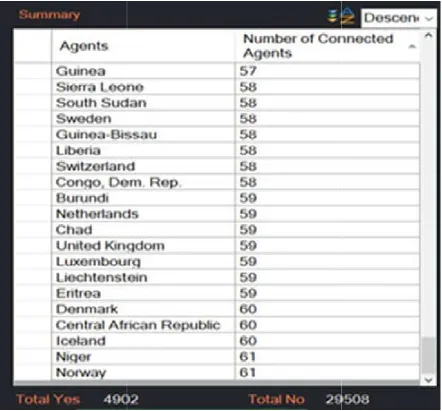
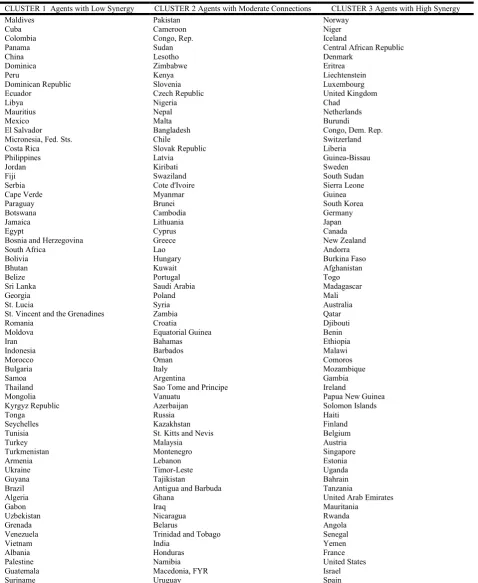
The results focused on the interactions between the connected agents. They are illustrated by scatter plot within the figures shown below. Figure 2 shows the summary of the synergy with a total number of connected agents of 4,902. This was computed using the statistical software. The results were plotted to draw the histogram ( see Figure 3) to determine the three clusters divided into equal frequency. Table 1 presents all agents clustered into three equal frequency-based on the results of the histogram. Cluster 1 is classified as agents of synergy with dissimilarity; cluster 2 are those agents with moderate similarity, and cluster 3 are agents with high synergy. The graph in Figure 4 is indicated on a scatter plot by a nonlinear flat trend with random fluctuations. The results reveal that Internet users do not depend apart from that fluctuates. Around 40, which is the point of reference, the amplitude is obtaining smaller. The variations on the number of internet users are low because it crosses the 75% HDI. Across 75% of HDI, internet users are almost the same. Below 75%, the use of the internet is high. Therefore, the human development index incorporates a stabilizing factor in internet usage which is verified in some wealthy countries wherever the internet is steady and will not be a luxury. However, it is still beyond the reach bulk of the world’s population as a result of access to the internet may be a given. Although one cannot afford a private, subscription-based fixed or mobile account, Wi-Fi hotspots providing free internet access are not restricted in coffee shops, public places, and even in some mass transit stations, that lets everybody with a smart phone, tablet, or laptop computers access the Internet (Kirkpatrick, 2018). On the other hand, among countries below 75% HDI, internet users are more likely young people who tend to use the internet more often. The increasing use of the Internet might be a good influence on education, economy, personal relationships, and politics in these countries.
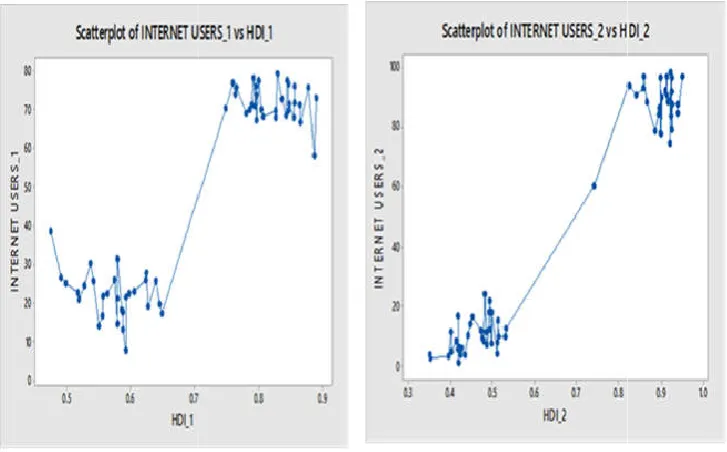
According to findings during a new report on online habits released by Hoot Suite and We Are Social, South-east Asia is one of the most internet-addicted regions worldwide, with the Philippines topping the world list with an average 10 hours and 2 minutes of screen time every day with principally the millennials ages 18 to 38. Thailand ranked 3rd where individuals spend an average of 9 hours and 11 minutes online each day, while those in neighboring Indonesia also devoted quite 8 hours and 36 minutes on the average. The scatterplot in Figures 5& 6 reflects two groups. The HDI at intervals 0.474 to 0.649 exhibits a nonlinear decreasing pattern in its number of internet users. However, a stronger jump from one cluster to the other jointly shows the interval of 0.784 to 0.890 which manifests a nonlinear flat trend in its number of internet users. Findings reveal that as you cross the 75% of HDI, the use of the internet shows gradual variations or fluctuations, whereas those agents under the 65% HDI have low internet usage. The results indicate a self – regulated control of the use of the internet. The graphs reveal that access to the internet of some agents is limited, and some are controlled and restricted by the government. Study shows several of the world's poverty-stricken individuals do not have the means or technology to go online. India, South-East Asia, East Africa, and North Korea are simply a few of the countries where most people do not have internet access.
Figure 1. The conceptual framework of the emerging structure
Figure 2. Summary of the Number of
[image:3.595.88.531.366.777.2]7797 International Journal
Figure 1. The conceptual framework of the emerging structure of the interacting agents
Figure 2. Summary of the Number of Connected Agents
Journal of Current Research, Vol. 11, Issue, 10, pp.7795-7800, October
the interacting agents
Figure 3. Histogram of the Number of Connected Agents
Figure 4. Relationship of Agents between HDI and Internet Users
Figures 5 & 6. Relationship of Agents
[image:4.595.116.480.549.775.2]7798 Inocencia M. Cañon and Michael Malachy
Figure 3. Histogram of the Number of Connected Agents
Figure 4. Relationship of Agents between HDI and Internet Users
Figures 5 & 6. Relationship of Agents between HDI and Internet Users
Cañon and Michael Malachy Dagami, Self-regulation of internet usage by human development index
and Internet Users
On the other hand, the adoption of internet usage cannot be explained solely by the level of HDI, however, by another factor, too. According to some research studies, agents that need formal approval for Internet Service Providers (ISPs) to start operations had fewer Internet users, whereas countries that regulate ISP prices have higher prices for internet users (Clarke, 2002). In the speech of Hilary Clinton entitled “Remarks on Internet Freedom” she strengthened the importance of Internet access in US foreign policy, stating its role in serving people to get new facts and making governments more accountable (US Department, 2010).
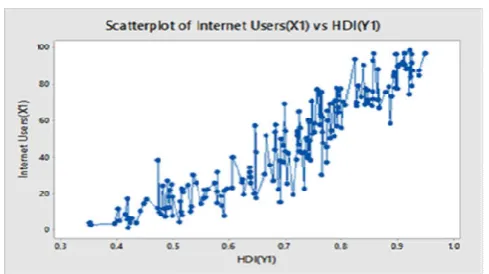
[image:5.595.58.537.83.667.2]Further, within the developing agents of the world however not restricted to some parts of Africa, Asia, and Latin America, there is limited infrastructure in place to allow people of these countries to access the internet. Moreover, though connections are available, many cannot afford either the devices needed or the account access. In general, Figure 7 presents upward oscillating movements with random fluctuation of points around the trend. The scatter plot showing the increasing human development index gives a positive effect on the internet users in a fluctuating pattern. The variations of HDI from 35% to 65% are high, and 75% of agents have low
Table 1. Summary of Agent with Low Synergy, Moderate Connections, and High Synergy
CLUSTER 1 Agents with Low Synergy CLUSTER 2 Agents with Moderate Connections CLUSTER 3 Agents with High Synergy
Maldives Pakistan Norway
Cuba Cameroon Niger
Colombia Congo, Rep. Iceland
Panama Sudan Central African Republic
China Lesotho Denmark
Dominica Zimbabwe Eritrea
Peru Kenya Liechtenstein
Dominican Republic Slovenia Luxembourg
Ecuador Czech Republic United Kingdom
Libya Nigeria Chad
Mauritius Nepal Netherlands
Mexico Malta Burundi
El Salvador Bangladesh Congo, Dem. Rep.
Micronesia, Fed. Sts. Chile Switzerland
Costa Rica Slovak Republic Liberia
Philippines Latvia Guinea-Bissau
Jordan Kiribati Sweden
Fiji Swaziland South Sudan
Serbia Cote d'Ivoire Sierra Leone
Cape Verde Myanmar Guinea
Paraguay Brunei South Korea
Botswana Cambodia Germany
Jamaica Lithuania Japan
Egypt Cyprus Canada
Bosnia and Herzegovina Greece New Zealand
South Africa Lao Andorra
Bolivia Hungary Burkina Faso
Bhutan Kuwait Afghanistan
Belize Portugal Togo
Sri Lanka Saudi Arabia Madagascar
Georgia Poland Mali
St. Lucia Syria Australia
St. Vincent and the Grenadines Zambia Qatar
Romania Croatia Djibouti
Moldova Equatorial Guinea Benin
Iran Bahamas Ethiopia
Indonesia Barbados Malawi
Morocco Oman Comoros
Bulgaria Italy Mozambique
Samoa Argentina Gambia
Thailand Sao Tome and Principe Ireland
Mongolia Vanuatu Papua New Guinea
Kyrgyz Republic Azerbaijan Solomon Islands
Tonga Russia Haiti
Seychelles Kazakhstan Finland
Tunisia St. Kitts and Nevis Belgium
Turkey Malaysia Austria
Turkmenistan Montenegro Singapore
Armenia Lebanon Estonia
Ukraine Timor-Leste Uganda
Guyana Tajikistan Bahrain
Brazil Antigua and Barbuda Tanzania
Algeria Ghana United Arab Emirates
Gabon Iraq Mauritania
Uzbekistan Nicaragua Rwanda
Grenada Belarus Angola
Venezuela Trinidad and Tobago Senegal
Vietnam India Yemen
Albania Honduras France
Palestine Namibia United States
Guatemala Macedonia, FYR Israel
Suriname Uruguay Spain
Figure 7. Scatterplot of Agents with Human Development Index and Percentage of Internet Users
variations. The graph shows the emergent feature which is self – regulation of internet usage by the human development index. The findings reveal that internet users with high self regulation are likely to allocate less time to social network sites. Self – regulated internet users will control accessing for internet usage when they know that they could not get any benefit from using it. However, it also shows that the majority of internet users were ambivalent towards regulating the extent of internet usage. Because of the ambivalence to self
there is a likelihood to the internet users to the urge to access connections of the internet. Self- regulation seems to work well as long as the group of agents exerting power is relatively cohesive (Scarpa, 1999). As HDI of agents increases utilization of the internet, this would encourage agents
to innovate, while agents, where the population focus is on basic survival due to extreme poverty and having a
accessing the internet is not a priority. Thus, the scatter implies that internet usage is dependent on the le
Conclusion
The results show that a country's regulatory approach to the Internet can have a big impact on its ubiquity throughout the country. It indicates the fact that for a fast
such as the internet, it absolutely depends
development level of agents. The increasing internet use positively affects the HDI. The findings reveal that internet users with high self - regulation would provide less time to social network sites. Self-regulated internet users will contro accessing for internet usage when they know that they could not get any benefit from using it. However, it also implies that the majority of internet users were ambivalent towards regulating the extent of internet usage and because of this ambivalence to self-regulate there is a likelihood to the internet users to the urge to access connections of the internet.
REFERENCES
Bradshaw, D. & Steyn, K. 2001. Non-communicable disease surveillance in developing countries.
https://doi.org/10.1177/14034948010290032401
Cassidy, L & Barners, G.D 2012. http://dx. Doi:.org/10.5751/ES 04963-17041
Center for the Digital Future, Annenberg School for Communication, University Of Southern California. Retrieved November 14, 2009, from http://www.digitalcenter.org/ pages/current_report.asp?intGlobalId=43
Collins English Dictionary https://www.collinsdictionary.com Communication Union, ITU Headquarters, Geneva. Sathiaseelan
A. 2013. Architecting the internet for the challenged. Retrieved from University of Cambridge:
7800 Inocencia M. Cañon and Michael Malachy
Figure 7. Scatterplot of Agents with Human Development Index and Percentage of Internet Users
The graph shows the emergent feature which is self ge by the human development index. The findings reveal that internet users with high self - regulation are likely to allocate less time to social network regulated internet users will control accessing for hey could not get any However, it also shows that the majority of internet users were ambivalent towards regulating the extent Because of the ambivalence to self-regulate, s to the urge to access regulation seems to work well as long as the group of agents exerting power is relatively As HDI of agents increases utilization such opportunities to innovate, while agents, where the population focus is on basic survival due to extreme poverty and having a low HDI, Thus, the scatter plot implies that internet usage is dependent on the level of HDI.
The results show that a country's regulatory approach to the Internet can have a big impact on its ubiquity throughout the country. It indicates the fact that for a fast-moving industry such as the internet, it absolutely depends on the human The increasing internet use The findings reveal that internet regulation would provide less time to regulated internet users will control accessing for internet usage when they know that they could However, it also implies that the majority of internet users were ambivalent towards regulating the extent of internet usage and because of this regulate there is a likelihood to the internet users to the urge to access connections of the internet.
communicable disease Retrieved from: https://doi.org/10.1177/14034948010290032401
.
Doi:.org/10.5751/ES-Center for the Digital Future, Annenberg School for munication, University Of Southern California. Retrieved http://www.digitalcenter.org/
https://www.collinsdictionary.com Communication Union, ITU Headquarters, Geneva. Sathiaseelan
A. 2013. Architecting the internet for the challenged.
Competition Policy Review Panel 2008. Globalization and the pace of change. Retrieved from Competition Policy Review Panel: https://www.ic.gc.ca/eic/site/cprp
Dutton, W. H., Helsper, E. J., & Gerber, M. M. 2009. The in Britain: 2009.
gepmc.nsf/eng/00055.html. Accessed 14 July 2008
Hettiarachchi C. 2018. Role of information and communication technologies (ICTs) in human development in South Asia.
Retrieved from Gatech Education:
http://mikeb.inta.gatech.edu/uploads/LMI_files/papers/hettiara chchi.pdf. Accessed 9Dec 2018
http://scholarcommons.usf.edu/etd/3225 https://doi.org/10.1016/j.techsoc.2018.09.010
Scholar https://www.cl.cam.ac.uk/~as2330/docs/sp
lcdnet.pdf. Accessed 18June 2013 Human Development Reports, 2019.
human-development- index-hdi
Karakara A.A., Osabuohien E. 2018. Households’ ICT access and bank patronage in West Africa: empirical insights from Burkina Faso and Ghana. Technol Soc.
Kirkpatrick, K. 2018. Bringing the Internet to the Developing
World. https://cacm.acm.org/magazines/2018/7/229046
bringing the-internet-to-the-developing Leiner, B. M., Cerf, V. G., Clark, D. D., Kahn, R.
L., Lynch, D. C., Postel, J., Roberts, "A Brief History of the Internet," ACM Communication Review, 39,
Macdougald, Joseph J. 2011. Development: Evidence and Policy Theses and Dissertations.
Mitchell, Melanie. 2009. Complexity: A Guided Tour. Oxford: Oxford University Press.
Oxford: Oxford Internet Institute. Retrieved from scholarship.org/digitalkoans/2009/06/24/the britain-2009/
Parent, I. and Cruickshank, N. 2009. The Growth of the Internet and Knowledge Networks, and their Impact in the Developing World.
doi/abs/10.1177/0266666909104709
Pew Research Center 2015. Internet Connectivity seen as Having Positive Impact on Life in Sub
https://www.penglobal.org/2018/10/09 seen-as-having-positive-impact
Retrieved May 2011],
HDR_2010_EN_Table1.pdf
Sarocco C. 2002. Improving IP Connectivity in the Least Developed Countries, Background Study.
Productivity in LDCs. International
Scandinavian is Global Leader in Social Cohes
https://www.bertelsmann-stiftung.de/en/press. New item
16/07/2013
Smoreda, Z., & Thomas, F. 2001. Social networks and residential
ICT adoption and use. In Proceeding
2001. Retrieved November 14,
www.eurescom.de/~public-web series/P903/ICT_use_Smoreda.pdf UNDP 2015. "Human Development Report
[Online],
Wallsten, S. 2002. Regulation and Internet Use in Developing Countries. We Are Social and Hootsuite. Digital 2019: Global
Internet Use Accelerates.
/2019/01/digital-2019-global-World Internet Project. 2009.
across North America, South America, Europe, Asia, the Middle East, and Oceania). Los Angeles, CA:
*******
Cañon and Michael Malachy Dagami, Self-regulation of internet usage by human development index
n Policy Review Panel 2008. Globalization and the pace of change. Retrieved from Competition Policy Review
https://www.ic.gc.ca/eic/site/cprp-
Dutton, W. H., Helsper, E. J., & Gerber, M. M. 2009. The Internet
gepmc.nsf/eng/00055.html. Accessed 14 July 2008
Hettiarachchi C. 2018. Role of information and communication technologies (ICTs) in human development in South Asia.
Retrieved from Gatech Education:
http://mikeb.inta.gatech.edu/uploads/LMI_files/papers/hettiara Dec 2018
http://scholarcommons.usf.edu/etd/3225
https://doi.org/10.1016/j.techsoc.2018.09.010 CrossRefGoogle
https://www.cl.cam.ac.uk/~as2330/docs/spice-June 2013
Human Development Reports, 2019. Hdr.und.org/en/content/ hdi
Karakara A.A., Osabuohien E. 2018. Households’ ICT access and bank patronage in West Africa: empirical insights from
Ghana. Technol Soc.
Bringing the Internet to the Developing
https://cacm.acm.org/magazines/2018/7/229046-developing-world/fulltext
Leiner, B. M., Cerf, V. G., Clark, D. D., Kahn, R. E., Kleinrock, J., Roberts, L. G. & Wolff, S. 2009. Internet," ACM SIGCOMM Computer
22-31.
Macdougald, Joseph J. 2011. "Internet Use and Economic Development: Evidence and Policy Implications". Graduate
Mitchell, Melanie. 2009. Complexity: A Guided Tour. Oxford:
Oxford: Oxford Internet Institute. Retrieved from http://digital-
digitalkoans/2009/06/24/the-internet-in-Parent, I. and Cruickshank, N. 2009. The Growth of the Internet and Knowledge Networks, and their Impact in the Developing
World. https://journals.sagepub.com/
doi/abs/10.1177/0266666909104709
Internet Connectivity seen as Having Positive Impact on Life in Sub-Saharan Africa. Available at: https://www.penglobal.org/2018/10/09
internet-connectivity-impact-on-life-in-sub-sharan-africa.
Retrieved May 2011], http://hdr.undp.org/ en/media/
Improving IP Connectivity in the Least Developed Countries, Background Study. Improving IP
International
Scandinavian is Global Leader in Social Cohesion.
stiftung.de/en/press. New item
Smoreda, Z., & Thomas, F. 2001. Social networks and residential
Proceedings of EURESCOM Summit
. Retrieved November 14, 2009, from http://
web-deliverables/ P900-
series/P903/ICT_use_Smoreda.pdf
Development Report Statistic of UNDP,"
Regulation and Internet Use in Developing Countries. We Are Social and Hootsuite. Digital 2019: Global
Internet Use Accelerates. https://wearesocial.com/blog
-internet-use-accelerates
World Internet Project. 2009. Summary report. (13 countries
across North America, South America, Europe, Asia, the Middle East, and Oceania). Los Angeles, CA: