NEW ERA IN DESIGNING AND GOVERNING COOLING INTENSITY OF LIQUID QUENCHANTS
TO DECREASE DISTORTION DURING HARDENING OF STEEL PARTS
1,*
Kobasko, N. I.,
2Moskalenko, A.A.,
2
Institute of Engineering Thermophysics of NASU, 2A Zhelyabova str., Kyiv, Ukraine, 03057
3
Department of Polymers Modification, Institute of Macromolecular Chemistry
4
Department of Mechanical and Materials Engineering, Portland State University, Portland, Oregon, USA
5
Intensive Technologies Ltd, 68/1 Peremohy ave., Kyiv, Ukraine, 03113
ARTICLE INFO ABSTRACT
It was proved in last decade that very intensive and uniform cooling eliminates quench crack formation and significantly decreases distortion of quenched steel parts as compared with their slow cooling in mineral oils. That opened a new era in design ing a
quenchants for strengthening steel parts and decrease their distortion after quenching. The new approaches were developed by authors to provide accelerated and uniform cooling steel parts during quenching by creatio
water polymer solutions of inverse solubility are used as a quenchant. More information on cooling intensity of Poly (Alkylene Glycol) polymers (PAG) solutions one can find in
(Totten
bath’s coolant which less affects environment. It is shown in presentation that accelerated cooling should be interrupted at proper
decrease more distortion and prevent quench crack formation. To govern process of quenching and make cooling interruption, software IQCalc2 was developed
Copyright © 2018, Kobasko et al. This is an open access distribution, and reproduction in any medium, provided
INTRODUCTION
It was a well-known fact in a heat treating practice which stated that quench crack formation and distortion of products after quenching always increase with increasing
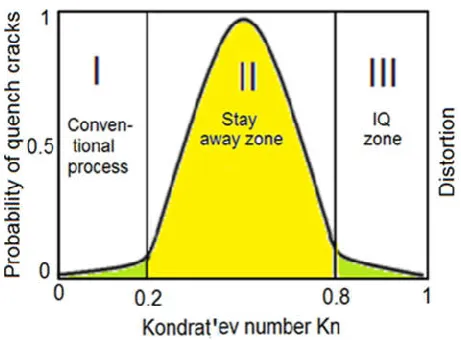
rate during hardening (see Fig. 1, section I and II). correlation between a probability of part cracking and part cooling rate during quenching is represented by a parabolic curve: the higher the part cooling rate the greater the probability of part cracking and the greater the part distortion. The intensive quenching (IQ) process phenomenon proved that this is not always the case. Actually, the correlation be the probability of part cracking and the cooling rate is represented by a bell-shaped curve shown in
1980; 2016). Where Kondrat’ev numbers Kn is directly proportional to cooling rate of a given product.
*Corresponding author: Kobasko, N. I.,
IQ Technologies, Inc. Akron, USA
DOI: https://doi.org/10.24941/ijcr.31683.08.2018
ISSN: 0975-833X
Article History:
Received 15th May, 2018
Received in revised form 20th June, 2018
Accepted 07th July, 2018 Published online 30th August, 2018
Citation: Kobasko, N. I., Moskalenko, A.A., Logvynenko, P.N., Totten, G.E. and Dobryvechir, V.V. Liquid Quenchants to Decrease Distortion During Hardening of Steel Parts
Key Words:
Polymers, Low Concentration, Insulating Layer, Absence Film Boiling, Decreased Distortion,
Accelerated Cooling, Interruption, High Quality, Green Technology.
RESEARCH ARTICLE
NEW ERA IN DESIGNING AND GOVERNING COOLING INTENSITY OF LIQUID QUENCHANTS
TO DECREASE DISTORTION DURING HARDENING OF STEEL PARTS
Moskalenko, A.A.,
3Logvynenko, P.N.,
4Totten, G.E. and
1
IQ Technologies, Inc. Akron, USA
Institute of Engineering Thermophysics of NASU, 2A Zhelyabova str., Kyiv, Ukraine, 03057
Department of Polymers Modification, Institute of Macromolecular Chemistry of NASU, 48 Kharkivske road,
Kyiv, Ukraine, 02160
Department of Mechanical and Materials Engineering, Portland State University, Portland, Oregon, USA
Intensive Technologies Ltd, 68/1 Peremohy ave., Kyiv, Ukraine, 03113
ABSTRACT
It was proved in last decade that very intensive and uniform cooling eliminates quench crack formation and significantly decreases distortion of quenched steel parts as compared with their slow cooling in mineral oils. That opened a new era in design ing and governing cooling intensity of liquid quenchants for strengthening steel parts and decrease their distortion after quenching. The new approaches were developed by authors to provide accelerated and uniform cooling steel parts during quenching by creation on their surface thin insulating layers. For this purpose low concentration of water polymer solutions of inverse solubility are used as a quenchant. More information on cooling intensity of Poly (Alkylene Glycol) polymers (PAG) solutions one can find in
(Totten et al., 1993). Along with decreasing distortion of steel parts, such approach decreases cost of bath’s coolant which less affects environment. It is shown in presentation that accelerated cooling should be interrupted at proper time to provide self tempering, fix compressive residual stresses, decrease more distortion and prevent quench crack formation. To govern process of quenching and make cooling interruption, software IQCalc2 was developed
access article distributed under the Creative Commons Attribution License, the original work is properly cited.
known fact in a heat treating practice which stated that quench crack formation and distortion of products after quenching always increase with increasing their cooling rate during hardening (see Fig. 1, section I and II). Such correlation between a probability of part cracking and part cooling rate during quenching is represented by a parabolic curve: the higher the part cooling rate the greater the lity of part cracking and the greater the part distortion. The intensive quenching (IQ) process phenomenon proved that this is not always the case. Actually, the correlation between the probability of part cracking and the cooling rate is shaped curve shown in Fig. 2 (Kobasko, here Kondrat’ev numbers Kn is directly proportional to cooling rate of a given product.
.08.2018
(Kobasko, Aronov et al. 2010
shaped curve was established by experiment. correctness of such unusual statement, the special conducted by IQ Technologies Inc.
DANTE Solutions, Inc., of Cleveland, Ohio using high velocity system for providing extremely high cooling rate and software DANTE (Distortion Analysis for Thermal Engineers). The IQ Technologies Inc. carried out experiments with a keyway shaft supported by mumerical calculations made by the DANTE Solutions Inc (Ferguson, 2013). Results of investigations were widely discussed by authors (Kobasko, Aronov, et.al., 2010; Ferguson, 2013) and are pres
2, Fig. 3, Fig. 4 and Table 1. It was shown (Kobasko, Aronov,
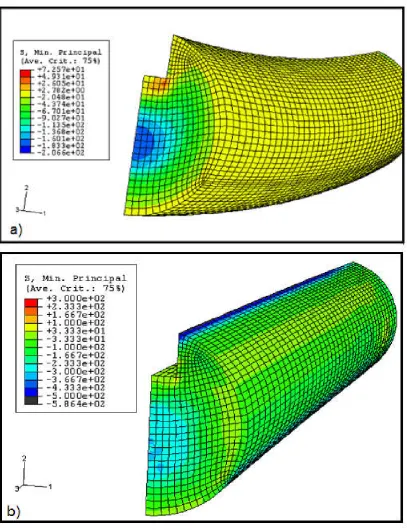
et.al., 2010) that distortion of keyway shaft during quenching in oil was greater than the distortion of the same keyway shaft intensively quenched by water. The reason for this w uniform formation of the martensitic layer throughout the entire part surface area and development of high current and residual surface compressive stresses during the IQ process (see Fig. 2).
International Journal of Current Research
Vol. 10, Issue, 08, pp.72631-72636, August, 2018
, A.A., Logvynenko, P.N., Totten, G.E. and Dobryvechir, V.V., 2018. “New Era in Designing and Governing Cooling Intensity of Liquid Quenchants to Decrease Distortion During Hardening of Steel Parts”, International Journal of Current Research, 10, (08),
NEW ERA IN DESIGNING AND GOVERNING COOLING INTENSITY OF LIQUID QUENCHANTS
TO DECREASE DISTORTION DURING HARDENING OF STEEL PARTS
Totten, G.E. and
5Dobryvechir, V.V.
Institute of Engineering Thermophysics of NASU, 2A Zhelyabova str., Kyiv, Ukraine, 03057
of NASU, 48 Kharkivske road,
Department of Mechanical and Materials Engineering, Portland State University, Portland, Oregon, USA
Intensive Technologies Ltd, 68/1 Peremohy ave., Kyiv, Ukraine, 03113
It was proved in last decade that very intensive and uniform cooling eliminates quench crack formation and significantly decreases distortion of quenched steel parts as compared with their slow nd governing cooling intensity of liquid quenchants for strengthening steel parts and decrease their distortion after quenching. The new approaches were developed by authors to provide accelerated and uniform cooling steel parts during n on their surface thin insulating layers. For this purpose low concentration of water polymer solutions of inverse solubility are used as a quenchant. More information on cooling intensity of Poly (Alkylene Glycol) polymers (PAG) solutions one can find in a well known book 1993). Along with decreasing distortion of steel parts, such approach decreases cost of bath’s coolant which less affects environment. It is shown in presentation that accelerated cooling time to provide self tempering, fix compressive residual stresses, decrease more distortion and prevent quench crack formation. To govern process of quenching and
License, which permits unrestricted use,
2010). For the first time, the bell – shaped curve was established by experiment. To check correctness of such unusual statement, the special study was conducted by IQ Technologies Inc. of Akron, Ohio and Solutions, Inc., of Cleveland, Ohio using high velocity system for providing extremely high cooling rate and software DANTE (Distortion Analysis for Thermal Engineers). s Inc. carried out experiments with a keyway shaft supported by mumerical calculations made by the DANTE Solutions Inc (Ferguson, 2013). Results of investigations were widely discussed by authors (Kobasko, 2010; Ferguson, 2013) and are presented in Fig. 2, Fig. 3, Fig. 4 and Table 1. It was shown (Kobasko, Aronov, distortion of keyway shaft during quenching in oil was greater than the distortion of the same keyway shaft intensively quenched by water. The reason for this was a uniform formation of the martensitic layer throughout the entire part surface area and development of high current and residual surface compressive stresses during the IQ process
OF CURRENT RESEARCH
Fig. 1. Crack formation and distortion versus Kondrat’ev number Kn (Kobasko, 1980; 2016): I – conventional processes (quenching in oil, polymers of high concentration or vacuum gas quenching); II – stay away zone; III – intensive quenching zone
Both the uniform martensitic layer and high surface compressive stresses reduce the part distortion compared to conventional oil quenching, where the formation of the martensite is not as uniform and the surface compressive stresses are smaller or tensile. The keyway shafts were made of AISI 1045 steel bars of 25.4 mm (1 in.) in diameter and of 254 mm (10 in.) in length. A nominal chemical composition of AISI 1045 steel is 0.43– 0.50 % carbon and 0.6–0.9 % manganese. The shafts were ground and polished to within ±0.025 mm (0.001 in.). The intensively quenched shafts proved to have both greater surface hardness and core hardness (Kondrat’ev, 1957).
Table 2 presents the distortion data obtained during quenching in oil and high velocity system (Kobasko, Aronov, et.al.,
2010). As seen from Table 1, intensive quenching caused much less shaft distortion than that did conventional oil quenching. A finite-element heat-treating-process computer calculations showed the same results shown in Fig. 2 (Ferguson, 2013). Thus, the IQ-3 process provides three times less distortion as compared to oil quenching. Obtained results proof the idea that high cooling rates is not a reason for the high part distortion when a uniform cooling is provided (see Fig. 3, Fig. 4 , and Table 1). This important for the practice fact opens the new possibility in designing and governing cooling intensity of liquid quenchants. More info on new direction in heat treating industry is provided below. In contrary to existing opinions, very intensive quenching decreases distortion (see Table 1) due to formation a uniform shell that acts as a die preventing quench crack formation and minimizing distortion (Kobasko, Aronov, et.al., 2012).
Designing of optimal concentration quenchants and governing of their cooling intensity by creation insulating layers on the surface of steel parts: An idea on decreasing initial heat flux density to eliminate film boiling processes using insulating surface layers was generated by authors in 1987 (Kovalenko, Kobasko, et.al., 1987). In 1996 authors (Kobasko, Moskalenko, et.al. 1996; Moskalenko, Kobasko et al., 1996) discovered that low concentration of PAG in tap water (1%) increases cooling rate of spherical silver probe 20 mm in diameter more than two times as compared with its cooling in water solution of PAG of high concentration (see Table 2).
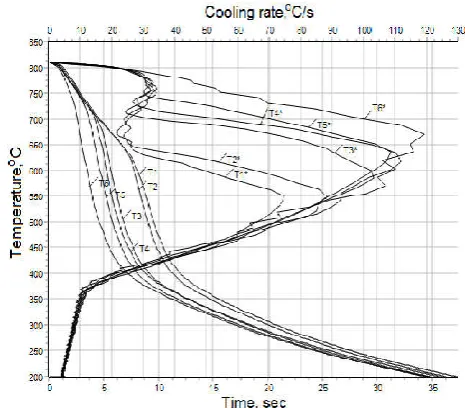
investigted using large cylindrical stainless probe. To be closer to the Liscic/Petrofer probe (Liscic, 2016), experiments were carried out with cylindrical probe 50 mm in diameter and 200 mm length made of AISI 304 steel. Three thermocouples were instrumented in the probe: on the surface, 5 mm below surface and at the center of the probe. This probe was used for testing low concentration of PAG in tap water and NaCl water solution to compare results of experiments. Investigated polymer was similar to UCON E. As is known, PAG polymers dissolved in water are widely used as the quenchants for hardening machine components and tools. Currently, 10%, 20%, and even 30% water solutions of PAG polymers in water are used to substitute the costly oils. According to Fig. 5, maximal cooling rate for cylindrical probe 50 mm in diameter during quenching probe in 1% water PAG solution is 16.8 oC/s when core temperature is 600oC. Taking into account thermal properties of AISI 304 steel from Tables 3 and 4, one can calculate effective heat transfer coefficient and effective Kn number using Eq. 1 and Eq. 2 (Kondrat’ev, 1957; Kobasko,
et.al., 2010):
T
T
m
K
aKn
v
(1)or
T
T
m
a
vK
Kn
(2)Kondratjev (Kondrat’ev) form factor for 50 mm in diameter probe is 105.25 x 10⁻⁶ m2 and average thermal diffusivity of steel AISI 304 at 600oC, according to Table 3, is 5.1 x 10⁻⁶ m2. That is why
614
.
0
565
/
10
1
.
5
10
25
.
105
/
8
.
16
2 6 2 6
C
s
m
m
s
C
Kn
o oAccording to Fig. 6, cooling rate is 10oC/s when core temperature is 465oC. In this case
505
.
0
430
/
10
85
.
4
10
25
.
105
/
10
2 6 2 2 6
C
s
m
m
m
s
C
Kn
o o .Fig. 2. Minimum principal residual stresses in keyway shaft after quenching in oil (a) and after IQ process (b) according to author (Ferguson, 2013)
Fig. 3 Martensitic uniform shell formation in keyways during IQ process: a – providing minimum distortion due to uniform shell formation during IQ process; b – resulting in more distortion due to non-uniform shell formation during oil
[image:3.595.119.497.610.755.2]It means (Lykov, 1967) that
1027 . 0 31
35 300 ln 35 650
ln
s
s
C C C
C m
o o o
o
.
When
VBi
, 6 2 12 6
048
.
0
10
25
.
105
/
10
1
.
5
s
m
s
m
K
a
m
and
0
.
56
048
.
0
027
.
0
1 1
s
s
Kn
. [image:4.595.106.491.79.155.2]Thus, intensity of cooling in brine (14% water solution of NaCl) is almost equal to intensity of cooling in 1% water polymer solution. It means that film boiling during quenching in low concentration of water polymer solution didn’t take place.
Fig. 4. Keyway shaft distortions (Kobasko, Aronov et al., 2010)
Table 1. Keyway shaft distortion in mm (Kobasko, Aronov, et.al., 2010; Ferguson, 2013)
[image:4.595.48.538.284.355.2]Single part oil quenching Batch oil quenching Single part intensive quenching 0.20 – 0.36 0.25 – 0.51 0.08 – 0.12
Table 2. Influence of the PAG concentration on the duration of film- and nucleate boiling during quenching silver spherical probe 20 mm in diameter (20 oC) (Kobasko and Moskalenko, 1996)
Concentration, %
fb
, s
nb, sv
max, oC/sWater 7 2 231
PAG, 1% 0.2 2.1 674
3 1.5 2.5 467
10 1.8 4 336
[image:4.595.63.532.390.456.2]20 2.6 6 251
Table 3. Thermal conductivity of super cooled austenite versus temperature
T, ºC 100 200 300 400 500 600 700 800 900
mK W
,
17.5 18 19.6 21 23 24.8 26.3 27.8 29.3
mK W
,
17.5 17.75 18.55 19.25 20.25 21.15 21.90 22.65 23.4
Table 4. Thermal diffusivity
a
of super cooled austenite versus temperatureT, ºC 100 200 300 400 500 600 700 800 900
S
m
a
2 6
,
10
4.55 4.63 4.70 4.95 5.34 5.65 5.83 6.19 6.55
4.55 4.59 4.625 4.75 4.95 5.10 5.19 5.37 5.55
[image:4.595.55.536.487.570.2] [image:4.595.39.554.632.694.2]Note:
anda
at 500°С (analogously at other temperatures) mean average values for the range of 100°С - 500°С.Table 5. Comparison of effective HTCs, generalized Biot numbers and effective numbers Kn obtained during quenching in brine, low and high concentration PAG in water and in mineral oils
Quenchant Effective HTC in W/m2K Bi
V Kn
14% NaCl water solution at 20oC, no agitation 2750 1.12 0.57
1% PAG water solution at 25oC 3510 1.35 0.61
Houghton K oil at 43oC agitated with 0.5 m/s. 1215 0.50 0.35
Amolite 22 oil at 43oC agitated with 0.5 m/s. 972 0.40 0.30 Deacon 70 oil at 43oC agitated wit 0.5 m/s. 1070 0.44 0.33
S
m
a
2 6
,
10
Fig. 5. Core cooling curve and cooling rate versus time during quenching probe 50 mm in diameter and 200 mm long in 1%
[image:5.595.315.548.57.261.2]water polymer (PAG) solution at 35oC
Fig. 6. Effective number Kn versus size of cylinders for different
convective heat transfer coefficients: B1 is 750W/ m2K; B2 is 1500
W/ m2K; B3 is 4000 W/ m2K (Kobasko, 2017b)
Fig. 7. Cooling curves obtained during quenching cylindrical
probe 50х200 мм in 14% water solution of NaCl at 350С: Т5 мм
is distance 5 mm below surface
[image:5.595.43.282.276.427.2]Effective HTCs, generalized Biot numbers and effective numbers Kn are shown for comparison in Table 5. Along with water polymer solutions, an addition of small amount of poluisibutelene polymer to mineral oil also eliminates film boiling and decreases distortion (Logvynenko, et.al, 2016, Kobasko et al., 2016).
Fig. 8. Cooling curves and cooling rates for solutions of
polyisobutylene polymer (PIB 2400) in I – 20A mineral oil at 50oC
versus concentration, %wt: 1-0; 2–0.5; 3–1.0; 4-1.5; 5-2.0; 6–3.0
(Logvynenko et al. 2016; Kobasko et al., 2016)
Authors (Kobasko, 2012; Logvynenko et al., 2017) explained such phenomenon by creating thin insulating layer with additive during quenching in oil. It was shown that the addition of PIB (polyisobutylene polymer) creates an insulating layer on the surface of steel parts during quenching in oils that eliminates film boiling without affecting physical properties of the oil. Insulating layer decreases initial heat flux density which becomes less than critical one of the oil. That is why film boiling during quenching with the PIB additive is absent (see Fig. 8). Authors believe that such approach will allow engineers to reduce effectively the steel parts distortion after quenching in oil too (Kobasko, 2012; Logvynenko et al.,
2017). Effect of insulating layer on decreasing initial heat flux density was considered in 2012 in detail by author (Kobasko, 2012). Further this effect was used to eliminate film boiling processes and govern cooling intensity of liquids during quenching in oils and inverse solubility polymers. Note that film boiling in mineral oil I – 20 was eliminated completely by adding to oil 3% PIB 2400 (see Fig. 8).
DISCUSSION
[image:5.595.44.283.486.674.2]machine components and tools are available to to develop cooling recipes during hardening of different materials. Effective Kn number allows combining transient nucleate boiling process with convection mode that simplifies significantly recipes calculations and is used in software IQCalc2. Along with creation insulating surface layers in water PAG solution, this approach is already used in practice during quenching steel parts in mineral oils.. The oils with special additives are prepared and sold by Barkor – Oil Ltd, Kyiv, Ukraine . The JSC"SKF in Ukraine" uses such oils to increase
quality of their bearing rings. Authors of the paper believe that
designing and governing cooling intensity of liquid quenchants by creation of thin insulating layers on the surface of machine components and tools is currently a new era in heat treating industry. In opinion of authors, the developed approach combined with the hydrodynamics emitters (UA Patent, 2013) can compete with the costly and complicated systems widely used for heat treating processes exploring costly liquid quenchants for hardening machine components and tools. Cost of heat treating processes will be significantly reduced in the nearest future.
Conclusion
1.Instead of water PAG solutions 10%, 20% and 30% can be used 1% polymer PAG solution which creates surface insulating layer that prevents film boiling and makes cooling uniform and intensive. 3% solution of PIB 2400 in mineral oil I -20A eliminates film boiling and provides uniform cooling in that oil that decreases distortion of steel parts too. Effective numbers Kn are used, obtained by painstaking experiments, to simplify computer calculations. The value Kn also serves as an characteristic of a quenchant.
REFERENCES
Ferguson, B.L. 2013. Applying DANTE Heat Treat Modeling to Intensive Quenching, Presentation at the Intensive Quenching Workshop held on April 24 in Cleveland, Ohio, USA.
Kobasko, N. I. 1980. Steel Quenching in Liquid Media Under Pressure. Kyiv: Naukova Dumka, 206.
Kobasko, N. I. 2012. Real and Effective Heat Transfer Coefficients (HTCs) Used for Computer Simulation of Transient Nucleate Boiling Processes during Quenching. Materials Performance and Characterization, 1 (1), 104656. doi: 10.1520/mpc104656.
Kobasko, N. I., Aronov, M. A., Ferguson, B. L., Li, Z. 2012. Local Film Boiling and Its Impact on Distortion of Spur Gears During Batch Quenching. Materials Performance and Characterization, 1 (1), 104533. doi: 10.1520/mpc 104533doi: 10.1520/mpc104533
Kobasko, N. I., Moskalenko, A. A. 1996. Intensification the methods of quenching by means of use water polymer solutions. Promyshlennaya Teplotekhnika, 18 (6), 55–60.
Intensive Quenching Systems: Engineering and Design. ASTM International, 242. doi: 10.1520/mnl64-eb
Kobasko, N., Moskalenko, A., Logvynenko, P., Karsim, L., Riabov, S. 2016a. . An effect of PIB additives to mineral oil resulting in elimination of film boiling during steel parts quenching. EUREKA: Physics and Engineering, 3, 17–24. doi: 10.21303/2461-4262.2016.00076
Kobasko, N.I. 2016b. Improvement of IQ - 3 processes to eliminate crack formation, decrease distortion, and maximize material strength, and ductility, EUREKA: Physics and Engineering, No. 4, pp. 3 – 10. DOI: 10.21303/2461-4262.2016.00122.
Kobasko, N.I. 2017a. Cooling intensity of inverse solubility polyalkylene glykol polymers and some results of investigations focused on minimizing distortion of metal components, EUREKA: Physics and Engineering, No. 2, pp. 55 – 62. DOI: 10.21303/2461-4262.2017.00294. Kobasko, N.I. 2017b. Investigation of transient nucleate
boiling processes and their practical use in heat treating industry, EUREKA: Physics and Engineering, No. 5, pp. 39 – 48. DOI: 10.21303/2461-4262.2017.00409
Kondrat’ev, G. M. 1957. Thermal Measurements. Moscow: Mashgiz.
Kovalenko, G. V., Kobasko, N. I., Khalatov, A. A., 1987. A Method of Hardening of Steel Components. USSR Certificate № 1355634. Bulletin of Inventions, 44.
Liščić, B. 2016. Measurement and Recording of Quenching Intensity in Workshop Conditions Based on Temperature Gradients. Materials Performance and Characterization, 5 (1), MPC20160007 .doi: 10.1520/mpc20160007.
Logvynenko, P. N., Moskalenko, A. A., Kobasko, N. I., Karsim, L. O., Riabov, S. V. 2016. Experimental Investigation of the Effect of Polyisobutilene Additives to Mineral Oil on Cooling Characteristics. Materials Performance and Characterization, 5 (1), MPC20150072. doi: 10.1520/mpc20150072
Logvynenko, P., Moskalenko, A., Kobasko, N., Karsim, L., Riabov, S. 2017. Mechanism of film boiling elimination during quenching probes in mineral oils containing oligomeric additives, WSEAS Transactions on HEAT and MASS TRANSFER , Vol. 12, pp. 93 – 99. E - ISSN: 2224-3461.
Lykov, A. V. 1967. Teoriya Teploprovodnosti (Theory of Heat Conductivity). Moscow: Vyschaya Shkola, 596.
Moskalenko, A. A., Kobasko, N. I., Tolmacheva, O. V., Totten, G. E., Webster, G. M. 1996. Quechants Characterization by Acoustical Noise Analysis of Cooling Properties of Aqueous Poly (Alkylene Glycol) Polymer Quenchants. Proceedings of the Second International Conference on Quenching and Control of the Distortion, 117–122.
Totten, G. E., Bates, C. E., Clinton, N. A. 1993. Handbook of Quenchants and Quenching Technology. ASM International, Materials Park, 513.
UA Patent No. 109572, filed: 07.10.2013; published: 10.09.2015, Bul. 17/2015.