An updated version of this paper was presented at 2nd International workshop on Statistical Techniques in Pattern Recognition, Sydney, Australia. August 1998, Lecture Notes in Computer Science, Springer Verlag.
Generalised Syntactic Pattern Recognition as a Unifying
Approach in Image Analysis
Mark Venguerov
POINT Information Systems Ltd. E-mail: [email protected]
Pádraig Cunningham
AIG, Department of Computer Science Trinity College, University of Dublin E-mail: [email protected]
Abstract
.
In this paper we analyse theoretical foundations of syntactic pattern recognition and its relationships with mathematical linguistics, structural pattern recognition, and statistical pattern recognition. We point out that all the above mentioned methods are based on two fundamental operations: thecombination of parts into wholes and abstraction. We provide examples of
those operations in different contexts. Finally, we note that at this level of generalisation, all three main approaches to pattern recognition (structural, statistical and syntactic) can be merged into one powerful method. We outline a system based on these principles and intended to be used for the recognition of unconstrained handwriting.
1 Introduction
There exists a huge variety of methods for pattern recognition. All those methods are usually classified as either statistical (decision-theoretical) or structural. Within the realm of structural methods there exists a special area called syntactic pattern recogni-tion (SPR) dealing with the applicarecogni-tion of methods developed in mathematical lin-guistics to pattern recognition.
2 Syntactic Pattern Recognition: State-of-the-art
As it is defined in [1,2], syntactic pattern recognition is the application of methods of mathematical linguistics to pattern recognition. The standard procedure is as follows: first, some pre-processing is done in order to reduce noise, improve contrast, etc. During the next stage certain predefined features are extracted from the input. Finally, the system parses the set of features discovered in the previous step using some type of grammar. If this parsing can be successfully finished (i.e. the whole input can be reduced to the grammar start symbol S) then the system has recognised a pattern (an object, a set of objects, etc.). Syntactic and semantic information calculated at this stage can be used for understanding and reasoning about the input.
Depending on the type of grammar used in this approach concrete implementa-tions can be further classified as string, tree and graph grammar based. The last ones are the most general and are perceived to be most suitable for generic pattern recogni-tion. Unfortunately, graph grammar based syntactic pattern recognition is generally speaking intractable.
3 Similarities and Differences Between Pattern Recognition and
Linguistics
Why can methods developed in one area of computer science be used in another? A naïve answer to this question is: because they work (when they work). Interestingly enough, this answer is considered often to be a satisfactory one. A more enlightened approach to the problem suggests that there must be something common between the two areas, some abstract entity which realises itself in different ways in those areas, but facilitates the transfer of methods between them.
In the case of pattern recognition and mathematical linguistics such a key common abstract entity is the notion of structure. The structure of an object is the way its con-stituent parts are put together to produce the object. There are two important parts in this definition: a) an object consists of parts and b) in order to constitute the object its parts have to relate to each other in a certain way, i.e. they should satisfy certain rela-tions.
In linguistics the objects to be recognised or generated are sentences. Sentences consist of words. So, words and word groups are those parts that constitute wholes -sentences. The relations that the words have to satisfy in order to produce valid sen-tences depend on the type of a particular language. In non-order free languages (e.g. English) this relation is adjacency. In word order free languages (e.g. Slavic lan-guages) this relation is grammatical conjugation through suffixes, auxiliary particles, articles, etc. In any case, the application of the notion of structure in linguistics is quite straightforward.
into rectangles and so on. The relations between the parts are 2-D (and deduced 3-D) spatial relations.
This universality of the notion of structure made some philosophers and cognitive scientists believe that any representation in any cognitive system is ‘language’ like.
Along with the similarities described above there exist a number of differences, which preclude direct application of linguistic methods in pattern recognition. The main obstacle here is the higher dimensionality of the input, which in turn leads to the absence of linear ordering. Although this may seem a minor issue, it results in expo-nential growth of the computational resources with the growth of input. Similar prob-lems arise in linguistics when algorithms developed for non-free order languages are directly applied to a free word order language.
The size of the input is another substantial difference. The size of a typical sen-tence (a unit of recognition in linguistics) is usually tens of words, whereas the size of a typical (realistic) image is at the level of hundreds and even thousands of features. This, combined with absence of ordering of the input, makes direct application of lin-guistic methods computationally intractable.
Some researchers made an attempt to overcome this intractability introducing an ‘artificial’ ordering of the input. This approach allows the application of efficient parsing algorithms from linguistics. Unfortunately, imposing an arbitrary ordering on the input leads in the general case to very unstable recognition, i.e. presence or ab-sence of a single small feature can dramatically change the result.
4 Two Basic Operations in Recognition
If we analyse the recognition process from a very abstract and general point of view, we discover that basically all of the different approaches to recognition are based on two fundamental operations - the combination of parts into wholes and abstraction. These two operations have corresponding fundamental relations - the part-whole rela-tion and the is-a relarela-tion.
The abstraction operation in recognition is the process of either finding a class to which an instance, detected during the recognition process, belongs, or finding a su-per-class for a given sub-class and further using this class in the recognition process. Such a definition of abstraction corresponds to the usage of this term in logic. We don't specifically distinguish the two forms of the operation - the instance-to-class and the sub-class-to-super-class.
Certain areas in pattern recognition emphasise one of those operations more than the other, e.g. structural pattern recognition is explicitly based on the part-whole rela-tion, whereas statistical pattern recognition pushes this relation almost to oblivion. Nevertheless, thorough analysis shows that either a specific method of recognition has a rather restricted area of applicability, or it implicitly uses both operations/relations.
well for the recognition of simple objects and scenes. If it is applied directly to the recognition of more realistic images, the number of models grows very quickly. What can help here is the organisation of the knowledge base into a structure similar to se-mantic networks, with explicit use of the is-a relation and the abstraction operation. We discuss this structure in more detail in the next section.
In linguistics, the combination operation corresponds to string concatenation. The abstraction operation is in this case more subtle. Let us consider a (context-free) grammar, which has exactly one rule with a given non-terminal in its left-hand side. If such a grammar contains recursion it generates infinite length strings. Otherwise, it generates exactly one string! So, for a grammar to generate more than one string, it has to contain multiple rules with the same non-terminal in their left-hand side. We can consider therefore such a non-terminal as a class, whose sub-classes are consti-tuted by strings generated by different rules. Based on this observation, we consider this combination of different rules for the same non-terminal a special case of ab-straction.
The notion of abstraction in linguistics becomes clearer if we convert a grammar into its Wolff's normal form [3,4]. In this form there are two types of rules, OR-rules and AND-rules. OR-rules are of the form:
A = B | C | D,
which is a short representation of a set of 'normal' rules A=B, A=C, A=D. AND-rules are just normal rules of the form:
W = X Y Z,
which means that W is a concatenation of terminals/non-terminals X, Y, and Z. Each terminal can be used in the left-hand side of exactly one rule, so the set of all non-terminals has two subsets: OR-symbols and AND-symbols. Any context-free grammar can be transformed into Wolff's normal form.
Now, each non-terminal is a class label for the class of all strings, which can be generated from it. Hence, the OR-rule A = B | C | D means that class A contains sub-classes B, C, and D and is an extensional abstraction of those sub-classes.
5 Abstraction
In order to understand better how the generic recognition process described in this paper works it is very important to analyse the abstraction operation. First of all, let us recall that in mathematical logic there exist two types of class definition - intentional and extensional. An extensional description of a class is an explicit listing of all its elements. An intentional definition is a predicate, which must produce TRUE when calculated for an object that belongs to the class. Corresponding to this distinction we define extensional and intentional abstraction.
In contrast to this, sets of numbers usually have intentional definitions. For in-stance, it is impossible to list all the prime numbers. Instead, having a number we can calculate the predicate 'prime' for this number (e.g. using Eratosthenes sieve algo-rithm). If the output of the algorithm is TRUE then the number is prime.
An important feature of the abstraction operation is that it always leads to a loss of information. An abstract concept contains less information than a specific instance of the concept. On the other hand, exactly this 'loss of information' allows cognitive systems to process information about the world. The trick here is that only the infor-mation irrelevant to the goals of perception or reasoning is stripped away. Which in-formation is relevant and which is not is highly context dependent. It makes it very difficult to model this feature of cognitive systems algorithmically.
A major problem in image analysis is the huge variability of the input. By this we understand the fact that even a relatively simple object (e.g. a cube) can produce a huge number of different images depending on its position in the view field, its pose, illumination conditions, etc. In this case the ability of a recognition system to strip out this irrelevant (for the purposes of recognition) information becomes instrumental. Many well-known methods in image analysis are examples of the abstraction opera-tion (e.g. thinning, edge detecopera-tion, etc.) though it is rarely stated explicitly.
6 Knowledge Representation in Recognition Systems
All the systems that perform recognition contain two main types of information. The first type is the ‘knowledge’ of the system about the recognition task. In neural net-works this knowledge is represented as connection weights, in case-based reasoning systems - as the case base, in model matching systems - as the database of models, in syntactical parsers - as the set of grammatical rules. The second type of information is the current input of the system, its state in the recognition process and the result (or set of results) of recognition. Some systems use one representation for both types of in-formation, some use two different representations. For instance, in neural networks both the ‘knowledge’ of the system and the processing information are represented as vectors of real numbers; in model matching systems used in computer vision models and the input are usually represented as graphs. In syntactical parsers the knowledge of the system is represented as a set of rules, the input of the system is a string, and the output is a parse tree.
In our model the ‘knowledge’ of the systems is represented as generalised syntac-tic rules. One type of rule representation corresponds to Wolff’s OR-rules. Rules of this type describe a class as a collection of its subclasses. Structural rules constitute the second type of rules. They describe what parts an object consists of and what rela-tions these parts have to satisfy and correspond to Wolff’s AND-rules.
specified using extensional representation of relations. In contrast to this, in our ap-proach we use intentional representation. This means that relations are specified as procedures taking object attributes as parameters and calculating truth values. The representation of relations allows us to express relations with different degree of ab-straction, ranging from exact positional relations (e.g. one object is located 30 pixels below the other) to very abstract qualitative relations (e.g. one object is located to the left of the other). This set of relations with the increasing degree of abstraction con-stitutes the framework of the knowledge representation of the system. It facilitates the creation of more and more abstract representations of the input of the system leading to the efficient recognition.
VE =
- Vertical Element
(Element of a vertical line)
HE =
- Horizontal Element
(Element of a horizontal line)
VL1 = VE + VE : R1
VL2 = VL + VE : R1
VL = VL1 | VL2
- Vertical Line
[image:6.595.137.428.283.563.2]GVL1 = VL + VL : R2
GVL = GVL1 | VL
- Generalised Vertical Line
HL1 = HE + HE : R3
HL2 = HL + HE : R3
HL = HL1 | HL2
- Horizontal Line
GHL1 = HL + HL : R4
GHL = GHL1 | HL
- Generalised Horizontal Line
LINE1 = GHL | GVL
LINE2 = LINE + LINE : R5
LINE = LINE1 | LINE2
- Curved Line
R1: left
1= left
2and (bottom
1= top
2or bottom
2= top
1)
R2: left
1= left
2±
1 and (bottom
1= top
2or bottom
2= top
1)
R3: top
1= top
2and (right
1= left
2or right
2= left
1)
R4: top
1= top
2±
1 and (right
1= left
2or right
2= left
1)
R5: distance(beg
1, end
2) < 2 and abs(angle
1- angle
2) < 10
°
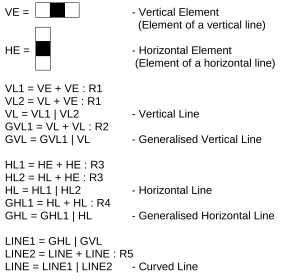
Fig. 1 A fragment of a knowledge base
explicitly that the difference between syntactic and structural pattern recognition sys-tems disappears at this level of generalisation.
Fig.1 shows a fragment of the knowledge base used to recognise (curved) lines starting at the pixel level in a binary image. Rules in this fragment have either AND-form (A=B+C:R) or OR-AND-form (A=B|C|D). R denotes a set of spatial relations which parts in the right-hand side have to satisfy. Some relations (R1-R4) are very concrete as they specify exactly mutual positions of parts. The relation R5 is an example of a more abstract relation.
Note the recursive nature of some rules in this fragment. This recursion is not re-lated to any ‘fractalness’. It rather reflects the fact that if we combine two straight line segments with the same direction and beginning of one segment coinciding with the end of another we still get a straight line segment with the same direction, i.e. an in-stance of the same class of segments.
7 The Recognition Procedure
The recognition procedure contains two simultaneously working processes. The most fundamental one is similar to a bottom-up chart parser. The elementary steps of this process are checks that a certain configuration of parts satisfies the set of relations for some object and the generation of such configurations. These elementary steps are inserted with different priorities into a priority queue corresponding to the agenda in a chart parser.
The second process is a top-down modification of elementary recognition step priorities, which uses information about most probable routes of recognition and the previous experience of the system. This process effectively is a heuristic reducing the exponentially sized search tree of the bottom-up process, so that the overall recogni-tion process becomes computarecogni-tionally tractable.
As the bottom-up process works with fuzzy relations and calculates a degree to which an instance satisfies a given model, it can be represented as an evidence-propagation approach, therefore facilitating application of statistical pattern recogni-tion methods. This is just one more piece of evidence that all the different approaches in pattern recognition could (and should) be naturally combined together in order to produce a really powerful system.
A detailed description of the knowledge representation and the recognition proce-dure are given in [5], as well as more detailed analysis of their underlying principles.
8 Conclusion
abstraction. Finally, we outlined knowledge representation and recognition algorithms used by the system.
It is important to note that there still exist a number of problems with the ap-proach, but we hope that once those problems are solved (and the solution is in our sight) we will develop a new highly extensible and powerful system for image analy-sis.
A specific version of the system based on the principles discussed in the paper and designed for the off-line recognition of unconstrained handwriting is being cur-rently implemented by one of the authors as a part of his Ph.D. thesis.
9 References
[1] M. Flasinski, Mathematical Linguistics Models for Computer Vision, Ma-chine GRAPHICS & VISION, vol. 5, ½,1996, pp.87-97.
[2] K.S. Fu, Syntactic Pattern Recognition and Applications, Prentice-Hall, Englewood Cliffs, New Jersey, 1982.
[3] J. G. Wolff, Language acquisition, data compression and generalization, Language and Communication, vol. 2, 1, pp. 57-89, 1982.
[4] J. G. Wolff, Simplicity and power - some unifying ideas in computing, Com-puter Journal, vol. 33, 6, pp. 518-534, 1990.