Polymorphonuclear function in naturally occurring
renal failure in dogs
S. Kralova
1, L. Leva
2, M. Toman
21Faculty of Veterinary Medicine, University of Veterinary and Pharmaceutical Sciences, Brno, Czech Republic
2Veterinary Research Institute, Brno, Czech Republic
ABSTRACT: Chronic renal failure causes immunosuppression in people and is thought to be one of the causes of non-infectious secondary immunosuppression in dogs. The purpose of this study was to evaluate changes in counts and activity of polymorphonuclears in dogs with chronic renal failure in various stages. Haematological, biochemical examinations and examination of non-specific immune response cells (total and differential leukocyte counts, phagocytosis of methacrylate particles, chemiluminescence test, and level of lysozyme) were performed in blood samples obtained from these dogs. Neutrophilia, lymphopoenia and a decreased number of eosinophils in comparison with healthy control were the main findings in groups with clinical signs. We found the statisti-cally highly significant elevation of lysozyme level; it was in a strong positive correlation with the level of urea, creatinine and phosphorus. We did not find any statistically significant changes in phagocytosis process and other serological factors. In conclusion, despite the reports from human medicine, chronic renal failure in dogs does not alter phagocytosis. From this aspect, the elevation of lysozyme level is the main effect of uraemia.
Keywords: leukocytes; uraemia; phagocytosis
Supported by the Ministry of Agriculture of the Czech Republic (Grant No. 0002716201) and the Internal Grant Agency of University of Veterinary and Pharmaceutical Sciences (Grant No. 9/2006/FVL).
Chronic renal failure (CRF) is a common problem of ageing dogs and cats. Renal failure is defined as a loss of three-quarters of functioning nephrons and it is associated with various clinical signs. The most common is polyuria and polydipsia due to the loss of concentrating ability. Gastrointestinal complica-tions (inappetence, anorexia, vomiting, diarrhoea, weight loss) are very common and they are usu-ally the first signs why owners come to veterinary practice. Neurological abnormalities associated with CRF are very common as well. They include dullness, lethargy, tremors, seizures, stupor and coma. The severity of these clinical signs may vary. The patients can be presented at various stages of the disease, ranging from subclinical (detected by laboratory tests only – the presence of azotaemia and inadequate urinary concentrating ability), mild
(vomiting, weight loss, mild neurological signs) to severe azotaemia (end stage, when the homeos-tasis is so disturbed that it is incompatible with life). Chronic renal failure is associated with many changes in laboratory test. The presence of azotae-mia and hyperphosphataeazotae-mia is typical, common finding is anaemia (nonregenerative, normochro-mic and normocytic).
there-fore mainly a result of their reduced ability to kill microorganisms intracellularly and is believed to increase the susceptibility to infections (Anding et al., 2003). The mechanism responsible for re-duced neutrophil functions is not well understood, although a number of partly interdependent fac-tors have been proposed, including iron overload, zinc deficiency, increased intracellular calcium, anaemia, malnutrition and dialysis therapy per se (Lewis and Parameter VanEpps, 1987). Furthermore a number of uremic toxins that affect the neutrophil function have been identified and characterized (Cohen et al., 1997).
The polymorphonuclear activity has not yet been evaluated in dogs with chronic renal failure. The purpose of this study is to determine possible changes in this part of immune response of these patients.
MATERIAL AND METHODS
Animals
Forty-five dogs with the diagnosis of chronic renal failure were assessed in the study. All these dogs were patients of the Clinic of Dogs and Cats Diseases, Faculty of Veterinary Medicine, University of Veterinary and Pharmaceutical Sciences, Brno, Czech Republic and were presented to clinic from May 2005 to June 2007. Dogs were diagnosed with CRF by the presence of persistent azotaemia (the serum creatinine level above the laboratory ref-erence range of 125 µmol/l) in conjunction with poor urinary concentrating ability. Haematological examination, standard biochemistry profile and urinanalysis were performed in all dogs, ultrasono-graphic examination of kidneys was performed in 36 dogs. In cases where we were not able to differ-entiate acute and chronic renal failure, histopatho-logical examination of renal tissue was performed.
Animals with signs of significant extrarenal dis-ease or prerenal/postrenal azotaemia at the time of initial diagnosis were excluded from the study. Animals with CRF and second disease which can cause secondary immunosuppression (e.g. hyper-adrenocorticism, hypohyper-adrenocorticism, diabetes mellitus, neoplasia, pyometra) or patients that had received corticosteroids were excluded as well.
There were twenty-four females (five of them neutered) and twenty-one males (one of them neu-tered) of various breeds. Average age was 9.85 years (from five months to sixteen years).
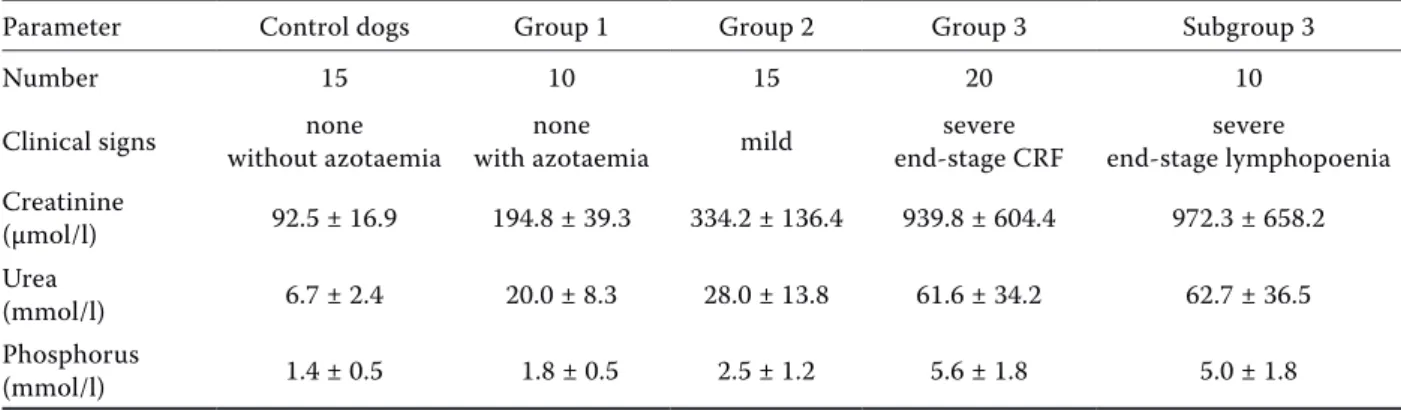
Dogs were divided into three groups according to the extent of clinical signs at the time of diagno-sis. Dogs without clinical signs of CRF were in the first group. Azotaemia was found by routine serum biochemistry examination and diagnosis of chronic renal failure was proved by other findings (urinan-alysis, ultrasonographic examination).The second group comprised dogs with clinical signs of urae-mia (vomiting, inappetence, anorexia) with good response to therapy. In the third group there were dogs in the end stage of renal failure; these animals were not able to deal with changes of homeostasis. These dogs died or were euthanized shortly after diagnosis because of no response to therapy. A de-scription of the groups is in Table 1.
Forty-five dogs were diagnosed with CRF accord-ing to history, clinical findaccord-ings, haematological and biochemical examination and urinanalysis. The diagnosis was confirmed by ultrasonography and in some case by histopathological examination of renal tissue. More severe clinical signs occurred when the levels of creatinine and urea increased. In addition, it was in a strong correlation with dimin-ishing number of red blood cells. Anaemia seen in these animals was typically non-regenerative. Main biochemical parameters (serum creatinine, urea and phosphorus) and red blood cells are shown in Table 2. Isostenuria was a typical finding and we found both active and passive urine sediment. In
Table 1. Characteristics of dogs, number in each group, average age (mean and standard deviation) and their cli-nical signs
Parameter Control dogs Group 1 Group 2 Group 3 Subgroup 3 (lymphopoenic)
Number 15 10 15 20 10
Sex (M/F) 11/4 7/3 6/9 8/12 5/5
Average age (years) 9.6 ± 2.9 11.4 ± 2.5 9.2 ± 4.3 9.4 ± 4.3 9.9 ± 3.6
ultrasonography, the kidneys were mostly hyper-echogenic. Diffuse chronic membranous glomer-ulonephritis was the most frequent result from histopathology.
Control dogs. Fifteen clinically normal dogs
(elev-en females, four of them neutered, four males, one of them neutered) of various breeds that came for vaccination to our clinic were included in the control group. The dogs were selected to be of similar age as CRF animals (average age 9.6 years). The dogs were considered to be healthy on the basis of history, physical examination findings and normal results of haematological and serum biochemistry analyses.
Blood samples
Blood samples were taken by venipuncture from
v. jugularis or v. cephalica antebrachii. The blood samples were collected into differential tubes: EDTA tubes for haematological examination, standard biochemistry tubes and heparinised tubes for immunological examination. All examinations were taken within 24 hours after collection.
Immunological tests
Total and differential leukocyte counts. Total
leukocyte counts were determined using the cell counter Digicell 500 (Contraves AG, Switzerland), differential leukocyte counts were enumerated from blood smears stained with May-Grunwald and Giemsa-Romanovski.
Phagocytosis of methacrylate particles. A slight
modification of the phagocytosis test using meth-acrylate particles (MSHP) in whole blood (Vetvicka et al., 1982) was used to examine the ingestion
activity of neutrophils and monocytes. Fifty µl of a suspension of MSHP particles (Artim, Prague) were mixed with 100 µl of blood in an Eppendorf type test tube and incubated at 37°C for one hour. Twenty µl of Na2EDTA (10–4M) were added 5 min
before the end of the incubation. Blood smears were prepared and stained according to Giemsa-Romanovski after the incubation. At least 200 cells were examined in each smear to determine the pro-portion of leukocyte types and the percentage of phagocytising cells, i.e. those in which at least three particles were engulfed.
The phagocytic index was calculated as the mean of the number of ingested particles in phagocytis-ing cells (examined 100 cells at least).
Chemiluminescence test
During the metabolic phase of phagocytosis phagocytic cells produce reactive oxygen radicals (hydrogen peroxide, superoxide, superoxide anion) that are very potent to kill bacteria and destroy ingested material. These radicals may provoke mild radiation in luminescent solutes (in this case lumi-nol) that can be detected with a suitable photom-ultiplier. 100 µl of blood was mixed with 400 µl of medium for cell cultivation (MEM, pH 7.2), just before measurement 200 µl of luminol was added (spontaneous chemiluminescence) and into select-ed tubes 100 ml of rice starch was addselect-ed (activatselect-ed chemiluminescence). The samples were meas-ured on a BioOrbit 1251 luminometer (BioOrbit, Finland) twenty minutes in two minutes intervals. The metabolic activity was evaluated according to two parameters: spontaneous activity and stimula-tion index, i.e. the ratio between spontaneous and stimulated activity.
Table 2. Characteristics of each group of dogs with chronic renal failure and group of healthy control (creatinine, urea and phosphorus levels expressed as a mean and standard deviation)
Parameter Control dogs Group 1 Group 2 Group 3 Subgroup 3
Number 15 10 15 20 10
Clinical signs without azotaemianone with azotaemianone mild end-stage CRFsevere end-stage lymphopoeniasevere
Creatinine
(µmol/l) 92.5 ± 16.9 194.8 ± 39.3 334.2 ± 136.4 939.8 ± 604.4 972.3 ± 658.2 Urea
(mmol/l) 6.7 ± 2.4 20.0 ± 8.3 28.0 ± 13.8 61.6 ± 34.2 62.7 ± 36.5 Phosphorus
Lysozyme level
Lysozyme is an enzyme with antimicrobial prop-erty found in granules of phagocytising cells and in body fluids.
The lysozyme level in the blood serum was de-termined by a spectrophotometric measurement of clarification of a suspension culture of Micrococcus lysodeicticus in test tubes (Richter and Prochazkova, 1986).
Data analysis
Statistics were calculated with MS-Excel 6.0® (means,
SD) and GraphPad Prism software (inter-group differ-ences). Statistical differences between groups were esti-mated by the unpaired nonparametric Mann-Whitney test. The differences with P < 0.05 and P < 0.01 were interpreted as significant and highly significant, respec-tively. Correlations between parameters were calcu-lated according to the Spearman test.
Table 3. Red blood cell counts and total and differential leukocyte counts in each group of dogs with chronic renal failure and healthy control (mean and standard deviation)
Parameter Control dogs Group 1 Group 2 Group 3 Subgroup 3
Number 15 10 15 20 10
Clinical signs without azotaemianone with azotaemianone mild end-stage CRFsevere end-stage lymphopoeniasevere
Red blood cells
(1012/l) 6.9 ± 0.9 6.0 ± 1.6 5.6 ± 1.3 4.8 ± 1.8 5.59 ± 1.9
Leukocytes
(106/l) 8 250 ± 1 818 12 023 ± 7 523 9 995 ± 2 312 10 311 ± 4 004 8 418 ± 2 548
Neutrophils
(106/l) 5 506 ± 1 331 8 387 ± 6 904 7 822 ± 2 552** 7 933 ± 3 495*** 6 541 ± 2 863***
Lymphocytes
(106/l) 2 075 ± 680 2 567 ± 1 271 1 573 ± 694** 1 413 ± 1 211*** 601 ± 237***
Monocytes
(106/l) 303 ± 177 688 ± 554 404 ± 256 526 ± 309 524 ± 279*
Eosinophils
(106/l) 345 ± 282 381 ± 439 196 ± 244** 125 ± 148*** 124 ± 121***
*P < 0.05, **P < 0.01, ***P < 0.001 when compared with control dogs
Table 4. The level of phagocytosis of methacrylate particles, phagocytic index, level of chemiluminescence and lysozyme levels in dogs with chronic renal failure and healthy control (mean and standard deviation)
Parameter Control dogs Group 1 Group 2 Group 3 Subgroup 3
Number 15 10 15 20 10
Clinical signs without azotaemianone with azotaemianone mild end-stage CRFsevere end-stage lymphopoeniasevere
Phagocytosis (%) 68.1 ± 29.4 64.4 ± 22.2 71.8 ± 23.9 68.8 ± 27.3 81.8 ± 20.2 Phagocytic index 21.8 ± 2.8 19.8 ± 3.3 17.4 ± 5.0 21.4 ± 1.6 20.3 ± 2.6 Chemiluminescence
– spontaneous (mV) 2.9 ± 1.4 4.4 ± 4.1 4.5 ± 7.4 5.7 ± 10.6 2.8 ± 1.8 Chemiluminescence
– stimulated (mV) 54.7 ± 22.4 97.9 ± 41.6** 91.7 ± 66.6 80.7 ± 46.8 85.9 ± 51.6 Chemiluminescence
– index 22.5 ± 10.9 30.5 ± 15.1 31.0 ± 21.2 31.6 ± 19.9 38.1 ± 17.8* Lysozyme (g/l) 4.7 ± 5.0 9.2 ± 5.2* 9.7 ± 5.9* 14.6 ± 6.6*** 11.9 ± 6.7*
RESULTS
Total and differential leukocyte counts
The total and differential leukocyte counts in each group of dogs with chronic renal failure and healthy control are summarized in Table 3. The main sta-tistically significant findings were neutrophilia, lymphopoenia and a decrease in the number of eosinophils in groups of dogs with clinical signs (Groups 2 and 3).
Phagocytosis of methacrylate particles, chemiluminescence test
The results of phagocytosis tests are summarized in Table 4. We did not find statistically significant differences between groups in the test of ingestion of methacrylate particles.
We found statistically significant difference in stimulated chemiluminescence between dogs with chronic renal failure without clinical signs and healthy control. Other groups of dogs with CRF had higher values of stimulated chemiluminescence as well; but the differences were not significant due to wide range of values. The values of both tests are shown in Table 3.
Lysozyme level
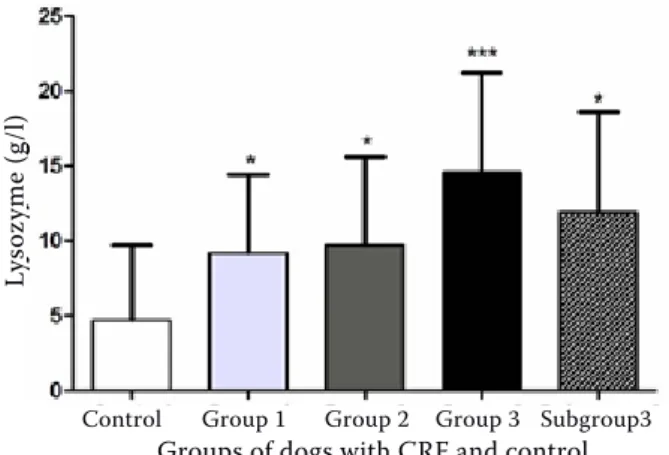
The level of lysozyme was increasing with the extent of clinical signs (Figure 1, Table 4.) while this increase was statistically highly significant.
Correlation between parameters
The levels of lysozyme are in significant positive correlation with the level of creatinine (r = + 0.4904,
P = 0.0006, ***), urea (r = + 0.3550, P = 0.0137, *) and phosphorus (r = + 0.5171, P = 0.0003, ***). The number of red blood cells was in positive correlation with the percentage proportion of neutrophils (r = +0.3104, P = 0.038, *). There was a negative correla-tion between the number of lymphocytes and the level of phagocytosis (r = –0.3629, P = 0.0143, *).
DISCUSSION
In this study we found that uraemia in dogs does not affect the neutrophil function in contrast with reports from human medicine. Statistically signifi-cant findings were neutrophilia, lymphopoenia, a decrease in the number of eosinophils, and a higher lysozyme level. Possible explanations of the differ-ences between people and dogs are discussed.
Former reports on dogs discussed leukocyto-sis (DiBartola et al., 1989) and even leukopoenia (Nairn et al., 2005). We did not find any statistically significant change in the total leukocyte number.
We found an increased number of neutrophils in groups with clinical signs of chronic renal fail-ure. Reports from human medicine discussing the number of neutrophils are controversial. They found a decreased number of neutrophils (Nairn et al., 2005), unchanged neutrophil counts (Alvarez-Lara et al., 2004) and an increased number of neu-trophils in comparison with the healthy control (Fernandez-Fresnedo et al., 2000).
Our finding of lymphopoenia is consistent with previous reports both from human and veterinary medicine (Chew et al., 1983; Yoon et al., 2006). According to reports from human medicine, lym-phopoenia may result from higher apoptosis of these cells, but the proper mechanisms are still unclear (Fernandez-Fresnedo et al., 2000; Jaber et al., 2001). In dogs with CRF and clinical symptoms we observed a statistically highly significant reduc-tion of eosinophils in comparison with the healthy control. It does not correspond with previous re-ports from human medicine, where eosinophilia is common (Gabizon et al., 1981; Hallgren et al., 1984; Lee et al., 1995). Most patients with eosinophilia were haemodialysed, so haemodialysis per se was considered as a possible cause of the increased number of eosinophils (Bodner et al., 1982).
Figure 1. Lysozyme levels (g/l) in the control group and in each group of dogs with chronic renal failure *P < 0.05, **P < 0.01, ***P < 0.001 when compared with con-trol dogs
Ly
so
zy
me (
g/l)
Control Group 1 Group 2 Group 3 Subgroup3
There is a lot of reports on neutrophil dysfunc-tion in people with chronic renal failure, but the mechanisms responsible for reduced neutrophil functions are not well understood, although a number of partly interdependent factors have been proposed, including iron overload, anaemia, mal-nutrition and dialysis therapy per se (Lewis and VanEpps, 1987).
Iron is used in conjunction with recombinant human erythropoietin in the therapy of anaemia following chronic renal failure. Iron is required for several immune processes and in contrast it is necessary for bacterial growth. Iron overload may cause abnormalities of the neutrophil phagocytic function. The negative effect of iron on the neu-trophil phagocytic function could be caused by a direct action of iron on the membrane or indirectly via enhanced production of oxygen metabolites (VanAsbeck et al., 1984; Himmelfarb and Hakim, 1994). We can exclude the influence of iron because none of the dogs in our study had received eryth-ropoietin and iron therapy.
Anaemia affects the tissue oxygenation and may subsequently have negative effects on various bio-logical functions. A highly significant correlation between the neutrophil function and hematocrit was observed and the neutrophil carbon dioxide production was improved with rHuEPO therapy (Vanholder and Ringoir, 1992). We found only a sig-nificant positive correlation between the number of red blood cells and the percentage proportion of neutrophils. But we did not find any statistically significant correlation between erythrocytes and neutrophil function.
The uremic condition is characterized by the pro-gressive retention of numerous solutes; therefore phagocytic dysfunction by toxic suppression is likely to occur. The main potential toxins are polyamines (spermine and spermidine), glycated proteins, free immunoglobulin light chains and leptin. Spermine and spermidine are biogenic polyamines and they are well-known uremic toxins with a negative effect on erythropoiesis. They may interact with eryth-ropoietin at a cellular level in the bone marrow (MacDougall, 2001). It was shown that spermine and spermidine suppressed the human neutrophil locomotion (Ferrante, 1985). Advanced glycation end products are elevated in uremic plasma and cause the increased neutrophil apoptosis (Cohen et al., 2001). In patients with the impaired kidney function there is an elevation of plasma levels of free immunoglobulin light chains (IgLCs). It was
shown that IgLCs obtained from dialysed patients significantly inhibited chemotaxis and glucose up-take of neutrophils (Cohen et al., 1995). The meas-urement of the polyamine, advanced glycation end products and IgLCs levels was not the purpose of this study, but it is likely that their level increased with the worsening function of kidneys, i.e. with a higher level of urea, creatinine and phosphorus. However we did not find any correlation between the level of azotaemia and neutrophil counts and functions.
Leptin is another solute believed as uremic toxin and interfering with the function of neutrophils. Leptin is a nonglycosylated peptide hormone in-volved in the control of food intake. The molecule of leptin is similar to molecules of some cytokines (IL-6, IL-11, IL-12) and consistently with this view it plays a role in affecting the immune response. The serum from patients with CRF was found to inhibit the migration of normal neutrophils in response to N-formyl-methionyl-leucyl-phenyla-lanine (chemoattractant) with a strict correlation between serum leptin levels and serum ability to suppress the neutrophil locomotion (Ottonello et al., 2004). Leptin is produced by adipocytes and its level is in strict correlation with body mass. Patients with chronic renal failure often suffer from malnutrition and cachexia, so lower levels of leptin can be expected. But chronic renal failure in people is characterized by hyperleptinaemia due to the impaired excretion function of kidneys (Clark and Gao, 2002). Dogs and cats with chronic renal failure starve as well; cachexia and malnutrition are common findings. But the levels of leptin in dogs with CRF need further investigations because we did not find any statistically significant disturbance of neutrophils.
The difference between reports from human medicine and our findings may be caused by the fact that most of the former studies were performed with patients on dialysis therapy. It was proposed that haemodialysis per se may partly evoke dis-turbances in phagocytosis (Vanholder et al., 1993; Sardenberg et al., 2006). Nevertheless, there are some studies with non-haemodialysed uremic peo-ple, where the phagocytic function was impaired (Sharma et al., 2000).
urea. This is in relation with Waldman et al. (1972). Lysozyme is an enzyme which destroys bacterial peptidoglycans and is found in high concentrations in neutrophil granules. It is a low molecular protein, so with decreased renal function there is retention of these molecules. The reports from human medi-cine are controversial: Kagan et al. (1989) found the elevated serum activity of lysozyme in patients with CRF undergoing continuous ambulatory peri-toneal dialysis, but Sharma et al. (2000) did not observe any change in the lysozyme level in non-dialyzed people with chronic renal failure. There is a theory that the elevation in lysozyme levels is associated with degranulation of blood neutrophils and it might be a sign of the immune system activa-tion (Trznadel et al., 1988). Despite these reports we tend to the opinion that the increased level of lysozyme is a result of decreased renal function according to the high positive correlation between levels of lysozyme, creatinine and urea.
Although we did not find any changes in phago-cytic activity, we proved the negative influence of chronic renal failure on the activity of immune sys-tem in these groups of dogs with chronic renal fail-ure. The negative effect was expressed by changes in lymphocyte counts and activity (Kralova et al., 2009, in press).
CONCLUSION
Despite the reports from human medicine chron-ic renal failure in dogs did not affect phagocytosis. Changes in neutrophil counts and increasing lys-ozyme levels were the most significant results of this study. The changes in neutrophil counts were not associated with the changes in their function. The difference between dogs and humans may be caused by using dialysis therapy in uremic people, because dialysis per se may influence the immune status.
REFERENCES
Alvarez-Lara M.A., Carracedo J., Ramirez R., Martin-Malo A., Rodriguez M., Madueno J.A., Aljama P. (2004): The imbalance in the ratio of Th1 and Th2 helper lymphocytes in uraemia is mediated by an in-creased apoptosis of Th1 subset. Nephrology Dialysis Transplantation, 19, 3084–3090.
Anding K., Gross P., Rost J.M., Allgaier D., Jacobs E. (2003): The influence of uraemia and haemodialysis
on neutrophil phagocytosis and antimicrobial killing. Nephrology Dialysis Transplantation, 18, 2067–2073. Bodner G., Peer G., Zakuth V., Spirer Z.H., Aviram A.
(1982): Dialysis-induced eosinophilia. Nephron, 32, 63–66.
Chew D., DiBartola S.P., Boyce J.T., Hayes H.M., Brace J.J. (1983): Juvenile renal disease in Doberman Pincher dogs. Journal of American Veterinary Medical Asso-ciation, 182, 481–485.
Clark W.R., Gao D. (2002): Low-molecular weight pro-teins in end-stage renal disease. Potential toxicity and dialytic removal mechanisms. Journal of American Society of Nephrology Supplement, 13, S41–S47. Cohen G., Haag-Weber M., Mai B., Deicher R., Horl W.H.
(1995): Effect of immunoglobulin light chains from hemodialysis and continuous ambulatory peritoneal dialysis patients on polymorphonuclear leukocyte functions. Journal of American Society of Nephrology, 6, 1592–1599.
Cohen G., Haag-Weber M., Horl W.H. (1997): Immune dysfunction in uremia. Kidney International, 62 (Suppl.), S79–S82.
Cohen G., Rudnicki M., Horl W.H. (2001): Uremic toxins modulate the spontaneous apoptotic cell death and essential functions of neutrophils. Kidney Interna-tional, 59(Suppl.), S48–S52.
DiBartola S.P., Tarr M.J., Parker A.T., Powers J.D., Pultz J.A. (1989): Clinicopathological findings in dogs with renal amyloidosis: 59 cases (1976–1986). Journal of American Veterinary Medicine Association, 195, 358–364.
Fernandez-Fresnedo G., Ramos M.A., Gonzales-Pardo M.C., Francisco A.L., Lopez-Hoyos M., Arias M. (2000): B lymphopenia in uremia is related to an accelerated in vitro apoptosis and dysregulation of Bcl-2. Nephrology Dialysis Transplantation, 15, 502–510.
Ferrante A. (1985): Inhibition of human neutrophil lo-comotion by the polyamine oxidase-polyamine system. Immunology, 54, 785–790.
Gabizon D., Kaufman S., Shaked U., Evans S.Y., Modai D. (1981): Eosinophilia in uremia. Nephron, 29, 36–39. Hallgren R., Grefberg N., Venge P. (1984): Elevated
cir-culating levels of eosinophil cationic protein in uremia as signs of abnormal eosinophil homeostasis. Neph-ron, 36, 10–14.
Himmelfarb J., Hakim R.M. (1994): Biocompatibility and risk of infection in haemodialysis patients. Nephrology Dialysis Transplantation, 9(Suppl.), 138–144.
Kagan A., BarKhayim Y., Yaari A., Fainaru M., Resnitzky P. (1989): Serum and effluent lysozyme (muramidase) activity in CAPD patients. Advances in Peritoneal Di-alysis, 5, 154–156.
Kralova S., Leva L., Toman M. (2009): Changes in lym-phocyte subsets and function in dogs with naturally occurring chronic renal failure. Canadian Journal of Veterinary Research (in press).
Lee C.C., Leu M.L., Kuo H.P., Huang C.C. (1995): Hy-pereosinophilia in hemodialysis patients. Changgeng Yi Xue Za Zhi, 18, 20–26.
Lewis S.L., VanEpps D.E. (1987): Neutrophil and mono-cyte alterations in chronic dialysis patients. American Journal of Kidney Diseases, 9, 381–395.
MacDougall I.C. (2001): Role of uremic toxins in exac-erbating anemia in renal failure. Kidney International, 78(Suppl.), S67–S72.
Nairn J., Hodge G., Henning P. (2005): Changes in leukocyte subsets: clinical implication for children with chronic renal failure. Pediatric Nephrology, 20, 190–196. Ottonello L., Gnerre P., Bertolotto M., Mancini M.,
Dapino P., Russo R., Garibotto G., Barreca T., Dallegri F. (2004): Leptin as a uremic toxin interferes with neu-trophil chemotaxis. Journal of the American Society of Nephrology, 15, 2366–2372.
Richter J., Prochazkova J. (1986): Lysosyme – the pho-tometric method. In: Prochazkova J., John C. (eds.): Selected Diagnostic Method in Medical Immunology (in Czech). Avicenum, Prague, 109.
Sardenberg C., Suassuna P., Andreoli M.C., Watanabe R., Dalboni M.A., Manfredi S.R., DosSantos O.P., Ka-llas E.G., Draibe S.A., Cendoroglo M. (2006): Effects of uremia and dialysis modality on polymorphonuclear cell apoptosis and function. Nephrology Dialysis Transplantation, 21, 160–165.
Sharma A., Tripathi A.K., Kalra O.P., Chakrabarty A.K. (2000): Impaired function of neutrophils in uraemic patients. The National Medical Journal of India, 13, 121–124.
Trznadel K., Luciak M., Zbrog Z., Kidawa Z. (1988): De-granulation of peripheral blood neutrophils during haemoperfusion in chronic uraemics. International Urology and Nephrology, 20, 685–690.
VanAsbeck B.S., Marx J.J., Struyvenberg A., VanKats J.H., Verhoef J. (1984): Effect of iron (III) in the presence of various ligands on the phagocytic and metabolic activity of human polymorphonuclear leukocytes. Journal of Immunology, 132, 851–856.
Vanholder R., Ringoir S. (1992): Polymorphonuclear cell function and infection in dialysis. Kidney Interna-tional, 38(Suppl.), S91–S95.
Vanholder R., DellAquilla R., Jacobs V., Dhondt A., Veys N., Waterloss M.A., VanLandschoot N., VanBiesen W., Ringoir S. (1993): Depressed phagocytosis in hemo-dialyzed patients in vivo and in vitro mechanisms. Nephron, 63, 409–415.
Vetvicka A., Fornusek L., Kopecek J., Kaminkova J., Kasparek L., Vranova M. (1982): Phagocytosis of hu-man blood leukocytes: a simple micromethod. Immu-nological Letters, 5, 97–100.
Waldmann T.A., Strober W., Mogielnicki R.P. (1972): The renal handling of low molecular proteins. II. Disorders of serum protein catabolism in patients with tubular renal proteinuria, the nephrotic syndrome, or uremia. Journal of Clinical Investigation, 51, 2162–2174. Yoon J.W., Gollapudi S., Pahl M.V., Vaziri N.D. (2006):
Na-ive and central memory T-cell lymphopenia in end-stage renal disease. Kidney International, 70, 371–376.
Received: 2009–02–11 Accepted after corrections: 2009–04–29
Corresponding Author:
MVDr. Simona Kralova, University of Veterinary and Pharmaceutical Sciences, Faculty of Veterinary Medicine, Palackeho 1–3, 612 42 Brno, Czech Republic