Development of an electrochemical assay for the illegal
“fat burner” 2,4-dinitrophenol and its potential
application in forensic and biomedical analysis
Kevin C. Honeychurch
Department of Applied Sciences, Faculty of Health and Life Sciences, University of the West of England, Frenchay Campus, Coldhar-bour Lane, Bristol, BS16 1QY, UK. [email protected], Tel. +44 (0)117 3287357
Abstract
The illegal use of 2,4-dinitrophenol (24DNP) as a diet aid has increased markedly resulting in a number of deaths. This paper describes the development of a simple voltammetric method for the measurement of 24DNP in serum at glassy carbon electrode (GCE). It is believed that this is the first report on the voltammetric determination of 24DNP in any biological sample. Initial investigations were undertaken using cyclic voltammetry to characterise the redox behav-iour of 24DNP. Over the pH range 2 to 10 four pH dependent reduction peaks were recorded on the initial negative going scan, concluded to result from the reduction of the two nitro groups to the corresponding hydroxylamines. On the return positive going scan two oxidation peaks were recorded, resulting from the oxidation of the hydroxylamine (O1) formed on the initial negative scan and the direct oxidation of the phenol group (O2). At pH 6, the peak potential of the oxidation process O1 occurred at a potential close to 0 V and was chosen for investigation. The optimum voltammetric conditions required were identified to be supporting electrolyte of 0.1 M pH 6.0 phosphate buffer containing 10 % acetonitrile. Us-ing differential pulse voltammetry, the calibration plot was found to be linear from 180 ng/mL to 184 µg/mL (R2= 0.9996), with a detection limit of 98.4 ng/mL (based on a signal-to-noise ratio of 3). The optimised method was evaluated by car-rying out 24DNP determinations on spiked and unspiked serum samples. Using an external calibration technique, mean recoveries of 79.2 % were obtained and coefficients of variation of 7.4 % were calculated for a forensically relative con-centration of 36.8 µg/mL. The performance characteristics show that the method holds promise and reliable data may be obtained for 24DNP in forensics and bioanalysis.Keywords
Voltammetry, serum 2,4-dinitrophenol1. Introduction
2,4-dinitrophenol (24DNP) has been utilised for a num-ber of different applications including the manufacture of dyes, pesticides, explosives and as a dieting aid. Frist World War French munition workers working with 24DNP reported symptoms of weight loss, weakness, dizziness, excess sweating associated with its exposure, resulting in some cases with death [1]. Further investigations showed that low doses of 24DNP increased metabolic rate resulting in weight loss; observations which lead in the 1930s to 24DNP being marketed as a diet-aid [2,3]. However, once freely available unsupervised usage resulted in a number of deaths and symptoms similar to that reported by the French munition workers. Furthermore, young women taking 24DNP under medical supervision starting losing their eye-sight; a situation latter seen in the wider United States pop-ulace [2]. Due to the wide range of adverse symptoms and deaths reported the American Food and Drug Administra-tion banned its use for humans in 1938. Nevertheless, in spite of this, reports of its usage continued with 24DNP recently being again marketed as a dieting aid, principally via the internet [4]; resulting in the occurrence of the same
range of adverse side effects and a number of deaths [4-13] with blood 24DNP levels in fatalities ranging from 28 mg/L [6] to 144 mg/L [14].
Technique Electrode material Linear range Detection limit Sample Comments Ref.
Multiply-pulse am-perometry
Expanded graphite – carbon nano-fiber – epoxy composite Electrode.
0.2 mM to 1.0 mM.
- - Multiple-pulsed amperometry; oxidation +1.25 V vs.
Ag/AgCl
[23]
Differential pulse volt-ammetry
Mercury meniscus-modified silver solid amalgam electrode m-(AgSAE) and polished silver solid amalgam electrode (p-AgSAE).
2 µM to 100 µM.
Depending on reduction peak chosen; m-AgSAE, 2.7 µM or 5.8 µM. p-AgSAE, 2.4 µM or 1.8 µM.
- 2-nitrophenol, 4-nitrophenol and 2,4-dinitrophenol inves-tigated. Solid phase extraction (SPE) for determination 2-nitrophenol in drinking water.
[24]
Differential pulse volt-ammetry
Glassy carbon electrode with a supporting electrode of 0.1 M pH 5.8 acetate buffer containing cetyl trimethyl ammonium bromide.
1.0×10⁻⁶ to 8.0×10⁻⁴ M.
2.4×10⁻⁷ M Model tap
water sample.
2,5-dinitrophenol also determined. [25]
Cyclic voltammetry Glassy carbon electrode modified with a vanadium pentoxide and cerium oxide nanoparticles nano-composite Santa Barbara Amor-phous silica (SBA-15) film and poly(vitamin B1) film.
3.0 µM to 30 µM.
0.5 μM Lake water. Adsorption of 24DNP demonstrated. [26]
Cyclic voltammetry hydrophilic molecularly imprinted polymers/nickel fibre electrode.
0.7 to 30 μg/L. 0.1 μg/L Surface water. - [27]
Differential pulse volt-ammetry
Graphene/ molecularly imprinted polymer glassy carbon electrode.
1.0 to 150.0 µM
0.4 µM Tap water and
artificial wastewater water
- [28]
Cyclic voltammetry Multi-walled carbon nano-tube-modified glassy carbon elec-trode.
0.001 to 0.05mM.
1.44×10⁻⁴ mM Soil. Measurements made in pH 5 phosphate buffer. Soil ex-tracted by sonication.
[29]
Differential pulse volt-ammetry
Glassy carbon electrode modified with poly-aspartic acid.
1.1 x 10⁻⁶ -6.0 x 10⁻⁴ M.
2.7 x 10⁻⁷ M Simulated
water sample.
2,5-dinitrophenol also determined. Analysis undertaken in pH 5 0.1 M acetate buffer.
[30] Differential pulse
volt-ammetry and chrono-coulometry
Hydroxylapatite film-modified glassy carbon electrode.
2 to 600 µM. 0.75 µM Water samples. Electrochemical oxidation at +1.75 V. [31]
Amperometry Silver solid amalgam working electrode.
Thin layer cell; 5 to 2500 µM. wall jet; 10 to 2500 µM.
Thin layer cell; 5 µM. Wall jet; 10 µM. N-Fenol MIX. Reverse phase HPLC, thin layer cell and wall jet config-urations investigated. 2-nitrophenol, 4-nitrophenol, 2,4-dinitrophenol and 2-methoxy-5-nitrophenol deter-mined.
Amperometry Boron-doped diamond film elec-trode
2x10- 6 to 1x10- 4 M for both anodic and cathodic approaches.
0.6 to 1.5 µM Drinking and
river water.
Reverse phase HPLC, wall-jet configuration. Mobile phase: acetate buffer (0.05 M pH 4.7/methanol 58/42, v/v) for cathodic detection at the potential of -1.2 V. For anodic detection, the mobile phase was 0.05 M phosphate buffer pH 6.75/methanol (65/35, v/v) at a detection po-tential of +1.3 V.
[33]
Amperometry Glassy carbon electrode 4.3 µg/L; 027 µg/L following solid phase extraction.
Drinking and river water.
Eleven substituted phenol analysed by reverse phase HPLC. Detector potential +1.0 V. Mobile phase: 25 % methanol, water acidified with 25 µL/L of 98 % sulphuric acid (pH 3). UV detection also investigated; detection limit, 266 µg/L 24DNP.
[34]
Amperometry and square wave voltamme-try
Ex situ deposited Bi film glassy carbon electrode
Up to 20 µg/L Amperometric flow injection analysis; 0.7 µg/L. Square wave voltammetry 3.3 µg/L.
- Flow injection and batch mode determination of 24DNP, 2-nitrophenol and 4-nitrophenol.
[35]
Differential pulse volt-ammetry
Hanging mercury drop electrode 0.05 to 3.0 mg/L.
0.0008 mg/L or 0.0013 mg/L dependent on reduction peak used.
Environmental water and industrial waste-water samples.
Britton–Robinson buffer pH 5.4. Nitrobenzene; 2-nitrophenol; 3-nitrophenol; 4-nitrophenol; 2,4-dinitrophenol investigated.
[36]
Differential pulse volt-ammetry
Hanging mercury drop electrode 2x10⁻⁹ to 1x10⁻⁷ M
1.5x10⁻⁹ M for both reduction peak used. - Adsorptive stripping voltammetry determination of 2-nitrophenol, 4-nitrophenol, 2-methoxy-5-nitrophenol and 24DNP reported. Britton–Robinson buffer pH 5 supporting electrolyte.
[37]
Cyclic voltammetry Pt–Ag 1x10⁻⁴ to 3x10⁻³ M.
8.5x10⁻⁵ M - Phenol, 4-nitrophenol, 2,4-dinitrophenol, 2,6-dinitrophenol, 1-naphthol, 2-naphthol, and 4-chlorophenol determined. Extracted from aqueous solution into the room temperature ionic liquid, 1-butyl-3-methylimidazolium hexafluorophosphate.
[38]
Differential pulse volt-ammetry
Boron-doped diamond film elec-trode
4x10⁻⁷ to 2x10⁻⁵ M
Pre-concentration by solid phase extraction from 0.1 L and 1.0 L of water samples was used to improve the limit of determination to ca. 2x10⁻⁸ and 2x10⁻⁷M respectively.
Drinking water and river water.
2-nitrophenol, 4-nitrophenol and 2,4-dinitrophenol de-termined in Britton-Robinson buffer pH 4 for reduction and pH 11 for oxidation measurements.
[39]
Differential pulse volt-ammetry
in-situ bismuth film modified screen-printed carbon electrode.
1 to 10 µM 0.4 to 0.7 µM depending sample. Distilled water, tap water and surface water
2-nitrophenol and 4-nitrophenol also determined. Using solid phase extraction a limit of quantification of 0.025 µM was obtained for 24DNP.
[40]
Clark-type oxygen electrode
Clark electrode modified with whole Rhodococcus erythropolis cells.
2×10⁻⁵ to 20×10−5 M.
1x10⁻⁵ M - Whole cell biosensor based on changes in the respiratory rate of Rhodococcus erythropolis caused by 24-DNP. Resulting oxygen concentration changes measured at the Clark electrode.
[image:3.808.31.739.41.525.2][41]
determination and is the first example of its electrochemical determination in any biological sample. In this study the cyclic voltammetric behaviour of 24DNP is first discussed. In the second section the optimisation of the conditions necessary for the differential pulse voltammetric (DPV) determination of 24DNP in serum are investigated and op-timised.
2. Experimental
2.1. Chemicals and Reagents
All chemicals were obtained from Fischer (Loughborough, UK), unless otherwise stated. Deionised water was ob-tained from a Purite RO200-Stillplus HP System, (Purite Oxon., UK). Stock solutions of sodium orthophosphate were made at a concentration of 0.2 M by dissolving the appropriate mass of solid in deionised water to give a 0.2 M solution. A stock solution of orthophosphoric acid was made by dilution in deionised water. These were then ti-trated together to give the required pH. Stock solutions of 2,4-dinitrophenol were prepared by dissolving the required mass in acetonitrile to give a concentration of 10 mM. Working standards, for voltammetric studies, were prepared by dilution of the primary stock solution with phosphate buffer and acetonitrile to give a final concentration of 0.1 M phosphate buffer. These were then adjusted with sufficient water to give a 10 % acetonitrile.
2.2 Apparatus
Cyclic voltammetry (CV) and differential pulse voltam-metry (DPV) were undertaken using an Ivium CompactStat potentiostat (Ivium Technologies, The Netherlands) inter-faced to a PC for instrument control and data acquisition. The voltammetric cell contained a platinum wire auxiliary electrode, a Ag/AgCl reference electrode, and a glassy car-bon electrode (GCE) (3 mm diameter), as the working elec-trode. The GCE was cleaned before each scan by polishing with slurry of aluminium powder. Cyclic voltammograms were initially recorded with plain solutions of 0.1 M phos-phate buffer, containing 10 % acetonitrile and then in the same solution containing 1 mM 24DNP. Samples were purged with nitrogen (BOC, Guildford, UK) for 10 minutes to eliminate oxygen. A starting and end potential of 0.0 V, an initial switching potential -1.5 V, second switching po-tential +1.0 V were utilised. Differential pulse voltammetry was undertaken using a starting potential of -1.3 V and a final potential of 0.0 V; using a step height of 10 mV, pulse repe-tition time 0.2 s, pulse amplitude of 75 mV, and pulse dura-tion of 50 ms.
2.3 Analytical Application
A 1.0 mL aliquot of bovine serum was taken and diluted ten times to be 10 % acetonitrile in 0.1 M phosphate buffer pH 6.0. A second aliquot was fortified to give 36.8 µg/mL 24DNP, and then diluted ten times to give a 10 % acetoni-trile and 0.1 M phosphate buffer pH 6.0 solution. These were then examined using the optimised differential pulse voltammetric procedure.
3. Results and Discussion
3.1. Voltammetric Studies of 2,4-Dinitrophenol at Glassy Carbon Electrode
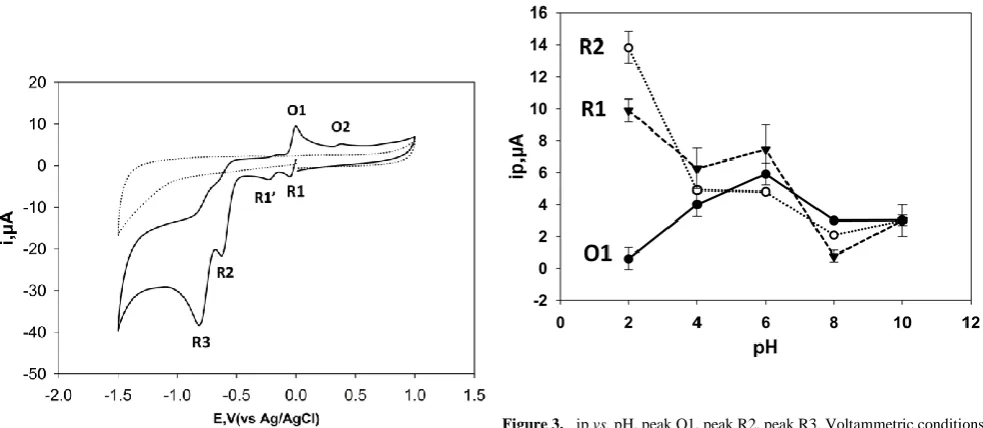
Initial cyclic voltammetric studies were made with a 1 mM solution of 24DNP, dissolved in 0.1 M phosphate buffer pH 6, containing 10 % acetonitrile (10 mL). Figure 1 shows the resulting voltammogram obtained using a scan rate of 50 mV/s. This shows the appearance of four reduc-tion peaks, R1, R1’, R2 and R3 on the first forward scan. The Ep of the first two reduction peaks R1 and R1’ were both found to be independent of pH; indicating that no pro-tons were involved the electrochemical process. Conse-quently, these peaks were considered to result from the one electron reduction of the two nitro groups to form a nitro radical anion (eq. 1) [42]. The two further reduction peaks R2 and R3 result from the formation of hydroxylamine moieties (eq. 2) formed form the sequential reduction of the two nitro groups. This is in agreement with polarographic studies made by Taha et al [43] who concluded that the two nitro groups of 24DNP are reduced independently of each other. On the return scan, two oxidation peaks O1 and O2 are observed. The oxidation O1 was considered to be the result of oxidation of the hydroxylamine species formed on the initial negative going scan to give the corresponding nitrosamine (eq. 3). The second oxidation peak, O2 was concluded to result from the oxidation of the phenol (eq. 4).
Further cyclic voltammetric investigations were made to explore this proposed mechanism for the formation of O1 and O2. Without prior reduction the oxidation peak O1 was not observable, however, peak O2 was still recorded. Consequently, it was concluded that O1 was the result of an oxidation of a compound formed on the negative going scan and O2 was the result of the direct oxidation of the molecule.
(eq. 1)
(eq. 2)
(eq. 3)
(eq. 4)
3.2. Effect of pH
protons and electrons involved in the oxidation step. The Ep of the oxidation process O2 (Figure 2B) was found to be dependent between pH 2 and 6. Above pH 6 the Ep of this peak was found to be constant. This was considered to be the result of an apparent pKa associated with the phenol group. Figure 2C and Figure 2D show that the reduction peaks R2 and R3 are pH dependent over the whole range investigated with slopes 60 mV/pH corresponding to an equal number of electrons and protons involved in their reduction.
[image:5.595.329.535.50.269.2]The peak current (ip) of all three peaks were found to be pH dependent over the range studied (Figure 3). The peak current of R2 and R3 was found to decrease with increasing pH. The peak current for O2 was found to decrease rapidly with pH and was only recordable at pH 2. This was most properly due to the stabilisation of the anion by the nitro groups. The maximum peak current of the oxidation peak O1 was found at pH 6. As this oxidation occurred at a po-tential close to 0 V it was chosen to investigate this peak further as this others a number of analytical advantages; such as lower background currents and is free from the common interference such as oxygen. Consequently, subsequent studies were undertaken using a supporting electrolyte of 0.1 M pH 6.0 phosphate buffer.
Figure 1. Cyclic voltammogram, obtained at a scan rate of 50 mV/s, for a 1 mM solution of 2,4-dinitrophenol in 10 % acetonitrile, buffered with 100 mM phosphate at pH 6.0. Starting and end potential; 0.0 V, initial switching potential; -1.5 V and second switching potential; +1.0 V. Dashed line in
the absence and solid line in the presence of 1 mM 2,4-dinitrophenol.
3.3. Effect of Scan Rate
[image:5.595.60.552.336.550.2]The effect of scan rate was studied on the cyclic voltam-metric behaviour of 24DNP at pH 6 was investigated over the range of 20 to 200 mV/s. A plot of peak height vs. the square root of scan (v½) was found to linear for all the peaks studied indicating a diffusional process. Peak potentials (Ep) were found to become increasingly more negative with scan rate suggesting electrochemical irreversibility.
Figure 2. Plot of Ep and ip vs. pH for 2,4-dinitrophenol. Ep vs. pH A) Peak O1, B) peak O2, C) peak R1, D) R2
Figure 3. ip vs. pH, peak O1, peak R2, peak R3. Voltammetric conditions
as Figure 1. Error bars represent ±σ.
3.4. Effect of Starting Potential
Figure 4. Effect of starting potential on 0.1 mM 2,4-dinitrophenol O1 oxidation peak obtained by linear
sweep voltammetry at pH 6.0. Error bars represent ±σ.
3.5. Calibration Curve and Limit of Detection
[image:6.595.80.283.55.209.2]In this part of our investigation it was decided to use the differential pulse waveform as it offers advantages over the linear sweep waveform. Such advantages include better discrimination between faradaic current and capacitance current giving improved sensitivity and resolution. Conse-quently, it should be beneficial for the determination of 24DNP in real samples. Initial studies were undertaken to study the effect of 24DNP concentrations on the magnitude of the differential pulse peak O1 occurring at a potential of 0 V. The calibration plot was found to be linear from 180 ng/mL to 184 µg/mL (R2 = 0.9996), with a detection limit of 98.4 ng/mL (based on a signal-to-noise ratio of 3).
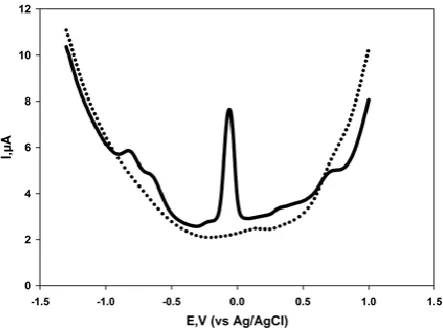
Figure 5. Differential pulse voltammograms obtained for serum sample. Dashed line in the absence and solid line
in the presence of 36.8 µg/mL 2,4-dinitrophenol
3.6. Analytical Application
The optimised procedure was used to determine the con-centration of 24DNP in spiked and unspiked bovine serum samples. Figure 5 shows the typical voltammograms ob-tained for theses samples and the recovery and precision data is summarised in Table 2. Clearly, these results show
[image:6.595.71.293.443.607.2]that the optimised differential pulse voltammetric method offers the possibility of determining 24DNP at forensically and bio-medically [6] relevant level in real samples.
Table 2. Recovery and precision data obtained for 2,4-dinitrophenol serum sample. ND = not detected.
Sample Native,
µg/mL
Added,
µg/mL
Found,
µg/mL
%Rec
1 ND 36.8 29.0 78.9 2 ND 36.8 28.0 76.2 3 ND 36.8 26.3 71.5 4 ND 36.8 31.9 86.7 5 ND 36.8 30.5 82.8
mean 79.2
sd 5.9
%CV 7.4
4. Conclusion
This is believed to be the first report on the utilisation of the redox generated hydroxylamine for the determination of 24DNP. It is also the first example of the voltammetric determination of 24DNP in a biological fluid. The paper demonstrates that 24DNP yields a well-defined voltammet-ric signal at a GCE. A simple and convenient assay for 24DNP was developed requiring only the dilution of sample in the optimised supporting electrolyte. A detection limit of 98.4 ng/mL with a linear response from 180 ng/mL up to 184 µg/mL (R2 = 0.9996). The results shown in Table 2 indicate that reliable results may be gained using this ap-proach using an external calibration method. The pro-posed method was shown capable of determining 24DNP in a serum samples at concentrations reported in real forensic and biomedical investigations [6]. This approach avoids the problems associated with the high positive or negative potentials normally used for the determination of 24DNP.
ACKNOWLEDGEMENT
The author would like to thank The University of the West of England for funding. Both Paul Bowdler and Kevin Sudlow are thanked for their technical assistance. Jonathan Parker is thanked for undertaking some preliminary studies.
REFERENCES
[1] Agency for Toxic Substances and Disease Registry (ATSDR). Toxicological Profile for Dinitrophe-nols. Public Health Service, U.S. Department of Health and Human Services, Atlanta, GA. 1995. [2] E. Colman, Dinitrophenol and obesity: An early
twentieth-century regulatory dilemma, Regul.
[3] J. Parascandola, Dinitrophenol and bioenergetics: An historical perspective, Mol. Cell. Biochem. 5 (1974) 69-77.
[4] A. Petróczi, J.A.V. Ocampo, I. Shah, C. Jenkinson, R. New, R.A. James, G. Taylor, D.P. Naughton, Russian roulette with unlicensed fat-burner drug 2,4-dinitrophenol (DNP): evidence from a multi-disciplinary study of the internet, bodybuilding supplements and DNP users, Subst. Abuse Treat. Prev. Policy 10 (2015) 39.
[5] J. Grundlingh, P.I. Dargan, M. El-Zanfaly, D.M. Wood, 2,4-Dinitrophenol (DNP): A Weight Loss Agent with Significant Acute Toxicity and Risk of Death, J. Med. Toxicol. 7 (2011) 205–212.
[6] H.C.H. Lee, C.Y. Law, M.L. Chen, Y.H. Lam, A.Y.W. Chan, T.W.L. Mak, 2,4-Dinitrophenol: A threat to Chinese body-conscious groups, J. Chin. Med. Assoc. 77 (2014) 443-445.
[7] E.J. Miranda, I.M. McIntyre, D.R. Parker, R.D. Gary, B.K. Logan, Two deaths attributed to the use of 2,4-dinitrophenol, J. Anal. Toxicol. 30 (2006) 219-222.
[8] J. Bartlett, M. Brunner, K. Gough, Deliberate poi-soning with dinitrophenol (DNP): an unlicensed weight loss pill, Emerg. Med. J. 27 (2010) 159-160.
[9] S. Cotton, 2,4-Dinitrophenol, Chemistry World, 2015,
http://www.rsc.org/chemistryworld/2015/08/dinitr ophenol-podcast-weight-loss, accessed 6/11/15. [10] A. Tewari, A. Ali, A. O'Donnell, M.S. Butt,
Weight loss and 2,4-dinitrophenol poisoning, BJA
102 (2009) 566-567.
[11] A. Kamour, N. George, D. Gwynnette, G. Cooper, D. Lupton, M. Eddleston, J.P. Thompson, J.A. Vale, H.K.R. Thanacoody, S. Hill, S.H.L. Thomas, Increasing frequency of severe clinical toxicity af-ter use of 2,4-dinitrophenol in the UK: a report from the National Poisons Information Service,
Emerg. Med. J. 32 (2015) 383–386.
[12] F. Zack, V. Blaas, C. Goos, D. Rentsch, A. Büttne, Death within 44 days of 2,4-dinitrophenol intake,
Int.J. Legal Med. 130 (2016) 1237–1241.
[13] B. Hoxha, A. Petróczi, Playing with fire? Factors influencing risk willingness with the unlicensed fat burner drug 2,4-Dinitrophenol (DNP) in young adults, Public Health, 129 (2015) 1519-1522. [14] C. Mathers, D.A McKeown, J. Button, T.D Lee,
D.W Holt, 2,4-Dinitrophenol: A dietary supple-ment that “blows” you away, http://www.the-ltg.org/data/uploads/posters/dnp.pd f accessed 13/1/15.
[15] X.-H. Zhao, J.-K. Jiang, Y.-Q. Lu, Evaluation of efficacy of resin hemoperfusion in patients with acute 2,4-dinitrophenol poisoning by dynamic monitoring of plasma toxin concentration, J. Zhejiang Univ. Sci. B. 16 (2015) 720–726.
[16] K.C. Honeychurch, G.C. Smith, J.P. Hart, Volt-ammetric behavior of nitrazepam and its
determi-nation in serum using liquid chromatography with redox mode dual-electrode detection, Anal. Chem.
78 (2006) 416-423.
[17] K.C. Honeychurch, J. Brooks, J.P. Hart, Develop-ment of a voltammetric assay, using screen-printed electrodes, for clonazepam and its application to beverage and serum samples, Talanta, 147 (2016) 510–515.
[18] N.D. McGuire, K.C. Honeychurch, J.P. Hart, The electrochemical behaviour of nitrazepam at a screen-printed carbon electrode and its determina-tion in beverages by adsorptive stripping voltam-metry, Electroanalysis, 21 (2009) 2165-2170. [19] K.C. Honeychurch, A. Chong, K. Elamin, J.P.
Hart, Novel electrode reactions of diazepam, fluni-trazepam and lorazepam and their exploitation in a new redox mode LC-DED assay for serum, Anal. Methods, 4 (2012) 132-140.
[20] K.C. Honeychurch, G.M. Davidson, E. Brown, J.P. Hart, Novel reductive–reductive mode electro-chemical detection of Rohypnol following liquid chromatography and its determination in coffee,
Anal. Chim. Acta, 853 (2015) 222–227.
[21] K.C. Honeychurch, J.P. Hart, Voltammetric be-haviour of p-nitrophenol and its trace determina-tion in human urine by liquid chromatography with a dual reductive mode electrochemical detection system, Electroanalysis, 19 (2007) 2176-2184. [22] K.C. Honeychurch, J.P. Hart, P. Pritchard, S.
Hawkins, N.M. Ratcliffe, Development of an elec-trochemical assay for 2,6-dinitrotoluene, based on a screen-printed carbon electrode, and its potential application in bio-analysis, occupational and pub-lic health, Biosens. Bioelectron. 19 (2003) 305-312.
[23] A. Bebeselea, F. Manea, G. Burtica, S. Picken, J. Schoonman, Electrochemical Determination of 2,4-Dinitrophenol from Aqueons Solution at Ex-panded Graphite – Carbon Nanofiber – Epoxy Composite Electrode, Chem. Bull. "POLITEHNI-CA" Univ. (Timisoara) 54 (2009) 61-65.
[24] J. Fischer, L. Vanourkova, A. Danhel, V. Vyskocil, K. Cizek, J. Barek, K. Peckova, B. Yosypchuk, T. Navratil, Voltammetric Determina-tion of Nitrophenols at a Silver Solid Amalgam Electrode Int. J. Electrochem. Sci. 2 (2007) 226-234.
[25] X.-G. Wang, Q.-S. Wu, W.-Z. Liu, Y.-P. Ding, Simultaneous determination of dinitrophenol iso-mers with electrochemical method enhanced by surfactant and their mechanisms research, Elec-trochim. Acta 52 (2006) 589–594.
[26] P. Yang, H. Cai, S. Liu, Q. Wan, X. Wang, N. Yange, Electrochemical reduction of 2,4-dinitrophenol on nanocomposite electrodes modified with mesoporous silica and poly(vitamin B1) films, Electrochim. Acta 56 (2011) 7097–7103.
2,4-dinitrophenol in surface water samples based on hydrophilic molecularly imprinted poly-mers/nickel fiber electrode, Biosens. Bioelectron.
26 (2011) 4450–4456.
[28] Y. Liu, L. Zhu, Y. Zhang, H. Tang, Electrochemi-cal sensoring of 2,4-dinitrophenol by using com-posites of graphene oxide with surface molecular imprinted polymer, Sensor. Actuat. B-Chem. 171-172 (2012) 1151–1158.
[29] X. Lü, Z. Wu, J. Shen, J. Feng, Y. Wang, Y. Song, Electrochemical Behavior of 2,4-Dinitrophenol at Multi-Walled Carbon Nanotube-Modified Glassy Carbon Electrode and Its Application, Int. J. Elec-trochem. Sci. 8 (2013) 2229-2237.
[30] X.G. Wang, Y.J. Fan, Z.X. Hao, L.H. Gan, Volt-ammetric determination of 2,4-dinitrophenol and 2,5-dinitrophenol using a poly-aspartic acid modi-fied electrode, Russ. J. Electrochem. 46 (2010) 1402-1407.
[31] H. Yin, Y. Zhou, R. Han, Y. Qiu, S. Ai, L. Zhu, Electrochemical oxidation behavior of 2,4-dinitrophenol at hydroxylapatite film-modified glassy carbon electrode and its determination in water samples, J. Solid State Electrochem. 16 (2012) 75–82.
[32] A. Danhel, K.K. Shiu, B. Yosypchuk, J. Barek, K. Peckova, V. Vyskocil, The Use of Silver Solid Amalgam Working Electrode for Determination of Nitrophenols by HPLC with Electrochemical De-tection, Electroanalysis, 21 (2009) 303–308. [33] J. Karaová, J. Barek, K. Schwarzová-Pecková,
Oxidative and Reductive Detection Modes for De-termination of Nitrophenols by High-performance Liquid Chromatography with Amperometric De-tection at a Boron Doped Diamond Electrode,
Anal. Lett. 49 (2016) 66-79.
[34] J. Ruana, I. Urbe, F. Borrull, Determination of phenols at the ng/L level in drinking and river wa-ters by liquid chromatography with UV and elec-trochemical detection, J. Chromatogr. A, 655 (1993) 217-226.
[35] E.A. Hutton, B. Ogorevc, M.R. Smyth, Cathodic electrochemical detection of nitrophenols at a bis-muth film electrode for use in flow analysis, Elec-troanalysis, 16 (2004) 1616-1621.
[36] Y. Nia, L. Wanga, S. Kokot, Simultaneous deter-mination of nitrobenzene and nitro-substituted phenols by differential pulse voltammetry and chemometrics, Anal. Chim. Acta 431 (2001) 101–113.
[37] J. Barek, H. Ebertova, V. Mejstrik, J. Zima, De-termination of 2-Nitrophenol, 4-Nitrophenol, 2-Methoxy-5-Nitrophenol, and 2,4-Dinitrophenol by Differential Pulse Voltammetry and Adsorptive Stripping Voltammetry, Collect. Czech. Chem.
Commun. 59 (1994) 1761-1771.
[38] K.S. Khachatryan, S.V. Smirnova, I.I. Torochesh-nikova, N.V. Shvedene, A.A. Formanovsky, I.V. Pletnev, Solvent extraction and
extrac-tion–voltammetric determination of phenols using room temperature ionic liquid, Anal. Bioanal.
Chem. 381 (2005) 464–470.
[39] J. Musilov, J. Barek, K. Peckov, Determination of Nitrophenols in Drinking and River Water by Dif-ferential Pulse Voltammetry at Boron-Doped Di-amond Film Electrode, Electroanalysis 23 (2011) 1236–1244.
[40] N. Lezi, A. Economou, J. Barek, M. Prodromidis, Screen-Printed Disposable Sensors Modified with Bismuth Precursors for Rapid Voltammetric De-termination of 3 Ecotoxic Nitrophenols, Electroa-nalysis, 26 (2014) 766–775.
[41] E.V. Emelyanova, A.N. Reshetilov, Rhodococcus erythropolis as the receptor of cell-based sensor for 2,4-dinitrophenol detection: effect of ‘co-oxidation’ Process Biochem. 37 (2002) 683–692.
[42] S. Bollo, L.J. Nunez-Vergara, M. Bonta, G. Chau-viere, J. Perie, J.A. Squella, Cyclic voltammetric studies on nitro radical anion formation from megazol and some related nitroimidazole deriva-tives J. Electroanal. Chem. 511 (2001) 46–54. [43] F. Taha, H.A. El Shayeb, A.A. Abd El Gaber,