Research Institute, Baoshan Iron & Steel Co., Ltd., 889 Fujin Road, Shanghai 201900, P. R. China
The cooling rate is a key factor of controlling the slab surface microstructures during continuous casting of steel. The effect of cooling rate on phase transformation and microstructure of NbTi microalloyed steel was investigated by a confocal laser scanning microscopy and a Gleeble-3800 thermal simulation machine. The process of phase transformation can be analyzed throughin situobservation. A critical cooling rate of 5 K·s¹1was revealed, below which the proeutectoid ferrite along austenite grain boundaries and widmanstatten structures were observed, and carbonitrides precipitated were also observed in the proeutectoid ferrite. With the increase of cooling rate, the quantity of the precipitates decreases while the width of the proeutectoid ferrite becomes smaller. The carbonitrides precipitated along the austenite grain boundary result in the decrease of the carbon concentration near the grain boundary, which is more favorable to form the proeutectoid ferrite as well as to change its width. When the cooling rate was greater than or equal to 5 K·s¹1, the precipitates were dispersed uniformly in the grain, and the bainite was observed mainly. [doi:10.2320/matertrans.M2013395]
(Received October 28, 2013; Accepted May 26, 2014; Published July 4, 2014)
Keywords: niobiumtitanium microalloyed steel, cooling rate, continuous casting, phase transformation
1. Introduction
Transverse corner cracks on the strand surface occur frequently during continuous casting of microalloyed steel and has been attracting much attention in the recent years.13) Studies have indicated that carbides and/or nitrides of the microalloying elements Nb, V and Ti precipitated along the austenitic grains boundaries deteriorate the ductility and lead to the formation of cracks during continuous casting.4)And in austenite-ferrite region, the proeutectoid ferrites formed along the austenite grain boundaries cause the appearance of embrittlement zone.5,6)The precipitation of the microalloying elements affects the microstructure.7) And different cooling rates also result in the formation of different microstruc-tures.8,9) Therefore in this paper in situ observation equip-ment of a confocal laser scanning microscopy (CLSM) and a Geeble-3800 thermal simulation machine were used to investigate the effect of cooling rate on phase transformation and microstructure of NbTi microalloyed steel. And it was found that the formation of the proeutectoid ferrite along the austenite grain boundaries was closely related with the precipitation of carbides and/or nitrides along the grain boundaries.
2. Experimental Procedures
The microalloyed steel used in the experiment was obtained from an as-cast slab by a conventional continuous casting and the chemical composition of the NbTi micro-alloyed steel (mass%) was 0.141C, 0.381Si, 1.427Mn, 0.01P, 0.002S, 0.028Al, 0.024Nb, 0.02Ti and 0.004N.
In CLSM experiments, the specimen was processed into a ¯ 5©2.5 mm section, and was placed in a quartz crucible. The adjustments and measurements of the temperature were achieved through a thermocouple attached near the wall of the crucible.
The static continuous cooling transformation can be investigated using a Gleeble-3800. The specimen was machined into a¯ 6©70 mm section.
Carbides and/or nitrides precipitate when the temperature of the microalloyed steel decreases. The precipitates are dissolved into the steel when it is heated. Therefore, in order to simulate a continuous casting process, the specimen was heated at the heating rate of 10 K·s¹1 to 1813 K for 5 min
in situ melting to ensure re-solution of precipitates10,11)and was cooled to room temperature at different cooling rates: 0.5, 1, 2, 3, 4, 5, 6, 7 and 8 K·s¹1.
After the experiments, the sectioned microstructure was observed and analyzed after being etched with 4% nital solution using the following instruments: optical microscopy (OM), scanning electron microscope (SEM) energy disper-sive spectroscopy (EDS). The precipitates of carbides and/or nitrides were further examined by transmission electron microscope (TEM).
3. Results and Discussion
3.1 In situ observation of continuous cooling trans-formation
In the CLSM experiments, the whole process of phase transformation can be directly observed through a micro-scope,12) and the start and end temperatures of the phase transformation at different cooling rates can be obtained.
The process of phase transformation through in situ
ends in the grain. Grain boundary has higher energy, which is easy to meet the condition of energy fluctuation for phase transformation. Furthermore, there are more vacancies, dislocations and other defects at grain boundaries, and the diffusion velocity of the solute atoms along the grain boundary is much faster. So, new phase nucleates firstly at grain boundaries and grows up in the grain.
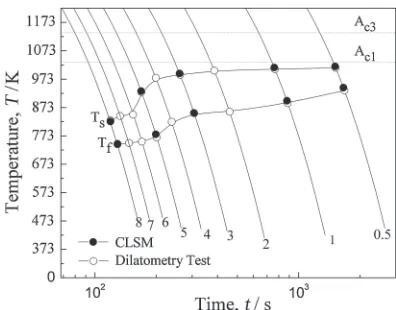
3.2 Analysis of continuous cooling transformation The continuous cooling transformation (CCT) curve of the NbTi microalloyed steel observed in situ by CLSM and tested by Gleeble-3800 is shown in Fig. 2. The results obtained by the two methods are consistent with each other, and the phase transformation temperature by CLSM method can be determined accurately and intuitively. In addition, with the increase of cooling rate, the degree of supercooling increases and the atomic diffusion velocity decreases, which makes the start temperature and start time of the phase transformation reduce.
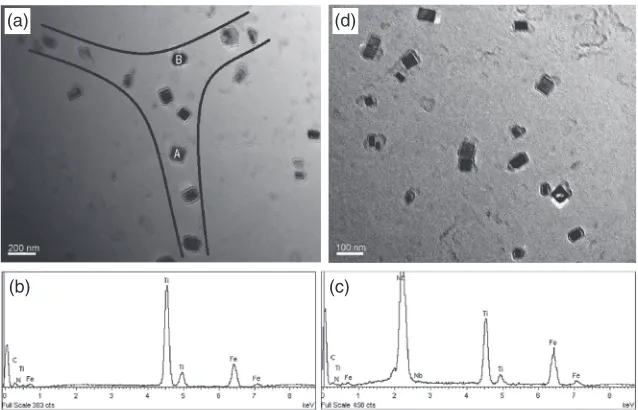
3.3 Observation and analysis of microstructures When the temperature is lower than the initial precipitation temperature of the microalloying elements, the precipitates are formed. By CLSM, at about 1343 K (1070°C), most of precipitates are observed at the austenite grain boundaries (Fig. 3(a)). With increasing cooling rates, at about 1324 K (1051°C), most of the precipitates are observed in the austenite grain (Fig. 3(b)). By SEM, the Ti or Nb-based precipitates and other inclusions and the proeutectoid ferrites are observed along the austenite grain boundaries (Fig. 4(a)). At a higher cooling rate, the Ti or Nb-based precipitates are distributed in the grain (Fig. 4(b)). By TEM, two different types of the Ti or Nb-based precipitates are observed (Fig. 5(a)). The cuboidal precipitate “A” in Fig. 5(a) was an Ti(C,N) carbonitride (Fig. 5(b)). The irregular-shaped precipitate “B” in Fig. 5(a) was identified as a precipitated (Nb,Ti)(C,N) carbonitride (Fig. 5(c)). The undissolved Ti-rich precipitates can act as preferential nucleation sites for precipitated Nb-rich carbides.13,14) Furthermore, Ti or Nb carbonitrides precipitate along the grain boundary at a lower cooling rate, as shown in the area surrounded by the black lines in Fig. 5(a) and with the increase of cooling rate, the carbonitrides precipitate in the grain (Fig. 5(d)).
At low cooling rates, the larger precipitates form along the grain boundary and the proeutectoid ferrites also precipitate along the austenite grain boundaries. The larger precipitates are observed obviously in the proeutectoid ferrites (Fig. 4(a)). Segregation of solute atoms usually occurs at the austenite grain boundary within the steel matrix. According to the calculation results of the biggest solute concentration factor of Nb, Ti at the austenite grain boundaries, Nb and Ti are easy to segregate at the austenite grain boundaries.15)For example, at 1323 K, the segregation concentrations of Nb, Ti at the austenite grain boundary are 5.858 and 4.994 times, respectively, that of the average concentration of the matrix. At 1273 K, they are 6.958 and 5.84 times, respectively. Furthermore, in the investigated Nb Ti microalloyed steel, there is a strong affinity between Nb,
(a) (b)
(c) (d)
Fig. 1 In situobservation of the£¼¡phase transformation by CLSM at 5 K·s¹1, (a) start of the phase transformation, (b) continuous growth of new phase, (c) about 70%for the quantity of phase transformation, and (d) completion of the phase transformation.
[image:2.595.144.454.69.278.2] [image:2.595.69.267.334.489.2]Fig. 3 In situobservation of the distribution of the precipitates by CLSM at different cooling rates, (a) 0.5 K·s¹1, and (b) 5 K·s¹1.
(a)
(b)
Fig. 4 The SEM images and EDS analysis of the precipitates at different cooling rates, (a) 0.5 K·s¹1, and (b) 5 K·s¹1.
(a)
(b) (c)
(d)
[image:3.595.134.463.70.180.2] [image:3.595.132.463.224.497.2] [image:3.595.139.458.545.750.2]Ti and C, N atoms, and they are segregated at the grain boundaries to form atomic groups, which is beneficial to reduce greatly the grain boundary energy.16,17) When the sample is cooled below the precipitation temperature, the microalloying elements react with carbon and nitrogen to form carbonitrides at the grain boundary, which results in lower solute concentrations at the grain boundaries. At low cooling rates, the microalloying elements within the grain, carbon and nitrogen atoms can diffuse toward the grain boundaries, so as to ensure continuous precipitation at the grain boundaries. The diffusion of the solute atoms at grain boundaries is relatively quicker, so the precipitates are easy to grow up, and also easy to aggregate with other inclusions together (Fig. 4(a)). Furthermore, the precipitation of car-bonitrides along the austenite grain boundary consumes carbon atoms in the austenite, and the carbon concentration decreases near the grain boundary, which promotes the formation of proeutectoid ferrite (Fig. 4(a) and Fig. 5(a)). With the increase of cooling rate, the degree of supercooling increase and the temperature decrease. According to the law of diffusion, the diffusion coefficient of the solute atoms (e.g., microalloying elements, carbon or nitrogen) exponen-tially decreases with the decreasing temperature. So the elements are not easy to diffuse toward the grain boundary and the microalloying elements at the grain boundaries are difficult to react with carbon and nitrogen to form carbonitrides. Then, most of microalloying elements are precipitated in situ or solid-dissolved. So the smaller precipitates are mainly distributed in the grain (Fig. 4(b) and Fig. 5(d)).
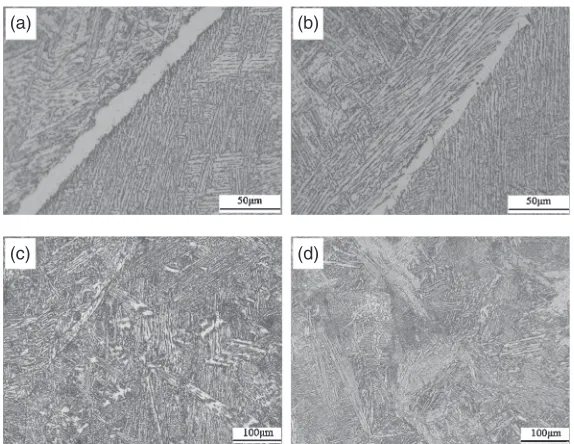
The microstructures become finer with the increase of cooling rate, as shown in Fig. 6. When the cooling rate increases, the start temperature of phase transformation decreases (Fig. 2) and the degree of supercooling increases. The driving force of phase transformation increases, and the size of critical nucleation and the critical nucleation energy reduce, and the nucleation rate increases. Therefore, the microstructures after phase transformation are refined
con-stantly. When the cooling rate is less than 5 K·s¹1, the proeutectoid ferrite along the grain boundary and widman-statten structure are observed, and with the increase of cooling rate, the width of proeutectoid ferrite becomes smaller (Figs. 6(a) and 6(b)). And the width is reduced from about 17 µm at the cooling rate of 0.5 K·s¹1 to 0 µm at the cooling rate of 5 K·s¹1, as shown in Fig. 7.
The formation process of proeutectoid ferrite includes nucleation and growth. Its nucleation formed at the austenite grain boundary and grew up rapidly. Figure 8 shows the concentration distribution of solute atoms during growth of a new phase ferrite (¡). The carbon content of formed ferrite is much lower than that of the parent phase austenite (£) at the interface between ferrite and austenite phases (C¡/£<C£/¡), which results in a concentration difference (C£/¡>C¨) in austenite. So the diffusion of carbon atoms in austenite destroys the balance of concentration at the interface. In order to maintain the balance of each phase at the interface, ferrite has to grow up.15) Its growth velocity is inversely
propor-(a) (b)
(c) (d)
Fig. 6 The microstructure of NbTi microalloyed steel at different cooling rates, (a) 0.5 K·s¹1, (b) 1 K·s¹1, (c) 5 K·s¹1, and (d) 8 K·s¹1.
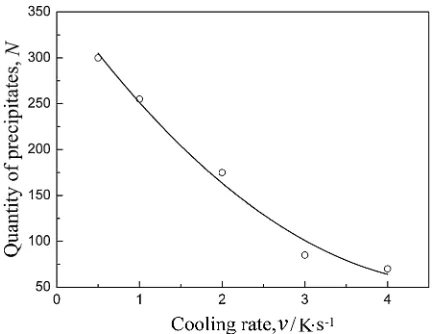
[image:4.595.155.442.68.290.2] [image:4.595.318.535.337.506.2]tional to the concentration difference on the interface.18)The precipitation of carbonitrides along the grain boundary makes the concentration difference decrease at the interface between the ferrite and austenite phases so as to promote the growth of proeutectoid ferrite. According to the statistics on the 20 observedfields of view, the quantity of precipitates along the austente grain boundary at different cooling rates is shown in Fig. 9. With the decrease of cooling rates, the precipitates grow in number. The more precipitates there are, the smaller the concentration difference at the interface will be. So the growth velocity of the proeutectoid ferrite increase and the ferrite becomes thicker at lower cooling rates. That is supported by the Figs. 7 and 9. With the increase of cooling rate, the phase transformation temperature decreases (Fig. 2), and the atomic diffusion coefficient decreases. So the growth velocity of the proeutectoid ferrite decreases and the width of the proeutectoid ferrite decrease (Fig. 7).
When the cooling rate is greater than or equal to 5 K·s¹1, bainite is observed mainly, which is a mixture of ferrite and carbide (Figs. 6(c) and 6(d)). The higher cooling rate makes proeutectoid reaction and the eutectoid transformation sup-pressed. Bainite is the product of displacive transformation.19) The ferrite nucleus in upper bainite are easy to form at the
are consistent with each other. And through in situ
observation, the phase transformation behavior can be investigated.
(2) When the cooling rate is below 5 K·s¹1, the proeutec-toid ferrite along the austenite grain boundaries and widmanstatten structure are observed, and the carboni-trides precipitated are also observed in the proeutectoid ferrite. With the increase of cooling rate, the quantity of the precipitates decreases, and the width of proeutectoid ferrite becomes smaller. When the cooling rate is greater than or equal to 5 K·s¹1, bainite is observed mainly and the precipitates are distributed in the grain.
(3) The carbonitrides precipitated along the austenite grain boundary consume carbon atoms in austenite and the carbon concentration near the grain boundary declines, which is more favorable to form the proeutectoid ferrite along the grain boundary. With the increase of cooling rate, the atomic diffusion coefficient decreases, and on the other hand, the quantity of the precipitates decreases and the concentration difference at the interface between the ferrite and austenite phases increase. So the growth velocity of the proeutectoid ferrite de-creases, which results in the decline in the width of proeutectoid ferrite.
Acknowledgments
The work was supported by Shanghai Young College Teacher Training and Financial Assistance Scheme under Grant No. ZZSDJ12006, Key Cultivation Project of Shanghai Dianji University under Grant No. 12C112, Scientific Research Fund of Shanghai Dianji University under Grant No. 13C402, Research and Innovation Project of Shanghai Municipal Education Commission No. 14YZ159, and Shanghai University Knowledge Service Platform Project of Shanghai Municipal Education Commis-sion under Grant No. ZF1225. The work was also supported by Shanghai Machine Building Technology Institute Co., Ltd.
REFERENCES
1) W. Derda and J. Wiedermann:Arch. Metall. Mater.57(2012) 303310.
2) K. Schwerdtfeger and K. H. Spitzer:ISIJ Int.49(2009) 512520.
3) B. Mintz:ISIJ Int.39(1999) 833855.
4) F. J. Ma, G. H. Wen, P. Tang, X. Yu, J. Y. Li, G. D. Xu and F. Mei:
Ironmak. Steelmak.37(2010) 7379.
5) K. R. Carpenter, R. Dippenaar and C. R. Killmore: Metall. Mater. Trans. A40(2009) 573580.
6) B. Mintz:Mater. Sci. Tech.24(2008) 112120.
7) J. Wang, G. Li and A. Xiao: Mater. Trans.52(2011) 20272031. Fig. 8 The concentration distribution of solute atoms during the growth of
¡phase.
[image:5.595.60.280.54.247.2] [image:5.595.61.277.288.455.2]8) K. Cho, Y. Koo and J. Park: J. Korean Inst. Met. Mater.46(2008) 329 337.
9) T. Kato, Y. Ito, M. Kawamoto, A. Yamanaka and T. Watanabe:ISIJ Int.
43(2003) 17421750.
10) F. Zarandi and S. Yue:ISIJ Int.45(2005) 686693.
11) F. Zarandi and S. Yue:Metall. Mater. Trans. A37(2006) 23162320.
12) Y. Arai, T. Emi, H. Fredrilsson and H. Shibata:Metall. Mater. Trans. A
36(2005) 3065.
13) A. J. Craven, K. He, L. A. J. Garvie and T. N. Baker:Acta Mater.48
(2000) 38573868.
14) S. G. Hong, K. B. Kang and C. G. Park:Scr. Mater.46(2002) 163168.
15) Q. L. Yong: The Second Phase in Iron and Steel Materials, (Metallurgical industry Publishers, Beijing, 2006) pp. 297348. 16) D. McLean: Grain Boundaries in Metals, (Oxford University Press,
London, 1957) pp. 67149.
17) M. Enomoto and Y. Sato:Mater. Trans.35(1994) 859867.
18) Z. Y. Liu: Master Thesis, Tsinghua University, Beijing, 2009, pp. 50 55.
19) J. W. Christian:The Theory of Transformations in Metals and Alloys, Part I, (Pergamon Press, Oxford, 1975) pp. 1568.