Efficient Tree-Based Topic Modeling
Yuening Hu
Department of Computer Science University of Maryland, College Park
Jordan Boyd-Graber iSchool and UMIACS
University of Maryland, College Park [email protected]
Abstract
Topic modeling with a tree-based prior has been used for a variety of applications be-cause it can encode correlations between words that traditional topic modeling cannot. How-ever, its expressive power comes at the cost of more complicated inference. We extend the SPARSELDA (Yao et al., 2009) inference scheme for latent Dirichlet allocation (LDA) to tree-based topic models. This sampling scheme computes the exact conditional distri-bution for Gibbs sampling much more quickly than enumerating all possible latent variable assignments. We further improve performance by iteratively refining the sampling distribution only when needed. Experiments show that the proposed techniques dramatically improve the computation time.
1 Introduction
Topic models, exemplified by latent Dirichlet alloca-tion (LDA) (Blei et al., 2003), discover latent themes present in text collections. “Topics” discovered by topic models are multinomial probability distribu-tions over words that evince thematic coherence. Topic models are used in computational biology, com-puter vision, music, and, of course, text analysis.
One of LDA’s virtues is that it is a simple model that assumes a symmetric Dirichlet prior over its word distributions. Recent work argues for structured distributions that constrain clusters (Andrzejewski et al., 2009), span languages (Jagarlamudi and Daum´e III, 2010), or incorporate human feedback (Hu et al., 2011) to improve the quality and flexibility of topic modeling. These models all use different tree-based prior distributions (Section 2).
These approaches are appealing because they preserve conjugacy, making inference using Gibbs sampling (Heinrich, 2004) straightforward. While straightforward, inference isn’t cheap. Particularly
for interactive settings (Hu et al., 2011), efficient inference would improve perceived latency.
SPARSELDA (Yao et al., 2009) is an efficient Gibbs sampling algorithm for LDA based on a refac-torization of the conditional topic distribution (re-viewed in Section 3). However, it is not directly applicable to tree-based priors. In Section 4, we pro-vide a factorization for tree-based models within a broadly applicable inference framework that empiri-cally improves the efficiency of inference (Section 5).
2 Topic Modeling with Tree-Based Priors
Trees are intuitive methods for encoding human knowledge. Abney and Light (1999) used tree-structured multinomials to model selectional restric-tions, which was later put into a Bayesian context for topic modeling (Boyd-Graber et al., 2007). In both cases, the tree came from WordNet (Miller, 1990), but the tree could also come from domain experts (Andrzejewski et al., 2009).
Organizing words in this way inducescorrelations that are mathematically impossible to represent with a symmetric Dirichlet prior. To see how correlations can occur, consider the generative process. Start with a rooted tree structure that contains internal nodes and leaf nodes. This skeleton is a prior that generates
Ktopics. Like vanilla LDA, these topics are distribu-tions over words. Unlike vanilla LDA, their structure correlates words. Internal nodes have a distribution
πk,iover children, whereπk,icomes from per-node
Dirichlet parameterized byβi.1 Each leaf node is
associated with a word, and each word must appear in at least (possibly more than) one leaf node.
To generate a word from topick, start at the root. Select a childx0 ∼ Mult(πk,ROOT), and traverse the tree until reaching a leaf node. Then emit the leaf’s associated word. This walk replaces the draw from a topic’s multinomial distribution over words.
1Choosing these Dirichlet priors specifies the direction (i.e.,
The rest of the generative process for LDA remains the same, withθ, the per-document topic multinomial, andz, the topic assignment.
This tree structure encodes correlations. The closer types are in the tree, the more correlated they are. Because types can appear in multiple leaf nodes, this encodes polysemy. The path that generates a token is an additional latent variable we must sample.
Gibbs sampling is straightforward because the tree-based prior maintains conjugacy (Andrzejewski et al., 2009). We integrate the per-document topic dis-tributionsθand the transition distributionsπ. The remaining latent variables are the topic assignmentz
and pathl, which we sample jointly:2
p(z=k, l=λ|Z−, L−, w) (1)
∝(αk+nk|d)
Y
(i→j)∈λ
βi→j+ni→j|k
P
j0(βi→j0+ni→j0|k)
where nk|d is topic k’s count in the document d;
αkis topick’s prior;Z−andL−are topic and path
assignments excluding wd,n; βi→j is the prior for
edgei → j, ni→j|tis the count of edgei → j in
topick; andj0denotes other children of nodei. The complexity of computing the sampling distri-bution isO(KLS)for models withKtopics, paths at mostLnodes long, and at mostSpaths per word type. In contrast, for vanilla LDA the analogous conditional sampling distribution requiresO(K).
3 Efficient LDA
The SPARSELDA (Yao et al., 2009) scheme for speeding inference begins by rearranging LDA’s sam-pling equation into three terms:3
p(z=k|Z−, w)∝(αk+nk|d)
β+nw|k
βV +n·|k
(2)
∝ αkβ
βV +n·|k
| {z }
sLDA
+ nk|dβ βV +n·|k
| {z }
rLDA
+(αk+nk|d)nw|k βV +n·|k
| {z }
qLDA
Following their lead, we call these three terms “buckets”. A bucket is the totalprobability mass marginalizing over latent variable assignments (i.e.,
sLDA ≡ P
k αkβ
βV+n·|k, similarly for the other buck-ets). The three buckets are a smoothing only bucket
2
For clarity, we omit indicators that ensureλends atwd,n.
3To ease notation we drop the
d,nsubscript forzandwin this and future equations.
sLDA, document topic bucketrLDA, and topic word
bucketqLDA(we use the “LDA” subscript to contrast
with our method, for which we use the same bucket names without subscripts).
Caching the buckets’ total mass speeds the compu-tation of the sampling distribution. BucketsLDA is shared by all tokens, and bucketrLDA is shared by a
document’s tokens. Both have simple constant time updates. BucketqLDA has to be computed specifi-cally for each token, but only for the (typispecifi-cally) few types with non-zero counts in a topic.
To sample from the conditional distribution, first samplewhichbucket you need and then (and only then) select a topicwithinthat bucket. Because the topic-term bucketqLDA often has the largest mass and has few non-zero terms, this speeds inference.
4 Efficient Inference in Tree-Based Models
In this section, we extend the sampling techniques for SPARSELDA to tree-based topic modeling. We first factor Equation 1:
p(z=k, l=λ|Z−, L−, w) (3)
∝(αk+nk|d)Nk,λ−1[Sλ+Ok,λ].
Henceforth we callNk,λthe normalizer for pathλ
in topick,Sλ the smoothing factor for pathλ, and
Ok,λthe observation for pathλin topick, which are
Nk,λ=
Y
(i→j)∈λ
X
j0
(βi→j0+ni→j0|k)
Sλ=
Y
(i→j)∈λ
βi→j (4)
Ok,λ=
Y
(i→j)∈λ
(βi→j+ni→j|k)−
Y
(i→j)∈λ βi→j.
Equation 3 can be rearranged in the same way as Equation 5, yielding buckets analogous to SPARSELDA’s,
p(z=k,l=λ|Z−, L−, w) (5)
∝αkSλ
Nk,λ
| {z }
s
+nk|dSλ Nk,λ
| {z }
r
+(αk+nk|d)Ok,λ Nk,λ
| {z }
q
.
Recall that one of the benefits of SPARSELDA was thatswas shared across tokens. This is no longer possible, as Nk,λ is distinct for each path in
tree-based LDA. Moreover,Nk,λ is coupled; changing
ni→j|k in one path changes the normalizers of all
cousin paths (paths that share some nodei).
This negates the benefit of cachings, but we re-cover some of the benefits by splitting the normalizer to two parts: the “root” normalizer from the root node (shared by all paths) and the “downstream” normal-izer. We precompute which paths share downstream normalizers; all paths are partitioned into cousin sets, defined as sets for which changing the count of one member of the set changes the downstream normal-izer of other paths in the set. Thus, when updating the counts for pathl, we only recomputeNk,l0 for all
l0in the cousin set.
SPARSELDA’s computation ofq, the topic-word bucket, benefits from topics with unobserved (i.e., zero count) types. In our case, any non-zero path, a path withanynon-zero edge, contributes.4To quickly
determine whether a path contributes, we introduce anedge-masked count(EMC) for each path. Higher order bits encode whether edges have been observed and lower order bits encode the number of times the path has been observed. For example, if a path of length three only has its first two edges observed, its EMC is11000000. If the same path were observed seven times, its EMC is11100111. With this formu-lation we can ignore any paths with a zero EMC.
Efficient sampling with refined bucket While caching the sampling equation as described in the previous section improved the efficiency, the smooth-ing only bucketsis small, but computing the asso-ciated mass is costly because it requires us to con-sider all topics and paths. This is not a problem forSparseLDAbecausesis shared across all tokens. However, we can achieve computational gains with an upper bound ons,
s=X k,λ
αkQ(i→j)∈λβi→j
Q
(i→j)∈λ
P
j0(βi→j0+ni→j0|k)
≤X
k,λ
αkQ(i→j)∈λβi→j
Q
(i→j)∈λ
P
j0βi→j0
=s0. (6)
A sampling algorithm can take advantage of this by not explicitly calculatings. Instead, we uses0
4
C.f. observed paths, wherealledges are non-zero.
as proxy, and only compute the exactsif we hit the buckets0 (Algorithm 1). Removing s0 and always computingsyields the first algorithm in Section 4.
Algorithm 1SAMPLING WITH REFINED BUCKET 1: forword w in this documentdo
2: sample=rand()∗(s0+r+q)
3: ifsample< s0then
4: computes
5: sample=sample∗(s+r+q)/(s0+r+q)
6: ifsample< sthen
7: return topickand pathλsampled froms
8: sample−=s
9: else
10: sample−=s0
11: ifsample< rthen
12: return topickand pathλsampled fromr
13: sample−=r
14: return topickand pathλsampled fromq
Sorting Thus far, we described techniques for ef-ficiently computing buckets, but quickly sampling assignments within a bucket is also important. Here we propose two techniques to consider latent vari-able assignments indecreasingorder of probability mass. By considering fewer possible assignments, we can speed sampling at the cost of the overhead of maintaining sorted data structures. We sort top-ics’ prominence within a document (SD) and sort the topics and paths of a word (SW).
Sorting topics’ prominence within a document (SD) can improve sampling fromrandq; when we need to sample within a bucket, we consider paths in decreasing order ofnk|d.
Sorting path prominence for a word (SW) can im-prove our ability to sample fromq. The edge-masked count (EMC), as described above, serves as a proxy for the probability of a path and topic. If, when sam-pling a topic and path fromq, we sample based on the decreasing EMC, which roughly correlates with path probability.
5 Experiments
In this section, we compare the running time5of our sampling algorithm (FAST) and our algorithm with the refined bucket (RB) against the unfactored Gibbs sampler (NA¨IVE) and examine the effect of sorting.
Our corpus has editorials from New York Times
5
Number of Topics
T50 T100 T200 T500
NAIVE 5.700 12.655 29.200 71.223
FAST 4.935 9.222 17.559 40.691
FAST-RB 2.937 4.037 5.880 8.551
FAST-RB-SD 2.675 3.795 5.400 8.363
FAST-RB-SW 2.449 3.363 4.894 7.404
FAST-RB-SDW 2.225 3.241 4.672 7.424 Vocabulary Size
V5000 V10000 V20000 V30000 NA¨IVE 4.815 12.351 28.783 51.088
FAST 2.897 9.063 20.460 38.119
FAST-RB 1.012 3.900 9.777 20.040
FAST-RB-SD 0.972 3.684 9.287 18.685
FAST-RB-SW 0.889 3.376 8.406 16.640
FAST-RB-SDW 0.828 3.113 7.777 15.397 Number of Correlations
C50 C100 C200 C500
NA¨IVE 11.166 12.586 13.000 15.377
FAST 8.889 9.165 9.177 8.079
FAST-RB 3.995 4.078 3.858 3.156
FAST-RB-SD 3.660 3.795 3.593 3.065
FAST-RB-SW 3.272 3.363 3.308 2.787
[image:4.612.77.296.70.337.2]FAST-RB-SDW 3.026 3.241 3.091 2.627
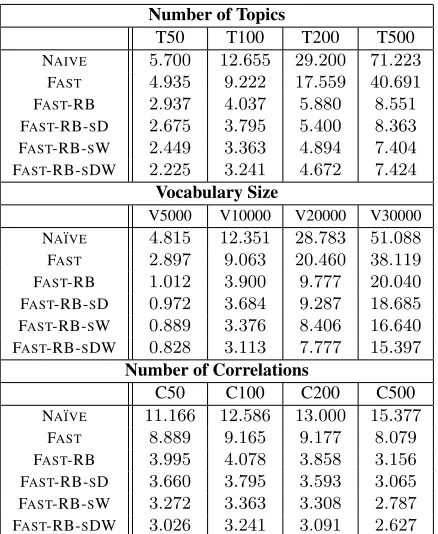
Table 1: The average running time per iteration (S) over 100 iterations, averaged over 5 seeds. Experiments begin with 100 topics, 100 correlations, vocab size 10000 and then vary one dimension: number of topics (top), vocabu-lary size (middle), and number of correlations (bottom).
from 1987 to 1996.6 Since we are interested in vary-ing vocabulary size, we rank types by average tf-idf and choose the topV. WordNet 3.0 generates the cor-relations between types. For each synset in WordNet, we generate a subtree with all types in the synset— that are also in our vocabulary—as leaves connected to a common parent. This subtree’s common parent is then attached to the root node.
We compared the FAST and FAST-RB against NA¨IVE(Table 1) on different numbers of topics, var-ious vocabulary sizes and different numbers of cor-relations. FAST is consistently faster than NA¨IVE and FAST-RB is consistently faster than FAST. Their benefits are clearer as distributions become sparse (e.g., the first iteration for FASTis slower than later iterations). Gains accumulate as the topic number increases, but decrease a little with the vocabulary size. While both sorting strategies reduce time, sort-ing topics and paths for a word (SW) helps more than sorting topics in a document (SD), and combining the
6
13284 documents, 41554 types, and 2714634 tokens.
1 1.05 1.1 1.15 1.2 1.25 1.3 1.35 1.4 2
4 6 8 10 12 14 16
Average number of senses per constraint word
Average running time per iteration (S)
Naive Fast Fast−RB
[image:4.612.318.534.71.198.2]Fast−RB−sD Fast−RB−sW Fast−RB−sDW
Figure 1: The average running time per iteration against the average number of senses per correlated words.
two is (with one exception) better than either alone. As more correlations are added, NA¨IVE’s time in-creases while that of FAST-RB decreases. This is be-cause the number of non-zero paths for uncorrelated words decreases as more correlations are added to the model. Since our techniques save computation for every zero path, the overall computation decreases as correlations push uncorrelated words to a limited number of topics (Figure 1). Qualitatively, when the synset with “king” and “baron” is added to a model, it is associated with “drug, inmate, colombia, water-front, baron” in a topic; when “king” is correlated with “queen”, the associated topic has “king, parade, museum, queen, jackson” as its most probable words. These represent reasonable disambiguations. In con-trast to previous approaches, inference speeds up as topics become more semantically coherent (Boyd-Graber et al., 2007).
6 Conclusion
Acknowledgments
We would like to thank David Mimno and the anony-mous reviewers for their helpful comments. This work was supported by the Army Research Labora-tory through ARL Cooperative Agreement W911NF-09-2-0072 and NSF grant #1018625. Any opinions or conclusions expressed are the authors’ and do not necessarily reflect those of the sponsors.
References
Steven Abney and Marc Light. 1999. Hiding a seman-tic hierarchy in a Markov model. InProceedings of the Workshop on Unsupervised Learning in Natural Language Processing.
David Andrzejewski, Xiaojin Zhu, and Mark Craven. 2009. Incorporating domain knowledge into topic mod-eling via Dirichlet forest priors. In Proceedings of International Conference of Machine Learning. David M. Blei, Andrew Ng, and Michael Jordan. 2003.
Latent Dirichlet allocation. Journal of Machine Learn-ing Research, 3:993–1022.
Jordan Boyd-Graber, David M. Blei, and Xiaojin Zhu. 2007. A topic model for word sense disambiguation. InProceedings of Emperical Methods in Natural Lan-guage Processing.
Gregor Heinrich. 2004. Parameter estima-tion for text analysis. Technical report. http://www.arbylon.net/publications/text-est.pdf. Yuening Hu, Jordan Boyd-Graber, and Brianna Satinoff.
2011. Interactive topic modeling. InAssociation for Computational Linguistics.
Jagadeesh Jagarlamudi and Hal Daum´e III. 2010. Ex-tracting multilingual topics from unaligned corpora. In
Proceedings of the European Conference on Informa-tion Retrieval (ECIR).
George A. Miller. 1990. Nouns in WordNet: A lexical inheritance system.International Journal of Lexicog-raphy, 3(4):245–264.
Alexander J. Smola and Shravan Narayanamurthy. 2010. An architecture for parallel topic models.International Conference on Very Large Databases, 3.