Shadow Detection and Removal using Discrete
Wavelet Transform and User Configurable
Parameters
Vandna Thakur1, Vikash Mishra2, Dr. Vishal Shrivastava3, Dr. Akhil Pandey4
1
M.Tech Scholar, 2Associate Professor, 3M.Tech Coordinator, 4M. Tech HOD, CSE Branch, ARYA College. Of Eng. & Info Tech, Jaipur, India
Abstract: Moving cast shadows are an important stress in today's execution from sweeping extent of various vision-based perception applications in light of the way that they exceedingly troublesome the thing portrayal task. A couple shadow distinguishing proof methodologies have been represented in the written work in the midst of the latest years. They are generally divided into two spaces. One as a general rule works with static pictures; however, the second one uses picture courses of action, to be particular video content. Despite the way that both cases can be also analyzed, there is a refinement in the application field. The primary case, shadow ID techniques can be abused to get additional geometric and semantic signs about shape and position of its tossing article ('shape from shadows') and the confinement of the light source. While in the second one, the essential purpose behind existing is regularly change revelation, scene planning or observation (generally in an establishment subtraction association). In our examination we have on a very basic level focused on the recognizable proof of shadow from the encouraging in order moving article through a video perception test multi-wavelet decision and customer configurable distinction parameters. In our test customer can pick the differing wavelets and change parameters. Edge model based super determination procedure is used to enhance results. Furthermore, the effect of cutting edge watermarking is focused on for the super-decided VOP (Video articles planes). Different tests have been proposed and made sense of a best framework for video observation application. Our proposed super determination (SR) framework gives favored results over bilinear and bi-cubic schedules.
Keywords: Shadow removal, Watermarking, Discrete Wavelet Transform (DWT), visual surveillance.
I. INTRODUCTION
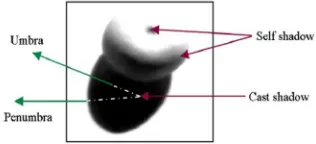
[image:1.612.228.386.643.715.2]A developing enthusiasm for the picture and video preparing com-munities is the undertaking of cast shadow recognition. In applications, for example, video observation, movement checking and human movement catch, great division and following of fore-ground items is a center prerequisite. Tragically, moving shadows in these applications may show up as closer view objects, when actually they are brought on by the communication in the middle of light and questions. The powerlessness to recognize frontal area protests and shadows can bring about extreme issues, for example, item consolidating, false division and distinguishing proof disappointment, all of which essentially influence execution. In this manner, shadow location and evacuation is an essential and important errand. Video Surveillance is an essential use of Computer Vision for an association, from the security perspective. This is one application where a computerized framework can supplant individuals, and also have inputs which are unrealistic through human observation alone. A shadow happens when an item in part or thoroughly blocks direct light from a wellspring of brightening. By and large, shadows can be isolated into two noteworthy classes: self shadows and cast shadows. A self shadow happens in the bit of an item which is not lit up by direct light. A cast shadow is the range anticipated by the article toward direct light. Cast shadows can be further ordered into umbra and penumbra area, which is an after effect of multi-lighting and self shadows additionally have numerous sub-locales, for example, shading and bury reflection. Beneath figure1 indicates diverse sorts of shadows.
II. LITERATURE REVIEW
We at first made a review out of existing headways of adjusted visual assessment of works that are starting now achieved for the ID of shadow from a moving or a stationary thing. Distinguishing regions that identify with moving inquiries, for instance, vehicles and people in trademark scenes is a tremendous and troublesome issue for some vision-based applications. The extraction of the moving zone is the introductory stride to discover where a moving shadow can be perceived. The most utilized procedures for movement division are:
A. Background subtraction,
B. Frame differencing, (a combination of both), or
C. Optical flow.
[image:2.612.185.424.314.404.2]Development division in perspective of optical stream uses characteristics of stream vectors of moving things after some an opportunity to perceive change areas in a photo progression. These frameworks can divide moving things in video groupings even from a moving camera. Regardless, most of these systems is computationally significantly expensive and particularly sensitive to racket. On a very basic level, the methodology behind any establishment subtraction framework involves in subtracting a model of the static scene "establishment" from each packaging of a video game plan. When in doubt, an establishment subtraction technique can be divided into three stages: in the first place, the time of a suitable reference model, commonly called establishment (planning stage); second, the estimation strategy or game plan (running stage) finally; the model backing (redesigning stage).
Figure 2: Moving Shadow detection and foreground detection
III. OBJECTIVE OF OUR WORK
Shadow area using DWT with Multi-wavelet decision plans to recognize and remove shadow from a moving object which is itself a great errand. Video data is given to UI which has been created with the help of MATLAB and after that using DWT and Image subtraction procedure, shadow is recognized and after that removed from the Image, it is so in light of the fact that here at first the video test is isolated into various picture pixels. By then in the wake of removing the shadow the article is taken to be in thought. Different examinations have been proposed and found a best framework for video perception application. Our proposed super determination (SR) system gives preferable results over bilinear and bi-cubic techniques.
IV. PROPOSED WORK
Our test setup is basically programming based structure in which a UI is created in MATLAB which is showed up in Figure 3, through this video test is taken as data and experienced particular number of steps that we will see as of late and after that we will get the article picture which is without shadow and through we can without a doubt choose the genuine estimations of the thing.
[image:2.612.183.429.597.717.2]The process of the software module is characterized in various numbers of steps which is mentioned below:
A. In the first step we have to clear all the variables and handle it. B. Delete all the files from the Directory V image, F image, FWS image.
C. From UI go to file Menu and select video input file.
D. Using video reader object read Video file into different matrix.
E. Matrix will be in the form of loop from 1 to No. of trees.
F. In image variable read I frame and also write into v-image.
G. Take background image from the user.
H. Then shorting of the files will be done mathematically.
I. The background image converted into HSV format.
J. Loop will be initiated now to read all the files and converts into HSV.
K. Then value of ∆H, ∆V and ∆S will be calculated.
L. Now transformation of wavelet is done into DWT.
M. Calculation of standard deviation.
N. Mean of CAV stored in mean.
O. Calculation of standard deviation which is ration of standard deviation of mean.
P. Now same procedure of CAS value is obtained.
Q. The obtained result categorized in two different sections, first in which only standard deviation considered and the second one in which Both standard and mean deviation considered.
R. Now the work is done on Mode 0 which is used to calculate front image without shadow.
Above mentioned steps are very important and just with the help of this image we can find out the shadow from a moving object.
V. METHODOLOGY AND PROCEDURE ADOPTED
GUI where we can learn about the shortcomings and trouble making of the framework which will be depicted soon in this area. At first we will see the work process that we have followed in our framework and afterward we will experience the aftereffects of the created framework.
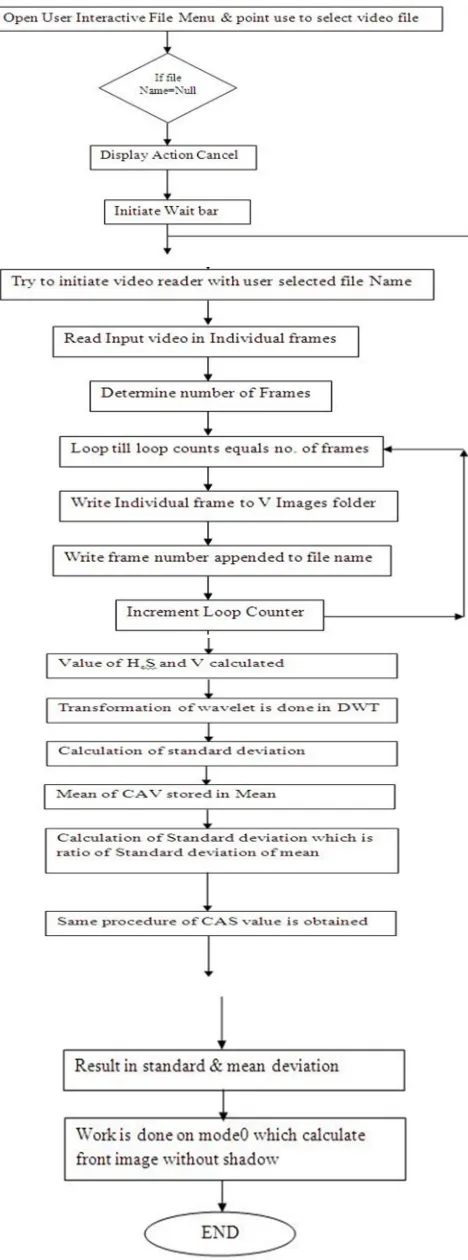
In Fig. 4 we can obviously see the work process of the that at first as an info Video test is taken and after that it is partitioned in casings and there the edges were concentrated on and shadow were expelled from the picture and promote augmentation were done in the framework and along these lines the entire procedure goes on.
The accomplishment of the technique depends basically on the exact determination of contender relative parameters of wavelets, for each piece pair in the pixel or the change spaces with which to test the zone relative condition. As video data is normally uproarious, this prescribes assessing candidate qualities using real measures that have botch and tumult reducing properties. To this effect in the DCT zone the DC quality and the total of the aeration and cooling system qualities prescribe intense estimations, while in the DWT space, the LL worth and the entire of LH, HL, HH values in like manner propose fruitful estimations. If we apply Sobel executive particularly, we will get various circles inside the edge map which will incite abundantly multifaceted nature to get the outcome. So after morphological operation, Sobel administrator is utilized to get article edge map.
Contributions of this work can be summarized as follows:
1) A strategy for shadow identification and expulsion from moving article which depends on DWT complex wavelet change has been displayed.
2) Coefficient of variation is used as a new threshold because it is more informative and more consistent.
3) The edge is naturally decided and does not require any directed learning or manual alignment.
4) The proposed method does not depend on any other parameter except complex wavelet coefficients.
5) The proposed system has been assessed for various video arrangements and is found to have better execution regarding a three execution measurements (shadow discovery rate, shadow separation rate and matched t-test) when contrasted with delegate best in class routines.
6) The proposed method performs well for, both, indoor and outdoor types of video sequences.
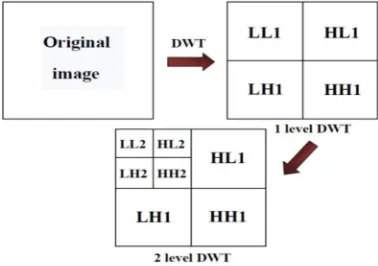
[image:5.612.210.399.435.568.2]In our Methodology we are using DWT which really suggests Discrete Wavelet Transformation which similarly changes over the photo from the spatial range to repeat space. As showed by the Fig. 5, the photo is detached by vertical and even lines and addresses the first-demand of DWT, and the photo can be separated with four segments those are LL1, LH1, HL1 and HH1. In additional, those four segments are identified with four repeat regions in the photo.
Figure 5: Frequency Distribution of DWT
VI. RESULTS AND IMPLEMENTATION
In this area we will talk about the general executed aftereffect of our running framework. Every yield and the procedure of the framework will be seen with the pertinent previews. How about we concentrate each of them steps tight clamp. UI which has been utilized as a part of this Experiment is MATLAB based programming. The product that we have created here is named as Shadow Detection utilizing DWT with Multi-wavelet determination and User-configurable change parameters. What's more, the complete procedure of our exploration are included in this product step shrewd which starts from the data of the video test and the last yield which will be put away in Fimage, Vimage and FWS picture.
Figure 6: Selection of suitable wavelength manually
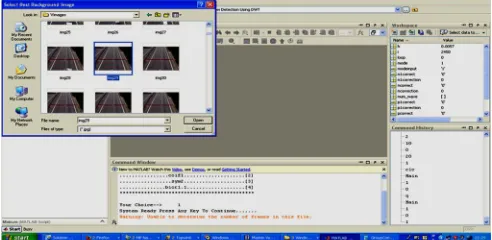
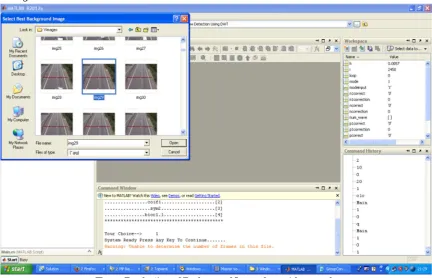
After selecting the proper wavelength and video sample, video is broken into various frames and among them suitable image is taken for the background.
Figure 7: selection of Background Image from video sample
[image:6.612.90.522.391.669.2]We will now see the results which are further obtained after breaking the video sample in different images.
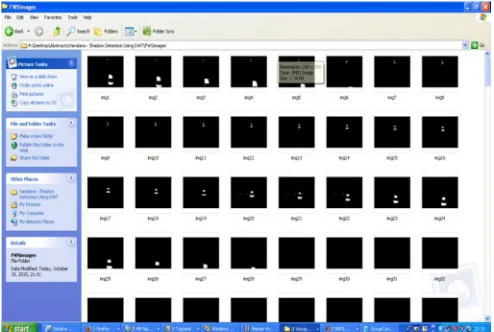
Fig.8: Frames obtained from video Sample and stored in Fimage
Fig. 9: Shadow image (White shade) stored in FWS folder
VII. CONCLUSION
In view of the above trials and results our framework discover the shadow from a moving item with the assistance of a video test and by using so as to break it into edges DWT technique which is one of the best strategy and we are additionally encourages the client to choose the suitable wavelength and recurrence physically.
Our proposed structure will in this way review the shadow which is in like way finding in moving picture, and greatly complex to find the shadow. Finally, shadow area and amusement is done in outstandingly fruitful and capable course by using above enhanced system. Complex wavelet change is in incorporating with above systems give more tried and true auxiliary wanting to proposed count. Solidifying the shadow properties and spooky characteristics of articles, this thought is proposed to utilize thresholding technique and morphological isolating to recognize shadows. To change the shrouded scene pixels of shadows in powerful way, shadow diversion estimation considering the example learning system and a MRF is created nearby CWT.
VIII. FUTURE WORKS
Since we realize that the trials and research have no end focuses so we can have some future works.
Testing future work in this field can be the circumstances when we have two light sources and getting two shadows for single articles. Overall these circumstances happen when we walk around the city in night and we get our two shadows in perspective of diligent street lights staying from starting stage to end point.
[image:7.612.183.430.290.456.2]REFERENCES
[1] Ariel Amato, Ivan Huerta, Mikhail G. Mozerov, F. Xavier Roca and Jordi Gonz`alezMoving , “Cast shadow Detection method for Video Surveillance Applications” Vol. 13 August 2001.
[2] Andrea Prati, Ivana Mikic, Mohan M. Trivedi and Rita Cucchiara. Detecting Moving Shadows: Algorithms and Evaluation. IEEE Transactions on Pattern Analysis and Machine Intelligence, vol.25, no. 7, July 2003.
[3] G. D. Finlayson, S. D. Hordley, and M. S. Drew. Removing shadows from images using retinex. Color Imaging Conference. IS&T - The Society for Imaging Science and Technology, 2002.
[4] Kishorebabu.g1, A.ravi2. Shadow Detection and Reconstruction in Low Resolution Images Using Wavelet Transforms. IJSETR International Journal of
Scientific Engineering and Technology Research, vol. 3, ISSUE.35, November 2014.
[5] Ruiqi Guo, Qieyun Dai, Derek Hoiem. Single-Image Shadow Detection and Removal using Paired Regions. University of Illinois at Urbana Champaign. [6] M. Baba and N. Asada.” Shadow removal from a real picture”. In SIGGRAPH, 2003.
[7] Shoaib M, Dragon R, Ostermann J. Shadow Detection for Moving Humans using Gradient-Based Background Subtraction. IEEE International Conference on Acoustics, Speech and Signal Processing, ICASSP, pp. 773-776, 2009
[8] Liang Xu, Liang Zhang, Ping Han, Ren-biao Wu. Adaptive Threshold Shadow Detection Based On Image Block Statistics. ICSP Proceedings, 2008.
[9] Song Xuehua, Ding Yan, Gen Jianfeng, Chen Yu. Shadow Removal of Vehicles in a Video System Based on RGB Chroma Model. International Conference on Computer Science and Software Engineering, vol.1, pp. 977-980, 2008.
[10] R Cucchiara, C Grana, M Piccardi and A Prati. Detecting objects, shadows and ghosts in video streams by exploiting color and motion information. 11th International Conference on Image Analysis and Proceedings, pp. 360-365, 2001.
[11] Y Deng, S Kenney, M S Moore and B S Manjunath. Peer group filtering and perceptual color image quantization. Proc. IEEE International Symposium on Circuits and Systems VLSI , (ISCAS'99), Orlando, FL, no. 4, pp.21-24, June 1999.
[12] Yu-Li You and M.Kaveh. Image Enhancement using fourth order partial differential equations. IEEE Transactions on Image Processing, 2000. [13] Soheil Feizi and Sina Zahedpour. Salt and pepper noise removal for image signals. International conference on telecommunications, pp.1-5, 2008. [14] James C Church, Yixin Chen, and Stephen V Rice. A Spatial Median Filter for Noise Removal in Digital Images. IEEE southeastcon, pp.618-623, 2008. [15] G. D. Finlayson, S. D. Hordley, C. Lu, and M. S. Drew. On the removal of shadows from images. PAMI, 28:59–68, Jan 2006.
[16] Gayatri Gaurav, Prof. M.B. Limkar. Study of Different Shadow Detection and Removal Algorithm. International Journal of Research in Electronics and Communication Technology (IJRECT 2014), Vol. 1, Issue 2 April - June 2014, ISSN : 2348 - 9065 (Online) ISSN : 2349 - 3143 (Print).
[17] Malay Kumar Nema, Subrata Rakshit, and Subhasis Chaudhuri. Edge Model Based High Resolution Image Generation. ICVGIP, Springer, 2006.
[18] A. Abinaya and V. Ganesan. Detection of objects using shadow removal and image Reconstruction. Arpan journal of engineering and applied sciences, vol. 10, no. 7, april 2015, ISSN: 1819-6608.
[19] C Staufer, W E L Grimson. Adaptive background mixture models for real-time tracking. Proc. of IEEE Conf. on Computer Vision and Pattern Recognition, Vol. 2, pp. 246-252, June 1999.
[20] Rafael C Gonzalez, Richard E Woods and Steven L Eddins. Digital Image Processing using Matlab. Pearson Education, Inc. 2004.
[21] Guangmin Sun and Yao Yu. DWT based Watermarking Algorithm of Color Images. IEEE Conference on Industrial Electronics and Applications, ICIEA, pp.1823-1826, 2007.
[22] B.V.Funt, M. Drew and M.Brockington, Recovering Shading from Color Images, In G. Sandini, editor, ECCV-92: Second European Conference on Computer Vision, pages 124-132. Springer-Verlag, May 1992.
[23] Gayatri Gaurav, Prof. M.B. Limkar. Review on Shadow Detection and Removal Techniques/Algorithms. IJCST Vol. 3, Iss ue 1, Jan. - March 2012, ISSN : 0976-8491 (Online) | ISSN : 2229-4333 (Print).