Abstract— Management and security of electric power plays
a key role in economy and sustainable development. The major concerns in optimal usage of Power are reduction in wastage and creating intelligent switching systems to make optimal use of the power available. This paper proposes an adaptive smart home system for optimal utilization of power, through Artificial Neural Network (ANN). The system proposed comprises of a Recurrent Neural Network to capture Human behavior patterns and a Feed Forward Architecture in ANN for security applications in the smart homes. The technique is used to minimize the power wastage by studying and adapting to the consumption behavior patterns of the consumers.
Index Terms — Temporal response, Human behavior
mapping, Recurrent Neural Network, single layer perceptron model.
I. INTRODUCTION
MART home is an emerging concept that attracts the synergy of several areas of science and engineering. A lot of research has been going on for more than a decade now in order to increase power efficiency at the consumer level of the Power Management systems. Smart Home is the term commonly used to define a residence that integrates technology and services through home networking to enhance power efficiency and improve the quality of living [1], [2], [3], [4].
However, advancements in the field of smart homes are not to be dealt as an isolated case. The developments taking place within the society also affect the development of smart home systems. For example creating smart environments to support the increasing population of the elderly and the disabled persons has enormous potential [5], [6]. Furthermore in order to create added value, the focus should be on the smart home environment instead of only on the technology used.
Smart home systems are generally sensor based systems aimed at reducing the power wastage. These systems have certain disadvantages for instance they cannot always suit the behaviour pattern of the user and can restrict power wastages only to a certain level. The research attempt in this paper towards an adaptive and intelligent house is “How neural network can be embedded into smart home for adaptation and awareness?”
Manuscript received August 15, 2011.
Amit Badlani, Mr., is with the Electrical and Electronics Department at Birla Institute of Technology and Science (BITS), Pilani, Rajasthan - 333031, India (phone: +91-9694412224; fax: +91-1596-244183; e-mail: [email protected]).
Surekha Bhanot, Dr., is the Chief of the Instrumentation Unit at Birla Institute of Technology and Science (BITS), Pilani, Rajasthan - 333031,
The purpose of this paper is to portray as to how Artificial Neural Network (ANN) encounters the challenges posed to the sensor based classical smart home systems and propose a methodology for implementation of these networks to build an adaptive and intelligent system.
II. ANN BASED SYSTEM
There are several challenges to the smart home system, the most common being less flexibility of these systems towards human moods or behaviour patterns and their limitation on power saving.
Consider an example of a room having a fan, an A/C, a Table-lamp and a Bulb. The sensor based system can count the number of persons in the room through motion tracking sensors and switch off the supply when the room is empty and switch it on when the person is inside a room. However, in the case of a person sleeping with the lights on, the system fails to sense the sleep or any physical activity of the user leading to power wastage. Hence the system cannot capitalize on such power wastage, thus reducing its efficiency. Secondly, the system fails to provide flexibility such as lowering the bulb light intensity and increasing the intensity of the table-lamp while studying.
An ANN based system tracks the time and action of the user at different times (temporal response) to accurately predict human behaviour and the switching of the devices takes place accordingly. For example the system dims the bulb and increases the intensity of the lamp when it is time for the user to study and switches off all the lights when it is time to sleep, saving on a considerable amount of energy. These easy to control automated systems would not only save power but would also aid persons with disabilities or limited range of movement.
A. Proposed System around ANN
The system proposed comprises of two neural networks – Recurrent Network for human behaviour mapping, Feed forward architecture for applications like security and fire alarm. The system can also have power measurement devices for measurement of power dissipated, which can be added as an additional input to the system.
The Recurrent Neural Network is implemented through a supervised learning algorithm. The input data is taken continuously from the user and is stored in the memory. After a day all sequences of data is fed to this network which becomes the learning data for the system. This kind of a network is efficient in dealing with sequential problems where the current state depends upon the past states of the
Smart Home System Design based on Artificial
Neural Networks
Amit Badlani, Surekha Bhanot
same variable. Thus, the system is able to track changes in human behavior with time.
This network is independent of the Feed-forward network which uses a Rule based approach with learning data set and state target values to achieve the desired output response for security and fire alarms.
The two networks adjust the weights corresponding to each input parameter after evaluating the sum of square errors (SSE). The desired weights could be transmitted via data highway to the middleware which would use the weight values to evaluate the outputs and generate a response. The input from the user is processed by a standalone system mostly a Home Controller (Microcontroller based system) which is a middleware system and is connected to the data lines. The data abstraction from the registers is done by this system and the data is passed on to the algorithm as a learning data. Integrating such a system allows the sensors and devices to communicate with the home controller [7].
III. HUMAN BEHAVIOUR MAPPING
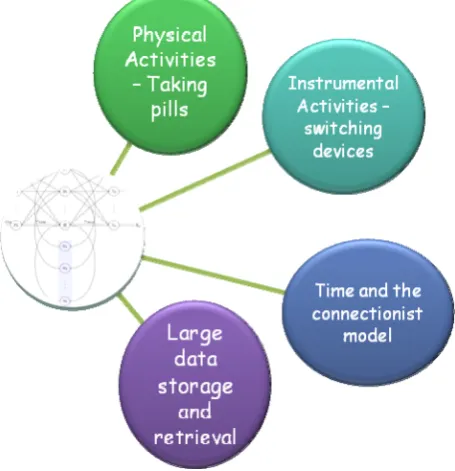
[image:2.595.313.555.162.382.2]Temporal rule mining and pattern discovery applied to time series data has attracted considerable amount of interest over the past few years. Learning temporal relations between time intervals in smart home data, which includes physical activities (such as taking pills while at home) and instrumental activities (such as turning on lamps and devices) requires mapping the human behavior pattern in that time interval. The map generated or stored in the form
Fig. 1. Parameters to be considered while designing a smart home system.
of data acts as a learning data set for the next period functionality of the system. Hence, knowing the parameters for the concerned smart home system is a very important aspect for its design [8], [9].
Temporal interval discovery based on Allen’s interval relations has several disadvantages when used for knowledge discovery and pattern recognition. One of the
major disadvantages is its ambiguous nature. As seen in Figure 1, by applying the notion of temporal relations, the relation can very well be identified relations as A “before” B and B “before” C. Finding the best representation for the identified temporal interval is a current challenge. We can simply visualize this representation as A “before” B “before” C. But the question of whether there are other possible interpretations for this relationship arises and we must choose the best representation.
Thus, it is very important to identify all the parameters
related to an appliance used in a home and the learning rule can be applied to the problem later.
Time is clearly important in cognition and extensively applied in the domain but how to represent time in connectionist models such as the one we are using is also very important as well as critical. One obvious way of dealing with patterns that have a temporal extent is to represent time explicitly by associating the serial order of the pattern with the dimensionality of the pattern vector. The first temporal event is represented by the first element in the pattern vector; the second temporal event is represented by the second position in the pattern vector; and so on. The entire pattern vector is processed in parallel by the model. This approach has also been used in a grammar learning model [10].
There are several drawbacks to this approach, which basically uses a spatial metaphor for time. Firstly, it requires that there be some interface with the world which buffers the input so that it can be presented all at once. Secondly, the shift-register imposes a rigid limit on the duration of patterns (since the input layer must provide for the longest possible pattern), and further suggests that all input vectors be of the same length. These problems are particularly troublesome in domains such as human behaviour analysis, which is quite random, where one would like comparable representations for patterns that are of variable length. Due to the various constraints faced by the above method, it is better to assign the processing system itself with dynamic properties which are responsive to temporal sequences. In short, the network must have memory for learning data storage [11].
[image:2.595.56.284.440.676.2]In feed-forward networks employing hidden units and a learning algorithm, the hidden units develop internal representations for the input patterns, such as users’ previous days’ routine, which record those patterns in a way which enables the network to produce the correct output for a given input.
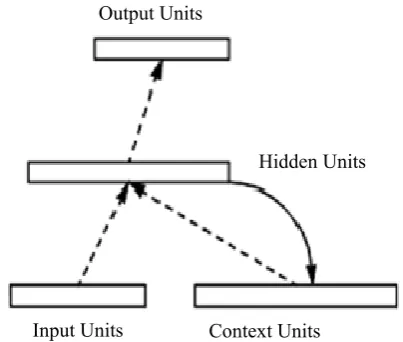
Context means situational information, and context-awareness means that one is able to use context information. A system is context-aware if it can extract, interpret and use context information and adapt its functionality to the current context of use [12]. So we use these special context units to represent the internal state of the system. In the proposed architecture, the context units remember the previous internal state. Thus, the hidden units have the task of mapping both an external input and also the previous internal state to some desired output (Figure 2). The internal representations that develop are sensitive to temporal context; the effect of time is implicit in these internal states. Activations are copied from hidden layer to context layer on a one-for-one basis, with fixed weight of 1.0. Dotted lines represent trainable connections.
The connections from the middle (hidden) layer to the context units are fixed with a weight of one. At each time step, the input is propagated in a standard feed-forward fashion, and then a learning rule is applied.
The fixed back connections result in the context units always maintaining a copy of the previous values of the hidden units (since they propagate over the connections before the learning rule is applied).
Thus, the network can maintain a sort of state, allowing it to perform tasks such as sequence-prediction etc. which are beyond the power of a standard multilayer perceptron. This however calls for the need for a memory which is highly task and stimulus dependent so that it could store in the rapid input changes with respect to time and the previous data for a certain time window. Information available back in time is inserted by widening the input space according to a fixed and pre-determined “window”
size. For example the window size in the system indicated by the following equation is Ґ.
X = x(t), x(t - 1), x(t - 2 ), ... x(t - Ґ) (1) However to minimize total error, Back Propagation Through Time (BPTT) is used to change each weight in proportion to its derivative with respect to the error.
However, for each layer the error is back-propagated and it gets smaller and smaller until it diminishes completely which is known as the vanishing gradient effect. The error gradients would hence, vanish exponentially with small window size between important events. However, on the other hand there would be a requirement of large memory in order to store huge amount of data for a larger window size. There is also a possibility of missing out on some important information. Hence optimizing the value of window size is another important factor which further depends upon the system parameters.
B. Profile generation using recurrent network
Contrary to Feed forward networks, recurrent networks are sensitive and adaptive to the past inputs, which is the central idea behind human behaviour mapping. This is because conventional feed forward networks can be used for a fixed input space, but human behaviour is not predictable and defined and it keeps on changing day by day.
Thus, the processing system would store the human responses and the activities, over a day, in the form of input data into the memory. The input data from the memory is then fed to the back propagation algorithm. Hence, in this manner a profile corresponding to the particular person is generated.
C. Proposed Algorithm
In sensor based smart home the response is based upon the default sensor system output for example if there is no one in a particular room then the power is switched off whereas if a person is inside the power is switched on. Even if the person is having a nap the lights remain on. Now, as the user opposes the default system response by switching off the ure has two parts, include the labels “(a)” and “(b)” as part of the artwork. Please verify that the figures and tables. lights the processor would store the data making a note of all the changes and thus an input pattern is stored in the memory. After about a day’s training the system accurately imitates the user and hence adapts to one’s behaviour pattern.
[image:3.595.77.279.330.501.2]Feed forward network, working on sensor output and Recurrent neural network, working on user input, produce an output and the processor chooses the output from the network having higher confidence (measured by the weights) in its response. The processor analyses the confidence in each case and hence chooses the results from a network which has the highest confidence. For example when the power dissipation in a room exceeds the threshold limit the confidence of the power analysis network increases. Now, though the Temperature is high the system would sacrifice a bit on the cooling of the room keeping the intensity of the table-lamp constant during study. On the Fig. 3: A simple recurrent network used in smart home systems.
Output Units
Hidden Units
other hand during a nap time any form of lighting would be sacrificed keeping the AC and the fan intensities constant. The priorities of the various devices depend on the state in which the system needs to function which is purely a function of weights assigned to the devices.
IV. SECURITY SYSTEMS
User authentication is very important in a networked smart environment. In order to prevent power related thefts or misuse, learning techniques in User authentication are used. Currently, a vast majority of systems use passwords as the means of authentication. Passwords are very convenient for the users, easier and inexpensive to implement and consequently very popular in smart homes that use a computer to authenticate local or remote users.
Although, the password-based authentication is highly convenient, it has drawbacks because users have the tendency to choose relatively short and simple passwords easy to remember, making them susceptible to exhaustive search or dictionary attacks [13].
In simple password-based authentication scheme, the system keeps each legitimate user’s ID and the corresponding password in a table (Table 1). Since an intruder maybe able to read or alter passwords, the password table in the system may present a potential threat to the security of the network; hence this table should be kept secured.
The technique of Multilayer Perceptron (MLP) instead of functions of the password table and verification table alone can be implemented. The system comprises of two phases namely the registration phase and the user authentication phase.
4.1 Registration Phase
The system applies a one-way hash function to the username and password and the result is used as the training pattern. Thus the training pattern consists of hashed username as the input of the neural network and the corresponding hashed password as the desired output of the neural network. After training the network, the weights are stored in the system which cannot be interpreted by an intruder. So this ANN based system can be used to securely store the passwords, user profiles, device profiles and access controls in smart home applications.
4.2 Authentication Phase
In the authentication phase the system uses the trained network and applies the same one-way hash functions to the username and password entered by the user. The system then extracts the output through the trained neural network and compares the output of the neural network with the hashed password. If the results are identical, the user is recognized as authentic otherwise rejected.
V. SIMULATIONRESULTS
In our proposed model the profile generation network was simulated as a single layer perceptron model in MATLAB programming environment. The simulation comprises of an analysis of a 2 input system to study the results using the Gradient Descent Algorithm to adjust the weights. Gradient descent algorithm ensures that after each step the gradient of the error function be calculated and the highest value of the gradient (the steepest slope) gives the direction in which the weight values would change in order to minimize the error. The system consists of m (in our case 150) training examples.
x Input variables / features y Output variable / target variable
The data set (x,y) comprise of a training example. Thus, ( , ) are the data in the row in the rule table or learning example.
(2) In the above case for conciseness we have defined as 1 and are real numbers and are called the parameters of learning algorithm with as the bias input. The program follows the following norm for evaluation of the error/weights.
3
In the above equation J(θ) indicates the sum of squares error (SSE). The SSE calculated using the deviations from the ideal behaviour is fed to the Gradient decent algorithm
TABLE I
DATA STORAGE DURING REGISTRATION PHASE (CLASSICAL APPROACH)
Usernames Hashed Passwords
User ID1 F (PWD 1)
User ID2 F (PWD 2)
. . . .
.
.
.
.
User IDn F (PWD n)
which calculates the weight values through minimization of the error.
There are two inputs to the system simulated – Temperature
(
) and humidity ( )
. The output of the system hastwo states to each of the four devices (fan, A/C, bulb, table-lamp) – High or low. In the simulation results shown below the output y corresponds to the output of the fan. If the computed response corresponding to the fan is high the output is 1.
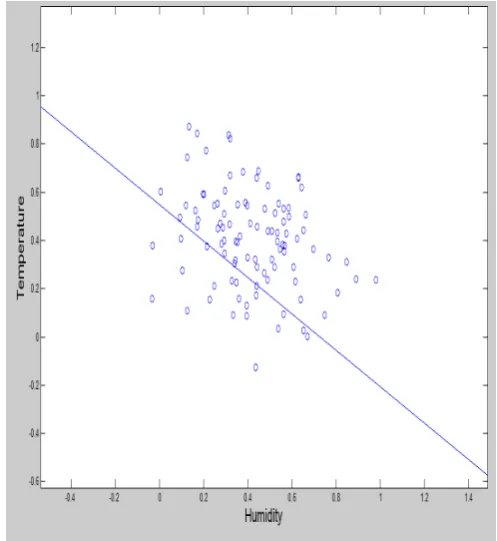
[image:5.595.307.559.95.374.2]The humidity and the temperature values are randomly taken by the system through sensors at intervals of 9 minutes (i.e. 160 data points in a day). The temperature range is 0 – 60° C and the data is normalized by dividing it with 60. The relative humidity values which are usually in percentage are taken in fractional form ranging from 0 to 1. The target or desired output corresponding to each input data set is then given by the user according to his comfort level leading to the generation of the corresponding user profile. In the following simulation we have taken the desired comfort level of the user as 25°C and 60% RH. If the relative humidity is below 60% and the temperature is below 25°C the fan output is 0 else the fan output is 1. In the plot in Figure 4, the x-axis indicates the humidity values whereas the y-axis indicates the Temperature values. The straight line shown in the plot is obtained by applying gradient descent algorithm to a single layer perceptron model with an optimum learning rate of 0.01 for 160 random values of temperature and humidity generated with mean 0.4 and variance 1. The final weights arrived were w1 = 6.8928 and w2 = 9.113 and the no. of epochs was 117. The characteristic line shows the threshold region above which the fan output is 1 and below which the fan output is 0.
Fig. 4: Classification line for Training data.
Figure 5 shown below is a plot of number of errors versus number of epochs and it indicates that the error cannot improve further after the variance of the error data goes below 2.
Fig. 5: Plot of number of errors v/s number of epochs.
[image:5.595.302.551.454.725.2]The accuracy of the network was tested using a random input of 100 temperature and humidity values with a mean
Fig. 6: Classification line for test data.
[image:5.595.48.286.478.768.2]The results of both the training data set and the test data set are shown in the Table II.
VI. CONCLUSION
The paper illustrates the use of ANNs in smart home systems for reducing power consumption by studying the human behaviour pattern. A single perceptron network is trained for random values of temperature and humidity to switch the fan on or off depending upon the comfort level of the user hence, generating a user profile to be used in intelligent home systems. The paper also illustrates the use of Artificial Neural network in user authentication for home security.
ACKNOWLEDGMENT
Amit Badlani is very grateful to the numerous students who punched the smart homes data in to the computer for the simulation, together with Mrs. Sangeeta Sharma who helped with the questionnaires that aided in determining the human comfort levels. Dr. Surekha Bhanot would like to thank Prof. Hartwig Schulz,Prof. Sachin Patwardhan, Prof. Sirish Shah, Paul Gregg, Dan Hamermesh, Prof. Paul Heng, Prof. Richard Brereton and participants in the International conference at Chennai, India, for a number of comments and suggestions.
REFERENCES
[1] MIT n_House (2001), http:// architecture.mit.edu/house_n/web [2] A. Pentland. Smart rooms, Scientific American 274(4): 68-76, 1996. [3] M.C. Mozer, An intelligent environment must be adaptive. IEEE
Intelligent Systems and their Appications 14/2, pp. 11-13, 1999. [4] M. Burmester, J. Machate, J. Klein: “Access for all: HEPHAISTOS -
A Personal Home Assistant”, Proc. HCI‘97, Atlanta, 1997
[5] Ilse Bierhoff, Ad Van Berlo, et al., Smart home Environment in Towards an Inclusive Future: Impact and wider potential of information and communication technologies, 2010.
[6] Van Berlo A. and Fellbaum K., Smart Home Technology: Useful Applications for older people in Bühler, C. and H. Knops: Assistive Technology on the Threshold of the New Millennium, Assistive Technology Research Series Vol. 6, Amsterdam, 1999, pp. 508-512. [7] Rosslin John Robles and Tai-Hoon Kim, Applications, Systems and
Methods in Smart Home Technology: A Review, International Journal of Advanced Science and Technology, Vol. 15, 2010.
[8] James F. Allen, and George Ferguson, Actions and Events in Interval Temporal Logic, Technical Report 521, July 1994.
[9] Mörchen, F., A better tool than Allen's relations for expressing temporal knowledge in interval data, In Proceedings the Twelfth ACM SIGKDD International Conference on Knowledge Discovery and Data Mining, Philadelphia, PA, USA, 2006.
[10] Hanson S., Kegl K., Parsnip, A connectionist network that learns Natural Language grammar from exposure to Natural language sentences, Proceedings of the Ninth Annual Conference of the Cognitive Science Society, 106-119, 1987.
[11] Jeffrey L. Elman, Finding Structure in Time, Cognitive Science, Volume 14, Issue 2, p. 179–211, 1990.
[12] Dey A. K, Providing Architectural Support for Building Context-Aware Applications, Ph.D. thesis, College of Computing, Georgia Institute of Technology, 2000.
[13] R. Morris, K. Thompson, Password security: A Case History, Communications of the ACM, 594–7, 1979.
[14] Stuart J. Russel and Peter Norvig, Artificial Intelligence: A Modern Approach, Prentice Hall, Englewood Cliffs, New Jersey, Pg No. 523-625.
[15] Selker T. and Burleson W., Context-aware design and interaction in computer systems, IBM systems Journal, 39 (3&4), 2000.
[16] Howard Demuth, Mark Beale and Martin Hagen, Neural Network Toolbox 6 User’s Guide, The MathWorks Inc., 1992 - 2000.
[17] "What is a Smart Home"
http://www.smarthomeusa.com/info/smarthome/. TABLE II
RESULT COMPARISON FOR TRAINING DATA AND TEST DATA
Results Training data set Test data set
Data size 160 100
No. of False Positives
9 10
No. of False
negatives 3 2
Total errors 12 12
Specificity 70.96 % 65.52 %
Sensitivity 97.47 % 96.97 %