University of Warwick institutional repository: http://go.warwick.ac.uk/wrap
This paper is made available online in accordance with
publisher policies. Please scroll down to view the document
itself. Please refer to the repository record for this item and our
policy information available from the repository home page for
further information.
To see the final version of this paper please visit the publisher’s website.
Access to the published version may require a subscription.
Author(s): Sarah Stewart-Brown and Anita Schrader McMillan
Article Title: HOME AND COMMUNITY BASED PARENTING
SUPPORT PROGRAMMES AND INTERVENTIONS
Year of publication: 2010
PROMOTING THE MENTAL HEALTH OF CHILDREN AND PARENTS EVIDENCE OUTCOMES
HOME AND COMMUNITY BASED
PARENTING SUPPORT PROGRAMMES
AND INTERVENTIONS
Report of Workpackage 2 of the
DATAPREV PROJECT
Professor Sarah Stewart-Brown
Warwick Medical School, University of Warwick
Dr Anita Schrader McMillan
Warwick Medical School, University of Warwick
ACKNOWLEDGEMENTS
This project was funded by the European Community under its 6th Framework Research ProgrammeSP5A-CT-2007-044145 and undertake in collaboration with
Dr Eva Jane-Llopis, Radboud University, Nijmegen, Netherlands Professor Katherine Weare, University of Southampton, UK
Professor Jan Czeslaw Czabala, Institute of Psychiatry and Neurology, Warsaw, Poland Professor Kristian Wahlbeck, University of Helsinki, Finland
Mr David McDaid, London School of Economics and Political Science, UK Professor Heinz Katschnig, Ludwig Boltzmann Gessellschaft Vienna
We would like to thank Professor Jane Barlow for her contribution to background early work on this project, Yaser Adi for conducting initial search strategies, Sue Kirkpatrick and Caroline Connelly for assistance with the tables and data extraction and Chloe Elston for secretarial support throughout.
For further information about the Unit’s research programme contact:
Professor Sarah Stewart-Brown Warwick Medical School
University of Warwick, Gibbet Hill, Coventry CV4 7AL Tel: 00 44 2476 574879
Fax: 00 44 2476 574510
Email: [email protected]
CONTENTS
Page
Acknowledgements 1
Contents 2
1. Executive Summary 3
2. Background 8
2.1 The impact of parenting 8
2.2 Patterns of parenting 9
2.4 Societal attitudes to parents and children 9
2.5 Risk and protective factors 10
2.6 Parenting interventions 11
2.7 Policy context 12
3. Aims and Objectives 13
4. Methodology 13
5. Results 16
5.1 Perinatal programmes 17
5.2 Parenting support in infancy and early years 28 5.3 Parenting programmes with a focus on prevention of child
behavioural problems 39
5.4 Parenting support for families in high risk groups: parents with severe mental health problems, substance abuse or who
have abused children 47
6. Discussion 53
6.1 Methods 53
6.2 Findings 56
6.3 Recommended programmes 63
References 65
Appendix Table 1 Contents of reviews 74
Table 2 Critical appraisal 90
1. EXECUTIVE SUMMARY
1.1 BACKGROUND
The last decade has witnessed an increasing interest in the promotion of mental health and wellbeing because of its importance for health and social functioning at the individual level and for the social and economic wellbeing of societies. Recent research from a range of disciplines has highlighted the importance of the quality of the parent-child relationships and parenting on children‟s emotional and social development, and on adult mental health and wellbeing.
Intervention studies involving children of all age groups have shown that if parenting can be influenced for the better outcomes can be changed.9
1.2 AIMS AND OBJECTIVES
The DataPrev project was funded by the 6th Framework of the European Community Research Programme under Policy-Orientated Research with the aim of establishing a database of evidence-based programmes in Europe that promote mental health and wellbeing and prevent mental illness throughout the life course.
This is the report of the Workpackage 2 describing the international evidence base on programmes to support parenting, including home and community based programmes.
Objectives
To undertake a systematic review of reviews of intervention studies evaluating the effectiveness of programmes to support parenting.
From this literature to
1.3. METHODOLOGY
The first stage of this study comprised a search of a range of electronic databases to identify systematic reviews of interventions that met the agreed inclusion criteria. A range of key electronic health, social science, and education databases were searched for the period 1990 to date using a broad set of search terms.
Abstracts and full papers were examined for eligibility by two reviewers. Disagreements were resolved by consultation with a third reviewer.
A range of data was extracted from each of the included reviews using a standard data extraction form.
All included systematic reviews were critically appraised using a standardised checklist.
Data from each of the included reviews was synthesised using a narrative summary aimed at the identification of common themes across all of the included reviews.
1.4 Inclusion criteria
To be included, systematic reviews needed to meet the following criteria either partially or fully:-
(i) Interventions – interventions to improve parenting in general population or high risk samples. Reviews of interventions to treat established child mental disorders were excluded.
(ii) Population – delivered to parents alone or parents and children. Interventions directed at the children alone (i.e. not focused on supporting parenting) were excluded.
(iii) Settings – Interventions delivered in all settings were included with the exception of programmes delivered through schools.
(v) Study designs– all systematic reviews were included, covering qualitative and quantitative
outcomes and narrative and meta-analytic analyses. Both narrative and quantitative analyses were included.
(vi) Years – Studies were included from 1990 - 2008.
1.5 RESULTS
Over 5,000 studies were identified. Of these, 51 systematic reviews (52 papers) met the inclusion criteria. The aims and contents of included reviews overlapped to a considerable extent and could not be simply grouped. A range of different evidence programmes were identified together with some principles relating to successful provision.
Principles relating to successful provision
Universal approaches are important because:
o improvements in „normal‟ parenting are necessary to promote mental wellbeing o they minimise stigma which influences uptake of targeted interventions
o they enable identification of high risk families
Targeted approaches are necessary to work on more intractable problems particularly: o Teenage parenting
o Abusive parenting
o Parenting in families with mental illness and drug and alcohol misuse
A combination of both universal and targeted approaches to support for parenting is likely to be most effective:-
Particular attention needs to be paid to recruitment and retention of high risk groups.
Parenting interventions need to adopt key principles, these are: o Positive framework
Staff development is critical to develop:
o Skills – non judgemental, strengths based, empathetic, respectful, genuine, group
work skills, attention to process o Realistic expectations
Effective interventions which can be recommended for use in Europe:-
Low cost universal:
Low cost skin to skin contact at birth Kangaroo care
Abdominal massage in pregnancy Media based parenting programmes
Slightly higher cost universal:
Developmental guidance Anticipatory guidance Infant massage
Targeted programmes for high risk groups:
Psychosocial interventions offering emotional and practical support for the prevention of
postnatal depression
Treatment for postnatal depression using cognitive behavioural approaches, interpersonal
therapy or non directive counselling
Long term home visiting multicomponent programmes starting antenatally offering both
support for parenting and support for parents particularly for teenage parents
Short sensitivity focused interventions including parent-infant interaction guidance training
for high risk infants
Manualised group based and one to one parenting programmes addressing behaviour
management and parent child relationships
Ineffective programmes which are not recommended:
Psychological debriefing after birth
Universal approaches to prevention of postnatal depression
Promising programmes which need more research:
In families experiencing attachment difficulties and where there is a risk of abuse: parent infant psychotherapy and infant led psychotherapy (for example the Watch Wait and Wonder programme)
In families in which physical abuse has occurred:-.Intensive, multicomponent, multisystemic family support approaches and cognitive behavioural based parenting programmes
In families in which emotional abuse has occurred:- parent-infant psychotherapy; and where anger management is also an issue.:- group based behavioural parent training with additional anger management components
In families where sexual abuse has occurred :- cognitive behavioural therapy for the non-abusing parents; abused children can also benefit .
In families where parents abuse drugs: multicomponent programmes targeting affect regulation, parental mood and views of self as a parent, drug use and parenting skills delivered on a one to one basis
Other areas warranting research:
Testing in Europe of evidence-based programmes identified in this review, which do not as yet have a presence in Europe
In families where parents suffer mental health problems: there is an urgent world - wide need for the development and evaluation of effective programmes for this very high risk group.
1.6 CONCLUSIONS
2. BACKGROUND
2.1 THE IMPACT OF PARENTING
Parents are critical for child development; without their care or the care of substitute parents, babies and children do not survive. Parents provide for their children‟s basic needs for food and
protection, care for them when sick, teach them language and help them master the basic skills of living in the community and society in which they were born. It is however in the more subtle aspects of parenting – in the quality of parent child relationships, parental sensitivity and attunement, in boundary setting and discipline practices that the roots of mental health lie.
Parenting of infants
Recent research from a range of disciplines (including neurodevelopment, developmental psychology and genetics) has pointed to the particular importance of the first few years of life for future mental, social and emotional development.1 The quality of the parent-infant relationship is one of the factors in determining outcomes. Excessive levels of stress from sub-optimal parenting during this time can seriously disrupt the child‟s developing nervous system and stress hormone regulatory systems, damaging the child‟s developing brain architecture and chemistry.2 3
These effects influence the child‟s neuro-endocrine response to threat resulting amongst other things in
insecure attachment patterns, problems with peer and intimate relationships,4 and abnormalities of cardiovascular and immune functioning.56 78
Parenting of older children and adolescents
Whilst the very early years are particularly important, other studies have documented the influence of parenting in older children and adolescents. These studies have focused particularly on behaviour problems and the emergence of conduct disorder, delinquency and violence. Older children and adolescents have a wider circle of relationships than infants, and teachers, peers and the wider community also influence outcomes, but many studies have shown that parenting remains an important determinant of outcomes at these ages.
Nature and nurture
Nature plays a part, alongside parental nurture, in determining the sort of adults that children grow up to be, and there has been much debate over the relative importance of the two. Over the last half century a large body of research has emerged which has shifted the balance of belief in terms of nature and nurture, illustrating just how much parents influence their children‟s development.
The influence of different approaches to parenting and the quality of parent-child relationships is now known to extend over the life course, and parenting is coming to be recognised as one of the most important remediable determinants of future health, particularly mental health.5,10,11 It is also strongly predictive of a wide range of detrimental health and social outcomes including antisocial behaviour, delinquency, violence, and criminality12; educational success and school dropout;13 a range of health related behaviours including sexual promiscuity14 drug and alcohol abuse,15 smoking16 and unhealthy eating;17 physical health in general and specific common diseases.7,18,19 These aspects of parental nurture also appear to influence nature. Epigenetic studies have demonstrated that the quality of parenting influences the phenotypic expression of individual genes which carry risk for mental disorders.20 21 22 Parenting is therefore hugely important to children parents and society.
2.2 PATTERNS OF PARENTING
The aspects of parenting which have been researched in this context include maternal sensitivity and attunement in infancy and patterns of „attachment‟ of infants to their carer. They also include
the quality of parent-child relationships (e.g. affection, rejection, hostility, respect, empathy, communication) throughout childhood and the adolescent years and aspects of behaviour management (boundary setting, positive discipline, and consistency). Suboptimal parenting is relatively common. Between 30% and 50% of infants are deemed not to be securely attached 23 and a large number of children are exposed to some degree of suboptimal parenting in mid- childhood.18 Father-child relationships have been less studied than mother-child relationships, but all the studies that have been undertaken point to a potential influence on child development as great as mothers.126 127 Abusive and neglectful parent-child relationships represent the most damaging end of the spectrum and have the most profound effects on future outcomes.4 137
2.3 SOCIETAL ATTITUDES TO PARENTS AND CHILDREN
and some allow this practice in all settings. Whilst many parents still hold strong views about the importance of physical punishment as the ultimate sanction, opinion polls in countries like the UK, where smacking is still legal, show that most parents who used physical punishment wish they did not. A wide range of studies has shown positive discipline to be a more effective discipline strategy.
Discipline is only one aspect of parenting and it is harder to create laws that support positive emotional interaction between parents and children and this may be more important in terms of outcome. Here societal attitudes are important and European countries vary greatly in the extent to which children and parents are „welcomed‟ in public places. The media and television have an
important role to play both in drama and in documentary – portraying and implicitly approving patterns of parenting, or illustrating and discussing problem parenting and its impact.
Another way in which societies support parenting is in respecting and making provision for the role. Establishing a relationship with a baby and learning the skills of parenting takes time. Parents who have to return to work very soon after the birth of their child are compromised. Paid leave with rights to return to work is now offered to mothers in many European countries and to fathers in some. In many countries mothers have the right to take maternity leave, paid or unpaid, and return to the same job after a defined period of maternity leave. Variation exists in the provision of day care for babies and young children and the extent to which social and fiscal policy supports such care. Several European countries now promote day care for very young babies as a way of getting women back into the workplace and off welfare. Long-term follow up studies of infants who have been in day care suggest that small improvements in cognitive functioning may be overshadowed by decreases in emotional and social functioning and increases in stress levels which are likely to increase the risk of mental health problems. 24 2526
2.4 RISK AND PROTECTIVE FACTORS
childhood poverty are important for a wide range of child outcomes and create an important backdrop for policies to promote parenting; however the evidence suggests that antipoverty strategies alone will not of themselves improve parenting.30
Poor parental mental health is another critically important risk factor for problem parenting.128 129 This has been researched in the context of the influence of post-natal depression on parenting and child outcomes and also in the context of the impact of parental mental health on older children. Cycles of disadvantage are important here because parent‟s mental health is
determined in part by the parenting they received as children. Because of the way in which parenting influences future relationships and ways of interacting with others in and outside the family, many aspects of parenting are passed down from one generation to another. Parents with mental health problems care deeply about their children but are often ill-equipped with the skills to parent in a positive way. Drug and alcohol misuse are also potent interrupters of parenting and are strongly related to parental mental health problems. Interventions for parents with mental health problems include those that improve mental health and also those that aim to improve parenting.
The factors that can protect children from the deleterious effects of suboptimal parenting have also been researched. These include educational achievement and perhaps most significantly a positive relationship with at least one adult during childhood.31
2.5 PARENTING INTERVENTIONS
Parenting interventions have been developed in a number of contexts. Many programmes have been developed in the context of the prevention of antisocial behaviour, criminality and violence. These programmes aim to treat or prevent the emergence of conduct disorder and are applicable for children aged 2 -12 years. They cover behaviour management principles with or without a range of other topics. More recently programmes are emerging to improve the quality of parent-infant relationships in the first year of life. Programmes for parents of adolescents tend to focus on prevention of problem lifestyles – drug and alcohol misuse, promiscuous sex. These programmes
can cover topics like parent-teenager communication and problem solving. Many programmes incorporate a range of topics and some also address issues unrelated to parenting.
not to say that deeply ingrained patterns of parenting are easy to change and certain factors are known to make a difference to the effectiveness of these programmes. Parents who feel supported and valued find change easier than those who do not. Programmes that aim to support parents are important as a backdrop to interventions to influence parenting; they include volunteer programmes like home start where parents receive one to one support from a peer, and toddler groups which increase social networks and reduce isolation. They need however to be distinguished from the programmes which aim to change parenting which are the subject of this report.
2.6 POLICY CONTEXT
Over the course of the last decade, governments throughout Europe have been persuaded of the importance of parenting in the prevention of crime and antisocial behaviour and have started to implement preventive policies to improve parenting in high risk communities. They have also discovered research relating to importance of the early years in terms of educational and social outcomes including several studies pointing to the cost effectiveness of early intervention.1 130 Support for parenting is one key component of early intervention.
3. AIMS AND OBJECTIVES
In this context, the DataPrev project was funded by the 6th Framework of the European Community Research Programme under Policy-Orientated Research to establish a database of evidence-based European programmes to promote mental health.
This is the report of the Workpackage 2 describing the international evidence base on programmes to support parenting, including home and community based programmes. .
Objectives
To undertake a systematic review of reviews of intervention studies evaluating the effectiveness of programmes to support parenting.
From this literature to
a) identify successful programmes which have been implemented and evaluated in Europe and b) successful programmes which could be implemented in Europe in the future.
4. METHODOLOGY
This study involved a review of a range of electronic databases to identify systematic reviews of interventions that met the agreed inclusion criteria. Reviews of reviews were excluded.
4.1 DATABASES SEARCHED
4.2 INCLUSION CRITERIA
To be included reviews needed to meet the following criteria either partially or fully:-
(i) Interventions – interventions to improve parenting in general population or high risk samples. Reviews of interventions to treat established child mental disorders were excluded.
(ii) Population – delivered to parents alone or parents and children. Interventions directed at the
children alone (i.e. not focused on supporting parenting) were excluded.
(iii) Settings: Interventions delivered in all settings were included with the exception of programmes delivered through schools. These are covered in the review of reviews undertaken for Workpackage 3.
(iv) Outcomes – including outcomes measuring parenting or mental health of children or parents e.g.:-
Parenting:- sensitivity; parent-child interaction/relationship quality; behaviour management; abuse
Infant attachment behaviours
Positive and negative aspects of child mental health including behaviour problems Parental mental health
(v) Study designs – all systematic reviews were included. Systematic reviews are those in which
the authors define an explicit replicable search strategy and predetermined inclusion and exclusion criteria. Both narrative and quantitative analyses were included. The quality of included reviews was assessed (see below).
(vi) Years – Studies were included from 1990 2008.
Studies were selected for inclusion by two reviewers based on abstracts and full papers.
4.3 SEARCH TERMS
A broad set of terms were used to increase the sensitivity of the search:
Terms to identify population: parent$ or father$ or mother$ or caregiver$ or care-giver and child$ or infan$ or toddler$ or neonatal$ or neo-natal$ or perinatal or peri-natal or post-natal or postnatal or pre-natal or prenatal or under fives or under 5 or pregnan$
Terms to identify intervention: intervention or program$ or service or prevention related to parenting or parent -child relations or attachment or abuse
Terms to identify outcome: Mental Health/ or exp Child Abuse/ or (mental wellbeing or mental well being or mental well-being or positive mental health or psychological well being or psychological well-being or psychological wellbeing or emotional competence or flourishing or attachment or attunement or neglect$ or conduct disorder* or infant sleep* or infant crying).
4.4 HAND SEARCHING
Two journals: Prevention Science and Parenting Science and Practice were hand searched from 2006-2008. No relevant systematic reviews were identified in either journal.
.
4.5 CRITICAL APPRAISAL
All included systematic reviews were critically appraised using a standardised checklist (CASP, 2002). This process enabled us to assess the reliability of the results produced by each of the included reviews and attach greater significance to the findings of the most rigorous reviews.
4.6 DATA EXTRACTION
A range of data was extracted from each of the included reviews using a standard data extraction form. It included the following categories:
Content: Focus of review, aims of the intervention, who delivered, intervention frequency and duration, population, setting and timing.
Results: Number of included studies, relevant outcomes, findings and authors conclusions.
4.7 ANALYSIS
5. RESULTS
Over 5,000 studies were identified. Of these, 51 systematic reviews met the inclusion criteria. Of these, one82 was an update of a systematic review undertaken several years earlier.131 One additional review is reported in two papers which focus on different outcomes. 8479
Table 1 Appendix 1 describes the contents of each review. Reviews are presented by alphabetical order of first author. The focus of the review and the aims frequency, duration, deliverer and timing of the interventions covered in the review are shown together with the population and settings in which studies were carried out.
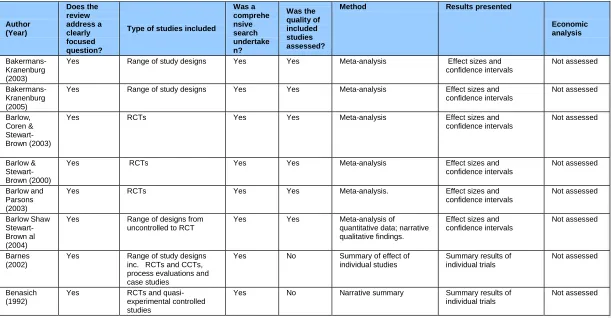
The results of the critical appraisal of all included systematic reviews are provided in Appendix 1 - Table 2. Twenty one out of 51 reviews were restricted to RCTs; the remainder include non-randomised controlled and non-controlled time series analysis. Twenty five of the 51 reviews reported a meta-analysis of results. Six reviews did not undertake a critical appraisal of included studies but all undertook a systematic search and investigated a clearly focused question. Two reviews attempted a health economic appraisal but findings were limited due to lack of data. One review covered qualitative studies only.
Table 3 reports the results of reviews both narrative and quantitative. Where quantitative results are given and an overall magnitude of the effect reported, these are described in the text. The latter are variously reported depending on the nature of the data extracted: most commonly as effect sizes (ES) (also called weighted mean difference); mean differences (MD); relative risks (RRs) or odds rations (OR). All effects reported in the text are statistically significant unless otherwise stated; where 95% confidence intervals are reported in the reviews, these are reported in the text.
and attunement and/or child behaviour. Other reviews focused on specific populations (eg teen parents or children of specific ages). Some reviews focused on high risk approaches, others reviewed universal interventions and yet others covered both. Many reviews included interventions and outcomes unrelated to parenting and mental health. We report here only the results relating to parenting and mental health outcomes in either the child or the parent. Whilst all the reviews present results meeting our inclusions criteria, because of the overlap between them, they do not lend themselves to description in neat categories. We present the findings under the following broad headings selected for ease of understanding of this complex material:-.
(I) Perinatal programmes
Including antenatal parenting programmes, and perinatal maternal mental health programmes.
(ii) Parenting support programmes in infancy and early years
Parenting programmes with a focus on maternal sensitivity and attunement,
Including:- video interaction guidance, parent-infant psychotherapy; holistic home visiting programmes and early intervention, to improving teenage parenting and to prevent abuse.
(iii) Formal parenting programmes with a focus on children’s behaviour
Including group-based one to one and media based parenting programmes.
(iv) Parenting support in the highest risk groups
Covers programmes for families where parents have a mental illness, abuse drugs and alcohol or have abused their children.
Under each heading we draw on the results of all reviews with relevant contents.
5.1 PERINATAL PROGRAMMES
(i) Antenatal education aiming to improve parenting
Gagnon (2007)32 evaluated the effectiveness of individual and/or group-based „traditional‟ antenatal education for childbirth on a variety of outcomes. Most of the antenatal education programmes included in this review focused on pregnancy, labour and physical care of the newborn, but some programmes included sessions to enhance parent-infant relations and attachment security. Of the nine included studies, two very small studies (Carter-Jessop 1981,33 Davis 198734) aimed to enhance „intrauterine‟ attachment by increasing mothers‟ awareness of foetal activity and promoting abdominal massage to develop sensitivity to the foetus. Two out of four attachment based outcomes in these studies showed positive results 2-4 days post delivery.
Gagnon (2007) also covered a trial of the effectiveness of a prenatal parenting group with low socioeconomic, young, first-time fathers (Pfannenstiel 199135; Pfannestiel 199536). Of the 67 men who were recruited by their partners, half were randomly assigned to participate in an intervention programme designed to acquaint fathers-to-be with information, insights, and clinically appropriate techniques in responsive care for infants. Intervention group fathers received two intensive 11 /2-hour sessions emphasising the nature and capabilities of the preborn/newborn and sensitive responsiveness to preborn/newborn cues and to partner cues. Postnatally, fathers were videotaped with their infants during two feeding interactions. Intervention fathers were rated as being significantly more sensitive during feeding interactions with their newborn infants on one out of two measures and marginally significant on a second. These differences were, however, not present at the one-month follow-up.
Controlled trials of antenatal preparation for parenthood were covered in the searches of a wide ranging review of parenting interventions reported below (Barnes & Freude-Lagevardi, 2003).37 This review reported on a non-randomised controlled trial of the effectiveness of PIPPIN (Parents and Infants in Partnership) (Parr 1998).38 PIPPIN is an attachment-based parenting programme involving both fathers and mothers in low risk families, beginning in the antenatal period and continuing beyond. The findings suggested that participation in the programme led to a significant increase in psychological well-being, parental confidence, and satisfaction with both couple and parent-infant relationship in the postnatal period.
on the Pfannenstiel (199135 study) and as well as second study (Dachman, 1986)44 of a prenatal intervention for fathers. The latter involved young men of low socio-economic background in individual role modelling of infant care and stimulation activities, using a newborn size doll. This study produced evidence of an increase of father‟s care and capacity to stimulate the infant,
although it had little effect on verbal interaction. The study was conducted on a very small sample.
Magill-Evans (2006) also covered three studies of demonstration of infant capabilities in hospital (Beal 198945; Culp 198946; Belsky 198547), two of infant massage (Scholz 199240, Cullen 200048) and one of kangaroo care (Feldman 200249), all discussed below.
(ii) Kangaroo Care and Skin To Skin Contact
Kangaroo care involves close contact care of the baby either in arms, pouch or sling on an ongoing basis. Skin to skin contact describes the placing of the naked newborn on the mother‟s
body immediately or within a short time after delivery. These interventions are important because they can be introduced into health services at very low or no cost.
Most studies of kangaroo care focus on preterm infants in which kangaroo care has been practiced in neonatal units. In low income countries this has been used together with early discharge from hospital as an alternative to hospital care. Most studies of skin to skin care are with healthy newborns.
Kangaroo care for preterm infants
Two reviews of controlled trials of kangaroo care with preterm infants (Dodd 2004121, Conde-Agudelo 2003)51 presented different findings relating to its impact on parental attachment. Dodd (2004), which covered both randomised control and non-randomised control studies, focused on infant outcomes and found increased attachment in two out of the three studies that measured this, and better regulated infant behaviour in eight out of the nine studies. Many studies assessed „physiologic safety‟ (heart rate, respiratory rate, oxygen saturation levels, and body temperature)
which is indicative of infant stress levels, with overall positive results.
Maternal attachment behaviours did not differ between control and intervention groups. Maternal confidence was increased in the kangaroo care group compared to control but there was no difference in mothers‟ feelings of worry and stress.
One additional RCT (Feldman 2002)49 was included in the review of interventions for fathers (Magill-Evans 2006). This investigated outcomes for fathers in a programme in which both mothers and fathers participated in kangaroo care for their preterm infants. Both mothers and fathers who gave kangaroo care had better scores on emotional and verbal responsiveness and sensitivity at 3 months post partum.
Kangaroo care for normal infants
One relevant RCT (Anisfeld 1990)50 was identified in a review evaluating the effectiveness of a wide range of attachment-promoting interventions (Bakermans-Kranenburg et al 2003).52 This trial, which evaluated kangaroo care for normal infants in a low socio-economic status sample, showed a moderate effect on maternal sensitivity to infant vocalisations (ES 0.53) and infants appeared more securely attached at 13 months (ES 0.62).
Skin to skin contact
One review (Moore 2009)53 identified 30 studies of skin to skin contact in the immediate post partum period. 26 of these studies related to healthy newborn infants, four to preterm infants (of 34 to 37 weeks gestational age). A wide range of outcomes were measured, most in only one or two trials. Of the relevant outcomes, maternal attachment behaviours during feeding (MD 0.52; [0.31,0.72]), mothers‟ affectionate touch at I year (MD 0.85; [0.09,1.61]); maternal scores on the
neonatal perception inventory (MD 1.90; [0.15, 3.65]) immediately post birth (but not at one month) and mothers behaviour during feeding, post birth (MD 28.40; [9.25,47.55]) and at one month favoured the intervention group. Mothers perception of connection to the infant was marginally positive (MD 0.08 [-00.1,0.17]).
(iii) Demonstration of infant capabilities
One systematic review was identified that assessed of the effect of the NBAS either by training parents to administer the scale or having them observe an examiner administering it (Das Eiden, 1996).54 This review included 13 studies with a total of 668 families. Eight studies involved mothers only, one study involved fathers only, and four included both fathers and mothers. The meta-analysis found a small to moderate impact on parenting as measured by observations of parent-child interactions and self report parenting measures (ES 0.42). Two of the trials included in this review (Beal, 198945; Belsky 198647) were also reported in the review of interventions that focused on fathers (Magill-Evans, 200639). One of these trials (Beal, 1989) was positive, the other, which had the strongest methodology, showed no difference between groups (Belsky 1985).
A third trial of NBAS (Culp 1989)46 not reported in Das Eiden, was included in a review of interventions with fathers by Magill Evans (2006). This reported some positive change, favouring the intervention, on paternal anxiety and realistic expectations. No significant change was found for the anxiety of mothers. Mothers, but not fathers, in the intervention group were more aware of infant‟s attempt to shut out stimulation (eg noise and light).
Further research with NBAS-based interventions is needed to identify the role of moderator variables including the frequency with which the NBAS is administered, and who administers it. For example, several researchers have discussed the possibility that parental administration of NBAS may be more effective than passive observation and explanation, and similarly, there has been little comparison to date of the effect of repeated administrations of the NBAS, in contrast to the more usual one-off application.
(iv) Anticipatory guidance
Anticipatory guidance is offered to parents (in the perinatal period and early infancy) primarily by paediatricians, in clinic settings and on a one to one basis. Its objective is to pre-empt common infant problems like excessive crying and poor sleep patterns, to promote sensitive parent-infant interaction and greater understanding of individual infants‟ temperament and needs. It has been particularly targeted at parents of infants that have „difficult temperaments‟.
assessment of the infant‟s temperament; three studies evaluated the effect of anticipatory guidance on promoting infant sleep; one study on promoting „time out‟ as an alternative to physical
disciplinary practices; three studies on the effect of anticipatory guidance on promoting more sensitive mother-infant interactions.
Temperament-based anticipatory guidance involves discussion by physicians, about the child's temperament in order to increase parents‟ understanding of the child‟s individuality and promote
better parent-child interaction. Twostudies examined the clinicaluse of temperament assessments in paediatric primary care.140 142 One paper reported (Cameron 1986) reported two trials of temperament-based anticipatory guidance materials designed to help parents understand and manage caregiving challenges from their infants.140 The first trial was a large scale RCT. Expected temperament profiles were developed for six clinical issues occurring between the ages of five and twelve months. Parents completed temperament questionnaires for infants when these were 4 months old. A computer programme selected two clinical issues per month for the expected temperament profile that most closely resembled the study infant. Parents received written anticipatory guidance by post about the clinical issues tailored to their infants‟
temperament profile. Temperament measured at four months demonstrated significant predictability. More than 80% of parents perceived the guidance materials useful in helping them understand clinical issues and 70% of the sample found anticipatory guidance advice helpful. In a second RCT of the same procedure (contained in the same paper), parents followed the same procedures and were assessed over a two-year period following the birth of healthy newborns. The intervention was of particular value to parents of challenging ("high-energy")infants.
A second cross sectional survey of temperament anticipatory guidance, (Little, 1983) 142 evaluated parents‟ perceptions of anticipatory guidance addressing infant temperament. This intervention
took place when infants were approximately 6 months old and evaluated at 8 months. 90% of respondents felt they had gained a better understanding of their children and 57% that discussion of infant temperament had changed their approach to parenting.
experimental group infants experienced significantly less night waking than controls.56 57 141 Efficacy was demonstrated for different behavioural approaches to mild sleep problems. However, behavioural modification techniques were not always effective for children with severe sleep problems.
One study (Sege 1997) was not related to the perinatal period. It evaluated the short-term effectiveness of anticipatory guidance on parents‟ use of discipline58 with children aged 15 – 24
months. The intervention group received discussion about the topic from providers, in conjunction with written materials that promoted the use of “time-out” in place of corporal punishment. There
were no significant differences between intervention and control groups in the use of non-violent disciplinary techniques (“time-out”) before or after the well-child visit. However, intervention parents who had not used “time-out” in the past were more likely to report using “time-out” for the
first time than parents in the control group.
Three studies examined the effect of anticipatory guidance on parent infant interaction.143 144 145 One CCT involved prenatal coaching for enhancing parent-infant interaction. Individualised training was provided for new parents on days 1, 2 and 7 of life designed to inform them of newborn capabilities and how to achieve optimal mother-infant interaction. Mothers receiving the intervention showed more effective vocal interactions and were more social during feeding interactions.143 A further RCT evaluated the effectiveness of providing adolescent mothers with a videotape modelling feeding interactions of mothers and infants. Experimental group mothers showed in alternating mealtime communication and attitudes among adolescent mothers. found that experimental group mothersreported more favourable interactions and communication with children.144 In a third study, also an RCT, the intervention group mothers of infants aged 0 – 6 received guidance aimed at enhancing mother-infant interaction, cooperation and play during. Experimental group mothers rated significantly higher on sensitivity, cooperation, and appropriateness of interaction and appropriateness of play.145
(v) Infant massage
Two reviews (Underdown et al 2006.59; Vickers et al 199960) evaluated the effectiveness of infant massage (delivered by the mother or another caretaker) in improving a range of outcomes for both mothers and infants Underdown (2006) covered 23 studies (of which one was a follow-up). 13 studies from China were analysed separately because of concerns about their rigour; all of these focused on infant weight gain. Four of the nine remaining RCTs measured outcomes relevant to this review and provide some, but not conclusive evidence of improved mother-infant interaction, infant sleep and relaxation, reduced crying and a beneficial impact on a number of hormones controlling stress. None of the studies measuring this showed a beneficial effect on infant temperament or attachment. Vickers (1999) review of massage for preterm infants found some evidence of benefit for outcomes for low birth weight babies. Massage interventions had a beneficial or marginally beneficial effect on infant stress behaviours (ES 0.70; [0.08,1.32]), the Bayley Mental Scale at 6 months (ES 12.0; [0.78,23.22]) and infant state regulation (ES 0.47; [0.31,1.25,]). Some of the relevant studies were very small and methodological quality was a concern to the reviewers becauseof selective reporting of outcomes.
Two moderate quality RCTs (Scholz 199240 , Cullen 2000 48) reported in Magill Evans (2006)39 and not reported in either of the above reviews evaluated the impact of teaching infant massage to fathers. Both found effects on father-infant interaction and fathers‟ increased involvement in child
care tasks.
(vi) Maternal Depression
Maternal depression during the perinatal period interrupts mother-infant communication and has a detrimental effect on infant and child mental health. Prevention and treatment of maternal depression during this period is therefore considered important for the promotion of infant mental health.
Prevention
The four reviews focusing on the prevention of post natal depression reviewed a wide variety of non-pharmacological interventions. Three came to the same conclusions. One study (Armstrong 1999)65 was included in allthree of these/reviews; in addition there were four studies common to Dennis (2004) and NICE (2007) and five studies common to Dennis (2004) and Shaw (2006).
Dennis (2004) identified 15 studies covering both psychosocial (antenatal and postnatal classes, professional and lay home visiting continuity of care and early post partum follow up) and psychological (debriefing and psychotherapy) interventions and found no overall impact. However, the seven trials that involved at-risk populations reported reduced risk of postnatal depression (RR 0.67; [0.51,0.89]). It was not possible to detect a difference in effect between single contact and multiple contact interventions; but one to one interventions were more effective than group based. There was no advantage to starting intervention in the antenatal period.
NICE (2007) included 16 studies evaluating the effect of preventive interventions among women at low risk for postnatal depression and found no evidence of effect. It also included 16 RCTs in populations with specific risk factors (childhood abuse and relationship difficulties or factors related to delivery) and, like Dennis (2004), showed benefit (RR 0.63 [0.44-0.91]).
The results of Shaw (2006) were consistent with the findings of these reviews. On the basis of 22 trials covering home visitation, hospital based provision of information and guidance, hospital based screening for relationship difficulties, postpartum debriefing, telephone based peer support from a trained mother and peer support groups she found that nurse home visits (MD -2.23, [-3.72,-0.74] and peer support (OR 6.23, [1.40,27.84] both produced a significant reduction in depression scores of women at high risk. Nurse home visiting and case conferencing also produced a significant improvement on the HOME scores (home environment as affected by parenting) of women at high risk.
be harmful. In contrast, women reported that an opportunity to talk with someone about the birth was helpful in facilitating recovery.
Identification and treatment of perinatal depression
Since maternal perinatal depression is often not disclosed by parents, identification is important. Women who have a history of depression or other forms of mental illness, are at high risk of experiencing reoccurrence of mental health problems in the perinatal period (Lewis 2001).137 Two main methods have been used in UK; one is the 10-item Edinburgh Postnatal Depression Scale (EPDS) and the other the use of 2 – 3 brief questions ((Whooley et al 1997135; Arroll et al 2005136).
One review (NICE 200666) included 7 included studies that measured the predictive value of antenatal screening and NICE 200761 discussed above included 8. Both reviews found that the sensitivity of the EPDS was high, but the specificity was low in general populations. NICE 2007 included two studies that measured the effectiveness of screening for depression using brief questions. Whooley et al (1997)135 and found that two questions („During the past month, have you often been bothered by feeling down, depressed or hopeless? During the past month, have you often been bothered by having little interest or pleasure in doing things?) had a sensitivity of 96% and a specificity of 57%, with a positive likelihood ratio of 2.2. Arroll et al (2005) developed a third question as an extension to the first two‟: „Is this something with which you would like help?‟ with three possible responses: „No‟, „Yes, but not today‟ and „Yes‟. The two Whooley questions plus the Arroll „help question‟ were validated against a standardised psychiatric interview. and the
addition of the help question resulted in a sensitivity of 96% (95% CI 86% to 99%) and an improved specificity of 89%, with a positive likelihood ratio for the help question of 9.1 (NICE 2007: 116). Current NICE guidelines for depression (NICE, 2007) recommend the „2-3 questions‟ although little specific evidence exists for their use in the perinatal period. In the UK
the use of 3 questions is favoured over the EPDS on the basis of patient choice.
psychotherapy with a parenting programme. Interpersonal psychotherapy was associated with a reduced risk of post partum depression.
Of the three reviews addressing the treatment of postnatal depression (NICE 200761, Gjerdingen, 200367, Poobalan, 200768, two addressed maternal mental health outcomes and one68 addressed mother-infant relationships and child outcomes.
NICE (2007) covered 15 studies, eight of which compared standard care or waiting-list control with psychodynamic psychotherapy, non-directive counselling and/or social support. Treatments with at least moderate quality evidence that showed an effect included cognitive behavioural therapy (CBT), interpersonal psychotherapy (IPT), psychodynamic psychotherapy and non-directive counselling. Very little evidence was found of differential effectiveness; the overall effect versus standard care was RR 0.57 [0.43-0.76]. Four studies included in this review compared psychosocial and psychological interventions with other treatments. Interpersonal therapy was found to be more effective than psychoeducation; six sessions of counselling more effective than one session; group exercise was more effective than social support alone; psychoeducation with women‟s partners more effective than psychoeducation with women alone; and individual
counselling more effective than group counselling. Three studies compared non-psychological interventions (infant massage, exercise, acupuncture). The evidence is not of high quality, but one study (Armstrong 2003)139 supports the view that group exercise may be of some benefit for depression. The evidence relating to infant massage and acupuncture was inconclusive.
Gjerdingen (2003), reviewing both pharmacological and non-pharmacological interventions and covering similar literature (5 out of 7 of the non-pharmacological interventions reviewed in this
review were also covered in the NICE 2007 review) came to similar conclusions.
Poobalan (2007) assessed the impact of treatments for postnatal depression on outcomes relating to parenting and children‟s cognitive development. Five of the eight studies identified
baby; neither showed a lasting effect on mother-infant interaction. One small trial examined three groups: mother-infant psychotherapy, interpersonal therapy and waiting list control; both intervention approaches improved mother-infant interaction in the short term. The results of studies looking at the effects of treatment of postnatal depression on mother-infant communication are therefore not conclusive. It contrast, the NICE (2007) review suggests, on the basis of six RCTs, that interventions designed to improve mother-infant interactions can alleviate or prevent depressive symptoms in the mother even if the intervention was not designed specifically to target this.
5.2 PARENTING SUPPORT IN INFANCY AND THE EARLY YEARS
The first few years of life are of particular importance in terms of the development of infant mental health, and problems with parenting and parental mental health during this period have been shown to have lasting effect. Many programmes have been developed to support parenting during this period. Most programmes have focused on high risk groups, but programmes have also been developed for low risk or population samples. Prominent amongst the former are teenage parents. An important mode of delivery of these programmes is one to one home visiting, but centre based and group based programmes have also been studied.
Home visiting is a delivery method which has been used for multiple purposes. Although many of these programmes aim to improve the aspects of parenting with which this review is concerned, many focus on other aspects of infant health either with or without parenting. Home visiting programmes have also been offered as part of multimodal programmes which include centre-based and group-centre-based initiatives. The contents and focus of reviews relevant to this section therefore overlap considerably and there is also some overlap with reviews covered above under the heading Perinatal Programmes. In this section, we have grouped reviews into those which focus on improving the key aspects of parenting in the first few years of life – enhancing sensitivity
Enhancing parental sensitivity and/or infant attachment
Maternal and paternal sensitivity and attunement to their infants have been much researched because of their influence on the development of the infant‟s social and emotional brain. A key way in which the latter has been measured in infants is attachment security – observation of the
response of the infant or young child to separation from the parent. Long-term studies have also examined the impact of these aspects of parenting on other aspects of emotional and social development and behaviour, the quality of peer relationships, and mental health more generally. Parental sensitivity is influenced by a number of factors relating to parental wellbeing. Maternal representation of the infant – the way the mother interprets infant behaviours and states - is one of
these. It is also influenced by parental mental illness. Mothers who are depressed show reduced levels of sensitivity and attunement. Social support, or lack of it, is a risk factor for maternal depression.
Several research groups have developed interventions to support the development of sensitivity, attunement and attachment and we identified three reviews which looked specifically at such interventions (Bakermans-Kranenburg, 200352 200569; Doughty, 200770) Some of the reviews described above (Dennis 2004; Das Eiden 1996, Underdown 2006), which focus on interventions like infant massage, the NBAS and treatment of postnatal depression have included studies with measures of parental sensitivity which are relevant to this section. One further large narrative review (Barnes 2003)36 covered a very wide range of interventions to enhance the mental health of children (0-4 years) and families including many interventions relating to attachment security.
The earliest focused review contained 81 studies, involving 7,636 families and 88 outcomes (Bakermans-Kranenburg, 2003). A wide range of Interventions were included and coded according to their focus as follows:- interventions that aimed to enhance sensitivity; interventions that aimed to enhance sensitivity and maternal representations; and interventions to increase social support; or any combination of the three. For example, interaction guidance with or without video was used to enhance parental sensitivity; psychotherapy was used to transform maternal representations; and in social support interventions, experienced mothers befriended and offered practical help to highly anxious mothers. Several interventions combined different strategies.
Interventions to increase maternal sensitivity
Interventions with a clear behaviourally orientated focus on enhancing maternal sensitivity were found to be more effective in increasing sensitivity than those with other orientations (i.e. that focused on support and/or changing maternal representations).
Short-term interventions (with fewer than five sessions) were found to be as effective as those with 5 – 16 sessions and more effective than interventions of more than 16 sessions. This is likely
to be because interventions to enhance sensitivity tended to be short relative to other interventions.
The effects were the same in groups with and without specific risk factors (eg teenage parents) and interventions conducted at home were as effective as those conducted elsewhere (e.g. community mental heath centres).
The three studies involving fathers as well as mothers (one of which, focusing on infant massage was also included in Magill Evans 2006, above), suggested increased impact from father involvement.
Effect of interventions on infant attachment
29 of the studies in Bakermans-Kranenburg (2003)52 used infant attachment security as the primary outcome and, comparing all insecurely attached infants with securely attached, suggested a small positive impact on attachment security (ES 0.19). Among the 23 randomised studies, interventions focusing on maternal/parental sensitivity were effective whereas those including support and maternal representation focus were not. As found in the analyses using maternal sensitivity as an outcome, interventions were most effective if they started after the age of 6 months. Meta-analysis of 15 randomised studies of families with multiple problems showed that the effect size was comparable to that for families with fewer problems. The authors suggested that infant attachment may be less sensitive to intervention in the short term, and that there may be a „sleeper‟ effect. It may also be that methods of measuring attachment security are less sensitive to change than those used to measure maternal sensitivity.
Overall they found no intervention impact and several interventions with a harmful effect. However, sensitivity focused interventions were effective (ES 0.24). As in the above analyses these were the interventions that started after 6 months of age. Interventions with high risk infants (irritable or preterm) were more likely to be successful than those focusing on high risk mothers. It is likely that low risk mothers are able to respond to these interventions more readily than high risk.
Positive trusting parent child relations in general
The third review (Doughty, 2007)70 searched for studies of a wide range of interventions that aimed to promote the development of positive trusting parent child relationships, including attachment security, in children 0-4yrs. The authors searched for studies of one to one and group-based programmes, parent training and education programmes, relationship group-based programmes, home visiting and centre-based programmes.
The 18 primary studies they identified included 4 that were part of the meta-analysis in Kranenburg (2003) and 5 that were included in the meta-analysis in Bakermans-Kranenburg (2005).
Reporting of interventions is sparse in the Doughty (2007) review, but it covers several promising psychotherapeutic interventions which are not covered by other reviews. Of the four trials of dyadic psychotherapy, one showed that both psycho-education and parent-infant psychotherapy were effective in improving mother-infant interaction (Cicchetti et al 200671)and that parent-infant psychotherapy resulted in the intervention infants attaining rates of secure attachment that were comparable with those of children in the non-depressed control group (Cicchetti et al 199972). A second less rigorous study (with no control group and a high rate of attrition from the intervention) involving women at high risk of child maltreatment and neglect, found that a combination of mother-infant psychotherapy, psychoeducation and developmental guidance was effective, at 3-year follow-up in improving maternal sensitivity, responsiveness and reciprocity (Osofsky et al 200773).
on therapist caseload and available time for treatment This study was also included in the Bakermans-Kranenburg (2003, 2005) reviews but neither of attempted to isolate the impact of parent-infant psychotherapy. Both Watch Wait and Wonder and mother-infant psychotherapy were successful in decreasing parenting stress, and reducing maternal intrusiveness and mother-infant conflict. The Watch Weight and Wonder group showed a greater shift toward a more organised or secure attachment relationship and a greater improvement in cognitive development and emotion regulation than infants in the mother-infant psychotherapy group. Mothers in the Watch Weight and Wonder group reported a larger increase in parenting satisfaction and competence and decrease in depression compared to mothers receiving mother-infant psychotherapy. These differences had disappeared by the 6-month follow-up.
The fourth relevant RCT evaluated the effectiveness of parent-child psychotherapy with children aged 3 – 5 years who were exposed to marital violence (Toth et al 2006).75 Seventy-five multiethnic preschool-age child-mother dyads from diverse socioeconomic backgrounds were randomly assigned to (1) dyadic psychotherapy or (2) case management plus community referral for individual treatment. Children were 3 to 5 years old. Results at 6 months indicated a significant symptom reduction; dyadic interactions became more harmonious (mothers became less intrusive and infants more cooperative). Maternal self-esteem grew significantly and negative affect decreased.
some involved a combination,. Some targeted mothers alone, some infants alone; some families and some mother-infant dyads.
With regard to effectiveness, Barnes‟ conclusions are largely compatible with the three reviews
described above. Perhaps most importantly, Barnes (2003) concluded that no single approach to mental health promotion is effective with all populations. The theoretical approach may be less important than the quality of the relationship established with the practitioner. However interventions focusing on the positive – enhancing positive mother-infant interaction and enjoyment and taking a strengths-based, empowering approach were more effective than psychodynamic programmes focusing on problems in the relationship and difficult past life histories.
Like Das Eiden (1996)54, Barnes (2003) found that brief interventions such as NBAS are effective in enhancing parental sensitivity and knowledge in low risk families. With high risk families, Barnes (2003) concluded that the impact of brief interventions may be short lived unless families are offered additional, ongoing support. Interventions are frequently targeted at vulnerable, high risk populations, but these risk factors reduce families‟ capacity to engage with or respond to
interventions. These families are likely to need flexible, multi-method programmes, grounded in ecological approaches, spanning at least two generations, and responding to the circumstances of individual families. It may be more effective to target high risk areas rather than high risk families. Within this context, offering a small number of high intensity services to a family is likely to be more effective than a large number of low intensity components. Prenatal contact enhances intervention effectiveness enabling practitioners to attend to primary engagement factors and establish a therapeutic alliance. Weekly contact continuing for the first year appears optimum. Longer term, more intensive psychodynamic therapies are less effective with young high-risk mothers.
Failure to engage and drop out are common especially amongst vulnerable families and both offering incentives (e.g. meals or free transport) and using outreach to understand local issues and circumstances can reduce attrition and participation.
These two groups can work together.
Where the Barnes (2003) review differs in its recommendations from Bakermans-Kranenburg (2003, 2005) is in findings relating to timing and length of intervention. Barnes (2003) found that for high risk populations, interventions starting prenatally and continuing with weekly contact for a year were more likely to be effective than either shorter or longer term interventions. The most effective interventions in the Bakermans-Kranenburg reviews (2003, 2005) were behaviourally orientated and focused on maternal sensitivity. It seems highly likely that the latter approaches can be effective in six sessions. However, as Barnes (2003) noted, it also seems likely that not all families can respond to such approaches. The optimum approach to supporting the most vulnerable families is still not entirely clear, partly because this is a very difficult group to study particularly in the context of randomised controlled trials. It seems likely that such families require highly skilled professionals offering multimodal and long-term programmes in order to engage with practitioners and to feel safe enough to respond to specific interventions – such as for example
the behaviourally orientated maternal sensitivity approaches described above.
Home visiting interventions
We identified eight systematic reviews which covered the effectiveness of home visiting interventions on outcomes relevant to this review. (Benasich, 199276 Bernazzini, 200177; Ciliska, 199678; Elkan, 200079; Guterman, 199780; MacLeod, 200081; MacMillan 200082; Roberts, 1996.83). One additional review (Kendrick, 200084) presents a focused meta-analysis of studies reviewed in Elkan (2000). Several of these reviews were not restricted to home visiting programmes including studies of, for example, centre based care, but as home visiting was the predominant approach they have been reviewed here.
Two of these reviews (Elkan 2000; Ciliska 1996) focused on home visiting in general, reporting the wide range of outcomes covered by these studies; one (Benasich 1992) focused on maternal benefits including parenting; four focused on the prevention of abuse (McMillan 2000; MacLeod and Nelson 2000; Guteman 1999 and Roberts 1996); and one (Bernazzini 2001) focused on prevention of behaviour problems.