
University of Warwick institutional repository: http://go.warwick.ac.uk/wrap
This paper is made available online in accordance with
publisher policies. Please scroll down to view the document
itself. Please refer to the repository record for this item and our
policy information available from the repository home page for
further information.
To see the final version of this paper please visit the publisher’s website.
Access to the published version may require a subscription.
Author(s):
Stephan Bathe and Martina Hausner
Article Title: Design and evaluation of 16S rRNA sequence based
oligonucleotide probes for the detection and quantification of
Comamonas testosteroni
in mixed microbial communities
Year of publication: 2006
Open Access
Methodology article
Design and evaluation of 16S rRNA sequence based oligonucleotide
probes for the detection and quantification of
Comamonas
testosteroni
in mixed microbial communities
Stephan Bathe
1,3and Martina Hausner*
2Address: 1Institute of Water Quality Control and Waste Management, Technical University of Munich, Am Coulombwall, 85748 Garching,
Germany, 2Department of Civil and Environmental Engineering, Northwestern University, 2145 Sheridan Road, Evanston IL 60208-3109, USA
and 3Department of Biological Sciences, The University of Warwick, Coventry CV4 7AL, UK
Email: Stephan Bathe - [email protected]; Martina Hausner* - [email protected] * Corresponding author
Abstract
Background: The β-proteobacterial species Comamonas testosteroni is capable of biotransformation and also biodegradation of a range of chemical compounds and thus potentially useful in chemical manufacturing and bioremediation. The ability to detect and quantify members of this species in mixed microbial communities thus may be desirable.
Results: We have designed an oligonucleotide probe for use in fluorescent in situ hybridization (FISH) and two pairs of PCR primers targeting a C. testosteroni subgroup. The FISH probe and one of the PCR primer pairs are suitable for quantification of C. testosteroni in mixed microbial communities using FISH followed by quantitative image analysis or real-time quantitative PCR, respectively. This has been shown by analysis of samples from an enrichment of activated sludge on testosterone resulting in an increase in abundance and finally isolation of C. testosteroni. Additionally, we have successfully used quantitative PCR to follow the C. testosteroni abundance during a laboratory scale wastewater bioaugmentation experiment.
Conclusion: The oligonucleotides presented here provide a useful tool to study C. testosteroni
population dynamics in mixed microbial communities.
Background
Comamonas testosteroni is a ubiquitously occuring β -pro-teobacterial species which has been isolated from aquatic as well as terrestrial environments. It has been shown to be capable of transformations of steroid compounds [1-4] and also of degradation of aromatic hydrocarbons [5-10].
C. testosteroni is thus of interest for potential biotechno-logical applications such as chemical transformations in fine chemical manufacturing [11] and bioremediation processes [7,12], as indicated by laboratory results.
Due to the widespread environmental distribution and the potential relevance of C. testosteroni in biotransforma-tion processes, it may be of interest to follow the popula-tion dynamics of this species over time in a mixed-species environment. Since culture-dependent methods are not sufficiently accurate to detect and quantify one particular species within a mixed bacterial community, methods tar-geting the 16S rRNA and/or its gene(s) need to be applied to such a problem, as has already been done in previous investigations [13-16]. Probes for species of the genera
Published: 13 June 2006
BMC Microbiology 2006, 6:54 doi:10.1186/1471-2180-6-54
Received: 10 April 2006 Accepted: 13 June 2006
This article is available from: http://www.biomedcentral.com/1471-2180/6/54
© 2006 Bathe and Hausner; licensee BioMed Central Ltd.
BMC Microbiology 2006, 6:54 http://www.biomedcentral.com/1471-2180/6/54
Comamonas and Delftia (COM1424 [17], and PPT [18]) as
well as for species of the family Comamonadaceae (CTE [19]) have been described earlier, but might lack the desired specificity. The use of reporter genes such as gfp or
dsRed is also possible, but only applicable to
environ-ments with intentionally introduced labelled strains and not to the investigation of uncharacterized environmental samples. Additionally, the introduction of reporter genes may impair the environmental fitness of the introduced strain [20], and variations in reporter expression might interfere with detection. The use of reporter gene carrying strains also means working with genetically modified organisms, which may not be possible in all cases.
The following study reports on the development of 16S rRNA sequence based oligonucleotide probes which are suitable for detection and quantification of Comamonas testosteroni in mixed cultures using PCR and/or fluorescent in situ hybridization (FISH).
Results
16S rRNA sequence diversity of Comamonas testosteroni
A short survey of 16S rRNA sequence diversity of C. testo-steroni was carried out. Fig. 1 shows a phylogenetic tree based on 16S rRNA sequences of species of the genera
Comamonas and Delftia, with an emphasis on sequences of
C. testosteroni isolates with more than 1200 bp length
available from Ribosomal Database Project II. The C.
tes-tosteroni sequences form two clades (designated A and B)
with a sequence divergence of approximately 1%. Clade A contains far more sequences than clade B, and all physio-logically characterized strains as well as all strains isolated during studies dealing with biotransformation or biodeg-radation fall within this clade.
Probe design
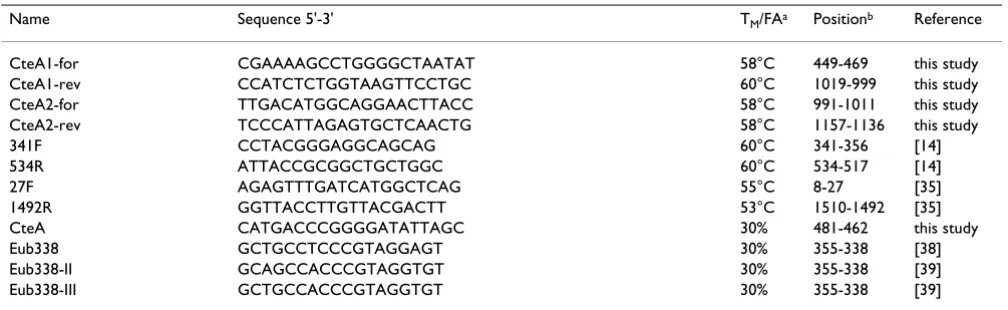
The sequence alignment from which the tree was con-structed was then used as a basis to identify sequence regions which could be used for the design of FISH probes and PCR primers specific for C. testosteroni. Useful stretches were identified around nucleotides 450–480, 990–1020, and 1130–1160 (E. coli numbering). How-ever, it was not possible to design oligonucleotides target-ing simultaneously sequences from clades A and B together. Since clade A seemed to contain the organisms with a higher environmental and biotechnological rele-vance, we decided to design probes targeting this sequence cluster. Two PCR primer pairs and one FISH probe were designed (see Table 1). BLAST searches revealed that these oligonucleotides had a complete match only with sequences showing >99% identity to the sequence of the C. testosteroni type strain.
Pure culture evaluation of the designed oligonucleotides
All oligonucleotides were evaluated in situ on a selection of proteobacterial pure cultures including all C. testosteroni
strains available from the German Collection of Microor-ganisms (DSM). The tests revealed that the newly designed primers and probe were specific for the strains of this species. Primer pair CteA1 yielded a PCR product with a size of 571 bp, whereas primer pair CteA2 produced an amplicon of 167 bp length. It should be noted here that both primer pairs produced products from all examined
C. testosteroni cultures, indicating that all tested cultures fell within clade A. A clade B culture was not available for testing, but since all developed oligonucleotides except primer CteA2-rev show 3 or more mismatches with the available clade B sequences, it can be expected that these strains would be excluded from detection by PCR or FISH. The CY3 labelled FISH probe CteA gave well-fluorescing signals when used with 30% of formamide in the hybrid-ization buffer. Cells of all available C. testosteroni isolates except of strain DSM 6781 gave well-fluorescing signals when FISH was applied to paraformaldehyde fixed cells. To identify the reason for the reduced signal intensity in strain DSM 6781, its 16S rRNA sequence was determined [EMBL:AM113745]. The sequence had a central mismatch with probe CteA. Accordingly, we suggest to work with a degenerate version of the probe with the sequence CAT GAC CCG (G/A)GG ATA TTA GC. All non-target strains tested did not produce PCR products with primers CteA1 and CteA2, nor did they give a fluorescence signal when using probe CteA in FISH, although low background flu-orescence was observed in some cultures.
Analysis of testosterone enrichment cultures and isolates
In order to test the developed oligonucleotides on an unknown mixed culture, we provided conditions for the enrichment of C. testosteroni from activated sludge by two successive enrichment steps in liquid media containing testosterone as the sole source of carbon and energy and finally by spreading samples of the second culture on agar plates composed of the same medium. Samples of the activated sludge, the two enrichment cultures, and of five isolates obtained from the testosterone plates were then analysed by PCR and FISH.
testo-steroni DSM 50244 was retrieved. Partial analysis of the 16S sequences of the isolates [EMBL:AM113739– AM113743] showed that the two isolates giving PCR products with the CteA1 primers displayed 100% sequence identity with the sequence of C. testosteroni DSM 50244, whereas the other isolates showed 100% identities to the sequences of Pseudomonas sp. B13 [Gen-Bank:AF039489], Pseudomonas sp. WAS2 [Gen-Bank:AB007999], and Rhodococcus equi
[GenBank:AF490539], respectively. The two C. testosteroni
strains could also be identified by FISH using the probe CteA.
In order to assess the suitability of the oligonucleotides for quantification of C. testosteroni in mixed cultures, primer pair CteA2 was used in real-time quantitative PCR and probe CteA was used for quantitative image analysis. The primer pair Eub341F/534R and the FISH probes Eub338 mix were used in parallel as a measure of total cell abun-dance. The ratios between C. testosteroni specific signals and the eubacterial specific signals will produce a frac-tional number representing the C. testosteroni abundance in a given sample. This approach has been applied to cells labelled by FISH [21] or fluorescent proteins [22] and has also been used in real-time PCR quantification [14].
Neighbour-joining tree of 16S rRNA gene sequences of species of the genera Comamonas and Delftia with an emphasis on
Comamonas testosteroni corresponding to E. coli positions 135-1369 Figure 1
Neighbour-joining tree of 16S rRNA gene sequences of species of the genera Comamonas and Delftia with an emphasis on
BMC Microbiology 2006, 6:54 http://www.biomedcentral.com/1471-2180/6/54
A dilution series of genomic DNA of C. testosteroni DSM 50244 yielded products from 5 fg on, which can be con-sidered the detection limit, and showed a linear relation-ship between the Ct-value and the log(DNA amount) over 5 orders of magnitude (50 fg to 0.5 ng, Fig. 3a) with nearly identical slopes close to the optimal value of -3.32 for the CteA2 and the Eub primer pairs. This indicates that both primer pairs are suitable for use in qPCR analysis. A com-parison of the C. testosteroni fractional numbers obtained by qPCR and FISH (Fig. 3b) shows identical trends for the abundances of C. testosteroni in the activated sludge and the following two enrichment steps. The initial C.
testo-steroni abundance was low (0.003% by qPCR, not
detect-able by FISH), and increased via a moderate level in the first enrichment culture (3% by qPCR and FISH) to a major proportion of the population detected by the EUB
primers or probe mix (50% by qPCR and 70% by FISH) in the second enrichment culture.
Determination of C. testosteroni abundance in a reactor bioaugmentation experiment via quantitative PCR
A further test of the qPCR primers CteA2 in mixed culture experiments was done on DNA samples extracted from 3 laboratory scale biofilm reactors in an experiment to introduce degradation of 3-chloroaniline (3CA) via con-jugal transfer of the 3CA-degradative plasmid pNB2. A full description of the experiment can be found elsewhere [23]. Briefly, all reactors where initially inoculated with an activated sludge-derived mixed bacterial culture. Reactor PB then received a Pseudomonas putida strain and reactor P received a Comamonas testosteroni strain, both carrying plasmid pNB2, whereas control reactor N did not receive additional bacteria. The P. putida strain was not able to degrade 3CA, whereas the C. testosteroni strain was. All reactors received a feed containing 3CA and four easily degradable carbon sources (glucose, gluconate, acetate, citrate). Reactor PB started to degrade 3CA after an initial lag phase, and finally, a number of C. testosteroni pNB2-transconjugants capable of 3CA-degradation could be iso-lated from this reactor. Reactor P showed 3CA-degrada-tion from the beginning of the experiment on, whereas no degradation could be observed in reactor N.
Using quantitative PCR, we determined the C. testosteroni
abundance in DNA samples obtained at the start of the experiment (day 0) as well as on day 18 after onset of deg-radation of reactor P and towards the end of the experi-ment on day 29 (Fig. 4). Whereas initial abundance of C. testosteroni in reactor PB was low around 1% and rose via 3% to a final level of 9%, reactor P initially showed a high
C. testosteroni abundance of 36% due to addition of the
pNB2-carrying C. testosteroni strain which then dropped to values around 18%. Surprisingly, reactor N showed the same trend as reactor PB with an increase of the C.
testo-Agarose gel showing PCR products obtained using the primer pair CteA1 from the testosterone enrichment cul-tures and the isolates grown on testosterone plates Figure 2
[image:5.612.54.558.99.254.2]Agarose gel showing PCR products obtained using the primer pair CteA1 from the testosterone enrichment cul-tures and the isolates grown on testosterone plates. M: 100 bp ladder, +ve: positive control (C. testosteroni genomic DNA), AS: activated sludge inoculum, E1: first enrichment step, E2: second enrichment step, I1–I5: isolates, -ve: negative control (no template DNA).
Table 1: PCR primers and FISH probes used in this study
Name Sequence 5'-3' TM/FAa Positionb Reference
CteA1-for CGAAAAGCCTGGGGCTAATAT 58°C 449-469 this study
CteA1-rev CCATCTCTGGTAAGTTCCTGC 60°C 1019-999 this study
CteA2-for TTGACATGGCAGGAACTTACC 58°C 991-1011 this study
CteA2-rev TCCCATTAGAGTGCTCAACTG 58°C 1157-1136 this study
341F CCTACGGGAGGCAGCAG 60°C 341-356 [14]
534R ATTACCGCGGCTGCTGGC 60°C 534-517 [14]
27F AGAGTTTGATCATGGCTCAG 55°C 8-27 [35]
1492R GGTTACCTTGTTACGACTT 53°C 1510-1492 [35]
CteA CATGACCCGGGGATATTAGC 30% 481-462 this study
Eub338 GCTGCCTCCCGTAGGAGT 30% 355-338 [38]
Eub338-II GCAGCCACCCGTAGGTGT 30% 355-338 [39]
Eub338-III GCTGCCACCCGTAGGTGT 30% 355-338 [39]
steroni abundance from low levels of 2% to finally 10%. Although the increase in C. testosteroni abundance in reac-tor PB is partly explained by growth of a 3CA-degrading,
pNB2-carrying C. testosteroni subpopulation, this indicates that also non-degrading C. testosteroni strains might bene-fit from the general growth conditions in our reactors.
Discussion
In our study, we present two sets of PCR primers and an rRNA directed oligonucleotide probe for use in FISH which can be applied for detection and quantification of a Comamonas testosteroni subgroup in mixed bacterial pop-ulations.
Relative quantifications (target group vs. a measure of whole eubacterial cell abundance) conducted by real-time PCR and FISH followed by image analysis demonstrate the same development of C. testosteroni populations dur-ing an enrichment process usdur-ing testosterone as a carbon source. However, since neither of the two methods meas-ure cell number, but rRNA gene copy number (PCR) and cell area (FISH), a direct numerical comparison is not pos-sible here. Both quantification methods may display a sample-inherent bias, when the average 16S rRNA gene copy number per cell differs from the number of 16S rRNA gene copies per C. testosteroni cell in PCR or the aver-age cell area in a sample differs from the averaver-age area of a
C. testosteroni cell in FISH. Additionally, we applied the real-time PCR approach presented here to successfully determine abundance of C. testosteroni in a set of labora-tory-scale wastewater treatment reactors inoculated with activated sludge bacteria and additionally bioaugmented
[image:6.612.91.520.84.280.2]Abundances of C. testosteroni during a bioaugmentation experiment [23] using laboratory scale biofilm reactors inoc-ulated with activated sludge bacteria
Figure 4
Abundances of C. testosteroni during a bioaugmentation experiment [23] using laboratory scale biofilm reactors inoc-ulated with activated sludge bacteria. Reactors PB and P addi-tionally received a P. putida and a C. testosteroni strain, respectively.
a) Real-time PCR standard curves obtained using primer pairs CteA2 (Cte, diamonds) and 341F/534R (Eub, squares) using 10fold serial dilutions of C. testosteroni genomic DNA as template DNA
Figure 3
BMC Microbiology 2006, 6:54 http://www.biomedcentral.com/1471-2180/6/54
with different bacteria of which one was a C. testosteroni
strain.
Comparison of the target groups of the new probe set with the previously described probes targeting Comamonas spe-cies reveals that our oligonucleotides exclusively match sequences of Comamonas testosteroni strains. Primer CteA2-rev is somewhat less specific, but the combination with primer CteA2-for ensures specificity of the primer pair. In contrast, probe CTE matches with most sequences of the genera Comamonas, Acidovorax and Hydrogenophaga, but has mismatches with the sequences of C. koreensis, Coma-monas sp. 12022, C. testosteroni SMCC B329 (clade B), and of the Delftia species among the sequences shown in Fig. 1. Probe PPT targets mainly Comamonas and Acidovorax, but both PPT and CTE also target a range of sequences from other genera of the Comamonadaceae [24]. Among the previously published probes, COM1424 has the nar-rowest range targeting predominantly Comamonas and
Delftia [24].
Conclusion
The oligonucleotides presented here are a useful tool to study C. testosteroni population dynamics in mixed micro-bial communities, when considering the method-inher-ent bias disussed above.
Methods
Bacterial strains and culture conditions
The following strains of Comamonas testosteroni were used: DSM 38, 1455, 1622, 6781, 11414, 12678, 50241, 50242, 50244, LMG 19554, SB3 [25] and SB4 [25]. In addition,
C. aquatica ATCC 11330, C. nitrativorans DSM 13191, C. koreensis TK17 [26], C. terrigena TK41 [26], Delftia acidovo-rans ATCC 15668, Delftia tsuruhatensis SB5 [25],
Pseu-domonas putida DSM 291, Pseudomonas aeruginosa PAO1
[27], Novosphingobium capsulatum DSM 30196, Aeromonas hydrophila DSM 30187, Escherichia coli DH5α, Serratia
ficaria ATCC 33105, Acinetobacter calcoaceticus BD413
[28], Ralstonia eutropha DSM 531, and Burkholderia cepacia
H111 [29] were included as non-target organisms. All cul-tures were maintained on nutrient broth at 30°C.
Enrichment of Comamonas testosteroni from activated sludge
Activated sludge was obtained from the aeration basin of the municipal wastewater treatment plant Garching (Ger-many). A sample representing approximately 1 mg of dry weight was inoculated into 25 ml of MMO medium [30] containing 0.05% testosterone (added as a 10% solution in DMSO) as the sole carbon source and incubated for 4 d (30°C, 150 rpm), until the disappearance of the testo-sterone crystals indicated degradation of the compound. 250 μl of this culture was inoculated into 25 ml of fresh medium and again incubated for 2 d, and a sample was
spread onto MMO plates with testosterone which were incubated for 7 d at 30°C.
Primer and probe design and evaluation
A multiple sequence alignment and calculation of a phyl-ogenetic tree of a selection of 16S rRNA gene sequences of the genus Comamonas was done using ClustalX 1.81 [31] (see Fig. 1 for the sequences included in the analysis). Sequence stretches showing identities within C.
testo-steroni clade A sequences, but having mismatches to the
remaining sequences, were used to design species-specific oligonucleotides. The sequences of the oligonucleotides which were finally used in this study are shown in Table 1.
The specificities of the primers and probes developed in this study as well as those of the probes COM1424, CTE, and PPT were checked using BLAST within the NCBI web-site [32] as well as the ProbeMatch tool in the RDP-II [33].
PCR
For PCR from pure cultures, cells suspended in water were used as template DNA. DNA from activated sludge and the enrichment cultures was isolated as described previ-ously [34].
Conventional PCR was carried out using a Mastercycler gradient (Eppendorf, Hamburg, Germany) and Qiagen HotStarTay DNA Polymerase (Qiagen, Hilden, Germany). A single reaction contained 0.2 μM of each primer CteA1-for and CteA1-rev, 0.2 mM of each dNTP, 1.5 mM MgCl2, 0.02 U/μl of Taq Polymerase in a volume of 20 μl. Either 1 μl of cell suspension or 10 ng of DNA was added as tem-plate DNA. The PCR protocol consisted of an initial dena-turation of 15 min at 95°C followed by 30 cycles of 30 sec at 95°C, 1 min at 58°C and 2 min at 72°C and was con-cluded by a final extension of 8 min at 72°C. To exclude the possibility of PCR inhibition, parallel positive control reactions using the general eubacterial primers 341F and 534R were conducted for each template. The 16S rRNA genes of isolates were partially amplified using primers 27F and 1492R [35] and custom sequenced using primer 341F by MWG Biotech (Ebersberg, Germany). PCR prod-ucts were analysed on 2% TAE agarose gels.
were used to generate standard curves for both primer pairs.
FISH and image analysis
FISH was performed as described [36], using paraformal-dehyde as a fixative. For elucidation of the hybridization conditions for the probe CteA, hybridization temperature was kept constant at 46°C. The formamide concentration in the hybridization buffer was varied by 10% increments.
C. testosteroni LMG 19554 and C. aquatica ATCC 11330
were used as positive and negative controls, respectively. The formamide concentration which resulted in clear strong signals for C. testosteroni and no signals for C. aquat-ica was used in subsequent hybridizations. Probe CteA was labelled with the cyanine dye CY3, whereas the EUB probe mix (an equimolar mixture of probes EUB338, EUB338-II, and EUB338-III) was labelled with the cya-nine dye CY5. All hybridizations were performed as simultaneous dual colour hybridizations where the EUB mix served the role of a general counter stain for total bac-terial cell number. Images were recorded using a Zeiss LSM 510 Meta (Carl Zeiss, Jena, Germany) confocal laser scanning microscope. For quantitative analyses, the per-centages of area coverage of signals from the CteA probe and the EUB mix were calculated using the Quantimet Q500W (Leica, Cambridge, England) image analysis sys-tem. The abundance of C. testosteroni was calculated as the ratio of the area covered by biomass stained simultane-ously with both CteA and EUB probes to the area covered by EUB-stained biomass only. For each sample, 20 micro-scopic fields (92 × 92 μm) were analysed.
Accession numbers
The 16S rRNA sequences determined in this study have been deposited in the EMBL nucleotide sequence data-base [37] under the accession numbers [EMBL:AM113739–AM113745].
Authors' contributions
Both authors contributed to experimental design of the project. SB carried out the experimental work and drafted the manuscript. MH revised and finalized the manuscript. All authors read and approved the final manuscript.
Acknowledgements
This work was supported by the German Research Foundation (DFG, grant Ha3164/2-2 to MH).
References
1. Horinouchi M, Kurita T, Yamamoto T, Hatori E, Hayashi T, Kudo T:
Steroid degradation gene cluster of Comamonas testo-steroni consisting of 18 putative genes from meta-cleavage enzyme gene tesB to regulator gene tesR. Biochem Biophys Res Commun 2004, 324(2):597-604.
2. Horinouchi M, Hayashi T, Yamamoto T, Kudo T: A new bacterial steroid degradation gene cluster in Comamonas testo-steroni TA441 which consists of aromatic-compound degra-dation genes for seco-steroids and 3-ketosteroid
dehydrogenase genes. Appl Environ Microbiol 2003,
69(8):4421-4430.
3. Skowasch D, Mobus E, Maser E: Identification of a novel Coma-monas testosteroni gene encoding a steroid-inducible extra-diol dioxygenase. Biochem Biophys Res Commun 2002,
294(3):560-566.
4. Oppermann UC, Maser E: Characterization of a 3 alpha-hydroxysteroid dehydrogenase/carbonyl reductase from the gram-negative bacterium Comamonas testosteroni. Eur J Bio-chem 1996, 241(3):744-749.
5. Sondossi M, Barriault D, Sylvestre M: Metabolism of 2,2'- and 3,3'-dihydroxybiphenyl by the biphenyl catabolic pathway of Comamonas testosteroni B-356. Appl Environ Microbiol 2004,
70(1):174-181.
6. Chen F, Cui M, Fu J, Sheng G, Sun G, Xu M: Biodegradation of qui-noline by freely suspended and immobilized cells of Coma-monas sp strain Q10. J Gen Appl Microbiol 2003, 49(2):123-128. 7. Boon N, Goris J, De Vos P, Verstraete W, Top EM:
Bioaugmenta-tion of activated sludge by an indigenous 3-chloroaniline-degrading Comamonas testosteroni strain, I2gfp. Appl Environ Microbiol 2000, 66(7):2906-2913.
8. Junker F, Saller E, Schlafli Oppenberg HR, Kroneck PM, Leisinger T, Cook AM: Degradative pathways for p-toluenecarboxylate and p-toluenesulfonate and their multicomponent oxygen-ases in Comamonas testosteroni strains PSB-4 and T-2.
Microbiology 1996, 142:2419-2427.
9. Goyal AK, Zylstra GJ: Molecular cloning of novel genes for poly-cyclic aromatic hydrocarbon degradation from Comamonas testosteroni GZ39. Appl Environ Microbiol 1996, 62(1):230-236. 10. Wang YZ, Zhou Y, Zylstra GJ: Molecular analysis of isophthalate
and terephthalate degradation by Comamonas testosteroni YZW-D. Environ Health Perspect 1995, 103 Suppl 5:9-12. 11. Takahashi E, Furui M, Seko H, Shibatani T: D-lysine production
from L-lysine by successive chemical racemization and microbial asymmetric degradation. Appl Microbiol Biotechnol
1997, 47(4):347-351.
12. Pepper IL, Gentry TJ, Newby DT, Roane TM, Josephson KL: The role of cell bioaugmentation and gene bioaugmentation in the remediation of co-contaminated soils. Environ Health Per-spect 2002, 110 Suppl 6:943-946.
13. Vervaeren H, De Wilde K, Matthys J, Boon N, Raskin L, Verstraete W: Quantification of an Eikelboom type 021N bulking event with fluorescence in situ hybridization and real-time PCR.
Appl Microbiol Biotechnol 2005, Epub ahead of print:.
14. Smits TH, Devenoges C, Szynalski K, Maillard J, Holliger C: Develop-ment of a real-time PCR method for quantification of the three genera Dehalobacter, Dehalococcoides, and Desulfito-bacterium in microbial communities. J Microbiol Methods 2004,
57(3):369-378.
15. Matsuki T, Watanabe K, Fujimoto J, Takada T, Tanaka R: Use of 16S rRNA gene-targeted group-specific primers for real-time PCR analysis of predominant bacteria in human feces. Appl Environ Microbiol 2004, 70(12):7220-7228.
16. Stubner S: Enumeration of 16S rDNA of Desulfotomaculum lineage 1 in rice field soil by real-time PCR with SybrGreen detection. J Microbiol Methods 2002, 50(2):155-164.
17. Amann RI, Ludwig W, Schulze R, Spring S, Moore E, Schleifer KH:
rRNA-targeted oligonucleotide probes for the identification of genuine and former pseudomonads. Syst Appl Microbiol 1996,
19:501-509.
18. Braun-Howland EB, Vescio PA, Nierzwicki-Bauer SA: Use of a sim-plified cell blot technique and 16S rRNA-directed probes for identification of common environmental isolates. Appl Environ Microbiol 1993, 59(10):3219-3224. 19. Schleifer KH, Amann RI, Ludwig W, Rothemund C, Springer N, Dorn S: Nucleic acid probes for the identification and in situ detec-tion of pseudomonads. In Pseudomonas: Molecular Biology and Bio-technology Edited by: Galli E, Silver S, Withold B. Washington , American Society for Microbiology; 1992:127-134.
20. Fuchslin HP, Ruegg I, Van Der Meer JR, Egli T: Effect of integration of a GFP reporter gene on fitness of Ralstonia eutropha dur-ing growth with 2,4-dichlorophenoxyacetic acid. Environ Micro-biol 2003, 5(10):878-887.
Publish with BioMed Central and every scientist can read your work free of charge
"BioMed Central will be the most significant development for disseminating the results of biomedical researc h in our lifetime."
Sir Paul Nurse, Cancer Research UK
Your research papers will be:
available free of charge to the entire biomedical community
peer reviewed and published immediately upon acceptance
cited in PubMed and archived on PubMed Central
yours — you keep the copyright
Submit your manuscript here:
http://www.biomedcentral.com/info/publishing_adv.asp
BioMedcentral
BMC Microbiology 2006, 6:54 http://www.biomedcentral.com/1471-2180/6/54
22. Kuehn M, Hausner M, Bungartz HJ, Wagner M, Wilderer PA, Wuertz S: Automated confocal laser scanning microscopy and semi-automated image processing for analysis of biofilms. Appl Environ Microbiol 1998, 64(11):4115-4127.
23. Bathe S, Schwarzenbeck N, Hausner M: Plasmid-mediated bio-augmentation of activated sludge bacteria in a sequencing batch moving bed reactor using pNB2. Lett Appl Microbiol 2005,
41:242-247.
24. ProbeBase - an online resource for rRNA-targeted oligonu-cleotide probes [http://www.microbial-ecology.net/probebase/ ] 25. Bathe S: Conjugal transfer of plasmid pNB2 to activated
sludge bacteria leads to 3-chloroaniline degradation in enrichment cultures. Lett Appl Microbiol 2004, 38(6):527-531. 26. Bathe S, Lebuhn M, Ellwart JW, Wuertz S, Hausner M: High
phylo-genetic diversity of transconjugants carrying plasmid pJP4 in an activated sludge-derived microbial community. FEMS Microbiol Lett 2004, 235(2):215-219.
27. Klausen M, Heydorn A, Ragas P, Lambertsen L, Aaes-Jorgensen A, Molin S, Tolker-Nielsen T: Biofilm formation by Pseudomonas aeruginosa wild type, flagella and type IV pili mutants. Mol Microbiol 2003, 48(6):1511-1524.
28. Kaplan N, Zosim Z, Rosenberg E: Reconstitution of emulsifying activity of Acinetobacter calcoaceticus BD4 emulsan by using pure polysaccharide and protein. Appl Environ Microbiol
1987, 53(2):440-446.
29. Huber B, Riedel K, Kothe M, Givskov M, Molin S, Eberl L: Genetic analysis of functions involved in the late stages of biofilm development in Burkholderia cepacia H111. Mol Microbiol
2002, 46(2):411-426.
30. Boon N, Goris J, De Vos P, Verstraete W, Top EM: Genetic diver-sity among 3-chloroaniline- and aniline-degrading strains of the Comamonadaceae. Appl Environ Microbiol 2001,
67(3):1107-1115.
31. Thompson JD, Gibson TJ, Plewniak F, Jeanmougin F, Higgins DG: The CLUSTAL_X windows interface: flexible strategies for mul-tiple sequence alignment aided by quality analysis tools.
Nucleic Acids Res 1997, 25(24):4876-4882.
32. National Centre for Biotechnology Information [http:// www.ncbi.nlm.nih.gov/ ]
33. Ribosomal Database Project-II [http://rdp8.cme.msu.edu/html/ ] 34. Ausubel FM, Brent R, Kingson RE, Moore DD, Seidman JG, Smith JA, Struhl K: Short protocols in molecular biology. New York, USA , Wiley and Sons; 1999.
35. Devereux R, Willis SG: Amplification of ribosomal RNA sequences. In Molecular Microbial Ecology Manual Volume 3.3.1.. Edited by: Akkermans ADL, van Elsas JD, De Bruijn FJ. Dordrecht, The Netherlands , Kluwer; 1995:1-11.
36. Amann RI: In situ identification of microorganisms by whole cell hybridization with rRNA-targeted nucleic acid probes.
In Molecular Microbial Ecology ManualVolume 3.3.6.. Edited by: Akker-mans ADL, van Elsas JD, de Bruijn FJ. Dordrecht, The Netherlands , Kluwer; 1995:1-15.
37. The EMBL Nucleotide Sequence Database [http:// www.ebi.ac.uk/embl/ ]
38. Amann RI, Binder BJ, Olson RJ, Chisholm SW, Devereux R, Stahl DA:
Combination of 16S rRNA-targeted oligonucleotide probes with flow cytometry for analyzing mixed microbial popula-tions. Appl Environ Microbiol 1990, 56(6):1919-1925.
![Figure 4ulated with activated sludge bacteriaexperiment [23] using laboratory scale biofilm reactors inoc-Abundances of C](https://thumb-us.123doks.com/thumbv2/123dok_us/9765055.477503/6.612.91.520.84.280/figure-ulated-activated-bacteriaexperiment-laboratory-biofilm-reactors-abundances.webp)
