The Future of Big Data and Business Operations
in the Context of Relational In-Memory Databases
Scenarios for the Year 2025
Master Thesis
Julia Reichelt
Student ID University of Twente: s1616633
Student ID Technical University of Berlin: 354767
To obtain a:
Master of Science (M.Sc.) in Business Administration
(University of Twente)
Master of Science (M.Sc.) in Innovation Management & Entrepreneurship
(Technical University of Berlin)
Submitted to
Prof. Dr. Katharina Hölzle
Dr. Michel Ehrenhard
University of Potsdam
University of Twente
Table of Contents
Management Summary ... III
List of Figures ...V
List of Tables ...V
List of Abbreviations ... VI
1 Motivation, research question and thesis outline ... 1
1.1 Problem statement: Real-time decisions to cope with change in the Industry 4.0... 1
1.2 Thesis goal and research question: RIMDB future developments and Industry 4.0 ... 3
1.3 Laying the foundations: Relevant literature and the research design ... 3
1.4 Theoretical & practical contribution ... 4
1.5 Thesis outline ... 5
2 Literature review ... 6
2.1. Technology management ... 6
2.1.1 Introduction to competitive strategy ... 6
2.1.2 Competitive strategy and the firm’s environment ... 7
2.1.3 The role of IT in competitive strategy and the value chain ... 8
2.1.4 From technology strategy to technology foresight ... 10
2.2 Business operations, the Internet of Things and Industry 4.0 ... 13
2.2.1 Overview over business operations ... 13
2.2.2 The Internet of Things and value creation ... 14
2.2.3 Industry 4.0 or the Industrial Internet of Things ... 16
2.3 Formulation of the research question ... 18
3 Research design and methodology ... 19
3.1 Data collection procedure ... 19
3.1.1 Combination approach of systematic and narrative literature review ... 19
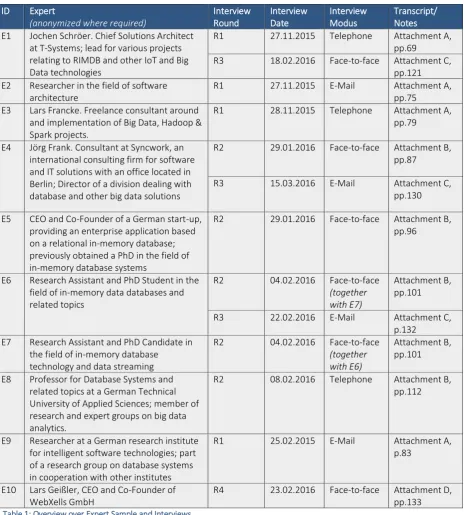
3.1.2 Semi-structured expert interviews and the expert sample ... 21
3.2 The scenario method ... 25
3.2.1 Definition of key terms and conceptualization ... 25
3.2.2 The scenario approach based on Reibnitz ... 26
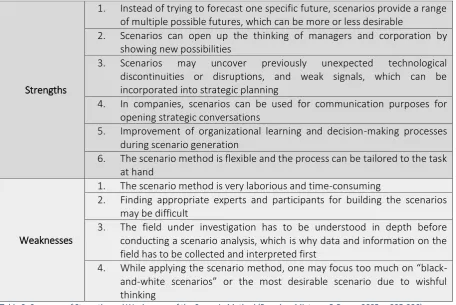
3.2.3 A critical view on the scenario method ... 29
4 Results ... 32
4.1 Scenario preparation: Technology Exploration Report (TER) ... 32
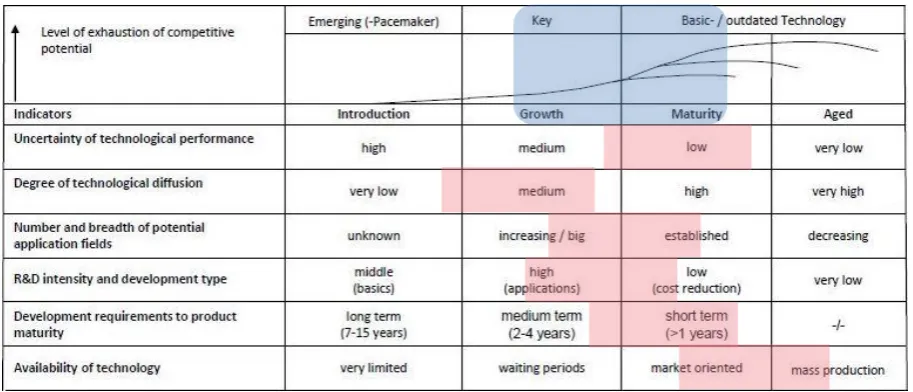
4.1.2 Technology life cycle of RIMDB ... 34
4.1.3 The active players and the competitive field ... 36
4.1.4 Brief assessment of the business potential of RIMDB ... 39
4.1.5 The driving forces for the future of RIMDB ... 40
4.2 Scenarios... 51
4.2.1 Scenario 1: The open-source revolution... 52
4.2.2 Scenario 2: The big data golden age ... 54
4.4.3 Scenario 3: Platforms for the win ... 56
5 Conclusions for RIMDB and Industry 4.0 ... 58
5.1 Developments relevant for RIMDB ... 58
5.2 Conclusions for Industry 4.0 ... 60
6 Discussion of limitations and future directions... 63
7 Acknowledgements ... 66
Appendix ... 67
Management Summary
Decision-makers are faced with a quickening pace of change today, which increases the uncertainty
businesses have to deal with. For this purpose, they need to be able to cope with changing
environments faster than ever. Therefore, real-time strategic decision-making is gaining in relevance.
In parallel to these developments, the Internet of Things (IoT) is a recent technological trend which
has received much attention. The IoT can be described as ubiquitous connectivity of smart devices or
objects. These smart connected devices (SCD) are equipped with sensors, and serve to collect data
from the environment. Extensive growth is expected for the IoT: By 2020, estimates project between
25 and 50 billion of such SCD as part of the IoT. Considering the enormous expected amount of SCD,
the ensuing data volumes that will be produced will also be very large. However, the full potential of
these large amounts of data, also called big data, can only be reached when the collected data are
analysed. Thus, in order to create value in the IoT, one essential aspect is data analysis. Of the data
collected today, only a small fraction is being analysed.
The IoT creates valuable data that can be used for real-time strategic decisions through data analysis.
A crucial technology for real-time big data analysis is relational in-memory databases (RIMDB).
Examples for RIMDB are SAP HANA, Oracle TimesTen, Microsoft Hekaton or IMDB DB2 with Blu.
Closely related to the IoT is another trend on which governments, researchers and practitioners put a
particular focus at the moment: Industry 4.0. The latter can be summarised as the implementation of
the IoT in industrial settings through the real-time use of data from various SCD, thereby changing the
activities and processes concerned with producing goods or services from resources (i.e. the
operations of a business). The potential impact of the IoT for such industrial settings is expected to be
particularly extensive, both for individual firms and for the economy in general. The relevance of
real-time strategic decisions, enabled by RIMDB, is thus particularly high for the Industry 4.0.
A thorough understanding of RIMDB can guide decision-makers to making more informed decisions
when it comes to the consideration and implementation of the big data analysis technology RIMDB.
Similar to all other domains, RIMDB are also subject to change due to various influencing factors and
driving forces. Hence, it is useful to not only look at the technology now, but also its future
development and how this development can be shaped. In addition to the players involved in the
Industry 4.0, RIMDB vendors can gain from this, as they themselves can exert an influence on the
future development of the technology.
To provide the strategic guidance to RIMDB vendors as well as players in the Industry 4.0, this thesis
answers the following research question: How can relational in-memory database (RIMDB)
developments by 2025 affect Industry 4.0? The research question consists of two sub-questions: (1)
What are future developments of RIMDB by 2025? and (2) What do these future developments mean
To answer the research question, a technology foresight study was conducted, using the scenario
method mainly based on Reibnitz (1988). The purpose of the scenarios is not to predict the future, but
to open the space of considered possibilities in decision-making by providing various alternative,
possible futures. Supporting the scenario approach, ten experts from research and practice were
consulted in thirteen semi-structured, qualitative interviews between November 2015 and March
2016. The software Parmenides EIDOS™ supported the scenario approach.
The scenarios built for this thesis are based on prior identification of 31 driving forces that can shape
the development of RIMDB. Based on further assessment of the influences between those 31 drivers,
six key drivers were identified: (1) Demand of real-time response & service acceleration, (2) RIMDB
costs (customer-side), (3) development of RIMDB open-source solutions, (4) regulatory and
government influences, (5) network and connectivity development, and (6) increase in number of
sensors. Because each of these six key drivers can develop into different directions, future projections
were created for the key drivers, serving as the foundation for the three final scenarios. The scenarios
combine different future projections for the key drivers in a narrative fashion and are set in the year
2025. As mentioned, the scenarios only provide a range of possible futures, but decision-makers are
advised to monitor the key driver development closely over the coming years in order to be prepared
in time for potential changes in one direction or another.
In the first scenario, a cloud-based, open-source RIMDB is made available to the community,
decreasing the market share of the proprietary RIMDB vendors significantly. RIMDB vendors should be
aware that such developments have taken place in other software domains, and prepare themselves
for that case by monitoring the competition and considering new business models.
In the second scenario, the further diffusion of cloud systems, alongside strong governmental support
for the opportunities that big data has to offer, foster a golden age for data. Big data technologies,
including RIMDB, are now also affordable for very cost-sensitive businesses such as SMEs. This
strengthens the overall economy as the value from data can be reaped more effectively. Many
industrial players rely on SMEs. To ensure that the latter do not lag behind when it comes to adapting
to big data analysis due to their limited resources, decision-makers concerned with Industry 4.0 should
evaluate these developments closely and enable SMEs to take part in the Industry 4.0.
In the third scenario, a new platform business model for RIMDB is described: One vendor makes the
code of its RIMDB freely available to the community, and uses it as a platform on which developers
can write solutions for use cases relating to big data. Platform users can purchase these solutions. The
vendor makes money as soon as a developer sells his/her solution through a share of the revenue.
Considering that eventually, market saturation for real-time big data analysis systems will be reached
if they become the state of the art, this business model may be particularly interesting for RIMDB
List of Figures
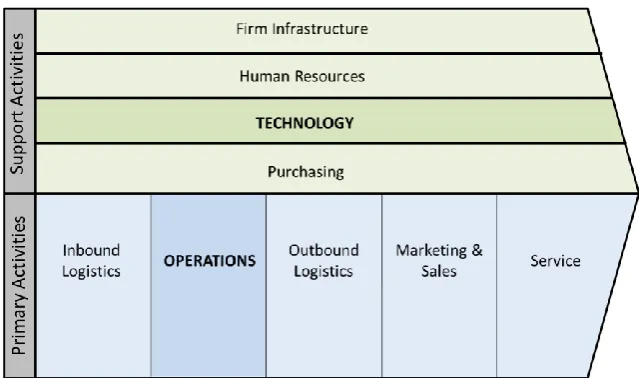
Figure 1: Generic Value Chain; highlighted: Technology and Operations ... 9
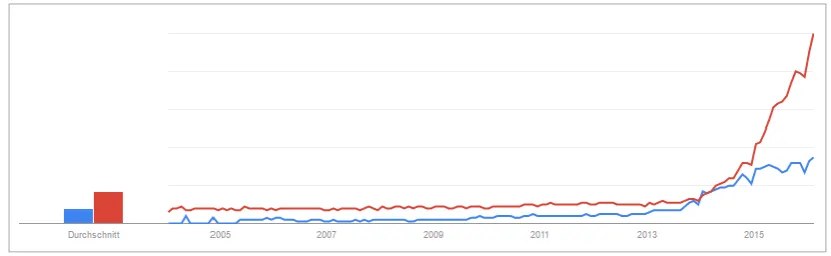
Figure 2: Google Trends for “Internet of Things” (blue) and “IoT” (red) ... 14
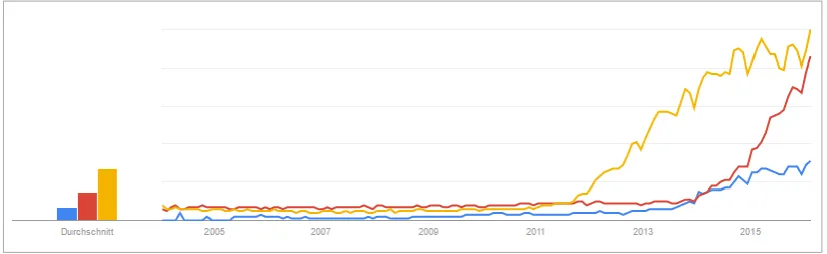
Figure 3: Google Trends for “Big Data (yellow), “Internet of Things” (blue) and “IoT” (red) ... 15
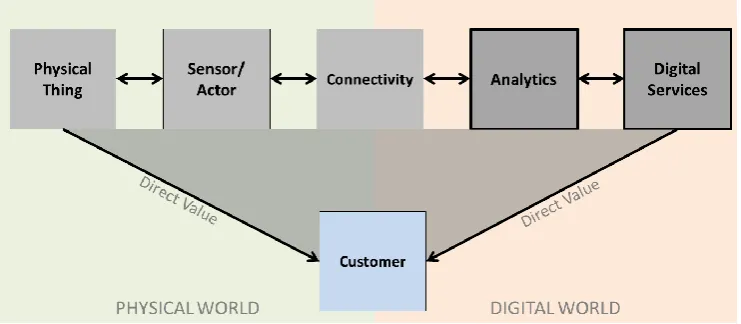
Figure 4: Value Delivery in the IoT (own illustration, based on Fleisch et al., 2014, p.7, Fig. 4) ... 16
Figure 5: Technology Life Cycle Stage ... 34
Figure 6: Google Trends for “SAP HANA” (blue), “TimesTen” (red), “Hekaton” (yellow) and “IBM DB2” (green) ... 37
Figure 7: Key drivers and projections (visualisation in EIDOS) ... 46
Figure 8: Consistency matrix (visualisation in EIDOS) ... 50
Figure 9: Scenario cluster selection ... 51
List of Tables
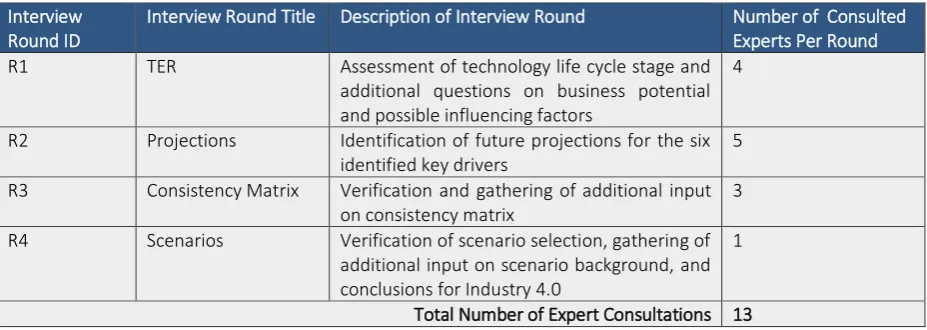
Table 1: Overview over Expert Sample and Interviews ... 22Table 2: Overview over Interview Rounds ... 24
Table 3: Summary of Strengths and Weaknesses of the Scenario Method ... 30
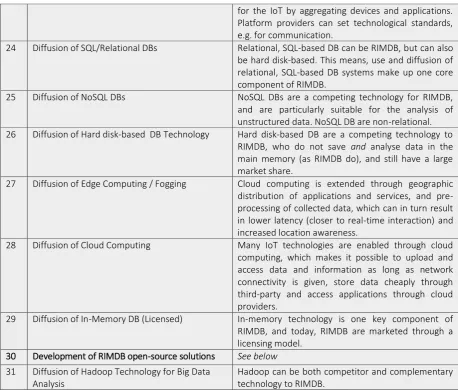
Table 4: The 31 Drivers; highlighted in bold are the key drivers, described in section 4.1.5.2 ... 43
List of Abbreviations
BTLE Bluetooth Low-Energy
CF Corporate Foresight
CPS Cyber-Physical Systems
CRM Customer Relationship Management
DB Database
e.g. exempli gratia
EC European Commission
ERP Enterprise Resource Planning
et al. et alii
EU European Union
i.e. id est
IM In-Memory
IoS Internet Of Services
IoT Internet Of Things
IT Information Technology
LiFi Light Based High-Speed Communication Technology
n.d. No Date
N/A Not Available
NoSQL Not Only Structured Query Language
OF Operational Foresight
OLAP Online Analytical Processing
OLTP Online Transactional Processing
p. Page
R&D Research And Development
RIMDB Relational In-Memory Database
SCD Smart Connected Device
SF Strategic Foresight
SME Small/Medium Enterprise
SQL Structured Query Language
TER Technology Exploration Report
TF Technology Foresight
TM Technology Management
1 Motivation, research question and thesis outline
1.1 Problem statement: Real-time decisions to cope with change in the Industry 4.0
“The pace of change will never again be as slow as it is now” (Fjord, 2015, p.3), stated Matthew Bishop(an editor for The Economist) at the 2015 Innovation Forum. For companies, change means
uncertainty, which can pose a serious threat for their survival (Zahra, 1996; Porter, 1985b). Hence, the
acceleration of change means that the uncertainty in the environment of companies increases as well.
Porter (1985b) notes that technological change can have a particularly significant influence on a firm’s
environment. Moreover, technology is of particular significance to strategy-making because it can
influence the entire value chain (Porter, 1985a). Therefore, according to various authors, the main
task of strategic management is to anticipate what will happen in the future in order to make
decisions now that can prepare their company for future change, thereby reducing uncertainty
(Drucker, 1986; Grant, 2010; Winterfeld & Karnani, 1987). Considering the increasing pace of change,
strategic management will also have to find a way to make decisions faster. In order to respond to
change fast, real-time strategic decision-making for competitive advantage will increasingly become
relevant for managers and other decision-makers (Rohrbeck & Bade, 2012).
One technological trend that can have a significant influence on strategic decision-making at the
moment, and also a well-known buzzword, is the Internet of Things (IoT): For example, Google Trends
show a rather steep incline in search volumes for the IoT since around 2013 (see Figure 2, p.14), and
Gartner, Inc. already rated the IoT as the most hyped emerging technology in 2014 (Gartner, Inc.,
2014a). The IoT can be defined as connectivity of anything or anyone at any time or place with
anything or anyone, and in an ideal case with any path or network and any service (Perera, Zaslavsky,
Christen, Georgakopoulos, 2014, p.416). These things that characterise the IoT are also called smart
connected devices (SCD) (Porter & Heppelmann, 2014). Such an SCD can be any object that has been
fitted with a sensor or actor, making it electronic and capable of collecting and sending data (Atzori,
Iera & Morabito, 2010; Porter & Heppelmann, 2014; Swan, 2012). Highlighting the enormous potential
impact of the IoT, Gartner, Inc. (2014b) forecast an increase in SCD from 4.9 billion in 2015 to around
25 billion until 2020. Other authors’ estimations go even further; e.g. Swan (2012) estimates 50 billion
SCD by 2020. The very large amounts of data (also called big data) that the SCD collect can then be
analysed for various purposes (Jankowski, Covello, Bellini, Ritchie, Costa, 2014, p.4-7; Porter &
Heppelmann, 2014, p.68). Since merely accumulating data cannot provide much insight, data analysis
is one central aspect where value can be created in the IoT (Fleisch, Weinberger & Wortmann, 2014).
Today, most of the potential that lies in big data is not exploited fully as it is simply collected and
stored, but not analysed further (Manyika, Chui, Bisson & Woetzel et al., 2015). Regarding the
significance of the IoT and big data for companies, the area of Industry 4.0 (also called the Industrial
e.g. Hermann, Pentek & Otto, 2015; Koch, Kuge, Geissenbauer & Schrauf, 2014; Manyika et al., 2015),
as elaborated in more detail in section 2.2.3 (pp.16). Firstly, this has to do with estimations that the
value from the IoT is expected to be the largest by billions of US-Dollars in production environments,
such as factories (Manyika et al., 2015). Thus, the economic impact of IoT and big data on industrial
settings will likely be extensive and can influence both companies individually and the economy as a
whole. Secondly, since industrial settings are concerned with the production of goods and services,
the value chain element operations (Porter, 1985a) plays a particularly large role. Business operations
are those value-creating activities where any kind of resource or input is transformed into an output in
the form of a product or service, including production and resource planning (CSCMP & Sanders, 2014;
Porter, 1985a; Robbins & Coulter, 2012). Operations are a crucial part of all day-to-day management
tasks relevant for product and service delivery, and can have a significant impact on the bottom-line
performance and financials of a company (CSCMP & Sanders, 2014). Due to this high relevance of
operations management, many businesses aim to improve the latter by implementing novel
technologies (Robbins & Coulter, 2012). That significant value could be added to the management of
operations by incorporating real-time data from the IoT is thus not too much of a stretch. Considering
the high relevance of operations for industrial settings, the particular focus on Industry 4.0 therefore
indeed makes sense. In order to conduct such real-time analyses of large amounts of data, novel
technologies are required. A technology for this purpose are relational in-memory databases (RIMDB).
Instead of storing data on a separate hard-disk, and moving it to the main memory for analysis, in an
RIMDB data can be both stored and analysed directly in the main memory of the database (DB). Thus,
the use of in-memory (IM) technology can tremendously speed up data analysis processes, and
real-time (or near real-real-time) data analysis is made possible (see Grandpierre, Buss & Esser, 2013; Krueger,
Grund, Tinnefeld, Eckart, Zeier & Plattner, 2010; Loos, Lechtenbörger, Vossen, Zeier & Krüger et al.,
2011; Vom Brocke, Debortoli, Müller & Reuter, 2014). RIMDB are reliable, meeting ACID criteria,
(Edlich, n.d.) and best suited for storing and analysing structured data (such as tables, tags, indexes,
reports) using SQL (Kanimozhi & Venkatesan, 2015). Alternative and complementary technologies in
the context of big data analysis exist (see section 4.1, pp.31), e.g. NoSQL DB for unstructured data
(such as audio or video files; Kanimozhi & Venkatesan, 2015). There are various examples for RIMDB,
commercially distributed by large software vendors, including Oracle TimesTen (Oracle Corporation,
n.d; Oracle Corporation, 2015), SAP HANA (SAP America, Inc., n.d., a), IBM DB2 with BLU (IBM
Corporation, n.d.) and Microsoft Hekaton (Diaconu, Freedman, Ismert, Larson, Mittal et al., 2013).
Because of their ability to analyse large amounts of data in real-time, RIMDB can be a highly relevant
enabler for real-time making. A thorough understanding of the technology can help
decision-makers in the Industry 4.0 to deliberate whether or not to invest in the technology in the first place,
where to exploit synergies with other technologies and how it can be implemented. That is why a
the IoT can bring about, RIMDB are also subject to change and influencing forces that could shape the
development of the technology. The future development of RIMDB, a big data analysis technology,
could hence also have a significant impact on the development of Industry 4.0. The aforementioned
other big data analysis technologies are, however, not disregarded but also considered as alternative
and/or complementary to RIMDB throughout this thesis. The scope of a master thesis would not allow
for an equally in-depth consideration of all big data analysis tools.
1.2 Thesis goal and research question: RIMDB future developments and Industry 4.0
Understanding the future development of RIMDB, and what these mean for Industry 4.0 as a highlyrelevant area in the context of big data analysis, can thus improve the decision-making of practitioners
from different backgrounds. This thesis aims at guiding strategic decision-makers –faced by the
increasing pace of change and expected disruptive developments in connection with the IoT– by
describing possible alternative scenarios for the future development of RIMDB. Due to the emphasised
heightened relevance of the IoT for industrial settings, i.e. Industry 4.0, this thesis moreover aims to
provide insights of particular pertinence to strategic decision-makers in industrial settings.
Additionally, a target group of high importance for this thesis is the RIMDB vendors who distribute
their systems, such as Oracle, SAP and Microsoft. As the vendors of the technology, they can play a
significant role in influencing the future development of RIMDB with their own strategic decisions.
In order to achieve the above, this thesis will answer the following research question: How can
relational in-memory database (RIMDB) developments by 2025 affect Industry 4.0?
The research question consists of two sub-questions:
(1) What are future developments of RIMDB by 2025?
(2) What do these future developments mean for Industry 4.0?
The year 2025 was set as the time frame for the thesis based on Coates’ (2010) definition that
foresight studies shall go more than five years into the future, but a time frame of more than ten years
likely yield results of only questionable validity (given the research design and means).
This thesis is conducted in cooperation with the Technical University of Berlin, the University of
Twente, and the University of Potsdam.
1.3 Laying the foundations: Relevant literature and the research design
As the “missing link” (Strebel et al., 2007, p.26, Abb.4) between engineering science and management,
technology management (TM) deals with enabling technological potentials in organisations in order to
achieve strategic and operative goals (Strebel et al., 2007). To achieve sufficient understanding of TM
in the context of strategic decision-making, this thesis firstly reviews literature on competitive
strategy, including Porter’s value chain (1985a, 1985b), and the particular role of technology for
competitive strategy. As already mentioned, Porter (1985a, 1985b) highlights the relevance of
technology –and particularly information technology (IT)– as a cause for uncertainty and in strategic
As this thesis aims to determine future developments of a technology, namely RIMDB, a useful
instrument for this purpose in the context of TM is technology foresight (TF) (Strebel et al., 2007;
Schuh & Klappert, 2011). TF encompasses the identification, observation, assessment and
interpretation of potentially influencing factors for change in the development of a technology, and
thus serves to prepare for making more informed decisions (see Rohrbeck, Arnold & Heuer, 2007;
Rohrbeck, Battistella & Huizingh, 2015). Literature on TF thus also provides a relevant foundation for
this thesis, enhancing understanding of the context and chosen research design. The relevance of
Industry 4.0, relating to the value chain element business operations and the disruptive technological
trend IoT, was already explained above. Therefore, the literature review is rounded off by delineating
the meaning of these terms and all the aspects involved in creating value in the IoT.
Due to the newness of the topic and the fact that neither a scenario analysis nor another type of
foresight study on the future development of RIMDB has been conducted to the best knowledge of
the researcher, the research design for this thesis is of explorative nature. As a technology foresight
(TF) study, this thesis applies the scenario method, based on the steps described by Reibnitz (1988),
but also drawing from other relevant literature (including Godet & Roubelat, 1996; Mietzner & Reger,
2005; Schoemaker, 1995; Van Notten, 2006). Reibnitz’ approach was slightly adapted to the context of
this thesis. Scenarios do not serve to predict an exact future, but to open the space of possibilities that
are considered for strategic decisions by providing several, alternative, possible scenarios. To support
the scenario building process, thirteen semi-structured, qualitative interviews were conducted with
ten experts in four different rounds between November 2015 and March 2016. The experts were
recruited through purposive non-probability sampling (Saunders et al., 2009) using the researcher’s
and thesis supervisors’ personal and professional networks as well as online research. The experts
come from various backgrounds in research and practice in connection with RIMDB and big data
analysis (see section 3.1.2). The entire scenario building process was aided by the software
Parmenides EIDOS™ (EIDOS).
1.4 Theoretical & practical contribution
Several aspects regarding the relevance of this thesis were already mentioned throughout the
previous sections. For the reader, it is important to understand that in the continuum between basic
and applied research (as illustrated by Saunders, Lews & Thornhill, 2009, p.9) this thesis tends more
towards the direction of applied research. Hence, the purpose of this thesis lies mainly within the area
of improving understanding of a management problem. The findings will be particularly relevant to
managers in organizations. Specifically, this thesis aims at guiding decision-making of managers when
it comes to decisions surrounding real-time analysis of large data volumes, as already elaborated.
Because the IoT is prognosticated to have a strong impact on the competitive environment across
industries, “(…) a new set of strategic choices (…)” (Porter & Heppelmann, 2014, p.66) will emerge. As
technologies that can enable real-time decision-making through big data analysis. Since RIMDB are a
crucial technology for enabling the latter, decision-makers need to thoroughly comprehend the
technology. This thesis shall serve to provide a sufficient overview over RIMDB to enhance
understanding of the technology. As no technology stands by itself without external influences, RIMDB
are also subject to the changes that IoT-related developments, the technology’s competitive
environment and other external drivers can bring about. Thus, the future development of the
technology could be shaped by various factors surrounding the developments in the IoT. On the other
hand, as a key big data analysis technology, also RIMDB could have an influencing effect on these
developments. Understanding the future development of RIMDB, as well as what these mean for
Industry 4.0 as a highly relevant area in the context of big data analysis, can thus improve the
decision-making of practitioners from different backgrounds. As described, this thesis is particularly directed
towards decision-makers (a) in industrial settings or for whom Industry 4.0 will be highly relevant and
(b) the vendors of RIMDB solutions. On top of that, this thesis can be useful for (c) the vendors of
alternative or complementary technologies regarding big data analysis, and (d) all organizations
considering the implementation of a big data solution.
Regarding the academic relevance, this thesis will enrich the growing body of research on IoT and big
data with a structured TF study focusing on the highly relevant big data analysis technology RIMDB.
Literature on TM, TF, competitive strategy, the value chain, business operations, the IoT and Industry
4.0 is reviewed mainly using a structured approach, unless a more narrative approach was required
due to the topic. In consequence, the connections between these different fields are derived in a
structured and comprehensive fashion, which can also serve as a foundation for future research.
Moreover, this thesis adds to literature on TF by applying the scenario method in a very current
context, namely big data analysis. Not only was the scenario approach by Reibnitz implemented, but
also adapted to the context. The latter may provide guidance for future research in a similar direction.
Furthermore, from the results of this thesis, future directions for research emerge.
1.5 Thesis outline
The next chapter of this thesis elaborates on relevant literature regarding technology management
and competitive strategy, the role of IT for the value chain, technology foresight as a technology
management tool and the value chain element business operations in the context of the IoT (Industry
4.0). The relevance of the literature for the research question is summarised at the end of the chapter.
The third chapter of this thesis concerns the research design and methodology. Thereafter, the results
of the thesis are presented, encompassing a thorough description of the technology RIMDB under
consideration of related technologies, relevant driving forces for the future development of RIMDB
and the three final scenarios. The thesis closes with conclusions for RIMDB and Industry 4.0 to answer
the research question in chapter five, and a discussion of limitations and future directions in chapter
2 Literature review
2.1. Technology management
Technology Management (TM) has been defined as the “missing link” (Strebel et al., 2007, p.26,
Abb.4) between engineering science and management, i.e. managing technological knowledge within
an organization. The focus is less on specific innovation processes, but on (more generic) technological
developments. The relevance of TM for organizations can be derived from its function as enabler of
the technological potentials in an organization, which in turn are necessary for reaching its strategic
and operative goals. Therefore, the tasks of TM can be summarised as development, allocation,
implementation, retention and exploitation of technologies, while ensuring a link between
engineering science and management. From a strategic perspective, TM includes activities
surrounding TF, planning, development, exploitation, protection and assessment. (Strebel et al., 2007;
Schuh & Klappert, 2011)
Conducting a TF study using the scenario analysis method, this thesis combines technological
knowledge on RIMDB, in addition to analysing the technology’s competitive environment and other
strategically important aspects. Thereby, this thesis aims at fulfilling the claim of TM to link
engineering science with (strategic) management.
To further embed this thesis into the context of TM, the following sub-chapters will provide a brief
overview over relevant literature and define key terms for competitive strategy and TF.
2.1.1 Introduction to competitive strategy
In 1986, Peter Drucker wrote: “(…) the one thing that is certain about the future is its uncertainty, its
risks.” (p.54). Yet in order to ensure the long-term survival of a firm managers have to consider both
present and future: Management may make decisions for action in the present, but inevitably these
actions will impact the firm’s future. Hence, Drucker (1986) concludes: “Management has no choice
but to anticipate the future, to attempt to mould it, and to balance short-range and long-range goals.”
(p.89). Grant (2010) underlines: “A company’s ability to adapt to changes in its environment depends
on its capacity to anticipate such changes.” (p.287). Accordingly, managers need to create and
implement a strategy in the present in order to prepare their firm for the future.
Porter’s concept of competitive strategy has become one of the most dominant paradigms in strategy
research (see e.g. a meta-analysis by Campbell-Hunt, 2000). He considers analysing the competitive
environment of a firm and its strategic positioning as central factors for creating sustained competitive
advantage. Another perspective in strategy research is the resource-based view (RBV) of the firm,
arguing that sustained competitive advantage depends on a firm’s resources and capabilities (e.g.
Barney, 1995; Wernerfelt, 1984). Studies (see e.g. Spanos & Lioukas, 2001) have found that both
industry (i.e. competitive environment) as well as a firm’s assets (i.e. resources) can contribute to firm
However, this thesis is mainly based on Porter’s perspective on competitive strategy, because in the
context of a TF study, environmental factors are deemed more relevant than one firm’s particular
assets. For instance, this thesis will explore the various players in the field, and the potentially
influencing factors (or “drivers”) of the studied technology (RIMDB). This way it will be able to provide
not only an overview over both the technology itself and the competitive environment today, but also
over potential future directions via the TF study. Wherever relevant, resource-related aspects will
nonetheless be considered in order to ensure a holistic perspective, and not be excluded out of
principle. The specifics of TF are explained in detail in section 2.1.4 (pp.10).
Firm-internal factors play a role for the value chain concept by Porter (1985a; 1985b; Porter & Miller,
1985), which is used as the basic structural model of this thesis, and elaborated below. However,
analysing the resources of a particular firm is not part of this thesis, neither is the ideal composition of
resources to gain sustained competitive advantage under given circumstances.
The following sections therefore proceed to explore relevant literature on competitive strategy by
defining key terms, presenting prominent concepts and relating these to TM and TF.
2.1.2 Competitive strategy and the firm’s environment
Competitive environments seem to be becoming less predictable and less stable (Grant, 2010), and
therefore more uncertain. Zahra (1996) defines uncertainty as the “(…) dynamism, heterogeneity, and
hostility of the company’s environment.” (p.192). Grant (2010) states: "When the firm is buffeted by
unforeseen threats and where new opportunities are constantly appearing, then strategy becomes a
vital tool to navigate the firm through stormy seas." (p.18). Winterfeld and Karnani (1987) note that
the main concern of strategy is the future, which is why „(…) the strategic context of a firm is always
uncertain (…)“ (p.187), with varying degrees and sources of uncertainty depending on the firm and its
context. Competitive uncertainty and externalities which relate to the competitive environment are
one key aspect of uncertainty according to the authors. Porter (1985b) particularly stresses
increasingly rapid technologicalchange as one main driver of competition in a firm’s environment: “Of
all the things that can change the rules of competition, technological change is among the most
prominent." (p.60).
For Porter (2008), “Competitive strategy is about being different.” (p.43). He defines competitive
strategy as the combination of different activities with the goal of delivering “a unique mix of value”
(p.43). This can both mean that a firm’s activities differ from those of rivals, or that the same or similar
activities are executed in a different way than those of rivals (Porter, 1996; Porter, 2008). Accordingly,
strategic positioning is defined by Porter (1996) as the attempt to “achieve sustainable competitive
advantage by preserving what is distinctive about a company” (p.60).
Porter (1980) therefore considers the firm’s environment and more specifically its industry (or
industries) central to strategy formulation: Competitive strategy is effective if it can generate a
“offensive or defensive action” (p.29). For Grant (2010), competitive strategy answers to the question
“How should we compete?” (p.19, Fig. 1.4). Similar to Porter, he emphasizes that strategy is the link
between the firm and its competitive environment.
Summarizing definitions of competitive strategy, Grant (2010) notes that (1) achieving certain goals,
(2) allocating resources according to strategically relevant actions, and (3) ensuring “consistency,
integration, or cohesiveness of decisions and actions” (p.16) are part of common strategy definitions.
This summary somewhat integrates aspects of the RBV, because it also includes the allocation of
resources depending on what is deemed the right strategic action in a specific competitive situation.
However, sustainable competitive advantage does not always result from a unique competitive
position, because it may be imitated by other firms (Porter, 2008). Porter (1985a) describes
competitive advantage in general as the gains from providing value for buyers to be higher than the
cost of creating this value. Grant (2010) even goes further by stating that the purpose of business itself
is the creation of value, firstly for customers, and secondly by extracting customer value in a way
which allows profiting from it. Firms can achieve superior value than competitors through lower prices
for equivalent benefits (cost leadership strategy), or unique benefits for which buyers are willing to
pay more (differentiation strategy) (Porter, 2008; Grant, 2010).
Contrasting Porter’s view that strategies are deliberately planned and executed is that of Mintzberg
(1978; 1987; 1994), who argues that strategies are always on a continuum between deliberate and
emergent: An intended strategy may be planned deliberately at a certain point in time, but very rarely
is it executed to the end as realized strategy without an emergent deviation from the original plan due
to changes in the environment and necessary adaptation of the strategy (Mintzberg, 1978). In other
words, Mintzberg’s (1978) understanding of strategy is not that of a fixed plan with systematic
execution, but more that of an emergent process with a more or less clearly defined intended strategy
at the outset. This notion comes from the observation that exact forecasting of the future in any
competitive environment, especially on the long-term, is impossible. The more uncertain and prone to
unexpected changes an environment is, the more an emergent strategy may simply be necessary for
the firm to survive.
As will be explained in section 2.1.4 (pp.10), this thesis does not aim to forecast an exact future, but
open the scope of possibilities that are considered when strategy is formulated. Whether this strategy
turns out to be planned and executed exactly as planned, or emerges and is adapted to change in the
environment will depend upon the particular circumstances and choices of any decision-makers who
consider this thesis for their strategy-making. Before giving details on TF, the following section
highlights the particular relevance of IT for value creation in Porter’s framework.
2.1.3 The role of IT in competitive strategy and the value chain
As mentioned, competitive strategy results from a combination of activities for value creation. To
(1985a) proposes the value chain as a tool, which "(…) disaggregates a firm into its strategically
relevant activities in order to understand the behaviour of costs and the existing and potential sources
of differentiation." (Porter, 1985a, p.33).
The primary activities of the value chain move from inbound logistics over to operations, from there to
outbound logistics, then to marketing and sales and finally to service (see Figure 1 below). Support
activities, including technology, back these primary activities, thus permeating every point of the value
chain. (Porter, 1985a)
Porter (1985b) moreover sees the value chain as a means for analysing the role of technology in
competitive advantage of a firm as support activity across all value chain elements. The peculiarity of
information technology (IT) is that it “is permeating the value chain at every point” (Porter & Miller,
[image:17.595.138.458.275.464.2]1985, p.151). The authors consider IT of crucial strategic significance.
Figure 1: Generic Value Chain; highlighted: Technology and Operations (own illustration, based on Porter, 1985a, p.37)
Carr (2003) opposes this notion with his article “IT doesn’t matter”, and proclaims that IT has become
a commodity due to its ubiquitous presence. However, he admits that technologies, especially
infrastructural technologies whose value increases when shared by different players, can create
competitive advantages for first-movers: "In addition to enabling new, more efficient operating
methods, infrastructural technologies often lead to broader market changes. Here, too, a company
that sees what's coming can gain a step on myopic rivals." (p.43). Still, Carr (2003) warns that
commoditization occurs particularly fast for IT. He adds that the type of investment and use of IT are
crucial factors for businesses regarding their cost and risk management. Thus, he does not negate the
strategic significance of IT entirely, and especially not before the technology in question becomes a
commodity. Considering its technology life cycle stage (see section 4.1.2, pp.33), RIMDB (the
technology in focus in this thesis) are not classified as a commodity. Therefore, even when taking
Carr’s perspective, RIMDB remain relevant to strategic decision-making.
Going back to the value chain, it is important to note that one firm’s value chain does not stand alone,
but is embedded in a larger value system, which may incorporate the value chains of suppliers, buyers
(1985a) reasons: “Gaining and sustaining competitive advantage depends on understanding not only a
firm's value chain but how the firm fits in the overall value system." (p.34). Since IT can exert influence
and is part of all points in the value chain, the relevance of IT for competitive strategy is thus further
highlighted, especially considering that this realisation of its importance will also hold true for all
points in the larger value system in the competitive field. In addition, Porter (1985b) sees technology
as one main driver of changes in industry structure and industry boundaries.
Other scholars have expanded the value chain model with the value shop and value network as ways
of configuring value creation in different contexts (see e.g. Stabell & Fjeldstad, 1998). However,
irrespective of the exact configuration of elements, for the purpose of this thesis the notion that IT
permeates all value creation elements shall be accepted. Moreover, the objective of this thesis is not
to conduct a value chain or value system analysis, but the value chain, and more specifically it’s value
creating elements, shall serve as basic structural models for this thesis and are important for
understanding the relevance of the research question: If IT permeates all primary value creation
activities and is particularly relevant to strategic positioning, then IT developments and innovations
can exert an influence on all value creation activities (and also the larger value system). Thus,
analysing such IT developments in detail shall be a high priority for strategic decision-makers. This
thesis aims at providing insight for the latter to current developments in the field of real-time big data
analysis through the technology RIMDB, as further elaborated below.
Considering the relevance of technology for value creation and the necessity to anticipate
environmental changes, a specific technology strategy for firms suggests itself. Technology strategy
can be defined as “(…) the company’s approach to deploying its technological resources to seize
opportunities in the market and to counteract uncertainty.” (Zahra, 1996, p.192). Porter (1985b) also
considered the creation of a technology strategy very relevant for strategic decision-makers, and
therefore provides seven generic steps for the formulation of technology strategy.
As mentioned, accurate prediction or forecasting of the future are nearly impossible, but thinking
about what might happen in the future is necessary when creating strategy (Grant, 2010). This is
where TF, as a means for formulating technology strategy, comes into play: TF can better prepare
firms for what may happen in the uncertain future and thereby reduce the competitive uncertainty to
a certain extent. The following section will go into more detail on TF. One specific tool that can be
used for a TF study, and is also used in this thesis, is the scenario analysis, which is described further
below in the methodology chapter (pp.19).
2.1.4 From technology strategy to technology foresight
To understand in how far TF can aid a technology strategy, it is firstly important to define what
scholars understand under the concept of foresight. Miles (2010) describes “(…) ’Foresight’ as a
popular way of describing broad programs of study of research and innovation plans and priorities in
concerning foresight activities on technological developments, has become a widely used term in
different areas1. Rohrbeck, Battistella and Huizingh (2015) note that the research stream corporate
and strategic foresight has grown remarkably over the last decade. In their literature review of over 30
years of research on future orientation of organizations, Rohrbeck and Bade (2012) found that over
time, previously distinct research streams seem to have been integrated into the terms corporate or
strategic foresight as the most common terminology for future research in an organizational context.
Rohrbeck and Schwarz (2013) summarize that the terms corporate foresight (CF), strategic foresight
(SF) and organizational foresight (OF) can be used as synonyms, which will also apply to this thesis.
Although this thesis is a TF and not a SF study, explained further below, it is still relevant to provide an
overview over SF to understand the context and purpose of this study.
Rohrbeck et al. (2007, p.4) combine market aspects (competitive intelligence, consumer foresight,
political environment foresight) with the technology-centric perspective by defining SF as
“(…) the identification, assessment and usage of weak signals2 to recognize and give warning about threats and opportunities at an early stage. Sources of weak signals are the political, socio-cultural and competitive environments as well as science and technology. Strategic Foresight defines the methods, the actors, the process and the system needed to enhance the competitive position of a company.”
In consequence, not only information on the technology itself but also its environment is of relevance
to SF activities. The latter should then serve to strengthen the competitive position of a company. In a
later article, Rohrbeck et al. (2015, p.2) also emphasise this point, i.e. the creation of competitive
advantage through foresight activities, and define CF as follows:
„Corporate foresight permits an organization to lay the foundation for future competitive advantage. Corporate Foresight is identifying, observing and interpreting factors that induce change, determining possible organization-specific implications, and triggering appropriate organizational responses. Corporate foresight involves multiple stakeholders and creates value through providing access to critical resources ahead of competition, preparing the organization for change, and permitting the organization to steer proactively towards a desired future.”
While accepting the notion that changing environments and uncertainty are a fact for companies
(especially when facing the future) the question remains why this changing environment poses such a
particular threat for firms. Rohrbeck and Gemünden (2011) summarize three reasons: (a) the rate of
change has increased significantly over the last years; (b) firms have been found to be ignorant
towards changes occurring in their environment; (c) firms are subject to inertia, e.g. due to the
complexity of their internal and external structures and prevailing cognitions. They also state how CF
attempts to mitigate these challenges: (1) as initiator, CF can directly stimulate the beginning of
innovation process in organizations; (2) as opponent, CF challenges prevalent ideas and assumptions
the innovators may have in a company; (3) as strategist, CF can e.g. provide guidance for the creation
1
For more details on the development of the term “Technology Foresight”, see Martin (2010) and Miles (2010). 2Weak signals can serve to prevent strategic surprises, i.e. “(…) sudden, urgent, unfamiliar changes in the firm's
of strategy and exploration of possible new business models. Although not embedded in a corporate
context, a TF study can still fulfil these roles to an extent if considered in the strategic decision-making
of a firm.
Rohrbeck and Bade (2012) relate CF to Igor Ansoff’s idea that “(…) strategic management will move
towards real-time and competitive advantage will be built on the basis of timely responses to external
(discontinuous) change (…).” (p.2). Especially considering the possibilities that new technologies
(including RIMDB and other IoT-related technologies) offer for real-time data analysis and the
relevance of technology for sustained competitive advantage in combination with increasingly rapid
technological change, the necessity for moving towards real-time strategic management does not
appear far-fetched.
Investigating SF empirically, Rohrbeck and Schwarz (2013) could find rather scarce support for value
contribution of SF in the majority of the examined firms (in part due to methodological difficulties),
although all previously determined value contributions were found to be achievable. Enhanced
perception (either through novel insights into environmental changes or reduced uncertainty) turned
out to be the most significant value contribution. In a previous study, Rohrbeck (2012) found empirical
evidence for several areas where CF was indeed able to create value. For example, companies were
able to identify relevant change, support breaking away from path dependency and trigger innovation
initiatives through CF activities.
These studies (and other more recent case studies, see e.g. the special issue on CF of Technological
Forecasting & Social Change, Vol. 101, 2015) already provide first evidence that CF does add value to
companies, especially with regard to the formulation of competitive strategy. Future research will
have to further investigate in this direction to broaden the empirical evidence base.
Other research has examined in how far SF can enhance the agility and dynamic capabilities of a firm,
and has found positive effects (see e.g. Vecchiato, 2015). This shall only be mentioned here for
completeness sake, as no particular firm is the focus of this thesis and dynamic capabilities are
therefore not a central topic.
A slightly different perspective on foresight, and more specifically SF, has been provided by Coates
(2010), who sees foresight as “(…) an end state; it is not a process for getting to that end state, and it
is not a particular instrument or tool for getting there.” (p.1428). He states: “The study of the future is
not and cannot be a science. It is an art form that draws on all the arts, sciences, and humanities.”
(p.1430). Moreover, Coates advocates that futures work need not imply any planning or management
actions and restricts foresight to all activities going five or more years into the future. He names a
number of popular methods and techniques for future studies, amongst others literature review,
scenarios, interviews, brainstorming and key technologies. In accordance with his definition of SF as a
(2010) also sees a variety of uses for SF, such as coping with the unexpected, widening alternatives,
and stimulating creative thinking.
Some of the arguments put forward by Coates, including that foresight deals with more long-term
futures (five years and beyond from the present), and that a number of methods and techniques may
serve for the purpose of SF, coincide with that of other authors. These notions shall also be considered
valid for this thesis, for example by setting the time frame of the scenario analysis at over five years in
the future (in 2025). However, in his rejection of planning and management actions as implications
from future work he differs distinctly from other understandings of foresight. For the purpose of this
thesis, the definitions of SF and CF by Rohrbeck et al. (2007; 2015) shall be applied, as they exhibit a
stronger link with the notions of management literature and strategic planning.
Because this thesis is not part of the strategy formulation of one specific company, but aims to guide
decision-making for strategy in corporate as well as other contexts (such as policy-making), this thesis
is not a corporate foresight, but a technology foresight study. Unlike a CF study, this thesis will not go
as far as formulating strategy, but aims to provide valuable insights and recommendations which can
provide the basis for strategy formulation of decision-makers. Apart from that, the principles for a TF
study are the same as those elaborated above for CF.
To do so, this thesis applies the scenario method (see section 3.2, pp.24), a foresight instrument, for
the technology RIMDB. From the resulting scenarios, conclusions are drawn on how potential future
developments of RIMDB may affect business operations as part of the value chain.
Above, the relevance of the value chain for competitive strategy and the relevance of IT for all value
chain points were already established. The following sections will now go deeper into the aspect of
business operations, one key element of the value chain, and elaborate on its particular relevance to
this research.
2.2 Business operations, the Internet of Things and Industry 4.0
2.2.1 Overview over business operations
Porter (1985a) defines the value chain element operations as “Activities associated with transforming
inputs into the final product form, such as machining, packaging, assembly, equipment maintenance,
testing, printing, and facility operations.” (p.40). Robbins and Coulter (2012) describe operations
management as “(…) the transformation process that converts resources into finished goods and
services” (p.516). The authors indicate that resources can be diverse inputs from technology,
equipment and materials over people to information and capital – similar to inputs from Porter’s
(1985a) support activities in the value chain (firm infrastructure, human resource management,
technology development and procurement).
Because of this transformative role from inputs to goods or services, the operations of a business can
have a direct impact on many decisions, activities and ultimately costs which is why operations are the
line” (CSCMP & Sanders, 2014, p.3). To reach high levels of efficiency and productivity, which in turn
influences costs, one important aspect of operations management are the identification, planning and
coordination of resources – from a technological perspective usually solved through Enterprise
Resource Planning (ERP) software systems (CSCMP & Sanders, 2014).
Although all elements of the value chain are vital for a firm, focus in this research is put on the
element operations, firstly because of the central role of operations concerning day-to-day
management tasks relevant for product/service delivery, including resource planning and production.
It shall also be mentioned here that the technology in focus of the scenario analysis, RIMDB, are
considered notably utile in the context of operations (explained in depth further below; see section
2.2.3, pp.16). Secondly, within the means of this master thesis, not all aspects of the value chain can
be explored in equal depth considering the time- and resource-intensity of a scenario analysis and
given constraints. Thus, it was deemed more important to explore one key element of the value chain
in depth than merely scratch at the surface of all value chain elements.
Similar to Porter’s (1985) notion of technology as a value chain support activity, Robbins and Coulter
(2012) highlight that, considering current market pressures for timely delivery of goods and services to
customers, “Smart companies are looking at ways to harness technology to improve operations
management.” (p.526). In particular, the authors mention controlling of costs through “(…) predictive
maintenance, remote diagnostics and utility cost savings.” (p.526). The latter keywords already point
towards sections 2.2.2 and 2.2.3, which deals in more depth with the link between operations and
current key technological trends (Internet of Things, Big Data and Industry 4.0).
2.2.2 The Internet of Things and value creation
One of the most discussed technological developments impacting businesses across industries is the
Internet of Things (IoT): Gartner, Inc. already rated the IoT as most hyped emerging technology in
2014 (2014a), and Google Trends show a continuous incline in search volumes for the IoT since
[image:22.595.89.505.565.693.2]around 2013 (see Figure 2 below).
Figure 2: Google Trends for “Internet of Things” (blue) and “IoT” (red); Screenshot taken on 23.02.2016
The IoT can be defined as „(…) the pervasive presence around us of a variety of things or objects –
such as Radio-Frequency Identification (RFID) tags, sensors, actuators, mobile phones, etc. – which,
through unique addressing schemes, are able to interact with each other and cooperate with their
Morabit, 2010). The authors add that the IoT could enable a vision of “(…) ’anytime, anywhere,
anymedia, anything’ communications.” (p.2803). Similarly, Perera et al. (2014, p.416) adopt a
definition of IoT based on the European Research Cluster on the Internet of Things (IERC)3:
Connectivity of anything or anyone at any time or place with anything or anyone, and in an ideal case
with any path or network and any service. Although other slightly different definitions exist (see e.g.
Atzori et al., 2010 and Perera et al., 2014), the latter definition shall be used for this thesis.
Kopetz (2011) points out that the differentiating factor of the IoT to existing devices with connection
to the internet is the enormous prognosticated size of the IoT. According to Gartner, Inc. (2014b), the
number of smart connected devices (SCD) will increase from 4.9 billion in 2015 to around 25 billion
[image:23.595.91.505.259.386.2]until 2020. Swan (2012) even estimates that 50 billion SCD will exist by 2020.
Figure 3: Google Trends for “Big Data (yellow), “Internet of Things” (blue) and “IoT” (red); Screenshot taken on 23.02.2016
On the consumer-side, SCD encompass a new generation of products, or “everyday objects that have
not previously seemed electronic at all” (Swan, 2012, p. 218). On the business-side, fields expected to
be widely affected by the IoT include “automation and industrial manufacturing, logistics,
business/process management, intelligent transportation of people and goods” (Atzori et al., 2010,
p.2787). According to Porter and Heppelmann (2014), SCD will transform the inherent characteristics
of products due to integration of new IoT-related technologies, as well as how value is created.
Considering the expected growth in SCD, it can be expected that the data volumes these SCD create
grow extensively, resulting in a related trend: Big Data (see Figure 3 above for Google Trends). Many
publications treating the topic of Big Data conclude that amassing large data volumes alone will not
help business, but the analysis of these immense data volumes can evoke actionable insights, and at
last add value (see e.g. Buhl, Röglinger, Moser & Heidemann, 2013; Lycett, 2013; McAfee &
Brynjolfsson, 2012; LaValle, Lesser, Shockley, Hopkins & Kruschwitz, 2011).
Data analysis is also described as one of the five layers of value creation in the IoT (see Figure 4, p.16),
identified in a Bosch White Paper based on an analysis of various IoT applications (Fleisch et al., 2014):
Direct customer value is created through a physical thing4 (layer 1), and digital services (layer 5). The
physical thing is related to the digital service via a sensor or actor (layer 2) via connectivity (layer 3) via
3
For more information on the IERC, please see http://www.internet-of-things-research.eu/. For more details on the IERC’s definition of the IoT, please see http://www.internet-of-things-research.eu/about_iot.htm.
analytics (layer 4), which also contribute to the creation of customer value indirectly. As mentioned,
this fourth layer (analysis) is of particularly high relevance for the IoT, because this is where “(…)
sensor data is collected, stored, checked for plausibility, and classified” (p.7). As a result, SCD,
equipped with (embedded) sensors or actors, need network connectivity in order to deliver data to an
[image:24.595.113.484.159.321.2]analytics system. Data analytics can then deliver results to digital services.
Figure 4: Value Delivery in the IoT (own illustration, based on Fleisch et al., 2014, p.7, Fig. 4)
Considering the fast-growing number of SCD in the IoT, and with it extensively expanding data
volumes available to decision-makers, the increasing importance of moving towards real-time
strategic management, as mentioned, shall be highlighted once more: Analytics of such large amounts
of data, and in real-time, should be able to provide much deeper and profound insights to strategic
decision-making than previously possible. Consequently, the digital services using insights from such
Big Data analytics should provide even better value to customers. Of the data available in the IoT
today, less than one percent is actually used and exploited fully (Manyika et al., 2015), further
accentuating the still untapped potentials of Big Data analysis. The already mentioned RIMDB are one
central technology for real-time analysis of large data amounts. The technology and potential
competitors are explained further in section 4.1 (pp.31).
Developments in the IoT and concerning real-time Big Data analytics are expected to have a large
impact on value creating activities. One area on which specific focus is being put by players today, are
developments in industrial production and manufacturing processes: the vision of Industry 4.0. The
following section gives a brief overview over this term and how it connects the IoT and business
operations, and section 2.3 (p.18) concludes with the formulation of the Research Question.
2.2.3 Industry 4.0 or the Industrial Internet of Things
Especially in Germany, various initiatives from government and industry exist to support the
development of Industry 4.05 (Hermann et al., 2015).
5
See for example: http://industrie40.vdma.org/, http://www.plattform-i40.de, http://industrie4.0.gtai.de, http://www.hightech-strategie.de/de/Industrie-4-0-59.php,
Based on the definition by German Platform Industry 4.0, consultants Strategy& and PwC (Koch et al.,
2014) define Industry 4.0 as follows:
“The term Industry 4.0 stands for the fourth industrial revolution. Best understood as a new level of organisation and control over the entire value chain of the life cycle of products, it is geared towards increasingly individualised customer requirements. (…) The basis for the fourth industrial revolution is the availability of all relevant information in real time by connecting all instances involved in the value chain. The ability to derive the optimal value-added flow at any time from the data is also vital. The connection of people, things and systems creates dynamic, self-organising, real-time optimised valueadded connections within and across companies. These can be optimised according to different criteria such as costs, availability and consumption of resources.” (p.10)
Koch et al. (2014) further highlight three aspects in their definition of Industry 4.0: (1) Vertical and
horizontal value chains are digitized and increasingly integrated; (2) product and service offerings are
increasingly digitized (“embedded systems”, p.11); and (3) digital business models are introduced.
Thus, Industry 4.0 describes the vision of IoT for the industrial sector, and “The potential uses of the
industrial internet go far beyond the optimisation of production technologies” (p.7). The authors
consider data analytics a core capability in the Industry 4.0, but observe that although data is already
being collected in some areas, the use of these data is still vastly unstructured. They also state that
“Established business models will become more data-based, efficient and customer-focused due to
the increased connectivity and use of data/ analytical abilities in all processes.” (p.33).
Closely related terms used to describe these developments – in particular outside of Germany –
include the Industrial Internet, Advanced Manufacturing, Integrated Industry, Smart Industry, Smart
Manufacturing and Smart Factory (Hermann et al., 2015). However, some of these terms are not
exactly superimposable with Industry 4.0 and could also be seen as components of Industry 4.0. A
Smart Factory, for example, would not go as far as encompassing the entire value chain, as per Koch et
al.’s definition would be the case for Industry 4.0.
A literature review by Hermann et al. (2015) identified four key components of Industry 4.0: (1)
Cyber-Physical Systems (CPS), which describes integration of processes from digital and physical world,
including smart products with integrated sensors and actuators; (2) the Internet of Things, which the
authors define as the network in which CPS cooperate; (3) the Internet of Services, which describes
the offer and combination of services through the internet and dynamic value chain activity
distribution; and (4) Smart Factories, which is characterised by context-awareness systems assisting
task execution of both humans and machines. Based on their literature review, the authors moreover
emphasise the high value of real-time capability (collection and analysis of data), as well as real-time
communication and cooperation of CPS through the IoT for Industry 4.0, amongst other aspects.
Overall, Manyika et al. (2015) found that the expected value coming from B2B applications in the IoT
will be twice as large as that from B2C applications, but add that linking B2B and B2C applications may
even further enhance the expected value. The authors postulate that the impact of the IoT will be by