http://wrap.warwick.ac.uk/
Original citation:Joy, Mike (1993) Ginger - a simple functional language. University of Warwick.
Department of Computer Science. (Department of Computer Science Research Report). (Unpublished) CS-RR-235
Permanent WRAP url:
http://wrap.warwick.ac.uk/60924
Copyright and reuse:
The Warwick Research Archive Portal (WRAP) makes this work by researchers of the University of Warwick available open access under the following conditions. Copyright © and all moral rights to the version of the paper presented here belong to the individual author(s) and/or other copyright owners. To the extent reasonable and practicable the material made available in WRAP has been checked for eligibility before being made available.
Copies of full items can be used for personal research or study, educational, or not-for-profit purposes without prior permission or charge. Provided that the authors, title and full bibliographic details are credited, a hyperlink and/or URL is given for the original metadata page and the content is not changed in any way.
A note on versions:
Mike Joy
Department of Computer Science, University of Warwick,
COVENTRY, CV4 7AL,
UK.
Phone: +44 1203 523368
Fax: +44 1203 525714
Email: [email protected]
Last revision: 12 December 1992
ABSTRACT
Ginger is a lazy functional language with simple syntax and semantics, heavily sugared lambda-calculus spiced with primitive data types and operators. Ginger is designed to run on a parallel machine, and operators to control parallelism are included. Primitives for a novel "divide-and-conquer" style list processing model are also included. This document is the reference manual for the language.
Contents
1 Introduction 2 Data Types 3 Syntax
4 Inbuilt Identifiers 5 Infix Operators 6 Parallel Operators 7 Divide-and-Conquer 8 Bibliography
Appendix 1 Formal BNF
1. Introduction
Many functional languages have been created, for a variety of purposes ranging from low-level codes such as FLIC [12] and GCODE [9] to user-friendly languages with substantial environments such as Miranda™ [14] and Haskell [8] . In order to facilitate work at Warwick and Birmingham Universities into parallel graph reduction machines it was necessary to choose a high level language with which to work.
Initially FLIC was used, but this language proved cumbersome, and was unsuited to teaching environments. None of the other mainstream languages was felt suitable either, principally because they were too big for the purpose. It was necessary to be able to introduce new constructs and data types into the language with ease, and these experimental features would fit awkwardly, if at all, with a known and already tightly-defined language.
We therefore decided to create a new language with the following features:
• Simplicity - syntax (and semantics) should be straightforward and easy to understand. • Flexibility - it should be possible to add new data types and new operators swiftly.
As a result, ginger was created. Essentially heavily sugared lambda-calculus, the main constructs which constitute the core of the language are:
• Data types - integer, floating point number, character, list, boolean.
• Local definitions - both expression where definitions and let definitions in expression constructs.
• Functions - an inbuilt set of several dozen "useful" functions together with a library of standard func-tions which can be optionally included. All funcfunc-tions are by default Curried (that is, prefix notation). • Infix operators - the principal arithmetic, boolean and list operators; each also has a prefix form. • Lambda expressions - can be coded in directly, if desired.
• Parallel evaluation - constructs for explicity apportioning sections of program to remote processors are provided.
• I/O - input from files allowed (a file considered a list of characters), but output to the standard output stream only.
• UNIX® environment.
No attempt is made to provide the sophisticated facilities available in a large language such as Miranda or Haskell, and in particular no further development of I/O is envisaged. However, the language will develop with time, according to the requirements of its users. This document describes the current state of the lan-guage.
It is not the purpose of this document to give the reader a tutorial introduction to functional languages - we cite [2,4,10,11] for this purpose. Nor do we intend to discuss theλ-calculus or combinatory logic from first principles - texts such as [5,6] are widely available. We assume the reader can program in a high-level lazy functional language such as Miranda or Haskell, for which [7] and [3] respectively are good introductory texts, and is familiar with "Turner combinators" [13] (S,K,I,B,C,S’,B’,C’,Y).
Implementation of ginger has been performed in ISO C and some conventions at the lexical level follow those for C. Reference will therefore from time to time be made to the ANSI standard.
2. Data Types
The following data types are accepted by ginger as core types. For the formal specifications, see the BNF below.
2.1. Integer
42
-4535634 0
2.2. Real
This type (denoted byReal) is implemented asdoublein C, and the lexical syntax also follows that for C. For example, the following are valid reals:
0.0 2.3 -5.67 2.3E99 6.7e-45 2. 4.e+33
The following are not syntactically correct:
0.0.0 +2.3 .67 2.3E
6.7e-2.3. Character
This type (denoted byChar) is implemented ascharin C, and the lexical syntax also follows that for C. For example, the following are valid characters:
’X’ ’\a’ ’\xa2’ ’\\’ ’"’
2.4. Boolean
This this enumerated type (denoted byBoolean) has values denoted by the keywordsTrueandFalse.
2.5. List
A list is an ordered sequence of zero or more objects. An empty list is denoted by[], a finite list by (for example)
[a1,a2,a3,a4,a5]
[a1..] the infinite list of integers commencinga1 [a1..an] the list of n integers froma1toaninclusive
[a1,a2..] the infinite list of integers commencinga1with step ofa2-a1 [a1,a2..an] the list of integers froma1toaninclusive with step ofa2-a1
Table 1: "dotdot" notation for lists
2.6. Strings
The syntax of a string is the same as that for C, for example:
"hello"
"this string has a\ttab in it and a \abell" "this string has a hex escape at the end\xa3"
However, a string is implemented as a list of characters.
2.7. Undefined
This type (denoted byUndefined) is bottom, and is returned by all functions with an undefined result. It is not usually of use to a programmer except to force an error condition explicitly (via the predefined func-tionserrororundef).
3. Syntax
For a detailed description of the syntax, see the BNF in the appendix below. This section is a brief overview of the syntax.
A ginger program is a sequence of definitions and expressions, each terminated by a semicolon. The defini-tions specify the user-defined names, and are of the format
name argument1 argument2 ... argumentN = expression
A name can have zero or more formal arguments, which must themselves be names (pattern-matching is NOT allowed in ginger).
There should normally be one top-level expression in a ginger program, which is understood to mean the expression which it is expected to evaluate. It is expected that this restriction will eventually be relaxed when the user-interface is sufficiently developed!
An expression is one of the following: • a name
• a datum (of typeReal,Integer,Char,Boolean, or a list)
• (expression)
• expression expression
• \name expression
• expression infix-operator expression
• expression where definitions endwhere
• letdefinitions in expression endlet
• ifexpression then expression else expression endif
wheredefinitionsis a sequence of semicolon-separated definitions in the same format as above.
λx.X
is denoted by by the ginger expression
\x X
Also, note that thewhereconstruct binds more tightly than \e; thus
(\f f where f = 99 endwhere) 88;
evaluates to 99.
Example: Factorial
The standard factorial function is given to illustrate the syntax. This ginger program defines the name fac-torialand then evaluatesfactorial 10.
factorial n =
if n <= 1 then 1
else n * factorial (n - 1) endif;
factorial 10;
4. Inbuilt Identifiers
The following (Curried) functions are predefined and cannot be redefined by the user. Each unary operator with the exception ofidis strict in its argument, and all n-ary operators (n > 1) are non-strict in all argu-ments unless explicitly stated otherwise. Any function will returnUndefined when presented with an argument of incorrect type. Operators which are enclosed in parentheses also have an infix form (see below), namely the string with the parentheses removed.
In the following, in the style of SML and Miranda, the notation::means "has type",[Integer]is the type "List of Integer", *is any type. The typeNumberrefers to eitherInteger orReal - functions requiring an argument of such type will convert fromIntegertoRealif required.
(!) :: [*]->Integer->*
takes a list and an integer n as argument, returning the nth element of that list (the head of the list is element 0). If n is negative or greater than the length of the list less 1,
Undefinedis returned. Strict in both arguments.
# :: [*]->Integer
takes a list and returns its length.
(%) :: Integer->Integer->Integer
is the standard modulus function, functionally equivalent to the C operator%. If the sec-ond argument is zero,Undefinedis returned. Strict in both arguments.
(&) :: Boolean->Boolean->Boolean
is the logical conjunction operator. Strict in first argument, it is defined by:
x & y = if x then y else False endif;
(*) :: Number->Number->Number
is multiplication; if both arguments are integers, anIntegeris returned, otherwise a
Real. Strict in both arguments.
(+) :: Number->Number->Number
(++) :: [*]->[*]->[*]
is append; this is defined by
x ++ y = if isnil x then y
else hd x : (tl x ++ y) endif;
Strict in its first argument only.
(-) :: Number->Number->Number
is subtraction; if both arguments are integers, an Integer is returned, otherwise a
Real. Strict in both arguments. Note that the symbol "-" is parsed at the lexical level, and thus
f -3
refers tofapplied to the integer-3, whereas
f - 3
means the same as(-) f 3. For unary minus, useneg.
(/) :: Number->Number->Number
is division; if both arguments are integers, anIntegeris returned, otherwise aReal. If the second argument is zero,Undefinedis returned. Strict in both arguments.
(:) :: *->[*]->[*]
is list construction (CONSof LISP). Note that(:)is not strict in its second argument, thus
hd (1 : 2)
will return1, notUndefined.
(<) :: *->*->Boolean
returns True if its first argument is less than the second. Strict in both arguments, which must be either bothNumberor bothChar.
(<=) :: Number->Number->Boolean
returnsTrueif its first argument is less than or equal to the second. Strict in both argu-ments, which must be either bothNumberor bothChar.
(==) :: *->**->Boolean
returnsTrueif its first argument is equal to the second. The arguments can be of any type, including List. Strict in both arguments. If either argument is Undefined
then Undefined is returned. If the arguments are of different types, False is returned. The two arguments must be of the same type:
0 == 0.0
will returnFalse.
(>) :: *->*->Boolean
returnsTrueif its first argument is greater than the second. Strict in both arguments, which must be either bothNumberor bothChar.
(>=) :: *->*->Boolean
(ˆ) :: Number->Number->Number
is the power function; if both arguments are integers, anIntegeris returned, other-wise aReal. If the first argument is negative, and the second oneReal, then Unde-finedis returned. Strict in both arguments.
(|) :: Boolean->Boolean->Boolean
is logical (inclusive) or. Strict in first argument, it is defined by:
x | y = if x then True else y endif;
˜ :: Boolean->Boolean
is logical not.
(˜=) :: *->**->Boolean
returnsTrueif its first argument is not equal to the second. The arguments can be of any type, including List. If either argument is Undefined then Undefined is returned. If the two arguments are of different types,Trueis returned. Strict in both arguments.
abs :: Number->Number
returns the absolute value of its first argument, this is defined by
abs x = if x >= 0 then x else neg x endif;
acos :: Number->Real
returns the inverse cosine of its argument (in radians),Undefinedif its argument is has absolute value greater than 1.
and :: [Boolean]->Boolean
takes a list of booleans and returns their logical conjunction. Defined by
and x =
if isnil x then True else hd x & and (tl x) endif;
asin :: Number->Real
returns the inverse sine of its argument (in radians),Undefinedif its argument is has absolute value greater than 1.
atan :: Number->Real
returns the inverse tangent of its argument (in radians).
code :: Char->Integer
returns the ASCII code denoting its character argument.
compose :: (*->**)->(***->*)->***->**
is equivalent to the combinator B, this is defined by
compose f g x = f (g x);
The infix form for compose is ".", thus
concat :: [[*]]->[*]
takes a list of lists and concatenates them. Defined by
concat x =
if isnil x then []
else hd x ++ concat (tl x) endif;
const :: *->**->*
returns its first argument and discards its second; equivalent to the combinator K, this is defined by
const x y = x;
converse :: (*->**->***)->**->*->***
is equivalent to the combinator C, this is defined by
converse f x y = f y x;
cos :: Number->Real
returns the cosine of its argument (in radians).
decode :: Integer->Char
returns the character its argument (considered as an ASCII code) represents, Unde-finedif that argument is negative or greater than 255.
distribute :: (*->**->***)->**->*->***
is equivalent to the combinator S, this is defined by
distribute f g x = f x (g x);
drop :: Integer->[*]->[*]
takes a number and a list as arguments, and returns that list less that number of its ini-tial elements. It is defined by:
drop n x =
if n == 0 then x
else drop (n - 1) (tl x) endif;
dropwhile :: (*->Boolean)->[*]->[*]
removes from its list argument its initial elements such that its first argument applied to them returnsTrue, and is defined by
dropwhile f x =
if isnil x then []
elsif f (hd x) then dropwhile f (tl x) else x
endif;
error :: [Char]->Undefined
exp :: Number->Real
returns e (2.718 ...) to the power of its argument.
filter :: (*->Boolean)->[*]->[*]takes a functionfand a listlis, and returns the list of elementseltoflissuch that(f elt)isTrue. It is defined by:
filter f x =
if isnil x then []
elsif f (hd x) then hd x : filter f (tl x) else filter f (tl x)
endif;
floor :: Number->Integer
returns the largest integer less than or equal to its argument.
foldl :: (*->**->*)->*->[**]->*
is strict in its third argument and is defined by
foldl op r x =
if isnil x then r
else foldl op (strict op r (hd x)) (tl x) endif;
foldl1 :: (*->*->*)->[*]->*
is defined by:
foldl1 op x = foldl op (hd x) (tl x)
foldr :: (*->**->**)->**->[*]->**
is strict in its third argument and is defined by
foldr op r x =
if isnil x then r
else op (hd x) (foldr op r (tl x)) endif;
foldr1 :: (*->*->*)->[*]->*
is defined by:
foldr1 op x =
if isnil (tl x) then hd x
else op (hd x) (foldr1 op (tl x)) endif;
force :: *->*
takes an argument and forces all components of its argument to be fully evaluated.
getenv :: [Char]->[Char]
returns the value assigned underUNIXto its first argument (considered as the name of a
hd :: [*]->*
returns the first element of its argument (Undefinedif its argument is null)..
hugenum :: Real
is the largestRealnumber representable - the value ofDBL_MAXin C.
id :: *->*
is the identity function.
init :: [*]->[*]
returns its list argument less the last element, and is defined by:
init x =
if isnil (tl x) then [] else hd x : init (tl x) endif;
isdigit :: Char->Boolean
returnsTrueif its argument represents a digit (’0’...’9’).
isletter :: Char->Boolean
returnsTrueif its argument represents a letter (’A’...’Z’,’a’...’z’).
isnil :: [*]->Boolean
returnsTrueif its argument is an empty list.
iterate :: (*->*)->*->[*]
is defined by:
iterate f x = x : iterate f (f x);
last :: [*]->*
returns the last element of its list argument, and is defined by:
last x =
if isnil (tl x) then hd x else last (tl x)
endif;
log :: Number->Real
returns the logarithm (base e) of its argument,Undefinedif its argument is negative.
log10 :: Number->Real
returns the logarithm (base 10) of its argument,Undefined if its argument is neg-ative.
map :: (*->**)->[*]->[**]
is defined by
map f x =
if isnil x then []
max :: [*]->*
takes a list of expressions and returns the one of maximum value.
max2 :: *->*->*
returns the maximum of its two arguments.
maxint :: Integer
is the largestIntegernumber representable - the value ofLONG_MAXin C.
min :: [*]->*
takes a list of expressions and returns the one of minimum value.
min2 :: *->*->*
returns the minimum of its two arguments.
minint :: Integer
is the smallestIntegernumber representable - the value ofLONG_MINin C.
neg :: Number->Number
returns the value of its argument with sign reversed.
or :: [Boolean]->Boolean
takes a list of boolean expressions and returns their logical disjunction. Defined by:
or x =
if isnil x then False else hd x | or (tl x) endif;
product :: [Number]->Number
multiplies the elements of its list argument together.
product x =
if isnil x then 1
else hd x * product (tl x) endif;
postfix :: *->[*]->[*]
adds its first element to the end of the list which is its second, and is defined by:
postfix a x = x ++ [a];
read :: [Char]->[Char]
attempts to read a file whose name is its string argument. If that file cannot be opened,
rep :: Integer->*->[*]
returns a list, of length its first argument, containing only instances of its second argu-ment:
rep n x =
if n == 0 then [] else x : rep (n - 1) x endif;
repeat :: *->[*]
returns an infinite list containing instances of its argument:
repeat x = x : repeat x;
reverse :: [*]->[*]
reverses its list argument.
showfloat :: Integer->Number->[Char]
takes an integer n and a number x and returns a string representing x displayed to n dec-imal places. Undefinedif n is negative.
shownum :: Number->[Char]
returns a string representing its argument.
showscaled :: Integer->Number->[Char]
takes an integer n and a number x and returns a string representing x displayed to n dec-imal places in scientific notation (m.mmmmme[+/-]mm). Undefinedif n is negative.
sin :: Number->Real
returns the sine of its argument (in radians).
sqrt :: Number->Real
returns the square root of its argument (Undefinedif its argument is negative).
strict :: *->*->*
is defined by
strict f x = f x;
but is strict in its second argument.
sum :: [Number]->Number
takes a list and returns the sum of its elements. Defined by:
sum x =
system :: [Char]->[]
always returns the null list, but as a side effect executes theUNIXcommand which is its first argument. Use with care! One use forsystemis for debugging - for instance to trace the functionf, one might have:
fdebug f = strict (const f)
(system "/bin/echo Function f invoked");
take :: Integer->[*]->[*]
returns a list which is the initial segment of its second argument, of length the first argu-ment, defined by:
take n x =
if n == 0 then []
else hd x : take (n - 1) (tl x) endif;
takewhile :: (*->Boolean)->[*]->[*]
creates the initial segment of its list argument such that its first argument applied to them returnsTrue, and is defined by
takewhile f x =
if isnil x then []
elsif f (hd x) then hd x : takewhile f (tl x) else []
endif;
tan :: Number->Real
returns the tangent of its argument (in radians).
tinynum :: Real
is the smallestRealnumber representable - the value ofDBL_MINin C.
tl :: [*]->[*]
returns the list which is its argument less the first element.
undef :: Undefined
is the bottom value.
until :: (*->Boolean)->(*->*)->*->*
is defined by:
until f g x =
if f x then x
else until f g (g x) endif;
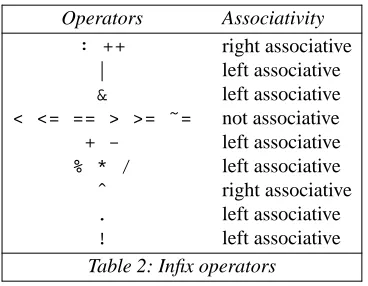
5. Infix Operators
Operators Associativity : ++ right associative
| left associative
& left associative
< <= == > >= ˜= not associative
+ - left associative
% * / left associative
ˆ right associative
. left associative
! left associative Table 2: Infix operators
6. Parallelism Operators
The following operators are used where ginger simulates a parallel machine.
leftchild :: Integer->Integer
leftchild nreturns the processor which is the left child of processornin a binary tree network. If the real network is not a binary tree, then a binary tree network is mapped onto the actual network, and appropriate results are given as if the network were a binary tree.
neighbours :: Integer->[Integer]
returns a list of the processors which are the nearest neighbours of its argument.
parallel :: Integer->*->*->*
has the semantics
parallel n x y = y;
but on a parallel machine indicates that expressionxshould be offshipped to processor
n. When the evaluation ofxis complete, its value is left on processorn, and migrated to its parent processor upon demand from that processor.
rightchild :: Integer->Integer
rightchild n returns the processor which is the right child of processor n in a binary tree network, as forleftchild.
whereis :: *->Integer
returns the number of the processor on which the graph representing its argument is located.
In order for programs written for a parallel machine to evaluate on a non-parallel machine, default defini-tions for the above operators are provided, as follows:
leftchild n = 0; neighbours n = []; rightchild n = 0; parallel n x y = y; whereis x = 0;
7. Divide-and-Conquer
[image:15.595.197.381.74.217.2]provides. Note that these lists are enabled in place of ordinary lists only if the option "-d" is giv en to the commandginger.
element :: [*]->*
returns the element of the singleton listx.
fst :: [*]->*
returns the first element ofsplit x.
issingleton :: [*]->Boolean
returnsTrueif its argument is a singleton list.
reduce :: (*->*->*)->*->[*]->*
is the divide-and-conquer equivalent offoldlandfoldr. It is defined by
reduce f z x =
if isnil x then z
elsif issingleton x then element x
else f (reduce f z (fst x)) (reduce f z (snd x)) endif;
snd :: [*]->*
returns the second element ofsplit x.
singleton :: *->[*]
returns a list containing its one element as argument.
These functions all returnUndefinedif ginger is not running divide-and-conquer lists, for two reasons. First of all,fstandsndcannot be easily defined in terms of conventional lists, and secondly, we felt it prudent to attempt to prevent users from mixing programming methodologies.
Conversely, when ginger is running using divide-and-conquer lists, the following functions cannot be used:
dropwhile foldl foldl1 foldr foldr1 iterate repeat takewhile
8. Bibliography
References
1. T.H. Axford and M.S. Joy, “List Processing Primitives for Parallel Computation,” Computer Lan-guages, 19, 1, pp. 1-17 (1993).
2. R. Bird and P.L. Wadler, Introduction to Functional Programming, Prentice Hall, Hemel Hempstead (1988). ISBN 0-13-484197-2 (pbk).
3. A.J.T. Davie, An Introduction to Functional Programming Using Haskell, Cambridge University Press, Cambridge, UK (1992). ISBN 0-521-27724-8 (pbk).
4. H. Glaser, C. Hankin, and D. Till, Principles of Functional Programming, Prentice-Hall, Englewood Cliffs, NJ (1984). ISBN 0-13-709163-X (pbk).
5. J.R. Hindley, B. Lercher, and J.P. Seldin, Introduction to Combinatory Logic, Cambridge University Press (1972).
6. J.R. Hindley and J.P. Seldin, Introduction to Combinators and λ-Calculus, Cambridge University Press, Cambridge, UK (1986). London Mathematical Society Student Texts 1. ISBN 0-521-31839-4 (pbk).
7. I. Holyer, Functional Programming with Miranda, Pitman (1991). ISBN 0-273-03453-7.
9. M.S. Joy and T.H. Axford, “GCODE: A Revised Standard Graphical Representation for Functional Programs,” ACM SIGPLAN Notices, 26, 1, pp. 133-139 (1991). Also Research Report 159, Depart-ment of Computer Science, University of Warwick, Coventry (1990) and Research Report CSR-90-9, School of Computer Science, University of Birmingham (1990).
10. G. Michaelson, An Introdunction to Functional Programming through Lambda Calculus, Addison-Wesley, Wokingham, Berks. (1989). ISBN 0-201-17812-5.
11. S.L. Peyton Jones, The Implementation of Functional Programming Languages, Prentice Hall, Lon-don, UK (1987). ISBN 0-13-453325-9 (pbk).
12. S.L. Peyton Jones and M.S. Joy, “FLIC - a Functional Language Intermediate Code,” Research Report 148, Department of Computer Science, University of Warwick, Coventry, UK (1989). Revised 1990. Previous version appeared as Internal Note 2048, Department of Computer Science, University College London (1987).
13. D.A. Turner, “A New Implementation Technique for Applicative Languages,” Software - Practice and Experience, 9, pp. 31-49 (1979).
Appendix 1: Formal BNF
Ginger first of all passes its input through the C preprocessor cpp and the ginger input may consequently include cpp directives. These are distinguished by lines commencing with the character#; such lines are ignored by ginger . The BNF which follows assumes such lines have been filtered out.
scr ipt ::= <statement>
| <statement> <script>
statement ::= <definition> ";" | <expression> ";"
definition ::= <identifiers> "=" <expression>
identifiers ::= <identifier> <identifiers>
| <identifier>
definitions ::= <definition>
| <definition> ";" <definitions>
expression ::= <application>
| <abstraction>
| "let" <definitions> "in" <expression> "endlet" | <expression> "where" <definitions> "endwhere" | "if" <expression> "then" <expression> <ifendexp>
ifendexp ::= "else" <expression> "endif"
| "elsif" <expression> "then" <expression> <ifendexp>
simple ::= <real>
| <int>
| <bool>
| <char>
| <str ing> | <list>
| <identifier>
| <operator>
| "(" <expression> ")"
int ::= "-" <digitsequence> | <digitsequence>
real ::= <realA>
| <realA> <exp> <digitsequence> | <realA> <exp> "+" <digitsequence> | <realA> <exp> "-" <digitsequence>
realA ::= <int> "."
| <int> "." <digitsequence>
exp ::= "e" | "E"
bool ::= "True" | "False"
char ::= "’" <singlechar> "’"
str ing ::= """ <str ingterminator>
str ingterminator ::= """
singlechar ::= <hexchar>
| <escapedchar>
| any single character with the exception of single-quote
singlestr ing ::= <hexchar>
| <escapedchar>
| any single character with the exception of double-quote
hexchar ::= "\" <hexinitiator> <hexdigit> <hexdigit> hexinitiator ::= "x" | "X"
escapedchar ::= "\"any character except <hexinitiator>
application ::= <application> <infixoperator> <application>
| <application> <simple>
| <simple>
abstraction ::= "\" <identifier> <expression>
list ::= <nulllist>
| <finitelist>
| <dotdotlist>
nulllist ::= "[" "]"
finitelisttail ::= <expression> "]"
| <expression> "," <finitelisttail>
finitelist ::= "[" <finitelisttail>
dotdotlist ::= "[" <expression> ".." "]"
| "[" <expression> "," <expression> ".." "]" | "[" <expression> ".." <expression> "]"
| "[" <expression> "," <expression> ".." <expression> "]"
identifier ::= <identifier initiator>
| <identifier> <identifierchar>
digitsequence ::= <digit>
| <digit> <digitsequence>
digit ::= "0" | "1" | "2" | "3" | "4" | "5" | "6" | "7" | "8" | "9" hexdigit ::= <digit> | "A" | ... | "F" | "a" | ... | "f"
letter ::= "A" | ... | "Z" | "a" | ... | "z" identifier initiator ::= <letter> | "_"
identifierchar ::= <identifier initiator> | <digit>
operator ::= any predefined operator - see above
infixoperator ::= any predefined infix operator - see above
comment ::= <commentstar t>anything except <commentend><commentend>
commentstar t ::= "/*"
Appendix 2: Running Ginger under UNIX
Ginger is called by the commandginger, and may be called with or without filename arguments; without filename arguments input is from the standard input stream, otherwise from the named files (the Standard Input may be named explicitly with the filename-). The input is then passed through the C preprocessor
cppbefore being parsed.
A number of options are available.
-c The program is compiled only, the intermediate code GCODE sent to the standard output.
-d Divide-and-conquer lists are implemented in lieu of "ordinary" lists.
-Dn Debug facility. The number n, in binary, indicates the amount of debugging to be produced; if n is 0, or is omitted, a list of options will be displayed and ginger will terminate.
-h Gives a short ‘usage’ help message and terminates.
-l Output is "sugared" to display its internal structure. For instance, the string"hello"would be out-put as[’h’,’e’,’l’,’l’,’o’]
-m Messages are output about resource usage, etc.
-Mn Changes size of (virtual) memory to n (default 10000).
-Sn The size of stack is changed to n (default 20).
-#n When evaluation simulates a parallel machine, n processors are utilised.
Appendix 3: Identifiers Defined in Header Files
Several header files are provided, containing useful functions which are sufficiently complex not to be inbuilt Each of these header files may be accessed by (for instance)
#include <stdlib.g>
at the start of the ginger program. For their specific definitions, consult the relevant file.
<stdio.g>
This file contains functions relevant to i/o; in particular, sev eral text formatting functions are provided.
cjustify :: Number->[Char]->[Char]
returns a string, of length its first argument, containing its second argument centered within that string, and padded with blanks.
lay :: [[Char]]->[Char]
takes a list of strings, and concatenates them together separating them with newline characters.
layn :: [[Char]]->[Char]
is aslay, but each string in the argument is prepended with its "line number".
lines :: [Char]->[[Char]]
is the reverse oflay; it takes a string containing newline characters, and returns a list of the substrings separating those newlines.
ljustify :: Number->[Char]->[Char]
returns a string, of length its first argument, containing its second argument, and padded out at the end with blanks.
rjustify :: Integer->[Char]->[Char]
returns a string, of length its first argument, containing its second argument, and padded out at the front with blanks.
spaces :: Integer->[Char]
returns a string, containing only blanks, of length its argument.
<stdlib.g>
This file contains miscellaneous functions.
index :: [*]->[Integer]
when applied to a list of length n will return[0,1,2..n-1]
limit :: [*]->*
takes a list containing values which converge to a limit; that limit is returned.
merge :: [*]->[*]->[*]
scan :: (*->**->*)->*->[**]->[*]
is such thatscan op rappliesfoldl op rto every initial segment of a list, and is defined by:
scan op = g
where
g r x =
if isnil x then [r]
else r : g (op r (hd x)) (tl x) endif
endwhere;
sort :: [*]->[*]
sorts its list argument.
transpose :: [[*]]->[[*]]
Appendix 4: Predefined Functions - Quick Reference
General Functions
Functions marked ‡ cannot be used with divide-and-conquer lists
operator Where defined Type
# inbuilt [*]->Integer
(!) inbuilt [*]->Integer->*
(%) inbuilt Integer->Integer->Integer (&) inbuilt Boolean->Boolean->Boolean (*) inbuilt Number->Number->Number (+) inbuilt Number->Number->Number (++) inbuilt [*]->[*]->[*]
(-) inbuilt Number->Number->Number (/) inbuilt Number->Number->Number (:) inbuilt *->[*]->[*]
(<) inbuilt *->*->Boolean (<=) inbuilt *->*->Boolean (==) inbuilt *->**->Boolean (>) inbuilt *->*->Boolean (>=) inbuilt *->*->Boolean
(ˆ) inbuilt Number->Number->Number (|) inbuilt Boolean->Boolean->Boolean (˜=) inbuilt *->**->Boolean
˜ inbuilt Boolean->Boolean
abs inbuilt Number->Number
acos inbuilt Number->Real
and inbuilt [Boolean]->Boolean
asin inbuilt Number->Real
atan inbuilt Number->Real
cjustify <stdio.g> Number->[Char]->[Char]
code inbuilt Char->Integer
compose inbuilt (*->**)->(***->*)->***->**
concat inbuilt [[*]]->[*]
const inbuilt *->**->*
converse inbuilt (*->**->***)->**->*->***
cos inbuilt Number->Real
decode inbuilt Integer->Char
distribute inbuilt (*->**->***)->(*->**)->(*->***) drop inbuilt Integer->[*]->[*]
dropwhile inbuilt ‡ (*->Boolean)->[*]->[*]
error inbuilt [Char]->Undefined
exp inbuilt Number->Real
filter inbuilt (*->Boolean)->[*]->[*]
floor inbuilt Number->Integer
foldl inbuilt ‡ (*->**->*)->*->[**]->* foldl1 inbuilt ‡ (*->*->*)->[*]->*
foldr inbuilt ‡ (*->**->**)->**->[*]->** foldr1 inbuilt ‡ (*->*->*)->[*]->*
force inbuilt *->*
getenv inbuilt [Char]->[Char]
hd inbuilt [*]->*
id inbuilt *->*
index <stdlib.g> [*]->[Integer]
init inbuilt [*]->[*]
isdigit inbuilt Char->Boolean isletter inbuilt Char->Boolean
isnil inbuilt [*]->Boolean
iterate inbuilt ‡ (*->*)->*->[*]
last inbuilt [*]->*
lay <stdio.g> [[Char]]->[Char] layn <stdio.g> [[Char]]->[Char] limit <stdlib.g> [*]->*
lines <stdio.g> [Char]->[[Char]]
ljustify <stdio.g> Number->[Char]->[Char]
log inbuilt Number->Real
log10 inbuilt Number->Real
map inbuilt (*->**)->[*]->[**]
max inbuilt [*]->*
max2 inbuilt *->*->*
maxint inbuilt Integer
merge <stdlib.g> [*]->[*]->[*]
min inbuilt [*]->*
min2 inbuilt *->*->*
minint inbuilt Integer
neg inbuilt Number->Number
or inbuilt [Boolean]->Boolean
postfix inbuilt *->[*]->[*] product inbuilt [Number]->Number read inbuilt [Char]->[Char] rep inbuilt Integer->*->[*] repeat inbuilt ‡ *->[*]
reverse inbuilt [*]->[*]
rjustify <stdio.g> Integer->[Char]->[Char] scan <stdlib.g> (*->**->*)->*->[**]->[*] showfloat inbuilt Integer->Number->[Char] shownum inbuilt Number->[Char]
showscaled inbuilt Integer->Number->[Char]
sin inbuilt Number->Real
sort <stdlib.g> [*]->[*]
spaces <stdio.g> Integer->[Char]
sqrt inbuilt Number->Real
strict inbuilt *->*->*
sum inbuilt [Number]->Number
system inbuilt [Char]->[]
take inbuilt Integer->[*]->[*] takewhile inbuilt ‡ (*->Boolean)->[*]->[*]
tan inbuilt Number->Real
tinynum inbuilt Real
tl inbuilt [*]->[*]
transpose <stdlib.g> [[*]]->[[*]]
undef inbuilt Undefined
Divide-and-Conquer Functions
operator Where defined Type
element inbuilt [*]->*
fst inbuilt [*]->*
issingleton inbuilt [*]->Boolean
reduce inbuilt (*->*->*)->*->[*]->* singleton inbuilt *->[*]
snd inbuilt [*]->*
Parallelism Operators
operator Where defined Type