• No results found

Basic Relations

N/A
N/A
Protected

Academic year: 2020

Share "Basic Relations"

Copied!
24
0
0

Loading.... (view fulltext now)

Full text

(1)

Basic Relations

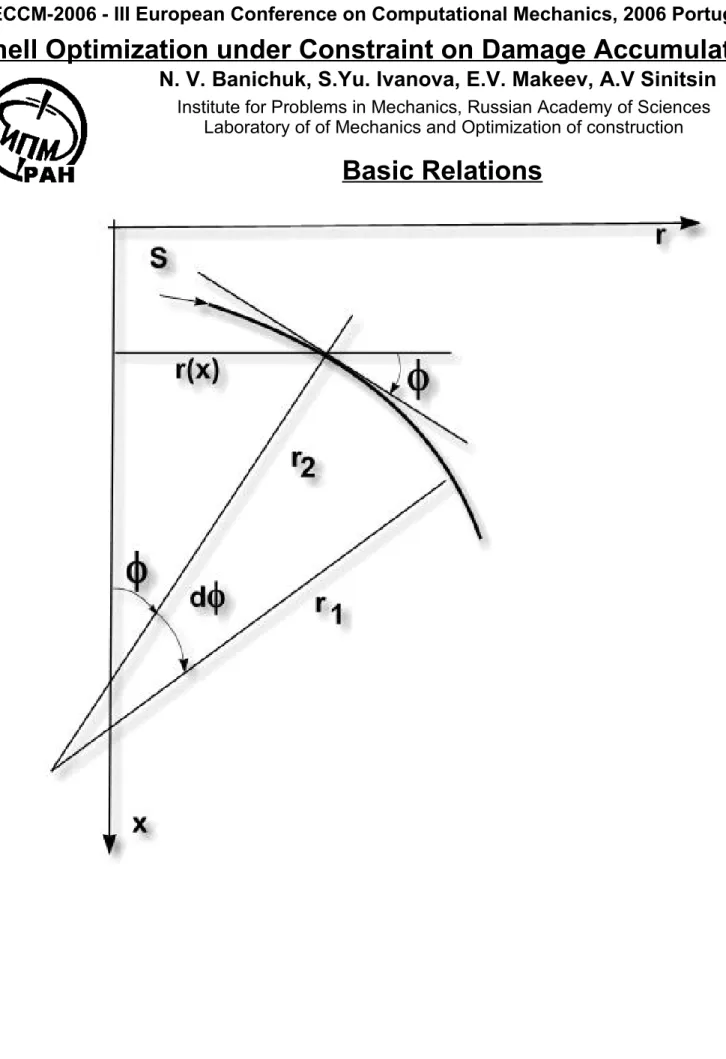
Figure 1 The Forces Action on the Shell r(x) – distance of rotation axis

h(x)-thickness of shel (design variable)

r

1

- meridional and r

2

- circumferential curvature

q-internal pressure R – resultant load

(2)

Basic Relations

(3)

Basic Relations

Figure 2 Geometric Terminology for the Shell

(4)

Basic Relations

 normal membrane forces per unit length



Normal membrane stresses

(5)

Fatigue Crack Growth under Cyclic Loading

Safety condition, K1-stress intensity K1C-given quasi-brittle strength constant

n

cr

-number of cycles, l

cr

- critical crack length before fracture

(6)

Safety Condition n

*

- given number of cycles

Optimized Functional (volume of material)

geometrical constraints

Shape Optimization under Structural Longevity

(7)

Analysis of the Longevity Constraint

Integration

Minimum of n

cr

with respect to l

i

Minimum of n

cr

with respect to 

where

Transformed longivity constraint

(8)

Analysis of the Longevity Constraint n

cr

is the root of the equation

if

than

For m=4 we have solution

(9)

Analysis of the Longevity Constraint Non-dimensional functional and constraints

parameter
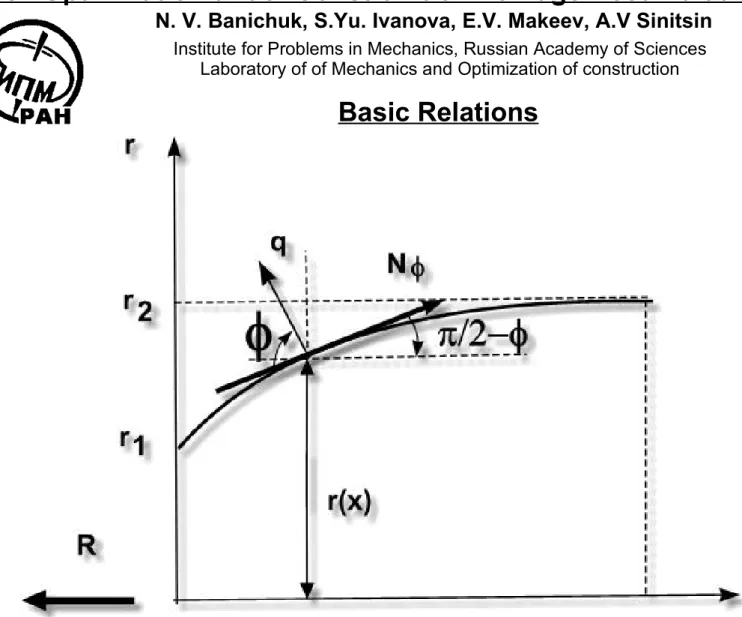
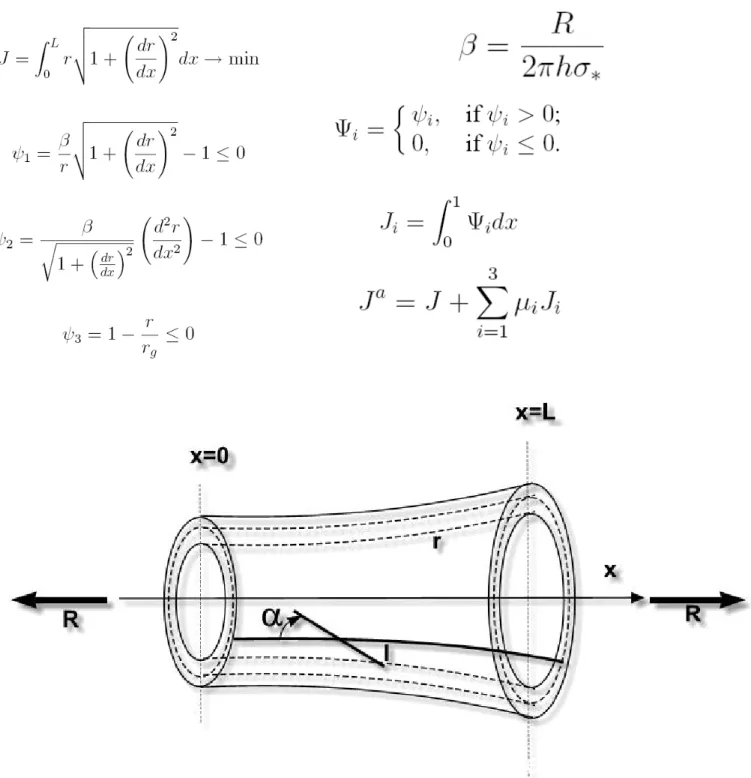
Figure 4 The Shell Loaded by Axisimmetrical Forces

Applied to the Free Ends

(10)

Genetic Algorithm

Modification:

cyclic probability of crossover and mutation, nodes fixation for process axelleration

(11)

Dependence Shell of Iteration Step

Computational Results with Genetic Algorithm

(12)

Computational Results with Genetic Algorithm

(13)

D 1 =2 D 2 =0.1 L=5

Computational Results with Genetic Algorithm

(14)

D 1 =2 D 2 =1 L=5

Computational Results with Genetic Algorithm

(15)

D 1 =2 D 2 =2 L=5

Computational Results with Genetic Algorithm

(16)

D 1 =1.5 D 2 =0.1 L=5

Computational Results with Genetic Algorithm

(17)

D 1 =1.5 D 2 =0.75 L=5

Computational Results with Genetic Algorithm

(18)

D 1 =1.5 D 2 =1.5 D 1 L=5

Computational Results with Genetic Algorithm

(19)

D 1 =1 D 2 =0.1 L=5

Computational Results with Genetic Algorithm

(20)

D 1 =1 D 2 =0.5 L=5

Computational Results with Genetic Algorithm

(21)

D 1 =1 D 2 =1 L=5

Computational Results with Genetic Algorithm

(22)

D 1 =0.5 D 2 =0.1 L=5

Computational Results with Genetic Algorithm

(23)

D 1 =0.5 D 2 =0.25 L=5

Computational Results with Genetic Algorithm

(24)

D 1 =0.5 D 2 =0.5 L=5

Computational Results with Genetic Algorithm

Figure

Figure 1 The Forces Action on the Shellr(x) – distance of rotation axis
Figure 2 Geometric Terminology for the Shell
Figure 4 The Shell Loaded by Axisimmetrical Forces  Applied to the Free Ends

References

Related documents

We prove a modified logarithmic Sobolev inequalities, a Stein inequality and an exact fourth moment theorem for a large class of point processes including mixed binomial processes

Among its performance in top 15 Indian universities, Panjab University registered 6 th rank in share of national collaborative papers, 10 th rank in publication output

Executive education by its very nature is designed to prepare the most promising middle managers for increasing responsibilities at the higher levels of management of their

Unlike in insects and other malacos- tracan crustaceans where the first optic neuropil (the lamina) is closely apposed to the retina, in Parhyale , axons can be seen emerging from

In chapter 2 it was proposed that the most suitable process to perform the synthesis of 5-MOP from 4-MCH was a fed-batch stirred tank reactor, with a certain question mark

The specific entities to be covered include: diffuse prolifer- ative glomerulonephritis; focal proliferative glomeru- lonephritis ; membranous glomerulonephritis; a nti- basement

In the international context of education, service users and carers are considered Experts by experience and col- laborate with social work courses in a different manner:

a) To understand the oxidation of oxidize able matter with a known amount of potassium Chromate, the titration of excess chromate, and the calculation of oxygen used. b) To