http://wrap.warwick.ac.uk/
Original citation:Birrell, Stewart A and Haslam, Roger A.. (2010) The effect of load distribution within military load carriage systems on the kinetics of human gait. Applied Ergonomics, Vol.41 (No.4). pp. 585-590.
Permanent WRAP url:
http://wrap.warwick.ac.uk/53195
Copyright and reuse:
The Warwick Research Archive Portal (WRAP) makes this work of researchers of the University of Warwick available open access under the following conditions. Copyright © and all moral rights to the version of the paper presented here belong to the individual author(s) and/or other copyright owners. To the extent reasonable and practicable the material made available in WRAP has been checked for eligibility before being made available.
Copies of full items can be used for personal research or study, educational, or not-for-profit purposes without prior permission or charge. Provided that the authors, title and full bibliographic details are credited, a hyperlink and/or URL is given for the original metadata page and the content is not changed in any way.
Publisher’s statement:
“NOTICE: this is the author’s version of a work that was accepted for publication in Applied Ergonomics. Changes resulting from the publishing process, such as peer review, editing,
corrections, structural formatting, and other quality control mechanisms may not be reflected in this document. Changes may have been made to this work since it was submitted for
publication. A definitive version was subsequently published in Applied Ergonomics, Vol.41 (No.4). pp. 585-590.
http://dx.doi.org/10.1016/j.apergo.2009.12.004 A note on versions:
The version presented here may differ from the published version or, version of record, if you wish to cite this item you are advised to consult the publisher’s version. Please see the ‘permanent WRAP url’ above for details on accessing the published version and note that access may require a subscription.
The Effect of Military Load Carriage on Ground Reaction Forces
Technical Note
Stewart A Birrell 1 Robin H Hooper 1 Roger A Haslam 1
1Department of Human Sciences, Loughborough University, Leicestershire, LE11 3TU,
UK
Abstract
Load carriage is an inevitable part of military life both during training and operations. Loads carried are frequently as high as 60% bodyweight, and this increases injury risk. In the military, load is carried in a backpack (also referred to as a Bergen) and webbing, these combined form a load carriage system (LCS). A substantial body of literature exists recording the physiological effects of load carriage; less is available regarding the biomechanics. Previous biomechanical studies have generally been restricted to loads of 20 and 40% of bodyweight, usually carried in the backpack alone. The effect of rifle carriage on gait has also received little or no attention in the published literature. This is despite military personnel almost always carrying a rifle during load carriage. In this study 15 male participants completed 8 conditions: military boot, rifle, webbing 8 and 16 kg, backpack 16 kg, and LCS 24, 32 and 40 kg. Results showed that load added in 8 kg increments elicited a proportional increase in vertical and anteroposterior ground reaction force (GRF) parameters. Rifle carriage significantly increased the impact peak and mediolateral impulse compared to the boot condition. These effects may be the result of changes to the vertical and horizontal position of the body’s centre of mass, caused by the restriction of natural arm swing patterns. Increased GRFs, particularly in the vertical axis, have been positively linked to overuse injuries. Therefore, the biomechanical analysis of load carriage is important in aiding our understanding of injuries associated with military load carriage.
Introduction
measure of the impact forces acting on the foot. It is therefore essential in the understanding and prevention of lower extremity injuries [1].
Research investigating the effect of load carriage on GRFs and gait is not widely represented within the literature [1,2,3,4,5,6]. However, conclusions drawn confirm, that as would be expected, both vertical and anteroposterior GRFs produced during gait increase when load is applied to the body. However, the proportionality or rate of this increase has been debated within the literature. The majority of research suggests that the increase in vertical and anteroposterior GRFs is directly proportional to the applied load [2,3,4]. These studies suggest that 1 kg of added load equates to approximately a 10 N increase in force. Other studies suggest that protective mechanisms, such as an increase in double support or decreased walking speed, are activated when carrying heavy loads in an effort to reduce stresses placed on the lower extremities [1,5]. Finally, changes to the GRF parameters of the mediolateral axis have been found to be insignificant [1,4,6].
The primary aim of this research was to examine the effect of progressive 8 kg increments in carried load on GRF parameters. This would help establish base-line GRF data for load carried using the U.K ‘90 Pattern LCS, and investigate heavy military load carriage. The study design allowed other factors to be investigated including the effect of changing the load distribution, and also the potential effects of rifle carriage on GRF parameters.
Technical Description
A Kistler™ force plate (Type 9286A, dimensions 60 x 30 x 5 cm) was used in conjunction with a Coda™ Mpx30 Motion Analysis System to obtain GRF data. Eight channels of kinetic data were sampled by the force plate at 400 Hz. This raw data were then processed via A/D converters situated in the Coda Mpx30 and outputted into CODAmotion v6.64 software. The data were then exported to Microsoft™ Excel for analysis. The force plate was embedded in an 8.4 m walkway. This gave adequate distance before and after the force plate to achieve a natural gait pattern. To measure the walking speed of the participants three pairs of infra-red photoelectric cells (Brower™ SpeedTrap II) were used placed 1.5 m apart from each other. One set recorded speed on approach to the force plate and the other after the force plate. Both speeds had to be within the desired range thus limiting the potential for acceleration or deceleration that would affect the GRFs produced.
The load was carried using a standard issue UK military ‘90 Pattern Short Back Bergen and PLCE (Personal Load Carrying Equipment) waist webbing, which, when worn together form a LCS. A replica SA80 assault rifle, weighing 2.1 kg, was also carried in certain conditions. Participants also wore standard issue military leather boots and woollen socks throughout the duration of the study.
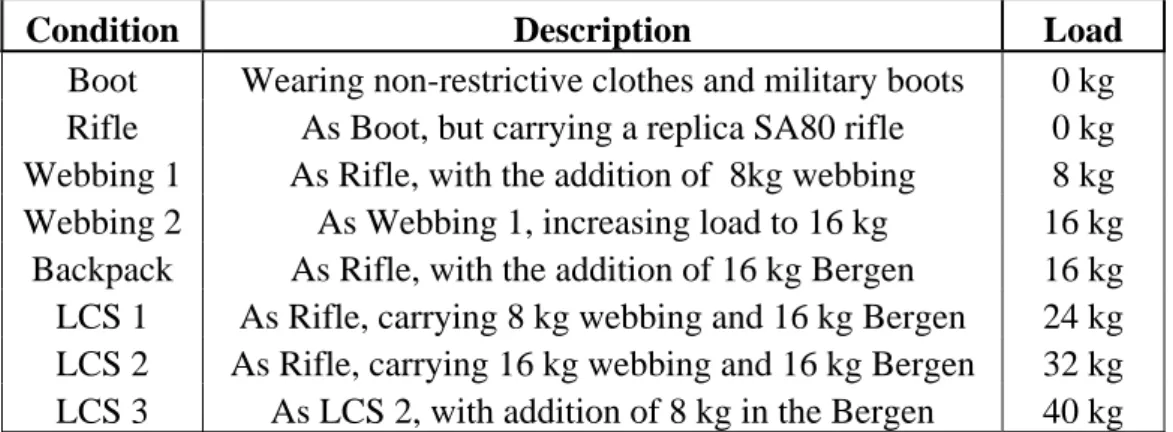
Each participant completed all 8 conditions (table 1), with 10 successful trials in each condition. The force data were sampled at 400 Hz and the target speed throughout was 1.5 m.s-1 (± 5%). A trial was deemed successful if the speed was attained, the participant’s dominant foot struck cleanly on the force plate and if a natural gait pattern was maintained. To ensure participants had familiarised themselves with the load and walking speed an unlimited number of practice walks were allowed. The order the participants completed the conditions were randomised.
Insert Table 1 Here
the rifle added to that of the participant). All data are expressed as N.BM-1 but as explained above this may either be the weight of the participant alone, or with the rifle.
The primary aim of the study was to examine the effects that small, incremental load increases of 8 kg have on selected GRF parameters. For this reason the boot and backpack condition were excluded from this particular section of the analysis (table 1). This is because the rifle condition was considered a more suitable control to the boot condition, as a rifle would be carried during each loading conditions. The backpack condition was also excluded, thus eliminating the issue of having two conditions where the carried load totalled 16 kg. To assess the effects of carried load on GRF parameters a one-way MANOVA was undertaken. To determine significance between the conditions a Bonferroni corrected pairwise comparisons were also conducted. A Paired Student t-test was conducted to assess significance with rifle carriage and changing load distribution. For these comparisons the boot and backpack condition were re-introduced. Significance was accepted at the level of p≤0.05 and all statistical testing was conducted using SPSS v12.0.
Discussion
Effect of Load
centre of mass (CoM) further away from its neutral position when load is added. Research has shown that the less the CoM is displaced the greater the static stability of an individual when carrying load [7].
Insert Table 2 Here
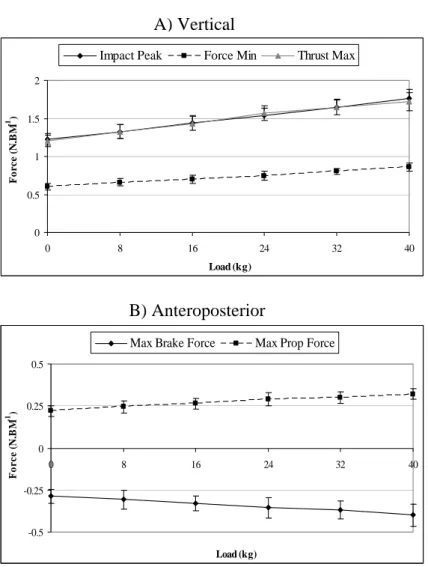
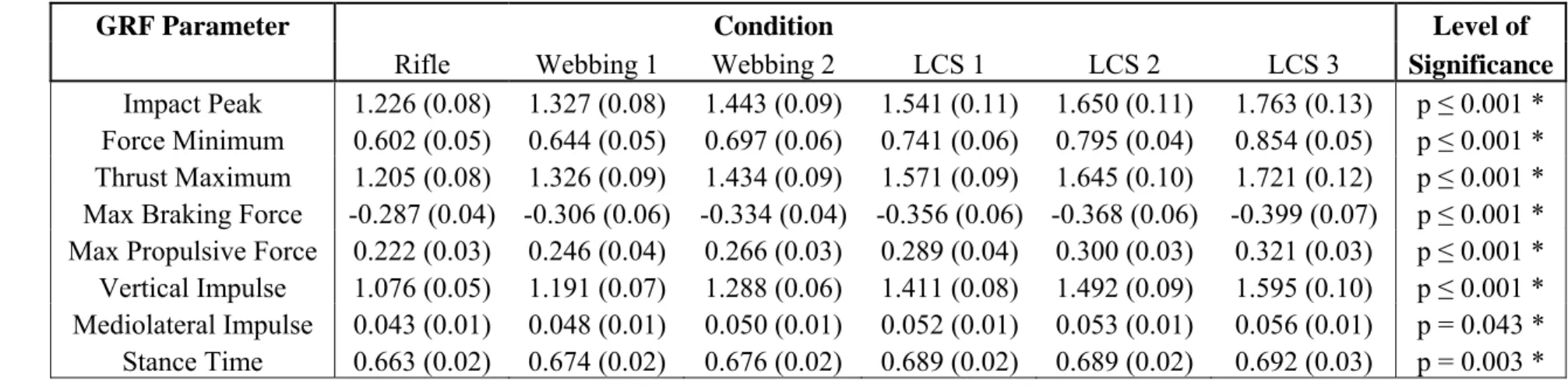
As highlighted previously, the literature on the proportionality of the increase in GRF parameters with applied load is contradictory. Results from the present study support the hypothesis that increases in vertical and anteroposterior GRF with applied load represent a linear relationship when walking at 1.5 m.s-1, even when heavy loads of 40 kg are carried. This suggests that the increase in force is predominantly due to the static effect of the load rather than changes in acceleration of the system [2]. Figure 1 shows the linear increase in measured force against carried load.
Insert Figure 1 Here
These distances or loads could then increase as training advances, as soldiers become more used to the physical activity and as increases in bone mineral density of the lower limb occur. Using linear regression analysis to calculate the increase in impact peak force with load gave this equation: Impact Peak = (0.013 x Load) + 1.223. Load is measured in kg and the values for impact peak are expressed as N.BM-1. The proportion of variation which can be explained by this equation (R2) is 0.780 or 78%.
Rifle Carriage and Load Distribution
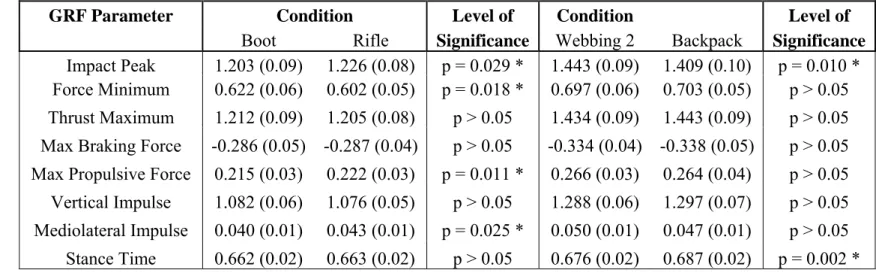
As mentioned in the introduction the study design allowed the effect of rifle carriage and changes to load distribution, with their subsequent affect on GRF, to be analysed. The following section will highlight differences found with the current study, however, more detailed analysis is needed with future research. The effect of rifle carriage was examined by comparing the Boot and Rifle condition and, load distribution by comparing the Webbing 2 and Backpack conditions (table 1). Results in table 3 show that the rifle condition exhibited a greater impact peak, maximum propulsive force and mediolateral impulse, while decreasing the force minimum compared to the boot condition. The most likely mechanism behind these changes to GRF parameters with rifle carriage is either the restriction of natural arm swing patterns, or the load of the rifle being added to the anterior of the body.
Insert Table 3 Here
time it takes to shift the CoM over the base of support, or an increased need for stability. Another factor may be as a result of increased dampening or flexion of the lower limb.
Conclusions
This study aimed to examine the effects of progressive increments in carried load on GRF parameters. Results from the study suggest that both vertical and anteroposterior GRF parameters increase proportionally when load is added in 8 kg increments to a UK standard issue ‘90 Pattern LCS. This increase is observed even when heavy loads of 40 kg are carried. Unlike many other studies significant increases in force generated in the mediolateral axis was also observed with increasing load. This may suggest a decrease in stability as greater loads are carried.
A new finding for this field of research is the effect of rifle carriage on GRFs. Rifle carriage caused an increase in the impact peak, maximum propulsive force and mediolateral impulse while decreasing the force minimum. These effects may be due to the forward shift in the CoM or more likely due to the restricted arm movements while carrying a rifle.
Acknowledgements
This work was sponsored by the UK Ministry of Defence under contract with Dstl.
References
[2] Kinoshita H. Effects of different loads and carrying systems on selected biomechanical parameters describing walking gait. Ergonomics 1985; 28: 1347-1362.
[3] Tilbury-Davis D.C, Hooper RH. The kinetic and kinematic effects of increasing load carriage upon the lower limb. Human Movement Science 1999; 18: 693-700.
[4] Polcyn A, Bensel C, Harman E, Obusek J, Pandorf C, Frykman P. Effects of weight carried by soldiers: Combined analysis of four studies on maximal performance, physiology, and biomechanics. Technical Report No TR-02/010 US Army Research Institute of Environmental Medicine, MA. 2002: 1-64.
[5] Weise-Bjornstal D, Dufek J. The effect of weightload and footwear on the kinetic and temporal factors in level grade backpacking. Journal of Human Movement Science 1991; 21: 167-181.
[6] Lloyd R, Cooke CB. Kinetic changes associated with load carriage using two rucksack designs. Ergonomics 2000; 43: 1331-1341.
[7] Schiffman JM. Load carriage: Quiet stance, postural sway, and balance recovery. Presentation: Natick Soldier Systems Center, Natick, MA. 2004.
[8] Cavanagh P, Lafortune MA. Ground reaction forces in distance running. Journal of Biomechanics 1980; 13: 397-406.
[9] Knapik J. Discharges during US Army basic training: Injury rates and risk factors. Military Medicine 2001; 166: 641-647.
A) Vertical 0 0.5 1 1.5 2
0 8 16 24 32 40
Load (kg) F o r ce ( N .B M -1 )
Impact Peak Force Min Thrust Max
B) Anteroposterior -0.5 -0.25 0 0.25 0.5
0 8 16 24 32 40
Load (kg) F o rce ( N .B M -1 )
Max Brake Force Max Prop Force
Figure 1: Changes to mean vertical (A) and anteroposterior (B) GRF parameters with
Table 1: Description of the conditions used during the trial and total load carried.
Condition Description Load Boot Wearing non-restrictive clothes and military boots 0 kg
Rifle As Boot, but carrying a replica SA80 rifle 0 kg Webbing 1 As Rifle, with the addition of 8kg webbing 8 kg Webbing 2 As Webbing 1, increasing load to 16 kg 16 kg
Table 2: Results showing changes to mean GRF parameters with the addition of 8 kg increments of load from 0 to 40 kg, standard deviation in
parentheses. Significance derived from the overall effect of load on selected parameter, * indicates significance (p≤0.05). Forces are measured in (N.BW-1), Impulses and Rates in ((N.BW-1).s) and Time in (s).
GRF Parameter Condition Level of
Rifle Webbing 1 Webbing 2 LCS 1 LCS 2 LCS 3 Significance
Impact Peak 1.226 (0.08) 1.327 (0.08) 1.443 (0.09) 1.541 (0.11) 1.650 (0.11) 1.763 (0.13) p ≤ 0.001 *
Force Minimum 0.602 (0.05) 0.644 (0.05) 0.697 (0.06) 0.741 (0.06) 0.795 (0.04) 0.854 (0.05) p ≤ 0.001 *
Thrust Maximum 1.205 (0.08) 1.326 (0.09) 1.434 (0.09) 1.571 (0.09) 1.645 (0.10) 1.721 (0.12) p ≤ 0.001 *
Max Braking Force -0.287 (0.04) -0.306 (0.06) -0.334 (0.04) -0.356 (0.06) -0.368 (0.06) -0.399 (0.07) p ≤ 0.001 *
Max Propulsive Force 0.222 (0.03) 0.246 (0.04) 0.266 (0.03) 0.289 (0.04) 0.300 (0.03) 0.321 (0.03) p ≤ 0.001 *
Vertical Impulse 1.076 (0.05) 1.191 (0.07) 1.288 (0.06) 1.411 (0.08) 1.492 (0.09) 1.595 (0.10) p ≤ 0.001 *
Mediolateral Impulse 0.043 (0.01) 0.048 (0.01) 0.050 (0.01) 0.052 (0.01) 0.053 (0.01) 0.056 (0.01) p = 0.043 *
Table 3: Results showing changes to selected mean GRF parameters for rifle carriage (boot and rifle condition) and load distribution (webbing 2
and backpack condition), standard deviation in parentheses. * indicates significant difference between conditions (p≤0.05).
GRF Parameter Condition Level of Condition Level of
Boot Rifle Significance Webbing 2 Backpack Significance
Impact Peak 1.203 (0.09) 1.226 (0.08) p = 0.029 * 1.443 (0.09) 1.409 (0.10) p = 0.010 *
Force Minimum 0.622 (0.06) 0.602 (0.05) p = 0.018 * 0.697 (0.06) 0.703 (0.05) p > 0.05
Thrust Maximum 1.212 (0.09) 1.205 (0.08) p > 0.05 1.434 (0.09) 1.443 (0.09) p > 0.05
Max Braking Force -0.286 (0.05) -0.287 (0.04) p > 0.05 -0.334 (0.04) -0.338 (0.05) p > 0.05
Max Propulsive Force 0.215 (0.03) 0.222 (0.03) p = 0.011 * 0.266 (0.03) 0.264 (0.04) p > 0.05
Vertical Impulse 1.082 (0.06) 1.076 (0.05) p > 0.05 1.288 (0.06) 1.297 (0.07) p > 0.05
Mediolateral Impulse 0.040 (0.01) 0.043 (0.01) p = 0.025 * 0.050 (0.01) 0.047 (0.01) p > 0.05