University of Warwick institutional repository: http://go.warwick.ac.uk/wrap
A Thesis Submitted for the Degree of PhD at the University of Warwick
http://go.warwick.ac.uk/wrap/36369
This thesis is made available online and is protected by original copyright. Please scroll down to view the document itself.
ct_4;
‘4,tvERs
p
44;
ry-x-y$
Ma .0
'k:t140
-WAKWICK
EXPORT MARKETING STANDARDISATION
AND ITS INFLUENCE ON EXPORT PERFORMANCE:
A STRUCTURAL MODEL EXAMINATION
by
Luis Filipe Costa Lages
A thesis submitted in the fulfilment of the requirements for the Degree of Doctor of Philosophy
Marketing and Strategic Management Warwick Business School
Warwick University
ACKNOWLEDGEMENTS
A great many people and institutions have contributed in a variety of ways to this
research study. Primary acknowledgements belong to Fundacdo para a Ciencia e a
Tecnologia (Portugal/EU) who generously funded this research.
My next debt is to my supervisors. Vivienne Shaw for believing in this project since
the first day and T.C. Melewar for his prompt interest in my study after Viv moved to
Otago University. Their comments, advice and criticisms are greatly appreciated.
Next, I thank Robin Wensley, whose keen intelligence, imaginative comments and
love for research was quite inspiring. My gratitude is extended to all the other
members of the Marketing and Strategic Management (MSM) group and my fellow
"doc" students for the comments made in many stimulating seminars at the Business
School. I am also indebted to John McGee (MSM Group Convenor), Sheila Frost and
Angela Ames for helping me to overcome a series of seemingly unending problems
associated with the development and implementation of a large international survey.
Outside Warwick, I am particularly grateful to Tim Ambler (LBS) for his excellent
ideas. A special note of thanks goes also to Minoo Farhangmehr (Minho), Luiz
Moutinho (Glasgow) and Aviv Shoham (Technion) for their useful insights and
never-failing support in international conferences. The following academics, who were
willing to meet me and discuss my research, are also acknowledged: David Arnold
(HBS), Carlos Brito (Oporto), George Day (Wharton), Adamantios Diamantopoulos
(Loughborough), Sandy Jap (Sloan), and Dipak Jain and Nancy Rothbard (Kellogg).
The collaboration of over 600 Portuguese managers was also invaluable to the
completion of this thesis. I am indebted to each one of them as well as to their
organisations for providing the data used in the empirical part of this dissertation.
Finally, but by no means least, I am grateful to my family: Maria do Ceti, Antonio
Jose and Cristiana Raquel. Most of all, I would like to express my deep appreciation
for the understanding, encouragement, love and support of my wife Carmen. It is to
Carmen and my family that this dissertation is dedicated. They stood fast by me
during these four years while providing me the indispensable emotional stability to
ABSTRACT
This dissertation aims to present an integrated approach to measuring and linking the
variables involved in the 'export marketing standardisation-export performance'
phenomenon. Drawing on the literature and primary data (exploratory study, main
survey and follow-up interviews), twenty-three hypotheses are developed,
simultaneously tested and discussed. Due to the magnitude of the valid sample (519
export market ventures), it was possible to use Confirmatory Factor Analysis (CFA)
and Structural Equation Modelling (SEM) with Weighted Least Squares (WLS)
(Curran et al., 1996).
At the measurement level, this thesis tests previous measures and presents new
constructs for the key elements discussed in the literature. Fourteen constructs
emerged across the following topics: degree of marketing programme standardisation,
export performance, and internal and external forces.
At the causality level, this research study suggests that both export marketing
standardisation and export performance are simultaneously affected by internal and
external forces. These simultaneous relationships have never been incorporated by
past empirical research. More importantly, findings suggest that past performance
plays a crucial role in the determination of current export marketing strategy. Export
performance must be seen not only as an outcome, as traditionally discussed in the
literature, but also as an antecedent of export marketing strategy.
Future investigations are encouraged to incorporate these new research directions in
the study of the 'export marketing strategy — export performance' relationship.
Additional guidelines are provided to stimulate future discussion and research in the
field. The literature and the findings are also used to generate a number of
implications for managers and public policy makers.
DECLARATION
This is to declare that:
• I am responsible for the work submitted in this thesis.
• This work has been written by me.
• All verbatim extracts have been distinguished and the sources specifically
acknowledged.
• During the preparation of this thesis a number of papers were prepared as listed
below. The remaining parts of the thesis are unpublished.
1. Lages, L. F. (2000). A conceptual framework of the determinants of export
performance: Reorganizing key variables and shifting contingencies in export
marketing. Journal of Global Marketing, 13(3), 29-51.
2. Lages, L. F. (2000). Wine marketing and wine business: Insights from Portuguese
exporters. Special Issue in International Wine Marketing, Wine Industry Journal,
15(4), 25-33.
3. Lages, L. F. and T. C. Melewar (2000). A factor analytic study of export
performance and its determinants: Evidence from Portuguese exporters. EMAC
2000, CD Rom Proceedings, Erasmus University, Rotterdam, Netherlands:
European Academy of Marketing.
4. Lages, L. F. and T. C. Melewar (2000). An exploratory study of Portuguese
exporters marketing strategies. EMAC 2000, CD Rom Proceedings, Erasmus
University, Rotterdam, Netherlands: European Academy of Marketing.
5. Lages, L. F. (1999a). Relationship between export performance and degree of
marketing programme adaptation: Adding to the traditional contingent approach.
Revista Portu_guesa de Gestdo, (2), 57-78.
6. Lages, L. F. (1999b). Changing gear in the export marketing-performance
relationship. Proceedings of the 8th International Business Association
7. Lages, L. F. (1999c). Strategic orientation and export marketing: The case of
Portuguese wine exporters. Proceedings of the 9th World Marketing Congress (pp.
464-470). Malta: Academy of Marketing Science.
8. Lages, L. F. (1999d) Marketing lessons from Portuguese wine exporters: The
development and application of a conceptual framework. Journal of Wine
Research, 10(2), 5-23.
9. Lages, L. F. and T.C. Melewar (1999). Determinants of export performance and
moderating effects of marketing programme adaptation: A review, conceptual
framework and research hypotheses. Warwick Business School Working Paper,
No. 317.
10. Lages, L. F. (1998). Componentes-chave de uma estrategia de marketing para
exportadores de vinho do porto [Key components of a marketing strategy for Port
wine exporters]. Revista Portuguesa de Marketing, 4(6), 93-101.
11. Lages, L. F. and V. Shaw (1998a). The marketing strategies of Port wine
companies. International Journal of Wine Marketing, 10(2), 5-23.
12. Lages, L. F. and V. Shaw (1998b). Marketing strategy and export performance:
The case of Port in the UK. Proceedings of the 1998 Annual Conference of the
Academy of Marketing (pp. 624-625). Sheffield, UK: Sheffield Business School.
• This work has not previously been submitted within a degree programme at this or
TABLE OF CONTENTS
ACKNOWLEDGEMENTS ii
ABSTRACT
DECLARATION . iv
TABLE OF CONTENTS 1
LIST OF TABLES 7
LIST OF FIGURES 8
LIST OF EQUATIONS 8
CHAPTER 1- INTRODUCTION 9
1.1 THE SCOPE OF THE RESEARCH 9
1.1.1 Export marketing strategy-export performance research 9
1.1.2 The unit of analysis 12
1.2 RESEARCH OBJECTIVES 13
1.3 THE ANALYTICAL APPROACH 13
1.4 EXPECTED RESEARCH CONTRIBUTION 14
1.4.1 The theoretical contribution 15
1.4.2 The managerial contribution 15
1.4.3 The contribution to public policy making 17
1.5 THE STRUCTURE OF THE THESIS 19
CHAPTER 2- LITERATURE REVIEW 23
2.1 THEORETICAL BACKGROUND 25
2.1.1 Export performance measurement 25
2.1.2 Marketing programme standardisation 29
2.1.2.1 The standardisation perspective 32
2.2 DETERMINANTS OF EXPORT PERFORMANCE 46
2.2.1 Impact of internal factors on export performance 46
2.2.1.1 Firm characteristics and competencies 46
2.2.1.2 Management attitudes and perceptions 48
2.2.1.3 Management characteristics 50
2.2.1.4 Product characteristics 51
2.2.2 Impact of external factors on export performance 53
2.2.2.1 Domestic market characteristics 53
2.2.2.2 Industry characteristics 54
2.2.2.3 Foreign market characteristics 55
2.2.3 Impact of marketing programme standardisation on export performance 56
2.2.3.1 Product standardisation 57
2.2.3.2 Promotion standardisation 58
2.2.3.3 Price standardisation 59
2.2.3.4 Distribution standardisation 60
2.3 DETERMINANTS OF MARKETING PROGRAMME STANDARDISATION 61
2.3.1 Impact of internal factors on marketing programme standardisation 62
2.3.1.1 Firm characteristics and competencies 62
2.3.1.2 Management attitudes and perceptions 63
2.3.1.3 Management characteristics 64
2.3.1.4 Product characteristics 65
2.3.2 Impact of external factors on marketing programme standardisation 66
2.3.2.1 Domestic market characteristics 66
2.3.2.2 Industry characteristics 67
2.3.2.3 Foreign market characteristics 68
2.3.3 Impact of export performance on marketing programme standardisation 70
2.4 DISCUSSION AND DIRECTIONS FOR FURTHER RESEARCH 72
2.5 SUMMARY 79
CHAPTER 3- EXPLORATORY STUDY 87
3.1.1 Portuguese exports growth 88
3.1.2 The growing importance of Portuguese companies in the international arena 89
3.2 METHODOLOGY FOR THE EXPLORATORY RESEARCH 91
3.2.1 Exploratory sample and procedure 91
3.2.2 Levels of analysis 92
3.2.2.1 Firm level: In-depth interviews on a particular firm 92
3.2.2.2 Sector level: In-depth interviews on a particular industry 93
3.2.2.3 Economy level: 1n-depth interviews across several industries 95
3.3 PRELIMINARY FINDINGS 95
3.3.1 Export performance measurement 96
3.3.2 The uncontrollable factors 98
3.3.3 The controllable factors 103
3.3.4 The export marketing strategy-export performance relationship 103
3.4 SUMMARY 106
CHAPTER 4- MODEL DEVELOPMENT AND HYPOTHESES 111
4.1 RESEARCH PROPOSITIONS AND THE CONCEPTUAL FRAMEWORK 112
4.2 RESEARCH HYPOTHESES AND OPERATIONAL MODEL 116
4.2.1 Determinants of export performance 117
4.2.2 Determinants of marketing programme standardisation 121
4.2.3 Summary of hypotheses and the operational model 124
4.3 SUMMARY 125
CHAPTER 5- METHODOLOGY 127
5.1 DATA COLLECTION 127
5.1.1 The unit of analysis 127
5.1.2 Development and pre-test of the survey instrument 128
5.1.3 Administration of the survey instrument 131
5.1.4 Profile of the sample 133
5.2 DATA ANALYSIS 136
5.2.1 Exploratory factor analysis and coefficient alpha 137
5.2.2 Confirmatory factor analysis 138
5.2.3 Structural equation modelling 140
5.2.4 Triangulation 141
5.3 SUMMARY 143
CHAPTER 6- FINDINGS 146
6.1 DATA SIMPLIFICATION: EFA AND COEFFICIENT ALPHA 146
6.2 THE MEASUREMENT MODEL: CFA 156
6.3 THE TESTING OF HYPOTHESES 165
6.3.1 Measures of model fit 167
6.3.2 SEM examination 167
6.4 SUMMARY 172
CHAPTER 7- DISCUSSION 175
7.1 THE DETERMINANTS OF THE CURRENT YEAR'S PERCEIVED EXPORT PERFORMANCE 177
7.1.1 Product standardisation and export performance 177
7.1.2 Promotion standardisation and export performance 178
7.1.3 Price standardisation and export performance 179
7.1.4 Distribution standardisation and export performance 182
7.1.5 Service standardisation and export performance 183
7.1.6 Firm size and export performance 186
7.1.7 Foreign market development and export performance 187
7.2 THE DETERMINANTS OF MARKETING STRATEGY STANDARDISATION 188
7.2.1 The determinants of product standardisation 188
7.2.1.1 The last year's export performance and product standardisation 189
7.2.1.2 Firm size and product standardisation 190
7.2.1.3 Export commitment and product standardisation 192
7.2.1.4 Competition and product standardisation 193
7.2.2 The determinants of promotion standardisation 196
7.2.2.1 The last year's export performance and promotion standardisation 197
7.2.2.2 Competition and promotion standardisation 199
7.2.3 The determinants of price standardisation 199
7.2.3.1 The last year's export performance and price standardisation 199
7.2.3.2 Domestic support for exporting and price standardisation 200
7.2.3.3 Competition and price standardisation 201
7.2.4 The determinants of distribution standardisation 202
7.2.4.1 The last year's export performance and distribution standardisation 202
7.2.4.2 Management experience/expertise and distribution standardisation 203
7.2.4.3 Foreign market development and distribution standardisation 204
7.2.5 The determinants of service standardisation 206
7.2.5.1 The last year's export performance and service standardisation 206
7.2.5.2 Competition and service standardisation 207
7.3 THE DETERMINANT OF THE LAST YEAR'S PERCEIVED EXPORT PERFORMANCE 208
7.3.1 The last year's financial and perceived export performance 208
7.4 SUMMARY 209
CHAPTER 8- CONCLUSION 212
8.1 RESEARCH CONTRIBUTIONS 212
8.1.1 Theoretical implications 212
8.1.1.1 The research hypotheses 213
8.1.1.2 New empirical findings 221
8.1.1.3 The methodological contribution 222
8.1.2 Implications for managers 223
8.1.3 Implications for public policy makers 227
8.2 RESEARCH LIMITATIONS 228
8.2.1 The method of sampling 228
8.2.2 The level of analysis / modelling 230
8.3 DIRECTIONS FOR FURTHER RESEARCH 233
8.3.2 The causality level 234
8.3.3 Other research directions . ... 236
8.4 SUMMARY 237
APPENDIX 1- QUESTIONNAIRE: ENGLISH VERSION AND SOURCES Apl
APPENDIX 2- QUESTIONNAIRE: PORTUGUESE VERSION Ap18
APPENDIX 3- QUESTIONNAIRE: BACK-TRANSLATION Ap33
LIST OF TABLES
TABLE 2-1: EXPORT PERFORMANCE MEASURES 82
TABLE 2-2: OPERATIONALISATION OF EXPORT PERFORMANCE MEASURES 83
TABLE 2-3: IMPACT OF INTERNAL FACTORS ON EXPORT PERFORMANCE 84
TABLE 2-4: IMPACT OF EXTERNAL FACTORS ON EXPORT PERFORMANCE 85
TABLE 2-5: IMPACT OF MARKETING MIX STANDARDISATION ON EXPORT PERFORMANCE 86
TABLE 3-1: CONTACTS WITHIN THE SAME FIRM (FIRM LEVEL) 108
TABLE 3-2: CONTACTS WITHIN THE SAME INDUSTRY (SECTOR LEVEL) 108
TABLE 3-3: CONTACTS ACROSS DIFFERENT INDUSTRIES (ECONOMY LEVEL) 109
TABLE 4-1: LIST OF RESEARCH HYPOTHESES 124
TABLE 5-1: ANALYSIS OF POPULATION VERSUS SAMPLE BY STRATA 144
TABLE 5-2: PROFILE OF SAMPLE AND POPULATION BY TYPE OF EXPORTER 144
TABLE 5-3: DESCRIPTIVE STATISTICS 145
TABLE 6-1: EXPLORATORY FACTOR ANALYSIS-FACTORS COMPOSITION, SOURCES AND DESCRIPTIVE
STATISTICS FOR 68 QUESTIONNAIRE ITEMS 147
TABLE 6-2: THE 18 ITEMS REMOVED FROM THE 86 QUESTIONNAIRE ITEMS DURING
THE PURIFICATION PROCESS (EFA AND RELIABILITY TESTS) 151
TABLE 6-3: THE PURIFIED VERSION OF EXPLORATORY FACTOR
ANALYSIS-FACTOR LOADINGS FOR THE 68 QUESTIONNAIRE ITEMS 153
TABLE 6-4: EIGEN-VALUES, VARIANCES AND COEFFICIENT ALPHAS FOR THE 14 EFA FACTORS 155
TABLE 6-5: THE 12 ITEMS REMOVED DURING THE PURIFICATION PROCESS (CFA WITH WLS) 162
TABLE 6-6: CFA WITH WLS- FACTOR LOADINGS, T-VALUES
AND RELIABILITY FOR THE 61 MEASURES 163
TABLE 6-7: ASSESSMENT OF RESEARCH HYPOTHESIS (SEM, WLS) 169
TABLE 6-8: THE 86 QUESTIONNAIRE ITEMS BEFORE THE PURIFICATION PROCESS 173
LIST OF FIGURES
FIGURE 1-1: THESIS STRUCTURE 22
FIGURE 4-1: A CONCEPTUAL FRAMEWORK OF THE EXPORT MARKETING
STANDARDISATION-EXPORT PERFORMANCE RELATIONSHIP 116
FIGURE 4-2: AN OPERATIONAL MODEL OF THE EXPORT MARKETING
STANDARDISATION-EXPORT PERFORMANCE RELATIONSHIP 125
FIGURE 6-1: SEM WITH WLS- ESTIMATES, T-VALUES, SIGNIFICANCE LEVELS AND
VARIANCE EXPLAINED 166
FIGURE 7-1: SUMMARY ASSESSMENT OF SEM WITH WLS 176
LIST OF EQUATIONS
CHAPTER 1
Introduction
The subject of this thesis is export marketing standardisation and its influence on
export performance. It is addressed by developing and testing an empirical model
which links current export performance with internal and external forces, export
marketing standardisation and past export performance.
This first chapter begins by discussing the scope of the research and the analytical
approach. Then, the contribution of the research to theory, practice and public policy
making is outlined. Finally, the structure of the thesis is summarised.
1.1 THE SCOPE OF THE RESEARCH
This section introduces the focus of the thesis by discussing the stream of export
marketing research that is our main concern namely, the export marketing strategy
-export performance relationship - and the unit of analysis (-export venture) that forms
the basis of the research.
1.1.1 EXPORT MARKETING STRATEGY-EXPORT PERFORMANCE RESEARCH
During the last four decades, world exports have grown exponentially until they have
The economic growth of many countries is strongly dependent on the exporting
success of their firms. This is the case of Portugal. The most recent data shows that,
between 1993 and 1998, Portuguese exports increased 60 per cent (National Statistics
Institute, 1999). For 2000-2001 it is also expected an increase of 7.1 per cent in the
export activity together with an economic growth rate of 3.6 per cent (European
Commission, 11/04/2000).
As a consequence of the growing importance of the exporting activity, export
marketing has become a priority for both practitioners and academics. During the last
two decades, there has been a great deal of empirical research in this area, leading to
the resurgence and development of seven major research streams in the literature
(Katsikeas et al., 1998: 323). These are concerned with (1) the factors that stimulate a
firm's decision to initiate exporting or maintain export commitment; (2) the problems
or barriers faced by firms when initiating exporting or maintaining export operations;
(3) the elements which influence the export development process; (4) network
relationships and their role in export development and internationalisation; (5) the
nature, importance and utilisation of information acquired for export marketing
decision making; (6) the nature and effectiveness . of governments' promotion and
assistance programmes; and, finally, (7) the identification of the factors that influence
export performance, with a particular emphasis on the export marketing strategy
-export performance relationship. Undoubtedly, a rich understanding of -export
marketing is provided by analysing this last research stream (Katsikeas et al., 1998).
This thesis also focuses on this research stream, specifically when looking into the
unclear and remains an unsolved issue amongst practitioners and academics
(Whitelock and Pimblett, 1997; Zou et al., 1997). Similarly to many studies in the
field of export marketing (e.g. Aaby and Slater, 1989; Axinn 1988; Axinn et al., 1996;
Ayal, 1982; Chetty and Hamilton, 1993; Diamantopoulos and Schlegelmich, 1994;
Evangelista, 1996; Koh, 1991; Matthyssens and Pauwels, 1996; Madsen, 1998;
McGuiness and Little, 1981; Shoham, 1998; Styles, 1998; Zou and Stan, 1998; Zou et
al., 1998), this research focus on export marketing strategy and export performance.
Other issues related to different disciplines (e.g. finance, accounting, operations) or to
other aspects of marketing strategy and performance measurement are therefore
outside the scope of this work.
The discussion of the. relationship between export marketing strategy and export
performance can be traced back to Tookey's (1964) work. Since then, major efforts
have been made to combine the results of previous research through reviews of the
literature (Aaby and Slater, 1989; Bilkey, 1978; Ford and Leonidou, 1991) and
meta-analytical works (Chetty and Hamilton, 1993; Leonidou, 1998; Madsen, 1987; Zou
and Stan, 1998). These studies emphasise the lack of unifying frameworks and
synthesis in this field. The lack of conceptual agreement together with a fragmented
collection of measurements has naturally led to divergent findings (Aaby and Slater,
1989; Cavusgil and Zou, 1994; Shoham, 1998; Styles, 1998) and has hindered
theoretical development (Zou et al., 1998). Today it is commonly argued that further ..
advances in export marketing depend on the provision of a more integrated approach
to conceptualising and measuring the variables involved in the exporting
previous studies and applies analytical techniques, thereby allowing greater
consistency in conceptualising and measuring export performance and its
determinants (Cavusgil and Zou, 1994; Katsikeas et al., 1998; Zou et al., 1998).
Furthermore, researchers are being encouraged to develop more conceptual and
empirical studies which analyse the relationship between internal and external forces,
export marketing strategy and export performance. Works which integrate the key
elements associated with the export marketing phenomenon are particularly welcome
(Katsikeas et al., 1998; Young, 1995).
1.1.2 THE UNIT OF ANALYSIS
The unit of analysis employed in this research is the firm's export venture. This
follows the emphasis of a large number of previous empirical studies (e.g. Bilkey,
1982; Madsen, 1989; Cavusgil and Kirpalani, 1993; Cavusgil and Zou, 1994). Export
venture is meant as the export of a single product or product line to a single foreign
market. This unit of analysis is chosen because if a firm is analysed as a whole, it is
extremely difficult to isolate the effects of specific actions (Cavusgil and Kirpalani,
1993).
In line with the work of Styles and Ambler (Styles, 1996, 1998; Styles and Ambler,
1994), only the main export venture (MEV) of a firm is selected. This was done for
three reasons. First, if more than one export venture from the same firm were used,
this would inevitably reduce variance. Second, there are many managers who just
define the strategy for the MEV and have no strategy for the other export venture(s).
Third, exploratory research suggests that in many cases the strategy used by a firm for
short, if more than one export venture from the same firm were used, this would
increase the likelihood of bias.
1.2 RESEARCH OBJECTIVES
In this thesis it is proposed to analyse export marketing standardisation and its
influence on export performance by examining Portuguese export market ventures.
The specific objectives of this thesis are:
1. To assess the potentially important role of past export performance in influencing
export marketing strategy, specifically export marketing standardisation.
2. To determine the characteristics of successful export ventures.
3. To contribute to a more comprehensive understanding of the simultaneous links
(both direct and indirect relationships are analysed) among internal and external
forces, export marketing strategy and export performance.
4. To provide an empirical study of firms based in Portugal: an emergent economy
which is strongly dependent on the success of the exporting activity of its firms.
5. To lay a theoretical and empirical foundation on which further research can be
based and to provide a research relevant to managers and public policy makers.
1.3 THE ANALYTICAL APPROACH
In order to understand the export marketing standardisation - export performance
relationship, this research draws on the literature as well as primary data collected
During the last few years, the growing understanding of the export marketing
phenomenon (Katsikeas et al., 1998) has been accompanied by a statistical revolution
which has completely transformed social science research (Hair et al., 1998). The
research approach used in previous export marketing research, described by Cavusgil
and Zou (1994: 2) as being of a "simplistic nature", has given way to the application
of sophisticated techniques of analysis that make it possible to simultaneously
measure and test the complex relationships among the variables involved in the
exporting phenomenon (Hoang, 1998; Shoham, 1999; Styles, 1996). This approach is
also used in this thesis to analyse the data gathered through the main survey:
Confirmatory Factor Analysis (CFA), associated with psychometrics, is combined
with the Structural Equations Model (SEM) from econometrics.
Given the magnitude of the valid sample (519 exporters), it was possible to use
Weighted Least Squares (WLS), an asymptotically distribution free method of
estimation (Curran et al., 1996) that has not previously been employed in (export)
marketing research. This provides a way to simultaneously assess the quality of
measurement (CFA) and examine the predictive relationships among the latent
variables (SEM) while remaining insensitive to the ordinal nature of the scales and
non-normality of the data (WLS) (Browne, 1984).
1.4 EXPECTED RESEARCH CONTRIBUTION
It is hoped that this thesis will make a significant contribution at the theoretical level
and will also assist managers and public policy makers by providing a number of
1.4.1 THE THEORETICAL CONTRIBUTION
This thesis aims to contribute at the theoretical level along the following dimensions:
theory extension, conceptualisation and measurement, testing and generalisation, and
replication.
First, at the theory extension level, the aim is to broaden the scope of export
marketing strategy - export performance theory. In this respect, this thesis is offered as
an additional contribution to the field of export marketing rather than as an empirical
study which aims to replace preceding theories and models in the area. The research
sets out to clarify the export marketing strategy - export performance relationship and,
at a later stage, to systematise this complex phenomenon in a structural model.
Secondly, at the conceptualisation and measurement level, the research seeks to
resolve existing confusion by re-testing variables used in preceding studies.
Additionally, it develops new variables which should help future researchers to
operationalise internal and external forces, export marketing strategy and export
performance.
Thirdly, the research seeks to contribute to theory testing and generalisation by
testing hypotheses from a cross-sectional and cross-size sample of export ventures.
Finally, through the re-testing of hypotheses used in previous research, a contribution
is also offered at the replication level.
1.4.2 THE MANAGERIAL CONTRIBUTION
modern companies (Albaum and Strand, 1998). Managers must look to exporting as
an attempt to improve firms' overall performance with low risks. Exporting demands
much less management involvement and capital investment than other
internationalisation processes through which production or services are moved abroad
(e.g. in joint ventures, franchising, and wholly owned subsidiaries) (Paliwoda, 1993).
A firm may benefit from exporting activity at different levels. By exporting, firms
may expand the market beyond the limits set by the domestic market. Competing in
only the domestic market leads to an excessive dependency on that market. By
diversifying into more economies, it is possible to remove this limitation while also
reducing the overall operating costs (e.g. costs associated with marketing, production,
R&D and technology) by increasing production. Exporting may also be used to absorb
a firm's excess capacity. One typical situation is when product's lines are subject to
seasonal demand. By exporting to a foreign market, firms may compensate for such
seasonality by stabilising sales. Another situation concerns the flowing off of products
which are already considered obsolete for the domestic market. By exporting to
markets that are less developed technologically, it is possible to extend the life cycle
of these products (Nelson, 1999). Exporting is also a way to enhance managers' skills.
By developing strategies to compete abroad against other firms, managers can
improve their marketing expertise and enhance their ability to protect the domestic
market.
Thus, there are several reasons that support a firm's involvement and managerial
interest in exporting. Participation in foreign markets can be very rewarding and is
a firm's exporting process usually face higher levels of uncertainty and risk then the
managers who focus on the domestic market (Styles, 1996). Without considering the
contingent forces affecting exporting operations, these managers cannot expect to be
successful (Czinkota and Ronkainen, 1995). An understanding of these forces can
thus help managers to assess the strategic direction of their firms while helping them
to select the best environment in which to become active. By (re-)defining the export
strategy and adjusting it to the internal and external environments, managers may also
reduce risk and uncertainty and, consequently, improve export performance. Thus, in
order to assist managers to improve their firms' export performance, several
guidelines on how to adjust export marketing strategy to the contingent forces will be
provided.
1.4.3 THE CONTRIBUTION TO PUBLIC POLICY MAKING
As a consequence of the growing importance of public policy making for international
marketing practice, there is an increasing need to develop more policy-oriented
international marketing research (Czinkota, 2000). Over the last four decades, the
major industrialised nations have become increasingly interdependent in economic
terms. There are now over 100 free trade agreements which provide new opportunities
for exporting companies (Branch, 2000). These agreements have been developed both
at the global and regional level. From a global perspective, the General Agreement on
Tariffs and Trade (GATT) and now the World Trade Organisation (WTO) have made
major contributions to reduce trade barriers and develop international trade. The 1994
round of negotiations alone predicted to increase global exports by more than $755
At the regional level, one example is the North American Free Trade Agreement
(NAFTA) between the United States, Mexico and Canada, which might be expanded
in future to other Latin American countries. Similarly, the emergence of the European
Union (EU) is based on several trade agreements between the present membership of
15 states, with the potential to expand in the near future to the countries of Central and
Eastern Europe. A number of trade accords have also been developed by the
Association of South East Asian Nations (ASEAN), which now has ten members, and
MERCOSUR, which unites six Latin American countries. All these agreements
demonstrate the strong interest of international public policy makers in reducing the
number of business barriers and encouraging firms to go global.
From the point of view of a national government, exporting is attractive because
"home products are exported, jobs stay at home and foreign currency is induced,
which has a positive effect on the nation's balance of payment" (Nelson, 1999: 6).
This encourages national governments to implement export promotion programmes
that match or counterbalance the promotion efforts of other nations (Czinkota et al.,
1996). Normally, this support falls into the following categories: marketing support,
export information and advice, production support, finance and guarantees (Elvey,
1990). Trade associations may also develop a number of supporting activities with the
aim of helping firms to increase their participation in international trade. All these
supporting programmes tend to be designed to help domestic firms to enter and
maintain their positions in foreign markets.
Both trade agreements and the various types of support provided to exporters show the
encouragement of international trade. However, in each case it is essential to evaluate
the support provided, its competitive impact and effectiveness (Czinkota et al., 1996).
The present research seeks to identify the "optimum" export marketing practice and to
show how firms are actually using the support provided by the EU, national
governments and trade associations in the definition of their export strategy. In so
doing, it is hoped that the research will be of help to national and international public
policy makers in planning and refining the substance of their support and will
contribute to reduce "the policy gap in international marketing" (Czinkota et al.,
2000).
1.5 THE STRUCTURE OF THE THESIS
This study is divided into eight chapters, the first of which is the introduction. This is
followed by a literature review (Chapter 2) and an account of the exploratory research
(Chapter 3). These two initial stages of research are then joined together in a
conceptual framework leading to the development of a set of hypotheses to be tested
(Chapter 4). After defining the methodological approach to be used in the main study
(Chapter 5), attention is given to the findings that emerge from the process of data
collection (Chapter 6). The statistical results are then discussed in relation to the
literature review and the managerial insights provided during the follow-up interviews
(Chapter 7). Finally, the conclusions, research limitations and directions for further
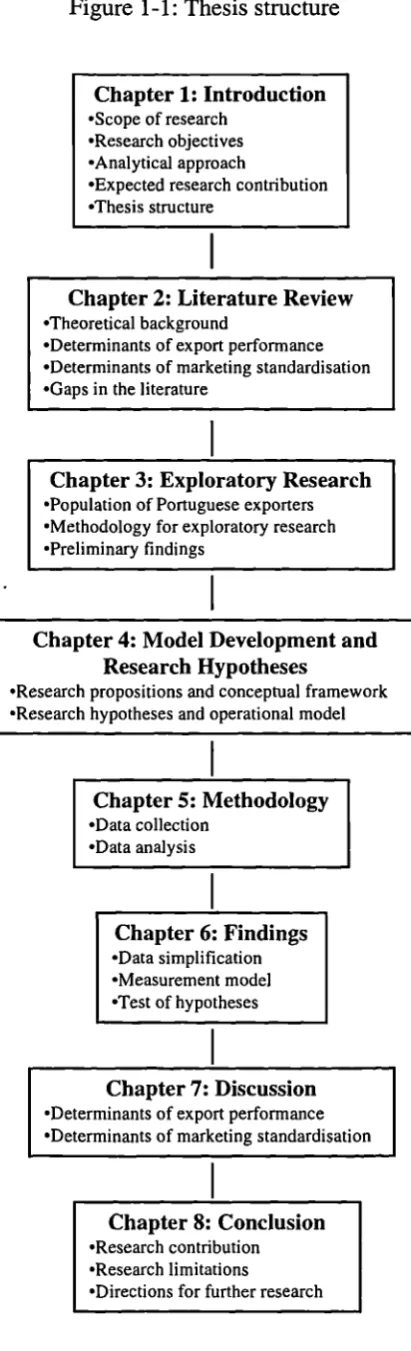
research are presented (Chapter 8). The structure of this thesis (see Figure 1-1) is
similar to that used by Styles (1996). A more detailed analysis of the contents of the
After this introduction (Chapter 1), Chapter 2 is concerned with the relevant literature
pertaining to the export marketing strategy - export performance relationship. Initially,
it presents the background to export performance measurement and distinguishes three
major approaches to the marketing standardisation controversy: standardisation,
adaptation and contingency. It then outlines the present state of knowledge concerning
the key determinants of export performance and marketing programme
standardisation. Finally, the major gaps in the literature are identified.
Chapter 3 introduces the population of Portuguese exporters and presents an overview
of their growing importance in the international arena. Then, the results of the
exploratory research are presented. This research was conducted with 25 managers at
three different levels: (1) the firm, (2) the sector, and (3) the economy (Pettigrew and
Whipp, 1998).
In Chapter 4, after establishing a bridge between the theory and key exploratory
findings, a conceptual framework is developed. Twenty-three hypotheses are then
integrated in an operational model of the export marketing strategy - export
performance relationship.
In Chapter 5 the methodology used to test the hypotheses and the operational model
developed in Chapter 4 is presented. The various steps and procedures associated with
data collection and analysis are discussed in detail.
The survey data and their analysis are presented in Chapter 6. During the main survey,
data were collected from 590 export ventures originating from the same number of
CFA with WLS) the various variables exhibited in the operational model, the 23
research hypotheses are tested (SEM with WLS). Eighteen of the hypotheses are
confirmed, three are refuted and two are revealed to be insignificant. A model which
summarises all the tested relationships is also presented.
Chapter 7 examines the extent to which the results support or refute each of the 23
hypothesis. The discussion is supported by the export marketing literature and
"between methods triangulation". The statistical findings are crossed with the findings
from ten follow-up interviews.
Finally, in Chapter 8, the research contribution to export marketing theory are
presented, and the key implications for export business practitioners and public policy
makers are discussed. The research limitations are discussed, and possible directions
Figure 1-1: Thesis structure
Chapter 1: Introduction
•Scope of research •Research objectives •Analytical approach
•Expected research contribution •Thesis structure
Chapter 2: Literature Review •Theoretical background
•Determinants of export performance •Determinants of marketing standardisation •Gaps in the literature
Chapter 3: Exploratory Research •Population of Portuguese exporters •Methodology for exploratory research •Preliminary findings
Chapter 4: Model Development and Research Hypotheses
•Research propositions and conceptual framework •Research hypotheses and operational model
Chapter 5: Methodology •Data collection
•Data analysis
Chapter 6: Findings •Data simplification •Measurement model •Test of hypotheses
Chapter 7: Discussion •Determinants of export performance •Determinants of marketing standardisation
Chapter 8: Conclusion •Research contribution •Research limitations
CHAPTER 2
Literature review
Despite the fact that exporting is becoming one of the fastest growing economic
activities, recent articles still maintain that there is a lack of a strong theoretical
framework in exporting marketing research (Cavusgil and Zou, 1994; Katsikeas et al.,
1998; Young, 1995; Zou and Stan, 1998). Some authors are of the opinion that the
immaturity of export marketing research is mainly due to the lack of interest in
unifying and synthesising the findings of previous studies (Cavusgil and Nevin, 1981;
Katsikeas et al., 1998; Young, 1995). This chapter seeks to fill this apparent gap in the
literature.
There has been a body of literature which specifically considers the virtues of
marketing mix standardisation and adaptation (Boddewyn et al., 1986; Buzzell, 1968;
Cavusgil et al., 1993; Hill and Still, 1984; Hite and Fraser, 1988; Jain, 1989; Samiee
and Roth, 1992; Shoham, 1996; Wang, 1996). Much of this research, however, has
been undertaken in the general context of international marketing with fewer
academics concentrating specifically on the debate in the field of export marketing. By
reviewing preceding conceptual and empirical studies it is expected to contribute to
the development of this particular area.
marketing process ignore both internal and external determinants of export
performance (Donthu and Kim, 1993). Indeed, very recently, when commenting on
the advances in exporting marketing theory and practice, Katsikeas et al. (1998)
pointed out that a richer understanding of export marketing is provided by the analysis
of contingent elements. Thus, another aim of this chapter is to look at the influence of
the contingent elements on export performance.
Over several decades both managers and academics have been concerned with
identifying the environmental factors which might influence performance in
international markets. However, there is little consensus not only as to the key factors
which impact on export performance but also as to how export performance should be
defined and measured (Das, 1994; Diamantopoulos and Schlegelmilch, 1994).
Previous studies on export performance measurement are also addressed in this
chapter.
Thus, in drawing all of the different strands of literature together, this chapter will be
divided into six sections. After this brief introduction, the second section will discuss
export performance measurement. Additionally, it will look into the marketing
standardisation controversy, discussing the three schools of thought associated with it
(i.e. standardisation, adaptation, and middle of the road approaches). The third section
will focus on the analysis of the determinants of export performance: internal, external
and marketing programme standardisation. The fourth section will look at the factors
affecting the degree of marketing programme standardisation: internal factors,
external factors, and past export performance. In the fifth section, through the
and directions for further research presented. Finally, conclusions are presented.
2.1 THEORETICAL BACKGROUND
In this section, two bodies of the export literature are discussed. Firstly, the various
theories about export performance measurement are expanded. Then, the three
approaches associated with the marketing standardisation controversy are presented
(i.e. standardisation, adaptation, and contingency approaches).
2.1.1 EXPORT PERFORMANCE MEASUREMENT
In today's complex business world, export performance measurement is an
indispensable guide for any company to analyse its level of international success. It is
particularly important for managers as they make future international commitments
based on this issue (Madsen, 1998). In fact, performance is central to the effective
management of the marketing process (Kinnear and Taylor, 1991). Despite its
importance, there is a lack of research concerning its relationship with marketing
programme standardisation (Hamel and Prahalad, 1985; Hout et al., 1982; Huszagh et
al., 1986; Jain, 1989) as well as no consensus about its conceptual and operational
definition (Das, 1994; Shoham, 1998; Zou et al., 1998). As Bonoma and Clarke
(1988:1) comment, "perhaps no other concept in marketing's short history has proven
as stubbornly resistant to conceptualisation, definition, or application". Indeed, the
task of dealing with export performance may become very complicated because there
are a large number of conceptual and operational definitions (Diamantopoulos and
Schlegelmilch, 1994).
credibility of the measures (i.e. financial and non-financial) and on the ways in which
one measures it (i.e. objective vs. subjective terms). There are two main approaches to
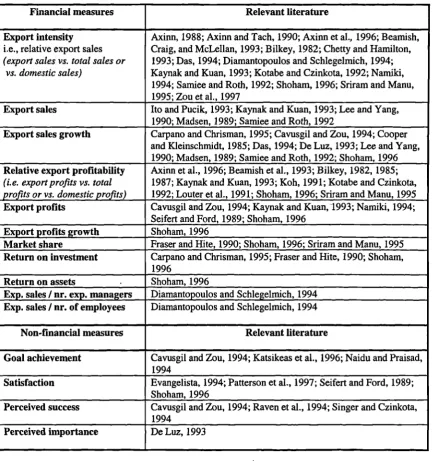
measuring export performance (see Table 2-1) - financial and non-financial measures
(Zou and Stan, 1998).
While the use of non-financial variables is still rare at the international level
(Evangelista, 1994), financial variables are very popular (Das, 1994). Financial
measures can be divided into static measures such as export intensity, export sales and
export profit intensity, and dynamic measures which include export sales and export
profit growth (Bilkey, 1984; Donthu and Kim, 1993; Madsen, 1987; Matthyssens and
Pauwels, 1996). Most empirical investigations use export intensity and export profit
intensity. Other financial measures, which are not so common, include export sales,
export profits, export profits growth, market share, return on investment, return on
assets, and ratios of export sales to number of export managers and to number of
export employees.
However, there are some limitations associated with the exclusive use of financial
variables (Axinn et al., 1994; Cavusgil, 1984a; Dalli, 1994; Evangelista, 1994;
Katsikeas et al., 1996; Madsen, 1989; Yang et al:, 1992). One of the key limitations
concerns the fact that some variables such as export intensity and export profit
intensity are dependent on the firm's overall performance and not just export
performance (Axinn et al., 1994; Dalli, 1994). Obtaining accurate financial
information at the export level is a difficulty acknowledged by some researchers
(Katsikeas et al., 1996; Yang et al., 1992). Furthermore, managers are not only guided
(Madsen, 1989). The 'strategic choice' school of thought asserts that management
action is guided by a manager's perceived reality of the internal and external
environment, rather than by an objective reality (Child, 1972). Similarly, with regard
to performance evaluation, managers use their own perceptions of performance, rather
than objective values, in order to formulate their own decisions (Bourgeois, 1980).
Export managers might, therefore, be unwilling or unable to respond effectively to
absolute values of export performance (Katsikeas et al., 1996; Shoham, 1996).
In addition, there are problems associated with a comparison of financial export
performance across industries, firms and products. What might be a tremendous
success for one company, may be a failure for another (Covin, 1991; Evangelista,
1994). The existing differences in terms of characteristics of the market, level of
competition and technology intensity might lead to a comparison of measures that do
not have the same meaning across the various sectors (Katsikeas et al., 1996). Finally,
as suggested by Cavusgil (1984a), export performance measures do not indicate
whether or not a firm has adequately exploited existing export opportunities. Thus, the
exclusive use of financial measures to operationalise export performance presents
several limitations. Nevertheless, it is possible to overcome some of these limitations
with the inclusion of some non-financial measures (Bijmolt and Zwart, 1994;
Cameron, 1986). The use of non-financial measures will allow managers to give their
personal interpretations and revelations taking as a basis their understanding of the
context in which a firm is operating.
Both financial and non-financial measures can be operationalised using either
measures (e.g. sales, profit, market share) have been associated with objective,
normally absolute, terms, non-financial measures (e.g. satisfaction levels, goal
achievement, success levels) have been associated with subjective terms (e.g.
manager's perception) (Katsikeas et al., 1996).
Following Bonoma and Clarke's (1988) work, as well as Aaby and Slater's (1989)
review, several empirical studies (see Table 2-2) have already shown evidence that
supports the reliability and validity of non-financial and subjective measures of export
performance. Table 2-2 presents a compilation these studies. For each study, both
export performance measures (i.e. financial and non-financial) and export
performance terms (i.e. objective or subjective) are presented.
These studies suggest that, provided that these variables are properly measured, the
arguments on the basis of these criticisms may be turned into strengths. Furthermore,
they might be "replicable, constant and valid across managers, settings and situations"
(Evangelista, 1994:210). For example, 'satisfaction' is a measure that has been used
increasingly in recent years at the exporting level (Evangelista, 1994; Patterson et al.,
1997; Shoham, 1996). After being introduced by Bonoma and Clarke (1988) in the
marketing field, it was empirically tested by Seifert and Ford (1989) in the export
field. Using a measure such as satisfaction, managers might be able to evaluate export
performance, taking into consideration the following factors: a firm's context,
responsiveness level to the existing export opportunities, and differentiation between a
firm's export performance and a firm's overall performance. Therefore, by measuring
satisfaction it might be possible to assess "the effectiveness of a marketing
terms of results [and those] that actually accrue from the programme" (Bonoma and
Clarke, 1988: 64).
In summary, due to the advantages and disadvantages associated with the various
types of measures, the use of multiple measures of export performance is advisable
(Cameron, 1986). As Bijmolt and Zwart (1994) point out, although it is possible to
measure export performance with one variable, in order to capture the complexity of
export success, it is advisable to construct a scale based on a set of different variables.
2.1.2 MARKETING PROGRAMME STANDARDISATION
Recent articles show that the standardisation debate is still unclear (Zou et al., 1997)
and it remains an unsolved issue amongst practitioners and academics (Whitelock and
Pimblett, 1997). There is a conceptual ambiguity about this issue, with several
approaches (Goshal, 1987; Hamel and Prahalad, 1985) and definitions being
suggested (Zou et al., 1997). Sorenson and Wiechmann (1975:38), define
standardisation as the use of "the same advertising [or better, promotion], pricing,
product, and distribution approach in more than one national market". Similarly, Zeid
(1981:419) presents a standardised strategy as "selling a standard product to different
foreign markets (...) with one uniform marketing mix".
Buzzell's (1968) definition, despite being an early one, still seems to be probably the
most accomplished and enlightened approach to this debate. He uses the definition to
introduce the contingency perspective, while defining both standardisation and
adaptation. Buzzell's (1968:103) states:
supported by identical promotional programmes, in several different
countries. At the other extreme, completely 'localised' marketing
strategies would contain no common elements whatsoever.
Obviously, neither of these extremes is often feasible or desirable."
Buzzell (1968) suggests that what exists is a continuum between the two extremes:
pure standardisation and pure adaptation. Since there are many factors (e.g. market
characteristics, industry conditions, legal aspects) affecting the degree of
standardisation, none of the extremes is suitable. This principle is the basis of the
contingency perspective, also known as the "middle of the road approach". The main
strength of the contingency perspective is based on the fact that it recognises both
advantages and disadvantages associated with both adaptation and standardisation,
and asserts that the adequate degree of standardisation is contingent upon a variety of
internal and external factors (Jain, 1989; Zou and Cavusgil, 1996).
After Buzzell's (1968) work, two approaches to the standardisation controversy have
been introduced: standardisation of marketing programmes/marketing mix
(programme-oriented standardisation) and standardisation of marketing processes
(process-oriented standardisation). This two-view approach was initially presented by
Sorenson and Wiechmann (1975) in an early work that consisted of an executive
survey of 27 multinationals operating in the consumer goods industry.
Marketing processes are concerned with the procedures followed by a company in
developing marketing decisions. Sorenson and Wiechmann (1975) present a
marketing process as the intellectual method used for approaching a marketing
arrive at a decision. According to Kreutzer (1988), the standardisation of a process
relates to the structures and processes for development, implementation and control of
marketing concepts, as well as the information processes connected with them. It
therefore relates to the management of the marketing components and implies the
tools that aid in programme development and implementation (Jain, 1989).
On the other hand, a marketing programme is concerned with various aspects of the
marketing mix such as product (e.g. design, positioning, packaging), promotion (e.g.
message, contents, theme), price (e.g. credit terms, trade margins, price charged) and
distribution (e.g. modes of transportation, role, functions and type of middlemen
used). Some authors (e.g. Dahringer and Muhlbacher, 1991; Huszagh et al., 1986)
argue that the standardisation level of most marketing programmes can be placed in
one of four stages. As Dahringer and Muhlbacher (1991:39) state: "a fully
standardised marketing mix is not often found. More frequently the mix will progress
toward complete standardisation, starting with product (Stage 1), then adding
promotion (Stage 2), price (Stage 3), and finally distribution (Stage 4)". The
standardisation of marketing programmes also relates to the identification of factors
involved in the development of a marketing mix strategy, such as the internal factors
and external factors affecting a marketing strategy (Cavusgil and Zou, 1994; Jain,
1989).
The present investigation, similar to other investigations in the field (e.g. Quelch and
Hoff, 1986; Jain, 1989; Sorenson and Wiechmann, 1975; Douglas and Wind, 1987),
rather than analysing marketing processes, deals with the understanding of the issues
Another way to look at standardisation is to examine (1) marketing strategies that are
applied to different world markets or (2) domestic marketing strategies that are
applied to foreign markets (Cavusgil and Zou, 1994; Zou et al., 1997). The first
perspective requires a comparison of the marketing strategies used for various
international markets. This particular approach is more concerned with the exploration
of the environmental differences between the world markets and their impact on the
marketing mix elements (Picard et al., 1988; Samiee and Roth, 1992). The second
perspective is concerned with the extent to which it is possible to use the domestic
strategies in international markets. This type of approach necessitates looking at the
environmental similarities and differences between home and foreign markets, as well
as their impact on marketing strategies (Bartels, 1968; Buzzell, 1968). Recent
empirical research (Cavusgil and Zou, 1994; Shoham and Albaum, 1994; Stewart,
1998) suggests that few studies deal with the application of domestic marketing
programmes to foreign markets. The present study will follow this approach.
2.1.2.1 The standardisation perspective
During the 1960s, with the appearance of the first standardisation advocates, a blend
of new ideas arose. In addition to the arguments that had been presented during the
1950s by the defenders of an adaptation strategy, new arguments began to be brought
forward by the advocates of a pro-standardisation strategy, particularly through works
in the field of advertising (Dunn, 1966; Elinder, 1961; Roostal, 1963; Fatt, 1967). As
a consequence, this decade became known as the 'decade of confusion' with regard to
the standardisation controversy (Agrawal, 1994). In the early 1980s, after the debate
Weinrauch and Rao, 1974; Wiechmann, 1976), Levitt (1983) was able to re-launch
this controversy 'in new clothes' (Bradley, 1995:112). With his polemical article,
"The globalization of markets", the debate over adapted/differentiated versus
standardised/global strategies was then followed by major authors in the marketing
and strategy fields (Hamel and Prahalad, 1985; Kotler, 1986; Ohmae, 1985; Porter,
1986; Quelch and Hoff, 1986; Sheth, 1986; Wind, 1986).
The first supporters of a pro-standardisation strategy (Dunn, 1966; Elinder, 1965;
Roostal, 1963; Fatt, 1967) were from the advertising field. Both Elinder (1961, 1965)
and Roostal (1963) took the European market as an example of why a standardised
strategy in the advertising field could be successful. They believed that "an
international advertising campaign with a truly universal appeal (could) be effective in
every market" (Fatt, 1967:61). Elinder (1965) drew attention to the fact that there was
an implicit need for advertising to become international. According to Elinder (1965),
although Europeans read and speak different languages, there are millions of
Europeans living under similar conditions with similar consumption habits. In the mid
1960s, Dunn (1966) argued that US print advertisements were transferable to Europe
and the Middle East. In the following year, Fatt (1967) argued that a growing school
of thought held that even different peoples are basically the same. In fact, according to
this author, in the late 1960s, many international advertisers were already using
campaigns with worldwide themes. One year later, with the contribution of both
Bartels' (1968) and Buzzell's (1968) work, the standardisation debate expanded to the
other areas of marketing, including the 4Ps approach.
arguments supporting the standardisation approach, particularly concerning
production and core product issues. According to Levitt (1983), only global
companies would be able to achieve long-term success by concentrating on what
everyone wants. He believed that if a company does not commit basic failures, and if
it "forces costs and prices down and pushes quality and reliability up [...] customers
will prefer its world-standardised products" (Levitt, 1983: 94). This means that it is
necessary for firms to focus on standardised strategies, especially concerning
production/product issues.
The trend towards the homogenisation of the markets (Buzzell, 1968; Ohmae, 1989;
Levitt, 1983) also leads to the possibility of using economies of scale in many other
fields, such as research .and development (R&D) and marketing strategies. As Ohmae
(1985, 1985b) points out, companies may treat the world as a global market, in
particular, with regard to the triad of Europe, Japan and USA. The consumer patterns
tend to become uniform among these countries.
Another key argument of standardisation supporters was related to the tremendous
advances in technology. According to Levitt (1983:92), during the 1980s technology
was a new force that led to the appearance of a "new commercial reality - the
emergence of global markets for standardised consumer products on a previously
unimagined scale of magnitude". As a consequence of technological development,
well-managed companies could now change from selling customised items to selling
world-standardised products. These companies could benefit from enormous
economies of scale in production, distribution, marketing, and management (Levitt,
consumers would prefer to give up some of their preferences for products that could
be priced cheaply and simultaneously advanced, functional and reliable (Levitt, 1983).
However, technology is not the only factor favouring standardisation. According to
Hout et al. (1982), the advantages of increased volume may also come from larger
production plants, efficient logistics networks, distribution, and research and
development.
Kreutzer (1988) presented an analytical framework to help companies decide whether
standardisation could be helpful to them. According to this author, cost-cutting
potential and control unproductive parallel work (e.g. in terms of R&D) are some of
the arguments in favour of standardisation. Quelch and Hoff (1986) have expressed a
similar view. According to these authors, the key advantages associated with
standardisation are lower operating costs and effective co-ordination (that will enable
the companies to develop their marketing ideas). Important also in the standardisation
arguments are some underlying assumptions including the homogenisation of
customer needs and interests, customer willingness to sacrifice some preferences (e.g.
design and functions) for lower prices with equivalent quality, and the achievement of
substantial economies of scale in production and marketing (Douglas and Wind,
1987).
Given the above views on the advantages of standardisation, researchers also
acknowledge that there are several barriers to standardisation (e.g. Boddewyn et al.,
1986; Buzzell, 1968; Shoham, 1995; Whitelock and Pimblett, 1997), such as
government regulations (Cavusgil et al., 1993; Cavusgil and Zou, 1994; Kreutzer,
1987; Grosse and Zinn, 1990; Hill and Still, 1984).
Both the barriers and underlying assumptions of the pro-standardisation approach will
be discussed in the following sections, when comparing the standardisation with the
adaptation approach, as well as in the context of a contingency approach.
2.1.2.2 The adaptation perspective
Buzzell (1968:103) defines marketing strategy adaptation as "a localised marketing
strategy which contains no common elements". Similarly, Zeid (1981: 419) defines an
"adaptation strategy" as "changing (...) products and other marketing mix elements to
meet the different needs of overseas markets (having different marketing mixes)."
During the 1950s, both practitioners and academics were clearly in favour of an
adaptation approach (Agrawal, 1994). Barlow (1953), Pratt (1956), Horn and Gomez
(1959) and Kramer (1959) were some amongst the first academics to support the
adaptation of advertising strategy. Barlow (1953), in an early investigation about US
manufacturing subsidiaries in Mexico, was the first to signal the need for a marketing
strategy adaptation in order to fit the local conditions. The arguments behind these
primary works are mainly concerned with the diverse characteristics associated with
any host country, such as the politico-legal, economic and socio-cultural
environments. The differences between the various countries in terms of customs
(Pratt, 1956), tastes, purchasing power, education, language, ways of living (Horn and
Gomez, 1959), tradition, religion, economic conditions (Kramer, 1959) were among
some of the first arguments in favour of an adaptation approach. Similarly, a recent
differences in the foreign markets, that is, differences in terms of market nature and
the number of elements inherent to market planning differentiation.
Several studies (Douglas and Urban, 1977; Douglas and Wind, 1987; Garreau, 1981;
Kahle, 1978; Mitchell, 1983; Saegert et al., 1987) argue that there are facts supporting
an increasing diversity of behaviour across different countries as well as between
regions and subcultural segments within a country. In addition, recent empirical
evidence (Craig et al., 1992) suggests that customer needs and interests among most
industrialised nations seem to be diverging rather than converging. Craig et al. (1992)
have looked at 15 macro variables using 18 industrialised nations. They have
concluded that despite increased interaction and communications between
industrialised nations, .they are not becoming more similar in terms of
macro-environment characteristics.
A key argument for the supporters of an adaptation strategy is that a standardised
strategy is often solely associated with a product orientation. Further, as asserted by
Douglas and Wind (1987), it is necessary to take into consideration all the factors of a
marketing strategy, and not be exclusively product-driven. Many studies (e.g. Day and
Wensley, 1988; Jaworski and Kohli, 1993; Kohli and Jaworski, 1990; Lusch and
Laczniak, 1987; Narver and Slater, 1990) have already demonstrated that having a
market orientation, rather than a product orientation, may improve performance. In
addition, companies that are product-oriented are more vulnerable to attacks from
overseas competition (Cavusgil and Zou, 1994; Kotler, 1996). As suggested by Kotler
(1996), if a company opts for a standardisation strategy, it may be able to achieve
what the consumer wants. Therefore, in order to achieve a better performance, when
competing on a worldwide scale, companies may be forced to adapt their international
marketing strategy (Buzzell, 1968; Hill and Still, 1984; Novell and Walters, 1972;
Wind and Douglas, 1972).
As noted earlier, standardisation advocates are concerned with achieving low costs
through substantial economies of scale in production and marketing. However,
adaptation advocates argue that costs of production are only one of several factors that
influence the final cost of a product (Douglas and Wind, 1987). Different authors
(Bartlett and Ghoshal, 1987; Douglas and Wind, 1987) argue that with the appearance
of flexible factory automation methods, it became possible to supply the markets in an
efficient and adapted way. A similar view was expressed in Rabstejnek's (1989)
theoretical work, when pointing out the primacy of a differentiation strategy over a
cost leadership strategy. A cost leadership strategy is usually associated with the
possibility of offering low prices. Contrary to Levitt's (1983: 94) opinion, that if a
company "forces costs and prices down and pushes quality and reliability up [...]
customers will prefer its world-standardised products", Douglas' and Craig's (1983)
research on the performance of US multinationals . in foreign markets, reveals that in
many markets there is an increasing desire for multiple product features, quality and
service. Furthermore, Douglas and Wind (1987) argue that having standardised lower
prices is very risky. Firstly, this is because a low price positioning is vulnerable in the
long-term, and secondly, a standardised low price may be 'overpriced' for some
markets and 'underpriced' for others.
differing politico-legal, economic and socio-cultural environment factors associated
with any host country; b) worldwide customer patterns seem to be diverging rather
than converging; c) a market-driven, rather than product-driven strategy, allows a
better competitive position and may improve performance; d) cost of production is
only one of several factors influencing the final cost of a product; e) the increasing
desire for multiple product features, quality and service rather than for low pricing;
and f) a standardised price may also not be the 'adequate' price, and a low price is
vulnerable in the long-term.
2.1.2.3 The contingency perspective
It is clear that there are pros and cons associated with both sides: adaptation and
standardisation. While there are some internal and external factors pushing for an
adaptation strategy, there are other factors that might support a more standardised
strategy (e.g. Akaah, 1991; Baalbalci and Malhotra, 1993; Cavusgil et al., 1993;
Cavusgil and Zou, 1994; Douglas and Wind, 1987; Hove11 and Walters, 1972; Jain,
1989; Kashani, 1989; Kreutzer, 1988; Samiee and Roth, 1992; Shoham, 1996;
Tuncalp, 1990; Yip, 1989). Due to the notoriety and actuality of this issue
(Evangelista, 1996), recent literature about the standardisation controversy stands on
the contingency perspective of international marketing (e.g. Baalbaki and Malhotra,
1993; Jain, 1989; Lee et al., 1993; Yavas et al., 1992; Wang, 1996; Zou et al., 1997).
It is essential to "understand under what conditions the globally standardised
marketing strategies should be employed" (Wang, 1996:89). Rather than questioning
which strategy is best (standardisation or adaptation), this school of thought maintains