The relationship between work-related
stress and job satisfaction: The
moderating effect of self-compassion
Julia M. Pellengahr S1477536 B.Sc. Thesis
June 2017
Supervisors: Dr. L. E. van Zyl Dr. M. G. Postel
Faculty of Behavioural, Management and Social Sciences University of Twente P.O. Box 217 7500 AE Enschede The Netherlands
Table of Content
Abstract...3
Introduction...4
Literature Review ...6
Study hypotheses...12
Method ...13
Design ...13
Participants...13
Measuring instruments...14
Procedure...16
Statistical analysis ...17
Results ...18
Descriptive statistics, reliability and correlations ...18
Regression analysis ...19
Moderation analysis...20
Discussion...22
Limitations and strengths of the study...25
Practical implications and directions for further research...26
Abstract
Each year, work related stress causes economical costs of approximately 4,2 billion Euro. Simultaneously to the increase of work-related stress, job satisfaction experienced a constant decrease over the past years. One’s working hours cover a big part of life and thus it is important to achieve high job satisfaction in terms of not having excessive stress. This study focuses on the moderating impact that self-compassion might have on the relationship between work-related stress and job satisfaction. Based on the Job Demands-Resources model, it can be suggested that self-compassion might function as a personal resource that buffers against the impact which work-related stressors have on individual outcomes such as job satisfaction. Self-compassion is already known to reduce stress and to be beneficial for one’s well-being and therefore thought to benefit that just mentioned relationship. Employed people were surveyed about their levels of work-related stress, self-compassion and job satisfaction. Then correlations were computed, such as a regression analysis and a moderation analysis, using the path model with an interaction term between work-related stress and self-compassion. The results revealed that work-work-related stress affects 21% of job satisfaction, which got supported by results of other studies. Further, there was no significant moderation effect of self-compassion on that relationship, which might be due to the discovery of a weak correlation between work-related stress and compassion. This leads then to the assumption that self-compassion might play a different role on work-related stress than expected within this study. An implication of these results is that it is important to focus more on the factors that trigger work-related stress. Furthermore, it would be highly valuable to investigate if self-compassion functions as personal resource as the Job Demands-Resource model suggests, in order to aid work-related stress and then over long term also job satisfaction.
Keywords: work-related stress, self-compassion, job satisfaction, moderation, job
Introduction
The biggest cause of absenteeism is found to be work-related stress (Health and Safety, 2001). During the past decades’ employees constantly have to deal with an increasing workload and more time pressure, which in turn may trigger psychological problems (Van der Kling, Blonk, Schene & Van Dijk, 2001). Long term statistics from the United Kingdom revealed that work-related stress causes costs about £3,7 billion each year (ca. 4,2 billion Euro) (Johnson, Cooper, Cartwright, Donald, Taylor & Millet, 2005).
Research suggests that work-related stress has been negatively related to job satisfaction (Collie, Shapka & Perry, 2012; Mossholder, Bedeian & Armenakis, 1981). Over the last few decades an ongoing downward trend of the overall job satisfaction has been detected (Green & Tsitsianis, 2005). Therefore, the relation between work-related stress and job satisfaction displays a recent topic that needs more investigation due to above mentioned economical influence and the overall sinking job satisfaction. Especially since work displays such a fundamental part of most people’s life, more research is needed in this field (Green & Tsitsianis, 2005).
The recent downward trend of job satisfaction was found to have a negative impact on employee’s well-being, which stresses the need of investigating that topic in more detail in terms of causes and possible cure (Green & Tsitsianis, 2005). There have been studies of factors that cause work-related stress and in turn de- or increase one’s job satisfaction. Thus, several external factors have already been found to influence work-related stress and on long-term also one’s job satisfaction. Adequate salaries, a supportive working environment and social support from colleagues are some few examples that decrease the probability of getting stressed within work settings (cited in Russel, Altmaier & Van Velzen, 1987). However, research does not provide information about possible buffers on that relationship yet.
Dejitterat (2005) even put self-compassion into the role of an effective emotional regulation strategy, since it is found to balance negative emotions with kindness and positivity. Therefore, it could be assumed that self-compassion also might benefit a more particular type of stress, such as work-related stress. Consequently, low levels of work-related stress are assumed to increase one’s job satisfaction (Collie et al., 2012; Macdonald & Maclntyre, 1997; Cooper, Rout & Faragher, 1989). Self-compassion enables people to objectively overlook situations, thus they are found to be less likely to overstate negative situations that cause stress or dissatisfaction in oneself (Neff, 2003a). Additionally, it is valuable to mention that self-compassion can increase the sense of autonomy, which might connect indirectly to job satisfaction in terms of not feeling inferior or limited when making decisions at work. Not feeling restricted is namely one crucial factor that increases one’s job satisfaction.
Literature Review
From reviewing literature, the importance and the definitions of work-related stress, self-compassion and job satisfaction will be discussed in more detail to create a base for the hypotheses and the study in general.
Work-Related Stress
Work-related stress causes high rates of tension and carries long-term risks to both the individual (e.g. development of anxiety, depression) and the organisation (e.g. increased absenteeism, lower productivity, higher financial costs) (Van der Klink, Blonk, Schene & Van Dijk, 2001). According to the Health and Safety Executive (HSE) (2001) stress is not considered to be a disease, although it is found to decrease the productivity and ability to perform, as well as the level of well-being. Research has found a combination of factors that promote an increase of work related stress (Johnson et al., 2005). The physical working environment (e.g. management styles, hierarchies), constant time pressure, a lack of job security and also a bad relationship to colleagues or the boss are found to be common sources of work-related stress (Johnson et al., 2005). Additionally, all these factors are found to increase the probability of risk behaviours such as smoking or alcohol consumption that are not beneficial for one’s physical health.
From this perspective, work-related stress is defined as an adverse reaction when dealing with excessive pressure, requirements and when expectations are placed on oneself in work settings (Health and Safety Executive, 2004). In support, the World Health Organisation (WHO) (2017) defines work-related stress similarly, but adds that it results from working demands and pressures that do not match with the employee’s knowledge and abilities. Especially in the 21st century the workplace displays an ever-changing environment, which is highly dynamic and offers a high amount of stimulation every day (HSE, 2004). Therefore, acting proactive or at least reactive creates consistent working pressure and might result in work-related stress (HSE, 2004).
Schaufeli, 2007). Physiological and psychological costs indicate job demands, therefore aspects such as physical effort in social, organizational or physical aspects count as job demands within this model (Bakker, Demerouti & Euwema, 2005). In contrast, job resources are defined to be beneficial for reaching certain goals at work, decrease job demands that are associated with physical costs, as well as achieving personal growth (Bakker et al, 2005). Each individual possesses some personal resources that can positively influence their working environment and well-being (Hobfoll, Johnson, Ennis & Jackson, 2003). Basically, it was found that it is unbeneficial for someone’s health and well-being to experience high job demands, as they possibly lead to an exhaustion of one’s job resources (Xanthopoulou et al., 2007). Work-related stress and job strain is therefore found to be the result of job demands such as role overload, emotional demands, excessive working pressure or environmental conditions (Bakker, Demerouti & Verbeke, 2004). In turn employees with sufficient job resources (e.g., job security, salary, team climate, authority level) experience lower levels of stress caused by work.
Several causes of work-related stress mentioned above were also found to cause low job satisfaction, such as lacking social relationships, unsatisfying salaries as well as missing social support. Additionally, a high work-related stress level is found to have a negative impact on the perceived job satisfaction of an employee (Johnson et al., 2005; Collie et al., 2012). This brings up the second construct used in the research question, namely job satisfaction which experienced a downward trend over the last years (Green & Tsitsianis, 2005).
Job Satisfaction
Maclntyre, 1997). Thus, stress could be seen as having a significant impact on job satisfaction. A person with a high job satisfaction level is found to behave in a more prosocial manner against oneself and others as well as being more cooperative at work (Bateman & Organ, 1983).
This research focuses on the definition of job satisfaction by Locke (1969). This definition assumes that job satisfaction is influenced by the discrepancy of the present and the desired situation within the occupation (Locke, 1969). Therefore, a satisfied employee experiences fulfilment in one’s occupation implies that job-related needs and demands are met (Evans, 1997; Collie et al., 2012). Job satisfaction needs to be differentiated from ‘employee morale’, since it is often thought to be interchangeably (Macdonald & Maclntyre, 1997). The former refers namely to the individual level, thus how an employee feels within one’s job situation and the latter refers to the organizational level in terms of how the employee identifies with the shared vision of that organization one is working for (Macdonald & Maclntyre, 1997).
Self-Compassion
Work-related stress is found to have crucial influence on job satisfaction, the third construct of self-compassion is assumed to act as buffer on that relationship. Within this study the construct of self-compassion will be treated as personal resource as this is defined by the JD-R model. According to this model, each individual brings a certain set of aspects of the self that refer to one’s capacity and the sense of being able to successfully manage job stressors (Hobfall et al., 2003). Those aspects of the self are called personal resources (e.g. self-efficacy, self-esteem or optimism) (Xanthopoulou et al., 2007). From the perspective of the JD-R model a personal resource can defined as a moderator and therefore buffers the impact of job demands on work-related stress or burnout (Bakker et al., 2005). Self-compassion could be seen as such a personal resource as it has already been found to impact stress in terms of decreasing it (Neff, 2003a).
while being unselfish. When it comes to self-compassion, it can be viewed from two different perspectives: Neff (2003a, b) or Gilbert (2009).
According to Neff (2003a,b) self-compassion is defined through and can be measured with the aid of three bipolar components that emerged from social psychology, but also already from early Buddhist traditions. ‘Self-kindness’ is the first component which is defined as being understanding and warm to oneself in problematic situations such as failure or stress (Neff, 2003a,b; Gilbert, 2009). Further, ‘common humanity’ addresses the fact that failures, stress and problems are a normal part of living. The last component ‘mindfulness’ stresses the process of finding a balance between positive and negative situations, such as success and failure (Neff, 2003a; Gilbert, 2009). The counteragents of these three components are ‘self-judgement’, ‘isolation’ and ‘over-identification’ (Neff, 2003a). Neff (2003a) stated therefore that self-compassionate people display a non-judgemental behaviour towards oneself, while being caring and kind (Neff, 2003a). Nevertheless, acts of failure are not being ignored or stay unnoticed. In turn, a high level of self-compassion provides a person with the possibility of stepping back from the situation in order to take a more objective viewpoint (Neff, 2003a). Therefore, self-compassion enables a person to view negative situations more objectively, without blaming oneself for failure. Rather it helps to understand that everybody fails sometimes (Neff, 2003b). The emotions and feelings that failures or negative events bring with them are thus less likely to be overidentified.
1992; Gilbert, Baldwin, Irons, Baccus & Clark, 2006). Research has actually shown that people scoring high on self-criticism have trouble with emotion regulation, which in turn might lower the level of well-being within a person (Gilbert, 2009). Therefore, Gilbert (2009) introduced his ‘Compassion Focused Therapy’ (CFT) in order to increase compassion. Additionally, it is also aimed at improving well-being, toleration of unpleasant emotions and also at reducing self-critical thoughts.
According to Neff (2003a) self-compassion is found to lower general stress and implies to treat oneself kindly. According to Bateman and Organ (1983) individuals with a high job satisfaction level are found to behave in a more prosocial manner against oneself and others as mentioned in the introduction, while also being more cooperative. This might imply that an increase of the ability of being kind and caring to oneself can be beneficial for one’s job satisfaction as one does not blame oneself that easily in negative or stressful situations. Therefore, self-compassion is thought to act as personal resource between work-related stress and job satisfaction.
The relationship between work-related stress, job satisfaction and self-compassion
Study hypotheses
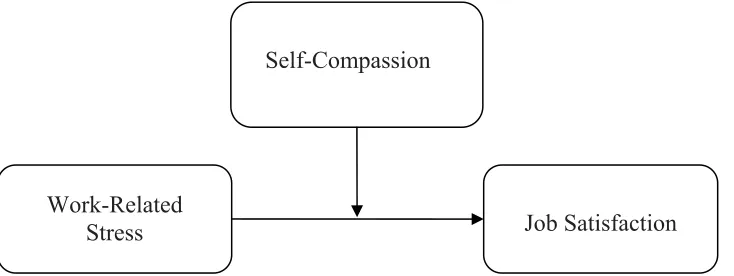
Based on the introduction and the literature review, it is of high value to investigate the effect of self-compassion on the relationship of work-related stress and job satisfaction. Although research suggests that personal resources are important buffers against the impact which job related stressors have on job satisfaction, only a few studies attempted to identify important personal resources in this relationship. Further, no research could be found where self-compassion (as a personal resource) acted as a moderator or buffer for work-related stress and job satisfaction. This will therefore be covered by this study and based on the preceding sections, the following research objects and associative research hypothesis are established:
(1) To determine the relationships between work-related stress, self-compassion and job satisfaction.
H1a: Work-related stress correlates negatively with job satisfaction. H1b: Work-related stress correlates negatively with self-compassion. H1c: Self-compassion does not correlate with job satisfaction. (2) To determine the effect of work-related stress on job satisfaction.
H2a: Work-related stress negatively effects job satisfaction.
(3) To determine the moderating effect of self-compassion on the relationship between work-related stress and job satisfaction.
H3a: Self-compassion moderates the relationship between work-related stress and job satisfaction.
Job Satisfaction Work-Related
Stress
[image:12.595.92.459.544.682.2]Self-Compassion
Method
Design
A quantitative cross-sectional electronic survey-based research design was employed to investigate the relationship between work-related stress, self-compassion and job satisfaction. According to Levin (2006) this research design is easily implementable, convenient or ‘rapid’ in its execution and makes it possible to estimate the prevalence of the outcome of interest within a given timeframe. This is beneficial when investigating whether self-compassion functions differently as a buffer amongst a variety of people. Standardised questionnaires were used as a mean to obtain data. Convenient sampling was used to gather participants due to its benefits in being a fast and keen method for Bachelor-students.
Participants
A convenience sample (n = 130) was drawn to investigate the relationships amongst the variables. Participants were invited via E-mail and social networks (e.g. Facebook, YouTube, Instagram) and were required to be at least 18 years of age and fully master the English language. For this particular research question, the requirement of being employed (full-time, part-time or having a side-job) became important. Individuals who were unemployed were removed or excluded from the analysis.
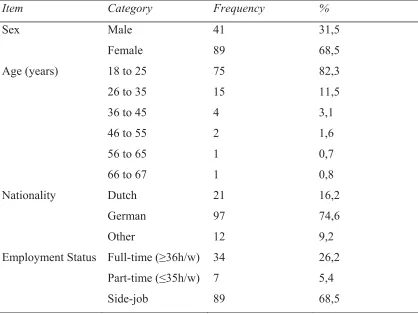
Table 1
General Biographical Characteristics of the Participants (N = 130).
Item Category Frequency %
Sex Male 41 31,5
Female 89 68,5
Age (years) 18 to 25 75 82,3
26 to 35 15 11,5
36 to 45 4 3,1
46 to 55 2 1,6
56 to 65 1 0,7
66 to 67 1 0,8
Nationality Dutch 21 16,2
German 97 74,6
Other 12 9,2
Employment Status Full-time (36h/w) 34 26,2
Part-time (35h/w) 7 5,4
Side-job 89 68,5
Measuring instruments
In order to gather data to address the main research question, three instruments were presented to participants to measure participants’ levels of work-related stress, self-compassion and job satisfaction.
(Į = 0,92), whereas the data set of this study revealed a satisfactory reliability as well with Į = 0,86. Also, the construct validity got supported by results of several studies and is therefore sufficient (De Bruin & Taylor, 2005; De Bruin, 2006).
Job satisfaction (JS) was measured by the short form of the Minnesota Satisfaction Questionnaire (MSQ) developed by the University of Minnesota, consisting out of 20 items. It provides the researcher with information about the job satisfaction level of each participant. The scores emerged by a five-point Likert scale ranging from 1 (“Very Dissatisfied”) to 5 (“Very Satisfied”) and all statements can be subdivided into three subscales. The first subscale is Intrinsic Satisfaction (12 items, Į = 0,86) with items such as “On my present job, this is how I feel about being able to keep busy all the time”. Secondly, the Extrinsic Satisfaction subscale (six items, Į = 0,80) such as “On my present job, this is how I feel about the way my boss handles his/her workers” and finally the General Satisfaction subscale consisting of both mentioned scales and two additional items (20 items, Į = 0,90) such as “On my present job, this is how I feel about the working conditions”. The psychometric quality of the MSQ can be rated as high, since the overall reliability coefficients were found to be high (Į = 0,88) (University of Minnesota, 1967). The data set of this research revealed a high reliability of this scale (Į = 0,89). According to research the construct validity could be rated as good for most of the times (University of Minnesota, 1967).
are really difficult, I tend to be tough on myself.”, secondly the Isolation subscale (four items, Į = 0,79) such as “When I’m feeling down, I tend to feel like most other people are probably happier than I am.” and lastly the Over-identification subscale (four items, Į = 0,81) such as “When I fail at something important to me I become consumed by feelings of inadequacy.” According to Neff (2003a) the psychometric quality of the SCS is adequate. All six dimensions had a good reliability (Cronbach’s alphas were all above 0,70 and ranged from 0,77 to 0,81) and the overall reliability was rated as high (Į = 0,90) (Raes, Pommier, Neff & Van Gucht, 2011). With the data set of this research the SCS could be rated with an overall reliability of very high (Į = 0,91).
Procedure
Statistical analysis
Results
Statistical analyses were computed with the aid of SPSS, valuable outcomes and results are presented below. First, general descriptives and reliability are displayed. Second, the correlations of all three constructs are illustrated, followed by a regression analysis between work-related stress and job satisfaction. Finally, the results of the moderation analysis, as well as the corresponding graph are presented.
Descriptive statistics, reliability and correlations
[image:18.595.83.566.503.586.2]Prior to analyses, the data was screened and reduced to the final data set. Cronbach’s alpha was computed for the investigation of the reliability of the scales within this data set (Table 2). Skewness and Kurtosis were used in order to investigate the distribution of the collected data. The data of the GWSS, SCS and also of the MSQ can be interpreted as being normally distributed, since Skewness and Kurtosis were below the value of 1. The variation of the employment status of all 130 participants was not equally distributed. 89 (68,5%) participants were occupied with a side job, while 34 (26,2%) participants had a full-time job and only 7 (5,4%) participants had a part-time job (Figure 2). Therefore, a ceiling effect is identifiable in regards to the employment status with Kurtosis being -1,04.
Table 2
Means, Standard Deviations, Alphas and Correlations for Each Scale.
Scales ȝ ı Į Skewness Kurtosis GWSS SCS MSQ
GWSS 1,74 0,63 0,87 0,81 0,21 1 - -
SCS 3,12 0,60 0,92 0,30 0,21 -0,28* 1 -
MSQ 3,64 0,57 0,89 -0,64 0,21 -0,46* 0,11 1
Figure 2. Histogram of the employment status of all participants (N = 130).
The Pearson correlation was conducted in order to test hypotheses 1a, 1b and 1c (Table 2). The correlation between work-related stress and job satisfaction was found to be moderate and significantly negative (r = -0,46; p = 0,00). Participants that scored either high on work-related stress (ȝ= 1,74; ı = 0,63) scored low on job satisfaction (ȝ= 3,64;ı = 0,57) or vice versa, which supports hypothesis 1a.
Furthermore, a weak but significant negative correlation was found between work-related stress and self-compassion (ȝ = 3,12; ı = 0,60) of participants (r = -0,28; p = 0,00). This reflects thus that participants who experience work-related stress have lower self-compassion or the other way around and it confirms hypothesis 1b.
Self-compassion did not correlate significantly with job satisfaction (r = 0,11;
p = 0,20). This finding does support hypothesis 1c and therefore allows further analysis for a possible moderation effect of self-compassion.
Regression analysis
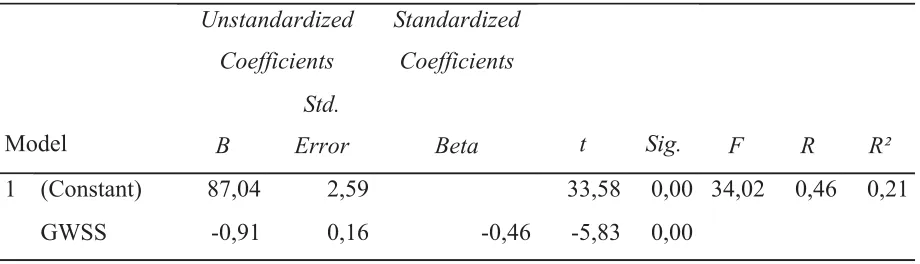
predicted the level of job satisfaction ß = 0,91, t(129) = 5,83, p < 0,00. Work-related stress explained a significant proportion of variance in the scores of job satisfaction,
[image:20.595.91.551.250.382.2]R² = 0,21, F(1,128) = 34,02, p < 0,00. Therefore, 21% of a person’s job satisfaction can be accounted to one’s work-related stress. The intercept value of job-satisfaction equals 87,04 (Table 3).
Table 3
Regression Analysis of Work-Related Stress and Job Satisfaction
Unstandardized Coefficients
Standardized Coefficients
Model B
Std.
Error Beta t Sig. F R R²
(Constant) 87,04 2,59 33,58 0,00 34,02 0,46 0,21
1
GWSS -0,91 0,16 -0,46 -5,83 0,00
a. Dependent Variable: MSQ
Moderation analysis
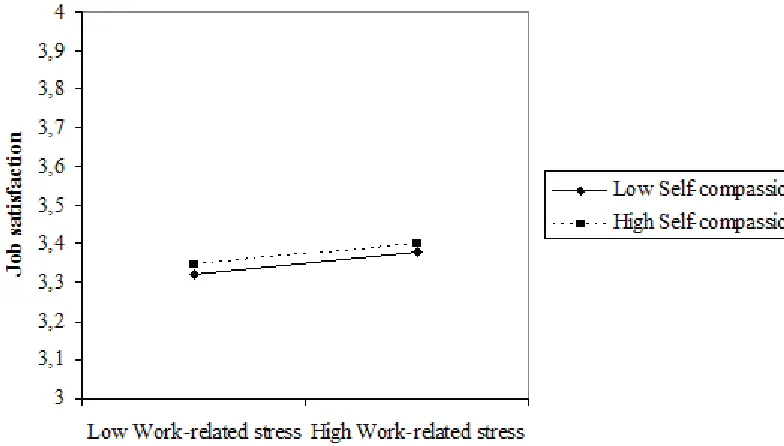
Self-compassion was examined to be a moderator of the relation between work-related stress (independent variable) and job satisfaction (dependent variable), as stated in hypothesis 3a. All variables were centred to compensate for potential high multicollinearity with the interaction term. Firstly, work-related stress and self-compassion were entered in the regression analysis as Model 1. This model was found to be significant in explaining variance in job satisfaction (R² = 0,21, F(2,127) = 16,92, p < 0,00). Secondly an interaction term was created with work-related stress and self-compassion (Model 2). This interaction term explained a significant decrease in variance in job satisfaction (R² = 0,23, F(3,126) = 12,78, p = 0,00).
Model 2 with the interaction term did not account for significantly more variance than work-related stress and self-compassion did by themselves (Model 1),
R² change = 0,02, p = 0,05, due to p > 0,05. Therefore, self-compassion cannot be
Discussion
The purpose of this study was to determine the relationship between work-related stress, self-compassion and job satisfaction. Specifically, the aim was to determine whether self-compassion could act as a moderator between work-related stress and job satisfaction. The results showed a moderate statistically significant negative relationship between work-stress and job satisfaction as well as a between work-stress and self-compassion (small effect). In contrast, no relationship could be found between compassion and job satisfaction. Finally, the results showed that self-compassion does not moderate the relationship between work-related stress and job satisfaction.
This study indicates that one’s work-related stress has the tendency to decrease one’s job satisfaction or vice versa, as a negative correlation could be identified (H1a). This finding is consistent with the findings of Collie et al. (2012) and the moderate correlation supports Ahsan, Abdullah, Fie and Alam’s (2009) statement of an existing interrelation between those two constructs. Moreover, this present study revealed that work-related stress explains job satisfaction to an extent of 21% (H2a). This causal relationship was to be expected based on several studies that had already revealed an effect of work-related stress on job satisfaction (Ahsan et al., 2009; Landsbergis, 1988). Additionally, the direction of the effect was not surprising, since work-related stress was found to trigger frustration and unhappiness in employees (Ahsan et al., 2009).
Additionally, no significant relationship between self-compassion and job satisfaction was found (H1c), just as it was expected from literature and hoped due to the basic assumptions of a moderation analysis. Therefore, it can be concluded that someone’s sense of job satisfaction seems to be in no relation with the level of self-compassion that person has. In line with that there were no results of other studies that lead to the assumption of self-compassion having a direct relationship with job satisfaction as those constructs were not examined in combination yet. The last analysis of moderation was essential to investigate if self-compassion does influence job satisfaction indirectly as moderator. It could be computed as the possible moderator seemed to have no relation with the dependent variable.
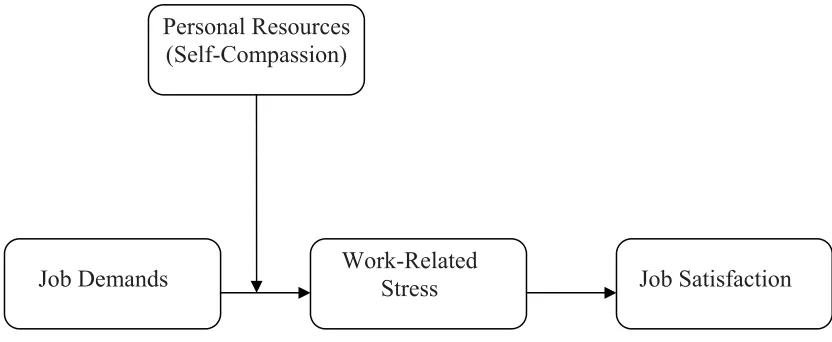
self-compassion are related with each other and also that work-related stress directly influences employee’s job satisfaction. Therefore, it seemed plausible to test if self-compassion might function as buffer on that relationship. However, this assumption could not be confirmed by this research. This inconsistency might be resolved through going back to the original JD-R model and treat self-compassion as personal resource in the way the model suggests. The existing correlation between work-related stress and self-compassion might be the base for further research in order to investigate if self-compassion moderates the relationship of job demands and work-related stress. Research revealed that employees with high levels of personal resources are able to cope more efficiently with high demands and are less likely to experience exhaustion or high levels of work-related stress (Xanthopoulou et al., 2007; Bakker et al., 2005). Hackman and Oldham stated that job resources trigger job commitment and the motivation to meet and master one’s own job goals (mastery-goal orientation) (as cited in Xantholpoulou et al., 2007). This statement implies that self-compassion might be seen as personal resource which could buffer against the experiences of job demands and work-related stress (and not job satisfaction). Therefore, it seems valuable to investigate the role of self-compassion on the relationship between job demands and work-stress in more detail.
Job Satisfaction Personal Resources
(Self-Compassion)
[image:25.595.88.504.70.241.2]Work-Related Stress Job Demands
Figure 4. The JD-R model illustrating Self-Compassion as possible personal resource.
Limitations and strengths of the study
This study also comprises some aspects of limitation regarding the data collection and the sample. First of all, it has to be mentioned that convenience sampling was used due to a lack of time. The used sample was therefore not normally distributed in terms of age and gender. Most importantly, the sample was not representative in terms of the employment status of the participants to answer the research question as it was aimed at work-related stress and job satisfaction. 68,5% of the participants had a side-job next to their studies, while only 26,2% of the participants had a full-time occupation. Studies focusing on constructs such as work-related stress and job satisfaction are usually carried out with a sample of exclusively full-time employees. Therefore, all conclusions need to be treated with caution.
Moreover, it was not specified what kind of job the participants are occupied with, which makes the interpretation of the results more difficult. According to research teachers, policy makers and school administrators suffer namely the highest work-related stress levels (as cited in Collie et al., 2012). Therefore, the possible difference between stress levels among different job types was not taken into account within this study. All this provides no ideal situation to draw generalizable conclusions based on the results.
effect got already confirmed by several other studies (Johnson et al., 2005; Collie et al., 2012).
However, this study has its strengths as well. Since data was collected quantitatively, this study provides advantages in easy documentation and repetition with a more representative sample. Moreover, the study was aimed at a gap in literature as no significant moderators are identified yet between work-related stress and job satisfaction. This study therefore provides the result that self-compassion probably can be seen as moderator on this relationship, but might still play an active role in influencing work-related stress.
Finally, this research revealed findings to a recent topic as the globalization and the ever-changing working environments raise issues for employees in terms of being stressed and experiencing less job satisfaction. Those findings provide new starting points for further research.
Practical implications and directions for further research
This study provides insight in work-related stress causing a decrease in job satisfaction among employees and revealed that self-compassion does correlate with work-related stress, but however does not moderate the earlier mentioned relationship. Due to the correlation between work-related stress and self-compassion, further research could dive into self-compassion being a possible personal resource on job stressors just as the JD-R model suggests. This might benefit the experience of work-related stress among employees that is found to be triggered by job demands (Bakker et al, 2004). Self-compassion does seem to be relevant when considering work-related stress, however this study did not show that it influences the effect of work-related stress on job satisfaction.
As this study used a sample consisting of people having a side-job, as well a part-time or full-time job it might be valuable to investigate if there is a significant difference between those groups regarding the levels of job satisfaction or work-related stress. Most studies focus mainly on full-time employees, whereas it might be interesting to compare the different groups of employees in terms of their experience of stress and satisfaction in job settings. Booth and van Ours (2008) stated already that increasing working hours correspond with a decreasing job satisfaction within employees.
References
Ahsan, N., Abdullah, Z., Fie, D. G., & Alam, S. S. (2009). A study of job stress on job satisfaction among university staff in Malaysia: Empirical study. European
journal of social sciences, 8(1), 121-131.
Allen, A. B., & Leary, M. R. (2010). Self̺Compassion, stress, and coping. Social
and Personality Psychology Compass, 4(2), 107-118.
Doi:10.1111/j.17519004.2009.00246.x
Bakker, A. B., Demerouti, E., & Euwema, M. C. (2005). Job resources buffer the impact of job demands on burnout. Journal of occupational health
psychology, 10(2), 170. Doi: 10.1037/1076-8998.10.2.170
Bakker, A. B., Demerouti, E., & Verbeke, W. (2004). Using the job
demands̺resources model to predict burnout and performance. Human
resource management, 43(1), 83-104.
Bateman, T. S., & Organ, D. W. (1983). Job satisfaction and the good soldier: The relationship between affect and employee “citizenship”. Academy of
management Journal, 26(4), 587-595.
Booth, A. L., & Van Ours, J. C. (2008). Job satisfaction and family happiness: the part̺time work puzzle. The Economic Journal, 118(526), F77-F99.
Collie, R. J., Shapka, J. D., & Perry, N. E. (2012). School climate and social emotional learning: Predicting teacher stress, job satisfaction, and teaching efficacy. Journal of Educational Psychology, 104(4), 1189. Doi:
10.1037/a0029356
De Bruin, G. P., & Taylor, N. (2005). Development of the sources of work stress inventory. South African Journal of Psychology, 35(4), 748-765.
De Bruin, G. P. (2006). The dimensionality of the general work stress scale: A hierarchical exploratory factor analysis. SA Journal of Industrial
Psychology, 32(4), 68-75.
Evans, L. (1997). Understanding teacher morale and job satisfaction. Teaching and
Teacher Education, 13, 831–845. doi:10.1016/S0742-051X(97)00027-9
Gilbert, P. (Ed.). (2005). Compassion: Conceptualisations, research and use in
psychotherapy. Routledge.
Gilbert, P. (2009). Introducing compassion-focused therapy. Advances in psychiatric
treatment, 15(3), 199-208. Doi: 10.1192/apt.bp.107.005264
Gilbert, P., Baldwin, M., Irons, C., Baccus, J., & Clark, M. (2006). Self-criticism and self warmth: An imagery study exploring their relation to depression. Journal
of Cognitive Psychotherapy, 20, 183–200.
Gilbert, P., McEwan, K., Matos, M., & Rivis, A. (2011). Fears of compassion: Development of three self̺report measures. Psychology and Psychotherapy:
Theory, Research and Practice, 84(3), 239-255.Doi:10.1348
/147608310X526511
Gilbert, P., & Procter, S. (2006). Compassionate mind training for people with high shame and self̺criticism: Overview and pilot study of a group therapy
approach. Clinical Psychology & Psychotherapy, 13(6), 353-379. Doi: 10.1002/cpp.507
Green, F., & Tsitsianis, N. (2005). An investigation of national trends in job satisfaction in Britain and Germany. British Journal of Industrial
Health and Safety Executive (2001), Tackling Work-related Stress, HSE Books, London.
Health and Safety Executive (2004), “Work related stress”, available at: ww.hse.gov.uk/stress/index.htm (accessed 15 March 2017)
Hobfoll, S. E., Johnson, R. J., Ennis, N., & Jackson, A. P. (2003). Resource loss, resource gain, and emotional outcomes among inner city women. Journal of
Personality and SocialPsychology, 84, 632–643. Doi: 10.1037/0022
3514.84.3.632
Johnson, S., Cooper, C., Cartwright, S., Donald, I., Taylor, P., & Millet, C. (2005). The experience of work-related stress across occupations. Journal of
managerial psychology, 20(2), 178-187. Doi: 10.1108/02683940510579803
Landsbergis, P.A. 1988. “Occupational stress among health care workers: A test of the jobdemands- control model”, Journal of Organizational Behavior, 9, pp.217-239. Doi: 10.1002/job.4030090303
Levin, K. A. (2006). Study design III: Cross-sectional studies. Evidence-based
dentistry, 7(1), 24-25.
Locke, E. (1969). What is job satisfaction? Organizational Behavior & Human
Performance, 4, 309–336. Doi:10.1016/0030-5073(69)90013-0
Lutz, A., Brefczynski-Lewis, J., Johnstone, T., & Davidson, R. J. (2008). Regulation of the neural circuitry of emotion by compassion meditation: Effects of meditative expertise. Public Library of Science, 3, 1–5.Doi:10.1371/ journal.pone.0001897
McKay, M., & Fanning, P. (1992). Self-esteem: A proven program of cognitive
techniques for assessing, improving, and maintaining your self-esteem (2nd
ed.). Oakland, CA: New Harbinger.
Mossholder, K. W., Bedeian, A. G., & Armenakis, A. A. (1981). Role perceptions, satisfaction, and performance: Moderating effects of self-esteem and
organizational level. Organizational behavior and human performance, 28(2), 224-234.
Muris, P., Meesters, C., Pierik, A., & de Kock, B. (2016). Good for the self: Self compassion and other self-related constructs in relation to symptoms of anxiety and depression in non-clinical youths. Journal of child and family
studies, 25(2), 607-617. Doi: 10.1007/s10826-015-0235-2
Neff, K. (2003a). The development and validation of a scale to measure self compassion. Self and Identity, 2, 223–250. Doi: 10.1080/15298860309027
Neff, K. (2003b). Self-compassion: An alternative conceptualization of a healthy attitude toward oneself. Self and identity, 2(2), 85-101. Doi:10.1080/ 15298860309032
Neff, K. D., Hsieh, Y. P., & Dejitterat, K. (2005). Self-compassion, achievement goals, and coping with academic failure. Self and identity, 4(3), 263-287. Doi: 10.1080/13576500444000317
Radey, M., & Figley, C. R. (2007). The social psychology of compassion. Clinical
Social Work Journal, 35(3), 207-214. Doi: 10.1007/s10615-007-0087-3
Raes, F., Pommier, E., Neff, K. D., & Van Gucht, D. (2011). Construction and factorial validation of a short form of the self̺compassion scale. Clinical
psychology & psychotherapy, 18(3), 250-255. Doi: 10.1002/cpp.702
support, and burnout among classroom teachers. Journal of applied
psychology, 72(2), 269.
University of Minnesota. (1967). Manual for the Minnesota Satisfaction
Questionnaire: User manual. Retrieved from:http://vpr.psych.umn.edu/sites
/g/files/pua2236/f/monograph_xxii_manual_for_the_mn_satisfaction_ questionaire.pdf
Van der Klink, J. J., Blonk, R. W., Schene, A. H., & Van Dijk, F. J. (2001). The benefits of interventions for work-related stress. American journal of public
health, 91(2), 270.
“WHO | Stress At The Workplace”. Who int. N.p., 2017. Web. 1 May 2017
Xanthopoulou, D., Bakker, A. B., Demerouti, E., & Schaufeli, W. B. (2007). The role of personal resources in the job demands-resources model. International