TOWARDS A PROCESSUAL
VIEW ON PARTNER SELECTION
Master Business Administration
25 JULI 2015
MAIK WESSELINKS1011820
Universiteit Twente
25
-7
-2
0
15
Wesselink, M.J.H. – Business Administration
2
Abstract
The moment that partners select each other is an important phase in the alliance formation
process. With help of the three drivers complementariness, compatibility and commitment
(Kale & Singh, 2009), we examine, with a case study, in depth how actors are challenged
with dealing and negotiate the social paradox of matching compatibility and
complementariness whilst assessing their commitment to the alliance. We found that actors
negotiate about the three drivers throughout the whole selection process. We describe that
actors need to overcome the paradox between compatibility and complementariness before
continuation is possible. We show that that actor negotiate about the paradox across several
levels, managerial and operational. Finally we show that the process of selecting a partner
25
-7
-2
0
15
Wesselink, M.J.H. – Business Administration
3
Table of contents
1. Introduction ... 4
2. Literature review ... 6
2.1. How can we understand the partner selection phase as a process? ... 6
2.2. Compatibility, complementariness and commitment as a paradoxical teleological process ... 8
3. Method ... 12
4. A Case-study Illustration: Itmundi ... 14
4.1. Introduction of the Case study ... 14
4.2. The background of Itmundi & Company 2 ... 14
4.3. Start approaching companies by Itmundi ... 15
4.4. First meeting: The acquaintance ... 17
4.5. Second meeting: Overcoming technique issues ... 21
4.6. Third meeting: Establishing an alliance ... 23
5. Conclusion ... 25
6. Discussion ... 27
6.1. Limitations ... 28
6.2. Future research ... 29
6.3. Managerial implications ... 29
References ... i
Attachments ... vi
Attachment 1a: E-mail to potential partner (Dutch) ... vi
Attachment 1b: Email to potential partners (English) ... vii
Attachment 1c: Email to potential partners revised (Dutch) ... viii
Attachment1d: Email to potential partners revised (English) ... ix
Attachment 2: Introduction of seven companies... x
Attachment 3: 1st Conversation Company 2 and Itmundi ... xii
25
-7
-2
0
15
Wesselink, M.J.H. – Business Administration
4
If you do not seek out allies and helpers, then you will be isolated and weak.
Sun Tzu, The Art of War
1.
Introduction
Strategic alliances are increasingly considered as a mean to realize firm goals and sustaining competitive advantage (Gulati, 1995; Prahalad & Hamel, 1990). Literature offers various recipes for how to establish and maintain alliances successfully (Das & Teng, 2008; Dhanaraj
& Pharke, 2006; Sagawa & Segal, 2000; Reed & Reed, 2009). Despite these recipes the literature suggests that 30% to 70% of all alliances fail (Kale & Singh, 2009; Bamford, Gomes-Casseres & Robinson, 2004; Park & Ungson, 2001; Loohuis & Groen, 2011). Literature reviews identified various reasons for this failure. Most of these reasons can be related to rivalry concerns and opportunistic behavior but also managerial issues such as cultural differences (Das & Teng, 1999; Park & Ungson, 2001; Bleeke & Ernst, 1993). In addition to this, literature has increasingly focused on the complexities of managing alliances after its formation (Faems, Alberink, Groen & Klein Woolthuis, 2010; Kale & Singh, 2009; Annand & Khanna, 2000). However, any alliance is preceded by the moment that partners select each other. Especially in the selection stage, crucial decisions need to be made. For instance a fit needs to be established, goals negotiated and set, including the determination of the necessary activities and resource appropriation. In addition, Gulati (1995) discusses the importance of social structure and familiarity, but also the trust needed to mitigate the likelihood of opportunistic behavior and risks (Das & Teng, 2001; Gulati, 1995B). In this regard Kale & Singh (2009) recognized so-called key drivers that important in the selection phase. They argue that sufficient partner complementarity, compatibility and commitment are important aspects for partner selection. Partner complementarity is the extent to which a partner contributes non-overlapping resources to the relationship. Partner compatibility is the fit between partners’ working styles and cultures. Partner commitment is the willingness of a
25
-7
-2
0
15
Wesselink, M.J.H. – Business Administration
5
on which actors respond and negotiate (De Rond & Bouchiki, 2001; Ring & van de Ven, 1994).
The purpose of this paper is to highlight the importance of the partner selection phase both
theoretically and from practice point of view to improve our thinking of partner selection as dynamic process rather than a static event. In doing so, we use Kale & Singh’s (2009) drivers of the selection phase to examine in depth how actors are challenged when dealing and negotiating with the social paradox of matching compatibility and complementariness whilst assessing their commitment to the alliance. Therefore the research question is: how do actors negotiate concerns of compatibility complementariness and commitment during partner
selection?
Methodologically, this study focuses on the selection efforts of two companies in the service industry. Since we are centrally interested in the challenges of situated actors, our research is embedded in a so-called strong process approach (van de Ven & Poole, 2005). This approach is oriented towards identifying how interactions between actors unfold dynamically.
In this study the negotiation efforts of the key actors of both companies are used as the units of analysis. To analyze these negotiation efforts the unit of observations are the key actors involved but also observations and to some extent documents to triangulate (Eisenhardt, 1989). The data gathered will be analyzed using a narrative strategy as proposed by Langley (1999). This research method will be further explained in chapter 3.
By this study, we attempt to contribute to the existing literature as follows: this thesis gives insights in the process dynamics of the selection phase by examining how actors negotiate the drivers involved in partner selection. The outcomes of these dynamics give an important insight on how this process operates.
25
-7
-2
0
15
Wesselink, M.J.H. – Business Administration
6
2.
Literature review
According to Webster and Watson (2002) “relevant literature is an essential feature of any academic project. An effective review creates a firm foundation for advancing knowledge” (p.13). Hence, literature is the basis of an academic paper. This will create the boundaries in which the research will fit. Based on the literature the research question can be specified and captured within the boundaries of the literature reviews (Tranfield, Denyer & Smart, 2003). In this chapter we used the retrieved literature to understand the partner selection phase as a process (chapter 2.1) and how the drivers complementariness, compatibility and commitment contribute to a paradoxical teleological process (chapter 2.2).
2.1. How can we understand the partner selection phase as a process?
This section describes what a process is and how the selection of a partner can be seen as a process. According to Van de Ven (1992), three meanings of a process are often used in the literature. The first one is that a process is a logic that explains a causal relationship between independent and dependent variables. The second meaning is that a process is a category of concepts of variables that refer to actions of individuals or organizations. The third and final meaning is that a process is a sequence of events that describes how things change over time. It is also observed by Pettigrew (1997), who defines a process as “a sequence of individual
and collective events, actions, and activities unfolding over time in context” (p338). The role of events is critical, because they influence the perception and interaction of the actors
involved in the selection phase and shape the process and the outcomes (Elo, Halinen & Törnroos, 2010). Events are specific happenings or incidents as long as they are perceived as such by human actors irrespective (Loohuis, 2015). The focus in this paper is on internal events, decisions made by actors based on technique used, trust, and other internal factors which occur during the phase of selecting a partner for an alliance. According to Van de Ven & Poole (1995) there are four dominant theories of changed process. ‘The life cycle process theory’, ‘the teleology process theory’, the dialectic process theory’ and the ‘evolution process theory’.
25
-7
-2
0
15
Wesselink, M.J.H. – Business Administration
7
‘governance and design’-phase and the ‘postformation alliance management’-phase. Like in
the paper of Kanter (1994) these event follow each other in time and each stage is the setting for the next. The process of selecting a partner can also be seen as a life cycle process,
because when considering the different events, one can distinguish that these follow each other in time (e.g. identifying potential partners selecting partners meeting partners choosing the right partner).
According to Van de Ven & Poole (2005), the teleology process theory means that the entity that occurs is purposeful and adaptive (by itself or in interaction with others). It constructs an end state and selects from the alternatives a way of action to reach it. This theory does not have a set of events that occur in a certain order, but it does imply standards by which change can be judged. The teleology theory implies that there are several paths to the same end point (Van de Ven & Poole, 1995). There are different authors who see the alliance process as a teleology process. For example Doz (1996) who sees the process of establishing a successful alliance as a teleology process. Doz (1996) stated that initial conditions and learning
contributes to a successful alliance. The author sets an endpoint, successful alliance, and he identifies that there are several paths influenced by initial conditions and learning to reach that final point. In addition Loohuis & Groen (2013) observed an alliance between two leather companies. They found that breakdowns (critical events) influence the way an alliance evolves. The selection of a partner for an alliance can also be seen as a teleology process. During the process of selecting a partner critical events can occur, for instance in regard to new techniques used inside a company, migration of a company to another place or country.
Due these critical events, the possibility exists that different paths have to be taken to establish an alliance.
The dialectic process theory stated that the developing entity exists in a world where events, forces or contradictory values collide and compete with each other for control and domination (Van de Ven & Poole, 1995). The balance in this process is that the colliding entities are equally strong and keep the balance. Changes occur when these entities go out of balance. De Rond & Bouchikhi (2004) stated that the formation and managing of an alliance is not preset, there are factors that occur unexpectedly and these factors contribute to a slow change of the process. The selection of a partner for an alliance can also be seen as dialectic, there is the possibility that one company will grow and wants to deliver a higher quality of products to its customers. During this growth, the possibility exist that they find their partner slowly less attractive because they need a higher product quality.
25
-7
-2
0
15
Wesselink, M.J.H. – Business Administration
8
routines, values and goals of different directions compete with each other and the
environment selects those forms which optimize or are best suited to the environment (Van de Ven & Poole, 1995). Reuer, Zollo & Singh (2002) for example wrote about the
post-formation process of an alliance as an evolutionary process, they stated that the experience of a partner with an alliance has impact on the governance of an alliance. This evolutionary process can also be applied on the selection of a partner for an alliance. Partners can learn from their experiences of negotiations with other companies during the selection of a partner. This way they prefer some drivers/factors over others. But also employees of a company can learn and have new requirements for complementary techniques.
The actors involved in the negotiating process of an alliance set a goal, this goal is to establish an alliance with the potential partner. The path to this goal cannot be established before negotiating with a potential partner, actors need to adjust their path to achieve the goal. Rond & Bouchikhi (2004) contribute to this assumption by stating that the management of
companies cannot plan in advance or control the sequence of events. Ring & Van de Ven (1994) stated that the development of cooperative IORs, which also embeds alliances, “are socially contrived mechanisms for collective action, which are continually shaped and
restructured by actions and symbolic interpretations of the parties involved (p.96).” They also stated that time, misunderstandings and conflicts are inevitable and these factors can provide cause for rethinking about the relationships (Ring & Van de Ven, 1994). Ring & Van de Ven (1994) develop a framework of three stages, negotiation, commitment and execution stage, but they state that underlying these heuristics a more complicated set of informal dynamics, that explains how and why IORs go through these stages, can be identified.
In this paper we state that the selection of a partner for an alliance is a teleology process, because there are always unplanned events, unexpected results from negotiations and conflicting interpretations and interests, which cause adjustments of the path to the goal (establishing an alliance), in the phase of selecting a partner.
2.2. Compatibility, complementariness and commitment as a paradoxical teleological process
Before explaining why the drivers compatibility, complementariness and commitment (Kale & Singh, 2009) are a paradoxical teleological process, the three drivers are explained. The first driver is complementarity. According to Kale & Singh (2009) Partner
25
-7
-2
0
15
Wesselink, M.J.H. – Business Administration
9
resources to the relationship, such that one partner brings those value-chain resources or capabilities the other lacks and vice versa” (P.48). This definition is also supported by other
authors (Dyer & Sing, 1998; Harrigan, 1988; Mowery, Oxley & Silverman, 1996). A resource
holds the potential sustained competitive advantage when the resource is valuable, rare, inimitable and organized (Barney, 1991). Valuable means that the resource enables the firm to conceive or implement strategies that improve the efficiency and effectiveness. Rare means that the resource is not used by large numbers of firms. Inimitable means that the resource obtained by the company, cannot be obtained by companies who do not possess it. Organized means that the firm has the organizational capability to exploit the gained resources, this embodies many facets in the organization (Barney, 1991). Chung, Singh & Lee (2000) argues that partners exchange their resources and capabilities with other companies in their alliance to initiate projects that they could not have done alone. Therefore it can be said that resources are complementary when the resource differs from the resources the partner has, and the resource contributes to initiate projects which the partner could not have done alone.
The second factor is partner commitment, Shah and Swaminathan (2008) stated that
commitment is described as “a pledge by alliance members to undertake specific actions that will facilitate the attainment of the alliance’s goals and objectives and is an essential part of
successful long-term relationships” (P.476). Some authors stated that commitment is the willingness to make short-term sacrifices for a longer-term benefit (Dwyer, Schurr & Oh, 1987; Gundlach, Achrol & Mentzer, 1995). Commitment seems particularly critical in alliances where partners have identified the specific benefits they expect to gain by coming together, but remain relatively unclear about the exact processes necessary to achieve them.
Failure in commitment leads often to the failure of an alliance (Morgan and Hunt, 1994). Through commitment in an alliance, different outcomes of that alliance can be established. According to Morgan & Hunt (1994) “Commitment not only leads to outcomes like decreased
turnover (Porter et al., 1974), higher motivation (Farrel and Rusbult, 1981) and increased organizational citizenship behaviors (Williams and Anderson, 1991), but it also results from such things that can be influenced by the firm as recruiting and training practices (Caldwell, Chatman and O’Reilly, 1990), job equity (Williams and Hazer, 1986) and organizational
support (Eisenberger, Fasolo and Davis-LaMastro, 1990)” (p. 23). It can be said that commitment is a very important factor in maintaining and establishing an alliance (Ring & Van de Ven, 1994).
25
-7
-2
0
15
Wesselink, M.J.H. – Business Administration
10
cultures (Kales & Singh, 2009). Sarkar, Echambadi, Cavusgil & Aulakh (2001) stated that “compatibility, or the congruence in organizational cultures and capabilities between alliance
partners, influences the extent to which partners are able to realize the synergistic potential of an alliance” (p. 361). Therefore compatibility is one of the main ingredients of a successful
alliance (Pansiri, 2008; Hagen, 2002). Compatibility can be divided in two dimensions: cultural compatibility and operational compatibility. Cultural compatibility is the congruence in the organizational goals, philosophies and values (Sarkar et al., 2001). Operational
compatibility addresses the extent of congruence in the partners’ procedural capabilities. It
can be said that partner compatibility addresses issues related to organizational norms and values, capability and procession issues (Sarkar et al., 2001). For example two IT companies are compatible when they use the same software in their daily way of working, but they can also be compatible if the management styles are the same or the resources used in the production of the end product are similar. Mitsuhashi & Greve (2009) stated that
compatibility has four consequences. The first consequence is that customers get the same quality from each alliance member. Secondly, the product service of an alliance is efficient and less vulnerable to competition from a single-firm entrant to the market. Thirdly, the pooling of compatible assets in an alliance can increase the production capacity and it can give scale advantages. Fourthly, the provision of compatible resources simplifies the task of equalizing inducements and contributions (Mitsuhashi & Greve, 2009).
Above drivers confront companies with a potential paradox in the partner selection phase. Like Sarkar et al. (2001) suggest that “collaborative value creation requires the pursuit of
partners who possess similar characteristics on certain dimensions and dissimilar and/or complementary characteristics on other dimensions” (p.358). In other words companies need
to be sufficient complementarity as well as sufficient compatibility and beside that they need to be committed to each other. This paradox contributes to the assumption that the process of selecting a partner for an alliance is a teleological process. Like mentioned above, Ring & van de Ven (1994) stated that actions and socially contrived mechanisms are continually shaped and restructured by actions and interpretations. These actions can occur due to the fact that companies want to overcome the paradox by being complementary and compatible to each other. For example one company produces leather and the other company produces leather seats, these two products are complementary. But to establish a leather seat from leather, the leather must meet several requirements so that the other company can produce their leather seats. These requirements of the input of one company must be compatible with the
25
-7
-2
0
15
Wesselink, M.J.H. – Business Administration
11
investigate whether this output is compatible to use as input for that company. This can be an unseen event before starting the negotiation with that specific company.
In conclusion, we state that the process of selecting a partner is a teleological process, because
there is one endpoint, the point where the alliance is established, but there are different paths to that endpoint. These paths include negotiations and adjustments made by the actors involved. The occurrence of events is given by the paradox that actors need to overcome the contradiction between being complementary on one hand but compatible on the other, while constantly assessing each other’s commitment to the new venture.
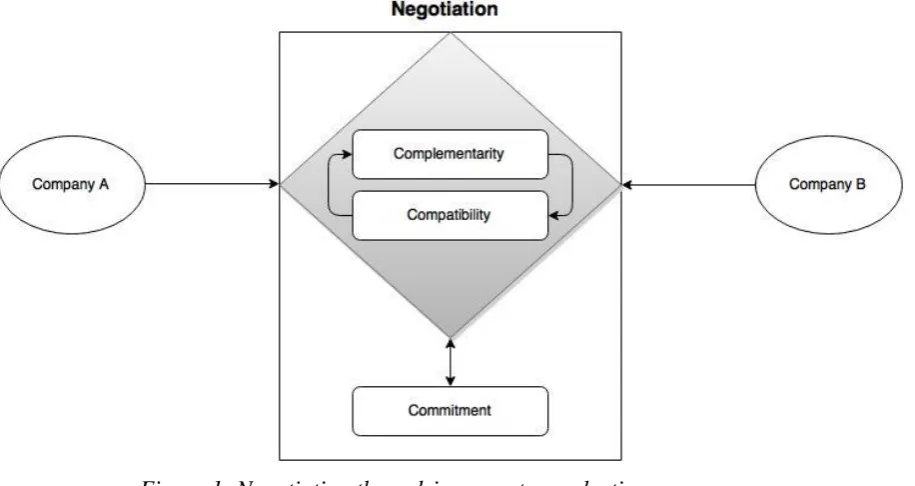
[image:11.595.72.530.345.588.2]In figure 1 the negotiation of an alliance is visualized. Company A and B both negotiate about the three drivers (Kale & Singh, 2009). In the diamond the paradox between complementarity and compatibility can be distinguished. Companies negotiate about this paradox to overcome this paradox whereas the driver commitment is a part of this negotiation.
25
-7
-2
0
15
Wesselink, M.J.H. – Business Administration
12
3.
Method
We use a case study (Yin, 2013) to illustrate that the process of selecting a partner for an alliance is a process that unfolds dynamically. This case study is done in a time-period of 4
months by an internet agency named Itmundi and follows a strong process approach (Type 3) (Van de Ven and Poole, 2005).
Van de Ven & Poole (2005) describe four different types of approaches for studying
organizational change. Type 1 is well suited for ‘what’-questions, this approach stated that change is a dependent variable and explains it as a function of independent variables. Type 2 conceptualizes change as events, stages, cycles in the development or growth of an
organization. Type 3, the strong process approach, examines questions on how processes unfold over time. Van de Ven & Poole (2005) stated that “processes are all there is, and only research that adopts the processual perspective is suited for the study of processes” (p.1390). Type 4 uses quantitative analysis of an event series. It specifies variables that characterize events and it assigns values to these variables, and finally it analyzes the resulting time series to examine the sequence, pattern or structure of the process (Van de Ven & Poole, 2005). Like mentioned above, this research used Type 3. This approach is chosen because the ‘How’-question is the key ‘How’-question in this research and given the assumption that the selection phase is a dynamic process and critical events can be identified which influence this process.
The single case study gives the opportunity to explore how actors deal with the paradox in partner selection processes. A case study is applicable in this research because it helps to focus on the understanding of the dynamics present within a single setting (Eisenhardt, 1989). According to Yin (2003) “the case study method allows investigators to retain the holistic and
meaningful characteristics of real-life events – such as individual life cycles, organizational
and managerial processes, (…)” (p.2). Case studies are preferred when ‘how’ and ‘why’ questions are posed, when the investigator has little control over events and when the focus is
on phenomenon within a real-life context (Yin, 2003). So a case-study is very applicable in this thesis, because there is not much known about the selection of a partner for an alliance as a dynamic process. The single-case study can provide in-depth data which could support the assumption that the selection of a partner for an alliance is a dynamic process.
25
-7
-2
0
15
Wesselink, M.J.H. – Business Administration
13
The focus is on situated actors involved in organizational processes. How do the actors of both companies negotiate about the drivers and the paradox provided by these drivers when analyzing the negotiation of these actors?
For data collection, we relied on observations during the meetings between parties. Beside observations, we relied on historical data of both companies. This is deemed important to develop a sufficient background knowledge of the companies involved. In sum using multiple data collection methods made triangulation of data possible and hence develop theoretical insights (Eisenhardt, 1989).
The data gathered from these observations and documents will be analyzed. There are many ways to analyze process data. Langley (1999) identified seven strategies to analyze process data: the narrative, quantification, alternate template, grounded theory, visual mapping, temporal bracketing and synthetic-strategy. Since we rely on a single case study, we follow the suggestion made by Langley (1999) to use a narrative strategy. The narrative strategy will be used to describe the events that occurred over time in relation to the paradox between complementariness and compatibility. According to Langley (1999) a narrative strategy of reporting findings works best for one or a few cases. In addition she argues that a high degree of authenticity can be achieved due the variety and richness of the described incidents and the linkages between these incidents.
The recordings from the first meeting were transcribed and the phrases contributing to the three drivers mentioned by Kale & Singh (2009) were listed in a table. During the second and third meeting no recordings were made, due sensitive company information that was being
25
-7
-2
0
15
Wesselink, M.J.H. – Business Administration
14
4.
A Case-study Illustration: Itmundi
4.1. Introduction of the Case study
To assure confidentiality, pseudonyms are used. The key actor (director) of Company 2 does not want to be mentioned by name in this thesis. This is also mentioned by the key actor (director) of Itmundi. The pseudonyms used are ‘key actor Itmundi’ and ‘key actor Company 2’. The first meeting is recorded with permission of both key actors. The second and third
meeting are not recorded because confidential company information is being discussed. The timeframe of the case study is nearly 2 months. In this case study observations and historical data are used to get insights in the way Itmundi and Company 2 negotiate with each other on a potential alliance. To analyze the data the narrative strategy will be used. In the first two paragraphs general information about both companies can be found. Next to that it is also described how the key actor of Itmundi approaches different potential partners. After these
two paragraphs the meetings were described, and these paragraphs are used to answer the main question. Furthermore this data is used for the conclusion. In the first paragraph the two companies are introduced. The second paragraph describes the way Itmundi approaches their partners. The third paragraph describes the first meeting between Itmundi and company 2. The fourth paragraph captures the second meeting. The fifth paragraph enclosures the third meeting. After each meeting the results are described.
4.2. The background of Itmundi & Company 2
25
-7
-2
0
15
Wesselink, M.J.H. – Business Administration
15
companies in their region, Itmundi is focusing on expanding their opportunities to other parts of the country. Therefore they are looking for partners who can assist Itmundi in covering a larger part of Holland than they served hitherto.
Company 2 is a publicity agency located in Lochem, The Netherlands. Lochem is situated about thirty miles to the south-west from Albergen. The company is founded in 1997 by the present owner. Company 2 has now 18 full-time employees working at their headquarters in Lochem. Company 2 is known from their work for well-known brands like ‘Schuurman Schoenen’, ‘HP’ and ‘Harley Davidson’. The company is specialized in building a stronger online and offline brand for companies with help of strategy, conceptualization, creation and realization. Company 2 works from a creative point of view. But only creativity is not the basis of their growth, the past couple of years Company 2 combined creativity with results. Since last year they have hired two new employees who can build small and easy websites, so they can build websites using their own employees, without outsourcing this part of the job. But for the more complex cases they still need partners who assist them in building websites. These complex problems are now outsourced to freelancers, Company 2 has a static pool with freelancers they can hire. For the upcoming and expected growth they are looking for a strong partner in this regard.
4.3. Start approaching companies by Itmundi
On April 29, the first step to establish an alliance with Company 2 was settled. A list of companies was established, this list was named the ‘long list’. Seven of these companies are selected because these companies are located close to Amsterdam and are of just the right size for Itmundi. A short introduction of these seven companies can be found in attachment 2. On May 7th an email (see attachment 1a & 1b) was sent to the first company to arrange a meeting to discuss the potential alliance. A company was contacted to arrange a meeting, if the
25
-7
-2
0
15
Wesselink, M.J.H. – Business Administration
16
After a few days the contacted company answered with the following email (translated to English):
Dear …,
We have been working for years with companies in our own region to our full
satisfaction. If you are of the opinion that your work is better than that of our
contracted companies, feel free to convince us.
Yours sincerely,
…..
Based on this mail, the mail that Itmundi sends to potential partners has been adjusted
(Attachment 1c & 1d). In the adjusted mail Itmundi states that they have tasks to outsource to the newly contracted company immediately. When the company wants to start an alliance, Itmundi can provide new tasks right away. This new email was sent to Company 2.
25
-7
-2
0
15
Wesselink, M.J.H. – Business Administration
17
4.4. First meeting: The acquaintance
On June 12, 2015 the director of Itmundi and the director of Company 2 met each other on the headquarters of Company 2 in Lochem. Both actors saw this meeting just as an informal acquaintance between the two companies.
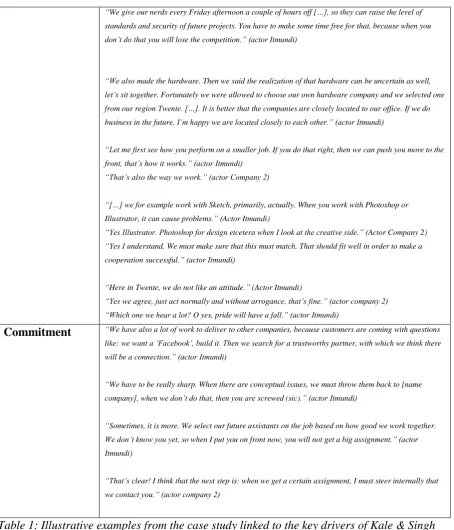
The two actors started with introducing themselves and their companies to each other. After the introduction, the key actors communicated more deeply about their working culture, assignments, way of working, techniques etcetera. The content of this in-depth conversation can be linked to the three key drivers mentioned by Kale & Singh (2009) and the paradox
between complementariness and compatibility. In table 1, the illustrative quotes from the acquaintance sessions are categorized into the drivers complementarity, compatibility and commitment, are presented.
Key Drivers (Kale & Singh, 2009)
Illustrative examples from the Case Study
Complementarity “When we look at Harley Davidson, we have numerous tasks that we fulfill for them. But most of the activation-mode, i.e., the strategy and identity, are not related to us. This is decided in The States and England […] Therefore there we are much more on activation in the Netherlands.”(Actor Company 2) “We are not familiar with technical aspects of creativity. When I look where we overlap, it will be there.” (actor Company 2)
“[…], we do not have knowledge about webshops. I think we overlap here as well, since you are not into webshops as well?” (actor company 2)
“What we do is invent the concept, the design.” (actor Company 2)
“Because we do not have the creativity your company possesses, we can see opportunities for cooperation”(actor Itmundi)
“But first go to Company 2 to clarify the concept, because the concept is not clear enough.” (actor Itmundi)
“If they did not come out right and they ask if we know another good company, we look which company is suitable.” (actor Itmundi)
“That is also important, because your output is their input. And that should match. They say that the output produced by your company is constructed in a certain way, then we can work with it.” (actor Itmundi)
25
-7
-2
0
15
Wesselink, M.J.H. – Business Administration
18
Compatibility “These are people who have turned their hobby into their profession, […]. They have a little clue about marketing and communication, that’s why we try, in association with Harley Benelux, to create campaigns on how we can win costumers regionally and nationwide.” (actor Company 2)
“a local publicity agent” (actor Company 2)
“We reject a lot of work as well, because we need to do what we’re good at. Some things we cannot do alone, then we search for a partner to deliver.” (actor Itmundi)
“Starting with creative development, we have also grown to other an extent where we need other partners.” (actor Company 2)
“What you see is that we can’t survive with creativity only, so combining creativity with results is what we developed the last couple of years. In the past we did a lot with partnerships and we still do, but we have started to do things by ourselves. […]. Therefore we have hired two technicians who can make the basic technical components. For the more complex assignments we have partners.” (actor Company 2) “What we do is invent the concept, the design.” (actor Company 2)
“What we do is sit together, you know the sessions. Based on these session there is a kind of briefing to the creative team within Company 2. Then a creative concept is developed.” (actor Company 2) “We primarily work with local, fixed partners. Think about application development. We search for freelancers, always someone with a lot of experience. But no big bureaus at the present moment.” (actor Company 2)
“What we often notice is that other advertising agencies are afraid of losing costumers due to our intervention. So we also give work away. We work very intensively with bureaus or the clients and we absorb a lot of information. We look into combining the passion for development and the wishes of our actors into new opportunities.” (actor Itmundi)
“Three people are working here, in the studio. It should match with what your company is doing. So when you say, that’s how the web shop must look like, then we make a prototype, that you can deliver to your clients. But we build such a prototype, that we know what should happen when it is decided it will be build. [… More about the way of working].” (actor Itmundi)
“So when a project is finished it will be transmitted to operational services, to monitor it. We are doing this also for other web-agencies, because most of them don’t have it.” (actor Itmundi)
“That’s what we do, but to a limited extent. When we are allowed to make a cool web shop, then these are the coolest frameworks […]. This is what we would advise to you and when the client likes it, we build it. We often see that the client needs a connection between CRM and an email package. That is what we will build. But not more than that.” (actor Itmundi)
25
-7
-2
0
15
Wesselink, M.J.H. – Business Administration
19
“We give our nerds every Friday afternoon a couple of hours off […], so they can raise the level of standards and security of future projects. You have to make some time free for that, because when you don’t do that you will lose the competition.” (actor Itmundi)
“We also made the hardware. Then we said the realization of that hardware can be uncertain as well, let’s sit together. Fortunately we were allowed to choose our own hardware company and we selected one from our region Twente. […]. It is better that the companies are closely located to our office. If we do business in the future, I’m happy we are located closely to each other.” (actor Itmundi)
“Let me first see how you perform on a smaller job. If you do that right, then we can push you more to the front, that’s how it works.” (actor Itmundi)
“That’s also the way we work.” (actor Company 2)
“[…] we for example work with Sketch, primarily, actually. When you work with Photoshop or Illustrator, it can cause problems.” (Actor Itmundi)
“Yes Illustrator. Photoshop for design etcetera when I look at the creative side.” (Actor Company 2) “Yes I understand. We must make sure that this must match. That should fit well in order to make a cooperation successful.” (actor Itmundi)
“Here in Twente, we do not like an attitude.” (Actor Itmundi)
“Yes we agree, just act normally and without arrogance, that’s fine.” (actor company 2) “Which one we hear a lot? O yes, pride will have a fall.” (actor Itmundi)
Commitment “We have also a lot of work to deliver to other companies, because customers are coming with questions like: we want a ‘Facebook’, build it. Then we search for a trustworthy partner, with which we think there will be a connection.” (actor Itmundi)
“We have to be really sharp. When there are conceptual issues, we must throw them back to [name company], when we don’t do that, then you are screwed (sic).” (actor Itmundi)
“Sometimes, it is more. We select our future assistants on the job based on how good we work together. We don’t know you yet, so when I put you on front now, you will not get a big assignment.” (actor Itmundi)
[image:19.595.73.528.64.595.2]“That’s clear! I think that the next step is: when we get a certain assignment, I must steer internally that we contact you.” (actor company 2)
Table 1: Illustrative examples from the case study linked to the key drivers of Kale & Singh
(2009)
This table gives insight in how the key actors of Itmundi and Company 2 negotiate about the key drivers in their first meeting. First a description of the event is given, which is supported by an illustrative quote, this is followed by an analyses after each decisive moment during the selection phase.
25
-7
-2
0
15
Wesselink, M.J.H. – Business Administration
20
technique the ‘design’-department of Itmundi works with. First Itmundi spoke about the
department named Studio and the most important technique they use at that department.
“That is also important, because your output is their input. And that should match. They say
that the output produced by your company is constructed in a certain way, then we can work
with it.” [Director Itmundi]
“We for example work with Sketch, actually primarily”. When you do everything in
Photoshop or Illustrator.” [Director Itmundi]
The key actor of Company 2 answered that they use another program were they are working with.
“Yes Illustrator. Photoshop for design etcetera when I look at the creative side.” [Director
Company 2]
The first critical event is identified which they cannot solve during this meeting between Itmundi and Company 2, because the key actor of Itmundi stated that the two programs must match.
“Yes I understand. We must make sure that this must match. That should fit well in order to
make a cooperation successful.”[Director Itmundi]
This event is the basis for the next step in the negotiation about an alliance between Itmundi and Company 2. The two key actors both agree that they want to evaluate the meeting within their company, and that they contact each other by email or telephone when done.
On 22 June 2015 telephone contact between Itmundi and Company 2 was established. The goal of this contact moment was to review the first meeting between the companies. Based on this telephone contact it can be said that after the first meeting both parties are willing to start
an alliance with each other, but first one issue has to be overcome. The issue that has to be overcome is a compatibility issue on operational level. This issue is located in the design department (Studio) at Itmundi, they have to work with the output that Company 2 delivers. Can this output be used as input easily for the design department at Itmundi? But next to that, can the output from the design department at Itmundi be used to convince the client of
Company 2 that this is the way to do it? On managerial level this issue and which techniques are being used is already discussed. But in practice, is it possible to work with the output from Company 2? And can Company 2 work with the output from the design department at
25
-7
-2
0
15
Wesselink, M.J.H. – Business Administration
21
This meeting is arranged between the employees on operational levels at both companies to look whether the techniques that both companies use are compatible.
4.4.1. Results after the first meeting
In the first meeting between the actors of Itmundi and Company 2 the three drivers
complementarity, compatibility and commitment, mentioned by Kale & Singh (2009), can be identified. Both actors spoke about complementarity in the form of techniques, work
exchange and knowledge. They also discussed issues of compatibility in the form of culture, technical capabilities, and way of working etcetera. Commitment was less discussed in this first meeting. See table 1 for the different phrases used by the actors, placed underneath the
three drivers.
In this first meeting one critical event can be identified. During this meeting the director of Itmundi and the director of Company 2 spoke about the technique the ‘design’-department of
Itmundi works with. This technique is differing from the technique Company 2 uses to establish their output. So the question arises whether the output of Company 2 can be used as input for the ‘design’-department of Itmundi. This critical event leads to the second meeting,
but not a meeting on managerial level like expected before. Instead it is a meeting between the employees of both companies on operational level. This event changed the path to the
endpoint (establishing an alliance).
This critical event is caused by the paradox between complementariness and compatibility. Both actors discuss the techniques used by the employees of both companies, when they discuss the technique used in the ‘design’-department of Itmundi they found a problem
between them. The different techniques used by the employees of both companies are complementary, but they also have to be compatible to each other. Due to this paradox and the uncertainty that these techniques are complementary but also compatible to each other a second meeting on operational is needed to overcome this paradox.
This critical event contributes to the teleology theory (Van de Ven, 1995), it changes the path to the end state, establishing an alliance. An extra meeting on operational level was needed to get to that end state.
4.5. Second meeting: Overcoming technique issues
25
-7
-2
0
15
Wesselink, M.J.H. – Business Administration
22
the output of Company 2 can be easily used as input for the studio of Itmundi. But also if the output of the studio of Itmundi is from such a quality that Company 2 can convince their clients to build it in that way.
First of all, the key actors of both companies introduce their employees to each other and explain why this meeting is set up. This introduction hinted at the fact that both companies are almost ready to form an alliance with each other.
“We are here because after our first meeting we had such a good feeling about that meeting
and we see a great potential in a cooperation with Itmundi. But before we can sign the
papers, one problem has to be overcome and that is why we are here.” [Director Company 2]
After the short introduction from the key actors the employees of both companies start with explaining how they work. First the employees from Company 2 explain their working style. What is the first step when they receive an assignment from a customer? What happens next? How do they come to their end product, which they put through to the studio of Itmundi? The employees of Itmundi had a couple of questions about the working style and after these questions were answered, the employees of Itmundi start to explain how they work and what their requirements are for the output of company 2 they use as input. Together they look at the best way to make both techniques compatible with each other.
After the explanation of both techniques the employees of Itmundi have some question about how they face some problems and what is their solution for certain problems.
“When you accepted an assignment and you already work on it, you might face the problem
that you cannot meet the deadline. What do you do? Regarding to the price, the
communication etcetera?” [Employees Itmundi]
“What do you do when you have a customer who wishes to setup a whole campaign and in the
middle of the process they ask for a campaign website as well? How do you tell them that a
third party they are not familiar with will be involved?”[Employees Itmundi]
These questions are the start of a discussion about how they can solve these problems and how the employees of Itmundi solve these problems. In this way the employees also explain how they work and how they solve certain problems.
25
-7
-2
0
15
Wesselink, M.J.H. – Business Administration
23
satisfied with the outcomes of this meeting and make an appointment for the third meeting. In this meeting they want to discuss the outcome of this meeting and some formal issues.
4.5.1. Results after the second meeting
In the second meeting, on operational level, the focus was on solving the paradox between complementarity and compatibility. They spoke about the techniques used by the employees of both companies on operational level. Compatibility in the way how the different techniques from both companies can work together and are compatible to each other. But besides the complementarity and compatibility, they also spoke about commitment. Commitment in the way how both companies deal with different problems during the alliance.
This second meeting was arranged to overcome the paradox between complementariness and compatibility which was identified in the first meeting between the actors of Itmundi and Company 2. In this second meeting the problems caused by the paradox were solved by explaining on operational level how the different techniques are used (complementary) and how the input and output of these technique will match (compatibility) so they can work together.
4.6. Third meeting: Establishing an alliance
On 3 July 2015 the third and last meeting was arranged. An unofficial meeting at a restaurant at a neutral location between Albergen and Lochem. The purpose of this meeting was to discuss the second meeting and some formal points for the alliance. Both key actors were satisfied about the second meeting between the employees on operational level. But both key actors are curious how the employees will work together on operational level when they really start an alliance. In the meetings they solved different problems on the way of working, but also on the different techniques, and how these can work together. But how will they cope with problems in practice, when there is a lot of pressure on the assignment?
Furthermore they discussed different things they require when working together. Overall they were very positive about establishing an alliance.
“I am very pleased that the cultures of our companies are almost comparable and that our
work styles in general are similar.” [Director Itmundi]
25
-7
-2
0
15
Wesselink, M.J.H. – Business Administration
24
“When the customer wants changes in their campaign or ‘design of the website’, we will send them back to Company 2 to ensure that this change is in line with the concept you made.”
[Director Itmundi]
An interesting thing in this last meeting is that they did not set a contractual agreement for their alliance. This alliance is based on trust from both sides. After this third meeting the alliance is settled. Both companies wait until they get an assignment that they can work on together.
4.6.1. Results after the third meeting
In the third and final meeting on managerial level all three drivers are mentioned. The director from Itmundi and the director of Company 2 spoke about the different drivers they have
25
-7
-2
0
15
Wesselink, M.J.H. – Business Administration
25
5.
Conclusion
The objective of this study was to understand how actors negotiate concerns of compatibility, complementariness and commitment during partner selection, following a strong process approach (Van de Ven & Poole, 2005). In addition we studied how actors deal with the paradox of being complementary but also compatible to each other.
This study contributes to the perspective at the beginning of the paper that the partner selection phase is a process that unfolds dynamically when looking at the drivers by Kale & Singh (2009): complementarity, compatibility and commitment. This is in contradiction with the existing literature, which stated that the three drivers are static and a kind of checklist
(Kale & Singh, 2009; Shah & Swaminathan, 2008; Sarkar et al., 2001). This research clearly shows that the actors negotiate about the drivers complementarity, compatibility and
commitment through the whole selection process. This is supported by the results that in every meeting between Itmundi and Company 2 the three drivers were discussed.
In addition this thesis concludes that the actors engaged in the selection phase negotiate on different levels of a company about the three drivers mentioned by Kale & Singh (2009). From the case we observed that the first meeting was on managerial level and concerned the drivers complementariness and compatibility, the second meeting on operational level in which actors also discussed the drivers complementariness and compatibility, and the third meeting on managerial level which concerned mainly the driver commitment. The switch to a meeting on operational level occurred due to the critical event in the first meeting caused by the paradox between complementarity and compatibility based on a dispute on technical matters.
Furthermore, it can be concluded that the drivers complementarity, compatibility and commitment contain different factors to identify that the key actors negotiate about these drivers in the selection phase. These factors were already mentioned by Sarkar et al (2001). By analyzing the negotiations between the key actors from Itmundi and company 2 these factors founded by Sarkar et al. (2001) can be identified as an identifier for a specific driver. For example the driver complementarity contains the factors techniques, knowledge etcetera. The identifiers mentioned by Sarkar et al (2001) which can be used to identify the three main
drivers are listed in the figure in attachment 4.
This paper also identifies the paradox that a partner needs to be unique based on
25
-7
-2
0
15
Wesselink, M.J.H. – Business Administration
26
and thus compatible. This observation is in line with Das & Teng, 1998 and Loohuis & Groen, 2011. However, in this study we showed how actors need to overcome this paradox before continuation is possible. This research also showed how actors negotiate across several
levels, i.e. operational and managerial. Therefore, this study shows that it is important to study alliance processes including these levels (see also Faems et al. (2007)).
When looking at the intensity the different drivers the key actors are negotiating about, it can be conclude that the driver commitment is less discussed than the drivers complementarity and compatibility. This does not mean that the driver commitment is less important or plays a role on the background in that stage. It is possible that in this case the key actors of Itmundi and Company 2 had a certain amount of trust in each other, which also is shown due to the fact that the key actors of Itmundi and Company 2 only established an oral agreement for their alliance. Bierly & Gallagher (2007) also stated that trust is important in the selection of a partner for an alliance and we showed that this should not be formalized at the beginning by establishing a contract.
Finally this study shows that the selection of a partner is a teleology process (Van de Ven, 1995). One critical event can be identified in the case study. This critical event changed the path to the end state by the necessary second meeting on operational level. The critical events in this case-study changed the path to the end state (establishing an alliance) and so the process of selecting a partner for an alliance can be identified as a teleological process.
In summary the key actors of Itmundi and Company 2 negotiate about the drivers
complementarity, compatibility and commitment in a (dynamic) teleological process which
25
-7
-2
0
15
Wesselink, M.J.H. – Business Administration
27
6.
Discussion
With this thesis we make several contributions to the literature. First we contribute to the literature concerned with the drivers for selection of partner (Kale & Singh, 2009). We have shown that the selection of a partner for an alliance is a process that unfolds dynamically when looking at the three drivers mentioned by Kale & Singh (2009), with help of the strong process approach (Van de Ven & Poole, 2005). We have hence challenged the literature (Shah & Swaminathan, 2008; Kale & Singh, 2009; Bekman, Haunschild and Philips, 2004) that the selection of a partner for an alliance is a checklist of different factors which can be checked off.
We have shown how actors negotiate about the three drivers by Kale & Singh (2009) on different levels of a company. In this thesis the actors negotiate on operational level and on
managerial level about the three drivers complementarity, compatibility and commitment. Furthermore we have shown how the actors deal with critical events and the paradox between complementariness and compatibility, which occurs during the process of selecting a partner. These critical events contributes to different paths taken by the actors before getting to the end state (establishing an alliance).
In addition we have shown that the selection of a partner is a teleological process when looking at the four process theories Van de Ven (1995) established. Critical events contribute to this conclusions, these events are the setting for changing the path to the end state.
25
-7
-2
0
15
Wesselink, M.J.H. – Business Administration
28
6.1. Limitations
This study is limited on the choice of critical events used as central triggers for change, change can also occur without these triggers (Greenwood & Hinnings, 1996). However Van de Ven (1986) stated that small failures or signals are often ignored by actors in a process. So the choice for critical events as a measure for change is provided to understand how and when actors change the process and how and when they solve the problems they face.
A second limitation is the methods that are used. The generalizability of a single case study is low because only one case is used in this case (Yin, 1984). Therefore in this research we cannot fully generalize that the selection of a partner for an alliance is a dynamic process. In
addition it cannot be fully generalized that the outcomes of this study can be used in another business sector. The possibility is that the drivers in this thesis are identified different in another sector or are even not mentioned in the process of selecting a partner in a certain specific sector. Furthermore Itmundi and Company 2 have almost no experience in establishing an alliance. Hence it is not certain that this alliance will last for long and is successful. If this is not certain, it cannot be said that this process is applicable to companies with more experience in establishing alliances. To ensure the validity of the research a literature framework is established. This framework support the results of this research. Still additional research is required to support the findings of this research.
A third limitation lies in the construct validity. Triangulation of different research methods is used. This research made use of observations but also documents which can substantiate the results from the observations. This strengthens the construct validity of this research. Despite the fact that the documents found and used in this research support the general information of the companies, these documents do not substantiate the observations. Next to that a single resource of evidence is used in this research, the selection of a partner by Itmundi. Like mentioned before, this single resource gives a low generalizability of the results.
On the other hand observations lead to the collection of sufficient detailed information, which could mark the conclusions of this research as well retrieved.
To make use of feedback by the participant or in this case, give the key actors insight in the
data gathered, will increase the construct validity of the research.
25
-7
-2
0
15
Wesselink, M.J.H. – Business Administration
29
Another limitation of this research is the observed timeframe used. In this research the observations stopped at the moment the alliance was established, not knowing whether this alliance will last long and is successful or not.
6.2. Future research
Future research is needed to support the findings of this research. A research with multiple cases in the same setting (companies with almost no experience in selecting a partner for an alliance, same size, same sector) can prove if the results from this thesis are supported. Multiple cases make the generalizability of the results higher (Eisenhardt, 1989).
In addition future researchers might examine in their research whether the alliance established
last for long and are successful. This will contribute to the assumption that the process used contributes to a successful alliance in the future. Next to that it can be taken in consideration to identify the effect of environmental changes on the process of selecting a partner for an alliance. Environmental changes can influence the way how companies establish an alliance. Further research is also needed to identify what the effect is of critical events in the process of selecting a partner for an alliance. In addition future research is needed to identify what the effect is when actors ignore these critical events, are they establishing an alliance with each other? Will this alliance be successful? Will these critical events occur again later in the process?
Further research is also needed in other sectors, concerning companies with more experience in establishing alliances, multiple companies involved in establishing an alliance etc. This will indicate if the results of this study are generalizable for other companies in other
environments.
Overall this study can provide a basis for future research on how actors negotiate on the drivers complementariness, compatibility and commitment in the process of selecting a partner for an alliance.
6.3. Managerial implications
Actors involved in the process of selecting a partner for an alliance can use this study to get insight in how the drivers complementarity, compatibility and commitment evolve in this process. These drivers and the factors underneath them are not just a checklist that actors can check when they spoke about it. Actors needs to consider that these drivers and factors are woven throughout the entire process, and they have to negotiate these drivers until the alliance is established.
25
-7
-2
0
15
Wesselink, M.J.H. – Business Administration
30
process that can be established before selecting a partner for an alliance. Critical events appear in the selection process which changes the patch to the endpoint. Actors must be able to anticipate to these critical events to establish the alliance with a potential partner.
25
-7
-2
0
15
i
References
Anand, B. N., & Khanna, T. (2000). Do firms learn to create value? The case of alliances.
Strategic management journal, 21(3), 295-315.
Bamford, J., Gomes-Casseres, B., & Robinson, M. (2004). Envisioning collaboration:
Mastering alliance strategies.
Barney, J. (1991). Firm resources and sustained competitive advantage.Journal of management, 17(1), 99-120.
Beckman, C. M., Haunschild, P. R., & Phillips, D. J. (2004). Friends or strangers? Firm-specific uncertainty, market uncertainty, and network partner selection. Organization science, 15(3), 259-275.
Bierly, P. E., & Gallagher, S. (2007). Explaining alliance partner selection: fit, trust and strategic expediency. Long Range Planning, 40(2), 134-153.
Bleeke, J., & Ernst, D. (Eds.). (1993). Collaborating to compete: Using strategic alliances and acquisitions in the global marketplace. New York: Wiley.
Chung, S. A., Singh, H., & Lee, K. (2000). Complementarity, status similarity and social
capital as drivers of alliance formation. Strategic management journal, 21(1), 1-22.
Das, T. K., & Teng, B. S. (1999). Managing risks in strategic alliances. The Academy of
Management Executive, 13(4), 50-62.
Das, T. K., & Teng, B. S. (2001). Trust, control, and risk in strategic alliances: An integrated
framework. Organization studies, 22(2), 251-283.
De Rond, M., & Bouchikhi, H. (2004). On the dialectics of strategic alliances. Organization
Science, 15(1), 56-69.
Dhanaraj, C., & Parkhe, A. (2006). Orchestrating innovation networks. Academy of
Management Review, 31(3), 659-669.
Doz, Y. L. (1996). The evolution of cooperation in strategic alliances: initial conditions or
learning processes? Strategic management journal, 17(S1), 55-83.
Dwyer, F. R., Schurr, P. H., & Oh, S. (1987). Developing buyer-seller relationships. The
25
-7
-2
0
15
Wesselink, M.J.H. – Business Administration
ii
Dyer, J. H., & Singh, H. (1998). The relational view: cooperative strategy and sources of
interorganizational competitive advantage. Academy of management review, 23(4), 660-679.
Elo, M. N., Halinen, A., & Törnroos, J. Å. (2010, September). Process research in business
networks—An event-based method for qualitative analysis. In 26th IMP conference.
Eisenberger, R., Fasolo, P., & Davis-LaMastro, V. (1990). Perceived organizational support
and employee diligence, commitment, and innovation. Journal of applied psychology, 75(1),
51.
Eisenhardt, K. M. (1989). Building theories from case study research. Academy of
management review, 14(4), 532-550.
Faems, D., Alberink, R., Groen, A., & Klein Woolthuis, R. (2010). Contractual alliance
governance: Impact of different contract functions on alliance performance.
Faems, D., Janssens, M., & Van Looy, B. (2007). The initiation and evolution of interfirm
knowledge transfer in R&D relationships. Organization Studies, 28(11), 1699-1728.
Farrell, D., & Rusbult, C. E. (1981). Exchange variables as predictors of job satisfaction, job
commitment, and turnover: The impact of rewards, costs, alternatives, and
investments. Organizational behavior and human performance, 28(1), 78-95.]
Greenwood, R., & Hinings, C. R. (1996). Understanding radical organizational change:
Bringing together the old and the new institutionalism. Academy of management
review, 21(4), 1022-1054.
Gulati, R. (1995). Social structure and alliance formation patterns: A longitudinal
analysis. Administrative science quarterly, 619-652.
Gulati, R. (1995B). Does familiarity breed trust? The implications of repeated ties for
contractual choice in alliances. Academy of management journal, 38(1), 85-112.
Gundlach, G. T., Achrol, R. S., & Mentzer, J. T. (1995). The structure of commitment in
exchange. The Journal of Marketing, 78-92.
Hagen, R. (2002), “Globalization, university transformation and economic regeneration: a UK case study of public/private sector partnership”, The International Journal of Public Sector
25
-7
-2
0
15
Wesselink, M.J.H. – Business Administration
iii
Hamel, G., & Prahalad, C. K. (1990). Corporate imagination and expeditionary
marketing. Harvard business review, 69(4), 81-92.
Harrigan, K. R. (1988). Joint ventures and competitive strategy. Strategic management
journal, 9(2), 141-158.
Kale, P., & Singh, H. (2009). Managing Strategic Alliances: What Do We Know Now, and
Where Do We Go From Here? Academy of Management Perspectives, 23(3).
Kanter, R. M. (1994). Collaborative advantage. Harvard business review, 72(4), 96-108.
Langley, A. (1999). Strategies for theorizing from process data. Academy of Management
review, 24(4), 691-710.
Loohuis, R. P. A. (2015). How practice breakdowns disclose existing structures and
contribute to practice innovation. University of Twente.
Loohuis, R. P., & Groen, A. J. (2011). TOWARD A MULTIDIMENSIONAL VIEW ON
COLLABORATIVE PROCESSES. The changing paradigm of consulting: Adjusting to the
fast-paced world, 13, 157.
Loohuis, R. P. A., Raesfeld, V. A., & Groen, A. J. (2013). A Socio-Material Perspective on
Business Relationship Development Breakdowns as a change oriented-process.
Mitsuhashi, H., & Greve, H. R. (2009). A matching theory of alliance formation and
organizational success: Complementarity and compatibility. Academy of Management
Journal, 52(5), 975-995.
Morgan, R. M., & Hunt, S. D. (1994). The commitment-trust theory of relationship
marketing. The journal of marketing, 20-38.
Mowery, D. C., Oxley, J. E., & Silverman, B. S. (1996). Strategic alliances and interfirm
knowledge transfer. Strategic management journal, 17(S2), 77-91.
O'Reilly, C. A., Chatman, J., & Caldwell, D. F. (1991). People and organizational culture: A
profile comparison approach to assessing person-organization fit. Academy of management
journal, 34(3), 487-516.
Pansiri, J., & Temtime, Z. T. (2008). Assessing managerial skills in SMEs for capacity
25
-7
-2
0
15
Wesselink, M.J.H. – Business Administration
iv
Park, S. H., & Ungson, G. R. (2001). Interfirm rivalry and managerial complexity: A
conceptual framework of alliance failure. Organization science, 12(1), 37-53.
Pettigrew, A. M. (1997). What is a processual analysis? Scandinavian journal of
management, 13(4), 337-348.
Porter, L. W., Steers, R. M., Mowday, R. T., & Boulian, P. V. (1974). Organizational
commitment, job satisfaction, and turnover among psychiatric technicians. Journal of applied
psychology, 59(5), 603.
Reed, A. M., & Reed, D. (2009). Partnerships for development: Four models of business
involvement. Journal of Business Ethics, 90(1), 3-37.
Ring, P. S., & Van de Ven, A. H. (1994). Developmental processes of cooperative
interorganizational relationships. Academy of management review, 19(1), 90-118.
Sarkar, M. B., Echambadi, R., Cavusgil, S. T., & Aulakh, P. S. (2001). The influence of
complementarity, compatibility, and relationship capital on alliance performance. Journal of
the academy of marketing science, 29(4), 358-373.
Sagawa, S., & Segal, E. (2000). Common interest, common good: Creating value through
business and social sector partnerships. Harvard Business Press.
Shah, R. H., & Swaminathan, V. (2008). Factors influencing partner selection in strategic
alliances: the moderating role of alliance context. Strategic Management Journal, 29(5),
471-494.
Teng, B. S., & Das, T. K. (2008). Governance structure choice in strategic alliances: The roles
of alliance objectives, alliance management experience, and international
partners. Management Decision, 46(5), 725-742.
Tranfield, D., Denyer, D., & Smart, P. (2003). Towards a methodology for developing
evidence‐informed management knowledge by means of systematic review. British journal of
management, 14(3), 207-222.
Van de Ven, A. H. (1986). Central problems in the management of innovation. Management
science, 32(5), 590-607.
Van de Ven, A. H. (1992). Suggestions for studying strategy process: A research