Munich Personal RePEc Archive
Cryptocurrency, Imperfect Information,
and Fraud
Li, Yiting and Wang, Chien-Chiang
National Taiwan University, National Taiwan University
May 2019
Online at
https://mpra.ub.uni-muenchen.de/94309/
Cryptocurrency, Imperfect Information, and
Fraud
Yiting Li
yNational Taiwan University
Chien-Chiang Wang
z xNational Taiwan University
Abstract
We study cryptocurrency in a monetary economy with imperfect information. The
network imperfection provides traders opportunities to engage in double spending
fraud, but the trackability of transaction messages allows us to impose proof-of-work
(PoW), proof-of-stake (PoS), and currency exclusion to mitigate fraud incentives.
How-ever, PoW consumes energy, and PoS requires extra cryptocurrency to be held as
de-posits, so deterring fraud may not be optimal. We …nd that forks can serve as signals
to detect double spending fraud and to trigger punishments. If the probability is high
that forks appear under double spending, imposing PoW and PoS to deter fraud is
op-timal; otherwise, it is optimal to save the cost but allow for double spending. Finally,
by endogenizing the incentives to double spend and the size of PoW and PoS, we show
that cryptocurrency economy can achieve e¢cient allocation as the imperfectness of
the internet is su¢ciently low.
Keywords: cryptocurrency, money, search, imperfect information, fraud
JEL classi…cation: E40, D80, G10
yDepartment of Economics, National Taiwan University, No. 1, Sec. 4, Roosevelt Rd., Taipei 10617, Taiwan. E-mail: [email protected].
zCorresponding author. Department of Economics, National Taiwan University, No. 1, Sec. 4, Roosevelt Rd., Taipei 10617, Taiwan. E-mail: [email protected].
1
Introduction
Cryptocurrency is a relatively new means of payment based on electronic systems that
main-tain a public transaction ledger in a distributed manner. Everyone can have his or her own
copy of the public ledger, and there is no central authority placing control or restrictions
on the right to manage, store, or distribute the ledger. People can freely create an account
and participate in the system, and payers update the public ledger by sending transaction
messages to other participants through peer-to-peer networks. These features impart many
properties into cryptocurrency that do not exist in traditional payment methods. For
exam-ple, the value of cryptocurrency is exempted from the risk and control of a central authority.
Moreover, traders and record makers are anonymous, which, together with the feature of
electronic transfers, positions cryptocurrency as a favorable payment method in the black
market and a way to circumnavigate international sanctions.1 These properties do not come
without a cost, however. In Bitcoin, the very …rst and the most successful cryptocurrency, a
record maker (referred to as a miner) is required to solve a hash problem, called proof-of-work
(PoW), that is intrinsically meaningless but consumes a substantial amount of time and
com-puting power. In Ethereum, the second most popular cryptocurrency, proof-of-stake (PoS) is
proposed in addition to PoW, which requires record makers to deposit a massive amount of
cryptocurrency in order to update the public ledger. Why do cryptocurrencies require PoW
and PoS? How does the use of PoW and PoS in‡uence the liquidity of a cryptocurrency?
Under what circumstances can cryptocurrency serve as an e¢cient payment system?
This paper aims to answer these questions. We argue that the imperfectness of networks
provides traders opportunities for fraud and that PoW and PoS can mitigate traders’
in-centives to engage in fraud and improve the e¢ciency of cryptocurrency. Cryptocurrency
operates in a network with uncertainty, missing information, and delays. Through this
im-perfect network, there is no guarantee that all participants receive the transaction messages
or that participants receive the messages in the same order, and thus cryptocurrency relies
on consensus algorithms to achieve agreement among participants regarding the order of
1For example, Bitcoin enthusiasm in Sudan is driven by U.S. sanctions imposed on the country (see
sent messages.2 This imperfection provides traders with opportunities for “double spending
fraud”: an attacker can send an initial message making a payment to a merchant, receive the
purchased good or service, and then send another message—the double spending message—
that transfers the currency to another account, either one owned by the attacker herself or
one owned by another merchant. The double spending message and the original message
con‡ict with each other, and there is a chance that the double spending message, instead
of the original one, is con…rmed by the consensus algorithm. If this occurs, the original
merchant will not receive the payment for its products.3
We study cryptocurrency in a monetary search model based onLagos and Wright(2005)
with heterogeneous agents similarly to Rocheteau and Wright (2005). In the model, buyers
and sellers meet bilaterally in a decentralized market. Traders are anonymous, and there
is no commitment, so unsecured credit is not feasible. There is no …at money or physical
assets that can be used as a means of payment. However, there is a cryptocurrency system
that allows traders to make payments by sending transaction messages to all other agents
through a consensus algorithm. If a message is con…rmed by the consensus algorithm, the
message will be observable by all agents, and if only the original message is sent, there is
no doubt that the message will be con…rmed by the consensus algorithm. However, if both
the original and the double spending message are sent, one of the following three results will
occur. One, the double spending message rather than the original message is con…rmed by
the consensus algorithm; we call this a “false agreement.” Two, only the original message is
con…rmed by the algorithm, and the double spending message is not; we call this a “correct
agreement.” Three, both messages are con…rmed by the algorithm; we call this a “fork.”4
We capture the imperfectness of the network by the probabilities that the above agreements
occur under double spending attacks. If the network is perfect, the receipt of the messages
2For example, in Bitcoin, blockchain and mining competition are applied to achieve consensus among
record makers (miners).
3The imperfect message sending we consider in cryptocurrency is also related to imperfect memory or
monitoring. SeeKocherlakota and Wallace(1998) andKocherlakota (1998).
4Forks can be categorized as “malicious forks” and "natural forks." Malicious forks are caused by double
will be immediate and guaranteed, and a double spending message will have no chance of
being misidenti…ed as the original one. The consensus algorithm thus will deliver a correct
agreement regardless of whether the buyer double spends, and cryptocurrency is equivalent
to a perfect message sending system and can support the social optimal allocation.
If the network is not perfect, then double spending, like credit default, may raise sellers’
concerns about not receiving the payment and will decrease their willingness to trade. When
one defaults on credit, there is a record attached to one’s name, allowing for appropriate
con-sequences to be enacted. Traders in cryptocurrency systems, however, preserve anonymity,
so agents who double spend cannot be punished by, for example, excluding them from the
market. The properties of digital payments prompt the system to impose multiple
uncon-ventional methods in order to mitigate the incentives of double spending and to safeguard
against fraudulent transactions. First, we can require each message to be attached with a
PoW; attaching PoW is costly, and in our model, we capture the cost by assuming that PoW
generates disutility to the message sender. Second, even though traders using cryptocurrency
are anonymous, transaction messages are trackable; thus, if double spending is observed, we
can exclude the cryptocurrency transferred in the message from future circulations, thereby
decreasing the attackers’ gain from double spending. Third, we can ask message senders
to attach a cryptocurrency deposit to the message, in other words, a PoS, and the deposit
can be forfeited if double spending is observed. If the expected gain of conducting double
spending is smaller than its cost, the buyer will have no incentive to engage in fraud.
Our results show that applying PoW and PoS to deter double spending is not always social
optimal. PoW generates a loss to social welfare because the original message is also required
to attach PoW. PoS, although not directly generating a loss, requires extra cryptocurrency
to be held as deposits, and the held deposits cannot be used for transactions. If, from
society’s viewpoint, preventing double spending by imposing PoW or PoS is too costly,
saving the cost and allowing for double spending can be socially desirable.5 We take a
mechanism design approach to investigate the optimal cryptocurrency system, taking as
given the characteristics of the consensus algorithm—the probabilities of a correct agreement,
5In reality, we also observe that double spending attacks happen from time to time in some
a false agreement, and a fork when double spending fraud is attempted. We construct two
forms of mechanisms as candidates for optimal mechanisms. The …rst is honest mechanisms,
in which PoW and PoS are set only high enough to prevent fraud, and thus buyers do not
double spend. The second is double spending mechanisms, in which no PoW or PoS is
imposed, and traders …nd it optimal to double spend in equilibrium. We show that any
equilibrium is dominated in terms of social welfare by an equilibrium generated by an honest
mechanism or by a double spending mechanism, so the following questions remain: How do
the characteristics of a consensus algorithm in‡uence welfare generated by both mechanisms?
Under what circumstance do honest mechanisms yield higher welfare over double spending
mechanisms, and vice versa?
Although both forks and false agreements are caused by network imperfections, they
in‡uence the e¢ciency of cryptocurrency in di¤erent ways. In an honest mechanism, a
correct agreement is the only agreement that occurs in equilibrium, and a false agreement
and a fork would occur only if the buyer had deviated to double spend. However, because
other agents cannot tell that a message is an original message or a double spending one, a
false agreement is not distinguishable from a correct agreement; therefore, only forks can
serve as signals for deviations and be used to trigger o¤-equilibrium punishments. When
a fork occurs, the cryptocurrency transferred in the message is excluded from circulation;
attackers’ payo¤s from forks are thus eliminated, and the sizes of PoW and PoS can be
set just high enough to o¤set their payo¤s from false agreements. As the probability of
false agreements becomes su¢ciently small, the cost of preventing fraud will be substantially
reduced, and honest mechanisms can then support the social optimal allocation.
Forks are also applied to trigger the forfeiting of PoS deposits, and therefore the amount
of PoS deposits required to prevent fraud could be lower if the probability that forks occur is
higher. The cost of PoW, however, materializes at the moment it is attached to a transaction,
regardless of whether a fork occurs. Thus, if the probability that a fork occurs is su¢ciently
high, PoS will be more e¢cient than PoW in preventing double spending. For the same
reason, the social welfare of equilibria generated by honest mechanisms also increases with
the probability of forks.
result in a decrease in social welfare. The reason is as follows. In this mechanism, buyers
double spend in equilibrium, so if the probability that forks occur under double spending
attacks increases and crowds out the frequency of correct agreements, this crowding will
decrease the seller’s payo¤ and in turn decrease the quantity of transactions in the bilateral
meeting. As a consequence, when forks occur su¢ciently frequently and crowd out the
probability of correct agreements, honest mechanisms can generate greater social welfare
than that generated by double spending mechanisms, which means that we should apply
PoW and PoS to deter double spending. If forks rarely occur, however, then mechanisms
that allow for double spending but save the cost of PoW and PoS would generate greater
social welfare than mechanisms that utilize them to prevent double spending fraud.
1.1
Literature Review
Nakamoto (2008) developed Bitcoin, in which PoW and blockchain purport to solve the
double spending problem. In the computer science literature, Bitcoin has been studied
in an environment where the number of honest and malicious players is taken as given;6
however, traders’ incentives to be honest or malicious are not considered. In the literature
on monetary economics, Chiu and Koeppl (2017) studies the incentive problem in Bitcoin
under a monetary-search framework, and Bitcoin is an ine¢cient means of payment in their
model due to the resource-intensive competition for updating the blockchain. In our model,
the opportunity for double spending originates from the network imperfection, and through
endogenizing PoW and PoS to mitigate the incentive to double spend, we can show that
e¢cient allocation is achievable when the imperfection of the internet is su¢ciently low.
Di¤erent from others who examine cryptocurrency, we do not model blockchain and
min-ing competitions. The reason is that blockchains and minmin-ing competitions are not universal
features among cryptocurrencies, and the optimal strategies of traders and record makers in
di¤erent consensus algorithms and environments can be di¤erent.7 Our abstraction on the
consensus algorithm minimizes the details in the formation of consensus, which allows us to
6See, for example,Garay, Kiayias, and Leonardos(2015) andPass, Seeman, and Shelat(2016).
7For example, in IOTA, there is no blockchain and mining competition. Instead, payers do PoW
focus on how the characteristics of a consensus algorithm in‡uence the optimal design and
e¢ciency of cryptocurrency.
The present paper is also closely related to the literature on counterfeiting and asymmetric
information including Li, Rocheteau, and Weill (2012) and Cavalcanti and Nosal (2011).
Although Li, Rocheteau, and Weill (2012) show that no counterfeiting is an equilibrium
result, both our paper andCavalcanti and Nosal (2011) conclude that eliminating fraud may
not always be social optimal.
The rest of the paper is organized as follows. Section 2sets up the environment. Section
3 discusses the optimal mechanism in the monetary equilibrium. Section 4concludes.
2
The Environment
The model follows the monetary-search framework ofLagos and Wright(2005) with
hetero-geneity among economic agents similar toRocheteau and Wright(2005). Time is indexed by
t= 0;1;2; :::, and in each period, there are two subperiods—the decentralized market (DM)
and the subsequent centralized market (CM). There is a large number of agents initially
outside the economy. Half of the agents are buyers, and half of the agents are sellers. At the
beginning of each CM, mass one of buyers enters the economy and leaves at the end of the
next CM; mass one of sellers enters the economy at the beginning of each DM and leaves
at the end of the CM of the same period. If an agent leaves the economy, she will never
enter again. The assumptions of new entrants and short-lived agent are made to capture
the openness feature of cryptocurrency—people can freely create an account and participate
in the system with no restrictions—and the anonymity of digital accounts, which will be
discussed in detail later. Buyers in the economy consume in the DM and consume and
pro-duce in the CM. Sellers in the economy propro-duce in the DM and consume and propro-duce in the
CM. In either the DM or the CM, one unit of labor input produces one unit of perishable
consumption goods.
An individual buyer who enters the economy at period t CM has preferences given by
where Xt; Xt0+1 2 ( 1;1) is the net consumption in the CM, and xt > 0 is consumption
in the DM. We assume that u( ) is twice di¤erentiable and u(0) = 0, u0(x) > 0, u00(x) <0
and limx!0u0(x) = 1, and 0 < < 1 is the buyer’s discount factor across periods. An
individual seller who enters the economy at periodt DM has preferences given by
Etf lt+Htg;
where Ht 2( 1;1) is net consumption in the CM, andlt>0is labor input in the DM.
There are random matches in the DM: each buyer is matched with a seller. All matches
are anonymous, and there is no enforcement or commitment. Thus, a means of payment is
essential for the DM trade. There are no physical assets such as …at money or Lucas trees,
but there is a cryptocurrency system. A cryptocurrency system consists of a set of digital
addresses and a consensus algorithm, and agents can freely create multiple digital accounts
on the digital addresses. Agents in the economy can transfer cryptocurrency by sending
transaction messages to all other agents through the consensus algorithm. A transaction
message includes the sender’s and receiver’s digital accounts and the amount of currency
transferred. The consensus outcome consists of a subset of all messages sent by agents in
the current DM, and if a message is included in the consensus outcome, we say that the
message is “con…rmed” by the consensus algorithm. The consensus outcome is observable
by all agents, whether the agent is inside or outside the economy. In this system of message
sending, the history of consensus outcomes—the public ledger—does not require a centralized
authority to manage or maintain, but an agent can infer the public ledger and the balance
of an account on the ledger by tracking the consensus outcomes she previously observed.
There are two stages in the DM. The …rst is a trading stage, in which the buyer in a
meeting makes a take-it-or-leave-it o¤er to the seller: the buyer asks for xt units of DM
goods in exchange for transferringZt units of cryptocurrency. The seller can accept or reject
the o¤er. If the seller accepts the o¤er, then she transfers xt units of DM goods to the
buyer, and the buyer sends a transaction message to the consensus algorithm to transfer
Zt units of cryptocurrency to the seller. If the seller rejects the o¤er, then nothing further
payment allows currency subsidies (or fee charges) to be imposed with the messages in the
cryptocurrency system. Let Tt denote the amount of currency subsidized with the transfer
by the cryptocurrency system, and Tt can be positive or negative. If a sender sends a
transaction message to make Zt units of transfers, then Zt units of cryptocurrency will be
taken away from the sender’s account, and Z^t = Zt+Tt units of cryptocurrency will be
added to the receiver’s account. Let t denote the price of the cryptocurrency in terms of
the CM consumption good at time t, and let 1 + t = t
t+1; then t denotes the in‡ation
rate of the cryptocurrency. In the discussion hereafter, we use the quantity of assets in real
terms. Let zt and t denote the real quantity of the transfer and subsidy at time t, then
t = tTt;
zt = tZt:
Letz^t denote the amount of transfer that the receiver receives; thenz^t=zt+ t.
The second stage is a settlement stage, and the outcome of the consensus algorithm is
realized at the end of this stage. In the settlement stage, before the consensus outcome is
realized, a buyer can send a second message that transfers the cryptocurrency to another
account owned by herself. Because agents are short-lived and new entrants constantly ‡ow
into the economy, the anonymity of accounts can be preserved; that is, people cannot
dis-tinguish whether a newly created account is owned by a seller or by a buyer who intends
to double spend. Thus, the message that makes transfer to the buyer’s another account
is not distinguishable from the …rst message sent; this anonymity provides the buyer with
opportunities to conduct double spending fraud.8
Note that sending a second message does not necessarily imply that the buyer double
spends. Double spending occurs if and only if, …rst, the two messages make transfers from
the same account, and, second, the account balance is not su¢cient to ful…ll both payments.
8Suppose that we consider the standardLagos and Wright(2005) framework with a …xed set of in…nitely
To simplify the analysis, we con…ne our attention to the cases in which the buyer sends the
second message with the purpose of engaging in double spending fraud, and we make the
following assumptions. First, the …rst and the second messages sent in the DM must make
transfers from the same account. Second, the transfer made by a message sent in the DM
must draw the total balance in that account. Under these assumptions, sending a second
message in the settlement stage is equivalent to double spending, and the buyer’s post-trade
decision becomes binary: to engage in double spending fraud or not. Hereafter, we call
the message sent in the trading stage the “original message” and the message sent in the
settlement stage the “double spending message.”9
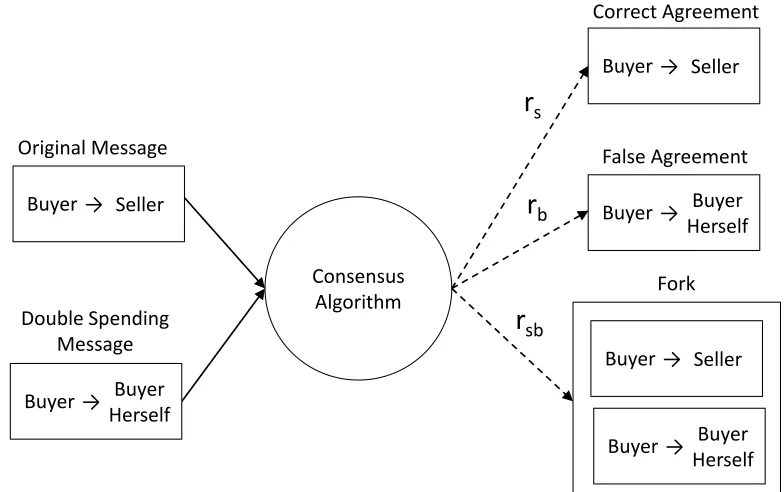
The consensus algorithm works as follows. In a DM meeting, if only the original message
is sent (i.e. the buyer is honest), the message will always be con…rmed by the consensus
algorithm (see Figure 1 for an illustration). If both the original and the double spending
messages are sent, one of the following will occur. 1) a correct agreement: only the original
message is con…rmed by the consensus algorithm; 2) a false agreement: only the double
spending message is con…rmed by the consensus algorithm; 3) a fork: both messages are
con…rmed by the consensus algorithm (see Figure 2 for an illustration). Let R (rs; rb; rsb)
denote the probabilities that the consensus algorithm delivers a correct agreement, a false
agreement, and a fork under the double spending attack, respectively, and rs+rb+rsb = 1. We assume that R is exogenously given by the technology, and we make the following
assumptions:
Assumption 1. rs >0; rb >0; rsb >0
Assumption 2. rs > rb
Assumption 1 captures the fact that the network is not perfect in the DM, so conducting
double spending fraud always has a chance to generate a fork or a false agreement.
Assump-tion 2 captures the property that the double spending message must be sent in the settlement
stage, after the original message was sent, a situation which gives the original message the
advantage of being con…rmed by the consensus algorithm.10 We say that an agreement is a
9Because in the current model the buyer can meet only one merchant in the DM, we do not consider the
case where the buyer sends the double spending message to make transfers to other merchants to purchase goods.
10In general, an agent may also send a message to transfer cryptocurrencies to herself during or before the
single agreement if it is a correct or false agreement. Because other agents cannot tell that a
message is an original message or a double spending one, if the consensus outcome delivers
a single agreement, they cannot tell whether the agreement is a correct agreement or a false
agreement; they can only observe that the agreement is a single agreement or a fork.
Note that a buyer can also send a message, either in the trading or the settlement stage,
to make a transfer to herself without making a transfer to the seller in advance, and we
call this “internal transfers.” A buyer may have an incentive to conduct internal transfers in
order to, for example, obtain a subsidy from the system. For simplicity, we exclude internal
transfers from the benchmark model by assuming that buyers cannot send a message to
transfer currencies to herself without transferring to the seller in advance. We incorporate
internal transfers into the model in the supplementary appendix and show that the main
implications of the present model still hold.11
Because consensus outcomes are observable by all agents, agents can recognize or reject
the receipt of a transfer conditional on whether the agreement is a single agreement or a
fork. If a transfer is recognized, the amount transferred is added to the receiver’s account;
if a transfer is rejected, that transfer is not added to any account and is equivalent to
being deleted. We assume that there are public signaling devices, such as sunspots, allowing
agents to coordinate regarding whether the currency in a transaction message is added to
the receiver’s account.12 Because the amount transferred in a transaction message is also
observable by all agents, the probability that a transfer is recognized can also be conditional
on the amount transferred, z^.13 Let p
1(^zt)denote the probability that the transfer is added
to produce. (See Li, Rocheteau, and Weill, 2012for a model in which people commit fraudulent payment before they trade.) In Bitcoin transfers, sellers can wait for a period of time before they deliver the goods to ensure that the buyer does not cheat, and this strategy is called “delay delivery” (SeeChiu and Koeppl,
2017). In this paper, we do not endogenize delay delivery but make assumptions on the timing of sending messages instead.
11In the supplementary appendix, we allow buyers to conduct internal transfers. Internal transfers cannot
be equilibrium strategies, but will result in a more constrained cryptocurrency mechanism because the mechanism has to deter the buyer’s incentive to conduct internal transfer.
12The use of lotteries or sunspots to determine the allocation of indivisible liquidity is applied inBerentsen,
Molico, and Wright(2002). As described inShell and Wright (1993), a sunspot has an advantage in serving as a coordination device.
13In Bitcoin and Ethereum, the balance of an account and the amount of transfer made in a message are
to the receiver’s account when the transfer is z^ and if the consensus algorithm delivers a
single agreement; if the consensus algorithm delivers a fork, we denote it by p2(^zt). In the supplementary appendix, we consider a more restrictive cryptocurrency system in which the
receipt of the transfer cannot be conditional on the amount of currency transferred, and we
show that the main results still hold.
We assume that the network is perfect in the CM: the transaction messages can be
received immediately by all participants. Thus, a consensus algorithm is not required in
the CM, and there are no double spending problems. Moreover, we assume that there is no
transaction subsidy in the CM.
To prevent double spending, a cryptocurrency system can require PoW be attached to a
message. PoW costs the message sender k units of disutility. If k is greater than the gain
from double spending, the buyer will have no incentive to commit fraud. We assume that
only the buyer can provide PoW and therefore it is the buyer who bears the disutility k.14
The second way to increase the cost of double spending is to require PoS, in which a message
must be attached with units of cryptocurrency as a deposit. The PoS deposit cannot be
used as payment in the DM trade. The return of the deposit occurs after the consensus
outcome is delivered and can also be conditional on the type of agreements and the amount
transferred. We denote q1(^zt)andq2(^zt)the probabilities of returning the deposit in a single agreement and a fork, respectively. If a deposit is not returned, it is equivalent to being
deleted from the cryptocurrency system.
2.1
The Trading Game and The Buyer’s Problem
Agents in the economy take as given the in‡ation rate t, transaction subsidy, t, PoW, k,
PoS, , and the probabilitiesP(^zt) = (p1(^zt); p2(^zt))and Q(^zt) = (q1(^zt); q2(^zt)). We analyze the transaction between the buyer and the seller in the DM as an extensive form game. The
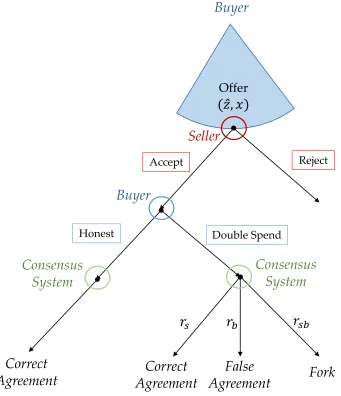
time line of the game is as follows.
1. CM: the buyer purchases cryptocurrency in the CM.
14We can also assume that the seller can provide PoW. In this case, the buyer must pay more currency to
2. DM: there are two stages:
trading stage: the buyer makes an o¤er to the seller. The seller decides to accept
or reject the o¤er.
settlement stage: the buyer decides whether or not to send a double spending
message.
The game tree in the DM is demonstrated in Figure3, and the consensus algorithm serves
as Nature to randomly assign an agreement.
A seller (or a buyer) receives the transfer if, …rst, the message that makes the transfer to
the seller (or the buyer) is con…rmed by the consensus algorithm, and, second, the receipt
of the transfer is recognized by all agents. If the buyer is honest, the consensus algorithm
will deliver a correct agreement with probability one. Thus, the probability that the seller
receives the transfer is p1(^zt), and the probability that the buyer receives the transfer is
zero. If the buyer double spends, the seller receives the payment only if the agreement is a
correct agreement (with probability rs) or a fork (with probability rsb), and the respective
probabilities that the seller receives the payment in a correct agreement and a fork are
p1(^zt) and p2(^zt); the buyer receives the payment only if the consensus algorithm delivers
a false agreement (with probability rb) or a fork (with probability rsb), and the respective
probabilities that the buyer receives the payment in a false agreement and a fork are p1(^zt)
and p2(^zt). Let i(^zt) and i(^zt)denote the probability that the seller and the buyer receive the currency transferred given that the buyer is honest (i=h), or engages in double spending
(i=d). Then according to the above discussion,
h(^zt) = p1(^zt);
h(^zt) = 0;
d(^zt) =p1(^zt)rs+p2(^zt)rsb; d(^zt) =p1(^zt)rb +p2(^zt)rsb:
(1)
Now we turn to the probabilities that the buyer receives the deposit that she attached
to a message. If the buyer is honest, the consensus system delivers a single agreement with
double spends, the probabilities that the consensus algorithm delivers a single agreement and
a fork are rs+rb and rsb, respectively, and the corresponding probabilities that the buyer
receives the deposit in a single agreement and a fork areq1(^zt)and q2(^zt). Let i(^zt)denote
the probability that the buyer receives the deposit; then
h(^zt) =q1(^zt);
d(^zt) =q1(^zt)(rs+rb) +q2(^zt)rsb:
(2)
In the post-trade stage, the buyer decides to be honest or to engage in double spending.
Let'h(^zt)and'd(^zt)denote the buyer’s post-trade gain for the honest and double spending
strategies, respectively. If the buyer is honest, she will take back the deposit with
prob-ability h(^zt). If the buyer sends the double spending message, she has to incur k units of
disutility to solve the hash problem again but will receive the cryptocurrency transferred z^
with probability d(^zt) and will receive the deposit with probability h(^zt). Thus,
'h(^zt) = h(^zt)
'd(^zt) = d(^zt)^z+ d(^zt) k:
(3)
We also consider the mixed strategy: let t denote the buyer’s strategy on the probability
of being honest and 1 t the probability of double spending; then the buyer’s post-trade
gain is
'(^zt; t) = t'h(^zt) + (1 t)'d(^zt): (4)
The buyer chooses her strategy by comparing'h(^zt)and'd(^zt). If'h(^zt)> 'd(^zt), the buyer will be honest ( t = 1); if 'h(^zt) < 'd(^zt), the buyer will double spend; if 'h(^zt) = 'd(^zt),
the buyer will be indi¤erent about being honest or double spending, so she can use a mixed
strategy ( t2[0;1]). Let B(^zt)denote the best response correspondence of the buyers after
trade; then
B(^zt) =
8 > > > > > <
> > > > > :
1 if d(^zt)^zt< k+ [ h(^zt) d(^zt)] [0;1] if d(^zt)^zt=k+ [ h(^zt) d(^zt)] 0 if d(^zt)^zt> k+ [ h(^zt) d(^zt)]
Now we turn to the seller’s strategy. Given the buyer’s transfer, z^t, and the seller’s belief
regarding the buyer’s post-trade strategy, ^t, the buyer will set the DM production xt to
make the seller indi¤erent:
xt = ~x(^zt;^t) [^t h(^zt) + (1 ^t) d(^zt)] ^zt: (6)
Letw(zt; t;^t) be the buyer’s gain in the bilateral meeting, then
w(^zt; t;^t) = (^zt t) k+u[~x(^zt;^t)] +'(^zt; t);
which consists of the cost due to the transfer, z^t t; the PoS deposit, ; the PoW for
the original message, k; the gain from consuming DM goods, u[~x(^zt; t)]; and the
post-trade gain,'(^zt; t). In equilibrium, the buyer’s strategy must be rational, so we must have t 2 B(^zt). Moreover, the seller’s belief must be consistent with the buyer’s strategy; that
is, t= ^t, and hence we abuse notations by denoting w(^zt; t) w(^zt; t; t) hereafter.
Given the in‡ation rate t, the buyer chooses mt and z^t in the CM to maximize her
expected payo¤. Note that the DM trade volume xt depends on the seller’s belief on the
buyer’s post-trade behavior (to double spend or not), and thus the game can have multiple
subgame perfect equilibria because the seller’s belief can vary. For example, according to (5),
if the buyer proposes z^tsuch that d(^zt)^zt=k+ [ h(^zt) d(^zt)] , then tcan be any value
between zero and one, so xt can be equal to [ t h(^zt) + (1 t) d(^zt)] ^zt for all t 2 [0;1].
We thus focus on the Pareto-dominant SPE, that is, the SPE such that there is no other
SPE that makes every player at least as well o¤ and at least one player strictly better o¤ in
terms of the CM expected value. Because the buyer makes a take-it-or-leave-it o¤er to the
seller, the seller’s expected gain must be zero. Thus, the Pareto-dominant SPE is the SPE
that maximizes the buyer’s expected payo¤ in the CM:
maxmt 1 0;z^t; t2B(^zt)Xt 1+
n
mt 1
1+ t 1 +w(^zt; t)
o
subject to
8 <
:
mt 1 = Xt 1
^
zt t+ m
t 1
1+ t 1
The …rst constraint in (7) says that the buyer’s end-of-period real cryptocurrency balance
mt 1 is equal to the net production in the CM, Xt 1; the second constraint is the budget
constraint, in which the real cryptocurrency balance at the beginning of the DM is equal to
the balance in the previous CM discounted by the in‡ation rate, mt 1
1+ t 1, and the budget can
be used as the deposit, ; and the transfer, zt = ^zt t.
2.2
Monetary Equilibrium
We …rst consider the money market clearing condition. Let mt denote the real aggregate
holdings of cryptocurrency at the end of the DM in period t. Since the aggregate quantity
of cryptocurrency does not change from the end of the DM to the end of the CM, mt also
denotes the aggregate cryptocurrency holdings at the end of the CM in period t. Then the
aggregate cryptocurrency holdings at the beginning of the DM in periodtare equal to mt 1
1+ t 1.
Nonetheless, the aggregate quantity of cryptocurrency can change within DM transactions
as a result of, for example, the buyer’s strategy on double spending, t, and the probabilities
of receiving the transfer and deposit, P(^zt) and Q(^zt); a situation that is characterized as follows:
mt=
mt 1
1 + t 1
(^zt t+ ) +
8 <
:
[ t h(^zt)^zt+ (1 t) d(^zt)^zt] + [ t h(^zt) + (1 t) ( d(^zt)^zt+ d(^zt) )]
9 =
;. (8)
Condition (8) says that the total amount of cryptocurrency at the end of the DM, mt, is
equal to the amount at the beginning of the DM, mt 1
1+ t 1, minus the transfer and PoS deposit
that are taken from the buyers’ accounts, z^t t+ t, plus the amount of transfer added
to the sellers’ accounts, t h(^zt) + (1 t) d(^zt), and the amount of transfer and deposit
return received by buyers, t h(^zt) + (1 t) ( d(^zt)^zt+ d(^zt) ). Note that the old buyers
and the sellers will leave the economy at the end of the CM, and thus they sell all their
cryptocurrency holdings mt in the CM. The new buyers are the only agents who live across
periods, andmt is their cryptocurrency demand. Thus, the CM money market clears if and
only if
A necessary condition for the clearing of the CM money market is
1 + t
1: (10)
The interpretation is as follows. If a buyer purchases cryptocurrency in the CM at period
t and resells it in the CM at period t+ 1, the rate of return in terms of utility is 1+ t. Therefore, if 1+ t <1, a buyer’s demand for cryptocurrency will be in…nite, and (9) cannot
hold. Given that (10) holds, it is not bene…cial for a buyer to hold extra currency without
using it to purchase goods in the DM. Thus, for simplicity, we assume that a buyer uses all
her cryptocurrency holdings to purchase DM goods, so the budget constraint in (7) must
bind:
^
zt t+ =
mt 1
1 + t 1
. (11)
Now the problem (7) can be rewritten as
max
^
zt; t2B(^zt)
Vt(^zt; t); (12)
where Vt(^zt; t) is the buyer’s expected payo¤ in the CM:
Vt(^zt; t) = (1 + t 1) (^zt t+ )
+
8 > <
> :
u[ t h(^zt)^zt+ (1 t) d(^zt)^zt] k
+ t h(^zt) + (1 t) [ k+ d(^zt)^zt+ d(^zt) ]
9 > =
> ;
. (13)
The buyer’s strategy (^zt; t)must satisfy
(^zt; t)2arg max
^
z0
t; 0t2B(^z0)
Vt(^z0t; 0t). (14)
We name (14) the individual optimality condition.
We focus on the stationary monetary equilibrium. Combining (8), (9), (11), and dropping
the time subscripts, we obtain the new CM money market clearing condition:
where the left side is the CM money supply and also the aggregate quantity of cryptocurrency
at the end of the DM; the right side is the CM money demand. Condition (15) illustrates
that, given the DM transferz^, an increase in the quantity of the cryptocurrency during the
DM transactions will result in an increase in the in‡ation rate , or the transaction subsidy
has to fall to withdraw the cryptocurrency from the market. From (13), an increase in
the in‡ation rate or a fall in the transaction subsidy will increase the buyer’s cost of the
DM trade, (1 + ) (^z + ). We call this channel the general equilibrium e¤ect, and
through this e¤ect, an individual buyer’s strategy on double spending not only in‡uences
her counterparty’s incentive to produce but also generates externality to other buyers by
in‡uencing their cost of trade through changing the in‡ation rate or the transaction subsidy.
Finally, in an equilibrium, a buyer must be individually rational to participate in the
cryptocurrency system, as argued byAndolfatto(2007). That is, a buyer’s expected value in
the CM when she enters the economy must be greater than zero, otherwise the buyer will not
purchase cryptocurrency in the CM and will not trade in the DM. By (13), in a stationary
equilibrium, the participation constraint holds if and only if
V(^z; ) = (1 + ) (^z + ) +
8 <
:
u[ h(^z)^z+ (1 ) d(^z)^z] k
+ h(^z) + (1 ) [ k+ d(^z)^z+ d(^z) ]
9 =
; 0
(16)
We de…ne a stationary monetary equilibrium to be a mechanism M = (k; ; ; ; P; Q)
and a strategy S = (^z; ) such that 1) agents optimize (agents’ strategies form a
Pareto-dominant SPE of the trading game); 2) the CM money market clears; 3) buyers are willing
to participate in the system. First of all, 1+ 1 is a necessary condition for the existence
of monetary equilibrium. Given that 1+ 1, then, …rst, (^z; ) is a Pareto-dominant SPE
if and only if the individual optimality condition (14) is satis…ed; second, the CM money
market clears if and only if (15) holds; third, buyers are incentivized to participate in the
system if and only if the participation constraint (16) holds. We de…ne a stationary monetary
equilibrium as follows:
and (14), (15), (16) hold.
We say that M generates an equilibrium E if E= (M;S)for some S.
2.3
Social Planner’s Problem
We now study the social planner’s problem in a stationary equilibrium, in which the planner
assigns the buyer’s production in the CM, X, and the seller’s production in the DM, x, to
maximize the aggregate utility of buyers and sellers. We assume that the social planner
can allocate resources between buyers and sellers freely, but he cannot enforce agents to
participate, so buyers and sellers must be individually rational in order to participate the
planner’s arrangement at any point in time. Let denote the discount factor of the social
planner and re‡ect how she weights the utilities of di¤erent generations, and we assume that
= . Then the social planner’s problem can be written as
max
x 0 u(x) x (17)
subject to x+ u(x) 0;
where x+ u(x) 0 is the buyer’s participation constraint in the CM. (See Appendix A
for the derivation of the social planner’s problem.) We …rst assume that the participation
constraint is not binding; then, the unconstrained optimal DM production, say x, solves
u0(x) 1 = 0. If x does not satisfy the participation constraint, then the optimal DM
production is equal tox^, whereinx^solves the binding participation constraint x^+ u(^x) =
0. Thus, the solution of the social planner’s problem isxe= minfx; x^ g, and this is the social
optimal allocation; the welfare level generated by the optimal allocation isWe=u(xe) xe,
and this is the social optimal welfare.
3
Optimal Mechanisms in Monetary Equilibrium
We take a mechanism design approach to …nd the mechanism that generates a monetary
(17), in a monetary equilibrium, social welfare includes an extra term, k+ (1 )2k, which
is the social loss due to PoW, so the social welfare function is
u (x) x [ k+ (1 )2k]. (18)
By the de…nition of monetary equilibrium (De…nition 1), the optimal mechanism problem
can be written as
max
(k; ; ; ;P(^z);Q(^z);z;^ )u [~x(^z; )] x~(^z; ) [ k+ (1 )2k] (19)
subject to 1 + 1, and (14), (15) and (16)
Because the set of optimal mechanisms can be profound, we construct two forms of
candi-dates for the optimal mechanisms: “simple honest mechanisms” and “simple double spending
mechanisms,” and we prove that any equilibrium is weakly dominated by an equilibrium
gen-erated by either a simple honest mechanism or a simple double spending mechanism. Thus,
when we look for an optimal equilibrium of cryptocurrency systems, it is su¢cient to look for
it within the set of equilibria generated by the simple honest mechanisms or double spending
mechanisms. In the following discussion, we …rst establish simple honest mechanisms and
then simple double spending mechanisms.
3.1
Simple Honest Mechanism
In a simple honest mechanism, we set p2(^z) = q2(^z) = 0 to punish buyers who deviate to
double spending; that is, whenever a fork occurs, the receivers of transaction messages will
not receive the transfers. Moreover, we set p1(^z)and q1(^z)to be indicator functions; that is,
p1(^z) =q1(^z) = 1ly(^z) 8 <
:
1 if z^=y
0 otherwise
; for some y >0,
and we name y the target value of the simple honest mechanism. By setting the equation
thusly, we impose a strict requirement on the amount transferred that will be recognized:
transferz^is di¤erent fromy, the transfer and the PoS deposit will be deleted as a punishment
for deviation. Moreover, we setk and just high enough to deter double spending. Let
s h = 1;
s
h = 0; sh = 1; s
d=rs; s
d=rb; sd= (rs+rb);
then by (1) and (2), p1(^z) = 1ly(^z) and p2(^z) = 0 imply i(y) = si; i(y) = s
i; andq1(^z) =
1ly(^z)and q2(^z) = 0 imply i(y) = si. Then k and are set to satisfy k+ ( sh sd) = s dy.
If k and are too small such that k+ ( s
h sd) < s
dy, the buyer will double spend; if
k and are too large such that k + ( s
h sd) > s
dy, the excessive PoW and PoS will
generate waste. Finally, because any transfer deviated from y will not be received by the
receiver, the in‡ation rate does not in‡uence the buyer’s marginal decision on the amount
of transfer as long as 1+ 1. For the purpose of exposition, we set equal to zero, and let
be chosen passively to satisfy the money market clearing condition (15). Then, given that
h(y) = h(y) = 1, and = 1, (15) implies = 0. To summarize, we de…ne a simple honest
mechanism as follows:
De…nition 2 (Simple honest mechanisms) A mechanismMh=(k; ; ; ; P(^z); Q(^z))is
a simple honest mechanism if
(i) There is a y >0 such thatp1(^z) = q1(^z) = 1ly(^z) and p2(^z) = q2(^z) = 0;
(ii) (k; ) satis…es sdy=k+ ( sh sd) ;
(iii) ( ; ) satis…es = 0; = 0.
The remaining questions concern whether the buyer will make transfer z^ = y and be
honest ( = 1) under the simple honest mechanism, and whether the simple honest
mecha-nism can generate an equilibrium. We show that it su¢ces to check that the participation
constraint (16) holds. Given a simple honest mechanismMh with target valuey, we denote
its corresponding honest strategy bySh = (^z; ) such thatz^=y; = 1. We …rst argue that
Sh is an optimal strategy underMh if the participation constraint (16) is satis…ed, as shown
Lemma 1 Let Mh be a simple honest mechanism with target value y, and let Sh = (^z; ) be
a strategy such thatz^=y, = 1. Then(Mh;Sh)satis…es the individual optimality condition
(14) if (Mh;Sh) satis…es the participation constraint (16).
Proof. See Appendix B.1.
The proof is sketched as follows. We show that under Mh, Sh generates the highest CM
value to the buyer among all strategies. First, suppose that the buyer makes a transferz^=y.
From De…nition 2 (ii), because sdy =k+ ( sh s
d) , any 2[0;1] can be a best response.
However, becausep2(y) = 0, the seller’s expected payo¤ will be lower when the buyer double
spends than when the buyer is honest, which in turn generates a smaller DM consumption
to the buyer, so any strategy in which < 1 will be dominated by the honest strategy
( = 1). Second, suppose that the buyer makes a transfer z^ 6= y, then neither the buyer nor the seller will receive the transfer, and thus the buyer’s CM value will be non-positive.
Because (Mh;Sh)satis…es the participation constraint, it generates non-negative CM value
to the buyer, and thusSh also weakly dominates all strategies such that z^6=y and therefore
satis…es the individual optimality constraint (14).
To show that(Mh;Sh)forms an equilibrium, we must check that 1+ 1and the money
market clearing condition (15) holds, and both of which hold by the construction of the
simple honest mechanism (De…nition2 (iii)). Thus, we have the following proposition:
Proposition 1 Let Mh be a simple honest mechanism with target value y, and let Sh = (^z; ) be a strategy such that z^=y, = 1. Then (Mh;Sh) is an equilibrium if and only if it
satis…es the participation constraint (16).
We name an equilibrium generated by a simple honest mechanism a “simple honest
equilibrium.”
3.2
Simple Double Spending Mechanism
In a simple double spending mechanism, we set k= = 0, and buyers double spend in this
mechanism. As in a simple honest mechanism, we also set p1(^z) = 1ly(^z)to punish transfers
spending is an equilibrium strategy, the reason that the transfers in forks are deleted is
not to punish deviations but is as follows. Because rs > rb, if the agreement is single, the
seller has a higher probability than the buyer to receive the transfer; if the agreement is a
fork, the probabilities for a buyer and a seller to receive the transfer are identical. However,
only the transfer received by the seller can facilitate the DM trade, but both the transfers
received by the buyer and the seller incur a trade cost to other participants through the
general equilibrium e¤ect. By setting p2(^z) = 0, we recognize transfers in single agreements
but not in forks and therefore minimize the cost of the DM trade. We also set = 0 in a
simple double spending mechanism and let be chosen passively to satisfy the money market
clearing condition (15); then given that d(y) = s
d, d(y) = s
d, and = 0, (15) implies = (1 s
d s
d)y. Finally, because is set to be zero,q1(^z)and q2(^z)will have no impact
on the buyer’s post-trade gain thus can take any value in[0;1]. We namey the target value
of the simple double spending mechanism, and summarize the de…nition of a simple double
spending mechanism as follows:
De…nition 3 (Simple double spending mechanisms)A mechanismMd=(k; ; ; ; P(^z); Q(^z)) is a simple double spending mechanism if
(i) There is a y >0 such thatp1(^z) = 1ly(^z), p2(^z) = 0;
(ii) (k; ) satis…es k= 0, = 0;
(iii) ( ; ) satis…es = 0; = (1 s d
s d)y.
Given a simple double spending mechanism Md with target value y, we denote its
cor-responding double spending strategy by Sd = (^z; ) such that z^= y and = 0. We argue
that (Md;Sd) is an equilibrium if it satis…es the buyer’s participation constraint (16). We
…rst show that Sd is an optimal strategy under Md if the buyer’s participation constraint
(16) is satis…ed:
Lemma 2 Let Md be a simple double spending mechanism with target value y, and let Sd = (^z; ) be a strategy such that z^ = y, = 0. Then Md;Sd satis…es the individual
optimality condition (14) if (Md;Sd) satis…es the participation constraint (16).
We sketch the proof as follows. Suppose that the buyer makes a transfer z^ = y, then
because k = 0 and = 0, conducting double spending ( = 0) is the buyer’s only best
response. Alternatively, suppose the buyer makes a transfer z^ 6= y; then the buyer’s CM value will be non-positive. Because (Md;Sd) satis…es the participation constraint (16), it
generates a non-negative CM value to the buyer, soSd weakly dominates all strategies such
that z^6=y and thus satis…es the individual optimality condition (14).
By the construction of the simple double spending mechanism (De…nition3(iii)),(Md;Sd)
also satis…es 1+ 1and the money market clearing condition (15), and thus(Md;Sd)forms
an equilibrium:
Proposition 2 Let Md be a simple double spending mechanism with target value y, and let
Sd = (^z; ) be a strategy such that z^ = y, = 0. Then (Md;Sd) is an equilibrium if and
only if it satis…es the participation constraint (16).
We name an equilibrium generated by a simple double spending mechanism a “simple
double spending equilibrium.”
3.3
Optimal Equilibrium
We prove that any equilibrium is either weakly dominated by a simple honest equilibrium
or a simple double spending equilibrium. Let E = (k ; ; ; ; P ; Q ; z ; ) be an
equi-librium; then we denote p^j =pj(^z );q^j =qj(^z );^i = i(^z ), ^i = i(^z ), ^i = i(^z ). The strategy of the proof is as follows. First, we show that an equilibrium with zero DM
produc-tion is dominated by a simple double spending equilibrium and therefore cannot be optimal.
Second, we show that an equilibrium with nonzero DM production is weakly dominated by
a simple honest equilibrium if PoW and PoS are su¢ciently high (k + (^h ^d) ^dz^ ) and is weakly dominated by a simple double spending equilibrium if PoW and PoS are low
(k + (^h ^d) <^dz^ ).
LetE denote the collection ofEthat are equilibria, and letZ =fE2 E: x~(^z; ) = 0gbe
the set of equilibria with zero DM productions. Then the following proposition holds:
The proof is straightforward. Because the DM production is zero in Z, welfare of E
must be non-positive. Moreover, becauselimx!0u0(x) = 1, we can construct a simple double
spending equilibrium with positive welfare if the target valueyis set to be su¢ciently small.
By proposition 3, in the following discussion, we exclude those equilibria in Z and denote
N =EnZ.
Proposition 4 Let E = (k ; ; ; ; P (^z); Q (^z);z ;^ )2 N
(i) If k + [^h ^d] ^dz^ , there is a simple honest equilibrium which (weakly)
domi-nates E ;
(ii) Ifk +[^h ^d] <^dz^ , there is a simple double spending equilibrium which (weakly)
dominates E :
Proof. See Appendix B.3.
The proof is sketched as follows. We divide N into three cases: 1) k + (^h ^d) = ^
dz^ ; 2) k + (^h ^d) > ^dz^ ; and 3) k + (^h ^d) < ^dz^ . First, in the case of
k + (^h ^d) = ^dz ;^ PoW and PoS are large enough such that the buyer is willing to be
honest given the DM transfer z^ . In a simple honest equilibrium, becausep2(^z) =q2(^z) = 0,
we minimize the buyer’s gain from double spending and PoW and PoS relative to the volume
of DM trade. Thus, given E , we can construct a simple honest equilibrium that generates
the same DM productionx but with a smaller cost of trade and therefore generates higher
social welfare compared with E .
In the case of k + (^h ^d) > ^dz^ , the extra PoW and PoS are waste. Thus, we
can construct an E0 that makes the same transfer z^ but with smaller k and that are just
enough to prevent double spending, soE0 generates higher social welfare thanE does. Then,
we use the same argument as in case 1) to …nd a simple honest equilibrium that dominates
E0 and therefore also dominates E .
Finally, in the case of k + (^h ^d) < ^dz^ , PoW and PoS are not large enough to prevent double spending, and thus PoW and PoS only generates waste. As a consequence, we
can decreasekand to zero to save the cost of PoW and PoS without in‡uencing the amount
of DM trade. Moreover, by setting p2(^z) = 0, we minimize the cost of trade, as discussed
same DM production x but with weakly higher welfare, and thus it weakly dominates the
equilibrium.
By Proposition 3 and Proposition 4, when we are looking for an optimal equilibrium,
it su¢ces to discuss the simple honest and simple double spending equilibria. Thus, we
con…ne our attention to the optimal welfare generated by these two forms of equilibria.
When comparing both mechanisms, notice that the cost of PoW and PoS is saved in a
simple double spending mechanism, but given the DM transfer y, the amount of DM trade
is smaller in a simple double spending mechanism than in a simple honest mechanism. In
the following discussion, we study under what circumstance the simple honest equilibria can
generate higher social welfare than simple double spending equilibria and vice versa.
3.4
Optimal Simple Double Spending Equilibrium
We …rst discuss the optimal simple double spending equilibrium. By Proposition2, a simple
double spending equilibrium is a simple double spending mechanism and a corresponding
double spending strategy (Md;Sd) that satisfy the participation constraint (16). Let y be
the target value of(Md;Sd), and given the social welfare function (18) and the participation
constraint (16) under(Md;Sd);the optimal simple double spending equilibrium solves
max
y u(
s dy)
s
dy (20)
subject to ( sd+ s
d)y+ fu( s dy) +
s
dyg 0:
Let x = s
dy denote the DM production, and because sd = rs, sd = rb, we rewrite the
mechanism design problem as
max
x u(x) x (21)
subject to 1 +1 rb
rs
x+u(x) 0:
Let Wd(R) denote the welfare level of optimization problem (21), then the key value that determines Wd(R) is rb
rs in the participation constraint. The interpretation is as follows. In
the seller only receives rsy units of cryptocurrency in the DM, and the buyer receives rby
units. Unlike the transfer received by the seller, the transfer received by the buyer does not
facilitate the DM transaction. However, both transfers received by the buyer and the seller
generate costs of trade through the general equilibrium e¤ect. Thus, the ratio rb
rs is a measure
of the ine¢ciency of cryptocurrency, and a smaller rb
rs will result in higher social welfare.
To understand how the network imperfection a¤ects e¢ciency, we study the impact of
changes in R = (rs; rb; rsb) on Wd(R). Note that rs +rb +rsb = 1, so a change in one
probability must result in corresponding changes in other probabilities. In the following
discussion, we study the bilateral trade-o¤ between the probabilities of one agreement and
another. Let denote the feasible set of R:
= (rs; rb; rsb)2R3>0 :rs+rb +rsb = 1; rs > rb :
The following lemma shows how an increase in rs in‡uences the optimal welfare of simple
double spending equilibria:
Lemma 3 An increase in rs and a corresponding decrease in either rb or rsb result in an
increase in Wd(R). That is, given 4>0, for R= (rs; rb; rsb)2 ;
(i) If R0 = (r
s+4; rb; rsb 4)2 , then Wd(R0) Wd(R);
(ii) If R0 = (r
s+4; rb 4; rsb)2 , then Wd(R0) Wd(R):
The holding of Lemma 3can be directly observed from Problem (20) and (21). First, an
increase inrs will increase the seller’s expected payo¤ given the amount transferredy. If the
increase inrscrowds outrsb, butrbis not a¤ected, then the buyer’s expected payo¤ relative to
the seller’s will decrease (rb
rs decreases). As a consequence, the ine¢ciency of cryptocurrency
decreases, and welfare increases. If the increase in rs results in a corresponding decrease in
rb, then rrsb decreases even more than in the …rst case, so welfare will also increase more than
in the …rst case.
By using symmetric arguments, we have the following properties for the impact of an
Lemma 4 An increase in rb and a corresponding decrease in either rsb or rs result in a
decrease in Wd(R). That is, given 4>0, for R= (rs; rb; rsb)2 ;
(i) If R0 = (r
s; rb+4; rsb 4)2 , then Wd(R0) Wd(R);
(ii) If R0 = (r
s 4; rb +4; rsb)2 , then Wd(R0) Wd(R):
Combining Lemma 3 and Lemma 4, we see that the impact of changes in rsb on Wd(R)
depends on it crowds out rb or rs. Lemma 3 (i) implies that an increase in rsb and a
corresponding decrease in rs result in a decrease in Wd(R); however, Lemma 4 (i) implies
that an increase inrsb and a corresponding decrease inrb result in an increase inWd(R). We
summarize the properties of Wd(R)in the following proposition:
Proposition 5 When considering the bilateral trade-o¤ between the probabilities of
agree-ments, the welfare of the optimal simple double spending equilibrium Wd(R) is positively related tors and negatively related torb. Moreover, the impact of increasingrsb is positive if
it crowds out rb and negative if it crowds out rs.
We take the buyer’s DM utility function as constant relative risk aversion (CRRA) for
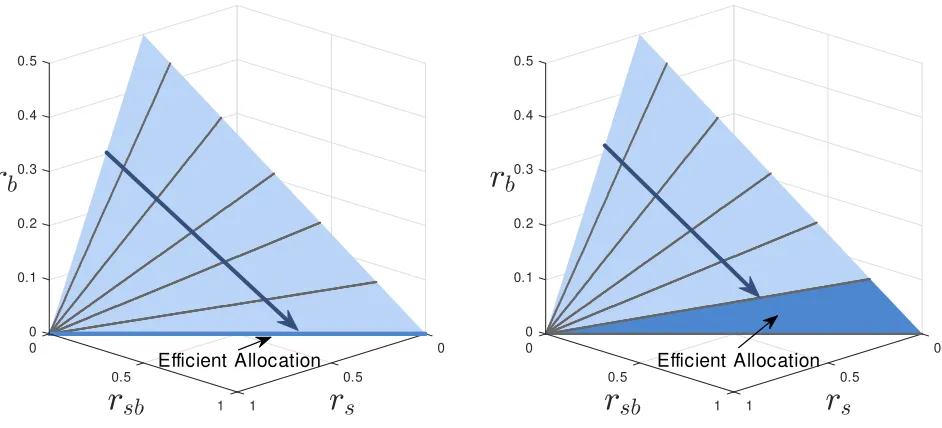
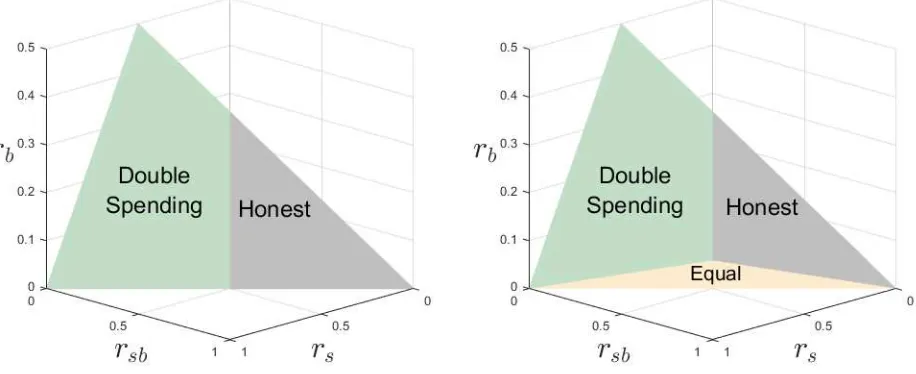
example and demonstrate the iso-welfare curves of Wd(R) in Figure 4. If the participation constraint is binding in the social planner’s problem, then Wd(R) approaches the social optimal welfare if and only if rb
rs approaches zero (see Figure 4, left). If the participation
constraint is non-binding in the social planner’s problem, the buyer is willing to tolerate a
small cost to trade with e¢cient allocation, and there is >0such thatWd(R)achieves the social optimal welfare if and only if rb
rs (see Figure 4, right).
Proposition 6 If the participation constraint of the social planner’s problem is binding,
then Wd(R)!We as rb
rs !0: If the participation constraint of the social planner’s problem
is not binding, then Wd(R) = We for rb
rs , where solves
1 +1 xe+u(xe) = 0:
3.5
Optimal Simple Honest Equilibrium
We then discuss the optimal simple honest equilibrium. By Proposition 1, a simple honest
equilibrium is a simple honest mechanism and a corresponding honest strategy (Mh;Sh)
participation constraint (16) under (Mh;Sh) is (y+ ) + fu(y) + kg 0, and the
social welfare function (18) isu(y) y k. Moreover, in a simple honest equilibrium, k and
can be chosen to meet the constraint that s
dy=k+ ( sh sd) . Thus, an optimal simple
honest equilibrium solves
maxy;k; u(y) y k (22)
subject to
8 > <
> :
(y+ ) + fu(y) + kg 0 s
dy=k+ ( sh sd)
.
Let x = y denote the DM production. By the constraint sdy = k+ ( sh sd) in problem
(22), we divide the DM production x into the part supported by PoW, xk = 1s
dk and the
part supported by PoS, x = sh s d s
d ; then x = x
k+x . Moreover, given that s
d = rb and s
h s
d=rsb, we rewrite (22) as
max
xk;x u x
k+x (1 +rb)xk x (23)
subject to (1 +rb)xk 1
+1 rb
rsb
x +u(xk+x ) 0:
LetWh(R)denote the welfare level of optimization problem (23). In the following discussion, we study PoW and PoS separately to investigate the channel through which changes in R
in‡uence Wh(R). We …rst shut down PoS in simple honest mechanisms by setting = 0
(x = 0), and we call the mechanisms “pure PoW mechanisms”; then we shut down PoW
by setting k = 0 (xk = 0), and we call the mechanisms “pure PoS mechanisms”. Finally,
we consider both PoW and PoS in the simple honest mechanism as in optimization problem
(23).
Optimal Pure PoW Equilibrium. An optimal pure PoW equilibrium solves the
follow-ing problem
max
xk u x
k (1 +rb)xk (24)
which is equivalent to settingx = 0in the optimization problem (23). LetWk
h(R)denote the
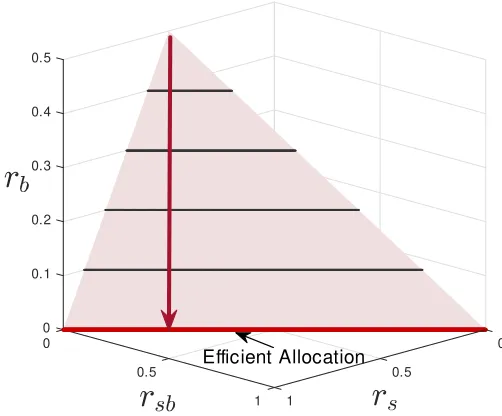
welfare level of the optimization problem (24), we observe thatWhk(R)is only determined by the probability of a false agreement,rb. This is because we punish forks by settingp2(^z) = 0,
and thus the buyer gains from double spending only when a false agreement occurs. Thus,
rb determines the required size of PoW to prevent double spending fraud: an increase in rb
directly decreases social welfare, and also tightens the participation constraint. In Figure
5, we demonstrate the iso-welfare curves of the optimal PoW equilibrium. Because PoW
generates a loss to social welfare, given that rb is greater than zero, Whk(R)must be smaller
than the social optimal welfare,We, regardless of whether the participation constraint binds
or not, and Whk(R)!We asrb !0:
Proposition 7 Wk
h(R) approaches the social optimal welfare as rb !0.
Optimal Pure PoS Equilibrium. An optimal pure PoS equilibrium solves the following
problem
max
x u x x (25)
subject to 1 + 1 rb
rsb
x +u(x ) 0;
which is equivalent to setting xk = 0 in the optimization problem (23). Let Wh(R) denote the welfare level of the optimization problem (25), then similar to pure PoW equilibria,
the buyer’s gain from double spending is also determined by rb. However, because PoS
utilizes forks as signals to detect double spending and to trigger the punishment for double
spending, a higher rsb will result in a smaller required size of PoS to prevent fraud. Thus,
the welfare of the optimal pure PoS equilibrium is determined by the ratio rb
rsb, and a smaller
rb
rsb will result in higher social welfare. In Figure 6, we depict the iso-welfare curves of the
optimal PoW equilibrium on . Similar to the optimization problem of the double spending
equilibrium, when the participation constraint in the social planner’s problem is binding,
Wh(R) approaches social optimum if rb
rsb ! 0 (Figure 6, left). When the participation
constraint in the social planner’s problem is nonbinding, the social optimum can be achieved
Proposition 8 If the participation constraint of the social planner’s problem is binding,
thenWh(R)!We as rb
rsb !0:If the participation constraint of the social planner’s problem
is not binding, then Wh(R) =We for rb
rsb , where solves
1 +1 xe+u(xe) = 0.
Proof-of-Work and Proof-of-Stake In this section, we utilize both PoW and PoS to
obtain the optimal simple honest equilibrium as in problem (23). According to the above
discussion, the di¤erences between pure PoW and pure PoS mechanisms are twofold: 1)
PoW generates disutility to the buyer and causes a direct loss to social welfare, but PoS
does not; 2) PoS relies on forks to trigger punishments, but PoW does not; thus, givenrb, if
rsb decreases, the cost of applying PoS to prevent fraud will increase, but the cost of applying
PoW remains the same.
We solve problem (23) in an example with a CRRA utility function and demonstrate the
results in Figure7. We …rst consider the case that the participation constraint in the social
planner’s problem is binding (Figure 7left). We observe from the …gure that given rb, when
rsb is low, the optimal simple honest equilibrium is generated by a pure PoW mechanism
(e.g., the pink region in the Figure); when rsb is high, the optimal equilibrium is generated
by a pure PoS mechanism (e.g., the blue region in the Figure). Moreover, because PoW and
PoS work di¤erently in a¤ecting e¢ciency, a combination of PoW and PoS may improve
social welfare; thus, there is a region between the pure PoW and pure PoS equilibrium in
which both PoW and PoS are utilized in the optimal equilibrium (e.g., the gray region in the
Figure). If the participation constraint is non-binding in the social planner’s problem (Figure
7, right), then given rb, if rsb is high, the optimal equilibrium is a pure PoS mechanism. If
rsb is low, PoW is required in the optimal equilibrium; however, PoS is also essential, and
that is, the optimal equilibrium applies both PoS and PoW to deter double spending.
In the following lemma, we discuss how an increase in rsb in‡uences the optimal welfare
of simple honest equilibria:
Lemma 5 An increase in rsb and a corresponding decrease in either rs or rb result in an
increase in Wh(R). That is, given 4>0, for R= (rs; rb; rsb)2 ;
(i) If R0 = (r
s 4; rb; rsb+4)2 , then Wh(R0) Wh(R);
(ii) If R0 = (r
The holding of Lemma 5 can be directly observed from Problem (23). First, an increase
inrsb increases the probability that double spending is detected. Moreover, if the increase in
rsb results in a decreases in rs but rb remains the same, then the gain from double spending
does not change. In this case, the e¢ciency of PoW is unchanged, but the e¢ciency of
PoS increases, and thus Wh(R) increases because of the increase in the e¢ciency of PoS. Furthermore, if the increase in rsb results