Proceedings of the 56th Annual Meeting of the Association for Computational Linguistics (Short Papers), pages 579–585
579
Exploiting Document Knowledge
for Aspect-level Sentiment Classification
Ruidan He†‡, Wee Sun Lee†, Hwee Tou Ng†, and Daniel Dahlmeier‡ †Department of Computer Science, National University of Singapore
‡SAP Innovation Center Singapore
†{ruidanhe,leews,nght}@comp.nus.edu.sg
Abstract
Attention-based long short-term memory (LSTM) networks have proven to be use-ful in aspect-level sentiment classifica-tion. However, due to the difficulties in annotating aspect-level data, existing public datasets for this task are all rela-tively small, which largely limits the ef-fectiveness of those neural models. In this paper, we explore two approaches that transfer knowledge from document-level data, which is much less expensive to obtain, to improve the performance of aspect-level sentiment classification. We demonstrate the effectiveness of our ap-proaches on 4 public datasets from Se-mEval 2014, 2015, and 2016, and we show that attention-based LSTM benefits from document-level knowledge in multi-ple ways.
1 Introduction
Given a sentence and an opinion target (also called an aspect term) occurring in the sentence, aspect-level sentiment classification aims to determine the sentiment polarity in the sentence towards the opinion target. An opinion target or target for short refers to a word or a phrase describing an aspect of an entity. For example, in the sentence “This little place has a cute interior decor but the prices are quite expensive”, the targets areinterior decorand prices, and they are associated with positive and negative sentiment respectively.
A sentence may contain multiple sentiment-target pairs, thus one challenge is to separate different opinion contexts for different targets. For this purpose, state-of-the-art neural meth-ods (Wang et al.,2016;Liu and Zhang,2017;Chen et al., 2017) adopt attention-based LSTM net-works, where the LSTM aims to capture sequen-tial patterns and the attention mechanism aims
to emphasize target-specific contexts for encod-ing sentence representations. Typically, LSTMs only show their potential when trained on large datasets. However, aspect-level training data re-quires the annotation of all opinion targets in a sentence, which is costly to obtain in practice. As such, existing public aspect-level datasets are all relatively small. Insufficient training data limits the effectiveness of neural models.
Despite the lack of aspect-level labeled data, enormous document-level labeled data are eas-ily accessible online such as Amazon reviews. These reviews contain substantial linguistic pat-terns and come with sentiment labels naturally. In this paper, we hypothesize that aspect-level sentiment classification can be improved by em-ploying knowledge gained from document-level sentiment classification. Specifically, we ex-plore two transfer methods to incorporate this sort of knowledge – pretraining and multi-task learning. In our experiments, we find that both methods are helpful and combining them achieves significant improvements over attention-based LSTM models trained only on aspect-level data. We also illustrate by examples that ad-ditional knowledge from document-level data is beneficial in multiple ways. Our source code can be obtained fromhttps://github.com/
ruidan/Aspect-level-sentiment.
2 Related Work
aspect-level annotated data is required, which is expen-sive to obtain in practice.
We explore both pretraining and multi-task learning for transferring knowledge from docu-ment level to aspect level. Both methods are widely studied in the literature. Pretraining is a common technique used in computer vision where low-level neural layers can be usefully transferred to different tasks (Krizhevsky and Sutskever, 2012; Zeiler and Fergus, 2014). In natural lan-guage processing (NLP), some efforts have been initiated on pretraining LSTMs (Dai and Le,2015; Zoph et al., 2016; Ramachandran et al., 2017) for sequence-to-sequence models in both super-vised and unsupersuper-vised settings, where promising results have been obtained. On the other hand, multi-task learning simultaneously trains on sam-ples in multiple tasks with a combined objec-tive (Collobert and Weston, 2008; Luong et al., 2015a; Liu et al., 2016), which has improved model generalization ability in certain cases. In the work of Mou et al. (2016), the authors investi-gated the transferability of neural models in NLP applications with extensive experiments, showing that transferability largely depends on the seman-tic relatedness of the source and target tasks. For our problem, we hypothesize that aspect-level sen-timent classification can be improved by employ-ing knowledge gained from document-level senti-ment classification, as these two tasks are highly related semantically.
3 Models
3.1 Attention-based LSTM
We first describe a conventional implementation of an attention-based LSTM model for this task. We use it as a baseline model and extend it with pretraining and multi-task learning approaches for incorporating document-level knowledge.
The inputs are a sentences = (w1, w2, ..., wn)
consisting ofnwords, and an opinion targetx = (x1, x2, ..., xm)occurring in the sentence
consist-ing of a subsequence of m words from s. Each word is associated with a continuous word embed-dingew (Mikolov et al.,2013) from an embedding
matrixE∈RV×d, whereV is the vocabulary size
anddis the embedding dimension.
LSTM is used to capture sequential informa-tion, and outputs a sequence of hidden vectors:
[h1, ...,hn] =LSTM([ew1, ...,ewn], θlstm) (1)
An attention layer assigns a weight αi to each
word in the sentence. The final target-specific rep-resentation of the sentencesis then given by:
z=
n
X
i=1
αihi (2)
Andαiis computed as follows:
αi =
exp(βi)
Pn
j=1exp(βj)
(3)
βi=fscore(hi,t) =tanh(hTi Wat) (4)
t= 1
m
m
X
i=1
exi (5)
where t is the target representation computed as the averaged word embedding of the target.fscore
is a content-based function that captures the se-mantic association between a word and the target, for which we adopt the formulation used in (Lu-ong et al.,2015b;He et al.,2017) with parameter matrixWa∈Rd×d.
The sentence representationzis fed into an out-put layer to predict the probability distribution p
over sentiment labels on the target:
p=sof tmax(Woz+bo) (6)
We refer to this baseline model as LSTM+ATT. It is trained via cross entropy minimization:
J =−X
i∈D
logpi(ci) (7)
whereDdenotes the overall training corpus,ci
de-notes the true label for sample i, and pi(ci)
de-notes the probability of the true label.
3.2 Transfer Approaches
LSTM+ATT is used as our aspect-level
model with parameter set θaspect =
{E, θlstm,Wa,Wo,bo}. We also build a
standard LSTM-based classifier based on
document-level training examples. This network is the same as the LSTM+ATT apart from the lack of the attention layer. The training ob-jective is also cross entropy minimization as shown in equation (7) and the parameter set is
θdoc={E0, θ0lstm,W0o,b0o}.
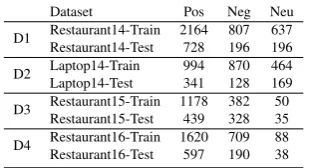
Dataset Pos Neg Neu
D1 Restaurant14-Train 2164 807 637
Restaurant14-Test 728 196 196
D2 Laptop14-Train 994 870 464
Laptop14-Test 341 128 169
D3 Restaurant15-Train 1178 382 50
Restaurant15-Test 439 328 35
D4 Restaurant16-Train 1620 709 88
[image:3.595.105.260.64.148.2]Restaurant16-Test 597 190 38
Table 1: Dataset description.
parametersE, θlstm,Wo,bo of LSTM+ATT with
the pretrained weights, and train it on aspect-level examples to fine tune those weights and learnWa
which is randomly initialized.
Multi-task Learning(MULT): This approach si-multaneously trains two tasks – document-level and aspect-level classification. In this setting, the embedding layer (E) and the LSTM layer (θlstm)
are shared by both tasks, and a document is rep-resented as the mean vector over LSTM outputs. The other parameters are task-specific. The over-all loss function is then given by:
L=J+λU (8)
where U is the loss function of document-level classification. λ∈(0,1)is a hyperparameter that controls the weight ofU.
Combined (PRET+MULT): In this setting, we first perform PRET on document-level exam-ples. We use the pretrained weights for parame-ter initialization for both aspect-level model and document-level model, and then perform MULT as discussed above.
4 Experiments
4.1 Datasets and Experimental Settings
We run experiments on four benchmark aspect-level datasets, taken from SemEval 2014 (Pontiki et al.,2014), SemEval 2015 (Pontiki et al.,2015), and SemEval 2016 (Pontiki et al., 2016). Fol-lowing previous work (Tang et al.,2016b; Wang et al.,2016), we remove samples withconflicting polarities in all datasets1. Statistics of the resulting datasets are presented in Table1.
We derived two document-level datasets from Yelp2014 (Tang et al., 2015) and the Amazon Electronics dataset (McAuley et al.,2015) respec-tively. The original reviews were rated on a 5-point scale. We consider 3-class classification and
1We remove samples in the 2015/6 datasets if an opinion
target is associated with different sentiment polarities.
thus label reviews with rating<3,>3, and= 3as negative, positive, and neutral respectively. Each sampled dataset contains 30k instances with ex-actly balanced class labels. We pair up an aspect-level dataset and a document-aspect-level dataset when they are from a similar domain – the Yelp dataset is used by D1, D3, and D4 for PRET and MULT, and the Electronics dataset is only used by D2.
In all experiments, 300-dimension GloVe vec-tors (Pennington et al.,2014) are used to initialize
E and E0 when pretraining is not conducted for weight initialization. These vectors are also used for initializing E0 in the pretraining phase. Val-ues for hyperparameters are obtained from experi-ments on development sets. We randomly sample 20% of the original training data from the aspect-level dataset as the development set and only use the remaining 80% for training. For all experi-ments, the dimension of LSTM hidden vectors is set to 300,λis set to 0.1, and we use dropout with probability 0.5 on sentence/document representa-tions before the output layer. We use RMSProp as the optimizer with the decay rate set to 0.9 and the base learning rate set to 0.001. The mini-batch size is set to 32.
4.2 Model Comparison
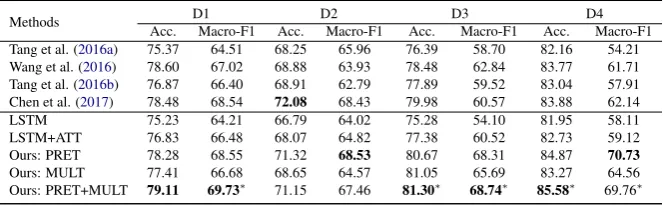
Table2shows the results of LSTM, LSTM+ATT, PRET, MULT, PRET+MULT, and four representa-tive prior works (Tang et al.,2016a,b;Wang et al., 2016; Chen et al., 2017). Significance tests are conducted for testing the robustness of methods under random parameter initialization. Both accu-racy and macro-F1 are used for evaluation as label distribution is unbalanced. The reported numbers are obtained as the average value over 5 runs with random initialization for each method.
We observe that PRET is very helpful, and con-sistently gives a 1–3% increase in accuracy over LSTM+ATT across all datasets. The improve-ments in macro-F1 scores are even more, espe-cially on D3 and D4 where the labels are ex-tremely unbalanced. MULT gives similar perfor-mance as LSTM+ATT on D1 and D2, but im-provements can be clearly observed for D3 and
D4. The combination (PRET+MULT) overall
yields better results.
Methods D1 D2 D3 D4
Acc. Macro-F1 Acc. Macro-F1 Acc. Macro-F1 Acc. Macro-F1
Tang et al. (2016a) 75.37 64.51 68.25 65.96 76.39 58.70 82.16 54.21
Wang et al. (2016) 78.60 67.02 68.88 63.93 78.48 62.84 83.77 61.71
Tang et al. (2016b) 76.87 66.40 68.91 62.79 77.89 59.52 83.04 57.91
Chen et al. (2017) 78.48 68.54 72.08 68.43 79.98 60.57 83.88 62.14
LSTM 75.23 64.21 66.79 64.02 75.28 54.10 81.95 58.11
LSTM+ATT 76.83 66.48 68.07 64.82 77.38 60.52 82.73 59.12
Ours: PRET 78.28 68.55 71.32 68.53 80.67 68.31 84.87 70.73
Ours: MULT 77.41 66.68 68.65 64.57 81.05 65.69 83.27 64.56
[image:4.595.134.466.63.166.2]Ours: PRET+MULT 79.11 69.73∗ 71.15 67.46 81.30∗ 68.74∗ 85.58∗ 69.76∗
Table 2: Average accuracies and Macro-F1 scores over 5 runs with random initialization. The best results are in bold. ∗ indicates that PRET+MULT is significantly better than Tang et al. (2016a), Wang et al. (2016), Tang et al. (2016b), Chen et al. (2017), LSTM, and LSTM+ATT withp < 0.05according to one-tailed unpaired t-test.
Settings D1 D2 D3 D4
Acc. Macro-F1 Acc. Macro-F1 Acc. Macro-F1 Acc. Macro-F1
LSTM only 78.09 67.85 71.04 66.80 78.95 65.30 83.85 67.11
Embeddings only 77.12 67.19 69.12 65.06 80.13 67.04 84.12 70.11
Output layer only 76.88 66.81 69.63 66.07 78.30 64.49 82.55 62.83
Without LSTM 77.45 67.25 69.82 66.63 80.27 68.02 84.80 70.27
Without embeddings 77.97 67.96 70.59 67.16 79.08 65.56 83.94 68.79
Without output layer 78.36 68.06 71.10 67.87 80.82 67.68 84.71 70.48
Table 3: PRET with different transferred layers. Averaged results over 5 runs are reported.
without any external knowledge might still be able to learn some neutral-related features on D1 but it is very hard to learn from D3 and D4. (2) The numbers of neutral examples in the test sets of D3 and D4 are very small. Thus, the precision and recall on neutral class will be largely affected by even a small prediction difference (e.g., with 5 more neutral examples correctly identified, recall is increased by more than 10% on both datasets). As a result, the macro-F1 scores on D3 and D4 are affected more.
4.3 Ablation Tests
Table2indicates that a large percentage of the per-formance gain comes from PRET. To better un-derstand the transfer effects of different layers – embedding layer (E), LSTM layer (θlstm), and
output layer (Wo,bo) – we conduct ablation tests
on PRET with different layers transfered from the document-level model to the aspect-level model. Results are presented in Table 3. “LSTM only” denotes the setting where only the LSTM layer is transferred, and “Without LSTM” denotes the set-ting where only the embedding and output layers are transferred (excluding the LSTM layer). The key observations are: (1) Transfer is helpful in all settings. Improvements over LSTM+ATT are observed even when only one layer is transferred. (2) Overall, transfers of the LSTM and embedding
layer are more useful than the output layer. This is what we expect, since the output layer is nor-mally more task-specific. (3) Transfer of the em-bedding layer is more helpful on D3 and D4. One possible explanation is that the label distribution is extremely unbalanced on these two datasets. Sen-timent information is not adequately captured by GloVe word embeddings. Therefore, with a small number of training examples in the negative and neutral classes, the embeddings trained by aspect-level classification still do not effectively capture the true semantics of the relevant opinion words. Transfer of the embedding layer can greatly help in this case.
4.4 Analysis
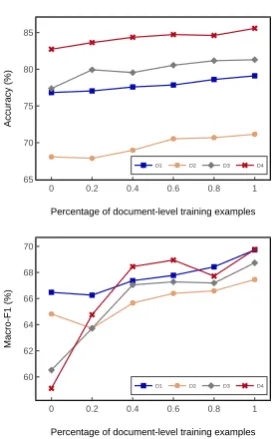
0 0.2 0.4 0.6 0.8 1 65
70 75 80 85
D1 D2 D3 D4
Percentage of document-level training examples
Accuracy (%)
0 0.2 0.4 0.6 0.8 1 60
62 64 66 68 70
D1 D2 D3 D4
Percentage of document-level training examples
[image:5.595.100.237.60.280.2]Macro-F1 (%)
Figure 1: Results of PRET+MULT vs. percentage of document-level training data.
unbalanced label distribution. In such cases, with the knowledge gained from a small number of bal-anced document-level examples, aspect-level pre-dictions on neutral examples can be significantly improved.
To better understand in which conditions the proposed method is helpful, we analyze a sub-set of test examples that are correctly classi-fied by PRET+MULT but are misclassiclassi-fied by LSTM+ATT. We find that the benefits brought by document-level knowledge are typically shown in four ways.
First of all, to our surprise, LSTM+ATT made obvious mistakes on some instances with common opinion words. Below are two examples where the target is enclosed in [] with its true sentiment indi-cated in the subscript:
1. “I was highly disappointed in the [food]neg.”
2. “This particular location certainly uses sub-standard [meats]neg.”
In the above examples, LSTM+ATT does attend to the right opinion words, but makes the wrong predictions. One possible reason is that the word embeddings from GloVe without PRET do not effectively capture sentiment information, while the aspect-level training samples are not sufficient to capture that for certain words. PRET+MULT eliminates this kind of errors.
Another finding is that our method helps to better capture domain-specific opinion words due to additional knowledge from documents that are
from a similar domain:
1. “The smaller [size]pos was a bonus because
of space restrictions.”
2. “The [price]posis 200 dollars down.”
LSTM+ATT attends onsmallercorrectly for the first example but makes the wrong prediction as smallercan be negative in many cases. It does not even capturedownin the second example.
Thirdly, we find that LSTM+ATT made a num-ber of errors on sentences with negation words:
1. I have experienced no problems, [works]pos
as anticipated.
2. [Service]negnot the friendliest to our party!
LSTMs typically only show their potential on large datasets. Without sufficient training exam-ples, it may not be able to effectively capture various sequential patterns. Pretraining the net-work on larger document-level corpus addresses this problem.
Lastly, PRET+MULT makes fewer errors on recognizing neutral instances. This can also be ob-served from the macro-F1 scores in Table2. The lack of training examples makes the prediction of neutral instances very difficult for all previous methods. Knowledge from document-level exam-ples with balanced labels compensates for this dis-advantage.
5 Conclusion
The effectiveness of existing aspect-level neural models is limited due to the difficulties in obtain-ing trainobtain-ing data in practice. Our work is the first attempt to incorporate knowledge from document-level corpus for training aspect-document-level sentiment classifiers. We have demonstrated the effective-ness of our proposed approaches and analyzed the major benefits brought by the knowledge transfer. The proposed approaches can be potentially in-tegrated with other aspect-level neural models to further boost their performance.
References
Peng Chen, Zhongqian Sun, Lidong Bing, and Wei Yang. 2017. Recurrent attention network on mem-ory for aspect sentiment analysis. InConference on Empirical Methods in Natural Language Processing (EMNLP 2017).
Ronan Collobert and Jason Weston. 2008. A unified architecture for natural language processing: Deep
neural networks with multitask learning. In
Andrew M. Dai and Quoc V. Le. 2015.
Semi-supervised sequence learning. In Neural
Informa-tion Processing Systems (NIPS 2015).
Li Dong, Furu Wei, Chuanqi Tan, Duyu Tang, Ming Zhou, and Ke Xu. 2014. Adaptive recursive neural network for target-dependent Twitter sentiment clas-sification. InAnnual Meeting of the Association for Computational Linguistics (ACL 2014).
Ruidan He, Wee Sun Lee, Hwee Tou Ng, and Daniel Dahlmeier. 2017. An unsupervised neural attention
model for aspect extraction. In Annual Meeting of
the Association for Computational Linguistics (ACL 2017).
Alex Krizhevsky and Ilya Sutskever. 2012. Imagenet classification with deep convolutional neural
net-works. In Neural Information Processing Systems
(NIPS 2012).
Jiangming Liu and Yue Zhang. 2017. Attention model-ing for target sentiment. InConference of the Euro-pean Chapter of the Association for Computational Linguistics (EACL 2017).
Yang Liu, Sujian Li, Xiaodong Zhang, and Zhifang Sui. 2016. Implicit discourse relation classification via
multi-task neural networks. InAAAI Conference on
Artificial Intelligence (AAAI 2016).
Minh-Tang Luong, Hieu Pham, and Christopher D. Manning. 2015b. Effective approaches to
attention-based neural machine translation. InAnnual
Meet-ing of the Association for Computational LMeet-inguistics (ACL 2015).
Minh-Thang Luong, Quoc V. Le, Ilya Sutskever, Oriol Vinyals, and Lukasz Kaiser. 2015a. Multi-task
se-quence to sese-quence learning. InInternational
Con-ference on Learning Representation (ICLR 2015).
Julian J. McAuley, Christopher Targett, Qinfeng Shi, and Anton van den Hengel. 2015. Image-based rec-ommendations on styles and substitutes. InThe 38th International ACM SIGIR Conference on Research and Development in Information Retrieval.
Tomas Mikolov, Ilya Sutskever, Kai Chen, Greg
Cor-rado, and Jeffrey Dean. 2013. Distributed
repre-sentations of words and phrases and their composi-tionality. InNeural Information Processing Systems (NIPS 2013).
Lili Mou, Zhao Meng, Rui Yan, Ge Li, Yan Xu,
Lu Zhang, and Zhi Jin. 2016. How transferable
are neural networks in NLP applications? In
Con-ference on Empirical Methods in Natural Language Processing (EMNLP 2016).
Thien Hai Nguyen and Kiyoaki Shirai. 2015.
PhraseRNN: Phrase recursive neural network for
aspect-based sentiment analysis. InConference on
Empirical Methods in Natural Language Processing (EMNLP 2015).
Jeffrey Pennington, Richard Socher, and Christo-pher D Manning. 2014. GloVe: Global vectors for
word representation. In Conference on Empirical
Methods in Natural Language Processing (EMNLP 2014).
Maria Pontiki, Dimitrios Galanis, Haris Papageorgiou, Suresh Manandhar, and Ion Androutsopoulos. 2015. SemEval-2015 task 12: Aspect based sentiment
analysis. In International Workshop on Semantic
Evaluation (SemEval 2015).
Maria Pontiki, Dimitrios Galanis, John Pavlopou-los, Haris Papageorgiou, Ion AndroutsopouPavlopou-los, and
Suresh Manandhar. 2014. SemEval-2014 task 4:
Aspect based sentiment analysis. InInternational
Workshop on Semantic Evaluation (SemEval 2014).
Maria Pontiki, Dimitris Galanis, Haris Papageor-giou, Ion Androutsopoulos, Suresh Manandhar, Mo-hammed AL-Smadi, Mahmoud Al-Ayyoub, Yanyan Zhao, Bing Qin, Orph´ee De Clercq, Veronique Hoste, Marianna Apidianaki, Xavier Tannier, Na-talia Loukachevitch, Evgeniy Kotelnikov, N´uria Bel, Salud Maria Jim´enez-Zafra, and G¨uls¸en Eryi˘git. 2016. SemEval-2016 task 5: Aspect based
senti-ment analysis. In International Workshop on
Se-mantic Evaluation (SemEval 2016).
Prajit Ramachandran, Peter J. Liu, and Quoc V. Le.
2017. Unsupervised pretraining for sequence to
sequence learning. In Conference on Empirical
Methods in Natural Language Processing (EMNLP 2017).
Duyu Tang, Bing Qin, Xiaocheng Feng, and Ting Liu. 2016a. Effective LSTMs for target-dependent senti-ment classification. InInternational Conference on Computational Linguistics (COLING 2016).
Duyu Tang, Bing Qin, and Ting Liu. 2015.
Learn-ing semantic representation of users and products for
document level sentiment classification. InAnnual
Meeting of the Association for Computational Lin-guistics (ACL 2015).
Duyu Tang, Bing Qin, and Ting Liu. 2016b. Aspect level sentiment classification with deep memory
net-work. InConference on Empirical Methods in
Nat-ural Language Processing (EMNLP 2016).
Duy-Tin Vo and Yue Zhang. 2015. Target-dependent Twitter sentiment classification with rich automatic features. InInternational Joint Conference on Arti-ficial Intelligence (IJCAI 2015).
Yequan Wang, Minlie Huang, Li Zhao, and Xiaoyan Zhu. 2016. Attention-based LSTM for aspect-level
sentiment classification. In Conference on
Em-pirical Methods in Natural Language Processing (EMNLP 2016).
Matthew D. Zeiler and Rob Fergus. 2014. Visualizing
and understanding convolutional networks. In
Meishan Zhang, Yue Zhang, and Duy-Tin Vo. 2016. Gated neural networks for targeted sentiment anal-ysis. InAAAI Conference on Artificial Intelligence (AAAI 2016).
Barret Zoph, Deniz Yuret, Jonathan May, and Kevin Knight. 2016. Transfer learning for low-resource
neural machine translation. In Conference on