228
Filtering and Mining Parallel Data in a Joint Multilingual Space
Holger Schwenk Facebook AI Research [email protected]
Abstract
We learn a joint multilingual sentence em-bedding and use the distance between sen-tences in different languages to filter noisy parallel data and to mine for parallel data in large news collections. We are able to improve a competitive baseline on the WMT’14 English to German task by 0.3 BLEU by filtering out 25% of the training data. The same approach is used to mine additional bitexts for the WMT’14 system and to obtain competitive results on the BUCC shared task to identify parallel sen-tences in comparable corpora.
The approach is generic, it can be applied to many language pairs and it is indepen-dent of the architecture of the machine translation system.
1 Introduction
Parallel data, also called bitexts, is an important resource to train neural machine translation sys-tems (NMT). It is usually assumed that the qual-ity of the automatic translations increases with the amount of available training data. However, it was observed that NMT systems are more sensitive to noise than SMT systems, e.g. (Belinkov and Bisk,
2017). Well known sources of parallel data are international organizations like the European Par-liament or the United Nations, or community pro-vided translations like the TED talks. In addi-tion, there are many texts on the Internet which are potential mutual translations, but which need to be identified and aligned. Typical examples are Wikipedia or news collections which report on the same facts in different languages. These collec-tions are usually called comparable corpora.
In this paper we propose an unified approach to filter noisy bitexts and to mine bitexts in huge
monolingual texts. The main idea is to first learn a joint multilingual sentence embedding. Then, a threshold on the distance between two sentences in this joint embedding space can be used to fil-ter bitexts (distance between source and target sen-tences), or to mine for additional bitexts (pairwise distances between all source and target sentences). No additional features or classifiers are needed.
2 Related work
The problem of how to select parts of bitexts has been addressed before, but mainly from the aspect of domain adaptation (Axelrod et al., 2011; San-tamar´ıa and Axelrod, 2017). It was successfully used in many phrase-based MT systems, but it was reported to be less successful for NMT (van der Wees et al., 2017). It should be stressed that do-main adaptation is different from filtering noisy training data. Data selection extracts the most rel-evant bitexts for the test set domain, but does not necessarily remove wrong translations, e.g. source and target sentences are both in-domain and well formed, but they are not mutual translations.
There is a huge body of research on mining bi-texts, e.g. by analyzing the name of WEB pages or links (Resnik and Smith, 2003). Another di-rection of research is to use cross-lingual informa-tion retrieval, e.g. (Utiyama and Isahara, 2003;
Munteanu and Marcu, 2005; Rauf and Schwenk,
sen-tences. However, distances between all sentences are only used to extract a set of potential mutual translation. The decision is based on a different system. InHassan et al.(2018) NMT systems for Zh↔En are learned using a joint encoder. A sen-tence representation is obtained as the mean of the last encoder states. Noisy bitexts are filtered based on the distance. In all these works, embeddings are learned for two languages only, while we learn one joint embedding for up to nine languages.
3 Multilingual sentence embeddings
We are aiming at an embedding of entire sen-tences in different languages into one joint space, with the goal that the distance in that space re-flects their semantic difference, independently of the language. There are several works on learning multilingual sentence embeddings which could be used for that purpose, i.e. (Hermann and Blunsom,
2014;Pham et al.,2015;Zhou et al.,2016; Chan-dar et al.,2013;Mogadala and Rettinger,2016).
In this paper, we extend our initial approach (Schwenk and Douze,2017). The underlying idea is to use multiple sequence encoders and decoders and to train them with N-way aligned corpora from the MT community. Instead of using one en-coder for each language as in the original paper, we use a shared encoder which handles all the in-put languages. Joint encoders (and decoders) have already been used in NMT (Johnson et al.,2016). In contrast to that work, we do not use a special in-put token to indicate the target language. Our joint encoder has no information at all on the encoded language, or what will be done with sentence rep-resentation.
We trained this architecture on nine languages1 of the Europarl corpus with about 2M sentences each. We use BPE (Sennrich et al., 2016b) to learn one 20k joint vocabulary for all the nine lan-guages.2 The joint encoder is a 3-layer BLSTM. The word embeddings are of size 384 and the hidden layer of the BLSTM is 512-dimensional. The 1024 dimensional sentence embedding is ob-tained by max-pooling over the BLSTM outputs. Dropout is set to 0.1. These settings are identical to those reported in (Schwenk and Douze,2017), with the difference that we observe slight improve-ment by using a deeper network for the joint en-coder. Once the system is learned, all the BLSTM
1
en, fr, es, it, pt, de, da, nl and fi
2Larger vocabularies achieve only slight improvements.
decoders are discarded and we only use the mul-tilingual BLSTM encoder to embed the sentences into the joint space.
A very similar approach was also proposed in
Espa˜na-Bonet et al. (2017). A joint NMT sys-tem with attention is trained on several languages pairs, similar to (Johnson et al.,2016), including a special token to indicate the target language. Af-ter training, the sum of the encoder output states is used to obtain a fixed size sentence representation.
4 Experimental evaluation: BUCC shared task on mining bitexts
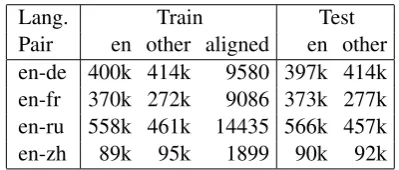
Since 2017, the workshop on Building and Us-ing Comparable Corpora (BUCC) is organizUs-ing a shared task to evaluate the performance of ap-proaches to mine for parallel sentences in compa-rable corpora (Zweigenbaum et al.,2018). Table1
summarizes the available data, and Table 2 the official results. Roughly a 40th of the sentences are aligned. The best performing system “VIC”
is based on the so-called STACC method which was shown to achieve state-of-the-art performance (Etchegoyhen and Azpeitia, 2016). It combines probabilistic dictionaries, search for similar sen-tences in both directions and a decision module which explores various features (common word prefixes, numbers, capitalized true-case tokens, etc). This STACC system was improved and adapted to the BUCC tasks with a word weight-ing scheme which is optimized on the monolin-gual corpora, and a named entity penalty. This task adaption substantially improved the generic STACC approach (Azpeitia et al.,2018). The sys-tems RALI (Gr´egoire and Langlais,2017) and H2 (Bouamor and Sajjad, 2018) have been already described in section 2. NLP2CT uses a denois-ing auto-encoder and a maximum-entropy classi-fier (Leong et al.,2018).
We applied our approach to all language pairs of the BUCC shared task (see Table3). We used the
Lang. Train Test
[image:2.595.316.516.644.729.2]Pair en other aligned en other en-de 400k 414k 9580 397k 414k en-fr 370k 272k 9086 373k 277k en-ru 558k 461k 14435 566k 457k en-zh 89k 95k 1899 90k 92k
System en-fr en-de en-ru en-zh
VIC’17 79 84 -
-RALI’17 20 - -
-LIMSI’17 - - - 43
VIC’18 81 86 81 77
H2’18 76 - -
-NLP2CT’18 - - - 56
Table 2: Official test set results of the 2017 and 2018 BUCC shared tasks (F-scores).
embeddings from (Schwenk and Douze,2017) for ru and zh, which were trained on the UN corpus. The only task-specific adaptation is the optimiza-tion of the threshold on the distance in the multi-lingual joint space. Our system does not match the performance of the heavily tuned VIC system, but it is on-pair with H2 on en-fr, and outperforms all other approaches by a large margin. We would like to emphasize that our approach uses no additional features or classifiers, and that we apply the same approach to all language pairs. It is nice to see that the performance varies little for the languages.
Espa˜na-Bonet et al. (2017) have also evaluated their technique on the BUCC data, but results on the official test set are not provided. Also, their joint encoder uses the“news-commentary”corpus during training. This is likely to add an important bias since all the parallel sentences in the BUCC corpus are from the news-commentary corpus.
Since we learn multilingual embeddings for many languages in one joint space, we can mine for parallel data for any language pair. As an example, we have mined for French/German and Chinese/Russian bitexts, respectively. There are no reference alignments to optimize the threshold for this language pair. Based on the experiments with the other languages, we chose a value of 0.55.
[image:3.595.77.288.62.161.2]Task en-fr en-de en-ru en-zh P 81.9 82.2 79.9 76.7 Train R 69.1 70.1 67.8 67.1 F1 74.9 76.1 73.3 71.6 Threshold 0.58 0.50 0.57 0.64 P 84.8 84.1 81.1 77.7 Test R 68.6 70.7 67.6 66.4 F1 75.8 76.9 73.8 71.6
Table 3: Results on the BUCC test set of our ap-proach: Precision, Recall and F-measure (%). We also provide the optimal threshold.
In the annex, we provide examples of extracted parallel sentences for various values of the mul-tilingual distance. These examples show that our approach may wrongly align sentences which are mainly an enumeration of named entities, numer-ical values, etc. Many of these erroneous align-ments could be possibly excluded by some post-processing, e.g. comparing the number of named entities in each sentence.
5 Experimental evaluation: improving WMT’14 En-De NMT systems
5.1 Baseline NMT systems
We have performed all our experiments with the freely available Sequence-to-Sequence Py-Torch toolkit from Facebook AI Research,3called
fairseq-py. It implements a convolutional
model which achieves very competitive results (Gehring et al.,2017). We use this system to show the improvements obtained by filtering the stan-dard training data and by integrating additional mined data. We will freely share this data so that it can be used to train different NMT architectures.
In this work, we focus on translating from En-glish into German using the WMT’14 data. This task was selected for two reasons:
• it is the de-facto standard to evaluate NMT systems and many comparable results are available, e.g. (Sennrich et al., 2016b;
Chunga et al.,2016;Wu et al.,2016;Gehring et al.,2017;Ashish Vaswani et al.,2017);
• only a limited amount of parallel training data is available (4.5M sentences). 2.1M are high quality human translations and 2.4M are crawled and aligned sentences (Common Crawl corpus).
As in other works, we use newstest-2014 as test set. However, in order to follow the standard WMT evaluation setting, we use
mteval-v14.plon untokenized hypothesis to
calculate case-sensitive BLEU scores. Note that in some papers, BLEU is calculated with
multi-bleu.perl on tokenized hypothesis.
All our results are for one single system only. We trained thefairseq-py system with de-fault parameters, but a slightly different pre- and
3https://github.com/facebookresearch/
[image:3.595.78.282.602.715.2]Corpus Human only All WMT’14 (Eparl+NC) (Eparl+NC+CC)
#sents 2.1M 4.5M
[image:4.595.311.514.60.205.2]BLEU 21.87 24.75
Table 4: Our baseline results on WMT’14 en-de.
post-processing scheme. In particular, we lower-case all data and use a 40k BPE vocabulary ( Sen-nrich et al., 2016b). Before scoring, the case of the hypothesis is restored using a recaser trained on the WMT German news data. Table 4 gives our baseline results using the provided data as it is. We distinguish results when training on human labeled data only, i.e. Europarl and News Com-mentary (2.1M sentences), and with all WMT’14 training data, i.e. human + Common Crawl (total of 4.5M sentences). Gehring et al.(2017) report a tokenized BLEU score of 25.16 on a slightly dif-ferent version of newstest-2014 as defined in ( Lu-ong et al.,2015).4 Please remember that the goal of this paper is not to set a new state-of-the-art in NMT on this data set, but to show relative im-provement with respect to a competitive baseline.
5.2 Filtering Common Crawl
The Common Crawl corpus is provided by the or-ganizers of WMT’14. We do not know how this corpus was produced, but like all crawled corpora, it is inherently noisy. To filter that corpus, we first embed all the sentences into the joint space and calculate the cosine distance between the English source and the provided German translation. We then extract subsets of different sizes as a function of the threshold on this distance.
All Commas <50 words LID 2399k 2144k 2071k 1935k
Table 5: Pre-processing of the Common Crawl corpus before distance-based filtering.
After some initial experiments, it turned out that some additional steps are needed before cal-culating the distances (see Table 5): 1) remove sentences with more than 3 commas. Those are indeed often enumerations of names, cities, etc. While such sentences maybe useful to train NMT systems, the multilingual distance is not very reli-able to distinguish list of named entities; 2) limit to sentences with less than 50 words; 3) perform LID on source and target sentences; These steps
4This version uses a subset of 2737 out of 3003 sentences.
24.6 24.7 24.8 24.9 25 25.1
0.6 0.8 1.0 1.2 LID All
0.5 1.0 1.5 2.0 2.5
LID LID
All All
BLEU
#sents [M]
Threshold on multilingual distance #sents
BLEU
Figure 1: Filtering the Common Crawl corpus: size of corpus (pink) and BLEU scores (green).
discarded overall 19% of the data. It is surpris-ing that almost 6% of the data seems to have the wrong source or target language.5
Figure1(pink curve) shows the amount of data as a function of the threshold on the multilingual distance. Some human inspection of the filtered corpus indicated that the translations start to be wrong for a threshold larger than 1.0. Therefore, we build NMT systems using a filtered version of Common Crawl for thresholds in the range of 0.8 to 1.2 (see Figure 1, green curve). It is good to see that the BLEU score increases when less but better data is used and then decreases again since we discard too much data. Best performance of 25.06 BLEU is achieved for a threshold of 1.0. This corresponds to a gain of 0.3 BLEU on top of a very competitive baseline (24.75→25.06), us-ing only 3.4M instead of the original 4.5M sen-tence pairs. We actually discard almost half of the Common Crawl data. For comparison, we also trained an NMT system using the pre-processed Common Crawl corpus of 1.9M sentences (cf. Ta-ble5), but without distance-based filtering. This gives a BLEU score of 24.82, a small 0.07 change. Aiming at a compromise between speed and full convergence, we trained all systems for 55 epochs which takes less than two days on 8 NVidia GPU100s. Longer training may improve the over-all results slightly.
5.3 Mining Parallel Data in WMT News
In the framework of the WMT evaluation, large news corpora are provided: 144M English and 187M German sentences (after removing sentence with more than 50 words). As in section 4, we
5LID itself may also commit errors, we used
[image:4.595.80.280.62.119.2]embed all sentences into the joint space. For each source sentence, we search for thek-nearest sen-tences in the target language. We use k = 20
since it can happen that for the same source sen-tence, several possible translations are found (dif-ferent news sites reporting on the same fact with different wordings). This search has a complex-ity ofO(N ×M), while filtering presumed paral-lel corpora isO(N). In our case,144M ×185M amounts to 26 peta distance calculations. This can be quite efficiently done with the highly optimized FAISS toolkit (Johnson et al.,2017).
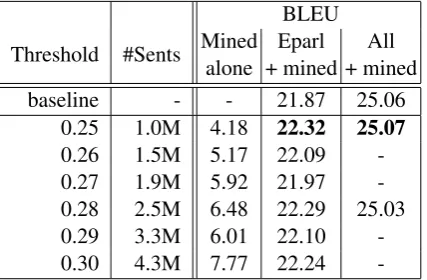
To start, we trained NMT systems on the ex-tracted data only (see Table 6, 3rd column). As with the Common Crawl corpus, we discarded sentences pairs with the wrong language and many commas. By varying the threshold on the distance between two sentences in the embedding space, we can extract various amounts of data. However, the larger the threshold, the more unlikely the tences are translations. Training on 1M mined sen-tences gives a modest BLEU score of 4.18, which increases up to 7.77 when 4.3M sentences are ex-tracted. This result is well below an NMT system trained on“real parallel data”.
We have observed that the length distribution of the mined sentences is very different of the one of the WMT’14 training corpora (see Figure2). The average sentence length for all the WMT training corpora is 24, while it is only 8 words for our mined texts. On one hand, it could be of course that our distance based mining approach works badly for long sentences. But on the other hand, the longer the sentences, the more unlikely it is to find perfect translation in crawled news data. If
BLEU
Threshold #Sents Mined Eparl All alone + mined + mined baseline - - 21.87 25.06
0.25 1.0M 4.18 22.32 25.07
0.26 1.5M 5.17 22.09 -0.27 1.9M 5.92 21.97 -0.28 2.5M 6.48 22.29 25.03 0.29 3.3M 6.01 22.10 -0.30 4.3M 7.77 22.24
-Table 6: BLEU scores when training on the mined data only, adding it (at different thresholds) to the human translated training corpus (Eparl+NC) and to our best system using filtered Common Crawl.
1 10 100 1000 10000 100000
1x10⁶
5 10 15 20 25 30 35 40 45 50
#sentences
sentence length
[image:5.595.310.515.60.205.2]Eparl + NC Common Crawl filt. Mined
Figure 2: Number of sentences as a function of their length, for WMT’14 training corpora and the mined news texts.
we shuffle the Europarl corpus and consider it as a comparable corpus, our approach is able to ex-tract more than 95% of the translation pairs. It is also an open question how short sentences impact the training of NMT systems. Further research in those directions is needed.
When adding our mined data to the Europarl and News Commentary corpora (2.1M sentences), we are able to achieve an improvement of 0.45 BLEU (21.87→22.32, 4th column of Table 6). However, we observe no improvement when adding the mined data to our best system which uses the filtered Common Crawl data (5th column of Table 6). It could be that some of our mined data is actually a subset of Common Crawl.
6 Conclusion
We have shown that a simple cosine distance in a joint multilingual sentence embedding space can be used to filter noisy parallel data and to mine for bitexts in large news collections. We were able to improve a competitive baseline on the WMT’14 English to German task by 0.3 BLEU by filtering out 25% of the training data. We will make the filtered and extracted data freely available, as well as a tool to filter noisy bitexts in nine languages.
There are many directions to extend this re-search, in particular to scale-up to larger corpora. We will apply it to the data mined by the European ParaCrawl project.6 The proposed multilingual sentence distance could be also used in MT con-fidence estimation, or to filter back-translations of monolingual data (Sennrich et al.,2016a).
[image:5.595.76.290.562.702.2]References
Ashish Vaswani et al. 2017. Attention is all you need. InNIPS.
Amittai Axelrod, Xiaodong He, and Jianfeng Gao. 2011. Domain adaptation via pseudo in-domain data selection. InEMNLP, pages 355–362.
Andoni Azpeitia, Thierry Etchegoyhen, and Eva Mart´ınez Garcia. 2018. Extracting paral-lel sentences from comparable corpora with STACC variants. InBUCC.
Yonatan Belinkov and Yonatan Bisk. 2017. Synthetic and artificial noise both break neural machine trans-lation. In https://arxiv.org/abs/1711. 02173.
Houda Bouamor and Hassan Sajjad. 2018. H2@bucc18: Parallel sentence extraction from comparable coprora using multlingual sentence embeddings. InBUCC.
Sarath Chandar, Mitesh M. Khapra, Balaraman Ravin-dran, Vikas Raykar, and Amrita Saha. 2013. Multi-lingual deep learning. InNIPS DL wshop.
Junyoung Chunga, Kyunghyun Choa, and Yoshua Ben-gio. 2016. A character-level decoder without ex-plicit segmentation for neural machine translation. Inhttps://arxiv.org/abs/1603.06147.
Cristina Espa˜na-Bonet, ´Ad´am Csaba Varga, Alberto Barr´on-Cede˜no, and Josef van Genabith. 2017. An empirical analysis of nmt-derived interlingual em-beddings and their use in parallel sentence identifi-cation. IEEE Journal of Selected Topics in Sigmal
Processing, pages 1340–1348.
Thierry Etchegoyhen and Andoni Azpeitia. 2016. Set-theoretic alignment of comparable corpora. InACL.
Jonas Gehring, Michael Auli, David Grangier, Denis Yarats, and Yann N Dauphin. 2017. Convolutional Sequence to Sequence Learning. InICML.
Francis Gr´egoire and Philippe Langlais. 2017. Bucc 2017 shared task: a first attempt toward a deep learn-ing framework for identifylearn-ing parallel sentences in comparable corpora. InBUCC, pages 46–50.
Hany Hassan, Anthony Aue, Chang Chen, Vishal Chowdhary, Jonathan Clark, Christian Feder-mann, Xuedong Huang, Marcin Junczys-Dowmunt, William Lewis, Mu Li, Shujie Liu, Tie-Yan Liu, Renqian Luo, Arul Menezes, Tao Qin, Frank Seide, Xu Tan, Fei Tian, Lijun Wu, Shuangzhi Wu, Yingce Xia, Dongdong Zhang, Zhirui Zhang, and Ming Zhou. 2018. Achieving human parity on auto-matic chinese to english translation. In https: //arxiv.org/abs/1803.05567.
Karl Moritz Hermann and Phil Blunsom. 2014. Multi-lingual models for compositional distributed seman-tics. InACL, pages 58–68.
Jeff Johnson, Matthijs Douze, and Herv´e J´egou. 2017. Billion-scale similarity search with gpus. arXiv preprint arXiv:1702.08734.
Melvin Johnson et al. 2016. Google’s multilin-gual neural machine translation system: Enabling zero-shot translation. Inhttps://arxiv.org/ abs/1611.04558.
Chongman Leong, Derek F. Wong, and Lidia S. Chao. 2018. Um-paligner: Neural network-based parallel sentence identification model. InBUCC.
Minh-Thang Luong, Hieu Pham, and Christophe D. Manning. 2015. Effective approaches to attention-based neural machine translation. InEMNLP, pages 1412–1421.
Aditua Mogadala and Achim Rettinger. 2016. Bilin-gual word embeddings from parallel and non-parallel corpora for cross-language classification. In
NAACL, pages 692–702.
Dragos Stefan Munteanu and Daniel Marcu. 2005. Im-proving machine translation performance by exploit-ing non-parallel corpora. Computational Linguis-tics, 31(4):477–504.
Hieu Pham, Minh-Thang Luong, and Christopher D. Manning. 2015. Learning distributed representa-tions for multilingual text sequences. InWorkshop
on Vector Space Modeling for NLP.
Sadaf Abdul Rauf and Holger Schwenk. 2009. On the use of comparable corpora to improve SMT perfor-mance. InEACL, pages 16–23.
Philip Resnik and Noah A. Smith. 2003. The web as a parallel corpus. Computational Linguistics, 29:349– 380.
Luc´ıa Santamar´ıa and Amittai Axelrod. 2017. Data se-lection with cluster-based language difference mod-els and cynical selection. InIWSLT, pages 137–145.
Holger Schwenk and Matthijs Douze. 2017. Learning joint multilingual sentence representations with neu-ral machine translation. InACL workshop on Rep-resentation Learning for NLP.
Rico Sennrich, Barry Haddow, and Alexandra Birch. 2016a. Improving neural machine translation mod-els with monolingual data. InACL, pages 86–96.
Rico Sennrich, Barry Haddow, and Alexandra Birch. 2016b. Neural machine translation of rare words with subword units. InACL, pages 1715–1725.
Masao Utiyama and Hitoshi Isahara. 2003. Reliable measures for aligning Japanese-English news arti-cles and sentences. InACL, pages 72–79.
Yonghui Wu et al. 2016. Google’s neural machine translation system: Bridging the gap between human and machine translation. In https://arxiv. org/abs/1610.05011.
Xinjie Zhou, Xiaojun Wan, and Jianguo Xiao. 2016. Cross-lingual sentiment classification with bilingual document representation learning. InACL.