557
Progressive Self-Supervised Attention Learning for
Aspect-Level Sentiment Analysis
Jialong Tang1,2,3∗, Ziyao Lu1∗, Jinsong Su1†, Yubin Ge4, Linfeng Song5, Le Sun2, Jiebo Luo5
1Xiamen University, Xiamen, China
2Institute of Software, Chinese Academy of Sciences, Beijing, China
3University of Chinese Academy of Sciences, Beijing, China
4University of Illinois at Urbana-Champaign, Urbana, IL 61801, USA
5Department of Computer Science, University of Rochester, Rochester NY 14627, USA
[email protected], [email protected] [email protected]
Abstract
In aspect-level sentiment classification (ASC), it is prevalent to equip dominant neural mod-els with attention mechanisms, for the sake of acquiring the importance of each context word on the given aspect. However, such a mecha-nism tends to excessively focus on a few fre-quent words with sentiment polarities, while ignoring infrequent ones. In this paper, we propose a progressive self-supervised atten-tion learning approach for neural ASC mod-els, which automatically mines useful atten-tion supervision informaatten-tion from a training corpus to refine attention mechanisms. Specif-ically, we iteratively conduct sentiment predic-tions on all training instances. Particularly, at each iteration, the context word with the maxi-mum attention weight is extracted as the one with active/misleading influence on the cor-rect/incorrect prediction of every instance, and then the word itself is masked for subsequent iterations. Finally, we augment the conven-tional training objective with a regularization term, which enables ASC models to continue equally focusing on the extracted active con-text words while decreasing weights of those misleading ones. Experimental results on mul-tiple datasets show that our proposed approach yields better attention mechanisms, leading to substantial improvements over the two state-of-the-art neural ASC models. Source code and trained models are available.1
1 Introduction
Aspect-level sentiment classification (ASC), as an indispensable task in sentiment analysis, aims at inferring the sentiment polarity of an input sen-tence in a certain aspect. In this regard,
pre-∗
Equal contribution †
Corresponding author
1https://github.com/DeepLearnXMU/PSSAttention
vious representative models are mostly discrim-inative classifiers based on manual feature engi-neering, such as Support Vector Machine ( Kir-itchenko et al., 2014; Wagner et al., 2014). Re-cently, with the rapid development of deep learn-ing, dominant ASC models have evolved into neural network (NN) based models (Tang et al., 2016b;Wang et al.,2016;Tang et al.,2016a;Ma et al., 2017; Chen et al., 2017; Li et al., 2018; Wang et al., 2018), which are able to automati-cally learn the aspect-related semantic representa-tion of an input sentence and thus exhibit better performance. Usually, these NN-based models are equipped with attention mechanisms to learn the importance of each context word towards a given aspect. It can not be denied that attention mecha-nisms play vital roles in neural ASC models.
However, the existing attention mechanism in ASC suffers from a major drawback. Specifically, it is prone to overly focus on a few frequent words with sentiment polarities and little attention is laid upon low-frequency ones. As a result, the perfor-mance of attentional neural ASC models is still far from satisfaction. We speculate that this is because there exist widely “apparent patterns” and “ inap-parent patterns”. Here, “apparent patterns” are interpreted as high-frequency words with strong sentiment polarities and “inapparent patterns” are referred to as low-frequency ones in training data. As mentioned in (Li et al.,2018;Xu et al.,2018; Lin et al.,2017), NNs are easily affected by these two modes: “apparent patterns” tend to be overly learned while “inapparent patterns” often can not be fully learned.
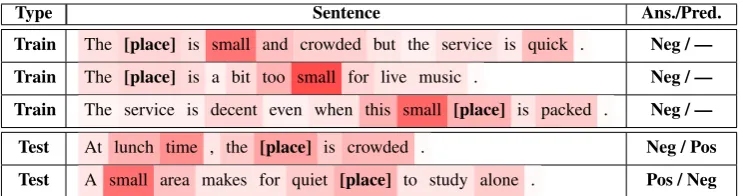
atten-Type Sentence Ans./Pred. Train The [place] is small and crowded but the service is quick . Neg / — Train The [place] is a bit too small for live music . Neg / — Train The service is decent even when this small [place] is packed . Neg / —
[image:2.595.114.486.61.159.2]Test At lunch time , the [place] is crowded . Neg / Pos Test A small area makes for quiet [place] to study alone . Pos / Neg
Table 1: The example of attention visualization for five sentences, where the first three are training instances and the last two are test ones. The bracketed bolded words are target aspects. Ans./Pred. = ground-truth/predicted sentiment label. Words are highlighted with different degrees according to attention weights.
tion mechanism pays more attention to it and di-rectly relates the sentences containing it with neg-ative sentiment. This inevitably causes another in-formative context word “crowded” to be partially neglected in spite of it also possesses negative sen-timent. Consequently, a neural ASC model incor-rectly predicts the sentiment of the last two test sentences: in the first test sentence, the neural ASC model fails to capture the negative sentiment implicated by ”crowded”; while, in the second test sentence, the attention mechanism directly focuses on “small” though it is not related to the given aspect. Therefore, we believe that the attention mechanism for ASC still leaves tremendous room for improvement.
One potential solution to the above-mentioned issue is supervised attention, which, however, is supposed to be manually annotated, requiring labor-intense work. In this paper, we propose a novel progressive self-supervised attention learn-ing approach for neural ASC models. Our method is able to automatically and incrementally mine attention supervision information from a training corpus, which can be exploited to guide the train-ing of attention mechanisms in ASC models. The basic idea behind our approach roots in the fol-lowing fact: the context word with the maximum attention weight has the greatest impact on the sentiment prediction of an input sentence. Thus, such a context word of a correctly predicted train-ing instance should be taken into consideration during the model training. In contrast, the con-text word in an incorrectly predicted training in-stance ought to be ignored. To this end, we itera-tively conduct sentiment predictions on all training instances. Particularly, at each iteration, we ex-tract the context word with the maximum attention weight from each training instance to form atten-tion supervision informaatten-tion, which can be used
to guide the training of attention mechanism: in the case of correct prediction, we will remain this word to be considered; otherwise, the attention weight of this word is expected to be decreased. Then, we mask all extracted context words of each training instance so far and then refollow the above process to discover more supervision infor-mation for attention mechanisms. Finally, we aug-ment the standard training objective with a regu-larizer, which enforces attention distributions of these mined context words to be consistent with their expected distributions.
Our main contributions are three-fold: (1)
Through in-depth analysis, we point out the exist-ing drawback of the attention mechanism for ASC. (2) We propose a novel incremental approach to automatically extract attention supervision infor-mation for neural ASC models. To the best of our knowledge, our work is the first attempt to explore automatic attention supervision informa-tion mining for ASC. (3) We apply our approach to two dominant neural ASC models: Memory Net-work (MN) (Tang et al.,2016b;Wang et al.,2018) and Transformation Network (TNet) (Li et al., 2018). Experimental results on several benchmark datasets demonstrate the effectiveness of our ap-proach.
2 Background
In this section, we give brief introductions to MN and TNet, which both achieve satisfy-ing performance and thus are chosen as the
foundations of our work. Here we introduce
some notations to facilitate subsequent descrip-tions: x= (x1, x2, ..., xN) is the input
sen-tence,t= (t1, t2, ..., tT) is the given target aspect,
y, yp∈{Positive, Negative, Neutral} denote the
…
"# "$ "% … ℎ# ℎ% … '# '$ '% ((*) Attention ℎ$ ,-…
CPT CPT … CPT
,
-"# "$ "%
Bi-LSTM L×
ℎ#(./#) ℎ$(./#) ℎ#(.) ℎ$(.)
CNN/Attention
…
*# *$ *0
… … …
… …
…
*# *$ *1 ℎ
2(./#) Bi-LSTM Attention ((*) Gating Fully-connected CPM
ℎ2(.)
ℎ%(.)
ℎ%(./#)
…
[image:3.595.85.276.58.205.2]3 3
Figure 1: The framework architecture of MN. …
"# "$ "%
…
ℎ# ℎ%
… '# '$ '% ((*) Attention ℎ$ , -… CPT CPT … CPT
,
-"# "$ "%
Bi-LSTM
×L
ℎ#(./#) ℎ$(./#)
ℎ#(.) ℎ$(.)
CNN/Attention
…
*# *$ *0
… … …
… … …
…
*# *$ *1 ℎ 2 (./#) Bi-LSTM Attention ((*) Gating Fully-connected CPM
ℎ2(.)
ℎ%(./#)
ℎ%(.)
Figure 2: The framework architecture ofTNet/ TNet-ATT. Note that TNet-ATT is the variant of TNet replac-ing CNN with an attention mechanism.
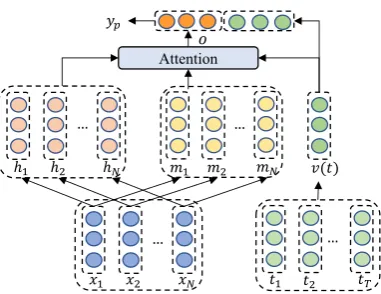
MN(Tang et al.,2016b;Wang et al.,2018). The framework illustration of MN is given in Figure 1. We first introduce an aspect embedding matrix converting each target aspect word tj into a
tor representation, and then define the final vec-tor representation v(t) of t as the averaged
as-pect embedding of its words. Meanwhile,
an-other embedding matrix is used to project each context wordxi to the continuous space stored in
memory, denoted bymi. Then, an internal
atten-tion mechanism is applied to generate the aspect-related semantic representationo of the sentence
x: o=P
isoftmax(vTtM mi)hi, whereM is an
at-tention matrix andhi is the final semantic
repre-sentation ofxi, induced from a context word
em-bedding matrix. Finally, we use a fully connected output layer to conduct classification based ono andv(t).
TNet (Li et al., 2018). Figure 2 provides the framework illustrations of TNet, which mainly consists of three components:
(1) The bottom layer is a Bi-LSTM that transforms the input x into the contextualized word representations h(0)(x)=(h(0)1 , h(0)2 , ..., h(0)N ) (i.e. hidden states of Bi-LSTM). (2) The mid-dle part, as the core of the whole model, con-tainsLlayers of Context-Preserving Transforma-tion (CPT), where word representaTransforma-tions are up-dated ash(l+1)(x)=CPT(h(l)(x)). The key oper-ation of CPT layers is Target-Specific
Transfor-mation. It contains another Bi-LSTM for
gen-erating v(t) via an attention mechanism, and then incorporates v(t) into the word
representa-tions. Besides, CPT layers are also equipped
with a Context-Preserving Mechanism (CPM) to preserve the context information and learn more
abstract word-level features. In the end, we
obtain the word-level semantic representations h(x)=(h1,h2...,hN), withhi=h(iL). (3) The
top-most part is a CNN layer used to produce the aspect-related sentence representation o for the sentiment classification.
In this work, we consider another alternative to the original TNet, which replaces its top-most CNN with an attention mechanism to pro-duce the aspect-related sentence representation as o=Atten(h(x),v(t)). In Section4, we will inves-tigate the performance of the original TNet and its variant equipped with an attention mechanism, de-noted byTNet-ATT.
Training Objective. Both of the
above-mentioned models take the negative log-likelihood of the gold-truth sentiment tags as their training objectives:
J(D;θ) =− X
(x,t,y)∈D
J(x, t, y;θ)
= X
(x,t,y)∈D
d(y)·logd(x, t;θ), (1)
whereDis the training corpus,d(y)is the one-hot vector ofy,d(x, t;θ) is the model-predicted sen-timent distribution for the pair (x,t), and·denotes the dot product of two vectors.
3 Our Approach
[image:3.595.76.284.242.409.2]of neural ASC models, without any impact on the model testing.
3.1 Basic Intuition
The basic intuition of our approach stems from the following fact: in attentional ASC models, the im-portance of each context word on the given aspect mainly depends on its attention weight. Thus, the context word with the maximum attention weight has the most important impact on the sentiment prediction of the input sentence. Therefore, for a training sentence, if the prediction of ASC model is correct, we believe that it is reasonable to con-tinue focusing on this context word. Conversely, the attention weight of this context word should be decreased.
However, as previously mentioned, the context word with the maximum attention weight is of-ten the one with strong sentiment polarity. It usu-ally occurs frequently in the training corpus and thus tends to be overly considered during model training. This simultaneously leads to the insuf-ficient learning of other context words, especially low-frequency ones with sentiment polarities. To address this problem, one intuitive and feasible method is to first shield the influence of this most important context word before reinvestigating ef-fects of remaining context words of the training instance. In that case, other low-frequency context words with sentiment polarities can be discovered according to their attention weights.
3.2 Details of Our Approach
Based on the above analysis, we propose a novel incremental approach to automatically mine in-fluential context words from training instances, which can be then exploited as attention supervi-sion information for neural ASC models.
As shown in Algorithm 1, we first use the ini-tial training corpus Dto conduct model training, and then obtain the initial model parametersθ(0)
(Line 1). Then, we continue training the model
for K iterations, where influential context words of all training instances can be iteratively extracted
(Lines 6-25). During this process, for each
train-ing instance (x, t, y), we introduce two word sets initialized as∅(Lines 2-5) to record its extracted context words: (1)sa(x)consists of context words
withactive effects on the sentiment prediction of x. Each word ofsa(x)will be encouraged to
re-main considered in the refined model training, and (2)sm(x)contains context words withmisleading
Algorithm 1: Neural ASC Model Training with
Automatically Mined Attention Supervision Infor-mation.
Input: D: the initial training corpus;
θinit: the initial model parameters;
α: the entropy threshold of attention weight distribution;
K: the maximum number of training iterations; 1: θ(0)←
Train(D;θinit ) 2: for(x,t,y)∈Ddo
3: sa(x)← ∅ 4: sm(x)← ∅ 5: end for
6: fork= 1,2...,Kdo
7: D(k)← ∅
8: for(x,t,y)∈Ddo
9: v(t)←GenAspectRep(t,θ(k−1)) 10: x0←MaskWord(x,sa(x),sm(x)) 11: h(x0)←GenWordRep(x0,v(t),θ(k−1)
) 12: yp,α(x0)←SentiPred(h(x0),v(t),θ(k−1)) 13: E(α(x0))←CalcEntropy(α(x0))
14: ifE(α(x0))< αthen
15: m←argmax1≤i≤Nα(x0i) 16: ifyp==ythen
17: sa(x)←sa(x)∪ {x0m}
18: else
19: sm(x)←sm(x)∪ {x0m} 20: end if
21: end if
22: D(k)←D(k)∪(x0,t,y) 23: end for
24: θ(k)←Train(D(k);θ(k−1)) 25: end for
26: Ds← ∅
27: for(x,t,y)∈Ddo
28: Ds←Ds∪(x,t,y,sa(x),sm(x)) 29: end for
30: θ←Train(Ds)
Return: θ;
effects, whose attention weights are expected to be decreased. Specifically, at thek-th training it-eration, we adopt the following steps to deal with (x, t, y):
InStep 1, we first apply the model parameters
θ(k−1)of the previous iteration to generate the as-pect representationv(t)(Line 9). Importantly, ac-cording tosa(x)andsm(x), we then mask all
pre-viously extracted context words of x to create a new sentencex0, where each masked word is re-placed with a special token “hmaski” (Line 10). In this way, the effects of these context words will be shielded during the sentiment prediction ofx0, and thus other context words can be potentially ex-tracted fromx0. Finally, we generate the word rep-resentationsh(x0)={h(x0i)}N
i=1(Line 11).
Iter Sentence Ans./Pred. E(α(x0)) x0m
1 The [place] is small and crowded but the service is quick . Neg / Neg 2.38 small
2 The [place] is hmaski and crowded but the service is quick . Neg / Neg 2.59 crowded
3 The [place] is hmaski and hmaski but the service is quick . Neg / Pos 2.66 quick
[image:5.595.76.527.63.143.2]4 The [place] is hmaski and hmaski but the service is hmaski . Neg / Neg 3.07 —
Table 2: The example of mining influential context words from the first training sentence in Table1. E(α(x0))
denotes the entropy of the attention weight distributionα(x0),αis entropy threshold set as3.0, andx0mindicates
the context word with the maximum attention weight. Note that all extracted words are replaced with “hmaski” and their background colors are labeled as white.
leverageθ(k−1)to predict the sentiment ofx0asyp
(Line 12), where the word-level attention weight
distribution α(x0)={α(x01), α(x02), ..., α(x0N)} subjecting toPN
i=1α(x0i) = 1is induced.
InStep 3, we use the entropyE(α(x0))to mea-sure the variance ofα(x0) (Line 13), which con-tributes to determine the existence of an influential context word for the sentiment prediction ofx0,
E(α(x0)) =−
N
X
i=1
α(x0i) log(α(x0i)). (2)
IfE(α(x0))is less than a thresholdα(Line 14),
we believe that there exists at least one context word with great effect on the sentiment prediction ofx0. Hence, we extract the context wordx0mwith the maximum attention weight (Line 15-20) that will be exploited as attention supervision informa-tion to refine the model training. Specifically, we adopt two strategies to deal withx0maccording to different prediction results onx0: if the prediction is correct, we wish to continue focusing onx0mand add it intosa(x)(Lines 16-17); otherwise, we
ex-pect to decrease the attention weight of x0m and thus include it intosm(x)(Lines 18-19).
In Step 4, we combine x0, t andy as a triple,
and merge it with the collected ones to form a new training corpus D(k) (Line 22). Then, we lever-ageD(k) to continue updating model parameters for the next iteration (Line 24). In doing so, we make our model adaptive to discover more influ-ential context words.
Through K iterations of the above steps, we manage to extract influential context words of all training instances. Table2 illustrates the context word mining process of the first sentence shown in Table1. In this example, we iteratively extract three context words in turn: “small”, “crowded” and “quick”. The former two words are included insa(x), while the last one is contained insm(x).
Finally, the extracted context words of each train-ing instance will be included into D, forming a final training corpusDswith attention supervision
information (Lines 26-29), which will be used to carry out the last model training (Line 30). The details will be provided in the next subsection.
3.3 Model Training with Attention
Supervision Information
To exploit the above extracted context words to refine the training of attention mechanisms for ASC models, we propose a soft attention regular-izer4(α(sa(x)∪sm(x)),αˆ(sa(x)∪sm(x));θ)to
jointly minimize the standard training objective, whereα(∗) andαˆ(∗) denotes the model-induced and expected attention weight distributions of words insa(x)∪sm(x), respectively. More
specif-ically,4(α(∗),αˆ(∗);θ)is anEuclidean Distance style loss that penalizes the disagreement between α(∗)andαˆ(∗).
As previously analyzed, we expect to equally continue focusing on the context words of sa(x)
during the final model training. To this end, we set their expected attention weights to the same value |s1
a(x)|. By doing so, the weights of words
extracted first will be reduced, and those of words extracted later will be increased, avoiding the over-fitting of high-frequency context words with sentiment polarities and the under-fitting of low-frequency ones. On the other hand, for the words insm(x)with misleading effects on the sentiment
prediction ofx, we want to reduce their effects and thus directly set their expected weights as 0. Back to the sentence shown in Table 2, both “small” and “crowded”∈sa(x) are assigned the same ex-pected weight 0.5, and the exex-pected weight of “quick”∈sm(x)is 0.
Domain Dataset #Pos #Neg #Neu
LAPTOP Train 980 858 454
Test 340 128 171
REST Train 2159 800 632
Test 730 195 196
TWITTER Train 1567 1563 3127
[image:6.595.72.286.61.162.2]Test 174 174 346
Table 3: Datasets in our experiments.#Pos,#Negand
#Neu denotes the number of instances with Positive, Negative and Neutral sentiment, respectively.
becomes
Js(Ds;θ) =−
X
(x,t,y)∈Ds
{J(x, t, y;θ)+ (3)
γ4(α(sa(x)∪sm(x)),αˆ(sa(x)∪sm(x));θ)},
whereJ(x, t, y;θ)is the conventional training ob-jective defined in Equation1, andγ>0is a hyper-parameter that balances the preference between the conventional loss function and the regulariza-tion term. In addiregulariza-tion to the utilizaregulariza-tion of attenregulariza-tion supervision information, our method has a further advantage: it is easier to address the vanishing gra-dient problem by adding such information into the intermediate layers of the entire network (Szegedy et al., 2015), because the supervision of αˆ(∗) is closer toα(∗)thany.
4 Experiments
Datasets. We applied the proposed approach
into MN (Tang et al., 2016b;Wang et al., 2018) and TNet-ATT (Li et al., 2018) (see Section 2), and conducted experiments on three benchmark datasets: LAPTOP, REST (Pontiki et al., 2014)
and TWITTER (Dong et al., 2014). In our
datasets, the target aspect of each sentence has been provided. Besides, we removed a few in-stances with conflict sentiment labels as imple-mented in (Chen et al., 2017). The statistics of the final datasets are listed in Table3.
Contrast Models. We referred to our two
enhanced ASC models as MN(+AS) and
TNet-ATT(+AS), and compared them withMN,TNet,
and TNet-ATT. Note our models require
addi-tional K+1-iteration training, therefore, we also compared them with the above models with addi-tional K+1-iteration training, which are denoted
asMN(+KT),TNet(+KT)andTNet-ATT(+KT).
Moreover, to investigate effects of different kinds of attention supervision information, we
0.66 0.68 0.7 0.72 0.74 0.76
0.0 1.0 2.0 3.0 4.0 5.0 6.0 7.0
F1
-s
co
re
LAPTOP REST TWITTER
!"
0.59 0.6 0.61 0.62 0.63 0.64 0.65
0.0 1.0 2.0 3.0 4.0 5.0 6.0 7.0
F1
-s
co
re
LAPTOP REST TWITTER
!"
Figure 3: Effects of α on the validation sets using
MN(+AS).
0.66 0.68 0.7 0.72 0.74 0.76
0.0 1.0 2.0 3.0 4.0 5.0 6.0 7.0
F1
-s
co
re
LAPTOP REST TWITTER
!"
0.59 0.6 0.61 0.62 0.63 0.64 0.65
0.0 1.0 2.0 3.0 4.0 5.0 6.0 7.0
F1
-s
co
re
LAPTOP
REST
!"
Figure 4: Effects of α on the validation sets using
TNet-ATT(+AS).
also listed the performance of MN(+ASa) and
MN(+ASm), which only leverage context words
ofsa(x)andsm(x), respectively, and the same for
TNet-ATT(+ASa)andTNet-ATT(+ASm).
Training Details. We used pre-trained GloVe
vectors (Pennington et al., 2014) to initialize the word embeddings with vector dimension 300. For out-of-vocabulary words, we randomly sampled their embeddings from the uniform distribution [-0.25, 0.25], as implemented in (Kim,2014). Be-sides, we initialized the other model parameters uniformly between [-0.01, 0.01]. To alleviate overfitting, we employed dropout strategy ( Hin-ton et al.,2012) on the input word embeddings of the LSTM and the ultimate aspect-related sentence representation.Adam(Kingma and Ba,2015) was adopted as the optimizer with the learning rate 0.001.
When implementing our approach, we
empir-ically set the maximum iteration number K as
[image:6.595.311.525.239.363.2]Model LAPTOP REST TWITTER
Macro-F1 Accuracy Macro-F1 Accuracy Macro-F1 Accuracy
MN (Wang et al.,2018) 62.89 68.90 64.34 75.30 — —
MN 63.28 68.97 65.88 77.32 66.17 67.71
MN(+KT) 63.31 68.95 65.86 77.33 66.18 67.78
MN(+ASm) 64.37 69.69 68.40 78.13 67.20 68.90
MN(+ASa) 64.61 69.95 68.59 78.23 67.47 69.17
MN(+AS) 65.24∗∗ 70.53∗∗ 69.15∗∗ 78.75∗ 67.88∗∗ 69.64∗∗
TNet (Li et al.,2018) 71.75 76.54 71.27 80.69 73.60 74.97
TNet 71.82 76.12 71.70 80.35 76.82 77.60
TNet(+KT) 71.74 76.44 71.36 80.59 76.78 77.54
TNet-ATT 71.21 76.06 71.15 80.32 76.53 77.46
TNet-ATT(+KT) 71.44 76.06 71.01 80.50 76.58 77.46
TNet-ATT(+ASm) 72.39 76.89 72.04 80.96 77.42 78.08
TNet-ATT(+ASa) 73.30 77.34 72.67 81.33 77.63 78.47
TNet-ATT(+AS) 73.84∗∗ 77.62∗∗ 72.90∗∗ 81.53∗ 77.72∗∗ 78.61∗
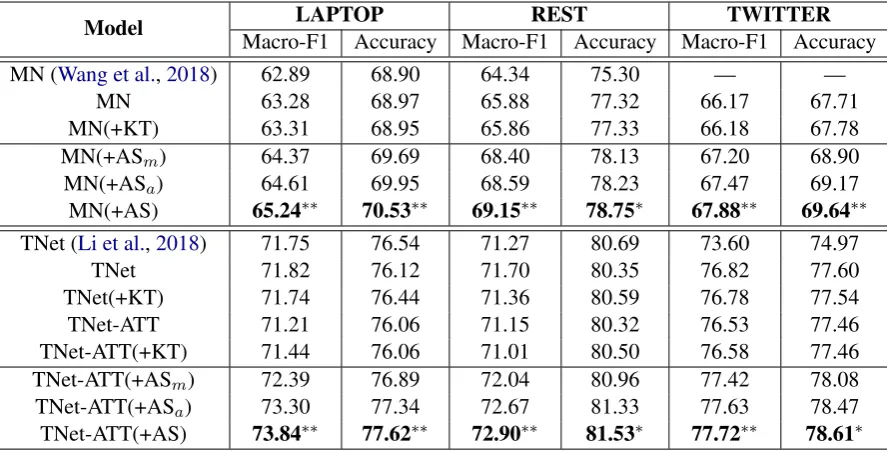
Table 4: Experimental results on various datasets. We directly cited the best experimental results of MN and TNet reported in (Wang et al.,2018;Li et al.,2018). ∗∗and∗means significant atp <0.01 andp <0.05 over the baselines (MN, TNet) on each test set, respectively. Here we conducted 1,000 bootstrap tests (Koehn,2004) to measure the significance in metric score differences.
measures.
4.1 Effects ofα
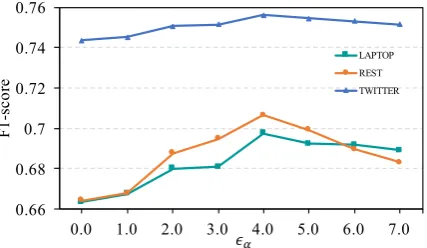
α is a very important hyper-parameter that
con-trols the iteration number of mining attention su-pervision information (see Line 14of Algorithm 1). Thus, in this group of experiments, we var-iedαfrom 1.0 to 7.0 with an increment of 1 each
time, so as to investigate its effects on the perfor-mance of our models on the validation sets.
Figure 3 and 4 show the experimental results of different models. Specifically, MN(+AS) with α=3.0achieves the best performance, meanwhile,
the optimal performance of TNet-ATT(+AS) is obtained when α=4.0. We observe the increase
ofαdoes not lead to further improvements, which
may be due to more noisy extracted context words. Because of these results, we setα for MN(+AS)
and TNet-ATT(+AS) as 3.0 and 4.0 in the follow-ing experiments, respectively.
4.2 Overall Results
Table4 provides all the experimental results. To enhance the persuasiveness of our experimental results, we also displayed the previously reported scores of MN (Wang et al., 2018) and TNet (Li et al., 2018) on the same data set. According to the experimental results, we can come to the fol-lowing conclusions:
First, both of our reimplemented MN and TNet
are comparable to their original models reported in (Wang et al.,2018;Li et al.,2018). These results show that our reimplemented baselines are com-petitive. When we replace the CNN of TNet with an attention mechanism, TNet-ATT is slightly in-ferior to TNet. Moreover, when we perform ad-ditional K+1-iteration of training on these mod-els, their performance has not changed signifi-cantly, suggesting simply increasing training time is unable to enhance the performance of the neural ASC models.
Second, when we apply the proposed approach
into both MN and TNet-ATT, the context words insa(x) are more effective than those in sm(x).
This is because the proportion of correctly pre-dicted training instances is larger than that of in-correctly ones. Besides, the performance gap be-tween MN(+ASa) and MN(+ASm) is larger than
that between two variants of TNet-ATT. One un-derlying reason is that the performance of TNet-ATT is better than MN, which enables TNet-TNet-ATT to produce more correctly predicted training in-stances. This in turn brings more attention super-vision to TNet-ATT than MN.
Finally, when we use both kinds of attention
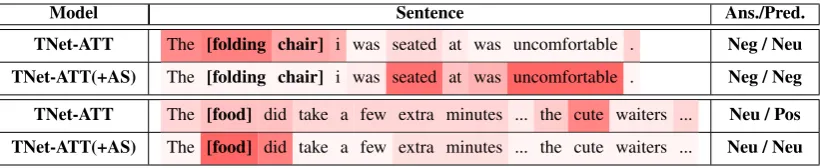
[image:7.595.77.521.62.289.2]in-Model Sentence Ans./Pred. TNet-ATT The [folding chair] i was seated at was uncomfortable . Neg / Neu TNet-ATT(+AS) The [folding chair] i was seated at was uncomfortable . Neg / Neg
[image:8.595.94.507.61.145.2]TNet-ATT The [food] did take a few extra minutes ... the cute waiters ... Neu / Pos TNet-ATT(+AS) The [food] did take a few extra minutes ... the cute waiters ... Neu / Neu
Table 5: Two test cases predicted by TNet-ATT and TNet-ATT(+AS).
ferior to TNet, TNet-ATT(+AS) still significantly surpasses both TNet and TNet-ATT. These results strongly demonstrate the effectiveness and gener-ality of our approach.
4.3 Case Study
In order to know how our method improves neural ASC models, we deeply analyze attention results of TNet-ATT and TNet-ATT(+AS). It has been found that our proposed approach can solve the above-mentioned two issues well.
Table5provides two test cases. TNet-ATT in-correctly predicts the sentiment of the first test sentence as neutral. This is because the context word “uncomfortable” only appears in two train-ing instances with negative polarities, which dis-tracts attention from it. When using our approach, the average attention weight of “uncomfortable” is increased to 2.6 times than that of baseline in
these two instances. Thus, TNet-ATT(+AS) is
capable of assigning a greater attention weight (0.0056→0.2940) to this context word, leading to the correct prediction of the first test sentence. For the second test sentence, since the context word “cute” occurs in training instances mostly with positive polarity, TNet-ATT directly focuses on this word and then incorrectly predicts the sen-tence sentiment as positive. Adopting our method, attention weights of “cute” in training instances with neural or negative polarity are significantly decreased. Specifically, in these instances, the av-erage weight of “cute” is reduced to 0.07 times of the original. Hence, TNet-ATT(+AS) assigns a smaller weight (0.1090→0.0062) to “cute” and achieves the correct sentiment prediction.
5 Related Work
Recently, neural models have been shown to be successful on ASC. For example, due to its multi-ple advantages, such as being simmulti-pler and faster, MNs with attention mechanisms (Tang et al., 2016b;Wang et al.,2018) have been widely used.
Another prevailing neural model is LSTM that also involves an attention mechanism to explic-itly capture the importance of each context word (Wang et al., 2016). Overall, attention mecha-nisms play crucial roles in all these models.
Following this trend, researchers have resorted to more sophisticated attention mechanisms to re-fine neural ASC models. Chen et al., (2017) pro-posed a multiple-attention mechanism to capture sentiment features separated by a long distance, so that it is more robust against irrelevant infor-mation. An interactive attention network has been designed by Ma et al., (2017) for ASC, where two attention networks were introduced to model the target and context interactively. Liu et al., (2017) proposed to leverage multiple attentions for ASC: one obtained from the left context and the other one acquired from the right context of a given as-pect. Very recently, transformation-based model has also been explored for ASC (Li et al.,2018), and the attention mechanism is replaced by CNN.
Different from these work, our work is in line with the studies of introducing attention super-vision to refine the attention mechanism, which have become hot research topics in several NN-based NLP tasks, such as event detection (Liu et al.,2017), machine translation (Liu et al.,2016), and police killing detection (Nguyen and Nguyen, 2018). However, such supervised attention acqui-sition is labor-intense. Therefore, we mainly com-mits to automatic mining supervision information for attention mechanisms of neural ASC models. Theoretically, our approach is orthogonal to these models, and we leave the adaptation of our ap-proach into these models as future work.
encourage the model to mine inapparent features or patterns for text classification. To the best of our knowledge, our work is the first one to explore au-tomatic mining of attention supervision informa-tion for ASC.
6 Conclusion and Future Work
In this paper, we have explored how to automat-ically mine supervision information for attention mechanisms of neural ASC models. Through in-depth analyses, we first point out the defect of the attention mechanism for ASC: a few frequent words with sentiment polarities are tend to be over-learned, while those with low frequency of-ten lack sufficient learning. Then, we propose a novel approach to automatically and incrementally mine attention supervision information for neu-ral ASC models. These mined information can be further used to refine the model training via a regularization term. To verify the effectiveness of our approach, we apply our approach into two dominant neural ASC models, where experimental results demonstrate our method significantly im-proves the performance of these two models.
Our method is general for attention
mecha-nisms. Thus, we plan to extend our approach
to other neural NLP tasks with attention mech-anisms, such as neural document classification (Yang et al.,2016) and neural machine translation (Zhang et al.,2018).
Acknowledgments
The authors were supported by National Natural
Science Foundation of China (Nos. 61433015,
61672440), NSF Award (No. 1704337),
Bei-jing Advanced Innovation Center for Language Resources, the Fundamental Research Funds for
the Central Universities (Grant No. ZK1024),
Scientific Research Project of National Language Committee of China (Grant No. YB135-49), and Project 2019X0653 supported by XMU Training Program of Innovation and Enterpreneurship for Undergraduates. We also thank the reviewers for their insightful comments.
References
Peng Chen, Zhongqian Sun, Lidong Bing, and Wei Yang. 2017. Recurrent attention network on mem-ory for aspect sentiment analysis. InEMNLP.
Li Dong, Furu Wei, Chuanqi Tan, Duyu Tang, Ming Zhou, and Ke Xu. 2014. Adaptive recursive neural network for target-dependent twitter sentiment clas-sification. InACL.
Geoffrey E. Hinton, Nitish Srivastava, Alex Krizhevsky, Ilya Sutskever, and Ruslan Salakhut-dinov. 2012. Improving neural networks by preventing co-adaptation of feature detectors. Computer Science.
Yoon Kim. 2014. Convolutional neural networks for sentence classification. InEMNLP.
Diederik P. Kingma and Jimmy Ba. 2015. Adam: A method for stochastic optimization. InICLR.
Svetlana Kiritchenko, Xiaodan Zhu, Colin Cherry, and Saif Mohammad. 2014. Nrc-canada-2014: Detect-ing aspects and sentiment in customer reviews. In SemEval.
Philipp Koehn. 2004. Statistical significance tests for machine translation evaluation. InEMNLP.
Xin Li, Lidong Bing, Wai Lam, and Bei Shi. 2018. Transformation networks for target-oriented senti-ment classification. InACL.
Tsung-Yi Lin, Priya Goyal, Ross Girshick, Kaiming He, and Piotr Dolla r. 2017. Focal loss for dense object detection. InICCV.
Lemao Liu, Masao Utiyama, Andrew M. Finch, and Eiichiro Sumita. 2016. Neural machine translation with supervised attention. InCOLING.
Shulin Liu, Yubo Chen, Kang Liu, and Jun Zhao. 2017. Exploiting argument information to improve event detection via supervised attention mechanisms. In ACL.
Dehong Ma, Sujian Li, Xiaodong Zhang, and Houfeng Wang. 2017. Interactive attention networks for aspect-level sentiment classification. InIJCAI.
Minh Nguyen and Thien Nguyen. 2018. Who is killed by police: Introducing supervised attention for hier-archical lstms. InCOLING.
Jeffrey Pennington, Richard Socher, and Christopher Manning. 2014. Glove: Global vectors for word representation. InEMNLP.
Maria Pontiki, Dimitris Galanis, John Pavlopoulos, Harris Papageorgiou, Ion Androutsopoulos, and Suresh Manandhar. 2014. Semeval-2014 task 4: As-pect based sentiment analysis. InSemEval.
Duyu Tang, Bing Qin, Xiaocheng Feng, and Ting Liu. 2016a. Effective lstms for target-dependent senti-ment classification. InCOLING.
Duyu Tang, Bing Qin, and Ting Liu. 2016b. Aspect level sentiment classification with deep memory net-work. InEMNLP.
Joachim Wagner, Piyush Arora, Santiago Cortes, Utsab Barman, Dasha Bogdanova, Jennifer Foster, and Lamia Tounsi. 2014. DCU: aspect-based polarity classification for semeval task 4. InSemEval.
Shuai Wang, Sahisnu Mazumder, Bing Liu, Mianwei Zhou, and Yi Chang. 2018. Target-sensitive mem-ory networks for aspect sentiment classification. In ACL.
Yequan Wang, Minlie Huang, Xiaoyan Zhu, and Li Zhao. 2016. Attention-based LSTM for aspect-level sentiment classification. InEMNLP.
Yunchao Wei, Jiashi Feng, Xiaodan Liang, Ming-Ming Cheng, Yao Zhao, and Shuicheng Yan. 2017. Object region mining with adversarial erasing: A simple classification to semantic segmentation approach. In CVPR.
Hengru Xu, Shen Li, Renfen Hu, Si Li, and Sheng Gao. 2018. From random to supervised: A novel dropout mechanism integrated with global information. In CONLL.
Zichao Yang, Diyi Yang, Chris Dyer, Xiaodong He, Alex Smola, and Eduard Hovy. 2016. Hierarchical attention networks for document classification. In NAACL.
Biao Zhang, Deyi Xiong, and Jinsong Su. 2018. Neu-ral machine translation with deep attention. IEEE Transactions on Pattern Analysis and Machine In-telligence.