207
TMU Transformer System Using BERT for Re-ranking at BEA 2019
Grammatical Error Correction on Restricted Track
Masahiro Kaneko Kengo Hotate Satoru Katsumata Mamoru Komachi Tokyo Metropolitan University, Japan
{kaneko-masahiro@ed, hotate-kengo@ed, katsumata-satoru@ed, komachi@}.tmu.ac.jp
Abstract
We introduce our system that is submitted to the restricted track of the BEA 2019 shared task on grammatical error correction1(GEC).
It is essential to select an appropriate hypothe-sis sentence from the candidates list generated by the GEC model. A re-ranker can evalu-ate the naturalness of a corrected sentence us-ing language models trained on large corpora. On the other hand, these language models and language representations do not explicitly take into account the grammatical errors written by learners. Thus, it is not straightforward to uti-lize language representations trained from a large corpus, such as Bidirectional Encoder Representations from Transformers (BERT), in a form suitable for the learner’s grammat-ical errors. Therefore, we propose to fine-tune BERT on learner corpora with grammat-ical errors for re-ranking. The experimen-tal results of the W&I+LOCNESS develop-ment dataset demonstrate that re-ranking using BERT can effectively improve the correction performance.
1 Introduction
Grammatical error correction (GEC) systems may be used for language learning to detect and cor-rect grammatical errors in text written by language learners. GEC has grown in importance over the past few years due to the increasing need for peo-ple to learn new languages. GEC has been ad-dressed in the Helping Our Own (HOO) (Dale and Kilgarriff, 2011; Dale et al., 2012) and Confer-ence on Natural Language Learning (CoNLL) (Ng et al.,2013,2014) shared tasks between 2011 and 2014.
Recent research has demonstrated the effective-ness of the neural machine translation model for
1https://www.cl.cam.ac.uk/research/nl/
bea2019st/
GEC. There are three main types of neural net-work models for GEC, namely, recurrent neural networks (Ge et al., 2018), a multi-layer convo-lutional model based on convoconvo-lutional neural net-works (Chollampatt and Ng, 2018a) and a trans-former model based on self-attention ( Junczys-Dowmunt et al.,2018). We follow the best prac-tices to develop our system based on the trans-former model, which has achieved better perfor-mance for GEC (Zhao et al.,2019).
Re-ranking using a language model trained on large-scale corpora contributes to the improved hypotheses of the GEC model (Chollampatt and Ng,2018a). Typically, a language model is trained by maximizing the log-likelihood of a sentence. Hence, such models observe only the positive ex-amples of a raw corpus. However, these mod-els may not be sufficient to take into account the grammatical errors written by language learners. Therefore, we fine-tune these models trained from large-scale raw data on learner corpora to explic-itly take into account grammatical errors to re-rank the hypotheses for the GEC tasks.
Bidirectional Encoder Representations from Transformer (BERT) (Devlin et al.,2019) can con-sider information of large-scale raw corpora and task specific information by fine-tuning on the target task corpora. Moreover, BERT is known to be effective in the distinction of grammatical sentences from ungrammatical sentences (Kaneko and Komachi,2019). They proposed a grammat-ical error detection (GED) model based on BERT that achieved state-of-the-art results in word-level GED tasks. Therefore, we use BERT, pre-trained with large-scale raw corpora, and fine-tune it with learner corpora for re-ranking the hypotheses of our GEC model to utilize not only the large-scale raw corpora but also a set of information on gram-matical errors.
the experimental results demonstrate that BERT, which considers both the representations trained on large-scale and learners corpora, is effective for re-ranking the hypotheses for GEC tasks. Ad-ditionally, we demonstrated that BERT based on self-attention can re-rank sentences corrected from the GEC model by capturing long distance infor-mation.
2 TMU System
Our system is a GEC model that is combined with a re-ranker. The GEC model is given a source sen-tence as input and generates hypothesis sensen-tences. These hypothesis sentences are given as input to the re-ranker, which selects the final corrected sen-tence form the hypothesis sensen-tences.
We use the transformer (Vaswani et al., 2017) architecture for the GEC model because it is a state-of-the-art model in the GEC task (Zhao et al., 2019). The transformer architecture comprises multiple layers of transformer block. The layers of the encoder and decoder have position-wise feedforward layers over the tokens of input sentences. The decoder has an extra attention layer over the encoder’s hidden states. This GEC model is optimized by minimizing the label smoothed cross-entropy loss.
The re-ranker uses five features. We use BERT fine-tuned on learner corpora to predict the gram-matical quality as a feature of re-ranking.
2.1 Architecture and training of BERT for re-ranking
We used BERT (Devlin et al., 2019) as a fea-ture for re-ranking the hypotheses of the GEC system. BERT is designed to learn deep bidi-rectional representations by jointly conditioning both the left and right contexts in all layers, based ontransformer blockwith multi-head self-attention and fully connected layers. The param-eters of BERT were pre-trained using a masked language model and the prediction of the next sen-tence.
We fine-tuned the pre-trained BERT on learner corpora to judge the grammatical quality of the in-put sentence, i.e., to distinguish between a sen-tence with and without grammatical errors on a sentence-level. We annotated sentences from par-allel learner corpora having incorrect and correct sentences with 0 (incorrect) and 1 (correct) labels. Hence, using the above, we can take advantage of
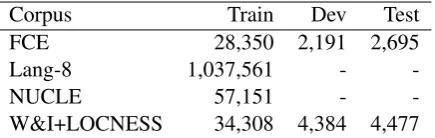
Corpus Train Dev Test
FCE 28,350 2,191 2,695
Lang-8 1,037,561 -
-NUCLE 57,151 -
[image:2.595.309.527.62.131.2]-W&I+LOCNESS 34,308 4,384 4,477
Table 1: Number of sentences in corpora on GEC shared task for restricted track.
both the large-scale raw data and learner corpora by using BERT. The model was optimized dur-ing fine-tundur-ing by minimizdur-ing the sentence-level cross-entropy loss.
2.2 Re-ranking
We used the following set of features for re-ranking, which are the same as those in a pre-viously reported approach (Chollampatt and Ng, 2018a), except for BERT:
• GEC model: The score of the hypothesis sentence from the GEC model is computed using the log probabilities of predictions nor-malized by sentence length on a token-level.
• Language model: A 5-gram language model score is computed by normalizing the log probabilities of the hypothesis sentence by sentence length.
• BERT: The predicted score for the grammat-ical quality of the hypothesis sentence.
• Edit operations: Three token level features, namely, denoting the number of substitutions, deletions, and insertions between the source sentence and the hypothesis sentence.
• Hypothesis sentence length: The number of words in the hypothesis sentence to penalize short hypothesis sentences.
Feature weights are optimized by minimum error rate training (MERT) (Och,2003) on the develop-ment set.
3 Experiments
3.1 Dataset
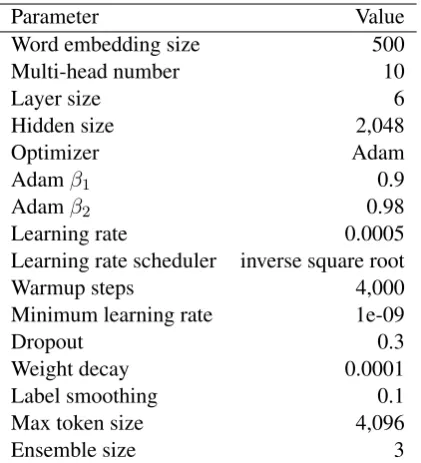
Parameter Value
Word embedding size 500
Multi-head number 10
Layer size 6
Hidden size 2,048
Optimizer Adam
Adamβ1 0.9
Adamβ2 0.98
Learning rate 0.0005
Learning rate scheduler inverse square root
Warmup steps 4,000
Minimum learning rate 1e-09
Dropout 0.3
Weight decay 0.0001
Label smoothing 0.1
Max token size 4,096
[image:3.595.310.523.60.131.2]Ensemble size 3
Table 2: Hyperparameter values of our transformer GEC model.
# Team Name P R F0.5
1 UEDIN-MS 72.28 60.12 69.47
2 Kakao&Brain 75.19 51.91 69.00
7 ML@IITB 65.70 61.12 64.73
[image:3.595.77.288.61.293.2]14 TMU 53.91 51.65 53.45
Table 3: Results of GEC systems with the highest P, R andF0.5overall vs TMU on restricted track on official
W&I test data.
English (NUCLE) (Dahlmeier et al., 2013) and Write & Improve (W&I)+LOCNESS corpus ( Yan-nakoudakis et al.,2018;Granger,1998) were used for this shared task. W&I+LOCNESS corpus was a new corpus released for this shared task and the shared task systems were evaluated on a gold test set of the overall W&I+LOCNESS dataset.
We used FCE (official split of train, dev, and test set), Lang-8, NUCLE, and W&I+LOCNESS training set as training data and we split the W&I+LOCNESS development set into develop-ment and test data by random selection from each Common European Framework of Reference for Languages (CEFR) levels (beginner, intermediate, advanced, native) for the transformer and BERT. The development and test data sizes were 2,191 and 2,193, respectively.
Model P R F0.5
TMU system 37.79 28.08 35.35
w/o BERT 38.75 23.76 34.41
w/o language model 37.85 26.41 34.83
[image:3.595.77.285.364.433.2]w/o re-ranking 36.46 22.91 32.60
Table 4: Effectiveness of re-ranking without different features.
3.2 Setup
We implemented the transformer model based on the Fairseq tool2. The hyperparameters used in our transformer GEC model are listed in Table 2. The parameters of the ensemble models were initialized with different values. We initialized the embedding layers of the encoder and decoder with the embeddings pre-trained on the English Wikipedia usingfastTexttool3(Bojanowski et al., 2017).
We used a publicly available pre-trained BERT model4, namely the BERTBASE uncased model,
which was pre-trained on large-scale BooksCor-pus and English Wikipedia corpora. This model had 12 layers, 768 hidden sizes, and 16 heads of self-attention. Our model’s hyperparameters for re-ranking were similar to the default ones de-scribed by Devlin et al. (2019). We used the same learner corpora with incorrect and correct sentences used for training our GEC model to fine-tune BERT.
The 5-gram language model for re-ranking was trained on a subset of the Common Crawl cor-pus (Chollampatt and Ng, 2018a).5 We used a Python spell checker tool6on the GEC model hy-pothesis sentences.
3.3 Evaluation
The systems submitted to the shared task were evaluated using the ERRANT7 scorer (Felice et al., 2016; Bryant et al., 2017). This metric is an improved version of the MaxMatch scorer (Dahlmeier and Ng, 2012) originally used in the
2https://github.com/pytorch/fairseq 3https://github.com/facebookresearch/
fastText
4https://github.com/google-research/
bert
5
https://github.com/nusnlp/ mlconvgec2018
6https://pypi.org/project/
pyspellchecker/
7https://github.com/chrisjbryant/
(a)
Source The range of public services will be expanded to remote areas ,it becomemuch more convenient . Gold The range of public services will be expanded to remote areas , and it will become much more convenient . w/o BERT The range of public services will be expanded to remote areas ,has becomemuch more convenient . TMU system The range of public services will be expanded to remote areas ,and it will becomemuch more convenient .
(b)
Source Her sister is 6 years old and you shouldlook after every weekend. Gold Her sister is 6 years old and you would have to look after her every weekend . w/o BERT Her sister is 6 years old and you shouldlook after it every weekend. TMU system Her sister is 6 years old and you shouldlook after it every weekend.
Table 5: (a) Successful and (b) unsuccessful examples of TMU system for long distance errors.Boldindicates the erroneous part of the source sentence; Underline indicates the corrected part of the gold sentence;Italicrepresents the corrected output of the GEC system.
CoNLL shared tasks (Ng et al.,2013,2014). The scorer reported the performance in terms of span-based and token-span-based detection. The system per-formance was primarily measured with regard to span-based correction using theF0.5metric, which
assigned twice as much weight to the precision. In this study, we report on precision, recall, andF0.5
based on the ERRANT score.
3.4 Results
Table3presents the results of our system (TMU) and others on precision (P), recall (R) andF0.5on
W&I+LOCNESS test data for the BEA 2019 GEC shared task on the restricted track. Our system was ranked 14 out of 21 teams.
4 Discussions
We investigated whether using BERT as a fea-ture for ranking can improve the corrected re-sults. Table 4 presents the experimental results of removing the following re-ranking features: BERT (w/o BERT); language model (w/o lan-guage model); and all features (w/o re-ranking). The recall andF0.5 of the complete model (TMU
system) is higher than those of w/o BERT, indicat-ing that usindicat-ing BERT for re-rankindicat-ing can improve the accuracy; especially, the recall is significantly improved. We conclude that BERT uses the ad-vantage of large-scale raw data to acquire general linguistic expressions and learn grammatical error information from learner corpora, thus detecting and re-ranking errors more effectively.
Additionally, we analyzed the type of grammat-ical errors that were corrected by using BERT for re-ranking. Table 5presents the output examples of our system with and without BERT. Example (a) demonstrates that our system can correct long distance verb tense errors, matching Gold in this case, where after stating that“... services will be expanded ...” in the first half, our system
prop-erly corrected“... it become ...” to“... it will be-come ...” in the second part of the given sentence. On the other hand, w/o BERT created a sentence with inconsistent verb tense by changing “... it become ...” to “... it has become ...”. Example (b) demonstrates that neither of the systems, i.e., with and without BERT, could properly correct the coreference resolution error. They both failed to trace the reference of“it”to“her sister”. By us-ing BERT based on self-attention for re-rankus-ing, which is effective for long distance information, our system became better at solving long distance errors; however, there is a room for improvement.
5 Related Work
Re-ranking using a language model trained on large-scale raw data significantly improved the results in numerous GEC studies ( Junczys-Dowmunt and Grundkiewicz, 2016; Chollam-patt and Ng, 2018a; Grundkiewicz and Junczys-Dowmunt, 2018;Junczys-Dowmunt et al., 2018; Zhao et al.,2019). However, their models do not explicitly consider grammatical errors of language learners.
Yannakoudakis et al. (2017) utilized the score from a GED model as a feature to consider gram-matical errors for re-ranking.Chollampatt and Ng (2018b) proposed a neural quality estimator for GEC. Their models predict the quality score when given a source sentence and its corresponding hy-pothesis. They consider representations of gram-matical errors of learners for re-ranking. However, their models did not use large-scale raw corpora.
Kaneko and Komachi(2019) proposed a model of applying attention to each layer of BERT for GED and achieved state-of-the-art results in word-level GED tasks. Our BERT model predicts gram-matical quality on a sentence-level for re-ranking.
6 Conclusion
In this paper, we described our TMU system, which is based on the GEC transformer model using BERT for re-ranking. We evaluated our TMU system on the restricted track of the BEA 2019 GEC shared task. The experimental results demonstrated that using BERT for re-ranking can improve the correction quality.
In this work, we only considered the infor-mation of the hypothesis sentence. In our fu-ture work, we will analyze the re-ranker, allowing BERT to utilize the information of the source sen-tence of the GEC model as well, given both source and hypothesis sentences.
7 Acknowledgments
We thank Yangyang Xi of Lang-8, Inc. for kindly allowing us to use the Lang-8 learner corpus. This work was partially supported by JSPS Grant-in-Aid for Scientific Research (C) Grant Number JP19K12099.
References
Piotr Bojanowski, Edouard Grave, Armand Joulin, and Tomas Mikolov. 2017. Enriching Word Vectors with Subword Information.TACL, 5:135–146.
Christopher Bryant, Mariano Felice, and Ted Briscoe. 2017. Automatic Annotation and Evaluation of Er-ror Types for Grammatical ErEr-ror Correction. In
ACL, pages 793–805, Vancouver, Canada. Associ-ation for ComputAssoci-ational Linguistics.
Shamil Chollampatt and Hwee Tou Ng. 2018a. A Mul-tilayer Convolutional Encoder-Decoder Neural Net-work for Grammatical Error Correction. InAAAI, pages 5755–5762, New Orleans, Louisiana. Associ-ation for the Advancement of Artificial Intelligence.
Shamil Chollampatt and Hwee Tou Ng. 2018b. Neu-ral Quality Estimation of Grammatical Error Correc-tion. In EMNLP, pages 2528–2539, Brussels, Bel-gium. Association for Computational Linguistics.
Daniel Dahlmeier and Hwee Tou Ng. 2012. Better Evaluation for Grammatical Error Correction. In
NAACL, pages 568–572, Montreal, Canada. Asso-ciation for Computational Linguistics.
Daniel Dahlmeier, Hwee Tou Ng, and Siew Mei Wu. 2013. Building a Large Annotated Corpus of Learner English: The NUS Corpus of Learner En-glish. InBEA, pages 22–31, Atlanta, Georgia. As-sociation for Computational Linguistics.
Robert Dale, Ilya Anisimoff, and George Narroway. 2012. HOO 2012: A Report on the Preposition and Determiner Error Correction Shared Task. In
BEA, pages 54–62, Montreal, Canada. Association for Computational Linguistics.
Robert Dale and Adam Kilgarriff. 2011. Helping Our Own: The HOO 2011 Pilot Shared Task. In
ENLG, pages 242–249, Nancy, France. Association for Computational Linguistics.
Jacob Devlin, Ming-Wei Chang, Kenton Lee, and Kristina Toutanova. 2019. BERT: Pre-training of Deep Bidirectional Transformers for Language Un-derstanding. InNAACL, Minneapolis, USA. Asso-ciation for Computational Linguistics.
Mariano Felice, Christopher Bryant, and Ted Briscoe. 2016. Automatic Extraction of Learner Errors in ESL Sentences Using Linguistically Enhanced Alignments. In COLING, pages 825–835, Osaka, Japan. The COLING 2016 Organizing Committee.
Tao Ge, Furu Wei, and Ming Zhou. 2018. Fluency Boost Learning and Inference for Neural Gram-matical Error Correction. In ACL, pages 1055– 1065, Melbourne, Australia. Association for Com-putational Linguistics.
Sylviane Granger. 1998. The Computer Learner Cor-pus: A Versatile New Source of Data for SLA Re-search. pages 3–18. Learner English on Computer.
Roman Grundkiewicz and Marcin Junczys-Dowmunt. 2018. Near Human-Level Performance in Gram-matical Error Correction with Hybrid Machine Translation. In NAACL, pages 284–290, New Or-leans, Louisiana. Association for Computational Linguistics.
Marcin Junczys-Dowmunt and Roman Grundkiewicz. 2016. Phrase-based Machine Translation is State-of-the-Art for Automatic Grammatical Error Correc-tion. InEMNLP, pages 1546–1556, Austin, Texas. Association for Computational Linguistics.
Marcin Junczys-Dowmunt, Roman Grundkiewicz, Shubha Guha, and Kenneth Heafield. 2018. Ap-proaching Neural Grammatical Error Correction as a Low-Resource Machine Translation Task. In
NAACL, pages 595–606, New Orleans, Louisiana. Association for Computational Linguistics.
Masahiro Kaneko and Mamoru Komachi. 2019. Multi-Head Multi-Layer Attention to Deep Language Rep-resentations for Grammatical Error Detection. In
Tomoya Mizumoto, Mamoru Komachi, Masaaki Na-gata, and Yuji Matsumoto. 2011. Mining Revi-sion Log of Language Learning SNS for Auto-mated Japanese Error Correction of Second Lan-guage Learners. In IJCNLP, pages 147–155, Chi-ang Mai, Thailand. Asian Federation of Natural Lan-guage Processing.
Hwee Tou Ng, Siew Mei Wu, Ted Briscoe, Christian Hadiwinoto, Raymond Hendy Susanto, and Christo-pher Bryant. 2014. The CoNLL-2014 Shared Task on Grammatical Error Correction. InCoNLL, pages 1–14, Baltimore, Maryland. Association for Compu-tational Linguistics.
Hwee Tou Ng, Siew Mei Wu, Yuanbin Wu, Christian Hadiwinoto, and Joel Tetreault. 2013. The CoNLL-2013 Shared Task on Grammatical Error Correction. InCoNLL, pages 1–12, Sofia, Bulgaria. Association for Computational Linguistics.
Franz Josef Och. 2003. Minimum Error Rate Training in Statistical Machine Translation. In ACL, pages 160–167, Sapporo, Japan. Association for Compu-tational Linguistics.
Marek Rei and Anders Søgaard. 2018. Zero-Shot Sequence Labeling: Transferring Knowledge from Sentences to Tokens. In NAACL, pages 293–302, New Orleans, Louisiana. Association for Computa-tional Linguistics.
Ashish Vaswani, Noam Shazeer, Niki Parmar, Jakob Uszkoreit, Llion Jones, Aidan N Gomez, Łukasz Kaiser, and Illia Polosukhin. 2017. Attention is All you Need. InNIPS, pages 5998–6008. Curran As-sociates, Inc.
Helen Yannakoudakis, Øistein E. Andersen, Ardeshir Geranpayeh, Ted Briscoe, and Diane Nicholls. 2018. Developing an Automated Writing Placement Sys-tem for ESL Learners. pages 251–267. Applied Measurement in Education 31:3.
Helen Yannakoudakis, Ted Briscoe, and Ben Medlock. 2011. A New Dataset and Method for Automatically Grading ESOL Texts. InNAACL, pages 180–189, Portland, Oregon, USA. Association for Computa-tional Linguistics.
Helen Yannakoudakis, Marek Rei, Øistein E. Ander-sen, and Zheng Yuan. 2017. Neural Sequence-Labelling Models for Grammatical Error Correction. In EMNLP, pages 2795–2806, Copenhagen, Den-mark. Association for Computational Linguistics.