51
Conversational Response Re-ranking Based on Event Causality
and Role Factored Tensor Event Embedding
Shohei Tanaka1, Koichiro Yoshino1,2, Katsuhito Sudoh1, Satoshi Nakamura1
1Nara Institute of Science and Technology
2PRESTO, Japan Science and Technology Agency
{takana.shohei.tj7, koichiro, sudoh, s-nakamura}@is.naist.jp
Abstract
We propose a novel method for selecting co-herent and diverse responses for a given dia-logue context. The proposed method re-ranks response candidates generated from conver-sational models by using event causality re-lations between events in a dialogue history and response candidates (e.g., “be stressed out” precedes “relieve stress”). We use dis-tributed event representation based on the Role Factored Tensor Model for a robust match-ing of event causality relations due to lim-ited event causality knowledge of the sys-tem. Experimental results showed that the pro-posed method improved coherency and dia-logue continuity of system responses.
1 Introduction
While a variety of dialogue models such as the neural conversational model (NCM) (Vinyals and Le, 2015) have been researched widely, such di-alogue models often generate simple and dull re-sponses due to the limitation of their ability to take dialogue context into account. It is very difficult for these models to generate coherent responses to a dialogue history. We tackle this problem with a new architecture by incorporating event causality relations between response candidates and a dia-logue history. Typical event causality relations are cause-effect relations between two events, such as “be stressed out” precedes “relieve stress.” In this paper, event causality relations are defined that an effect event is likely to happen after a correspond-ing cause event happens (Shibata and Kurohashi,
2011;Shibata et al., 2014). Event causality rela-tions have been used in why-question answering systems to focus on causalities between questions and answers (Oh et al., 2013, 2016, 2017). It is also reported that a conversational model using event causality relations can generate diverse and coherent responses (Fujita et al.,2011). However,
the relation between dialogue continuity and the coherency of system responses is still an underly-ing problem.
In this paper, we propose a novel method to se-lect an appropriate response from response candi-dates generated by NCMs. We define a score for re-ranking to select a response that has an event causality relation to a dialogue history. Re-ranking effectively improves response reliability in lguage generation tasks such as why-question an-swering and dialogue systems (Oh et al., 2013;
Jansen et al.,2014;Bogdanova and Foster,2016;
Ohmura and Eskenazi, 2018). We used event causality pairs extracted from a large-scale cor-pus (Shibata and Kurohashi, 2011;Shibata et al.,
2014). We also use distributed event represen-tation based on the Role Factored Tensor Model (RFTM) (Weber et al., 2018) to realize a robust matching of event causality relations, even if these causalities are not included in the extracted event causality pairs. In human and automatic evalua-tions, the proposed method outperformed conven-tional methods in selecting coherent and diverse responses.
2 Response Re-ranking Using Event Causality Relations
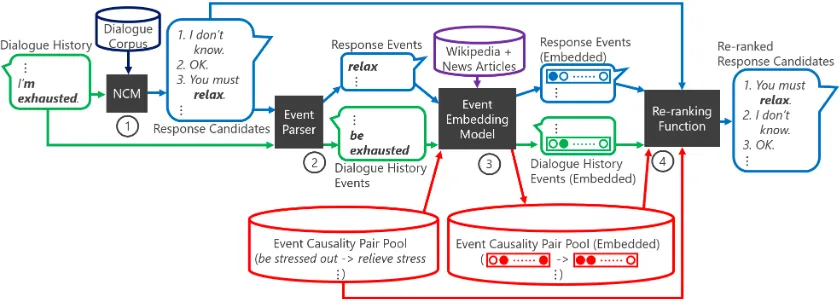
Figure 1 shows an overview of the proposed method. The process consists of four parts. First,
N-best response candidates are generated from an NCM given a dialogue history (Figure 1 ⃝1 ; Section 2.1). Then, events (predicate-argument structures) are extracted by an event parser from both the dialogue history and the response candi-dates (Figure 1 ⃝2 ). We used Kurohashi Nagao Parser (KNP)1 (Kawahara and Kurohashi, 2006;
Sasano and Kurohashi,2011) as the event parser. Next, the extracted events are converted to
Figure 1: Neural conversational model+re-ranking using event causality; a response that has an event causality relation (“be exhausted”→“relax”) to the dialogue history is selected by the re-ranking.
predicate 1 argument 1 predicate 2 argument 2 lif t be stressed out - relieve stress 10.02
Table 1: Example of event causality relations included in event causality pairs
tributed event representations by an event embed-ding model (Figure 1 ⃝3 ; Section 2.3). Events in event causality pairs are also converted to dis-tributed representations to calculate similarities. The RFTM is used for the embedding. Finally, re-sponse candidates are re-ranked (Figure1⃝4 ; Sec-tion 2.2, 2.4). We describe these components in more detail below.
2.1 Neural Conversational Model (NCM)
NCM learns a mapping between input and out-put word sequences by using recurrent neural net-works (RNNs). NCMs can generate N-best re-sponse candidates by using beam search or sam-pling (Macherey et al.,2016).
2.2 Event Causality Pairs
The proposed method uses event causality pairs. Events in a pair, which have cause-effect relations, are extracted from a large-scale corpus on the ba-sis of co-occurring statistics and case frames ( Shi-bata and Kurohashi, 2011;Shibata et al., 2014). 420,000 entries are extracted from 1.6 billion texts: each entry consists of information denoted in Table 1. “predicate 1” and “argument 1” are components of a cause event, and “predicate 2” and “argument 2” are components of an effect event. Each event consists of a predicate and argu-ments. The predicate is required, and the argument is optional. We used arguments that have the fol-lowing roles: nominative, accusative, dative, in-strumental, and locative cases. lif tis the mutual
information score between two events, which indi-cates the strength of the causality relation. Using
lif t, we propose a score for re-ranking as,
score= max
<eh,er>
log2p (
log2lif t(eh,er)
)λ. (1)
pis the posterior probability of the response can-didate provided by NCM. λ is a hyper parame-ter to decide the weight of event causality rela-tions. lif t(eh,er) is the lif t score between an eventeh in the dialogue history, and an event er in the response candidate, which is equal to 2 if the pair does not appear in the extracted event causality pair pool. Note thatlif t(eh,er) is log-scaled because it has a wide range of values(10< lif t(eh,er) < 10,000). In the case where more than one event causality relations are recognized between the dialogue history and the response can-didate, the score of the candidate is determined by the relation with the highestlif t(eh,er). We call this model “Re-ranking.”
2.3 Distributed Event Representation Based on Role Factored Tensor Model (RFTM)
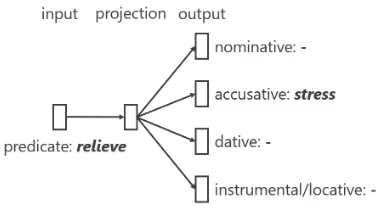
Figure 2: Model architecture of predicate embedding
We define an event with a single predicate or a pair of a predicate and arguments. Argumenta
of an event is embedded into vector asvaby using Skip-gram (Mikolov et al.,2013c,a,b). Predicatep
of an event is embedded into vector asvpby using predicate embedding which is based on case-unit Skip-gram. Figure2shows the model architecture of predicate embedding. The model learns predi-cate vector representations which are good at pre-dicting its arguments. To get an event embedding for the pair ofvpandva, we propose to use RFTM, which was proposed byWeber et al.(2018). The RFTM embeds a predicate and its arguments into vectoreas,
e =∑
a
WaT(vp,va). (2)
The relation of a predicate and its arguments is computed using a 3D tensorTand matricesWa. If the event has no arguments,eis substituted byvp. The RFTM is trained to predict an event sequence; thus it can represent the meaning of the event in a particular context.
2.4 Event Causality Relation Matching Based on Distributed Event Representation
Figure3illustrates the process of matching events on the basis of distributed event representation. Given an event pair from a response candidate and a dialogue history, the proposed method finds an event causality pair that has the highest cosine similarity from the pool.lif tscore, strength of the event causality relation, is extended as,
lif temb(eh,er) =
lif t(ec,ee)∗mean
(
sim(eh,ec), sim(er,ee)
) .
(3)
[image:3.595.321.503.67.172.2]eh is an event in the dialogue history, er is an event in the response candidate. ecandeeare re-spectively a cause and an effect event of an event
Figure 3: Event causality relation matching; thelif t of the event causality relation in which “be exhausted” precedes “relax,” is calculated from thelif tof the most similar event causality relation where “be stressed out” precedes “relieve stress.”
Ave.dist-1 Ave.dist-2
EncDec 0.44 0.56
[image:3.595.343.490.268.301.2]HRED 0.33 0.42
Table 2: Diversity ofN-best Response Candidates
causality pair. We also calculate the score for the case in which the cause and effect events are ex-changed to deal with the inverse case. Note that bothsimvalues have a threshold to prevent over-generalization. The threshold was empirically de-cided as√3/2. Replacinglif t(eh,er)in Eq. (1) with lif temb(eh,er), the score using distributed event representation is defined as,
score= max
<eh,er>
log2p (
log2lif temb(eh,er)
)λ. (4)
We call this model “Re-ranking (emb).”
3 Experiments
We conducted automatic and human evaluations to compare responses with and without the re-ranking. We evaluated our proposed re-ranking method on a conventional Encoder-Decoder with Attention (EncDec) model (Bahdanau et al.,2015;
Luong et al., 2015) and a Hierarchical Recurrent Encoder-Decoder (HRED) model (Sordoni et al.,
2015;Serban et al.,2016). While HRED tries to generate more coherent responses to dialogue con-text than a simple Encoder-Decoder, the diversity of responses is small due to context constraints.
We used the Japanese data from a Wikipedia dump for training Skip-gram and predicate word embeddings of RFTM, and the Maichichi news-paper dataset 20172 for training RFTM. We
col-2
Method Evaluation
NCM history re-ranking re-ranked (%) BLEU NIST extrema dist-1 dist-2 PMI length
reference - - - 0.06 0.40 1.86 21.43
EncDec - 1-best - 1.12 1.19 0.42 0.06 0.18 1.77 15.55 EncDec 1 Re-ranking 4,016 (7.90) 1.10 1.18 0.42 0.06 0.19 1.78 15.52 EncDec 1 Re-ranking (emb) 29,343 (57.71) 1.02 1.07 0.40 0.06 0.20 1.77 15.64 EncDec 5 Re-ranking 6,469 (12.72) 1.09 1.17 0.42 0.06 0.19 1.78 15.50 EncDec 5 Re-ranking (emb) 35,284 (69.39) 1.00 1.04 0.39 0.07 0.21 1.77 15.66 HRED - 1-best - 1.34 2.74 0.42 0.07 0.20 1.84 35.05 HRED 1 Re-ranking 3,671 (7.22) 1.33 2.74 0.42 0.06 0.20 1.84 35.20 HRED 1 Re-ranking (emb) 30,992 (60.95) 1.28 2.74 0.41 0.06 0.20 1.86 34.80 HRED 5 Re-ranking 6,231 (12.25) 1.33 2.73 0.42 0.06 0.20 1.84 35.30
[image:4.595.94.507.62.178.2]HRED 5 Re-ranking (emb) 36,373(71.53) 1.28 2.74 0.41 0.06 0.20 1.86 34.60
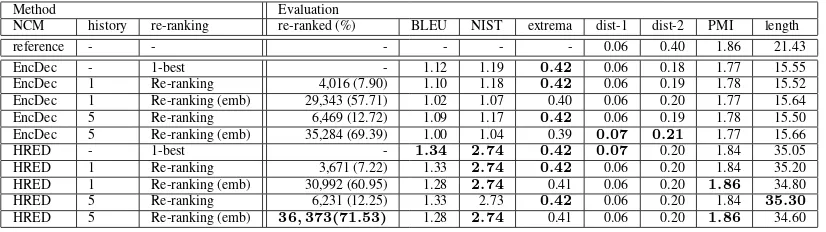
Table 3: Comparison results before and after re-ranking
lected 2,632,114 dialogues from Japanese micro blogs (Twitter) to train and test the dialogue mod-els. The average dialogue turn was 21.99, and the average utterance length was 22.08 words. We re-moved emoticons from utterances to reduce vo-cabulary size and accelerate the training. The dia-logue corpus was split into 2,509,836, 63,308, and 58,970 dialogues as training, validation, and test-ing data, respectively.
3.1 Model Settings
The hidden unit size of Skip-gram (Mikolov et al.,
2013c,a,b), predicate embedding, and RFTM ( We-ber et al., 2018) was 100. We used gated recur-rent units (GRUs) (Cho et al.,2014;Chung et al.,
2014) whose number of layers was 2 and hidden unit size was 256, for the encoder and decoder of the NCMs. The batch size was 100, the dropout probability was 0.1, and the teacher forcing rate was 1.0. We used Adam (Kingma and Ba,2015) as the optimizer. The gradient clipping was 50, the learning rate for the encoder and the context RNN of HRED was1e−4, and the learning rate for the decoder was 5e−4. The loss function was in-verse token frequency (ITF) loss (Nakamura et al.,
2019). We used sentencepiece (Kudo and Richard-son, 2018) as the tokenizer, and the vocabulary size was 32,000. These settings were the same in all models.
Repetitive suppression (Nakamura et al.,2019) and length normalization (Macherey et al.,2016) were used at the decoding step. Finally,λof Eq. (1) and Eq. (4) was set to 1.0.
3.2 Diversity of Beam Search
We investigated internal diversity of N-best re-sponse candidates generated from each dialogue model. It is expected that the higher diversity is, the more effective re-ranking is. Hence, we evalu-ated diversity on the test data by dist-1, 2 (Li et al.,
2016). Beam width was set to 20; it is same in the
following experiments.
The result is shown in Table 2: Ave.distsare averages of dist computed internal N-best re-sponse candidates. The diversity of EncDec is higher than that of HRED.
3.3 Comparison in Automatic Metrics
Table 3 shows the results of our evaluation us-ing automatic metrics. We compared the results by referring to the ratio of responses different from the without re-ranking method (“re-ranked”), bilingual evaluation understudy (BLEU) (Papineni et al.,2002), NIST (Doddington,2002), and vector extrema (Gabriel et al.,2014) (“extrema”) score. NIST is based on BLEU, but heavily weights less frequent N-grams to focus on content words. Vec-tor extrema computes cosine similarity between sentence vectors of a reference and a generated re-sponse from a model. Each sentence vectoresis computed by taking extrema of Skip-gram word vectorsew in each dimensiondas,
esd=
{
maxw∈sewd if ewd >|minw′∈sew′d|
minw∈sewd otherwise
.
(5)
esd and ewd are the dth dimensions of es and
ew respectively. Additionally, we evaluated dist (Li et al., 2016), Pointwise Mutual Information (PMI) (Newman et al., 2010), and average re-sponse length (“length”). Dist and PMI are used to evaluate diversity and coherency respectively. PMI between a response and a dialogue history is defined as,
PMI = 1
|response|
|response∑ |
wr
max
wh PMI(wr, wh).
(6)
word coherency
dialogue continuity 1-best 28.62 40.84
[image:5.595.326.508.61.117.2]Re-ranking 33.91 38.53 neither 37.47 20.62
Table 4: 1-best v.s. Re-ranking; # dialogues is 100.
word coherency
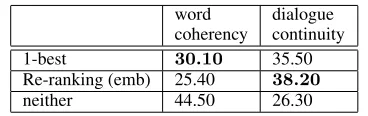
dialogue continuity 1-best 30.10 35.50 Re-ranking (emb) 25.40 38.20
neither 44.50 26.30
Table 5: 1-best v.s. Re-ranking (emb); # dialogues is 100.
specific NCM, a range of dialogue history used for re-ranking, and re-ranking method. Methods with “1-best” used neither re-ranking and event embed-ding. Those with “Re-ranking” used re-ranking but did not use event embedding. Those with “Re-ranking (emb)” used both the re-“Re-ranking and the proposed event embedding method.
Re-ranking lowered scores of the similarity to reference: BLEU, NIST, and extrema, because normal NCM models were trained to generate sim-ilar responses to the references, generated top 1 response before re-ranking should have the high-est scores in those similarity metrics. Dist-2 and PMI were improved by re-ranking. This indicates that words in re-ranked responses are diverse and coherent to dialogue histories. However, ratios of re-ranked responses were around 10%; hence, the effect of re-ranking was limited. By introducing the proposed event embedding method, the ratios of re-ranked responses improved drastically (Re-ranking vs. Re-(Re-ranking (emb)). Moreover, the re-ranking models with event embedding have high-est dist-1, dist-2, and PMI. As the HRED mod-els had higher BLEU, NIST, and PMI values than those of EncDec models in all re-ranking methods, we conducted a human evaluation by comparing HRED model-based systems.
3.4 Human Evaluation
It is difficult to evaluate system performances only with automatic metrics (Liu et al.,2016). Hence, we compared a baseline model and our models in a human evaluation to confirm coherency and dialogue continuity of responses selected by our proposed methods. We compared baseline HRED model with our proposed models, re-ranked with-out embedding and with embedding using the last
word coherency
dialogue continuity Re-ranking 23.70 35.53 Re-ranking (emb) 22.91 35.65
[image:5.595.104.259.61.117.2]neither 55.39 28.83
Table 6: Re-ranking v.s. Re-ranking (emb); # dialogues is 100.
five histories. To reduce evaluators’ workload, we used test data whose the number of user utter-ances is less than three, and removed dialogues which need external knowledge to evaluate. We used crowdsourcing for the human evaluation. Ten crowd-workers compared responses selected by two of three models in the following two sub-jective criteria. The first one is “which words in a response are more related to a dialogue his-tory” (word coherency), which indicates system response coherency to dialogue histories. The sec-ond criterion is “which response is easier to re-spond to” (dialogue continuity), which indicates how much dialogue continuity system responses have. We were inspired to make these criteria by those of the Alexa Prize (Ram et al.,2018).
The results are shown in Table4,5, and6. Word coherency was improved by our model without embedding, but lowered by the model with em-bedding. This is because workers acknowledged causality relations included in the event causal-ity pair pool, but did not acknowledge generalized causalities with event embedding. However, di-alogue continuity was improved by the proposed re-ranking model with embedding, it is probably because the proposed model reduced the number of dull responses. We need to investigate the bet-ter threshold in the event embedding to balance out the coherency and the continuity as the future work.
4 Discussion
We analyzed an adequacy of re-ranking using event causality relations. Here are system re-sponse examples of our proposed method. “()” in-dicates original Japanese sentences, “[]” inin-dicates event causality relations used for re-ranking, and “<>” indicates responses before re-ranking. All examples are translated from Japanese to English.
Conversation 1:
[image:5.595.89.273.154.212.2](Mou fuan-na koto ga oosugitesutoresu ga tamatteku.)
User 2 (System): Are you OK? Don’t work too hard.
ß (Daijobu desukamuri shinaide kuda-saine)
[work too hard→be stressed out (muri wo suru→sutoresu ga tamaru)] <Are you OK? (Daijobu desuka)>
Conversation 2:
User 1: Someone, let’sgoto eat lunch aroundYayoi-ga-okatomorrow. Every-one is welcome.
(Dareka, ashita, yayoi-ga-oka shuhen de hiru-gohan tabe ni iko daredemo iiken onegai)
User 2 :Let’s go. (Ikimasuka) User 1:Where will we go? (Doko kui iku)
User 2 (System):Anywherenear Shin-jukustation
(Shinjuku-eki nochikaku)
[be near→go (chiaku→ikeru)] <Where are you? (doko inno)>
In above examples, appropriate event causality relations are used to select logical, coherent, and diverse responses. However, we found that these cases are not majority. Our method used inade-quate event causality relations even if coherent re-sponses were selected as a result (“Conversation 3”). Responses selected by our method are some-times unnatural and incoherent than those before re-ranking as “Conversation 4”, “Conversation 5”, or “Conversation 6”.
Conversation 3:
User 1:I can’tstop coughing: ( (Hen naseki ga tomaranai...namida) User 2 (System):Don’tcatch a cold. (kaze hikanai dene)
[catch cold→stop coughing (kaze wo hiku→seki ga tomaru)] <Are you OK? (daijobu-ka)>
Conversation 4:
User 1: Our president who cannot drink alcoholgives me beer...
(Osake wo nomenai shacho ga biru wo kureru...)
User 2 (System):I willdrink alcohol. (Osake nomu.)
[drink alcohol→can drink alcohol (osake wo nomu→osake wo nomeru)] <I see. (wakaru)>
Conversation 5:
User 1: Despite of morning, ambu-lances and police cars were noisy... I was wondered what happened?
(Asa nanoni, kyu-kyu-sha to patoka no oto ga sugoi...doshitandaro)
User 2 (System): Good morning. (Ohayogozaimasu)
[morning→good morning (asa→ohayo)]
<Are you OK? (Daijobu desuka)>
Conversation 6:
User 1: I, I can’t get up... I’m gonna take a day off... I have a fever...
(O, okiagarenai... kaisha yasumu... netsu...)
User 2 (System): You must be tired. (Otsukaresama desu)
[be tired→take a day off (tsukare→yasumu)]
<Take care of yourself. (Odaiji-ni)>
5 Conclusion
We proposed a selection of response candidates generated from a neural conversational model (NCM) utilizing event causality relations. The method had a robust matching of event causal-ity relations attributed to distributed event rep-resentation. Experimental results showed that the proposed method selects a coherent and di-verse response. The proposed method can be applied to any languages that have a semantic parser, because it uses predicate-argument struc-ture based event expressions. However, unnatural responses were sometimes selected due to inade-quate event causality relations. Future work will focus on solving the problem by preventing over-generalization of events, and maintaining response naturalness.
Acknowledgments
We would like to thank Sadao Kurohashi, Ph.D. and Tomohide Shibata, Ph.D. of Kurohashi Lab-oratory in Kyoto University who provided us the event causality pairs.
This work is supported by JST PRESTO (JP-MJPR165B).
References
Dzmitry Bahdanau, Kyunghyunand Cho, and Yoshua Bengio. 2015. Neural Machine Translation by Jointly Learning to Align and Translate. In Proceed-ings of the 3rd International Conference on Learn-ing Representations (ICLR).
Dasha Bogdanova and Jennifer Foster. 2016. This is how we do it: Answer Reranking for Open-Domain How Questions with Paragraph Vectors and Minimal Feature Engineering. InProceedings of the 15th An-nual Conference of the North American Chapter of the Association for Computational Linguistics:
Hu-man Language Technologies (NAACL-HLT), pages
1290–1295.
Kyunghyun Cho, Bart van Merrienboer, Caglar Gul-cehre, Dzmitry Bahdanau, Fethi Bougares, Hol-ger Schwenk, and Yoshua Bengio. 2014. Learn-ing Phrase Representations UsLearn-ing RNN Encoder-Decoder for Statistical Machine Translation. In Pro-ceedings of the 2014 Conference on Empirical
Meth-ods in Natural Language Processing (EMNLP).
Junyoung Chung, Caglar Gulcehre, KyungHyun Cho, and Yoshua Bengio. 2014. Empirical Evaluation of Gated Recurrent Neural Networks on Sequence Modeling. In Proceedings of the 28th Confer-ence Neural Information Processing Systems, Deep
Learning and Representation Learning Workshop (NIPS).
George Doddington. 2002. Automatic Evaluation of Machine Translation Quality Using N-gram Co-occurrence Statistics. InProceedings of the 2nd In-ternational Conference on Human Language
Tech-nology Research (HLT), pages 138–145.
Motoyasu Fujita, Rafal Rzepka, and Kenji Araki. 2011. Evaluation of Utterances Based on Causal Knowl-edge Retrieved from Blogs. InProceedings of the 14th IASTED International Conference Artificial
In-telligence and Soft Computing (ASC), pages 294–
299.
Forgues Gabriel, Joelle Pineau, Jean-Marie Larchevˆeque, and R´eal Tremblay. 2014. Boot-strapping Dialog Systems with Word Embeddings.
Peter Jansen, Mihai Surdeanu, and Peter Clark. 2014. Discourse Complements Lexical Semantics for Non-factoid Answer Reranking. InProceedings of the 52nd Annual Meeting of the Association for
Computational Linguistics (ACL), pages 977–986.
Daisuke Kawahara and Sadao Kurohashi. 2006. A Fully-Lexicalized Probabilistic Model for Japanese Syntactic and Case Structure Analysis. In Proceed-ings of Human Language Technology Conference - North American Chapter of the Association for Computational Linguistics Annual Meeting
(HLT-NAACL), pages 176–183.
Diederik P. Kingma and Jimmy Ba. 2015. Adam: A Method for Stochastic Optimization. In Proceed-ings of the 3rd International Conference on Learn-ing Representations (ICLR).
Taku Kudo and John Richardson. 2018. Sentence-Piece: A Simple and Language Independent Sub-word Tokenizer and Detokenizer for Neural Text Processing. InProceedings of the 2018 Conference on Empirical Methods in Natural Language
Pro-cessing (EMNLP).
Jiwei Li, Michel Galley, Chris Brockett, Jianfeng Gao, and Bill Dolan. 2016. A Diversity-Promoting Ob-jective Function for Neural Conversation Models.
In Proceedings of the 15th Annual Conference of
the North American Chapter of the Association for Computational Linguistics: Human Language
Tech-nologies (NAACL-HLT), pages 110–119.
Chia-Wei Liu, Ryan Lowe, Iulian V. Serban, Michael Noseworthy, Laurent Charlin, and Joelle Pineau. 2016. How NOT to Evaluate Your Dialogue System: An Empirical Study of Unsupervised Evaluation Metrics for Dialogue Response Generation. In Pro-ceedings of the 2016 Conference on Empirical
Meth-ods in Natural Language Processing (EMNLP).
Minh-Thang Luong, Hieu Pham, and Christopher D. Manning. 2015. Effective Approaches to Attention-Based Neural Machine Translation. InProceedings of the 2015 Conference on Empirical Methods in
Wolfgang Macherey, Maxim Krikun, Yuan Cao, Qin Gao, Klaus Macherey, Jeff Klingner, Apurva Shah, Melvin Johnson, Xiaobing Liu, Łukasz Kaiser, Stephan Gouws, Yoshikiyo Kato, Taku Kudo, Hideto Kazawa, Keith Stevens, George Kurian, Nishant Patil, Wei Wang, Cliff Young, Jason Smith, Jason Riesa, Alex Rudnick, Oriol Vinyals, Greg Corrado, Macduff Hughes, and Jeffrey Dean. 2016. Google’s Neural Machine Translation Sys-tem: Bridging the Gap Between Human and Ma-chine Translation. InarXiv:1609.08144.
Tomas Mikolov, Kai Chen, Greg Corrado, and Jeffrey Deany. 2013a. Efficient Estimation of Word Rep-resentations in Vector Space. InProceedings of the 1st International Conference on Learning Represen-tations (ICLR).
Tomas Mikolov, Ilya Sutskever, Kai Chen, Greg Cor-rado, and Jeffrey Dean. 2013b. Distributed Repre-sentations of Words and Phrases and Their Compo-sitionality. InProceedings of the 26th International Conference on Neural Information Processing
Sys-tems (NIPS), volume 2, pages 3111–3119.
Tomas Mikolov, Wen-tau Yih, and Geoffrey Zweig. 2013c. Linguistic Regularities in Continuous Space Word Representations. In Proceedings of the 12th Annual Conference of the North American Chapter of the Association for Computational Lin-guistics: Human Language Technologies (NAACL-HLT), pages 746–751.
Ryo Nakamura, Katsuhito Sudoh, Koichiro Yoshino, and Satoshi Nakamura. 2019. Another Diversity-Promoting Objective Function for Neural Dialogue Generation. InProceedings of the 33rd Association for the Advancement of Artificial Intelligence Con-ference on Artificial Intelligence, Workshop on Rea-soning and Learning for Human-Machine Dialogues
(DEEP-DIAL 2019) (AAAI).
David Newman, Jey Han Lau, Karl Grieser, and Timo-thy Baldwin. 2010. Automatic Evaluation of Topic Coherence. InProceedings of the 11th Annual Con-ference of the North American Chapter of the Asso-ciation for Computational Linguistics: Human
Lan-guage Technologies (NAACL-HLT), pages 100–108.
Jong-Hoon Oh, Kentaro Torisawa, Chikara Hashimoto, Ryu Iida, Masahiro Tanaka, and Julien Kloetzer. 2016. A Semi-supervised Learning Approach to Why-Question Answering. In Proceedings of the 30th Association for the Advancement of Artificial Intelligence Conference on Artificial Intelligence
(AAAI), pages 3022–3029.
Jong-Hoon Oh, Kentaro Torisawa, Chikara Hashimoto, Motoki Sano, Stijn De Saeger, and Kiyonori Ohtake. 2013. Why-Question Answering Using Intra- and Inter-Sentential Causal Relations. InProceedings of the 51st Annual Meeting of the Association for Com-putational Linguistics (ACL), pages 1733–1743.
Jong-Hoon Oh, Kentaro Torisawa, Canasai Kru-engkrai, Ryu Iida, and Julien Kloetzer. 2017.
Multi-Column Convolutional Neural Networks with Causality-Attention for Why-Question Answering.
In Proceedings of the 10th Association for
Com-puting Machinery International Conference on Web
Search and Data Mining (WSDM), pages 415–424.
Junki Ohmura and Maxine Eskenazi. 2018. Context-Aware Dialog Re-ranking for Task-Oriented Dialog Systems. InProceedings of IEEE Spoken Language
Technology Workshop (SLT).
Kishore Papineni, Salim Roukos, Todd Ward, and Wei-Jing Zhu. 2002. BLEU: a Method for Automatic Evaluation of Machine Translation. InProceedings of the 40th Annual Meeting of the Association for
Computational Linguistics (ACL), pages 311–318.
Ashwin Ram, Rohit Prasad, Chandra Khatri, Anu Venkatesh, Raefer Gabriel, Qing Liu, Jeff Nunn, Behnam Hedayatnia, Ming Cheng, Ashish Nagar, Eric King, Kate Bland, Amanda Wartick, Yi Pan, Han Song, Sk Jayadevan, Gene Hwang, and Art Pet-tigrue. 2018. Conversational AI: The Science Be-hind the Alexa Prize. InarXiv:1801.03604.
Ryohei Sasano and Sadao Kurohashi. 2011. A Dis-criminative Approach to Japanese Zero Anaphora Resolution with Large-Scale Lexicalized Case Frames. In Proceedings of the 5th International Joint Conference on Natural Language Processing
(IJCNLP), pages 758–766.
Iulian V. Serban, Alessandro Sordoni, Yoshua Bengio, Aaron Courville, and Joelle Pineau. 2016. Build-ing End-To-End Dialogue Systems UsBuild-ing Genera-tive Hierarchical Neural Network Models. In Pro-ceedings of the 30th Association for the Advance-ment of Artificial Intelligence Conference on Artifi-cial Intelligence (AAAI).
Tomohide Shibata, Shotaro Kohama, and Sadao Kuro-hashi. 2014. A Large Scale Database of Strongly-Related Events in Japanese. In Proceedings of the 9th International Conference on Language Re-sources and Evalu ation (LREC).
Tomohide Shibata and Sadao Kurohashi. 2011. Ac-quiring Strongly-Related Events Using Predicate-Argument Co-occurring Statist ics and Case Frames. InProceedings of the 5th International Joint
Confer-ence on Natural Language Proce ssing (IJCNLP),
pages 1028–1036.
Alessandro Sordoni, Yoshua Bengio, Hossein Vahabi, Christina Lioma, Jakob G. Simonsen, and Jian-Yun Nie. 2015. A Hierarchical Recurrent Encoder-Decoder For Generative Context-Aware Query Sug-gestion. InProceedings of the 24th Association for Computing Machinery International Conference on
Information Knowledge and Management (ACM).
Oriol Vinyals and Quoc V. Le. 2015. A Neural Con-versational Model. InProceedings of the 32nd In-ternational Conference on Machine Learning, Deep