Exploiting Image Generality for Lexical Entailment Detection
Douwe Kiela
Computer Laboratory University of Cambridge
Laura Rimell
Computer Laboratory University of Cambridge
Ivan Vuli´c
Department of Computer Science KU Leuven
Stephen Clark
Computer Laboratory University of Cambridge
Abstract
We exploit the visual properties of con-cepts for lexical entailment detection by examining a concept’sgenerality. We in-troduce three unsupervised methods for determining a concept’s generality, based on its related images, and obtain state-of-the-art performance on two standard se-mantic evaluation datasets. We also intro-duce a novel task that combines hypernym detection and directionality, significantly outperforming a competitive frequency-based baseline.
1 Introduction
Automatic detection of lexical entailment is useful for a number ofNLPtasks including search query expansion (Shekarpour et al., 2013), recognising textual entailment (Garrette et al., 2011), metaphor detection (Mohler et al., 2013), and text genera-tion (Biran and McKeown, 2013). Given two se-mantically related words, a key aspect of detecting lexical entailment, or the hyponym-hypernym re-lation, is thegeneralityof the hypernym compared to the hyponym. For example,birdis more general thaneagle, having a broader intension and a larger extension. This property has led to the introduc-tion of lexical entailment measures that compare the entropy of distributional word representations, under the assumption that a more general term has a higher-entropy distribution (Herbelot and Gane-salingam, 2013; Santus et al., 2014).
A strand of distributional semantics has recently emerged that exploits the fact that meaning is of-ten grounded in the perceptual system, known as multi-modal distributional semantics (Bruni et al., 2014). Such models enhance purely linguistic models with extra-linguistic perceptual informa-tion, and outperform language-only models on a
range of tasks, including modelling semantic sim-ilarity and conceptual relatedness (Silberer and Lapata, 2014). In fact, under some conditions uni-modal visual representations outperform tradi-tional linguistic representations on semantic tasks (Kiela and Bottou, 2014).
We hypothesize that visual representations can be particularly useful for lexical entailment detec-tion. Deselaers and Ferrari (2011) have shown that sets of images corresponding to terms at higher levels in the WordNet hierarchy have greater vi-sual variability than those at lower levels. We ex-ploit this tendency using sets of images returned by Google’s image search. The intuition is that the set of images returned foranimalwill consist of pictures of different kinds of animals, the set of images forbird will consist of pictures of differ-ent birds, while the set forowlwill mostly consist only of images of owls, as can be seen in Figure 1. Here we evaluate three different vision-based methods for measuring term generality on the se-mantic tasks of hypernym detection and hypernym directionality. Using this simple yet effective un-supervised approach, we obtain state-of-the-art re-sults compared with supervised algorithms which use linguistic data.
2 Related Work
In the linguistic modality, the most closely related work is by Herbelot and Ganesalingam (2013) and Santus et al. (2014), who use unsupervised distri-butional generality measures to identify the hyper-nym in a hypohyper-nym-hyperhyper-nym pair. Herbelot and Ganesalingam (2013) use KL divergence to com-pare the probability distribution of context words, given a term, to the background probability dis-tribution of context words. Santus et al. (2014) use the median entropy of the probability distribu-tions associated with a term’s top-weighted
Figure 1: Example of howvultureandowlare less dispersed concepts thanbirdandanimal, according to images returned by Google image search.
text words as a measure of information content. In the visual modality, the intuition that visual representations may be useful for detecting lexi-cal entailment is inspired by Deselaers and Ferrari (2011). Using manually annotated images from ImageNet (Deng et al., 2009), they find that con-cepts and categories with narrower intensions and smaller extensions tend to have less visual vari-ability. We extend this intuition to the unsuper-vised setting of Google image search results and apply it to the lexical entailment task.
3 Approach
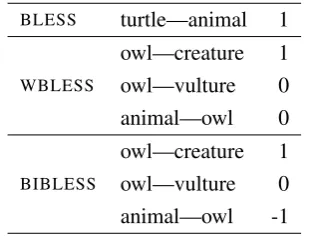
We use two standard evaluations for lexical entail-ment: hypernym directionality, where the task is to predict which of two words is the hypernym; and hypernym detection, where the task is to predict whether two words are in a hypernym-hyponym relation (Weeds et al., 2014; Santus et al., 2014). We also introduce a third, more challenging, eval-uation that combines detection and directionality.
For the directionality experiment, we evaluate on the hypernym subset of the well-knownBLESS dataset (Baroni and Lenci, 2011), which consists of1337hyponym-hypernym pairs. In this case, it is known that the words are in an entailment re-lation and the task is to predict the directionality of the relation. BLESS data is always presented with the hyponym first, so we report how often our measures predict that the second term in the pair is more general than the first.
For the detection experiment, we evaluate on the BLESS-based dataset of Weeds et al. (2014), which consists of 1168 word pairs and which we call WBLESS. In this dataset, the positive examples are hyponym-hypernym pairs. The negative examples
BLESS turtle—animal 1
WBLESS
owl—creature 1 owl—vulture 0 animal—owl 0
BIBLESS
owl—creature 1 owl—vulture 0 animal—owl -1
Table 1: Examples for evaluation datasets.
include pairs in the reversed hypernym-hyponym order, as well as holonym-meronym pairs, co-hyponyms, and randomly matched nouns. Ac-curacy on WBLESS reflects the ability to distin-guish hypernymy from other relations, but does not require detection of directionality, since re-versed pairs are grouped with the other negatives.
For the combined experiment, we assign re-versed hyponym-hypernym pairs a value of -1 in-stead of 0. We call this more challenging dataset BIBLESS. Examples of pairs in the respective datasets can be found in Table 1.
3.1 Image representations
Following previous work in multi-modal seman-tics (Bergsma and Goebel, 2011; Kiela et al., 2014), we obtain images from Google Images1 for the words in the evaluation datasets. It has been shown that images from Google yield higher-quality representations than comparable resources such as Flickr and are competitive with “hand pre-pared datasets” (Bergsma and Goebel, 2011; Fer-gus et al., 2005).
1www.google.com/imghp. Images were retrieved on
[image:2.595.339.495.276.394.2]For each image, we extract the pre-softmax layer from a forward pass in a convolutional neural network (CNN) that has been trained on the Im-ageNet classification task using Caffe (Jia et al., 2014). As such, this work is an instance of deep transfer learning; that is, a deep learning represen-tation trained on one task (image classification) is used to make predictions on a different task (age generality). We chose to use CNN-derived im-age representations because they have been found to be of higher quality than the traditional bag of visual words models (Sivic and Zisserman, 2003) that have previously been used in multi-modal dis-tributional semantics (Bruni et al., 2014; Kiela and Bottou, 2014).
3.2 Generality measures
We propose three measures that can be used to cal-culate the generality of a set of images. The image dispersiondof a concept wordwis defined as the average pairwise cosine distance between all im-age representations {w~1 ... ~wn} of the set of
im-ages returned forw:
d(w) = n(n2−1) X
i<j≤n
1−cos(w~i, ~wj) (1)
This measure was originally introduced to account for the fact that perceptual information is more rel-evant for e.g. elephantthan it is forhappiness. It acts as a substitute for the concreteness of a word and can be used to regulate how much perceptual information should be included in a multi-modal model (Kiela et al., 2014).
Our second measure follows Deselaers and Fer-rari (2011), who take a similar approach but in-stead of calculating the pairwise distance calculate the distance to thecentroid~µof{w~1... ~wn}:
c(w) = n1 X 1≤i≤n
1−cos(w~i, ~µ) (2)
For our third measure we follow Lazaridou et al. (2015), who try different ways of modulating the inclusion of perceptual input in their multi-modal skip-gram model, and find that theentropyof the centroid vector~µworks well (wherep(µj) = ||µ~µj||
andmis the vector length):
H(w) =−Xm j=1
p(µj) log2(p(µj)) (3)
3.3 Hypernym Detection and Directionality We calculate the directionality of a hyponym-hypernym pair with a measuref using the follow-ing formula for a word pair(p, q). Since even co-hyponyms will not have identical values forf, we introduce a thresholdαwhich sets a minimum dif-ference in generality for hypernym identification:
s(p, q) = 1−f(fp) +(q) α (4)
In other words,s(p, q) > 0ifff(q) > f(p) +α, i.e. if the second word (q) is (sufficiently) more general. To avoid false positives where one word is more general but the pair is not semantically related, we introduce a second thresholdθwhich setsf to zero if the two concepts have low cosine similarity. This leads to the following formula:
sθ(p, q) = (
1−f(fp()+q)α if cos(µ~p, ~µq)≥θ
0 otherwise
(5) We experimented with different methods for ob-taining the mean vector representations for co-sine (hereafter µc) in Equation (5), and found
that multi-modal representations worked best. We concatenate an L2-normalized linguistic vector with the L2-normalized centroid of image vectors to obtain a multi-modal representation, following Kiela and Bottou (2014). For a wordp with im-age representations {pimg1 ... pimgn }, we thus set µc = pling || n1 Pni pimgi , after normalizing both
representations. For comparison, we also report results for a visual-onlyµc.
For BLESS, we know the words in a pair stand in an entailment relation, so we set α = θ = 0 and evaluate whether s(p, q) > 0, indicating thatq is a hypernym of p. For WBLESS, we set α = 0.02 andθ = 0.2without tuning, and eval-uate whethersθ(p, q) >0(hypernym relation) or sθ(p, q) ≤ 0 (no hypernym relation). For BIB
-LESS, we set α = 0.02 and θ = 0.25 with-out tuning, and evaluate whether sθ(p, q) > 0
(hyponym-hypernym), s(p, q) = 0(no relation), ors(p, q)≤0(hypernym-hyponym).
4 Results
BLESS WBLESS BIBLESS
Frequency 0.58 0.57 0.39
WeedsPrec 0.63 — —
WeedsSVM — 0.75 —
WeedsUnSup — 0.58 —
SLQS 0.87 — —
[image:4.595.80.280.62.176.2]Dispersion 0.88 0.75 (0.74) 0.57 (0.55) Centroid 0.87 0.74 (0.74) 0.57 (0.54) Entropy 0.83 0.71 (0.71) 0.56 (0.53) Table 2: Accuracy. ForWBLESSandBIBLESSwe report results for multi-modalµc, with visual-only µcin brackets.
challenging baseline for hypernym directionality (Herbelot and Ganesalingam, 2013; Weeds et al., 2014). In addition, we compare to the reported re-sults of Santus et al. (2014) for WeedsPrec (Weeds et al., 2004), an early lexical entailment mea-sure, and SLQS, the entropy-based method of Santus et al. (2014). Note, however, that these are on a subsampled corpus of 1277 word pairs from BLESS, so the results are indicative but not directly comparable. On WBLESS we compare to the reported results of Weeds et al. (2014): we include results for the highest-performing su-pervised method (WeedsSVM) and the highest-performing unsupervised method (WeedsUnSup). For BLESS, both dispersion and centroid dis-tance reach or outperform the best other measure (SLQS). They beat the frequency baseline by a large margin (+30% and +29%). Taking the en-tropy of the mean image representations does not appear to do as well as the other two methods but still outperforms the baseline and WeedsPrec (+25% and +20% respectively).
In the case of WBLESS and BIBLESS, we see a similar pattern in that dispersion and cen-troid distance perform best. For WBLESS, these methods outperform the other unsupervised ap-proach, WeedsUnsup, by +17% and match the best-performing support vector machine (SVM) approach in Weeds et al. (2014). In fact, Weeds et al. (2014) report results for a total of6supervised methods (based on SVM and k-nearest neighbor (k-NN) classifiers): our unsupervised image dis-persion method outperforms all of these except for the highest-performing one, reported here.
We can see that the task becomes increasingly difficult as we go from directionality to detection to the combination: the dispersion-based method goes from0.88to0.75to0.57, for example. BIB -LESS is the most difficult, as shown by the
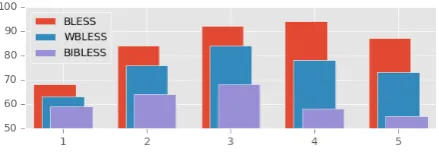
fre-Figure 2: Accuracy by WordNet shortest path bucket (1 is shortest, 5 is longest).
quency baseline obtaining only0.39. Our methods do much better than this baseline (+18%). Image dispersion appears to be the most robust measure. To examine our results further, we divided the test data into buckets by the shortest WordNet path connecting word pairs (Miller, 1995). We expect our method to be less accurate on word pairs with short paths, since the difference in generality may be difficult to discern. It has also been suggested that very abstract hypernyms such as object and entityare difficult to detect because their linguistic distributions are not supersets of their hyponyms’ distributions (Rimell, 2014), a factor that should not affect the visual modality. We find that con-cept comparisons with a very short path (bucket 1) are indeed the least accurate. We also find some drop in accuracy on the longest paths (bucket 5), especially forWBLESSandBIBLESS, perhaps be-cause semantic similarity is difficult to detect in these cases. For a histogram of the accuracy scores according to WordNet similarity, see Figure 2.
5 Conclusions
We have evaluated three unsupervised methods for determining the generality of a concept based on its visual properties. Our best-performing method, image dispersion, reaches the state-of-the-art on two standard semantic evaluation datasets. We introduced a novel, more difficult task combin-ing hypernym detection and directionality, and showed that our methods outperform a frequency baseline by a large margin.
We believe that image generality may be par-ticularly suited to entailment detection because it does not suffer from the same issues as linguis-tic distributional generality. Herbelot and Gane-salingam (2013) found that general terms like liq-uid do not always have higher entropy distribu-tions than their hyponyms, since speakers use them in very specific contexts, e.g. liquidis often coordinated withgas.
[image:4.595.312.532.66.142.2]to some degree on Google’s search result diversifi-cation, but do not feel this detracts from the utility of the method, since the fact that general concepts achieve greater maximum image dispersion than specific concepts is not dependent on any partic-ular diversification algorithm. In future work, we plan to explore more sophisticated visual gener-ality measures, other semantic relations and dif-ferent ways of fusing visual representations with linguistic knowledge.
Acknowledgments
DK and LR are supported by EPSRC grant EP/I037512/1. IV is supported by the PARIS project (IWT-SBO 110067) and the PDM Kort postdoctoral fellowship from KU Leuven. SC is supported by ERC Starting Grant DisCoTex (306920) and EPSRC grant EP/I037512/1. We thank the anonymous reviewers for their helpful comments.
References
Marco Baroni and Alessandro Lenci. 2011. How we BLESSed distributional semantic evaluation. In
Proceedings of the GEMS 2011 Workshop, pages 1– 10.
Shane Bergsma and Randy Goebel. 2011. Using vi-sual information to predict lexical preference. In
Proceedings of RANLP, pages 399–405.
Or Biran and Kathleen McKeown. 2013. Classifying taxonomic relations between pairs of wikipedia
arti-cles. InProceedings of IJCNLP, pages 788–794.
Johan Bos and Katja Markert. 2005. Recognising tex-tual entailment with logical inference. In Proceed-ings of EMNLP, pages 628–635.
Elia Bruni, Nam-Khanh Tran, and Marco Baroni.
2014. Multimodal distributional semantics. Journal
of Artificial Intelligence Research, 49:1–47. Daoud Clarke. 2009. Context-theoretic semantics for
natural language: An overview. In Proceedings of
the GEMS 2009 Workshop, pages 112–119.
Jia Deng, Wei Dong, Richard Socher, Li-Jia Li, Kai Li, and Fei-Fei Li. 2009. ImageNet: A large-scale
hier-archical image database. InProceedings of CVPR,
pages 248–255.
Thomas Deselaers and Vittorio Ferrari. 2011. Visual and semantic similarity in imagenet. InProceedings of CVPR, pages 1777–1784.
Robert Fergus, Li Fei-Fei, Pietro Perona, and Andrew Zisserman. 2005. Learning object categories from
Google’s image search. In Proceedings of ICCV,
pages 1816–1823.
Dan Garrette, Katrin Erk, and Raymond Mooney. 2011. Integrating logical representations with
prob-abilistic information using Markov logic. In
Pro-ceedings of IWCS, pages 105–114.
M. Geffet and I. Dagan. 2005. The distributional
in-clusion hypotheses and lexical entailment. In
Pro-ceedings of ACL, pages 107–114.
Aur´elie Herbelot and Mohan Ganesalingam. 2013. Measuring semantic content in distributional vec-tors. InProceedings of ACL, pages 440–445.
Yangqing Jia, Evan Shelhamer, Jeff Donahue, Sergey Karayev, Jonathan Long, Ross Girshick, Sergio Guadarrama, and Trevor Darrell. 2014. Caffe: Con-volutional architecture for fast feature embedding.
arXiv preprint arXiv:1408.5093.
Hongyan Jing. 1998. Usage of wordnet in natural
language generation. In Proceedings of
COLING-ACL’98 Workshop on Usage of WordNet in Natural Language Processing Systems.
Douwe Kiela and L´eon Bottou. 2014. Learning image embeddings using convolutional neural networks for
improved multi-modal semantics. InProceedings of
EMNLP, pages 36–45.
Douwe Kiela, Felix Hill, Anna Korhonen, and Stephen Clark. 2014. Improving multi-modal representa-tions using image dispersion: Why less is sometimes
more. InProceedings of ACL, pages 835–841.
Lili Kotlerman, Ido Dagan, Idan Szpektor, and Maayan Zhitomirsky-Geffet. 2010. Directional distribu-tional similarity for lexical inference. Natural Lan-guage Engineering, 16(4):359–389.
Angeliki Lazaridou, Nghia The Pham, and Marco Ba-roni. 2015. Combining language and vision with
a multimodal skip-gram model. In Proceedings of
NAACL-HLT.
Alessandro Lenci and Giulia Benotto. 2012. Identify-ing hypernyms in distributional semantic spaces. In
Proceedings of *SEM, pages 75–79.
Omer Levy, Steffen Remus, Chris Biemann, and Ido Dagan. 2015. Do supervised distributional methods really learn lexical inference relations? In Proceed-ings of NAACL.
J.H. Martin. 1990. A Computational Model of
Metaphor Interpretation. Academic Press Profes-sional, Inc.
George A. Miller. 1995. WordNet: A lexical database
for English. InCommunications of the ACM,
Michael Mohler, David Bracewell, Marc Tomlinson, and David Hinote. 2013. Semantic signatures for example-based linguistic metaphor detection. In
Proceedings of the 1st Workshop on Metaphor in NLP.
Laura Rimell. 2014. Distributional lexical entailment
by topic coherence. InProceedings of EACL, pages
511–519.
Enrico Santus, Alessandro Lenci, Qin Lu, and Sabine Schulte im Walde. 2014. Chasing
hyper-nyms in vector spaces with entropy. InProceedings
of EACL, pages 38–42.
Saeedeh Shekarpour, Konrad H¨offner, Jens Lehmann, and S¨oren Auer. 2013. Keyword query expansion on linked data using linguistic and semantic features. In Proceedings of the 7th IEEE International Con-ference on Semantic Computing, pages 191–197. Carina Silberer and Mirella Lapata. 2014.
Learn-ing grounded meanLearn-ing representations with
autoen-coders. InProceedings of ACL, pages 721–732.
Josef Sivic and Andrew Zisserman. 2003. Video Google: A text retrieval approach to object match-ing in videos. InProceedings of ICCV, pages 1470– 1477.
Peter D. Turney, Yair Neuman, Dan Assaf, and Yohai Cohen. 2011. Literal and metaphorical sense iden-tification through concrete and abstract context. In
Proceedings of EMNLP, pages 680–690.
Julie Weeds, David Weir, and Diana McCarthy. 2004. Characterising measures of lexical distributional similarity. InProceedings of COLING.
Julie Weeds, Daoud Clarke, Jeremy Reffin, David Weir, and Bill Keller. 2014. Learning to distinguish
hy-pernyms and co-hyponyms. InProceedings of
COL-ING, pages 2249–2259.
W. A. Woods, Stephen Green, Paul Martin, and Ann Houston. 2001. Aggressive morphology and lexi-cal relations for query expansion. InProceedings of TREC.