Proceedings of the 55th Annual Meeting of the Association for Computational Linguistics, pages 11–22 Vancouver, Canada, July 30 - August 4, 2017. c2017 Association for Computational Linguistics Proceedings of the 55th Annual Meeting of the Association for Computational Linguistics, pages 11–22
Vancouver, Canada, July 30 - August 4, 2017. c2017 Association for Computational Linguistics
Neural End-to-End Learning for Computational Argumentation Mining
Steffen Eger†‡, Johannes Daxenberger†, Iryna Gurevych†‡
†Ubiquitous Knowledge Processing Lab (UKP-TUDA)
Department of Computer Science, Technische Universitt Darmstadt
‡Ubiquitous Knowledge Processing Lab (UKP-DIPF)
German Institute for Educational Research and Educational Information
http://www.ukp.tu-darmstadt.de
Abstract
We investigate neural techniques for end-to-end computational argumentation min-ing (AM). We frame AM both as a based dependency parsing and as a token-based sequence tagging problem, includ-ing a multi-task learninclud-ing setup. Contrary to models that operate on the argument component level, we find that framing AM as dependency parsing leads to subpar per-formance results. In contrast, less com-plex (local) tagging models based on BiL-STMs perform robustly across classifica-tion scenarios, being able to catch long-range dependencies inherent to the AM problem. Moreover, we find that jointly learning ‘natural’ subtasks, in a multi-task learning setup, improves performance.
1 Introduction
Computational argumentation mining (AM) deals with finding argumentation structures in text. This involves several subtasks, such as: (a) separating argumentative units from non-argumentative units, also called ‘component segmentation’; (b) classi-fying argument components into classes such as “Premise” or “Claim”; (c) finding relations be-tween argument components; (d) classifying rela-tions into classes such as “Support” or “Attack” (Persing and Ng,2016;Stab and Gurevych,2017). Thus, AM would have to detect claims and premises (reasons) in texts such as the following, where premise P supports claim C:
Since it killed many marine livesP ,
:::::::
tourism:::has::::::::::threatened::::::natureC.
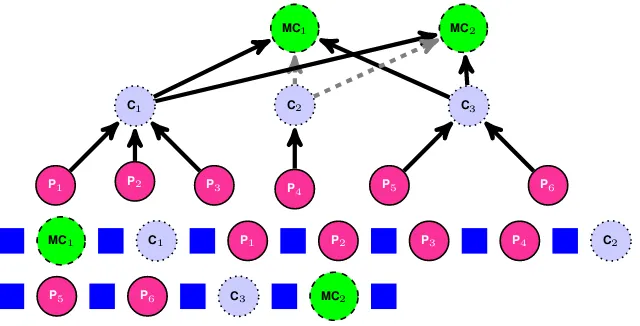
Argument structures in real texts are typically much more complex, cf. Figure1.
While different research has addressed different subsets of the AM problem (see below), the ul-timate goal is to solve all of them, starting from unannotated plain text. Two recent approaches to this end-to-end learning scenario arePersing and Ng (2016) andStab and Gurevych (2017). Both solve the end-to-end task by first training indepen-dent models for each subtask and then defining an integer linear programming (ILP) model that en-codes global constraints such as that each premise has a parent, etc. Besides their pipeline architec-ture the approaches also have in common that they heavily rely on hand-crafted features.
Hand-crafted features pose a problem because AM is to some degree an “arbitrary” problem in that the notion of “argument” critically relies on the underlying argumentation theory (Reed et al.,
2008; Biran and Rambow, 2011; Habernal and Gurevych,2015;Stab and Gurevych,2017). Ac-cordingly, datasets typically differ with respect to their annotation of (often rather complex) argu-ment structure. Thus, feature sets would have to be manually adapted to and designed for each new sample of data, a challenging task. The same cri-tique applies to the designing of ILP constraints. Moreover, from a machine learning perspective, pipeline approaches are problematic because they solve subtasks independently and thus lead to er-ror propagation rather than exploiting interrela-tionships between variables. In contrast to this, we investigateneuraltechniques for end-to-end learn-ing in computational AM, which do not require the hand-crafting of features or constraints. The models we survey also all capture some notion of “joint”—rather than “pipeline”—learning. We in-vestigate several approaches.
First, we frame the end-to-end AM problem as a dependency parsing problem. Dependency parsing may be considered a natural choice for AM, because argument structures often form trees,
or closely resemble them (see §3). Hence, it is not surprising that ‘discourse parsing’ (Muller et al., 2012) has been suggested for AM ( Peld-szus and Stede, 2015). What distinguishes our approach from these previous ones is that we op-erate on the token level, rather than on the level of components, because we address the end-to-end framework and, thus, do not assume that non-argumentative units have already been sorted out and/or that the boundaries of argumentative units are given.
Second, we frame the problem as a sequence tagging problem. This is a natural choice espe-cially for component identification (segmentation and classification), which is a typical entity recog-nition problem for which BIO tagging is a stan-dard approach, pursued in AM, e.g., by Haber-nal and Gurevych (2016). The challenge in the end-to-end setting is to also include relations into the tagging scheme, which we realize by coding the distances between linked components into the tag label. Since related entities in AM are often-times several dozens of tokens apart from each other, neural sequence tagging models are in prin-ciple ideal candidates for such a framing because they can take into accountlong-range dependen-cies—something that is inherently difficult to cap-ture with traditional feacap-ture-based tagging models such as conditional random fields (CRFs).
Third, we frame AM as a multi-task (tagging) problem (Caruana, 1997; Collobert and Weston,
2008). We experiment with subtasks of AM—e.g., component identification—as auxiliary tasks and investigate whether this improves performance on the AM problem. Adding such subtasks can be seen as analogous to de-coupling, e.g., component identification from the full AM problem.
Fourth, we evaluate the model of Miwa and Bansal (2016) that combines sequential (entity) and tree structure (relation) information and is in principle applicable to any problem where the aim is to extract entities and their relations. As such, this model makes fewer assumptions than our de-pendency parsing and tagging approaches.
The contributions of this paper are as follows. (1) We present the first neural end-to-end solu-tions to computational AM. (2) We show that sev-eral of them perform better than the state-of-the-art joint ILP model. (3) We show that a framing of AM as a token-based dependency parsing prob-lem is ineffective—in contrast to what has been
proposed for systems that operate on the coarser component level and that (4) a standard neural se-quence tagging model that encodes distance in-formation between components performs robustly in different environments. Finally, (5) we show that a multi-task learning setup where natural sub-tasks of the full AM problem are added as auxil-iary tasks improves performance.1
2 Related Work
AM has applications in legal decision making (Palau and Moens,2009;Moens et al.,2007), doc-ument summarization, and the analysis of scien-tific papers (Kirschner et al.,2015). Its importance for the educational domain has been highlighted by recent work on writing assistance (Zhang and Litman,2016) and essay scoring (Persing and Ng,
2015;Somasundaran et al.,2016).
Most works on AM address subtasks of AM such as locating/classifying components (Florou et al., 2013; Moens et al., 2007; Rooney et al.,
2012;Knight et al.,2003;Levy et al.,2014;Rinott et al.,2015). Relatively few works address the full AM problem of componentand relation identifi-cation. Peldszus and Stede (2016) present a cor-pus of microtexts containing only argumentatively relevant text of controlled complexity. To our best knowledge,Stab and Gurevych(2017) created the only corpus of attested high quality which anno-tates the AM problem in its entire complexity: it contains token-level annotations of components, their types, as well as relations and their types.
3 Data
We use the dataset of persuasive essays (PE) from
Stab and Gurevych(2017), which contains student essays written in response to controversial top-ics such as “competition or cooperation—which is better?”
Train Test
Essays 322 80
Paragraphs 1786 449 Tokens 118648 29538
Table 1: Corpus statistics
As Table1details, the corpus consists of 402 es-says, 80 of which are reserved for testing. The
MC1 MC2
C1 C2 C3
P1 P2 P3 P4 P5 P6
MC1 C1 P1 P2 P3 P4 C2
P5 P6 C3 MC2
Figure 1: Bottom: Linear argumentation structure in a student essay. The essay is comprised of non-argumentative units (square) and non-argumentative units of different types: Premises (P), claims (C) and major claims (MC). Top: Relationsships between argumentative units. Solid arrows are support (for), dashed arrows are attack (against).
notation distinguishes betweenmajor claims(the central position of an author with respect to the es-say’s topic),claims(controversial statements that are either for or against the major claims), and
premises, which give reasons for claims or other premises and eithersupportorattackthem. Over-all, there are 751 major claims, 1506 claims, and 3832 premises. There are 5338 relations, most of which are supporting relations (>90%).
The corpus has a special structure, illustrated in Figure 1. First, major claims relate to no other components. Second, claims always relate to all other major claims.2 Third, each premise relates to exactly one claim or premise. Thus, the argument structure in each essay is—almost—a tree. Since there may be several major claims, each claim po-tentially connects to multiple targets, violating the tree structure. This poses no problem, however, since we can “loss-lessly” re-link the claims to one of the major claims (e.g., the last major claim in a document) and create a special root node to which the major claims link. From this tree, the actual graph can be uniquely reconstructed.
There is another peculiarity of this data. Each essay is divided into paragraphs, of which there are 2235 in total. The argumentation structure is completely contained within a paragraph, except, possibly, for the relation from claims to major claims. Paragraphs have an average length of 66 tokens and are therefore much shorter than essays, which have an average length of 368 tokens. Thus, prediction on the paragraph level is easier than
2All MCs are considered as equivalent in meaning.
prediction on the essay level, because there are fewer components in a paragraph and hence fewer possibilities of source and target components in argument relations. The same is true for compo-nent classification: a paragraph can never contain premises only, for example, since premises link to other components.
4 Models
This section describes our neural network fram-ings for end-to-end AM.
Sequence Tagging is the problem of
assign-ing each element in a stream of input tokens a label. In a neural context, the natural choice for tagging problems are recurrent neural nets (RNNs) in which a hidden vector representation ht at time point t depends on the previous hid-den vector representation ht−1 and the input xt. In this way, an infinite window (“long-range de-pendencies”) around the current input token xt can be taken into account when making an out-put prediction yt. We choose particular RNNs, namely, LSTMs (Hochreiter and Schmidhuber,
1997), which are popular for being able to address vanishing/exploding gradients problems. In addi-tion to considering a left-to-right flow of informa-tion, bidirectional LSTMs (BL) also capture infor-mation to the right of the current input token.
[image:3.595.141.461.61.224.2]BiLSTM-CRF (BLC) (Huang et al.,2015). The model of
Ma and Hovy (2016) adds convolutional neural nets (CNNs) on the character-level to BiLSTM-CRFs, leading to BiLSTM-CRF-CNN (BLCC) models. The character-level CNN may address problems of out-of-vocabulary words, that is, words not seen during training.
AM as Sequence Tagging: We frame AM as
the following sequence tagging problem. Each in-put token has an associated label fromY, where
Y={(b, t, d, s)|b∈ {B,I,O}, t∈ {P,C,MC,⊥},
d∈ {. . . ,−2,−1,1,2, . . . ,⊥},
s∈ {Supp,Att,For,Ag,⊥}}.
(1)
In other words, Y consists of all four-tuples (b, t, d, s) where b is a BIO encoding indicating
whether the current token is non-argumentative (O) or begins (B) or continues (I) a component;
t indicates the type of the component (claim C,
premise P, or major claim MC for our data). More-over, dencodes the distance—measured in
num-ber of components—between the current compo-nent and the compocompo-nent it relates to. We encode the samedvalue for each token in a given
compo-nent. Finally,sis the relation type (“stance”)
be-tween two components and its value may be Sup-port (Supp), Attack (Att), or For or Against (Ag). We also have a special symbol ⊥ that indicates when a particular slot is not filled: e.g., a non-argumentative unit (b = O) has neither
compo-nent type, nor relation, nor relation type. We refer to this framing asSTagT (for “SimpleTagging”), whereT refers to the tagger used. For the example
from§1, our coding would hence be:
Since it killed many
(O,⊥,⊥,⊥) (B,P,1,Supp) (I,P,1,Supp) (I,P,1,Supp)
marine lives , tourism
(I,P,1,Supp) (I,P,1,Supp) (O,⊥,⊥,⊥) (B,C,⊥,For)
has threatened nature .
(I,C,⊥,For) (I,C,⊥,For) (I,C,⊥,For) (O,⊥,⊥,⊥)
While the size of the label setY is potentially
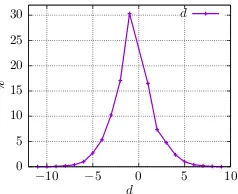
infinite, we would expect it to be finite even in a potentially infinitely large data set, because hu-mans also have only finite memory and are there-fore expected to keep related components close in textual space. Indeed, as Figure 2 shows, in our PE essay data set about 30% of all relations be-tween components have distance−1, that is, they
follow the claim or premise that they attach to. Overall, around 2/3 of all relation distancesdlie
in {−2,−1,1}. However, the figure also illus-trates that there are indeed long-range dependen-cies: distance values between −11 and +10 are
observed in the data.
0 5 10 15 20 25 30
−10 −5 0 5 10
%
d d
Figure 2: Distribution of distances d between
components in PE dataset.
Multi-Task Learning Recently, there has been a lot of interest in so-called multi-task learning (MTL) scenarios, where several tasks are learned jointly (Søgaard and Goldberg, 2016; Peng and Dredze,2016;Yang et al.,2016;Rusu et al.,2016;
H´ector and Plank,2017). It has been argued that such learning scenarios are closer to human learn-ing because humans often transfer knowledge be-tween several domains/tasks. In a neural context, MTL is typically implemented via weight sharing: several tasks are trained in the same network ar-chitecture, thereby sharing a substantial portion of network’s parameters. This forces the network to learngeneralizedrepresentations.
In the MTL framework of Søgaard and Gold-berg (2016) the underlying model is a BiLSTM with several hidden layers. Then, given differ-ent tasks, each task k ‘feeds’ from one of the
hidden layers in the network. In particular, the hidden states encoded in a specific layer are fed into a multiclass classifierfk. The same work has demonstrated that this MTL protocol may be suc-cessful when there is a hierarchy between tasks and ‘lower’ tasks feed from lower layers.
AM as MTL: We use the same framework
STagT for modeling AM as MTL. However, we in addition train auxiliary tasks in the network— each with a distinct label setY0.
[image:4.595.356.475.131.228.2]etc. The system starts with an initial configuration in which sentence elements are on abuffer and a stack, and a classifier successively decides which action to take next, leading to different configura-tions. The system terminates after a finite number of actions, and the parse tree is read off the ter-minal configuration. Graph-basedparsers solve a structured prediction problem in which the goal is learning a scoring function over dependency trees such that correct trees are scored above all others. Traditional dependency parsers used hand-crafted feature functions that look at “core” ele-ments such as “word on top of the stack”, “POS of word on top of the stack”, and conjunctions of core features such as “word is X and POS is Y” (seeMcDonald et al.(2005)). Most neural parsers have not entirely abandoned feature engineering. Instead, they rely, for example, on encoding the core features of parsers as low-dimensional em-bedding vectors (Chen and Manning,2014) but ig-nore feature combinations.Kiperwasser and Gold-berg(2016) design a neural parser that uses only four features: the BiLSTM vector representations of the top 3 items on the stack and the first item on the buffer. In contrast,Dyer et al.(2015)’s neural parser associates each stack with a “stack LSTM” that encodes their contents. Actions are chosen based on the stack LSTM representations of the stacks, and no more feature engineering is neces-sary. Moreover, their parser has thus access to any part of the input, its history and stack contents.
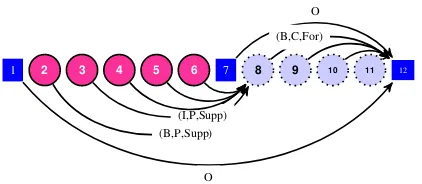
AM as Dependency Parsing: To frame a prob-lem as a dependency parsing probprob-lem, each in-stance of the problem must be encoded as a di-rected tree, where tokens have heads, which in turn are labeled. For end-to-end AM, we propose the framing illustrated in Figure3. We highlight two design decisions, the remaining are analogous and/or can be read off the figure.
• The head of each non-argumentative text to-ken is the document terminating toto-kenEND, which is a punctuation mark in all our cases. The label of this link is O, the symbol for non-argumentative units.
• The head of each token in a premise is the
first token of the claim or premise that it links to. The label of each of these links is (b,P,Supp) or (b,P,Att) depending on
whether a premise “supports” or “attacks” a claim or premise;b∈ {B,I}.
1 2 3 4 5 6 7 8 9 10 11 12
O (B,P,Supp) (I,P,Supp)
O
[image:5.595.312.523.63.155.2](B,C,For)
Figure 3: Dependency representation of sample sentence from§1. Links and selected labels.
LSTM-ER Miwa and Bansal (2016) present a
neural end-to-end system for identifying both enti-ties as well as relations between them. Their entity detection system is a BLC-type tagger and their re-lation detection system is a neural net that predicts a relation for each pair of detected entities. This relation module is a TreeLSTM model that makes use of dependency tree information. In addition to de-coupling entity and relation detection but jointly modeling them,3pretraining on entities and scheduled sampling (Bengio et al., 2015) is ap-plied to prevent low performance at early training stages of entity detection and relation classifica-tion. To adapt LSTM-ER for the argument struc-ture encoded in the PE dataset, we model three types of entities (premise, claim, major claim) and four types of relations (for, against, support, at-tack).
We use the feature-based ILP model from
Stab and Gurevych (2017) as a comparison system. This system solves the subtasks of AM—component segmentation, component clas-sification, relation detection and classification— independently. Afterwards, it defines an ILP model with various constraints to enforce valid ar-gumentation structure. As features it uses struc-tural, lexical, syntactic and context features, cf.
Stab and Gurevych (2017) and Persing and Ng
(2016).
Summarizing, we distinguish our framings in terms of modularity and in terms of their con-straints. Modularity: Our dependency parsing framing and LSTM-ER are more modular than
STagT because they de-couple relation informa-tion from entity informainforma-tion. However, (part of)
this modularity can be regained by usingSTagT in an MTL setting. Moreover, since entity and re-lation information are considerably different, such a de-coupling may be advantageous. Constraints: LSTM-ER can, in principle, model any kind of— even many-to-many—relationships between de-tected entities. Thus, it is not guaranteed to pro-duce trees, as we observe in AM datasets.STagT also does not need to produce trees, but it more severely restricts search space than does LSTM-ER: each token/component can only relate to one (and not several) other tokens/components. The same constraint is enforced by the dependency parsing framing. All of the tagging modelings, in-cluding LSTM-ER, arelocalmodels whereas our parsing framing is aglobalmodel: it globally en-forces a tree structure on the token-level.
Further remarks: (1) part of the TreeLSTM modeling inherent to LSTM-ER is ineffective for our data because this modeling exploits de-pendency tree structures on the sentence level, while relationships between components are al-most never on the sentence level. In our data, roughly 92% of all relationships are between com-ponents that appear in different sentences. Sec-ondly, (2) that a modelenforcesa constraint does not necessarily mean that it is more suitable for a respective task. It has frequently been observed that models tend to produce output consistent with constraints in their training data in such situations (Zhang et al.,2017;H´ector and Plank,2017); thus, they havelearnedthe constraints.
5 Experiments
This section presents and discusses the empirical results for the AM framings outlined in §4. We
relegate issues of pre-trained word embeddings, hyperparameter optimization and further practi-cal issues to the supplementary material. Links to software used as well as some additional error analysis can also be found there.
Evaluation Metric We adopt the evaluation
metric suggested inPersing and Ng(2016). This computes true positives TP, false positives FP, and false negatives FN, and from these calculates com-ponent and relationF1scores asF1 = 2TP+FP+FN2TP . For space reasons, we refer to Persing and Ng
(2016) for specifics, but to illustrate, for compo-nents, true positives are defined as the set of com-ponents in the gold standard for which there ex-ists a predicted component with the same type that
‘matches’. Persing and Ng(2016) define a notion of what we may term ‘levelα matching’: for
ex-ample, at the 100% level (exact match) predicted and gold components must have exactly the same spans, whereas at the 50% level they must only share at least 50% of their tokens (approximate match). We refer to these scores as C-F1 (100%) and C-F1 (50%), respectively. For relations, an analogous F1 score is determined, which we de-note by R-F1 (100%) and R-F1 (50%). We de-note that R-F1 scores depend on C-F1 scores because correct relations must have correct arguments. We also define a ‘global’ F1 score, which is the F1-score of C-F1 and R-F1.
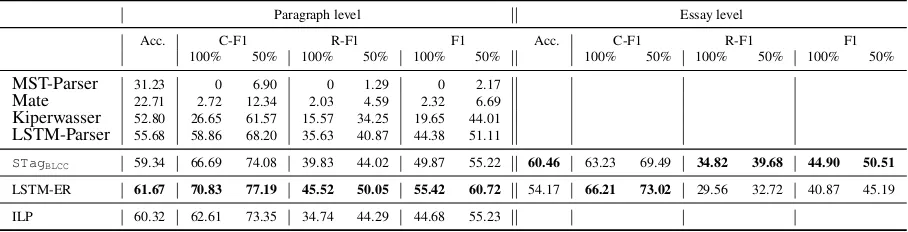
Most of our results are shown in Table2.
(a) Dependency Parsing We show results for
the two feature-based parsers MST (McDonald et al., 2005), Mate (Bohnet and Nivre, 2012) as well as the neural parsers by Dyer et al. (2015) (LSTM-Parser) and Kiperwasser and Goldberg
(2016) (Kiperwasser). We train and test all parsers on the paragraph level, because training them on essay level was typically too memory-exhaustive.
MST mostly labels only non-argumentative units correctly, except for recognizing individ-ual major claims, but never finds their exact spans (e.g.,“tourism can create negative impacts on” while the gold major claim is“international tourism can create negative impacts on the des-tination countries”). Mate is slightly better and in particular recognizes several major claims cor-rectly. Kiperwasser performs decently on the ap-proximate match level, but not on exact level. Upon inspection, we find that the parser often pre-dicts ‘too large’ component spans, e.g., by includ-ing followinclud-ing punctuation. The best parser by far is the LSTM-Parser. It is over 100% better than Kiperwasser on exact spans and still several per-centage points on approximate spans.
How does performance change when we switch to the essay level? For the LSTM-Parser, the best performance on essay level is 32.84%/47.44% C-F1 (100%/50% level), and 9.11%/14.45% on R-F1, but performance result varied drastically be-tween different parametrizations. Thus, the per-formance drop between paragraph and essay level is in any case immense.
mini-Paragraph level Essay level
Acc. C-F1 R-F1 F1 Acc. C-F1 R-F1 F1
100% 50% 100% 50% 100% 50% 100% 50% 100% 50% 100% 50% MST-Parser 31.23 0 6.90 0 1.29 0 2.17
Mate 22.71 2.72 12.34 2.03 4.59 2.32 6.69 Kiperwasser 52.80 26.65 61.57 15.57 34.25 19.65 44.01 LSTM-Parser 55.68 58.86 68.20 35.63 40.87 44.38 51.11
[image:7.595.72.526.63.179.2]STagBLCC 59.34 66.69 74.08 39.83 44.02 49.87 55.22 60.46 63.23 69.49 34.82 39.68 44.90 50.51 LSTM-ER 61.67 70.83 77.19 45.52 50.05 55.42 60.72 54.17 66.21 73.02 29.56 32.72 40.87 45.19 ILP 60.32 62.61 73.35 34.74 44.29 44.68 55.23
Table 2: Performance of dependency parsers,STagBLCC, LSTM-ER and ILP (from top to bottom). The
ILP model operates on both levels. Best scores in each column in bold (signific. atp <0.01; Two-sided
Wilcoxon signed rank test, pairing F1 scores for documents). We also report token level accuracy.
mal feature set employed by Kiperwasser is appar-ently not sufficient for accurate AM but still a lot more powerful than the hand-crafted feature ap-proaches. We hypothesize that the LSTM-Parser’s good performance, relative to the other parsers, is due to its encoding of the whole stack history— rather than just the top elements on the stack as in Kiperwasser— which makes it aware of much larger ‘contexts’. While the drop in performance from paragraph to essay level is expected, the LSTM-Parser’s deterioration is much more severe than the other models’ surveyed below. We believe that this is due to a mixture of the following: (1) ‘capacity’, i.e., model complexity, of the parsers— that is, risk of overfitting; and (2) few, but very long sequences on essay level—that is, little train-ing data (trees), paired with a huge search space on each train/test instance, namely, the number of possible trees on ntokens. See also our
discus-sions below, particularly, our stability analysis.
(b) Sequence Tagging For these experiments, we use the BLCC tagger from Ma and Hovy
(2016) and refer to the resulting system as
STagBLCC. Again, we observe that paragraph
level is considerably easier than essay level; e.g., for relations, there is ∼5% points increase from essay to paragraph level. Overall, STagBLCC is ∼13% better than the best parser for C-F1 and ∼11% better for R-F1 on the paragraph level. Our explanation is that taggers are simpler local mod-els, and thus need less training data and are less prone to overfitting. Moreover, they can much bet-ter deal with the long sequences because they are largely invariant to length: e.g., it does in princi-ple not matter, from a parameter estimation per-spective, whether we train our taggers on two se-quences of lengths n and m, respectively, or on
one long sequence of lengthn+m.
(c) MTL As indicated, we use the MTL tagging framework fromSøgaard and Goldberg(2016) for multi-task experiments. The underlying tagging framework is weaker than that of BLCC: there is no CNN which can take subword information into account and there are no dependencies between output labels: each tagging prediction is made in-dependently of the other predictions. We refer to this system asSTagBL.
Accordingly, as Table 3 shows for the essay level (paragraph level omitted for space reasons), results are generally weaker: For exact match, C-F1 values are about ∼10% points below those of STagBLCC, while approximate match
perfor-mances are much closer. Hence, the independence assumptions of the BL tagger apparently lead to more ‘local’ errors such as exact argument span identification (cf. error analysis). An analogous trend holds for argument relations.
Additional Tasks: We find that when we train
STagBL with only its main task—with label set Y as in Eq. (1)—the overall result is worst. In contrast, when we include the ‘natural subtasks’ “C” (label set YC consists of the projection on the coordinates (b, t) in Y) and/or “R” (label set
YR consists of the projection on the coordinates
(d, s)), performance increases typically by a few
the C task and the full task feed from the same layer in the deep BiLSTM. Moreover, we find that the C task is consistently more helpful as an aux-iliary task than the R task.
C-F1 R-F1 F1
100% 50% 100% 50% 100% 50%
Y-3 49.59 65.37 26.28 37.00 34.35 47.25
Y-3:YC-1 54.71 66.84 28.44 37.35 37.40 47.92
Y-3:YR-1 51.32 66.49 26.92 37.18 35.31 47.69
Y-3:YC-3 54.58 67.66 30.22 40.30 38.90 50.51
Y-3:YR-3 53.31 66.71 26.65 35.86 35.53 46.64
Y-3:YC-1:YR-2 52.95 67.84 27.90 39.71 36.54 50.09
Y-3:YC-3:YR-3 54.55 67.60 28.30 38.26 37.26 48.86
Table 3: Performance of MTL sequence tagging approaches, essay level. Tasks separated by “:”. Layers from which tasks feed are indicated by re-spective numbers.
On essay level, (d) LSTM-ER performs very well on component identification (+5% C-F1 com-pared to STagBLCC), but rather poor on relation
identification (-18% R-F1). Hence, its overall F1 on essay level is considerably below that of
STagBLCC. In contrast, LSTM-ER trained and
tested on paragraph level substantially outper-forms all other systems discussed, both for com-ponent as well as for relation identification.
We think that its generally excellent perfor-mance on components is due to LSTM-ER’s de-coupling of component and relation tasks. Our findings indicate that a similar result can be achieved for STagT via MTL when com-ponents and relations are included as auxiliary tasks, cf. Table 3. For example, the improve-ment of LSTM-ER over STagBLCC, for C-F1,
roughly matches the increase for STagBL when
including components and relations separately (Y-3:YC-3:YR-3) over not including them as aux-iliary tasks (Y-3). Lastly, the better performance of LSTM-ER over STagBLCC for relations on
paragraph level appears to be a consequence of its better performance on components. E.g., when both arguments are correctly predicted,STagBLCC
has even higher chance of getting their relation correct than LSTM-ER (95.34% vs. 94.17%).
Why does LSTM-ER degrade so much on essay level for R-F1? As said, text sequences are much longer on essay level than on paragraph level— hence, there are on average many more entities on essay level. Thus, there are also many more pos-sible relations between all entities discovered in a text—namely, there areO(2m2)possible relations
between m discovered components. Due to its
0 0.1 0.2 0.3 0.4 0.5 0.6 0.7 0.8
2 4 6 8 10
prob
.correct
|d| LSTM-ER
[image:8.595.355.473.65.162.2]STagBLCC
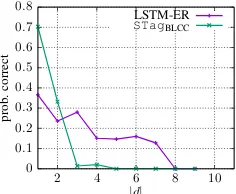
Figure 4: Probability of correct relation identifica-tion given true distance is|d|.
generality, LSTM-ER considers all these relations as plausible, while STagT does not (for any of choice ofT): e.g., our coding explicitly constrains each premise to link to exactlyoneother compo-nent, rather than to0, . . . , mpossible components,
as LSTM-ER allows. In addition, our explicit cod-ing of distance valuesdbiases the learnerT to
re-flect the distribution of distance values found in real essays—namely, that related components are typically close in terms of the number of com-ponents between them. In contrast, LSTM-ER only mildly prefers short-range dependencies over long-range dependencies, cf. Figure4.
The (e) ILP has access to both paragraph and essay level information and thus has always more information than all neural systems compared to. Thus, it also knows in which paragraph in an essay it is. This is useful particularly for major claims, which always occur in first or last paragraphs in our data. Still, its performance is equal to or lower than that of LSTM-ER andSTagBLCCwhen both
are evaluated on paragraph level.
Stability Analysis
Table4shows averages and standard deviations of two selected models, namely, the STagBLCC
in the training data, while the taggers are always roughly trained on 120K tokens. On paragraph level, they do observe more trees, namely, 1786.
STagBLCC LSTM-Parser
Essay 60.62±3.54 9.40±13.57 Paragraph 64.74±1.97 56.24±2.87
Table 4: C-F1 (100%) in % for the two indicated systems; essay vs. paragraph level. Note that the mean performances are lower than the majority performances over the runs given in Table2.
Error analysis
A systematic source of errors for all systems is de-tecting exact argument spans (segmentation). For instance, the ILP system predicts the following premise:“As a practical epitome , students should be prepared to present in society after their grad-uation”, while the gold premise omits the pre-ceding discourse marker, and hence reads: “stu-dents should be prepared to present in society af-ter their graduation”. On the one hand, it has been observed that even humans have problems exactly identifying such entity boundaries ( Pers-ing and Ng, 2016;Yang and Cardie, 2013). On the other hand, our results in Table2indicate that the neural taggers BLCC and BLC (in the LSTM-ER model) are much better at such exact identi-fication than either the ILP model or the neural parsers. While the parsers’ problems are most likely due to model complexity, we hypothesize that the ILP model’s increased error rates stem from a weaker underlying tagging model (feature-based CRF vs. BiLSTM) and/or its features.4 In fact, as Table 5 shows, the macro-F1 scores5 on only the component segmentation tasks (BIO la-beling) are substantially higher for both LSTM-ER andSTagBLCCthan for the ILP model. Note-worthy, the two neural systems even outperform the human upper bound (HUB) in this context, re-ported as 88.6% inStab and Gurevych(2017).
6 Conclusion
We present the first study on neural end-to-end AM. We experimented with different framings,
4The BIO tagging task is independent and thus not af-fected by the ILP constraints in the model of Stab and Gurevych(2017). The same holds true for the model of Pers-ing and Ng(2016).
5DenotedFscore
MinSokolova and Lapalme(2009).
STagBLCC LSTM-ER ILP HUB
Essay 90.04 90.57
Paragraph 88.32 90.84 86.67 88.60
Table 5: F1 scores in % on BIO tagging task.
such as encoding AM as a dependency parsing problem, as a sequence tagging problem with par-ticular label set, as a multi-task sequence tagging problem, and as a problem with both sequential and tree structure information. We show that (1) neural computational AM is as good or (substan-tially) better than a competing feature-based ILP formulation, while eliminating the need for man-ual feature engineering and costly ILP constraint designing. (2) BiLSTM taggers perform very well for component identification, as demonstrated for ourSTagT frameworks, forT =BLCC andT = BL, as well as for LSTM-ER (BLC tagger). (3) (Naively) coupling component and relation identi-fication is not optimal, but both tasks should be treated separately, but modeled jointly. (4) Re-lation identification is more difficult: when there are few entities in a text (“short documents”), a more general framework such as that provided in LSTM-ER performs reasonably well. When there are many entities (“long documents”), a more re-strained modeling is preferable. These are also ourpolicy recommendations. Our work yields new state-of-the-art results in end-to-end AM on the PE dataset fromStab and Gurevych(2017).
Another possible framing, not considered here, is to frame AM as an encoder-decoder problem (Bahdanau et al.,2015;Vinyals et al.,2015). This is an even more general modeling than LSTM-ER. Its suitability for the end-to-end learning task is scope for future work, but its adequacy for com-ponent classification and relation identification has been investigated inPotash et al.(2016).
Acknowledgments
References
Dzmitry Bahdanau, Kyunghyun Cho, and Yoshua Ben-gio. 2015. Neural machine translation by jointly
learning to align and translate. InProc. ICLR.
Samy Bengio, Oriol Vinyals, Navdeep Jaitly, and
Noam Shazeer. 2015. Scheduled sampling for
sequence prediction with recurrent neural net-works. In C. Cortes, N. D. Lawrence, D. D. Lee,
M. Sugiyama, and R. Garnett, editors,Advances in
Neural Information Processing Systems 28, Curran Associates, Inc., pages 1171–1179.
Or Biran and Owen Rambow. 2011. Identifying
justi-fications in written dialogs. InFifth IEEE
Interna-tional Conference on Semantic Computing (ICSC). pages 162–168.
Bernd Bohnet and Joakim Nivre. 2012. A transition-based system for joint part-of-speech tagging and
labeled non-projective dependency parsing. In
Pro-ceedings of the 2012 Joint Conference on Empiri-cal Methods in Natural Language Processing and Computational Natural Language Learning. Asso-ciation for Computational Linguistics, Stroudsburg, PA, USA, EMNLP-CoNLL ’12, pages 1455–1465.
Rich Caruana. 1997. Multitask
learn-ing. Mach. Learn. 28(1):41–75.
https://doi.org/10.1023/A:1007379606734.
Danqi Chen and Christopher D Manning. 2014. A fast and accurate dependency parser using neural
net-works. InEmpirical Methods in Natural Language
Processing (EMNLP).
Ronan Collobert and Jason Weston. 2008. A
uni-fied architecture for natural language process-ing: Deep neural networks with multitask learn-ing. In Proceedings of the 25th International Conference on Machine Learning. ACM, New York, NY, USA, ICML ’08, pages 160–167. https://doi.org/10.1145/1390156.1390177.
Chris Dyer, Miguel Ballesteros, Wang Ling, Austin Matthews, and Noah A. Smith. 2015. Transition-based dependency parsing with stack long
short-term memory. In Proceedings of the 53rd Annual
Meeting of the Association for Computational Lin-guistics and the 7th International Joint Conference on Natural Language Processing (Volume 1: Long Papers). Association for Computational Linguistics, Beijing, China, pages 334–343.
Eirini Florou, Stasinos Konstantopoulos, Antonis Koukourikos, and Pythagoras Karampiperis. 2013. Argument extraction for supporting public policy
formulation. InProceedings of the 7th Workshop on
Language Technology for Cultural Heritage, Social Sciences, and Humanities. Association for Compu-tational Linguistics, Sofia, Bulgaria, pages 49–54.
Ivan Habernal and Iryna Gurevych. 2015. Exploit-ing debate portals for semi-supervised argumenta-tion mining in user-generated web discourse. In
Proceedings of the 2015 Conference on Empirical Methods in Natural Language Processing. Lisbon, Portugal, pages 2127–2137.
Ivan Habernal and Iryna Gurevych. 2016. Argumen-tation Mining in User-Generated Web Discourse. Computational Linguistics43(1). In press. Preprint: http://arxiv.org/abs/1601.02403.
Martnez Alonso H´ector and Barbara Plank. 2017. When is multitask learning effective? semantic se-quence prediction under varying data conditions. In Proceedings of EACL 2017 (long paper). Associa-tion for ComputaAssocia-tional Linguistics.
Sepp Hochreiter and J¨urgen Schmidhuber. 1997. Long
short-term memory. Neural Comput. 9(8):1735–
1780.https://doi.org/10.1162/neco.1997.9.8.1735.
Zhiheng Huang, Wei Xu, and Kai Yu. 2015. Bidirectional LSTM-CRF models for se-quence tagging. CoRR abs/1508.01991. http://arxiv.org/abs/1508.01991.
Eliyahu Kiperwasser and Yoav Goldberg. 2016. Sim-ple and accurate dependency parsing using
bidirec-tional lstm feature representations. Transactions
of the Association for Computational Linguistics 4:313–327.
Christian Kirschner, Judith Eckle-Kohler, and Iryna Gurevych. 2015. Linking the thoughts: Analysis of argumentation structures in scientific publications. InProceedings of the 2nd Workshop on Argumenta-tion Mining held in conjuncArgumenta-tion with the 2015 Con-ference of the North American Chapter of the Asso-ciation for Computational Linguistics Human Lan-guage Technologies (NAACL HLT 2015). pages 1– 11.
Kevin Knight, Daniel Marcu, and Jill Burstein. 2003. Finding the write stuff: Automatic identification of
discourse structure in student essays. IEEE
Intelli-gent Systems18:32–39.
Ran Levy, Yonatan Bilu, Daniel Hershcovich, Ehud Aharoni, and Noam Slonim. 2014. Context
depen-dent claim detection. InCOLING 2014, 25th
Inter-national Conference on Computational Linguistics, Proceedings of the Conference: Technical Papers, August 23-29, 2014, Dublin, Ireland. pages 1489– 1500.
Xuezhe Ma and Eduard Hovy. 2016. End-to-end
sequence labeling via bi-directional lstm-cnns-crf. In Proceedings of the 54th Annual Meeting of the Association for Computational Linguistics (Volume 1: Long Papers). Association for Computational Linguistics, Berlin, Germany, pages 1064–1074. http://www.aclweb.org/anthology/P16-1101.
Ryan McDonald, Fernando Pereira, Kiril Ribarov, and
Jan Hajiˇc. 2005. Non-projective dependency
and Empirical Methods in Natural Language Pro-cessing. Association for Computational Linguistics, Stroudsburg, PA, USA, HLT ’05, pages 523–530. https://doi.org/10.3115/1220575.1220641.
Makoto Miwa and Mohit Bansal. 2016.End-to-end
re-lation extraction using lstms on sequences and tree structures. InProceedings of the 54th Annual Meet-ing of the Association for Computational LMeet-inguistics (Volume 1: Long Papers). Association for Compu-tational Linguistics, Berlin, Germany, pages 1105–
1116.http://www.aclweb.org/anthology/P16-1105.
Marie-Francine Moens, Erik Boiy, Raquel Mochales
Palau, and Chris Reed. 2007. Automatic
de-tection of arguments in legal texts. In Pro-ceedings of the 11th International Conference on Artificial Intelligence and Law. ACM, New York, NY, USA, ICAIL ’07, pages 225–230. https://doi.org/10.1145/1276318.1276362.
Philippe Muller, Stergos D. Afantenos, Pascal De-nis, and Nicholas Asher. 2012. Constrained
decod-ing for text-level discourse parsdecod-ing. In COLING
2012, 24th International Conference on Computa-tional Linguistics, Proceedings of the Conference: Technical Papers, 8-15 December 2012, Mumbai, India. pages 1883–1900.
Thomas M¨uller, Helmut Schmid, and Hinrich Sch¨utze.
2013. Efficient higher-order CRFs for
morpholog-ical tagging. InProceedings of the 2013 Confer-ence on Empirical Methods in Natural Language Processing. Association for Computational Linguis-tics, Seattle, Washington, USA, pages 322–332. http://www.aclweb.org/anthology/D13-1032.
Raquel Mochales Palau and Marie-Francine Moens.
2009. Argumentation mining: The detection,
classification and structure of arguments in text. In Proceedings of the 12th International Confer-ence on Artificial IntelligConfer-ence and Law. ACM, New York, NY, USA, ICAIL ’09, pages 98–107. https://doi.org/10.1145/1568234.1568246.
Andreas Peldszus and Manfred Stede. 2015. Joint
prediction in mst-style discourse parsing for ar-gumentation mining. In Proceedings of the 2015 Conference on Empirical Methods in Natu-ral Language Processing. Association for Computa-tional Linguistics, Lisbon, Portugal, pages 938–948. http://aclweb.org/anthology/D15-1110.
Andreas Peldszus and Manfred Stede. 2016. An
anno-tated corpus of argumentative microtexts. In
Argu-mentation and Reasoned Action: Proceedings of the 1st European Conference on Argumentation. Lis-abon, pages 801–815.
Nanyun Peng and Mark Dredze. 2016.
Multi-task multi-domain representation learning for sequence tagging. CoRR abs/1608.02689. http://arxiv.org/abs/1608.02689.
Isaac Persing and Vincent Ng. 2015. Modeling
ar-gument strength in student essays. InProceedings
of the 53rd Annual Meeting of the Association for Computational Linguistics and the 7th International Joint Conference on Natural Language Processing (Volume 1: Long Papers). Association for Computa-tional Linguistics, Beijing, China, pages 543–552.
Isaac Persing and Vincent Ng. 2016. End-to-end
ar-gumentation mining in student essays. In Pro-ceedings of the 2016 Conference of the North American Chapter of the Association for Com-putational Linguistics: Human Language Tech-nologies. Association for Computational Linguis-tics, San Diego, California, pages 1384–1394. http://www.aclweb.org/anthology/N16-1164.
Peter Potash, Alexey Romanov, and Anna Rumshisky.
2016. Here’s my point: Argumentation
Min-ing with Pointer Networks. Arxiv preprint
https://arxiv.org/abs/1612.08994.
Chris Reed, Raquel Mochales-Palau, Glenn Rowe, and Marie-Francine Moens. 2008. Language resources
for studying argument. InProceedings of the Sixth
International Conference on Language Resources and Evaluation. Marrakech, Morocco, LREC ’08, pages 2613–2618.
Ruty Rinott, Lena Dankin, Carlos Alzate Perez, Mitesh M. Khapra, Ehud Aharoni, and Noam Slonim. 2015. Show me your evidence - an auto-matic method for context dependent evidence
detec-tion. InProceedings of the 2015 Conference on
Em-pirical Methods in Natural Language Processing, EMNLP 2015, Lisbon, Portugal, September 17-21,
2015. pages 440–450.
N. Rooney, H. Wang, and F. Browne. 2012. Applying
kernel methods to argumentation mining. In
Twenty-Fifth International FLAIRS Conference.
Andrei A. Rusu, Neil C. Rabinowitz, Guillaume Des-jardins, Hubert Soyer, James Kirkpatrick, Koray Kavukcuoglu, Razvan Pascanu, and Raia Hadsell.
2016. Progressive neural networks. arXiv preprint
arXiv:1606.04671.
Anders Søgaard and Yoav Goldberg. 2016. Deep
multi-task learning with low level tasks supervised at lower layers. InProceedings of the 54th Annual Meeting of the Association for Computational Lin-guistics (Volume 2: Short Papers). Association for Computational Linguistics, Berlin, Germany, pages
231–235. http://anthology.aclweb.org/P16-2038.
Marina Sokolova and Guy Lapalme. 2009. A
systematic analysis of performance mea-sures for classification tasks. Information Processing & Management 45(4):427–437. https://doi.org/10.1016/j.ipm.2009.03.002.
Swapna Somasundaran, Brian Riordan, Binod
Gyawali, and Su-Youn Yoon. 2016. Evaluating
In COLING 2016, 26th International Conference on Computational Linguistics, Proceedings of the Conference: Technical Papers, December 11-16, 2016, Osaka, Japan. pages 1568–1578.
Christian Stab and Iryna Gurevych. 2017.
Pars-ing argumentation structures in persuasive
es-says. Computational Linguistics(in press), preprint:
http://arxiv.org/abs/1604.07370).
Oriol Vinyals, Meire Fortunato, and Navdeep Jaitly.
2015. Pointer networks. In C. Cortes, N. D.
Lawrence, D. D. Lee, M. Sugiyama, and R.
Gar-nett, editors, Advances in Neural Information
Pro-cessing Systems 28, Curran Associates, Inc., pages 2692–2700.
Bishan Yang and Claire Cardie. 2013. Joint
infer-ence for fine-grained opinion extraction. In Pro-ceedings of the 51st Annual Meeting of the As-sociation for Computational Linguistics (Volume 1: Long Papers). Association for Computational Linguistics, Sofia, Bulgaria, pages 1640–1649. http://www.aclweb.org/anthology/P13-1161.
Zhilin Yang, Ruslan Salakhutdinov, and William W. Cohen. 2016. Multi-task cross-lingual sequence
tag-ging from scratch. CoRRabs/1603.06270.
Fan Zhang and Diane J. Litman. 2016. Using con-text to predict the purpose of argumentative writing
revisions. In The Conference of the North
Ameri-can Chapter of the Association for Computational Linguistics: Human Language Technologies. pages 1424–1430.