Proceedings of the 55th Annual Meeting of the Association for Computational Linguistics, pages 1073–1083 Vancouver, Canada, July 30 - August 4, 2017. c2017 Association for Computational Linguistics Proceedings of the 55th Annual Meeting of the Association for Computational Linguistics, pages 1073–1083
Vancouver, Canada, July 30 - August 4, 2017. c2017 Association for Computational Linguistics
Get To The Point: Summarization with Pointer-Generator Networks
Abigail See
Stanford University [email protected]
Peter J. Liu
Google Brain [email protected]
Christopher D. Manning
Stanford University [email protected]
Abstract
Neural sequence-to-sequence models have
provided a viable new approach for
ab-stractive text summarization (meaning
they are not restricted to simply selecting and rearranging passages from the origi-nal text). However, these models have two shortcomings: they are liable to reproduce factual details inaccurately, and they tend to repeat themselves. In this work we pro-pose a novel architecture that augments the standard sequence-to-sequence attentional
model in two orthogonal ways. First,
we use a hybrid pointer-generator network that can copy words from the source text
via pointing, which aids accurate
repro-duction of information, while retaining the ability to produce novel words through the
generator. Second, we use coverage to
keep track of what has been summarized, which discourages repetition. We apply
our model to theCNN / Daily Mail
sum-marization task, outperforming the current abstractive state-of-the-art by at least 2 ROUGE points.
1 Introduction
Summarization is the task of condensing a piece of text to a shorter version that contains the main in-formation from the original. There are two broad
approaches to summarization: extractiveand
ab-stractive.Extractive methodsassemble summaries
exclusively from passages (usually whole sen-tences) taken directly from the source text, while
abstractive methods may generate novel words
and phrases not featured in the source text – as a human-written abstract usually does. The ex-tractive approach is easier, because copying large
Original Text (truncated):lagos, nigeria (cnn) a day after winning nige-ria’s presidency,muhammadu buharitold cnn’s christiane amanpour that
he plans to aggressively fight corruption that has long plagued nigeria
and go after the root of the nation’s unrest. buharisaid he’ll “rapidly give attention” to curbing violence in the northeast part of nigeria, where the ter-rorist group boko haram operates. by cooperating with neighboring nations chad, cameroon and niger,he said his administration is confident it will be able to thwart criminalsand others contributing to nigeria’s instability. for the first time in nigeria’s history, the opposition defeated the ruling party in democratic elections. buharidefeated incumbent goodluck jonathan by about 2 million votes, according to nigeria’s independent national electoral commission.the win comes after a long history of military rule, coups and botched attempts at democracy in africa’s most populous nation.
Baseline Seq2Seq + Attention:UNK UNKsays his administration is confi-dent it will be able todestabilize nigeria’s economy.UNKsays his admin-istration is confident it will be able to thwart criminals and othernigerians. he says the country has long nigeria and nigeria’s economy.
Pointer-Gen:muhammadu buharisays he plans to aggressively fight cor-ruptionin the northeast part of nigeria. he says he’ll “rapidly give at-tention” to curbing violencein the northeast part of nigeria. he says his administration is confident it will be able to thwart criminals.
Pointer-Gen + Coverage:muhammadu buharisays he plans to aggressively fight corruption that has long plagued nigeria. he says his administration is confident it will be able to thwart criminals. the win comes after a long his-tory of military rule, coups and botched attempts at democracy in africa’s most populous nation.
Figure 1: Comparison of output of 3
abstrac-tive summarization models on a news article. The
baseline model makes factual errors, a
nonsen-sical sentence and struggles with OOV words
muhammadu buhari. The pointer-generator model
is accurate butrepeats itself. Coverage eliminates repetition. The final summary is composed from
several fragments.
chunks of text from the source document ensures baseline levels of grammaticality and accuracy. On the other hand, sophisticated abilities that are crucial to high-quality summarization, such as paraphrasing, generalization, or the incorporation of real-world knowledge, are possible only in an abstractive framework (see Figure5).
Due to the difficulty of abstractive summariza-tion, the great majority of past work has been ex-tractive (Kupiec et al., 1995; Paice, 1990; Sag-gion and Poibeau,2013). However, the recent
suc-cess of sequence-to-sequence models (Sutskever
...
Attention
Distribution
<START>
Vocabulary
Distribution
Context Vector
Germany
a zoo
Partial Summary
"beat"
Germany emerge victorious in 2-0 win against Argentina on Saturday ...
Encoder Hidden States
Decoder
Hidden States
[image:2.595.102.501.59.227.2]Source Text
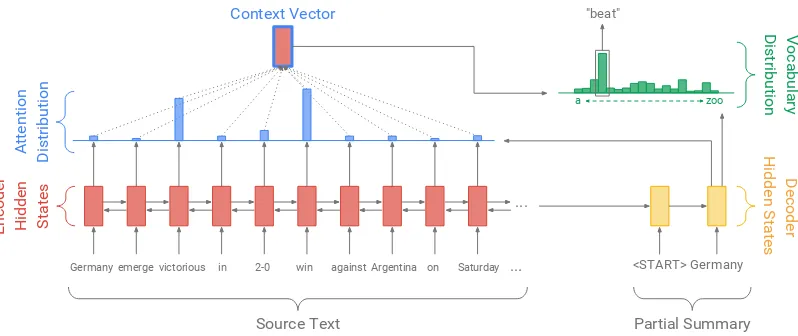
Figure 2: Baseline sequence-to-sequence model with attention. The model may attend to relevant words in the source text to generate novel words, e.g., to produce the novel wordbeatin the abstractive summary
GermanybeatArgentina 2-0the model may attend to the wordsvictoriousandwinin the source text.
et al., 2014), in which recurrent neural networks (RNNs) both read and freely generate text, has
made abstractive summarization viable (Chopra
et al., 2016; Nallapati et al., 2016; Rush et al.,
2015;Zeng et al., 2016). Though these systems are promising, they exhibit undesirable behavior such as inaccurately reproducing factual details, an inability to deal with out-of-vocabulary (OOV) words, and repeating themselves (see Figure1).
In this paper we present an architecture that addresses these three issues in the context of multi-sentence summaries. While most recent ab-stractive work has focused on headline genera-tion tasks (reducing one or two sentences to a single headline), we believe that longer-text sum-marization is both more challenging (requiring higher levels of abstraction while avoiding repe-tition) and ultimately more useful. Therefore we
apply our model to the recently-introducedCNN/
Daily Maildataset (Hermann et al.,2015;
Nallap-ati et al.,2016), which contains news articles (39 sentences on average) paired with multi-sentence summaries, and show that we outperform the state-of-the-art abstractive system by at least 2 ROUGE points.
Our hybrid pointer-generator network
facili-tates copying words from the source text via point-ing (Vinyals et al., 2015), which improves accu-racy and handling of OOV words, while retaining
the ability togeneratenew words. The network,
which can be viewed as a balance between extrac-tive and abstracextrac-tive approaches, is similar to Gu et al.’s (2016) CopyNet andMiao and Blunsom’s
(2016) Forced-Attention Sentence Compression,
that were applied to short-text summarization. We propose a novel variant of thecoverage vector(Tu et al., 2016) from Neural Machine Translation, which we use to track and control coverage of the source document. We show that coverage is re-markably effective for eliminating repetition.
2 Our Models
In this section we describe (1) our baseline sequence-to-sequence model, (2) our pointer-generator model, and (3) our coverage mechanism that can be added to either of the first two models. The code for our models is available online.1
2.1 Sequence-to-sequence attentional model
Our baseline model is similar to that ofNallapati et al. (2016), and is depicted in Figure2. The to-kens of the articlewi are fed one-by-one into the
encoder (a single-layer bidirectional LSTM), pro-ducing a sequence ofencoder hidden states hi. On
each stept, the decoder (a single-layer unidirec-tional LSTM) receives the word embedding of the previous word (while training, this is the previous word of the reference summary; at test time it is the previous word emitted by the decoder), and
hasdecoder state st. Theattention distribution at
is calculated as inBahdanau et al.(2015):
eti=vTtanh(Whhi+Wsst+battn) (1)
at =softmax(et) (2)
where v, Wh, Ws and battn are learnable
parame-ters. The attention distribution can be viewed as
Source Text
Germany emerge victorious in 2-0 win against Argentina on Saturday ... ...
<START>
Vocabulary Distribution
Context Vector
Germany
a zoo
beat
a zoo
Partial Summary Final Distribution
"Argentina"
"2-0"
Attention Distribution
Encoder Hidden States
[image:3.595.99.504.61.288.2]Decoder Hidden States
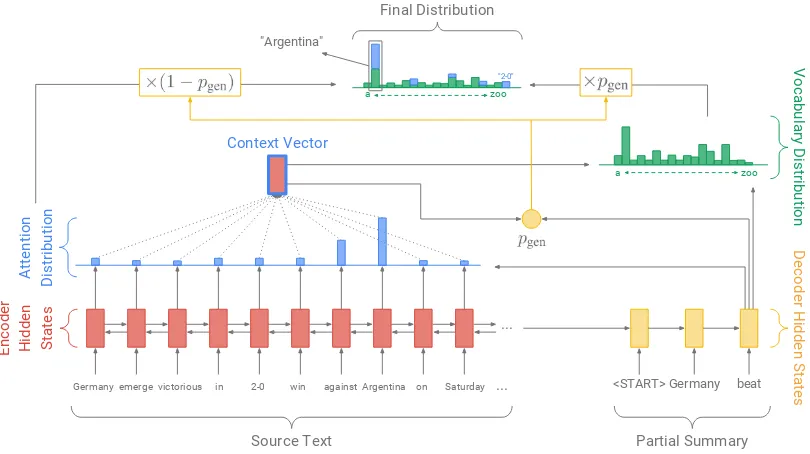
Figure 3: Pointer-generator model. For each decoder timestep a generation probability pgen∈[0,1]is
calculated, which weights the probability ofgeneratingwords from the vocabulary, versuscopyingwords from the source text. The vocabulary distribution and the attention distribution are weighted and summed to obtain the final distribution, from which we make our prediction. Note that out-of-vocabulary article words such as2-0are included in the final distribution. Best viewed in color.
a probability distribution over the source words, that tells the decoder where to look to produce the next word. Next, the attention distribution is used to produce a weighted sum of the encoder hidden states, known as thecontext vector h∗
t:
h∗
t =
∑
iatihi (3)The context vector, which can be seen as a fixed-size representation of what has been read from the source for this step, is concatenated with the de-coder statest and fed through two linear layers to
produce the vocabulary distributionPvocab:
Pvocab=softmax(V0(V[st,h∗t] +b) +b0) (4)
where V, V0, b and b0 are learnable parameters.
Pvocab is a probability distribution over all words
in the vocabulary, and provides us with our final distribution from which to predict wordsw:
P(w) =Pvocab(w) (5)
During training, the loss for timestept is the neg-ative log likelihood of the target wordw∗
t for that
timestep:
losst =−logP(w∗t) (6)
and the overall loss for the whole sequence is:
loss= 1
T
∑
T
t=0losst (7)
2.2 Pointer-generator network
Our pointer-generator network is a hybrid between our baseline and a pointer network (Vinyals et al.,
2015), as it allows both copying words via point-ing, and generating words from a fixed vocabulary. In the pointer-generator model (depicted in Figure
3) the attention distribution at and context vector
h∗
t are calculated as in section2.1. In addition, the
generation probability pgen∈[0,1]for timesteptis
calculated from the context vectorh∗
t, the decoder
statest and the decoder inputxt:
pgen=σ(wTh∗h∗t +wTsst+wTxxt+bptr) (8)
where vectorswh∗,ws,wxand scalarbptrare
learn-able parameters and σ is the sigmoid function.
Next, pgen is used as a soft switch to choose
be-tweengenerating a word from the vocabulary by
sampling fromPvocab, orcopyinga word from the
input sequence by sampling from the attention dis-tribution at. For each document let theextended
vocabulary denote the union of the vocabulary,
and all words appearing in the source document. We obtain the following probability distribution over the extended vocabulary:
P(w) =pgenPvocab(w) + (1−pgen)
∑
i:wi=wati (9)Note that if w is an out-of-vocabulary (OOV)
not appear in the source document, then∑i:wi=wati
is zero. The ability to produce OOV words is one of the primary advantages of pointer-generator models; by contrast models such as our baseline are restricted to their pre-set vocabulary.
The loss function is as described in equations (6) and (7), but with respect to our modified prob-ability distributionP(w)given in equation (9).
2.3 Coverage mechanism
Repetition is a common problem for sequence-to-sequence models (Tu et al., 2016; Mi et al.,
2016;Sankaran et al., 2016;Suzuki and Nagata,
2016), and is especially pronounced when gener-ating multi-sentence text (see Figure1). We adapt
thecoverage modelofTu et al.(2016) to solve the
problem. In our coverage model, we maintain a
coverage vector ct, which is the sum of attention
distributions over all previous decoder timesteps:
ct=
∑
tt−0=10at0 (10)Intuitively,ct is a (unnormalized) distribution over
the source document words that represents the de-gree of coverage that those words have received from the attention mechanism so far. Note thatc0
is a zero vector, because on the first timestep, none of the source document has been covered.
The coverage vector is used as extra input to the attention mechanism, changing equation (1) to:
eti=vTtanh(Whhi+Wsst+wccti+battn) (11)
wherewc is a learnable parameter vector of same
length asv. This ensures that the attention mecha-nism’s current decision (choosing where to attend next) is informed by a reminder of its previous decisions (summarized inct). This should make
it easier for the attention mechanism to avoid re-peatedly attending to the same locations, and thus avoid generating repetitive text.
We find it necessary (see section5) to addition-ally define acoverage lossto penalize repeatedly attending to the same locations:
covlosst=
∑
imin(ati,cti) (12)Note that the coverage loss is bounded; in particu-lar covlosst≤∑iati=1. Equation (12) differs from
the coverage loss used in Machine Translation. In MT, we assume that there should be a roughly one-to-one translation ratio; accordingly the final cov-erage vector is penalized if it is more or less than 1.
Our loss function is more flexible: because sum-marization should not require uniform coverage, we only penalize the overlap between each atten-tion distribuatten-tion and the coverage so far – prevent-ing repeated attention. Finally, the coverage loss, reweighted by some hyperparameterλ, is added to the primary loss function to yield a new composite loss function:
losst =−logP(wt∗) +λ
∑
imin(ati,cti) (13)3 Related Work
Neural abstractive summarization. Rush et al.
(2015) were the first to apply modern neural net-works to abstractive text summarization, achiev-ing state-of-the-art performance on DUC-2004 and Gigaword, two sentence-level summarization datasets. Their approach, which is centered on the attention mechanism, has been augmented with re-current decoders (Chopra et al., 2016), Abstract Meaning Representations (Takase et al.,2016), hi-erarchical networks (Nallapati et al., 2016), vari-ational autoencoders (Miao and Blunsom, 2016), and direct optimization of the performance metric (Ranzato et al., 2016), further improving perfor-mance on those datasets.
However, large-scale datasets for summariza-tion oflongertext are rare.Nallapati et al. (2016) adapted the DeepMind question-answering dataset (Hermann et al.,2015) for summarization,
result-ing in the CNN/Daily Maildataset, and provided
the first abstractive baselines. The same authors then published a neuralextractiveapproach ( Nal-lapati et al.,2017), which uses hierarchical RNNs to select sentences, and found that it significantly outperformed their abstractive result with respect to the ROUGE metric. To our knowledge, these are the only two published results on the full data-set.
Prior to modern neural methods, abstractive summarization received less attention than extrac-tive summarization, butJing(2000) explored cut-ting unimportant parts of sentences to create sum-maries, andCheung and Penn(2014) explore sen-tence fusion using dependency trees.
the input sequence. The pointer network has been
used to create hybrid approaches for NMT (
Gul-cehre et al., 2016), language modeling (Merity et al.,2016), and summarization (Gu et al.,2016;
Gulcehre et al., 2016;Miao and Blunsom, 2016;
Nallapati et al.,2016;Zeng et al.,2016).
Our approach is close to the Forced-Attention
Sentence Compression model ofMiao and
Blun-som (2016) and the CopyNet model of Gu et al.
(2016), with some small differences: (i) We cal-culate an explicit switch probabilitypgen, whereas
Gu et al. induce competition through a shared soft-max function. (ii) We recycle the attention distri-bution to serve as the copy distridistri-bution, but Gu et al. use two separate distributions. (iii) When a word appears multiple times in the source text, we sum probability mass from all corresponding parts of the attention distribution, whereas Miao and Blunsom do not. Our reasoning is that (i) calcu-lating an explicit pgen usefully enables us to raise
or lower the probability of all generated words or all copy words at once, rather than individually, (ii) the two distributions serve such similar pur-poses that we find our simpler approach suffices, and (iii) we observe that the pointer mechanism often copies a word while attending to multiple oc-currences of it in the source text.
Our approach is considerably different from that of Gulcehre et al.(2016) andNallapati et al.
(2016). Those works train their pointer compo-nents to activate only for out-of-vocabulary words or named entities (whereas we allow our model to freely learn when to use the pointer), and they do not mix the probabilities from the copy distribu-tion and the vocabulary distribudistribu-tion. We believe the mixture approach described here is better for abstractive summarization – in section6we show that the copy mechanism is vital for accurately reproducing rare but in-vocabulary words, and in section7.2we observe that the mixture model en-ables the language model and copy mechanism to work together to perform abstractive copying.
Coverage. Originating from Statistical Ma-chine Translation (Koehn, 2009), coverage was adapted for NMT byTu et al.(2016) andMi et al.
(2016), who both use a GRU to update the
cov-erage vector each step. We find that a simpler approach – summing the attention distributions to obtain the coverage vector – suffices. In this re-spect our approach is similar toXu et al. (2015), who apply a coverage-like method to image
cap-tioning, andChen et al.(2016), who also incorpo-rate a coverage mechanism (which they call ‘dis-traction’) as described in equation (11) into neural summarization of longer text.
Temporal attention is a related technique that
has been applied to NMT (Sankaran et al.,2016) and summarization (Nallapati et al., 2016). In this approach, each attention distribution is di-vided by the sum of the previous, which effec-tively dampens repeated attention. We tried this method but found it too destructive, distorting the signal from the attention mechanism and reducing performance. We hypothesize that an early inter-vention method such as coverage is preferable to a post hoc method such as temporal attention – it is better toinformthe attention mechanism to help it make better decisions, than to override its de-cisions altogether. This theory is supported by the large boost that coverage gives our ROUGE scores (see Table1), compared to the smaller boost given by temporal attention for the same task (Nallapati et al.,2016).
4 Dataset
We use the CNN/Daily Mail dataset (Hermann
et al., 2015; Nallapati et al., 2016), which con-tains online news articles (781 tokens on average) paired with multi-sentence summaries (3.75 sen-tences or 56 tokens on average). We used scripts supplied by Nallapati et al. (2016) to obtain the same version of the the data, which has 287,226 training pairs, 13,368 validation pairs and 11,490 test pairs. Both the dataset’s published results (Nallapati et al.,2016,2017) use theanonymized
version of the data, which has been pre-processed to replace each named entity, e.g.,The United
Na-tions, with its own unique identifier for the
exam-ple pair, e.g.,@entity5. By contrast, we operate
directly on the original text (or non-anonymized
version of the data),2 which we believe is the fa-vorable problem to solve because it requires no pre-processing.
5 Experiments
For all experiments, our model has 256-dimensional hidden states and 128-256-dimensional word embeddings. For the pointer-generator mod-els, we use a vocabulary of 50k words for both source and target – note that due to the pointer net-work’s ability to handle OOV words, we can use
ROUGE METEOR
1 2 L exact match + stem/syn/para
abstractive model (Nallapati et al.,2016)* 35.46 13.30 32.65 -
-seq-to-seq + attn baseline (150k vocab) 30.49 11.17 28.08 11.65 12.86
seq-to-seq + attn baseline (50k vocab) 31.33 11.81 28.83 12.03 13.20
pointer-generator 36.44 15.66 33.42 15.35 16.65
pointer-generator + coverage 39.53 17.28 36.38 17.32 18.72
lead-3 baseline (ours) 40.34 17.70 36.57 20.48 22.21
lead-3 baseline (Nallapati et al.,2017)* 39.2 15.7 35.5 -
-extractive model (Nallapati et al.,2017)* 39.6 16.2 35.3 -
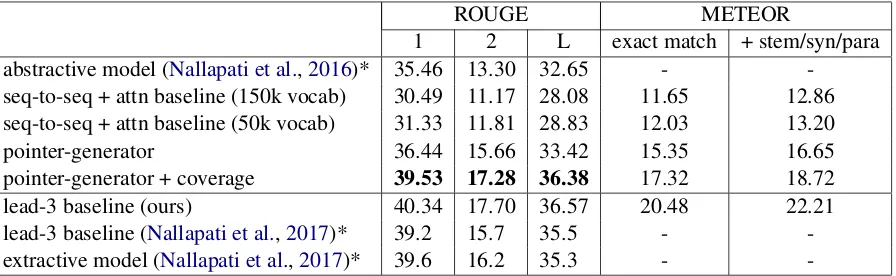
-Table 1: ROUGE F1 and METEOR scores on the test set. Models and baselines in the top half are
abstractive, while those in the bottom half are extractive. Those marked with * were trained and evaluated on the anonymized dataset, and so are not strictly comparable to our results on the original text. All our
ROUGE scores have a 95% confidence interval of at most±0.25 as reported by the official ROUGE
script. The METEOR improvement from the 50k baseline to the pointer-generator model, and from the pointer-generator to the pointer-generator+coverage model, were both found to be statistically significant using an approximate randomization test withp<0.01.
a smaller vocabulary size than Nallapati et al.’s (2016) 150k source and 60k target vocabularies. For the baseline model, we also try a larger vocab-ulary size of 150k.
Note that the pointer and the coverage mecha-nism introduce very few additional parameters to the network: for the models with vocabulary size 50k, the baseline model has 21,499,600 parame-ters, the pointer-generator adds 1153 extra param-eters (wh∗,ws,wxandbptr in equation8), and
cov-erage adds 512 extra parameters (wc in equation 11).
Unlike Nallapati et al.(2016), we do not pre-train the word embeddings – they are learned from scratch during training. We train using Ada-grad (Duchi et al., 2011) with learning rate 0.15 and an initial accumulator value of 0.1. (This was found to work best of Stochastic Gradient Descent, Adadelta, Momentum, Adam and RM-SProp). We use gradient clipping with a maximum gradient norm of 2, but do not use any form of reg-ularization. We use loss on the validation set to implement early stopping.
During training and at test time we truncate the article to 400 tokens and limit the length of the summary to 100 tokens for training and 120 to-kens at test time.3 This is done to expedite train-ing and testtrain-ing, but we also found that truncattrain-ing the article canraisethe performance of the model
3The upper limit of 120 is mostly invisible: the beam search algorithm is self-stopping and almost never reaches the 120th step.
(see section 7.1 for more details). For training, we found it efficient to start with highly-truncated sequences, then raise the maximum length once converged. We train on a single Tesla K40m GPU with a batch size of 16. At test time our summaries are produced using beam search with beam size 4. We trained both our baseline models for about 600,000 iterations (33 epochs) – this is similar to the 35 epochs required by Nallapati et al.’s (2016) best model. Training took 4 days and 14 hours for the 50k vocabulary model, and 8 days 21 hours for the 150k vocabulary model. We found the pointer-generator model quicker to train, re-quiring less than 230,000 training iterations (12.8 epochs); a total of 3 days and 4 hours. In par-ticular, the pointer-generator model makes much quicker progress in the early phases of training. To obtain our final coverage model, we added the coverage mechanism with coverage loss weighted toλ =1 (as described in equation13), and trained for a further 3000 iterations (about 2 hours). In this time the coverage loss converged to about 0.2, down from an initial value of about 0.5. We also tried a more aggressive value of λ =2; this re-duced coverage loss but increased the primary loss function, thus we did not use it.
[image:6.595.78.526.62.200.2]iteration rather than as a separate training phase, but found that in the early phase of training, the coverage objective interfered with the main objec-tive, reducing overall performance.
6 Results
6.1 Preliminaries
Our results are given in Table 1. We
evalu-ate our models with the standard ROUGE metric (Lin,2004b), reporting the F1scores for
ROUGE-1, ROUGE-2 and ROUGE-L (which respectively measure the word-overlap, bigram-overlap, and longest common sequence between the reference summary and the summary to be evaluated). We
obtain our ROUGE scores using the pyrouge
package.4 We also evaluate with the METEOR
metric (Denkowski and Lavie, 2014), both in ex-act match mode (rewarding only exex-act matches between words) and full mode (which addition-ally rewards matching stems, synonyms and para-phrases).5
In addition to our own models, we also report the lead-3 baseline (which uses the first three sen-tences of the article as a summary), and compare to the only existing abstractive (Nallapati et al.,
2016) and extractive (Nallapati et al.,2017) mod-els on the full dataset. The output of our modmod-els is available online.6
Given that we generate plain-text summaries but Nallapati et al. (2016;2017) generate anonymized
summaries (see Section 4), our ROUGE scores
are not strictly comparable. There is evidence to suggest that the original-text dataset may re-sult in higher ROUGE scores in general than the anonymized dataset – the lead-3 baseline is higher on the former than the latter. One possible expla-nation is that multi-word named entities lead to a higher rate of n-gram overlap. Unfortunately, ROUGE is the only available means of compar-ison with Nallapati et al.’s work. Nevertheless, given that the disparity in the lead-3 scores is (+1.1 1, +2.0 2, +1.1 ROUGE-L) points respectively, and our best model scores exceedNallapati et al. (2016) by (+4.07 ROUGE-1, +3.98 ROUGE-2, +3.73 ROUGE-L) points, we may estimate that we outperform the only previous abstractive system by at least 2 ROUGE points all-round.
4pypi.python.org/pypi/pyrouge/0.1.3
5www.cs.cmu.edu/~alavie/METEOR
6www.github.com/abisee/pointer-generator
1-grams 2-grams 3-grams 4-gramssentences 0
10 20 30
%
that
are
duplicates
[image:7.595.313.519.67.221.2]pointer-generator, no coverage pointer-generator + coverage reference summaries
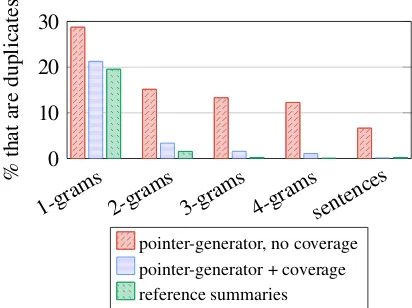
Figure 4: Coverage eliminates undesirable
repe-tition. Summaries from ournon-coverage model
contain many duplicatedn-grams while our
cover-age modelproduces a similar number as the
ref-erence summaries.
6.2 Observations
We find that both our baseline models perform poorly with respect to ROUGE and METEOR, and in fact the larger vocabulary size (150k) does not seem to help. Even the better-performing baseline (with 50k vocabulary) produces summaries with several common problems. Factual details are fre-quently reproduced incorrectly, often replacing an uncommon (but in-vocabulary) word with a
more-common alternative. For example in Figure 1,
the baseline model appears to struggle with the rare word thwart, producing destabilize instead, which leads to the fabricated phrase destabilize
nigeria’s economy. Even more catastrophically,
the summaries sometimes devolve into repetitive nonsense, such as the third sentence produced by the baseline model in Figure 1. In addition, the baseline model can’t reproduce out-of-vocabulary
words (such asmuhammadu buhariin Figure 1).
Further examples of all these problems are pro-vided in the supplementary material.
Our pointer-generator model achieves much better ROUGE and METEOR scores than the baseline, despite many fewer training epochs. The difference in the summaries is also marked: out-of-vocabulary words are handled easily, factual details are almost always copied correctly, and there are no fabrications (see Figure1). However, repetition is still very common.
Article:smugglers lure arab and african migrants by offer-ing discounts to get onto overcrowded ships if people broffer-ing more potential passengers, a cnn investigation has revealed. (...)
Summary:cnn investigationuncoversthebusiness inside
ahuman smuggling ring.
Article: eyewitness video showing white north charleston police officer michael slager shooting to death an unarmed black man has exposed discrepancies in the reports of the first officers on the scene. (...)
Summary:morequestions than answers emergein con-troversial s.c.police shooting.
Figure 5: Examples of highly abstractive reference summaries (bolddenotes novel words).
of Nallapati et al. (2016) by several ROUGE points. Despite the brevity of the coverage train-ing phase (about 1% of the total traintrain-ing time), the repetition problem is almost completely elimi-nated, which can be seen both qualitatively (Figure
1) and quantitatively (Figure4). However, our best model does not quite surpass the ROUGE scores of the lead-3 baseline, nor the current best extrac-tive model (Nallapati et al.,2017). We discuss this issue in section7.1.
7 Discussion
7.1 Comparison with extractive systems
It is clear from Table1that extractive systems tend to achieve higher ROUGE scores than abstractive, and that the extractive lead-3 baseline is extremely strong (even the best extractive system beats it by only a small margin). We offer two possible ex-planations for these observations.
Firstly, news articles tend to be structured with the most important information at the start; this partially explains the strength of the lead-3 base-line. Indeed, we found that using only the first 400 tokens (about 20 sentences) of the article yielded significantly higher ROUGE scores than using the first 800 tokens.
Secondly, the nature of the task and the ROUGE metric make extractive approaches and the lead-3 baseline difficult to beat. The choice of con-tent for the reference summaries is quite subjective – sometimes the sentences form a self-contained summary; other times they simply showcase a few interesting details from the article. Given that the articles contain 39 sentences on average, there are many equally valid ways to choose 3 or 4 high-lights in this style. Abstraction introduces even more options (choice of phrasing), further
decreas-ing the likelihood of matchdecreas-ing the reference
sum-mary. For example, smugglers profit from
des-perate migrants is a valid alternative abstractive
summary for the first example in Figure 5, but
it scores 0 ROUGE with respect to the reference summary. This inflexibility of ROUGE is exac-erbated by only having one reference summary, which has been shown to lower ROUGE’s relia-bility compared to multiple reference summaries (Lin,2004a).
Due to the subjectivity of the task and thus the diversity of valid summaries, it seems that ROUGE rewards safe strategies such as select-ing the first-appearselect-ing content, or preservselect-ing
orig-inal phrasing. While the reference summariesdo
sometimes deviate from these techniques, those deviations are unpredictable enough that the safer strategy obtains higher ROUGE scores on average. This may explain why extractive systems tend to obtain higher ROUGE scores than abstractive, and even extractive systems do not significantly ex-ceed the lead-3 baseline.
To explore this issue further, we evaluated our systems with the METEOR metric, which rewards not only exact word matches, but also matching stems, synonyms and paraphrases (from a pdefined list). We observe that all our models re-ceive over 1 METEOR point boost by the inclu-sion of stem, synonym and paraphrase matching, indicating that they may be performing some ab-straction. However, we again observe that the lead-3 baseline is not surpassed by our models. It may be that news article style makes the lead-3 baseline very strong with respect to any metric. We believe that investigating this issue further is an important direction for future work.
7.2 How abstractive is our model?
We have shown that our pointer mechanism makes our abstractive system more reliable, copying fac-tual details correctly more often. But does the ease of copying make our system any lessabstractive?
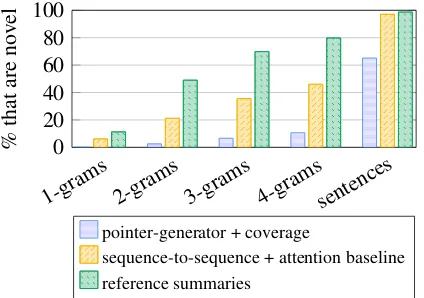
Figure 6 shows that our final model’s
sum-maries contain a much lower rate of noveln-grams (i.e., those that don’t appear in the article) than the reference summaries, indicating a lower degree of abstraction. Note that the baseline model produces
novel n-grams more frequently – however, this
statistic includes all the incorrectly copied words,
UNK tokens and fabrications alongside the good
1-grams 2-grams 3-grams 4-gramssentences 0
20 40 60 80 100
%
that
are
no
vel
pointer-generator + coverage
[image:9.595.77.289.65.214.2]sequence-to-sequence + attention baseline reference summaries
Figure 6: Although ourbest modelis abstractive, it does not produce novel n-grams (i.e., n-grams that don’t appear in the source text) as often as the reference summaries. The baseline model
produces more noveln-grams, but many of these
are erroneous (see section7.2).
Article:andy murray (...) is into the sefinals of the mi-ami open , but not before getting a scare from 21 year-old austrian dominic thiem, who pushed him to 4-4 in the sec-ond set before going down 3-6 6-4, 6-1 in an hour and three quarters. (...)
Summary: andy murraydefeateddominic thiem 3-6 6-4, 6-1 in an hour and three quarters.
Article: (...) wayne rooney smashes home during manch-ester united ’s 3-1 win over aston villa on saturday. (...)
Summary: manchester unitedbeataston villa 3-1 at old trafford on saturday.
Figure 7: Examples of abstractive summaries pro-duced by our model (bolddenotes novel words).
In particular, Figure 6 shows that our final
model copies whole article sentences 35% of the time; by comparison the reference summaries do so only 1.3% of the time. This is a main area for improvement, as we would like our model to move beyond simple sentence extraction. However, we observe that the other 65% encompasses a range of abstractive techniques. Article sentences are trun-cated to form grammatically-correct shorter ver-sions, and new sentences are composed by stitch-ing together fragments. Unnecessary interjections, clauses and parenthesized phrases are sometimes omitted from copied passages. Some of these abil-ities are demonstrated in Figure1, and the supple-mentary material contains more examples.
Figure7 shows two examples of more
impres-sive abstraction – both with similar structure. The dataset contains many sports stories whose sum-maries follow theX beat Yhscoreionhdayi
tem-plate, which may explain why our model is most confidently abstractive on these examples. In gen-eral however, our model does not routinely pro-duce summaries like those in Figure7, and is not close to producing summaries like in Figure5.
The value of the generation probability pgen
also gives a measure of the abstractiveness of our model. During training, pgen starts with a value
of about 0.30 then increases, converging to about 0.53 by the end of training. This indicates that the model first learns to mostly copy, then learns to generate about half the time. However at test time,pgenis heavily skewed towards copying, with
a mean value of 0.17. The disparity is likely due to the fact that during training, the model re-ceives word-by-word supervision in the form of the reference summary, but at test time it does not. Nonetheless, the generator module is use-ful even when the model is copying. We find that pgen is highest at times of uncertainty such
as the beginning of sentences, the join between stitched-together fragments, and when producing periods that truncate a copied sentence. Our mix-ture model allows the network to copy while si-multaneously consulting the language model – en-abling operations like stitching and truncation to be performed with grammaticality. In any case, encouraging the pointer-generator model to write more abstractively, while retaining the accuracy advantages of the pointer module, is an exciting direction for future work.
8 Conclusion
In this work we presented a hybrid pointer-generator architecture with coverage, and showed that it reduces inaccuracies and repetition. We ap-plied our model to a new and challenging long-text dataset, and significantly outperformed the abstractive state-of-the-art result. Our model ex-hibits many abstractive abilities, but attaining higher levels of abstraction remains an open re-search question.
9 Acknowledgment
References
Dzmitry Bahdanau, Kyunghyun Cho, and Yoshua Ben-gio. 2015. Neural machine translation by jointly learning to align and translate. InInternational Con-ference on Learning Representations.
Qian Chen, Xiaodan Zhu, Zhenhua Ling, Si Wei, and Hui Jiang. 2016. Distraction-based neural networks for modeling documents. In International Joint Conference on Artificial Intelligence.
Jackie Chi Kit Cheung and Gerald Penn. 2014. Unsu-pervised sentence enhancement for automatic sum-marization. InEmpirical Methods in Natural Lan-guage Processing.
Sumit Chopra, Michael Auli, and Alexander M Rush. 2016. Abstractive sentence summarization with at-tentive recurrent neural networks. InNorth Amer-ican Chapter of the Association for Computational Linguistics.
Michael Denkowski and Alon Lavie. 2014. Meteor universal: Language specific translation evaluation for any target language. InEACL 2014 Workshop on Statistical Machine Translation.
John Duchi, Elad Hazan, and Yoram Singer. 2011. Adaptive subgradient methods for online learning and stochastic optimization. Journal of Machine Learning Research12:2121–2159.
Jiatao Gu, Zhengdong Lu, Hang Li, and Victor OK Li. 2016. Incorporating copying mechanism in sequence-to-sequence learning. In Association for Computational Linguistics.
Caglar Gulcehre, Sungjin Ahn, Ramesh Nallapati, Bowen Zhou, and Yoshua Bengio. 2016. Pointing the unknown words. In Association for Computa-tional Linguistics.
Karl Moritz Hermann, Tomas Kocisky, Edward Grefenstette, Lasse Espeholt, Will Kay, Mustafa Su-leyman, and Phil Blunsom. 2015. Teaching ma-chines to read and comprehend. InNeural Informa-tion Processing Systems.
Hongyan Jing. 2000. Sentence reduction for automatic text summarization. In Applied natural language processing.
Philipp Koehn. 2009. Statistical machine translation. Cambridge University Press.
Julian Kupiec, Jan Pedersen, and Francine Chen. 1995. A trainable document summarizer. InInternational ACM SIGIR conference on Research and develop-ment in information retrieval.
Chin-Yew Lin. 2004a. Looking for a few good metrics: Automatic summarization evaluation-how many samples are enough? In NACSIS/NII Test Collection for Information Retrieval (NTCIR) Work-shop.
Chin-Yew Lin. 2004b. Rouge: A package for auto-matic evaluation of summaries. InText summariza-tion branches out: ACL workshop.
Stephen Merity, Caiming Xiong, James Bradbury, and Richard Socher. 2016. Pointer sentinel mixture models. In NIPS 2016 Workshop on Multi-class and Multi-label Learning in Extremely Large Label Spaces.
Haitao Mi, Baskaran Sankaran, Zhiguo Wang, and Abe Ittycheriah. 2016. Coverage embedding models for neural machine translation. InEmpirical Methods in Natural Language Processing.
Yishu Miao and Phil Blunsom. 2016. Language as a latent variable: Discrete generative models for sen-tence compression. InEmpirical Methods in Natu-ral Language Processing.
Ramesh Nallapati, Feifei Zhai, and Bowen Zhou. 2017. SummaRuNNer: A recurrent neural network based sequence model for extractive summarization of documents. InAssociation for the Advancement of Artificial Intelligence.
Ramesh Nallapati, Bowen Zhou, Cicero dos Santos, C¸aglar Gulc¸ehre, and Bing Xiang. 2016. Abstrac-tive text summarization using sequence-to-sequence RNNs and beyond. InComputational Natural Lan-guage Learning.
Chris D Paice. 1990. Constructing literature abstracts by computer: techniques and prospects. Information Processing & Management26(1):171–186.
Marc’Aurelio Ranzato, Sumit Chopra, Michael Auli, and Wojciech Zaremba. 2016. Sequence level train-ing with recurrent neural networks. InInternational Conference on Learning Representations.
Alexander M Rush, Sumit Chopra, and Jason Weston. 2015. A neural attention model for abstractive sen-tence summarization. InEmpirical Methods in Nat-ural Language Processing.
Horacio Saggion and Thierry Poibeau. 2013. Auto-matic text summarization: Past, present and future. In Multi-source, Multilingual Information Extrac-tion and SummarizaExtrac-tion, Springer, pages 3–21.
Baskaran Sankaran, Haitao Mi, Yaser Al-Onaizan, and Abe Ittycheriah. 2016. Temporal attention model for neural machine translation. arXiv preprint arXiv:1608.02927.
Ilya Sutskever, Oriol Vinyals, and Quoc V Le. 2014. Sequence to sequence learning with neural net-works. InNeural Information Processing Systems.
Sho Takase, Jun Suzuki, Naoaki Okazaki, Tsutomu Hi-rao, and Masaaki Nagata. 2016. Neural headline generation on abstract meaning representation. In
Empirical Methods in Natural Language Process-ing.
Zhaopeng Tu, Zhengdong Lu, Yang Liu, Xiaohua Liu, and Hang Li. 2016. Modeling coverage for neural machine translation. In Association for Computa-tional Linguistics.
Oriol Vinyals, Meire Fortunato, and Navdeep Jaitly. 2015. Pointer networks. InNeural Information Pro-cessing Systems.
Kelvin Xu, Jimmy Ba, Ryan Kiros, Kyunghyun Cho, Aaron C Courville, Ruslan Salakhutdinov, Richard S Zemel, and Yoshua Bengio. 2015. Show, attend and tell: Neural image caption generation with visual attention. In International Conference on Machine Learning.