Home Environment, Teacher Language, and Literacy Development Across the First Grade Year
Kelly Buchanan
University of North Carolina at Chapel Hill Spring 2013
A thesis presented to the faculty of The University of North Carolina at Chapel Hill in
partial fulfillment of the requirements for the Bachelor of Science degree with Honors in
Psychology.
Advisor: Dr. Peter Ornstein
Committee Member: Dr. Jennifer Coffman
Acknowledgements
I would first and foremost like to thank both Dr. Peter Ornstein and Dr. Jennifer Coffman
for your guidance throughout this year. I am so grateful for your incredible encouragement and
trust in me every step of the way. Thank you also to Dr. Liz Pungello for your infectious
enthusiasm, first as a teacher and later as a member of my committee.
I am incredibly appreciative to Kesha Hudson for your immense amount of help. Thank
you for your patience in teaching me to code, for helping me sift through data and analyses, and
for your flexibility and willingness to help me with every aspect of this project.
I would also like to thank my family, friends, and roommates for being my cheerleaders
and helping me navigate the occasional mental stress that accompanies a project of this
magnitude. Thanks especially to my mom, for knowing when to provide the professional
wisdom of a psychologist and when to just offer a mother’s assurance. I wouldn’t have made it
through this year without all of you believing in me.
Finally, I would like to acknowledge that this research was made possible by funding
Abstract
Existing research has established both parent behavior and teacher language to be
important mechanisms in memory development during the early elementary years. Preliminary
research on math achievement during this time has suggested that these relationships extend into
achievement domains. The purpose of this investigation was to test if these patterns extend into
literacy development. Literacy outcomes at the beginning of the first grade year and growth
across the year were explored as a function of home literacy environment and teacher mnemonic
style. Children who scored higher on the Family Literacy Environment subscale performed
better on literacy tasks at both the beginning and end of the first grade. However, children in
classrooms with high mnemonic teachers did not show different levels of growth in literacy
outcomes when compared to children with low mnemonic teachers. These patterns suggest that
a richer home literacy environment does predict better literacy performance at the beginning and
throughout the first grade, while teacher memory talk does not appear to be related to literacy
outcomes across the year. The results of this study suggest that home environment is important
in fostering literacy development in early childhood, though further research is needed to
understand the specific mechanisms that should be employed to facilitate literacy development in
Home Environment, Teacher Language, and Literacy Development Across the First Grade Year
The early elementary years are a vital period in cognitive development. During this time,
children experience significant growth in the ways in which they process and store information.
Although the cognitive growth across these years can certainly be attributed in part to
maturation, it has also been shown to be highly social in nature in that perceptual skills, memory,
logical thinking, and other cognitive processes are highly influenced by both social interactions
in the home and classroom contexts. A wide body of research has explored the mechanisms
through which this increased sophistication occurs (e.g., Coffman, Ornstein, McCall, & Curran,
2008; Moely, Hart, Leal, & Santulli, 1992; Fivush & Nelson, 2004; Fivush, Reese, & Haden
2006; Kosmodis, Zafari, & Politimou, 2011; Morrison, Smith, & Dow-Ehrensberger, 1995;
Morrison & Connor, 2002; Christian, Morrison, Frazier, & Massetti, 2000). This study focused
on the parallels in the development of memory and literacy, both of which have been shown to
be strongly related to parent-child interactions and teacher instruction, and the role of home and
classroom environments play in their development over the first grade year.
The Socialization of Memory
The kindergarten and first grade years have been revealed to be especially important in
guiding the development of children’s memory skills, both at home and at school. Before
exposure to formal schooling, children’s memory development is shaped by interactions with
parents, such as mother-child conversation during and after events that have been experienced
jointly (Fivush et al., 2006; Haden, Ornstein, Eckerman, & Didow, 2001; Nelson & Fivush,
shape the development of memory skills and strategies (Coffman et al., 2008; Moely, et al.,
1992; Wagner, 1978).
Memory Development and the Home. The majority of literature on home factors draws
from Vygotsky’s sociocultural theory and the assumption that children develop skills primarily
through interactions with parents or other more developmentally competent individuals in their
environment. The language content of parent-child interactions has been found to be especially
important in the development of children’s memory.
Haden et al. (2001) conducted a longitudinal investigation of mother-child conversations
during events such as specially constructed “adventures” (e.g., a pretend camping activity) and
the ways in which the conversational content related to children’s later recall for those events.
Researchers analyzed mother-child interactions during these events when the children were 30-,
36-, and 42-months of age, focusing on for whether specific components of the events were
jointly discussed, discussed only by the mother, or not discussed at all. Children were later
evaluated for memory of the events using open-ended recall, and were also assessed at 42
months in terms of the general memory strategies they used on an object memory task. The
researchers observed that children’s success in open-ended recall of details from these events
was strongly associated with joint talk with their mothers during the event, suggesting that
mother-child conversation during the event was a factor in focusing the children’s attention and
enhancing their understanding and storing of information related to the activity.
To further examine the relationship between mother-child conversation and child recall
for an event, Boland, Haden, and Ornstein (2003) developed an experimental methodology in
which mothers were trained to use specific conversation techniques - wh-questions, associations,
who were 3-4 years of age at evaluation. Children were also evaluated for general language skills and recall of details for two prior novel events selected by the mother. Results from this experiment showed that children whose mothers had been trained in the use of these components of an elaborative conversational style subsequently exhibited better recall for the camping event, thus confirming the hypothesis that the mothers were able to facilitate their children’s
understanding and retention of event details through the trained conversational techniques. Analyses also showed that children with higher language skills performed better on recall of event details.
Research has consistently affirmed the idea that parent-child interactions are crucial for structuring children’s understanding and memory. This can be attributed to a variety of reasons.
In cases of more specific event-relevant recall, parent-child conversational techniques have the
ability to focus the attention of children to better comprehend and retain information as an event
is occurring (Haden et al. 2001). However, linkages have also been found between maternal
reminiscing, or talking about past events, and developmental outcomes. Nelson and Fivush
(2006) have linked maternal reminiscing style, defined by the use of “many questions and
statements to add information to the ongoing narrative”, to the development of children’s
autobiographical memory, language, and narrative skills across the preschool years. Using
Vygotsky’s sociocultural theory to explain these linkages, the researchers suggest that by
exposing children to strategies for discussing and remembering past events, parents provide a
model for children to organize and understand their own episodic memories.
Memory Development and the Classroom. Before children are exposed to formal
schooling, their parents or caregivers serve as their primary “instructors” in the development of
development. Once children are exposed to a formal classroom environment, however, in what
ways do teachers effect the further development of memory? What changes in memory
development during this time period can be attributed to teaching methods versus maturation?
Early research on the subject demonstrated the unique role of the classroom in the
development of cognitive abilities, as opposed to simple aging (Scribner & Cole, 1978; Wagner,
1978). Wagner’s (1978) work in Morocco compared different memory processes between
children who did and did not have the opportunity to attend formal school, in both urban and
rural areas. This research showed specifically that whereas some aspects of memory (e.g., the
short-term store and other “hardware” components of the system) seemed to be universal and
developed as a function of age, others (e.g., “control processes,” including the use of strategies)
were dependent on exposure to schooling. This early research established that although some
cognitive growth does occur naturally with age, exposure to schooling is crucial to development
of cognitive processes such as skilled remembering.
Moely et al. (1992) further confirmed the importance of exposure to schooling for
development of more advanced cognitive strategies and sought to examine in more detail the
timing and nature of teacher instruction specifically intended to encourage cognitive activity and
development. The researchers conducted classroom observations and coded teacher instruction
for the presence of specific teaching behaviors in intervals evaluated every 30 seconds. In these
observations, Moely and her colleagues found that instruction directly intended to teach children
about the use of mnemonic techniques was observed fairly infrequently (e.g., in only 9% of all
observed intervals), in contrast to other types in instruction, such as providing content specific
information or requesting correct answers from children. They also observed wide variability
presented. In fact, teachers provided the most strategy suggestions for students in 2nd and 3rd
grade classrooms, whereas they provided fewer for both younger and older children. According
to the authors, this period in schooling occurs at a point when children are unlikely to nominate
strategies independently, but are nonetheless highly receptive to memory strategy training.
A more recent and widely used tool for examining the effect of schooling on cognitive
development is the “cutoff” method. A cutoff date refers to a school system’s set date by which
a child must be a certain age to enter into school. The “cutoff” method enables researchers to
compare children who have either just missed or just made their school system’s “cutoff” date
(e.g., “old kindergartners versus “young” first graders), meaning that the children are all of
similar age but are receiving different types of schooling (Christian et al., 2000). By comparing
these groups, researchers can make inferences about whether factors such as achievement are
more closely related to exposure to formal schooling versus biological age. Using this
methodology, Morrison et al. (1995) found that the development of explicit memory skills and
strategies was primarily a function of exposure to formal schooling in first grade, and that
children of the same age in kindergarten did not demonstrate having developed the same
cognitive processes, confirming the crucial role of schooling in cognitive development. Burrage
et al. (2008), also using a cutoff design, found similar results in children as young as
kindergarten, confirming that working memory and executive functioning are more developed in
children of the same age who attended pre-kindergarten versus those who did not.
This research has well established the importance of formal schooling in cognitive
development and memory. Given Moely’s (1992) evidence that teachers infrequently employ
specific strategy instruction, what are the factors that contribute to this development?
mechanisms and timing of changes in memory development (Ornstein, Grammer, & Coffman,
2010). Coffman et al. (2008) focused in on the specific mechanisms of memory development in
the first grade. The students in this study were followed beginning in the first grade and assessed
at different time points over the course of the year. Additionally, teachers were observed in
order to evaluate the language that they used when providing instruction in math and language
arts. Teacher instruction was coded in 30-second intervals, and a total of 60 minutes was coded
for each teacher in each subject matter domain.
In terms of classroom instruction, the Coffman et al.’s (2008) findings revealed
considerable variability in teachers’ use of “memory-relevant” language, such as providing
suggestions, asking metacognitive questions, or pairing instructional and cognitive information
with explicit memory requests. Memory-related content was measured using the Taxonomy for
Teacher Behaviors, categorizing types of instruction into four broad categories: instructional,
cognitive structuring, memory requests, and metacognitive information (Coffman et al., 2008;
Ornstein et al., 2010). Examples of specific codes within these categories include general
information giving, book reading, attention regulation, semantic and episodic questions, strategy
suggestions, and metacognitive questions. The “mnemonic style” of the teachers was assessed
on the basis of the frequency of five specific codes: (1) strategy suggestions and (2)
metacognitive questions, as well as the co-occurrence of memory requests with (3) instructional
activities, (4) cognitive structuring activities, that increase the depth to which information is
processed, and (5) metacognitive information. Teacher scores on these 5 codes were
standardized to get a T score for each measure, which were then averaged into a single
mnemonic orientation score for each teacher. A median split was then performed on those scores
Researchers then examined patterns of recall and strategy use as a function of mnemonic
style. By the spring of the children’s first grade year, Coffman et al. (2008) observed that
variation across teachers in the mnemonic content of their language during instruction was
associated with differences in students’ memory skills. Children in “high-mnemonic” classrooms
displayed more use of memory strategies such as sorting and clustering while engaged in
memory tasks than did their peers in low mnemonic classrooms. Further, children taught by
teachers labeled “high mnemonic” performed slightly better in terms of recall than did those with
teachers labeled “low mnemonic.”
Cross-sectional and longitudinal classroom-based research has made it very apparent that
teacher language is instrumental in shaping children’s memory skills and strategies. Not only
have linkages between teacher language and children’s memory skills been established in the
first grade, but the influences of teacher mnemonic language have been observed in later years as
well (Ornstein et al. 2010; Coffman et al. 2008). “Cutoff” research by Morrison et al. (1995)
found significant differences in memory growth over a school year in children who were in the
first grade versus children of similar age who were in kindergarten, suggesting something about
the first grade year that is especially important for the growth of memory skills. Baker-Ward,
Ornstein, & Holden (1984) also stressed the first-grade year as the point at which children’s
explicit strategy use becomes associated with improved memory performance
Parent and Teacher Influences on Literacy Development
As with memory development, the role of parents and teachers as motivators of literacy
growth is undeniable. Both at home and in the classroom, children’s literacy skills are shaped by
the instruction they receive from these adults (Martini & Sénéchal, 2012; McGeown, Johnston,
Literacy Development in the Home. Literacy development in early childhood is highly
dependent on “instruction” derived from interactions with parents. Success in in early reading
depends on many factors, such as letter knowledge, ability to comprehend and manipulate
phonemes, and the mapping of sounds and symbols (Caravolas et al. 2012). Through what
mechanisms do children develop these individual skills?
In a correlational study of environmental factors in the home and children’s literacy,
Martini and Sénéchal (2012) stressed the importance of parents as instructors in their child’s
literacy development. Informal parent teaching activities, such as shared book reading, as well
as formal teaching behaviors, such as explicit pointing and labeling of letters and words, were
demonstrated to be strongly related to children’s literacy outcomes. These relationships affirm
the role of the parent as a child’s instructor in the early developmental years, asserting that
parental choices – such as the types of activities in which to engage their children and how often
to do so – are crucial to consider in the context of child literacy development.
Although this correlational work suggests a strong relation between parent instruction
and child literacy, the possibility of bidirectionality must be acknowledged; for example, a child
with higher interest in literacy might elicit more frequent reading or instruction from his or her
parents. However, with experimental methodology, McGeown et al. (2012) provided evidence to
affirm the causal linkage between parents as important instructors and children’s developing
literacy skills. In this study, researchers confirmed that the types of strategies children were
instructed to use highly influenced the cognitive skills they used later in early reading, as well as
overall their reading ability. It is indisputable that even before exposure to formal schooling,
Literacy in the Classroom. Once children enter the formal schooling environment,
their literacy development continues to be shaped by the instruction they receive. Research
seeking to distinguish the separate influences of chronological age vs. exposure to schooling
shows that although some developmental processes, such as self-regulation and vocabulary, are
dependent on chronological age, children of the same age who had received an extra year of
schooling show more advanced letter knowledge and decoding skills (Skibbe et al. 2011). Just
as memory development in these years appears to be strongly related to the content of teacher
instruction, studies suggest that development of literacy skills is highly affected by emphasis of
skill-specific instruction in the classroom setting (McGeown et al. 2012; Skibbe et al., 2011).
Furthermore, research utilizing cutoff methodology to examine specific influences of classroom
instruction on literacy skills has demonstrated that instruction time is predictive of growth in
vocabulary and decoding skills, especially for children who initially performed lower than their
peers in these areas (Morrison & Connor, 2002). This research confirms the importance of
teacher instruction, but also implies that teaching strategies may differ in efficacy for students of
different initial skill levels.
Linking Memory and Achievement
Linking Teacher Talk and Memory. The linkages between teacher memory talk and
children’s memory development are well established. Furthermore, it is evident that
development of both memory and literacy are highly related to the home and classroom contexts,
and the timing of the emergence of these cognitive skills is similar (Christian et al., 2000;
Morrison et al., 1995; Morrison et al., 2002).In terms of academic achievement, content-specific
teacher talk has been shown to play a role in young children’s knowledge in academic areas. For
of math-specific language used by preschool teachers and the links between this content and
child math knowledge at the end of the school year. The researchers found that there was great
variability among teachers in the amount of math talk they provided, and that differences in
levels of math talk were in fact predictive of child math knowledge at the end of the year.
Only very recently have researchers begun to explore the connections between teacher
memory talk and child achievement outcomes in content-specific areas. Grammer, Coffman,
Sidney, & Ornstein (under review) explored the math outcomes of second graders in classes
whose teachers were identified as being “high-mnemonic” or “low-mnemonic” on the basis of
the language they used when teaching mathematics. Though the two groups of students showed
no differences in math ability at the beginning of the second grade year, students with
“high-mnemonic” teachers performed significantly better on math assessments by the end of that year.
Hudson (2012) explored children’s math outcomes in the kindergarten year as a function
of both parental influence (specifically, maternal metamemory talk during a mother-child
reminiscing task) and teacher mnemonic style. In this study, Hudson observed that maternal
memory talk predicted children’s mathematics skill levels at the beginning of the kindergarten
year, such that higher levels of memory talk were associated with higher levels of math skills.
She also found that the content of teacher talk (previously demonstrated to facilitate the
emergence of memory skills) was not related to mathematics outcomes for children at the
beginning of the kindergarten year, but that it was associated with achievement at the end of
kindergarten. Interestingly, Hudson (2012) also found that the effects of maternal and teacher
conversational style at the end of the academic year were additive: Kindergartners with both a
high mnemonic mother and a high mnemonic teacher performed better than their peers in the
a high mnemonic teacher were better than those with low mnemonic mothers and teachers.
Overall, the study demonstrated that children’s growth in mathematics skills across the
kindergarten year varied as a function of parent and teacher influences individually as well as a
function of the interplay of both factors, affirming the importance of both environments
individually and together.
Linking Teacher Memory Talk and Literacy. Although some work has explored links
between memory and literacy, most research has focused on the role of language in memory
development. Language is instrumental in early childhood memory growth, specifically in the
development of autobiographical memory, because it is a tool for interpreting, organizing, and
expressing memories (Fivush & Nelson, 2004). Furthermore, it is not until children have
language that they can participate in the parent-child dialogues previously established to be
beneficial to remembering events. Links have also been established between literacy and
working memory. Kosmidis, Zafiri, and Politimou (2011) explored this relation, asserting the
role of working memory in vocabulary and literacy acquisition. In comparisons between
illiterate, self-educated literate, and formal-educated literate populations, researchers concluded
that although some deficits in working memory could be attributed to illiteracy, formal schooling
enhanced memory processes in literate individuals, again emphasizing the important role of
formal schooling in memory development.
The present study was designed to further explore the relation between the home
environment and teacher instruction and the development of literacy across the first grade year.
Although the current literature demonstrates the importance of both parent and teacher
instruction on literacy development, very little research has examined the potential influence of
teacher talk in memory development, as well as its apparent role in math achievement, it is likely
that the mnemonic content of teacher instruction is predictive of literacy development, as well.
This study was designed to explore the hypothesis that the mnemonic content of teachers’
instruction is in fact related to the literacy achievement in children during the first grade year.
Furthermore, in examining factors related to both memory and literacy development, we hope to
examine the interplay of both environments in shaping children’s development. Specifically, we
examined whether home environment moderates the relationship between teacher talk and child
outcomes, hypothesizing that teacher talk would have a stronger association with memory
outcomes for children from lower home literacy environments than it would for children from
high home literacy environments.
Method
Participants
This particular study is part of a larger longitudinal project in which children were
followed through their kindergarten and first grade years. Student and teacher participants were
recruited from four elementary schools in North Carolina (two in Chapel Hill and two in
Durham). The teacher sample was made up of 17 teachers, all of whom were female. Three of
the teachers were African-American, and 14 were Caucasian.
The total student sample used included 130 first-graders, 74 of whom had participated in
the study during their kindergarten year and 56 who were recruited at the beginning of the first
grade year. Sixty-five children were students in the Chapel Hill-Carrboro City Schools, and 65
attended the Durham Public Schools. In this sample, 61 children were female and 69 were male.
were Hispanic/Latino, 8% were Asian or Pacific Islander, and 12% identified as mixed ethnicity.
Mean age was 6.49 years.
For the purpose of this study, only the 56 participants who entered the study at the start of
the first grade year were used. Of these students, 29 children were male and 27 were female.
46% were Caucasian, 15% were African American, 18% were Hispanic/Latino, 10% were Asian
or Pacific Islander, and 10% identified as mixed ethnicity. These students were spread across the
classrooms of the 17 teachers, with an average of 3.5 students per class in our sample (SD = 1.5).
Procedure
Classroom Observations. To collect data on the content of teacher language, naturalistic
observations were conducted the classrooms of participating teachers. Each teacher was filmed
while instructing the class in lessons in mathematics and language arts. For the purpose of this
study, only language arts instruction was used. Researchers filmed teachers during multiple
visits over the course of the year to collect 60 minutes of instruction per teacher in each of the
two domains of instruction. The research assistant who made each observation visit also
recorded information about the lesson content, teacher and child behavior, as well as materials in
the classroom context. A research assistant later coded the tapes for content of the teacher’s
language using the Taxonomy of Teacher Behaviors (Coffman et al., 2008).
Child Assessments. Over the first grade year, child assessments were conducted at three
time points: in the fall, winter, and spring. During the assessments, which lasted from 45 to 75
minutes, participants were given a variety of tasks to measure memory performance and strategy
use, as well as self-regulation and achievement. Assessments were generally conducted before
we focused on two subscales of the Woodcock Johnson III Tests of Achievement administered,
one administered only at Time 1 and one administered at both Time 1 and Time 3.
Measures
Family Literacy Environment. To assess the quality of the literacy environment in the
home, parents were given Griffin and Morrison’s (1997) Home Literacy Environment
questionnaire. The questionnaire, composed of 8 items, asked parents to report information about
a variety of factors, including the amount of time their child spends watching TV per week, the
newspaper and magazine subscriptions in the home, the time that the parents spend reading to
themselves, and the time they spend reading to the child. The questionnaire was scored as a sum
of all responses.
Teacher Language Content. Teacher instruction and mnemonic content was evaluated
using the Taxonomy of Teacher Behaviors developed by Coffman et al. (2008). Teacher
language was coded for the presence and frequency of specific types of language, in intervals of
30 seconds.
As can be seen in Table 1, teacher language was classified into four broad categories:
instructional activities, cognitive structuring activities, memory requests, and metacognitive
information. Codes for instructional activities included: book reading from a book or other
written source; general information giving, such as the presentation of new factual information;
specific task instruction, includingdirections for completing a particular activity; and prospective
summary, such as descriptions of upcoming lessons or events.
Cognitive structuring codes were given for massed repetition, i.e., direction to perform an
activity in unison; identifying features, including thegeneration of features for a specific
categories; personal experiences (home), such as requests for children to associate a prior
experience outside school with the current classroom activity; personal experiences (school),
including requests for the children to associate a prior classroom experience with the current
activity; drawing inferences, such as asking students to predict an outcome, or the intentions of a
character; visual imagery, including asking students to create visual mental images; attention
regulation (instructional goals), such as the provision ofdirections for focusing attention or
following along with the activity; and attention regulation (behavioral goals), including attempts
at regulating or changing student behavior.
Codes given for memory requests included semantic requests, for already learned
information; episodic requests, for the retrieval of memories of specific past events; procedural
requests, for the retrieval of a series of ordered tasks to achieve a specific goal; prospective
requests, including the assignment of non-instructional tasks to be completed for a future
purpose; and anticipated requests, such as asking students to remember academic or procedural
information for the purpose of future learning or studying. When these requests were explicitly
stated (using language like “remember”, “don’t forget”, or “put it in your brain”), these codes
were paired with an expressed code.
Teacher language was coded for metacognitive information when the teacher provided or
solicited metacognitive information. These codes included strategy suggestions, such as the
recommendation of a specific method with which to remember or process information;
metacognitive questioning, including asking a student to provide a strategy or explain the
rationale for a utilized strategy; metacognitive rationale, as when the teacher provided a rationale
an unhelpful or inappropriate method; and replacement, or the recommendation of a an alternate,
more effective strategy.
Codes were also given for non-instructional/non memory relevant language to capture
instances in which the teacher was not engaged in instructionally relevant activity, there was a
verbal interruption, or a period of no verbal instruction spanned an entire interval.
The coder of the language that teachers use during the course of instruction was initially
trained in use of the Taxonomy of Teacher Behaviors by exposure to 8 training videos in the
laboratory. The coder had to reach 100% reliability with these video clips before beginning to
code the instruction of the teachers in this study. The coder then had to attain 80% reliability
with a master coder on 25% of the teacher videos from the present sample (4.25 hours) before
continuing to code independently.
Child Literacy Outcomes. Child literacy outcomes were measured by two Woodcock
Johnson III subscales - Letter-Word Identification and Reading Fluency (Woodcock, McGrew,
& Mather, 2001).
The Letter-Word Identification task measures the child’s word-decoding skills. The child
is presented with single letters and words and asked to correctly identify them. The words must
be pronounced correctly. The task includes 76 items, which increase in difficulty as the task is
administered. A basal level is established if the participant answers 6 items in a row correctly,
and a ceiling is reached when the participant misses 6 items in a row.
For the timed Reading Fluency task, participants must read a series of sentences and
circle either “yes” or “no” based on whether the sentence is true. The task is made up of 98
sentences, and the participant is given 3 minutes to complete as many sentences as possible. The
Results
Descriptive Statistics of the First-Grade Sample
Because some students participated in the study during their kindergarten year, they had
already been administered some of the tasks and training in memory strategy. To eliminate the
possible influence of testing effects, only those participants who were recruited at the beginning
of the first grade year were included in the analyses for the purpose of this study. One teacher
did not have any children who entered the study in the first grade, so that teacher was excluded.
Four students who participated in the study at Time 1 were not assessed at Time 3, so data for
those students was excluded.
To observe the development of children’s literacy skills across the first grade year, two
Woodcock Johnson III subscales were used. The Reading Fluency task, administered only at
Time 1, was used as a measure of literacy skills upon entry into the first grade. At Time 1,
students scored an average of 35.06 (SD = 8.40). The Letter-Word identification task,
administered at Time 1 and Time 3, allowed us to observe the growth in literacy skills over the
course of the first grade year. Children showed some growth on this task over the course of the
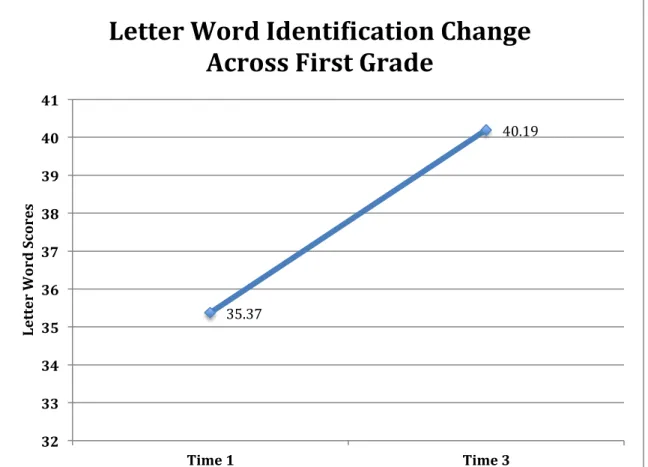
year, as can be seen in Figure 1. As can be seen in the figure, the participants’ average score at
Time 1 was 35.37 (SD = 8.17), while the average score at Time 3 was 40.19 (SD = 7.96).
Descriptive Statistics of Home Environment
Finally, the Home Literacy subscale was used as a measure of the richness of home
environments as pertaining to literary development. The survey included 8 items addressing
factors such as books in the home and time parents spend reading with children. Questions were
all rated on a Likert scale, and scores on all items were summed to create a general HLE score.
Parents reported reading to their child an average of 8.3 times per week, though length of time
was not specified. A total of 43% of families reported that their child owns 80 books or more,
whereas only 16% of the families reported that their child owns fewer than 20 books. Moreover,
94% of the families reported owning a library card, though only 66% reported using it at least
once a month.
The individual items from the subscale were not used in analyses, but we rather focused
on the sum measure of overall Home Literacy Environment. Scores for this measure ranged
from 4 to 22, with a mean of 13.5 (SD = 4.2).
Descriptive Statistics of Teacher Instruction
The Taxonomy of Teacher Behaviors was used to classify the content of teacher
instruction across 120 30-second intervals of teacher-led language arts lessons in each of 17
first-grade classrooms (see Table 1). Instruction was summarized in four broad categories: (1)
instructional activities, (2) cognitive structuring activities, (3) memory requests, and (4)
provision or solicitation of metacognitive information.
Unsurprisingly, teachers devoted the most content to providing simple instruction, as
95.7% of all intervals contained some kind of instructional language. More specifically, 86.4%
of intervals contained instances of general information giving, while 32.1% contained specific
task instruction. Memory requests constituted the second most prevalent type of instruction,
with 63.8% of intervals containing some language asking students to use memory. The most
common type of memory request was a semantic question, present in 57.3% of intervals.
Cognitive structuring also constituted a large part of teacher instruction (44.5% of intervals), the
most common types being connection to personal experiences – school (13.7%) and attention
metacognitive information, which was found in only 9.0% of all intervals. Specifically, 5.2% of
instruction intervals contained strategy suggestions, while even fewer contained metacognitive
questions (2.5%) or metacognitive reasoning (2.9%). Overall frequency of each individual code
can be found in Table 2.
Three component codes were also created in order to examine the co-occurrence of
specific codes in the same interval: 1) memory requests and instructional activities, 2) memory
requests and cognitive structuring, and 3) memory requests and metacognitive information. As
can be seen, the use of memory requests with instructional activities occurred frequently, with a
range of 49.2% to 60.5% of intervals. Memory requests and cognitive structuring co-occurred
less frequently, with a range of 15.8% to 29.9% of intervals. The co-occurrence of memory
requests with metacognitive information was highly infrequent, occurring in a range of 1.7% to
5.7% of intervals.
In order to categorize teachers on the basis of mnemonic orientation, we created a median
split of “high” mnemonic teachers and “low” mnemonic teachers. To do this we combined the
teachers’ use of 5 codes: strategy suggestions, metacognitive questions, and the three
co-occurrence codes. Teacher’s scores for each code were standardized to get a T score for each
measure. The T scores for the individual measures were then averaged into one mnemonic
orientation score for each teacher. As mentioned previously, the number of students per teacher
in our sample was quite small, meaning that student outcomes when considered in the context of
individual classrooms were susceptible to a large amount of variability. Therefore, a median split
was created with mnemonic orientation scores to divide teachers into either “high” or “low”
mean of T scores for the mnemonic orientation measure was 50 (SD = 5), with a range of 41 to
59.
Linking Home Environment and Literacy Outcomes
To investigate the link between home literacy environment and children’s literacy
performance at the beginning of the first grade, we performed correlations between HLE score
and the Reading Fluency task taken at Time 1. HLE score and Reading Fluency score were
significantly, positively correlated (r = .43, p = .008), indicating that children with richer home
literacy environments performed significantly better on the Reading Fluency measure upon first
grade entry than did children with less literacy-rich home environments. We then created a
median split for the HLE measures to further compare differences between children in terms of
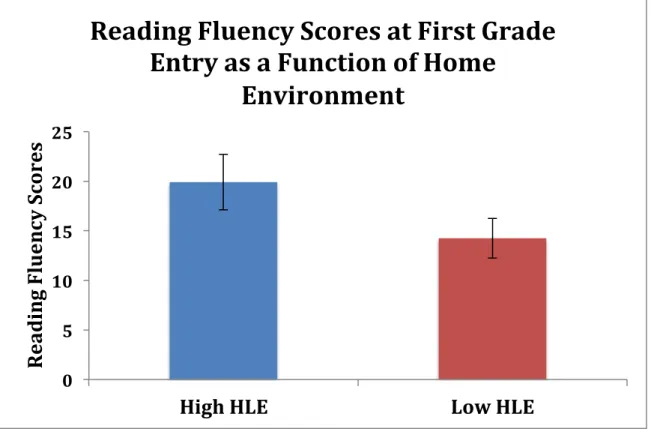
“high” and “low” home literacy environments. As can be seen in Figure 2, children in the high
HLE group scored an average of 19.91 (SD = 13.0) on the Reading Fluency task, while children
in the low HLE group scored an average of 14.25 (SD = 10.7). A one-tailed independent
samples t-test found this difference to be significant, t(52) = -1.65, p = .05. These differences are
consistent with the correlation observed above, suggesting that children from richer home
environments perform better on the Reading Fluency task at first grade entry than do children
from less rich home environments.
Letter Word scores were also used to examine the relation between home environment
and literacy outcomes. There was a slight, positive relationship between HLE and LWI scores at
Time 1, but they were not significantly correlated, r = .27, p = .10. Though the correlation is not
quite significant, the trend observed is consistent with a positive relationship between home
environment and literacy outcomes at the beginning of the first grade year suggested by
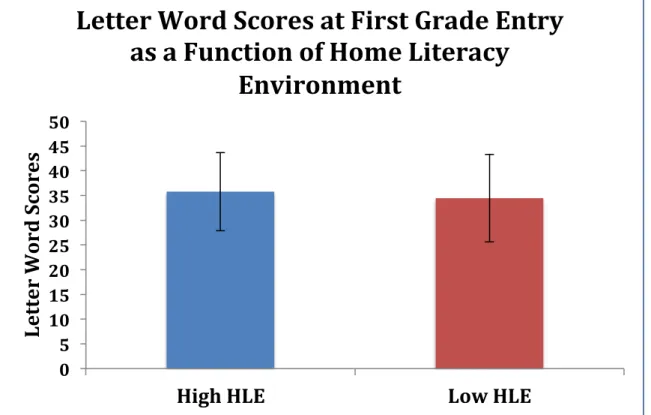
HLE to compare differences between the groups. As displayed in Figure 3, on the Letter Word
Identification task, “high” HLE children had a mean score of 35.77 (SD = 7.90) and low HLE
children had a mean score of 34.55 (SD = 8.83). A one-tailed independent samples t-test found
differences between these groups to be marginally significant as well, t(51)= -1.39, p = .09.
To examine the relationship of home environment and literacy growth across the first
grade year, we performed a correlation between HLE scores and LW difference scores from
Time 1 to Time 3. HLE and LW growth across the year were not significantly correlated, r =
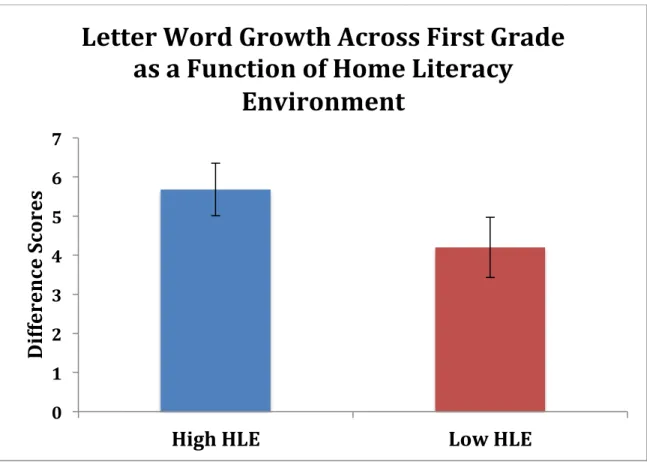
.04, p = .83. As can be seen in Figure 4, when examined as a function of “high” versus “low”
HLE groups, “high” HLE children had a mean difference score of 5.68 (SD = 3.12) and low
HLE children had a mean difference score of 4.20 (SD = 4.22). A one-tailed independent
samples t-test found differences between these groups to be marginally significant, t(50)= -1.39,
p = .09. This suggests that a rich home literacy environment may not only predict higher
literacy performance at the beginning of the first grade year, but more growth across the course
of the year as well.
Linking Teacher Mnemonic Orientation and Literacy Outcomes
To examine growth in literacy skills over the course of the first grade year as a function
of teacher mnemonic orientation, we examined pre- and post-test scores for the Letter Word
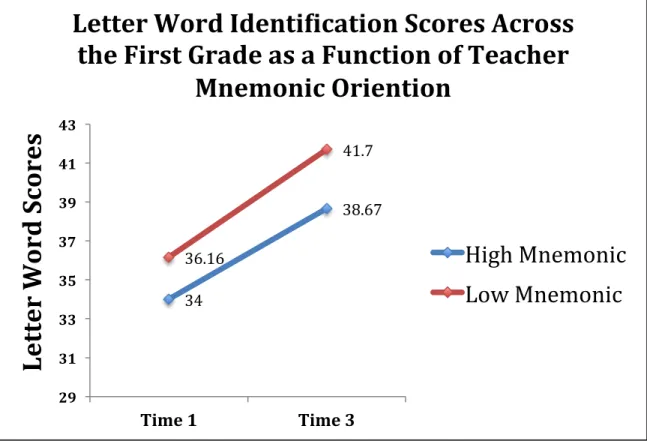
Identification task between high mnemonic and low mnemonic classrooms. As displayed in
Figure 5, at Time 1 students in low mnemonic classrooms had an average score of 36.16 (SD =
8.69) and students in high mnemonic classrooms had an average score of 34 (SD = 7.23). At
Time 3, students in low mnemonic classrooms had an average score of 41.70 (SD = 8.45) and
seen in Figure 5, the lines are almost parallel and are quite close to each other, suggesting no
notable differences between the groups at either time point.
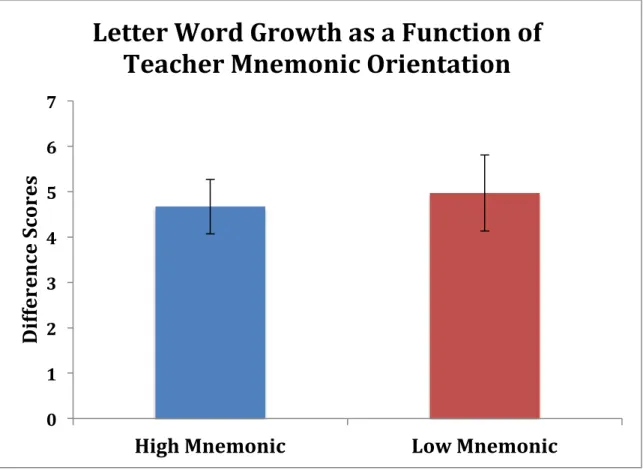
To further analyze growth in Letter Word scores across the year, a difference score was
created for the Letter-Word Identification task by subtracting participants’ scores at Time 1 from
their scores at Time 3. These difference scores were then analyzed as a function of teacher
mnemonic orientation, which can be seen in Figure 6. As seen in the figure, children in high
mnemonic classrooms had a mean difference score of 4.67 (SD = 2.96), whereas children in low
mnemonic classrooms had a mean difference score of 4.97 (SD = 4.45), again suggesting that
growth across the year did not differ between children with low mnemonic teachers versus
children with high mnemonic teachers. Consistent with inspection of Figures 5 and 6,
differences between the two groups were not significant, t (49) = .27, p = .79.
Interplay of Home and Classroom and Literacy Outcomes
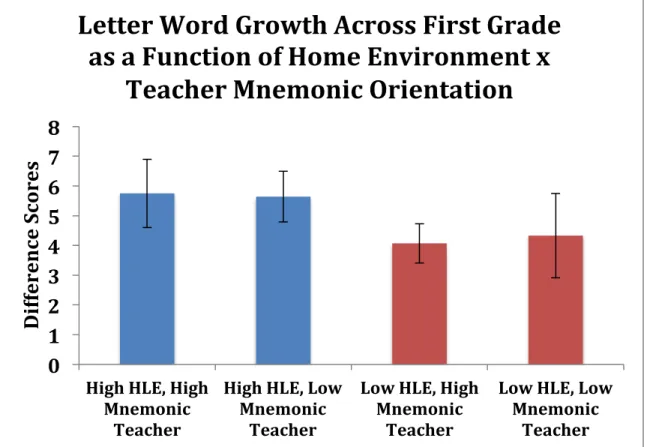
Finally, we sought to examine children’s literacy performance as a function of the
interplay between home environment and teacher talk. To do this a composite score was created
for each child using both HLE group and teacher mnemonic group. Children were split into 4
groups: (1) high HLE and low mnemonic teacher, (2) high HLE and low mnemonic teacher, (3)
low HLE and high mnemonic teacher, and (4) low HLE and low mnemonic teacher. Letter
Word difference scores were then examined to measure growth across the year as a function of
this interplay. As can be seen in Figure 7, children with both a high HLE and high mnemonic
teacher increased an average of 5.75 across the year (SD = 3.2). Students with a high HLE and
low mnemonic teacher had an average difference score of 5.64 (SD = 3.2). Students with a low
HLE and high mnemonic teacher improved an average of 4.07 (SD = 2.5), and students with a
ANOVA did not reveal any significant differences between these groups, F (51) = 1.93, p = .17.
Though there were no significant differences between the groups, inspection of Figure 7 suggests
that children with in the high HLE group performed generally better than children in the low
HLE group for both measures, regardless of teacher mnemonic orientation.
Discussion
The purpose of this study was to examine literacy outcomes in the first grade as a
function of both teacher language and home environment. We expected the home literacy
environment to predict greater literacy performance at first grade entry. Furthermore, previous
research has well established an association between both parent conversation and teacher
memory-relevant talk and the development of memory (Coffman et al., 2008; Ornstein et al,
2010). Preliminary research on math outcomes suggests that these relations may extend into
achievement domains, as well (Hudson, 2012). Given these linkages, we hypothesized that
teacher mnemonic level in the classroom would predict greater growth in literacy skills over the
course of the first grade year. Lastly, we hoped to examine the joint effect of both the home and
classroom environment, hypothesizing that home environment would act as a moderator in the
relationship between teacher language and literacy growth across the first year.
This investigation did find evidence of home effects consistent with what we
hypothesized. The significant relation between Home Literacy scores and child performance on
the Reading Fluency task at the beginning of the first grade confirms the expected linkage
between Home Literacy Environment and literacy. Though the relation observed was not as
strong we expected it would be, it does affirm our hypothesis children with richer home literacy
environments perform better on literacy tasks at the beginning of the first grade year. This is
interest in literacy and the child’s literacy development. Trends on the Letter Words task also
suggested that children from richer home literacy environments experience more literacy growth
over the course of the first grade year. It is not surprising that factors such as parent interest in
reading, time spent reading with children, and books in the home are positively related to child
literacy outcomes, as these factors make up the primary environment to which children are
exposed in the early years of development.
In the classroom context, previous research has suggested that children in classrooms
with high mnemonic teachers show increased recall and more frequent strategy use when
engaged in memory tasks than do children with low mnemonic teachers (Coffman et al., 2008).
Hudson (2012) observed a similar trend in math outcomes as a function of teacher mnemonic
orientation. However, in examining literacy growth across the first grade, we found no evidence
to suggest a linkage between teacher memory talk and literacy outcomes. Literacy scores
between children with high mnemonic teachers and low mnemonic teachers were essentially the
same at both the beginning and end of the year, with the low mnemonic group actually
performing slightly better. Growth across the first grade year was essentially identical for
children with low mnemonic teachers and children with high mnemonic teachers.
It is interesting that we would find no effects of teacher mnemonic orientation in literacy
outcomes when such effects were found in math domains. To understand this it may be
necessary consider the differences in (1) the frequency of memory-relevant language in math
instruction versus language arts instruction, and (2) the relevance of memory-relevant language
to success in each domain. In previous studies of teacher memory talk as well as this study, we
find memory-rich language to be used more frequently in math instruction than in language arts
instruction, which is in large part focused on teaching general strategies to be employed in the
future to solve specific problems (counting, adding, subtracting, etc.) Language arts instruction,
in contrast, encompasses a wider range of activities, such as teachers reading to students,
brainstorming writing material, etc. Though the types of memory-relevant talk we use to score
teachers as “high mnemonic” is still present in language arts instruction, it may be less frequent
than in math instruction simply because it is less relevant to the activities and future goals of
language arts instruction. This could also be reflected in the link between memory-relevant talk
and domain-specific outcomes. It is intuitive that more memory-rich talk predicts higher
memory performance and strategy use. It also makes sense that this relationship would extend to
math performance, given the proportion of math instruction focused on learning strategies to be
implanted repeatedly in certain types of problems. However, given the variety of material
included in language arts lessons, this type of language simply may be less relevant in the
context of language arts instruction how it effects child outcomes.
This investigation also aimed to examine the joint effect of home environment and
teacher language. As our findings did not support a relation between teacher mnemonic
orientation and literacy, we were unable to further evaluate home environment as a moderator for
such a relationship. However, examining literacy outcomes as a function of combined home and
teacher effects reiterates earlier evidence suggesting that home matters regardless of teacher
mnemonic orientation. Between children grouped by both home environment and teacher
mnemonic level, we observed slightly higher scores for children with high HLE scores over
children with low HLE scores, whether their teacher was high or low mnemonic. Though
environment predicts slightly higher literary performance regardless teacher mnemonic
orientation.
One limitation we faced in this investigation was the strength of the measures used to
assess literacy skills. The Letter-Word Identification measure was unfortunately the only
measure for which we had data at both the beginning and end of the first grade year. This was
therefore the only measure available with which to evaluate growth in literacy over the course of
the first grade year, as well as to examine joint effects of home environment and teacher
language. This measure is limited in scope in that it only measures word decoding, and does not
measure any comprehension or more complex literacy skills. The Reading Fluency task, which
does assess reading comprehension and semantic decision making, is an example of a task that
may more accurately measure the literacy skills we aimed to evaluate (but again, we
unfortunately only collected data for this at Time 1). The fact Reading Fluency scores were
more strongly correlated with Home Literacy Environment scores than were Letter-Word scores
provides further support for this suggestion. If literacy outcomes were evaluated more
complexly or thoroughly, it is possible that we might start to see patterns more consistent with
those seen in previous research on the linkage between teacher mnemonic language and other
outcomes.
Another limitation to this study was the size of our sample. Dividing the student sample
across 17 classrooms lead to a small sample size per individual classroom. Additionally, there
was a good deal of variability in sample sizes between classrooms. The fact that sample sizes for
individual classrooms were so small could be a contributing factor to the variability in student
outcomes within individual classrooms. We attempted to address this by creating a median split
“high-mnemonic” or “low-“high-mnemonic” teachers; however, larger, more equally distributed sample
would have lessened the potential influence variability between individual student outcomes.
Furthermore, larger samples within classrooms would have made it more feasible to examine
student outcomes as a function of teacher mnemonic orientation on a continuum, which may
have revealed patterns more consistent with our hypotheses.
A third and important limitation of this study was our failure to account for demographic
differences within our sample. Though we were unable to account demographic school effects in
our analyses, preliminary examination of the sample suggests notable differences in student
outcomes between the four schools from which we gathered our data. These differences could
be attributed to a mix of factors including the location of the schools and SES of the student
populations at those schools. It is possible that some of these factors were at play in the outcomes
observed in this study. Again, a larger sample size could be useful in reducing the effects of
other variables, as could be the case here. However, it may also be useful to take these factors
into account in any further investigations of classroom environments and student achievement.
Although we did not find the relationship we expected between teacher mnemonic
orientation and literacy in the first-grade, there are still practical implications to be noted.
Previous research linking teacher memory talk with memory development and math outcomes
suggests that teacher language is important in facilitating cognitive development during the early
elementary years. This is encouraging in that it suggests that teachers can be trained in the use of
specific types of language in the classroom in order to more positively influence children’s
cognitive development during these early childhood years. If there is truly no relation between
teacher memory talk and literacy outcomes during these years, as our results suggest, we must
This is especially important when considered in the context of the home effects we do see in
literacy development. We can see that there is a positive relationship between home
environment and child outcomes. This is encouraging for children who do come from rich
literacy environments, but suggests that children who come from less rich home environments
are disadvantaged despite the school context to which they are exposed. If teacher mnemonic
orientation is not the mechanism that facilitates development of literacy skills in these early
years, what is? If researchers can identify the specific mechanisms that contribute to the literacy
development in the classroom, this can be put to practical use in helping students from
disadvantaged home environments to still be able to achieve academic success.
Future research should therefore focus more accurately identifying the factors that matter
to literacy development in early childhood. Our evidence suggests that home is important, but
what factors in the classroom can be addressed to increase potential for students despite their
home backgrounds? Future models should take into account factors such as demographics on
both the student and school level, and should attempt to observe literacy outcomes more
thoroughly in order to understand the complex mix of factors at play in children’s cognitive
development during the early elementary years. Once these relationships are more deeply
understood, this knowledge can be put to practical use in facilitating literacy development during
References
Baker-Ward, L., Ornstein, P. A., & Holden, D. J. (1984). The expression of memorization in
early childhood. Journal of Experimental Child Psychology, 37, 555-575.
Boland, A. M., Haden, C. A., & Ornstein, P. A. (2003). Boosting children's memory by training
mothers in the use of an elaborative conversational style as an event unfolds. Journal of
Cognition and Development, 4, 39-65.
Burrage, M. S., Ponitz, C., McCready, E. A., Shah, P., Sims, B. C., Jewkes, A. M., & Morrison,
F. J. (2008). Age- and schooling-related effects on executive functions in young children:
A natural experiment. Child Neuropsychology, 14, 510-524.
Caravolas, M., Lervåg, A., Mousikou, P., Efrim, C., Litavský, M., Onochie-Quintanilla, E., & ...
Hulme, C. (2012). Common patterns of prediction of literacy development in different
alphabetic orthographies. Psychological Science, 23, 678-686.
Christian, K., Morrison, F. J., Frazier, J. A., & Massetti, G. (2000). Specificity in the nature and
timing of cognitive growth in kindergarten and first grade. Journal of Cognition and
Development, 1, 429-448.
Coffman, J. L., Ornstein, P. A., McCall, L. E., & Curran, P. J. (2008). Linking teachers'
memory-relevant language and the development of children's memory skills. Developmental
Psychology, 44, 1640-1654.
Fivush, R., & Nelson, K. (2004). Culture and language in the emergence of autobiographical
memory. Psychological Science, 15, 573-577.
Fivush, R., Reese, E., & Haden, C. A. (2006). Elaborating on elaborations: Role of maternal
reminiscing style in cognitive and socioemotional Development. Child Development,
Grammer, J. K., Coffman, J. L., Sidney, P. G., & Ornstein, P. A. (Under review). Linking teacher
instruction and student achievement in mathematics: The role of teacher language.
Griffin, E. A., & Morrison, F. J. (1997). The unique contribution of home literacy environment
to differences in early literacy skills 1. Early Child Development and Care, 127, 233-243.
Haden, C. A., Ornstein, P. A., Eckerman, C. O., & Didow, S. M. (2001). Mother–child
conversational interactions as events unfold: Linkages to subsequent remembering. Child
Development, 72, 1016-1031.
Hudson, K. (2012). Mathematics achievement in kindergarten: The effects of maternal
elaboration style, teacher mnemonic style, and self-regulation. Unpublished honors
thesis, University of North Carolina at Chapel Hill.
Klibanoff, R. S., Levine, S. C., Huttenlocher, J., Vasilyeva, M., & Hedges, L. V. (2006).
Preschool children's mathematical knowledge: The effect of teacher 'math talk.'
Developmental Psychology, 42, 59-69.
Kosmidis, M. H., Zafiri, M., & Politimou, N. (2011). Literacy versus formal schooling: Influence
on working memory. Archives of Clinical Neuropsychology, 26, 575-582.
Martini, F., & Sénéchal, M. (2012). Learning literacy skills at home: Parent teaching,
expectations, and child interest. Canadian Journal of Behavioural Science/Revue
Canadienne Des Sciences du Comportement, 44, 210-221.
McGeown, S. P., Johnston, R. S., & Medford, E. (2012). Reading instruction affects the
cognitive skills supporting early reading development. Learning and Individual
Moely, B. E., Hart, S. S., Leal, L., & Santulli, K. A. (1992). The teacher's role in facilitating
memory and study strategy development in the elementary school classroom. Child
Development, 63, 653-672.
Morrison, F. J., Smith, L., & Dow-Ehrensberger, M. (1995). Education and cognitive
development: A natural experiment. Developmental Psychology, 31, 789-799.
Morrison, F. J., & Connor, C. (2002). Understanding schooling effects on early literacy: A
working research strategy. Journal of School Psychology, 40, 493-500.
Nelson, K., & Fivush, R. (2004). The emergence of autobiographical memory: A social
cultural developmental theory. Psychological Review, 111, 486-511.
Ornstein, P. A., Coffman, J. L., & Grammer, J. K. (2009). Learning to remember. In O. A.
Barbarin, B. Wasik (Eds.), Handbook of child development and early education:
Research to practice (pp. 103-122). New York, NY US: Guilford Press.
Ornstein, P. A., Grammer, J. K., & Coffman, J. L. (2010). Teachers' 'mnemonic style' and the
development of skilled memory. In H. Waters, W. Schneider (Eds.), Metacognition,
strategy use, and instruction (pp. 23-53). New York, NY: Guilford Press.
Scribner, S., & Cole, M. (1978). Literacy without schooling: Testing for intellectual effects.
Harvard Educational Review, 48, 448-461.
Skibbe, L. E., Connor, C., Morrison, F. J., & Jewkes, A. M. (2011). Schooling effects on
preschoolers’ self-regulation, early literacy, and language growth. Early Childhood
Research Quarterly, 26, 42-49.
Woodcock, R. W., McGrew, K., & Mather, N. (2001). The Woodcock-Johnson Tests of
Figures & Tables
Figure 1. Children’s performance on the Letter Word Identification task at the beginning and end of the first grade.
35.37
40.19
32 33 34 35 36 37 38 39 40 41
Time 1 Time 3
Le
tt
er
W
or
d
S
co
re
s
Figure 2. Children’s performance on the Reading Fluency task at the beginning of the first grade as a function of home environment.
0 5 10 15 20 25
High HLE
Low HLE
R
ea
d
in
g
Fl
u
en
cy
S
co
re
s
Reading Fluency Scores at First Grade
Entry as a Function of Home
Figure 3. Children’s performance on the Letter Word Identification task at the beginning of the first grade as a function of home environment.
0 5 10 15 20 25 30 35 40 45 50
High HLE
Low HLE
Le
tt
er
W
or
d
S
co
re
s
Letter Word Scores at First Grade Entry
as a Function of Home Literacy
Figure 4. Children’s growth on the Letter Word Identification task as a function of home environment.
0 1 2 3 4 5 6 7
High HLE
Low HLE
D
if
fe
re
n
ce
S
co
re
s
Letter Word Growth Across First Grade
as a Function of Home Literacy
Figure 5. Children’s performance on the Letter Word Identification task at the beginning and end of the first grade as a function of teacher mnemonic orientation.
34
38.67
36.16
41.7
29 31 33 35 37 39 41 43
Time 1 Time 3
Le
tt
er
W
or
d
S
co
re
s
Letter Word Identi>ication Scores Across
the First Grade as a Function of Teacher
Mnemonic Oriention
Figure 6. Children’s growth on the Letter Word Identification task across the first grade as a function of teacher mnemonic orientation.
0 1 2 3 4 5 6 7
High Mnemonic
Low Mnemonic
D
if
fe
re
n
ce
S
co
re
s
Figure 7. Children’s growth on the Letter Word Identification task as a function of the interplay between home environment and teacher mnemonic orientation.
0
1
2
3
4
5
6
7
8
High HLE, High Mnemonic
Teacher
High HLE, Low Mnemonic
Teacher
Low HLE, High Mnemonic
Teacher
Low HLE, Low Mnemonic
Teacher