Exponentially Decaying Bag-of-Words Input Features for Feed-Forward
Neural Network in Statistical Machine Translation
Jan-Thorsten Peter, Weiyue Wang, Hermann Ney
Human Language Technology and Pattern Recognition, Computer Science Department RWTH Aachen University, 52056 Aachen, Germany
{peter,wwang,ney}@cs.rwth-aachen.de
Abstract
Recently, neural network models have achieved consistent improvements in
sta-tistical machine translation. However,
most networks only use one-hot encoded input vectors of words as their input. In this work, we investigated the ex-ponentially decaying bag-of-words input features for feed-forward neural network translation models and proposed to train the decay rates along with other weight pa-rameters. This novel bag-of-words model improved our phrase-based state-of-the-art system, which already includes a neural network translation model, by up to 0.5%
BLEU and 0.6% TER on three different
translation tasks and even achieved a simi-lar performance to the bidirectional LSTM translation model.
1 Introduction
Neural network models have recently gained much attention in research on statistical machine trans-lation. Several groups have reported strong im-provements over state-of-the-art baselines when combining phrase-based translation with feed-forward neural network-based models (FFNN) (Schwenk et al., 2006; Vaswani et al., 2013; Schwenk, 2012; Devlin et al., 2014), as well as with recurrent neural network models (RNN) (Sundermeyer et al., 2014). Even in alternative translation systems they showed remarkable per-formance (Sutskever et al., 2014; Bahdanau et al., 2015).
The main drawback of a feed-forward neural network model compared to a recurrent neural network model is that it can only have a limited
context length on source and target sides. Using theBag-of-Words (BoW) model as additional in-put of a neural network based language model, (Mikolov et al., 2015) have achieved very simi-lar perplexities on automatic speech recognition tasks in comparison to the long short-term mem-ory (LSTM) neural network, whose structure is much more complex. This suggests that the bag-of-words model can effectively store the longer term contextual information, which could show improvements in statistical machine translation as well. Since the bag-of-words representation can cover as many contextual words without further modifying the network structure, the problem of limited context window size of feed-forward neu-ral networks is reduced. Instead of predefining fixed decay rates for the exponentially decaying bag-of-words models, we propose to learn the de-cay rates from the training data like other weight parameters in the neural network model.
2 The Bag-of-Words Input Features
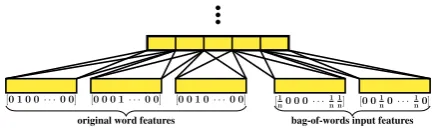
The bag-of-words model is a simplifying repre-sentation applied in natural language processing. In this model, each sentence is represented as the set of its words disregarding the word order. Bag-of-words models are used as additional input fea-tures to feed-forward neural networks in addition to the one-hot encoding. Thus, the probability of the feed-forward neural network translation model
with anm-word source window can be written as:
p(eI1|f1J)≈YI
i=1
p(ei|fbbii+∆m−∆m, fBoW,i) (1)
where∆m = m−21 andbiis the index of the single
aligned source word to the target wordei. We
ap-plied theaffiliationtechnique proposed in (Devlin
et al., 2014) for obtaining the one-to-one
ments. The bag-of-words input featuresfBoW,ican
be seen as normalizedn-of-N vectors as
demon-strated in Figure 1, wherenis the number of words
inside each bag-of-words.
[0 1 0 0· · ·0 0] [0 0 0 1· · ·0 0] [0 0 1 0· · ·0 0] [1
[image:2.595.70.288.127.193.2]n0 0 0· · ·1n1n] [0 01n0· · ·1n0] original word features bag-of-words input features
Figure 1: The bag-of-words input features along with the original word features. The input vectors are projected and concatenated at the projection layer. We omit the hidden and output layers for simplification, since they remain unchanged.
2.1 Contents of Bag-of-Words Features Before utilizing the bag-of-words input features we have to decide which words should be part of it. We tested multiple different variants:
1. Collecting all words of the sentence in one bag-of-words except the currently aligned word.
2. Collecting all preceding words in one bag-of-words and all succeeding bag-of-words in a second bag-of-words.
3. Collecting all preceding words in one bag-of-words and all succeeding bag-of-words in a second bag-of-words except those already included in the source window.
All of these variants provide the feed-forward neural network with an unlimited context in both directions. The differences between these setups
only varied by 0.2% BLEU and 0.1% TER. We
choose to base further experiments on the last vari-ant since it performed best and seemed to be the most logical choice for us.
2.2 Exponentially Decaying Bag-of-Words Another variant is to weight the words within the of-words model. In the standard bag-of-words representation these weights are equally distributed for all words. This means the bag-of-words input is a vector which marks if a word is given or not and does not encode the word
or-der. To avoid this problem, theexponential decay
approach proposed in (Clarkson and Robinson, 1997) has been adopted to express the distance of
contextual words from the current word. There-fore the bag-of-words vector with decay weights can be defined as following:
˜
fBoW,i= X
k∈SBoW
d|i−k|f˜k (2)
where
i, k Positions of the current word and words
within the BoW model respectively.
˜
fBoW,i The value vector of the BoW input
fea-ture for thei-th word in the sentence.
˜
fk One-hot encoded feature vector of thek
-th word in -the sentence.
SBoW Indices set of the words contained in the
BoW. If a word appears more than once in the BoW, the index of the nearest one to the current word will be selected.
d Decay rate with float value ranging from
zero to one. It specifies how fast weights of contextual words decay along with dis-tances, which can be learned like other weight parameters of the neural network. Instead of using fixed decay rate as in (Irie et al., 2015), we propose to train the decay rate like other weight parameters in the neural network. The ap-proach presented by (Mikolov et al., 2015) is com-parable to the corpus decay rate shown here, ex-cept that their work makes use of a diagonal ma-trix instead of a scalar as decay rate. In our ex-periments, three different kinds of decay rates are trained and applied:
1. Corpus decay rate: all words in vocabulary share the same decay rate.
2. Individual decay rate for each bag-of-words: each bag-of-words has its own decay rate given the aligned word.
3. Individual decay rate for each word: each word uses its own decay rate.
We use the English sentence
“friends had been talking about thisfishfor a long time” as an example to clarify the differences between these variants. A five words contextual window
centered at the current aligned word fish has
been applied: {about, this, fish, for, a}.
other source words outside the context window: {friends,had,been,talking}and{long,
time}. Furthermore, there are multiple choices
for assigning decay weights to all these words in the bag-of-words feature:
Sentence: friends had been talkingabout thisfish for along time
Distance: 6 5 4 3 3 4
1. Corpus decay rate: d
Weights: d6 d5 d4 d3 d3 d4
2. Bag-of-words individual decay rate:d=dfish
Weights: d6
fish d5fish d4fish d3fish d3fish d4fish
3. Word individual decay rate:
d∈ {dfriends, dhad, dbeen, dtalking, dlong, dtime}
Weights: d6
friendsd5hadd4been d3talking d3longd4time
3 Experiments
3.1 Setup
Experiments are conducted on the IWSLT 2013
German→English, WMT 2015 German→English
and DARPA BOLT Chinese→English translation
tasks. GIZA++ (Och and Ney, 2003) is applied for aligning the parallel corpus. The translation
quality is evaluated by case-insensitive BLEU
(Pa-pineni et al., 2002) and TER(Snover et al., 2006)
metric. The scaling factors are tuned with MERT
(Och, 2003) with BLEU as optimization criterion
on the development sets. The systems are
evalu-ated using MultEval (Clark et al., 2011). In the
experiments the maximum size of the n-best lists applied for reranking is 500. For the translation experiments, the averaged scores are presented on the development set from three optimization runs.
Experiments are performed using the Jane
toolkit (Vilar et al., 2010; Wuebker et al., 2012) with a log-linear framework containing following feature functions:
• Phrase translation probabilities both directions
• Word lexicon features in both directions
• Enhanced low frequency counts
(Chen et al., 2011)
• 4-gram language model
• 7-gram word class language model
(Wuebker et al., 2013)
• Word and phrase penalties
• Hierarchical reordering model
(Galley and Manning, 2008)
Additionally, a neural network translation model, similar to (Devlin et al., 2014), with following configurations is applied for reranking the n-best lists:
• Projection layer size 100 for each word
• Two non-linear hidden layers with 1000 and 500
nodes respectively
• Short-list size 10000 along with 1000 word
classes at the output layer
• 5 one-hot input vectors of words
Unless otherwise stated, the investigations on bag-of-words input features are based on this neural network model. We also integrated our neural net-work translation model into the decoder as pro-posed in (Devlin et al., 2014). The relative im-provements provided by integrated decoding and reranking are quite similar, which can also be con-firmed by (Alkhouli et al., 2015). We therefore decided to only work in reranking for repeated ex-perimentation.
3.2 Exponentially Decaying Bag-of-Words As shown in Section 2.2, the exponential decay approach is applied to express the distance of con-textual words from the current word. Thereby the information of sequence order can be included into bag-of-words models. We demonstrated three dif-ferent kinds of decay rates for words in the bag-of-words input feature, namely the corpus general decay rate, the bag-of-words individual decay rate and the word individual decay rate.
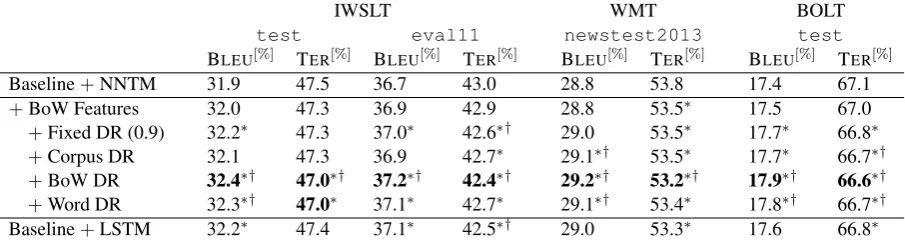
Table 1 illustrates the experimental results of the neural network translation model with ex-ponentially decaying bag-of-words input features
on IWSLT 2013 German→English, WMT 2015
IWSLT WMT BOLT
test eval11 newstest2013 test
BLEU[%] TER[%] BLEU[%] TER[%] BLEU[%] TER[%] BLEU[%] TER[%]
Baseline+NNTM 31.9 47.5 36.7 43.0 28.8 53.8 17.4 67.1
+BoW Features 32.0 47.3 36.9 42.9 28.8 53.5∗ 17.5 67.0
+Fixed DR (0.9) 32.2∗ 47.3 37.0∗ 42.6∗† 29.0 53.5∗ 17.7∗ 66.8∗
+Corpus DR 32.1 47.3 36.9 42.7∗ 29.1∗† 53.5∗ 17.7∗ 66.7∗†
+BoW DR 32.4∗† 47.0∗† 37.2∗† 42.4∗† 29.2∗† 53.2∗† 17.9∗† 66.6∗†
+Word DR 32.3∗† 47.0∗ 37.1∗ 42.7∗ 29.1∗† 53.4∗ 17.8∗† 66.7∗†
[image:4.595.73.526.65.185.2]Baseline+LSTM 32.2∗ 47.4 37.1∗ 42.5∗† 29.0 53.3∗ 17.6 66.8∗
Table 1: Experimental results of translations using exponentially decaying bag-of-words models with
different kinds of decay rates. Improvements by systems marked by∗have a 95% statistical significance
from the baseline system, whereas†denotes the 95% statistical significant improvements with respect to
theBoW Featuressystem (without decay weights). We experimented with several values for the fixed decay rate (DR) and 0.9 performed best. The applied RNN model is the LSTM bidirectional translation model proposed in (Sundermeyer et al., 2014).
translation tasks. Here we applied two bag-of-words models to separately contain the preced-ing and succeedpreced-ing words outside the context win-dow. We can see that the bag-of-words feature without exponential decay weights only provides small improvements. After appending the de-cay weights, four different kinds of dede-cay rates provide further improvements to varying degrees. The bag-of-words individual decay rate performs the best, which gives us improvements by up to
0.5% on BLEUand up to 0.6% on TER. On these
tasks, these improvements even help the feed-forward neural network achieve a similar perfor-mance to the popular long short-term memory re-current neural network model (Sundermeyer et al., 2014), which contains three LSTM layers with 200 nodes each. The results of the word individual decay rate are worse than that of the bag-of-words decay rate. One reason is that in word individual case, the sequence order can still be missing. We initialize all values for the tunable decay rates with
0.9. In the IWSLT 2013 German→English task,
the corpus decay rate is tuned to 0.578. When in-vestigating the values of the trained bag-of-words individual decay rate vector, we noticed that the variance of the value for frequent words is much lower than for rare words. We also observed that most function words, such as prepositions and conjunctions, are assigned low decay rates. We could not find a pattern for the trained value vec-tor of the word individual decay rates.
3.3 Comparison between Bag-of-Words and Large Context Window
The main motivation behind the usage of the bag-of-words input features is to provide the model with additional context information. We compared the bag-of-words input features to different source side windows to refute the argument that simply increasing the size of the window could achieve the same results. Our experiments showed that in-creasing the source side window beyond 11 gave no more improvements while the model that used the bag-of-words input features is able to achieve the best result (Figure 2). A possible explanation for this could be that the feed-forward neural net-work learns its input position-dependent. If one source word is moved by one position the feed-forward neural network needs to have seen a word with a similar word vector at this position dur-ing traindur-ing to interpret it correctly. The likeli-hood of precisely getting the position decreases with a larger distance. The bag-of-words model on the other hand will still get the same input only slightly stronger or weaker on the new distance and decay rate.
4 Conclusion
im-3 5 7 9 11 15 21 36.5
36.6 36.7 36.8 36.9 37 37.1 37.2
Context window size (|input vectors|)
B
L
E
U
scores
on
eval
5 words + 2 BoWs
Figure 2: The change of BLEU scores
on the eval11 set of the IWSLT 2013
German→English task along with the source
context window size. The source windows are always symmetrical with respect to the aligned word. For instance, window size five denotes that two preceding and two succeeding words along with the aligned word are included in the window. The average sentence length of the corpus is about 18 words. The red line is the result of using a model with bag-of-words input features and a bag-of-words individual decay rate.
provements, since the original bag-of-words rep-resentation does not include information about the ordering of each word. To avoid this problem, we applied the exponential decay weight to express the distances between words and propose to train the decay rate as other weight parameters of the network. Three different kinds of decay rates are proposed, the bag-of-words individual decay rate performs best and provides improvements by
av-eragely 0.5% BLEU on three different translation
tasks, which is even able to outperform a bidirec-tional LSTM translation model on the given tasks. By contrast, applying additional one-hot encoded input vectors or enlarging the network structure can not achieve such good performances as bag-of-words features.
Acknowledgments
This paper has received funding from the Euro-pean Union’s Horizon 2020 research and
innova-tion programme under grant agreement no645452
(QT21).
References
Tamer Alkhouli, Felix Rietig, and Hermann Ney. 2015. Investigations on phrase-based decoding with recur-rent neural network language and translation
mod-els. InEMNLP 2015 Tenth Workshop on Statistical
Machine Translation (WMT 2015), pages 294–303, Lisbon, Portugal, September.
Dzmitry Bahdanau, Kyunghyun Cho, and Yoshua Ben-gio. 2015. Neural machine translation by jointly
learning to align and translate. In Proceedings of
the 3rd International Conference on Learning Rep-resentations, San Diego, CA, USA, May.
Boxing Chen, Roland Kuhn, George Foster, and Howard Johnson. 2011. Unpacking and Transform-ing Feature Functions: New Ways to Smooth Phrase
Tables. InProceedings of MT Summit XIII, pages
269–275, Xiamen, China, September.
Jonathan H. Clark, Chris Dyer, Alon Lavie, and Noah A. Smith. 2011. Better Hypothesis Testing for Statistical Machine Translation: Controlling for Op-timizer Instability. In Proceedings of the 49th An-nual Meeting of the Association for Computational Linguistics: Short Papers, pages 176–181, Portland, OR, USA, June.
P. Clarkson and A. Robinson. 1997. Language Model Adaptation Using Mixtures and an Exponentially
Decaying Cache. InProceedings of the 1997 IEEE
International Conference on Acoustics, Speech, and Signal Processing, pages 799–802, Washington, DC, USA, April.
Jacob Devlin, Rabih Zbib, Zhongqiang Huang, Thomas Lamar, Richard Schwartz, and John Makhoul. 2014. Fast and robust neural network joint models for sta-tistical machine translation. In Proceedings of the 52nd Annual Meeting of the Association for Com-putational Linguistics, pages 1370–1380, Baltimore, MD, USA, June.
Michel Galley and Christopher D. Manning. 2008. A simple and effective hierarchical phrase reordering
model. In Proceedings of the 2008 Conference on
Empirical Methods in Natural Language
Process-ing, pages 848–856, Honolulu, HI, USA, October.
Kazuki Irie, Ralf Schlter, and Hermann Ney. 2015. Bag-of-Words Input for Long History Representa-tion in Neural Network-based Language Models for
Speech Recognition. In Proceedings of the 16th
Annual Conference of International Speech Com-munication Association, pages 2371–2375, Dresden, Germany, September.
Franz Josef Och and Hermann Ney. 2003. A Sys-tematic Comparison of Various Statistical
Align-ment Models. Computational Linguistics, 29:19–
51, March.
Franz Josef Och. 2003. Minimum Error Rate Train-ing in Statistical Machine Translation. In Proceed-ings of the 41st Annual Meeting on Association for Computational Linguistics, pages 160–167, Sap-poro, Japan, July.
Kishore Papineni, Salim Roukos, Todd Ward, and Wei-Jing Zhu. 2002. BLEU: A Method for Automatic
Evaluation of Machine Translation. InProceedings
of the 40th Annual Meeting on Association for Com-putational Linguistics, pages 311–318, Philadelphia, PA, USA, July.
Holger Schwenk, Daniel D´echelotte, and Jean-Luc Gauvain. 2006. Continuous space language models for statistical machine translation. InProceedings of the 44th Annual Meeting of the International Com-mittee on Computational Linguistics and the Asso-ciation for Computational Linguistics, pages 723– 730, Sydney, Australia, July.
Holger Schwenk. 2012. Continuous space translation models for phrase-based statistical machine transla-tion. InProceedings of the 24th International Con-ference on Computational Linguistics, pages 1071– 1080, Mumbai, India, December.
Matthew Snover, Bonnie Dorr, Richard Schwartz, Lin-nea Micciulla, and John Makhoul. 2006. A study of translation edit rate with targeted human
annota-tion. In Proceedings of the Conference of the
As-sociation for Machine Translation in the Americas, pages 223–231, Cambridge, MA, USA, August. Martin Sundermeyer, Tamer Alkhouli, Joern Wuebker,
and Hermann Ney. 2014. Translation modeling with bidirectional recurrent neural networks. In Pro-ceedings of the 2014 Conference on Empirical Meth-ods in Natural Language Processing, pages 14–25, Doha, Qatar, October.
Ilya Sutskever, Oriol Vinyals, and Quoc V. Le. 2014. Sequence to sequence learning with neural net-works. In Z Ghahramani, M Welling, C Cortes, N D
Lawrence, and K Q Weinberger, editors, Advances
in Neural Information Processing Systems 27, pages 3104–3112. Curran Associates, Inc.
Ashish Vaswani, Yinggong Zhao, Victoria Fossum, and David Chiang. 2013. Decoding with large-scale neural language models improves translation. In Proceedings of the 2013 Conference on Empiri-cal Methods in Natural Language Processing, pages 1387–1392, Seattle, WA, USA, October.
David Vilar, Daniel Stein, Matthias Huck, and Her-mann Ney. 2010. Jane: Open Source Hierarchi-cal Translation, Extended with Reordering and
Lex-icon Models. InACL 2010 Joint Fifth Workshop on
Statistical Machine Translation and Metrics MATR, pages 262–270, Uppsala, Sweden, July.
Joern Wuebker, Matthias Huck, Stephan Peitz, Malte Nuhn, Markus Freitag, Jan-Thorsten Peter, Saab
Mansour, and Hermann Ney. 2012. Jane 2:
Open Source Phrase-based and Hierarchical Statis-tical Machine Translation. InInternational Confer-ence on Computational Linguistics, pages 483–491, Mumbai, India, December.
Joern Wuebker, Stephan Peitz, Felix Rietig, and Her-mann Ney. 2013. Improving Statistical Machine
Translation with Word Class Models. In