Proceedings of the 13th International Workshop on Semantic Evaluation (SemEval-2019), pages 119–124 119
UC Davis at SemEval-2019 Task 1: DAG Semantic Parsing with
Attention-based Decoder
Dian Yu
University of California, Davis [email protected]
Kenji Sagae
University of California, Davis [email protected]
Abstract
We present a simple and accurate model for semantic parsing with UCCA as our submis-sion for SemEval 2019 Task 1. We propose an encoder-decoder model that maps strings to di-rected acyclic graphs. Unlike many transition-based approaches, our approach does not use a state representation, and unlike graph-based parsers, it does not score graphs directly. Instead, we encode input sentences with a bidirectional-LSTM, and decode with self-attention to build a graph structure. Results show that our parser is simple and effective for semantic parsing with reentrancy and discon-tinuous structures.
1 Introduction
Semantic parsing aims to capture structural re-lationships between input strings and graph rep-resentations of sentence meaning, going beyond concerns of surface word order, phrases and re-lationships. The focus on meaning rather than surface relations often requires the use of reen-trant nodes and discontinuous structures. Uni-versal Conceptual Cognitive Annotation (UCCA) (Abend and Rappoport,2013) is designed to sup-port semantic parsing with mappings between sen-tences and their corresponding meanings in a framework intended to be applicable across lan-guages.
SemEval 2019 Task 1 (Hershcovich et al., 2018b,2019) focuses on semantic parsing of texts into graphs consisting of terminal nodes that repre-sent words, non-terminal nodes that reprerepre-sent in-ternal structure, and labeled edges representing re-lationships between nodes (e.g. participant, cen-ter, linker, adverbial, elaborator), according to the UCCA scheme. Annotated datasets are pro-vided, and participants are evaluated in four set-tings: English with domain-specific data, English
with out-of-domain data, German with domain-specific data, and French with only development and test data, but no training data. Additionally, there are open and closed tracks, where the use of additional resources is and is not allowed, respec-tively. Our entry in the task is limited to the closed track and the first setting, domain-specific English using the Wiki corpus, where the relatively small dataset (4113 sentences for training, 514 for devel-opment, and 515 for testing) consists of annotated sentences from English Wikipedia.
Our model follows the encoder-decoder archi-tecture commonly used in state-of-the-art neural parsing models (Kitaev and Klein, 2018; Kiper-wasser and Goldberg, 2016b; Cross and Huang, 2016; Chen and Manning, 2014). However, we propose a very simple decoder architecture that relies only on a recursive attention mechanism of the encoded latent representation. In other words, the decoder does not require state encod-ing and model-optimal inference whatsoever. Our novel model achieved a macro-averaged F1-score of 0.753 in labeled primary edges and 0.864 in unlabeled primary edge prediction on the test set. The results confirm the suitability of our proposed model to the semantic parsing task.
2 Related work
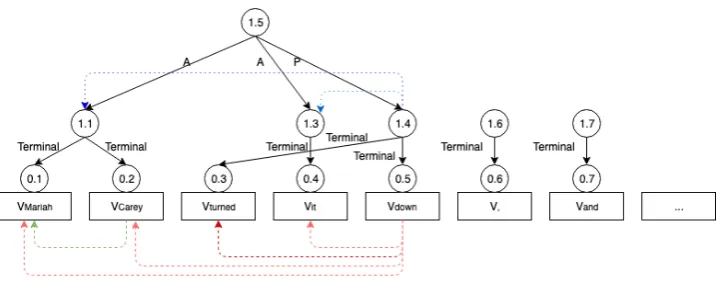
Figure 1: Illustration of the decoder for the beginning of a sentence, “Mariah Carey turned it down, and ...”. Eachvi represents the context embedding for each wordifrom the BiLSTM encoder. Words on edges represent
category labels between nodes, whereAis participant andPis process. Circles represent nodes in the graph, each with a pair in indices. Circles with0as the first index are terminal nodes, and circles with 1as the first index are non-terminal nodes. (1). Dashed green lines represent the attention mechanism for the wordCarey, which forms a continuous proper noun “Mariah Carey”. (2). Dashed red lines represent the attention mechanism for the worddown, which forms a discontinuous unit “turned ... down”. (3). Dotted blue lines represent the attention mechanism fornode1.4. The darker the color, the higher the attention score.
the requirements of reentrancy, discontinuity, and non-terminals, other powerful parsers were shown to be less suitable for parsing with UCCA ( Hersh-covich et al.,2017).
3 Parsing Model
BiLSTM models are capable of providing feature representations with sequential data, and atten-tion mechanisms (Vaswani et al.,2017) have been applied successfully to parsing tasks (Kitaev and Klein,2018). Inspired by their success, our model uses a BiLSTM encoder and a self-attention de-coder. The encoder represents each node (terminal and non-terminal) in the DAG without the need to encode features and the current parser state. The proposed decoder takes the encoded repre-sentation as the configuration and uses attention mechanism. Without any additional feature ex-traction, it serves a similar role as an oracle and a transition-system in transition-based parsers. We jointly train a label prediction model and a discon-tinuity prediction model. We predict remote edges with a different encoder. An example of the pars-ing model can be seen in Figure1.
3.1 Terminal Nodes
To mitigate sparsity due to the small amount of training data available, we concatenate part-of-speech tags embeddings to word embeddings in terminal nodes. In addition, because the connec-tions between terminal nodes and non-terminal nodes often require identification of named
enti-ties, we also added entity type and case informa-tion as addiinforma-tional knowledge. Given a sentence x = x1, ..., xn, the vector for each input token is thus represented asui = emb(xi)◦emb(posi)◦
emb(entity typei)◦emb(casei), wherecaseiis 1 if the first character of the word is capitalized and 0 otherwise. We use pretrained word embeddings from fastText1 foremb(xi). POS tags and entity types are predicted using external models2and are provided in the training corpus. Each word repre-sentation from the encoder isvi=BiLST M(ui). We assign these contextual word embeddings as vectors to terminal nodes.
3.2 Non-terminal Nodes
For non-terminal nodes with only one terminal node as the child, the representation is the same as its corresponding terminal node, i.e. a contextual word embedding from the BiLSTM encoder. For other non-terminal nodes that have more than one terminal children or non-terminal children (i.e. represent more than one word in the text), we use a span representation. FollowingCross and Huang (2016), we represent the span between the words
xi, xjasvi,j = (fj−fi)◦(bi−bj)wheref0, ..., fn and b0, ..., bn are the output of the forward and backward directions in the BiLSTM, respectively. However, the linear subtractions from a nonlinear recurrent neural network (RNN) as a span approx-imation is not intuitive. Instead, we experimented
1
https://fasttext.cc/
with an additional BiLSTM on the target span
xi, xi+1, ..., xj, similar to the recursive tree repre-sentations in (Socher et al.,2013;Kiperwasser and Goldberg, 2016a) but replaced the feed-forward network with an LSTM. In our experiments with the small dataset in the closed track of the English domain-specific track, this method did not result in improved performance.
3.3 Attention Mechanism For Decoding
Our basic decoding model is inspired by the global attention mechanism used in machine translation. The attention averages the encoded state in each time step in the sequence with trainable weights (Luong et al.,2015). We set a maximum sequence length and calculate the attention weights (in prob-ability) for the left boundary index of the span given the node representationvi,j(i≤j):
hspan=M LP(vi,j) (1)
plef t boundary=sof tmax(hspan) (2)
whereM LP is a multilayer perceptron andhspan is of size (1, max sequence length). We choose
arg maxiplef t boundary as the index of the left boundary of the predicted span. Letjldenote the index of the left most child of the nodej(for ex-ample, in Figure1,jl for node1.5 is 1andjl for
node1.6 is 6)3. If i ≥ jl, then the node attends to itself to indicate that a span cannot be created yet (as is the case fornode1.6 in Figure1).
Oth-erwise, there is a span that forms a semantic unit and we need to create a parent node. For example,
i= 1for thenode1.4, so we create a newnode1.5
which connects the nodes within the span [1: 5], i.e.node1.1,node1.3, andnode1.4.
We do this recursively to attend to a previous in-dex until the node attends to itself. Then we repeat the procedure on the next word in the sequence. The illustration is shown in Figure1 with dotted blue lines. The algorithm is presented in Algo-rithm1below.primary parentindicates the par-ent node to which the currpar-ent node is not a remote child (in the DAG setting, a child node may have multiple parents). We set the maximum number of recurrence to be 7 to prevent excessive node cre-ation during inference.
Despite its simplicity, there are two limitations to this method. One is the restriction of the maxi-mum sequence length. The other is the distinction
3For simplicity, word indices start at 1 in the Figure.
Algorithm 1Index-attention decoder
1: forrecur num = 1 to max recurdo
2: ifi≥jlthen
3: break
4: end if
5: hspan=M LP(vi,j)
6: iattn= argmax
i
sof tmax(hspan)
7: i=primary parent(viattn)l 8: end for
between the indices and the actual words in each sentence. The model may cheat during training to attend to specific indices regardless of the actual words in these indices.
Motivated by the success of biaffine atten-tion(Dozat and Manning,2016) and self-attention models (Vaswani et al.,2017), we replace the in-dex attention decoder with a multiplication model where we can leverage fast optimized matrix mul-tiplication. Similar to the left most child, let jr denote the index of the right most child ofnodej.
vo = v[1 : jr] where v is the output from the encoder of size (sequence length, batch size, hid-den size). The scoring function is defined as:
hi=ReLU(W ×vi+b) (3)
ho=ReLU(W ×vo+b) (4)
mm=matrix multiplication(hi, hTo) (5)
plef t boundary=sof tmax(mm) (6)
Compared to the index attention decoder above, this decoder considers both the index and the span representation and thus is more flexible and ro-bust to new texts. The recurrence call remains the same by replacing line5and6in Algorithm1with equations3−6.
3.4 Label Prediction
previous research with RNN models, the contex-tual information is lost for a relatively long sen-tence. Therefore, similar to the label prediction problem with dependency parsers, we use a MLP to predict the label of a spanvi,j given its context
p=primary parent(vi,j).
h=ReLU(Wl1×(p◦vi,j) +b1l) (7)
l=argmax l
sof tmax(Wl2∗h+b2l) (8)
We also experimented with only using span repre-sentation as seen in constituency parsing (Gaddy et al.,2018) by replacing(p◦vi,j)withvi,jin equa-tion7. Surprisingly, this increased the F1 score on the development set by1.4points. We conjecture that this is due to the limited amount of training data, which makes it more difficult to learn noisier representations.
3.5 Discontinuous Unit
After finding the left boundary of the current span unit as shown in section 3.3, we use two MLPs for binary classification to check (1) if the span forms a proper noun with which we need to com-bine multiple terminal nodes to one non-terminal node (as “Mariah Carey” in Figure1) and (2) if the span forms a discontinuous unit (such as “turn ... down” in Figure1).
probpropn=Wp2×ReLU(Wp1×vi,j+b1p) +b2p (9)
probdiscont=Wd2×ReLU(Wd1×vi,j+b1d) +b2d (10) If the node span attends to a node in the left and the model predicts a proper noun, we will cre-ate a non-terminal node and links all the terminal nodesi, i+ 1, ..., jas its terminal children (shown as dashed green lines in Figure1).
If the model predicts that the span is a discon-tinuous unit, instead of connecting all the terminal nodes as its children, the new created node only connectsnodei andnodej, and do the recurrence checks afterwards as shown in Algorithm1 (illus-trated as dashed red lines in Figure1).
3.6 Remote Edges
We predict remote edges the same way as the ma-trix multiplication decoder for primary edges. We use a different BiLSTM encoder to learn represen-tations and avoid confusion between attention to primary edges and remote edges.
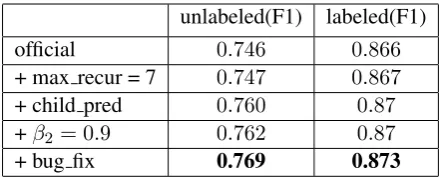
unlabeled(F1) labeled(F1)
official 0.746 0.866
+ max recur = 7 0.747 0.867
+ child pred 0.760 0.87
+β2 = 0.9 0.762 0.87
[image:4.595.306.526.62.151.2]+ bug fix 0.769 0.873
Table 1: F1 score on primary edges evaluated on the development set
4 Training and Inference
During training, nodei attends to the left most child of its primary parent (nodep) recursively un-tilnodepis not the left most child ofnodep’s par-ent. Because a span representation contains infor-mation from both left to right and right to left,
nodei with the highest attention score not only contains the embedding of its terminal node, but also the span between indexiandjin the text. We use cross entropy loss to jointly train for embed-dings, the BiLSTM encoder, and the decoder.
For inference, we take the output of each token in the text from the BiLSTM encoder as input and create a non-terminal node for each terminal node. We create a new node when the token embedding attends to a different token outside of the current span boundary. The recurrence algorithm for each newly created non-terminal node shown in Algo-rithm1is applied.
5 Experiments
For the encoder, we use a 2-layer, 500 dimensional BiLSTM with 0.2 dropout. The word embedding size is 300 with feature embedding size of 20 each (pos tagging, entity type, and case information). We use Adam optimizer (Kingma and Ba, 2014) withβ2set to 0.9 as suggested byDozat and
Man-ning (2016). Development set is used for early stopping. Because of the small dataset (4113 train-ing sentences), the model overfits after 4 epochs.
6 Results
Table1provides the results on the development set and Table2shows the results on the test set. offi-cial shows results of the model we submitted to the competition with a maximum recursion num-ber of 5 and a β2 = 0.99. We obtained higher
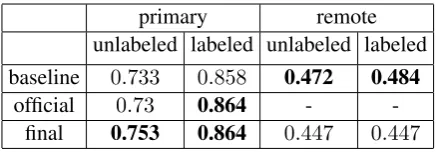
primary remote unlabeled labeled unlabeled labeled baseline 0.733 0.858 0.472 0.484
[image:5.595.72.293.61.137.2]official 0.73 0.864 - -final 0.753 0.864 0.447 0.447
Table 2: F1 score on primary and remote edges re-ported on the test set
as explained in section3.4(+ child pred), chang-ingβ2 as shown in section5(+β2 = 0.9) and
fix-ing minor bugs (+ bug fix) incrementally.baseline
shows the results of the baseline model (TUPA) fromHershcovich et al.(2017).finalshows the re-sults of the model fine-tuned on the development set mentioned in Table1.
Since there are normally 0 or 1 remote edges in each sentence in the training corpus, the remote edge prediction model is not as effective. Still, the model captures some remote relations. For exam-ple, in the sentence “Additionally, Carey’s newly slimmed Figure began to change, as she stopped her exercise routines and gained weight”, the node “gained weight” is predicted to point to “Carey” where the target annotated remote child is “she”. Discontinuous unit prediction also suffers from the problem of insufficient training samples.
7 Conclusion
This paper describes the system that the UC Davis team submitted to SemEval 2019 Task 1. We pro-pose a recursive self-attention decoder with a sim-ple architecture. Our model is effective in UCCA semantic parsing, ranking third in the close track in-domain task with modest fine-tuning, highlight-ing the suitability of our approach.
Acknowledgments
This work was supported by the National Science Foundation under Grant No. 1840191. Any opin-ions, findings, and conclusions or recommenda-tions expressed are those of the authors and do not necessarily reflect the views of the NSF.
References
Omri Abend and Ari Rappoport. 2013. Universal
con-ceptual cognitive annotation (ucca). In ACL (1),
pages 228–238. The Association for Computer Lin-guistics.
Laura Banarescu, Claire Bonial, Shu Cai, Madalina Georgescu, Kira Griffitt, Ulf Hermjakob, Kevin Knight, Philipp Koehn, Martha Palmer, and Nathan Schneider. 2013. Abstract meaning representation for sembanking.
Danqi Chen and Christopher D. Manning. 2014. A fast and accurate dependency parser using neural
net-works. InEMNLP, pages 740–750. ACL.
James Cross and Liang Huang. 2016. Span-based constituency parsing with a structure-label system
and provably optimal dynamic oracles. CoRR,
abs/1612.06475.
Timothy Dozat and Christopher D. Manning. 2016. Deep biaffine attention for neural dependency pars-ing.CoRR, abs/1611.01734.
David Gaddy, Mitchell Stern, and Dan Klein. 2018. What’s going on in neural constituency parsers? an analysis. CoRR, abs/1804.07853.
Daniel Hershcovich, Omri Abend, and Ari Rappoport. 2017. A transition-based directed acyclic graph
parser for UCCA. InProceedings of the 55th
An-nual Meeting of the Association for Computational Linguistics, ACL 2017, Vancouver, Canada, July 30 - August 4, Volume 1: Long Papers, pages 1127– 1138.
Daniel Hershcovich, Omri Abend, and Ari Rappoport. 2018a. Multitask parsing across semantic
represen-tations. In Proceedings of the 56th Annual
Meet-ing of the Association for Computational LMeet-inguis- Linguis-tics, ACL 2018, Melbourne, Australia, July 15-20, 2018, Volume 1: Long Papers, pages 373–385.
Daniel Hershcovich, Zohar Aizenbud, Leshem Choshen, Elior Sulem, Ari Rappoport, and Omri Abend. 2019. Semeval 2019 task 1:
Cross-lingual semantic parsing with UCCA. CoRR,
abs/1903.02953.
Daniel Hershcovich, Leshem Choshen, Elior Sulem, Zohar Aizenbud, Ari Rappoport, and Omri Abend. 2018b. Semeval 2019 shared task: Cross-lingual se-mantic parsing with UCCA - call for participation.
CoRR, abs/1805.12386.
Diederik P. Kingma and Jimmy Ba. 2014. Adam:
A method for stochastic optimization. CoRR,
abs/1412.6980.
Eliyahu Kiperwasser and Yoav Goldberg. 2016a. Easy-first dependency parsing with hierarchical tree lstms.
CoRR, abs/1603.00375.
Eliyahu Kiperwasser and Yoav Goldberg. 2016b. Sim-ple and accurate dependency parsing using
bidi-rectional LSTM feature representations. CoRR,
abs/1603.04351.
Nikita Kitaev and Dan Klein. 2018. Constituency
parsing with a self-attentive encoder. CoRR,
Minh-Thang Luong, Hieu Pham, and Christo-pher D. Manning. 2015. Effective approaches to attention-based neural machine translation. CoRR, abs/1508.04025.
Joakim Nivre, Marie-Catherine de Marneffe, Filip Ginter, Yoav Goldberg, Jan Hajic, Christopher D. Manning, Ryan T. McDonald, Slav Petrov, Sampo Pyysalo, Natalia Silveira, Reut Tsarfaty, and Daniel Zeman. 2016. Universal dependencies v1: A
mul-tilingual treebank collection. In Proceedings of
the Tenth International Conference on Language Resources and Evaluation LREC 2016, Portoroˇz, Slovenia, May 23-28, 2016.
R Socher, A Perelygin, J.Y. Wu, J Chuang, C.D. Man-ning, A.Y. Ng, and C Potts. 2013. Recursive deep models for semantic compositionality over a senti-ment treebank. EMNLP, 1631:1631–1642.
Ashish Vaswani, Noam Shazeer, Niki Parmar, Jakob Uszkoreit, Llion Jones, Aidan N. Gomez, Lukasz Kaiser, and Illia Polosukhin. 2017. Attention is all