Building Better Open-Source Tools to Support Fairness
in Automated Scoring
Nitin Madnani1, Anastassia Loukina1, Alina von Davier2, Jill Burstein1and Aoife Cahill1 1Educational Testing Service, Princeton, NJ
2ACT, Iowa City, IA
1{nmadnani,aloukina,jburstein,acahill}@ets.org
Abstract
Automated scoring of written and spo-ken responses is an NLP application that can significantly impact lives especially when deployed as part of high-stakes tests such as the GRE® and the TOEFL®. Ethical considerations require that auto-mated scoring algorithms treat all test-takers fairly. The educational measument community has done significant re-search on fairness in assessments and au-tomated scoring systems must incorporate their recommendations. The best way to do that is by making available automated,
non-proprietarytools to NLP researchers that directly incorporate these recommen-dations and generate the analyses needed to help identify and resolve biases in their scoring systems. In this paper, we attempt to provide such a solution.
1 Introduction
Natural Language Processing (NLP) applications now form a large part of our everyday lives. As researchers who build such applications, we have a responsibility to ensure that we prioritize the ideas of fairness and transparency and not just blindly pursue better algorithmic performance.
In this paper, we discuss the ethical considera-tions pertaining to automated scoring of written or spoken test responses, referred to as “constructed responses”. Automated scoring is an NLP appli-cation which aims to automatically predict a score for such responses. We focus on automated sys-tems designed to score open-ended constructed response questions. Such systems generally use text and speech processing techniques to extract a set of features from responses which are then combined into a scoring model to predict the
fi-nal score assigned by a human rater (Page, 1966; Burstein et al., 1998; Zechner et al., 2009; Bern-stein et al., 2010).
Test scores whether assigned by human raters or computers can have a significant effect on people’s lives and, therefore, must be fair to all test takers. Automated scoring systems may offer some ad-vantages over human raters, e.g., higher score con-sistency (Williamson et al., 2012). Yet, like any other machine learning algorithm, models used for score prediction may inadvertently encode dis-crimination into their decisions due to biases or other imperfections in the training data, spurious correlations, and other factors (Romei and Rug-gieri, 2013b; von Davier, 2016).1
The paper has the following structure. We first draw awareness to the psychometric research and recommendations on quantifying potential biases in automated scoring and how it relates to the ideas of fairness, accountability, and transparency in machine learning (FATML). The second half of the paper presents an open-source tool called
RSMTool2 for developers of automated scoring
models whichdirectlyintegrates these psychome-tric recommendations. Since such developers are likely to be NLP or machine learning researchers, the tool provides an important bridge from the ed-ucational measurement side to the NLP side. Next, we discuss further challenges related to fairness in automated scoring that are not currently addressed byRSMToolas well as methods foravoidingbias in automated scoring rather than just detecting it. The paper concludes with a discussion of how these tools and methodologies may, in fact, be
ap-1Some of these problems were recently discussed at a
panel focused on Fairness in Machine learning in Educa-tional Measurement that was held at the annual meeting of National Council for Educational Measurement (von Davier and Burstein, 2016).
2http://github.com/
EducationalTestingService/rsmtool
plicable to other NLP applications beyond auto-mated scoring.
2 Ethics and Fairness in Constructed Response Scoring
At this point in the paper, we believe it is important to define exactly what we refer to asfairnessfor the field of scoring constructed responses, whether it is done manually by humans or automatically by NLP systems.
A key concept here is the idea of a “construct” which is defined as a set of related knowledge, skills, and other abilities that a test is designed to measure. Examples of possible constructs include logical reasoning, language proficiency, reading comprehension etc. A fair test is one where dif-ferences in test scores between the test-takers are dueonlyto differences in skills which are part of the construct. Any consistent differences in scores between different groups of test takers that result from other factors notimmediately related to the construct (i.e., “construct-irrelevant”) — e.g., test-taker gender — may indicate that the test is unfair. Specifically, for a test to be fair, the non-random effects of construct-irrelevant factors need to be minimized during the four major phases of a test: test development, test administration, test scoring, and score interpretation (Xi, 2010; Zieky, 2016):
1. Test development. All tests must be free of bias, i.e., no questions on a test should include any content that may advantage or disadvantage any specific subgroup of test-takers in ways that are unrelated to the con-struct the test is designed to assess. The sub-groups in this case are defined based on fac-tors that include test-taker personal informa-tion such as gender, race, or disability, but may also go beyond the standard protected properties. For example, Xi (2010) discusses how familiarity with the subject matter in an English language proficiency test may impact test performance and, thus, would require an explicit analysis of fairness for a group de-fined by test-taker fields of study. Addition-ally, on the same test, test-takers whose na-tive languages use the Roman alphabet will have an advantage over test-takers with native languages based on other alphabets. How-ever, this advantage is allowable because it is relevant to the construct of English compre-hension. To ensure bias-free questions, the
developers of the test conduct both qualita-tive and quantitaqualita-tive reviews of each question (Angoff, 2012; Duong and von Davier, 2013; Oliveri and von Davier, 2016; Zieky, 2016).
2. Test administration. All test-takers must be provided with comparable opportunities to demonstrate the abilities being measured by the test. This includes considerations such as the location and number of test centers across the world, and whether the testing conditions in each test center are standardized and se-cure. For example, Bridgeman et al. (2003) showed that, at least for some tests, exami-nee test scores may be affected by screen res-olution of the monitors used to administer the test. This means that for such tests to be fair, it is necessary to ensure that all test-takers use monitors with a similar configuration. 3. Test scoring. There should also be no bias
in the test scores irrespective of whether they are produced by human raters or by auto-mated scoring models. The unequal distribu-tion of social, economic, and educadistribu-tional re-sources means that some differences in per-formance across subgroups are to be ex-pected. However, differences large enough to have practical consequences must be investi-gated to ensure that they are not caused by construct-irrelevant factors (AERA, 1999). 4. Score interpretation Finally, while most
tests tend to have a constant structure, the actual questions change regularly. Some-times several different versions of a test (“test forms”) exist in parallel. Even if two test-takers take different versions of a test, their test scores should still be comparable. To achieve this, a separate statistical process process called “test equating” is often used to adjust for unintended differences in the diffi-culty of the test forms (Lee and von Davier, 2013; Liu and Dorans, 2016). This process itself must also be investigated for fairness to ensure that it does not introduce bias against any group of test-takers.
In this paper, we focus on the third phase: the
groups are likely to have profound consequences: they may be denied career opportunities and ac-cess to resources that they deserve. Therefore, it is important to ensure — among other things — that construct-irrelevant factors do not intro-duce systematic biases in test scores, irrespective of whether they are produced by human raters or by an automated scoring system.
Over the last few years, there has been a sig-nificant amount of work done on ensuring fair-ness, accountability, and transparency for machine learned models from what is now referred to as the FATML community (Kamiran and Calders, 2009; Kamishima et al., 2012; Luong et al., 2011; Zemel et al., 2013). More recently, Friedler et al. (2016) proposed a formal framework for conceptualizing the idea of fairness. Within that framework, the authors define the idea of “structural bias”: the unequal treatment of subgroups when there is no clear mapping between the features that are easily observable for those subgroups (e.g., largely irrel-evant, culturally and historically defined charac-teristics) and the true features on which algorith-mic decisions should actually be based (the “con-struct”). Our conceptualization of fairness for au-tomated scoring models in this paper — avoiding systematic biases in test scores across subgroups due to construct-irrelevant factors — fits perfectly in this framework.
3 Detecting Biases in Automated Scoring
Human scoring of constructed responses is a sub-jective process. Among the factors that can im-pact the assigned scores are rater fatigue (Ling et al., 2014), differences between novice and ex-perienced raters (Davis, 2015), and the effect of raters’ linguistic background on their evaluation of the language skill being measured (Carey et al., 2011). Furthermore, the same response can sometimes receive different scores from different raters. To guard against such rater inconsistencies, responses for high-stakes tests are often scored by multiple raters (Wang and von Davier, 2014; Pen-field, 2016). Automated scoring of constructed re-sponses can overcome many of these issues inher-ent to human scoring: computers do not get tired, do not have personal biases, and can be config-ured to always assign the same score to a given response.
However, recent studies in machine learning have highlighted that algorithms often introduce
their own biases (Feldman et al., 2015) either due to an existing bias in the training data or due to a minority group being inadequately represented in the training data. Automated scoring is cer-tainly not immune to such biases and, in fact, several studies have documented differing perfor-mance of automated scoring models for test-takers with different native languages or with disabilities (Burstein and Chodorow, 1999; Bridgeman et al., 2012; Wang and von Davier, 2014; Wang et al., 2016; An et al., 2016; Loukina and Buzick, In print).
Biases can also arise because of techniques used to develop new features for automated scoring models. The automated score may be based on features which are construct-irrelevant despite be-ing highly correlated with the human scores in the training data. As an example, consider that more proficient writers tend to write longer responses. Therefore, one almost always observes a consis-tent positive correlation between essay length and human proficiency score (Perelman, 2014; Sher-mis, 2014b). This is acceptable since verbal flu-ency — a correlate of response length — is consid-ered an important part of the writing proficiency. Yet, longer essays should not automatically re-ceive higher scores. Therefore, without proper model validation to consider the relative impact of such features, decisions might be made that are unfair to test-takers.
On this basis, the psychometric guidelines re-quire that if automated scoring models are to be used for making high-stakes decisions for col-lege admissions or employment, the NLP re-searchers developing those models should perform model validation to ensure that demographic and construct-irrelevant factors are not causing their models to produce significant differences in scores across different subgroups of test-takers (Yang et al., 2002; Clauser et al., 2002; Williamson et al., 2012). This is exactly whatfairness– as we define it in this paper – purports to measure.
engine performance. We believe that such a tool should be open-source and non-proprietary so that the automated scoring community can not only au-dit the source code of the already available analy-ses to ensure their compliance with fairness stan-dards but also contribute new analyses.
We describe the design of such a tool in the rest of the paper. Specifically, our tool provides the fol-lowing model validation functionality to NLP/ML researchers working on automated scoring: (a) defining custom subgroups and examining differ-ences in the performance of the automated scor-ing model across these groups; (b) examinscor-ing the effect of construct-irrelevant factors on automated scores; and (c) comparing the effects of such fac-tors in two different versions of the same scoring model, e.g., a version with a new feature added to the model and a version without the same feature.
4 RSMTool
In this section, we present an open-source Python tool calledRSMTooldeveloped by two of the au-thors for building and evaluating automated scor-ing models. The tool is intended for NLP re-searchers who have already extracted features from the responses and need to choose a learner function and evaluate the performance as well as the fairness of the entire scoring pipeline (the training data, the features, and the learner func-tion).
Once the responses have been represented as a set of features, automated scoring essentially be-comes a machine learning problem and NLP re-searchers are free to use any of the large number of existing machine learning toolkits. However, most of those toolkits are general-purpose and do not provide the aforementioned fairness analyses. Instead, we leverage one such toolkit — scikit-learn (Pedregosa et al., 2011) — to build a tool that integrates these fairness analysesdirectlyinto the machine learning pipeline and researchers then get them automatically in the form of a compre-hensive HTML report.
Note that the automated scoring pipeline built into the tool provides functionality for eachstep of the process of building and evaluating auto-mated scoring models: (a) feature transformation, (b) manual and automatic feature selection, and (c) access to linear and non-linear learners from
scikit-learnas well as the custom linear learners we have implemented. In this paper, we will
fo-cus solely on the fairness-driven evaluation capa-bilities of the tool that are directly relevant to the issues we have discussed so far. Readers inter-ested in other parts of the RSMToolare referred to the comprehensive documentation available at
http://rsmtool.readthedocs.org.
Before we describe the fairness analyses im-plemented in the tool, we want to acknowledge that there are many different ways in which re-searchers might approach building as well as eval-uating scoring models (Chen and He, 2013; Sher-mis, 2014a). The list of learners and fairness anal-yses the tool provides is not, and cannot be, ex-haustive. In fact, later in the paper, we discuss some analyses that could be implemented in future versions of the tool since one of the core charac-teristics of the tool is its flexible architecture. See
§4.4 for more details.
In the next section, we present in detail the anal-yses incorporated intoRSMToolaimed at detecting the various sources of biases we introduced earlier. As it is easier to show the analyses in the context of an actual example, we use data from the Hewlett Foundation Automated Student Assessment Prize (ASAP) competition on automated essay scoring (Shermis, 2014a).3 As our scoring model, we
use ordinary linear regression with features ex-tracted from the text of the essay; see Attali and Burstein (2006) for details of the features. Note that since the original ASAP data does not con-tain any demographic information, we simulate an L1 attribute (the test-taker’s native language) for illustration purposes.4 The complete report
auto-matically generated by RSMTool is available at:
http://bit.ly/fair-tool. The report contains
links to the raw data used to generate it and to other input files needed to runRSMTool. We fo-cus on specific sections of the report below.
4.1 Differential Feature Functioning
In order to evaluate the fairness of a machine learning algorithm, Feldman et al. (2015) recom-mend preventive auditing of the training data to determine if the resulting decisions will be fair, ir-respective of the machine learning model learned from that training data.RSMToolincorporates
sev-3https:/www.kaggle.com/c/asap-aes/
data/
4We believe it is more transparent to use a publicly
eral such auditing approaches borrowed from pre-vious research in both educational measurement and machine learning.
The first step in evaluating the fairness of an au-tomated scoring model is to ensure that the per-formance of each feature is not primarily deter-mined by construct-irrelevant factors. The tra-ditional way to approach this is to have an ex-pert review the features and ensure that their de-scription and method of computation are in line with the definition of the specific set of skills that the given test purports to measure (Deane, 2013). However, features incorporated into a modern au-tomated scoring system often rely on multiple un-derlying NLP components such as part-of-speech taggers and syntactic parsers as well as complex computational algorithms and, therefore, a quali-tative review may not be sufficient. Furthermore, some aspects of spoken or written text canonlybe measured indirectly given the current state of NLP technologies (Somasundaran et al., 2014).
RSMTool allows the user to explore the quan-titative effect of two types of construct-irrelevant factors that may affect feature performance: cate-gorical and continuous.
4.1.1 Categorical Factors
This group of factors generally includes variables that can take on one of a fixed number of possible values, e.g., test-takers’ demographic characteris-tics, different versions of the same test question, or various testing conditions. We refer to these factors as “subgroups” though they are not always limited to demographic subgroups.
When this information is available for all or some of the responses, RSMTool allows the user to compare the feature distributions for differ-ent subgroups using box-plots and other distri-butional statistics such as mean and standard de-viations. However, feature distributions depend on the scores which may differ across subgroups and, therefore, differences in a feature’s distri-bution across subgroups may not always indicate that the feature is biased. To address this, RSM-Toolalso includesDifferential feature functioning
(DFF) analysis (Penfield, 2016; Zhang et al., In print). This approach compares the mean values of a given feature for test-takers with the same score but belonging to different subgroups. These dif-ferences can be described and reviewed directly using DFF line plots. Figure 1(a) shows a box-plot for the distribution of the GRAMMAR feature
by test-taker L1 subgroups in our sample dataset; Figure 1(b) shows a DFF line plot for the same feature. These plots indicate that the values for the GRAMMAR feature are consistently lower for one of the test-taker subgroups (L1=Hindi) across all score levels. If such a pattern were observed in real data, it would warrant further investigation to establish the reasons for such behavior.
4.1.2 Continuous Factors
This type of construct-irrelevant factors includes continuous covariates which despite being corre-lated with human scores are eithernotdirectly rel-evant to the construct measured by the test or, even if they are, shouldnotbe the primary contributor to the model’s predictions. Response length, as previously discussed, is an example of such co-variates. Even though it provides an important indication of verbal fluency, a model which pre-dominantly relies on length will not generate fair scores. To explore the impact of such factors,
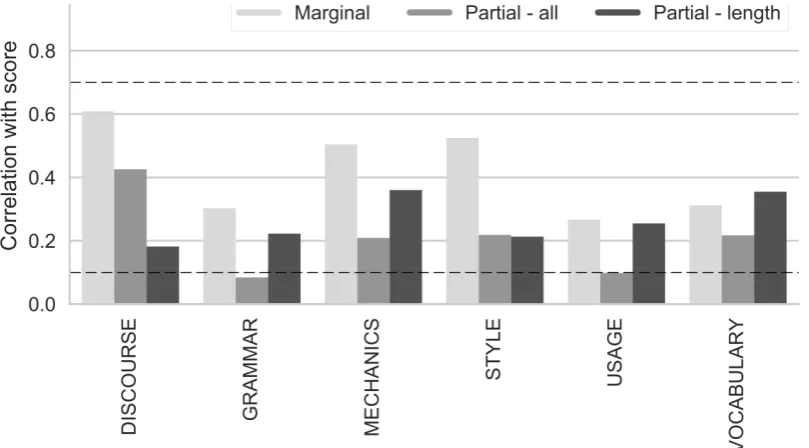
RSMToolcomputes two types of correlations: (a) the marginal correlation between each feature and the covariate, and (b) the “partial” correlation be-tween each feature and the human score, with the effects of the covariate removed (Cram´er, 1947). This helps to clearly bring out the contribution of a feature above and beyond being a proxy for the identified covariate. The marginal and par-tial correlation coefficients for our example are shown in Figure 1(c). It shows that although all features in our simulated dataset contribute infor-mation beyond response length, for some features, length accounts for a substantial part of their per-formance.
4.2 Bias in Model Performance
Not all types of machine learning algorithms lend themselves easily to the differential feature func-tioning analysis. Furthermore, the sheer number of features in some models may make the results of such analyses difficult to interpret. Therefore, a second set of fairness analyses included into
RSMToolconsiders how well the automated scores agree with the human scores (or another, user-specified gold standard criterion) and whether this agreement is consistent across different groups of test-takers.
(a) Box-plots showing the distribution of standard-ized GRAMMAR feature values by test-taker na-tive language (L1). The dotted red lines represent the thresholds for outlier truncation computed as the mean feature value±4 standard deviations.
(b) A differential feature functioning (DFF) plot for the GRAMMAR feature. Each line represents an L1; each point shows the mean and 95% confi-dence intervals of the feature values computed for test-takers with that L1 and that assigned score.
[image:6.595.96.501.397.621.2](c) Pearson’s correlation coefficients (r) between features and human scores: (a)Marginal: marginal correlation of each feature with human score (b)Partial−all: correlation of each feature with human score with the effects of all other features removed, and (c)Partial−length: the correlation of each feature with human score with the effect of response length removed. The two dotted lines represent correlations thresholds recommended by Williamson et al. (2012).
(R2), and root mean squared error (RMSE). In
addition, it also computes other measures that are
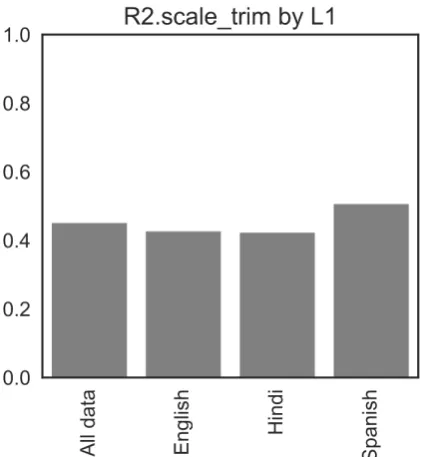
specifically recommended in psychometric liter-ature for evaluating automated scoring models: quadratically-weighted kappa, percentage agree-ment with human scores, and the standardized mean difference (SMD) between human and au-tomated scores (Williamson et al., 2012; Rami-neni and Williamson, 2013). These metrics are computed for the whole evaluation set as well as for each subgroup separately in order to evaluate whether the accuracy of automated scores is con-sistent across different groups of test-takers. Fig-ure 2 shows a plot illustrating how the modelR2
[image:7.595.73.287.295.524.2]computed on the evaluation set varies across the different test-taker L1 subgroups.
Figure 2: The performance of our scoring model (R2) for different subgroups of test-takers as
de-fined by their native language (L1). Before com-puting the R2, the predictions of the model are
trimmed and then re-scaled to match the human score distribution in the training data.
4.3 Model comparison
Like any other software, automated scoring sys-tems are updated on a regular basis as researchers develop new features or identify better machine learning algorithms. Even in scenarios where new features or algorithms are not needed, changes in external dependencies used by the scoring pipeline might necessitate new releases. Automated scor-ing models may also be regularly re-trained to
avoid population drift which can occur when the test-taker population used to train the model no longer matches the populationcurrentlyevaluated by this model.
When updating an automated scoring system for one of the above reasons, one should not only conduct a fairness analysis for the new version of the model, but also a comprehensive compar-ison of the old and the new version. For example, a change in the percentage of existing test-takers who have passed a particular test resulting from the update would need to be explained not only to the test-takers but also to the people making deci-sions based on test scores (von Davier, 2016).
RSMTool includes the functionality to conduct a comprehensive comparison of two different ver-sions of a scoring system and produce a report which includes fairness analyses for each of the versions as well as how these analyses differ be-tween the two versions. As an example, we com-pare two versions of our example scoring model — one that uses all features and another that does not include the GRAMMAR feature. The compar-ison report can be be seen here:http://bit.ly/ fair-tool-compare.
4.4 CustomizingRSMTool
The measurement guidelines currently imple-mented in RSMTool follow the psychometric framework suggested by Williamson et al. (2012). It was developed for the evaluation ofe-rater, an automated system designed to score English writ-ing proficiency (Attali and Burstein, 2006), but is generalizable to other applications of automated scoring. This framework was chosen because it offers a comprehensive set of criteria for both the accuracy as well as the fairness of the predicted scores. Note that not all of these recommenda-tions are universally accepted by the automated scoring community. For example, Yannakoudakis and Cummins (2015) recently proposed a different set of metrics for evaluating the accuracy of auto-mated scoring models.
prediction is generally accurate, then there is a risk that subgroup membership could be implic-itly used by the scoring model and lead to unfair scores. However, if the subgroup prediction has high error over all models generated from the fea-tures, then the scores assigned by a model trained on this data are likely to be fair.
RSMToolhas been designed to make it easy for the user to add new evaluations and analyses of these types. The evaluation and report-generation components of RSMTool (including the fairness analyses) can be run on predictions fromany ex-ternal learner, not just the ones that are provided by the tool itself. Each section of its report is implemented as a separate Jupyter/IPython note-book (Kluyver et al., 2016). The user can choose which sections should be included into the final HTML report and in which order. Furthermore, NLP researchers who want to use different evalu-ation metrics or custom fairness analyses can pro-vide them in the form of new Jupyter notebooks; these analyses are dynamically executed and in-corporated into the final report along with the ex-isting analyses or even in their place, if so desired, without modifying a single line of code.
Finally, for those who want to make more sub-stantive changes, the tool is written entirely in Python, is open-source with an Apache 2.0 li-cense, and has extensive online documentation. We also provide a well-documented API which allows users to integrate various components of
RSMToolinto their own applications.
4.5 Model Transparency & Interpretability
The analyses produced byRSMToolonly suggest a potential bias and flag individual subgroups or features for further consideration. As we indi-cated earlier, the presence of differences across subgroups does not automatically imply that the model is unfair; further review is required to estab-lish the source of such differences. One of the first steps in such a review usually involves examining each feature separately as well as the individual contribution of each feature to the final score. It is important to note here that unfairness may also be introduced by what isnotin the model. An auto-mated scoring system may not cover a particular aspect of the construct which can be evaluated by humans. If the performance across subgroups dif-fers on this aspect of the construct, the difference may be due to “construct under-representation”
rather than due to construct-irrelevant factors. The automated scoring models used in sys-tems such as e-rater for assessing writing profi-ciency in English (Attali and Burstein, 2006) or
SpeechRater for spoken proficiency (Zechner et al., 2009) have traditionally been linear models with a small number of interpretable features be-cause such models lend themselves more easily to a detailed fairness review and allow decision-makers to understand how, and to what extent, dif-ferent parts of the test-takers’ skill set are being covered by the features in the model (Loukina et al., 2015). For such linear models,RSMTool dis-plays a detailed model description including the model fit (R2) computed on the training set as well
as the contribution of each feature to the final score (via raw, standardized, and relative coefficients).
At the same time, recent studies (Heilman and Madnani, 2015; Madnani et al., 2016) on scor-ing actual content rather than just language profi-ciency suggest that it is possible to achieve higher performance, as measured by agreement with hu-man raters, by employing hu-many low-level fea-tures and more sophisticated machine learning al-gorithms such as support vector machines or ran-dom forests. Generally, these models are built us-ing sparse feature types such as wordn-grams, of-ten resulting in hundreds of thousands of predom-inantly binary features. Using models with such a large feature space means that it is no longer clear how to map the individual features and their weights to various parts of the test-takers’ skill set, and, therefore, difficult to identify whether any differences in the model performance stem from the effects of construct-irrelevant factors.
5 Mitigating Bias in Automated Scoring
So far we have primarily discussed techniques fordetectingpotential biases in automated scoring models. We showed that there are multiple sources of possible bias which makes it unlikely that there would be a single “silver bullet” that can make test scores completely bias-free. The approach currently favored in the educational measurement community is to try and reduce susceptibility to construct-irrelevant factors by design. This in-cludes an expert review of each feature before it is added to the model to ensure that it is theoretically and practically consistent with the skill set being measured by the test. These features are then com-bined in an easily interpretable model (usually lin-ear regression) which is trained on a representative sample of test-taker population.
However, simpler scoring models may not al-ways be the right solution. For one, as we dis-cussed in §3, several studies have shown that even such simple models may still exhibit bias. In addition, recent studies on scoring test-takers’ knowledge of content rather than proficiency have shown that using more sophisticated — and hence, less transparent — models yields non-trivial gains in the accuracy of the predicted scores. There-fore, ensuring completely fair automated scoring at large requires more complex solutions.
The machine learning community has identified several broad approaches to deal with discrimina-tion that could, in theory, be used for automated scoring models, especially those using more com-plex non-linear algorithms: the training data can be modified (Feldman et al., 2015; Kamiran and Calders, 2012; Hajian and Domingo-Ferrer, 2013; Mancuhan and Clifton, 2014), the algorithm it-self can be changed so that it optimizes for fair-ness as well as the selection criteria (Kamishima et al., 2012; Zemel et al., 2013; Calders and Verwer, 2010), and the output decisions can be changed after-the-fact (Kamiran et al., 2012). A survey of such approaches is provided by Romei and Rug-gieri (2013a). Future work in automated scoring could explore whether these methods can address some of the known biases.
Of course, it is also important to note that such bias-mitigating approaches often lead to a decline in the overall model performance and, therefore, one needs to balance model fairness and accuracy which likely depends on the stakes for which the model is going to be used.
6 Conclusion
In this paper, we discussed considerations that go into developing fairer automated scoring mod-els for constructed responses. We also presented
RSMTool, an open-source tool to help NLP re-searchers detect potential biases in their scoring models. We described the analyses currently in-corporated into the tool for evaluating the impact of construct-irrelevant categorical and continuous factors. We also showed that the tool is designed in a flexible manner which allows users to easily add their own custom fairness analyses and showed some examples of such analyses.
While RSMTool has been designed for auto-mated scoring research (some terminology in the tool and the report is specific to automated scor-ing), its flexible nature and well-documented API allow it to be easily adapted foranymachine learn-ing task in which the numeric prediction is gener-ated by regressing on a set of non-sparse, numeric features. Furthermore, the evaluation component can be used separately which allows users to eval-uate the performance and fairness of any model that generates numeric predictions.
Acknowledgments
We would like to thank the anonymous review-ers for their valuable comments and sugges-tions. We would also like to thank Lei Chen, Sorelle Friedler, Brent Bridgeman, Vikram Rama-narayanan, and Keelan Evanini for their contribu-tions and comments.
References
AERA. 1999. Standards for Educational and Psy-chological Testing. American Educational Research Association.
Ji An, Vincent Kieftenbeld, and Raghuveer Kan-neganti. 2016. Fairness in Automated Scoring: Screening Features for Subgroup Differences. Pre-sented at the Annual Meeting of the National Coun-cil on Measurement in Education, Washington DC.
William H. Angoff. 2012. Perspectives on Differen-tial Item Functioning Methodology. In P.W. Holland and H. Wainer, editors,Differential Item Function-ing, pages 3–23. Taylor & Francis.
Jared Bernstein, A. Van Moere, and Jian Cheng. 2010. Validating Automated Speaking Tests. Language Testing, 27(3):355–377.
Brent Bridgeman, Mary Lou Lennon, and Altamese Jackenthal. 2003. Effects of Screen Size, Screen Resolution, and Display Rate on Computer-Based Test Performance. Applied Measurement in Educa-tion, 16(3):191–205.
Brent Bridgeman, Catherine Trapani, and Yigal Attali. 2012. Comparison of Human and Machine Scor-ing of Essays: Differences by Gender, Ethnicity, and Country. Applied Measurement in Education, 25(1):27–40.
Jill Burstein and Martin Chodorow. 1999. Automated essay scoring for nonnative english speakers. In
Proceedings of a Symposium on Computer Medi-ated Language Assessment and Evaluation in Nat-ural Language Processing, pages 68–75, Strouds-burg, PA, USA.
Jill Burstein, Karen Kukich, Susanne Wolff, Chi Lu, Martin Chodorow, Lisa Braden-Harder, and Mary Dee Harris. 1998. Automated Scoring Us-ing A Hybrid Feature Identification Technique. In
Proceedings of the 36th Annual Meeting of the As-sociation for Computational Linguistics and 17th In-ternational Conference on Computational Linguis-tics, Volume 1, pages 206–210, Montreal, Que-bec, Canada, August. Association for Computa-tional Linguistics.
Toon Calders and Sicco Verwer. 2010. Three Naive Bayes Approaches for Discrimination-Free Classi-fication. Data Mining journal; special issue with selected papers from ECML/PKDD.
M. D. Carey, R. H. Mannell, and P. K. Dunn. 2011. Does a Rater’s Familiarity with a Candidate’s Pro-nunciation Affect the Rating in Oral Proficiency In-terviews? Language Testing, 28(2):201–219. Hongbo Chen and Ben He. 2013. Automated Essay
Scoring by Maximizing Human-Machine Agree-ment. In Proceedings of the 2013 Conference on Empirical Methods in Natural Language Process-ing, pages 1741–1752, Seattle, Washington, USA, October. Association for Computational Linguistics. Brian E. Clauser, Michael T. Kane, and David B. Swan-son. 2002. Validity Issues for Performance-Based Tests Scored With Computer-Automated Scoring Systems. Applied Measurement in Education, 15(4):413–432.
Harald Cram´er. 1947. Mathematical Methods of Statistics. Princeton University Press.
Larry Davis. 2015. The Influence of Training and Ex-perience on Rater Performance in Scoring Spoken Language.Language Testing, 33:117–135.
Paul Deane. 2013. On the Relation between Auto-mated Essay Scoring and Modern Views of the Writ-ing Construct.Assessing Writing, 18(1):7–24.
Minh Q. Duong and Alina von Davier. 2013. Hetero-geneous Populations and Multistage Test Design. In Roger E. Millsap, L. Andries van der Ark, Daniel M. Bolt, and Carol M. Woods, editors, New Devel-opments in Quantitative Psychology: Presentations from the 77th Annual Psychometric Society Meeting, pages 151–170. Springer New York.
Michael Feldman, Sorelle A. Friedler, John Moeller, Carlos Scheidegger, and Suresh Venkatasubrama-nian. 2015. Certifying and Removing Disparate Im-pact. Proceedings of the 21th ACM SIGKDD Inter-national Conference on Knowledge Discovery and Data Mining, pages 259–268.
Sorelle A. Friedler, Carlos Scheidegger, and Suresh Venkatasubramanian. 2016. On the (Im)possibility of Fairness.CoRR, abs/1609.07236.
Sara Hajian and Josep Domingo-Ferrer. 2013. A Methodology for Direct and Indirect Discrimina-tion PrevenDiscrimina-tion in Data Mining. IEEE Transactions on Knowledge and Data Engineering, 25(7):1445 – 1459.
Michael Heilman and Nitin Madnani. 2015. The Impact of Training Data on Automated Short An-swer Scoring Performance. In Proceedings of the Tenth Workshop on Innovative Use of NLP for Build-ing Educational Applications, pages 81–85, Denver, Colorado, June. Association for Computational Lin-guistics.
Faisal Kamiran and Toon Calders. 2009. Classifying without Discriminating. InProceedings of the IEEE International Conference on Computer, Control and Communication, pages 1–6.
Faisal Kamiran and Toon Calders. 2012. Data Prepro-cessing Techniques for Classification Without Dis-crimination. Knowledge and Information Systems, 33(1):1 – 33.
Faisal Kamiran, Asad Karim, and Xiangliang Zhang. 2012. Decision Theory for Discrimination-aware Classification. InInternational Conference on Data Mining (ICDM).
Toshihiro Kamishima, Shotaro Akaho, Hideki Asoh, and Jun Sakuma. 2012. Fairness-aware Classifier with Prejudice Remover Regularizer. In Proceed-ings of the Joint European Conference on Machine Learning and Knowledge Discovery in Databases, pages 35–50.
Been Kim, Dmitry Malioutov, and Kush Varshney, ed-itors. 2016. Proceedings of the ICML Workshop on Human Interpretability in Machine Learning.
Safia Abdalla, Carol Willing, and Jupyter Develop-ment Team. 2016. Jupyter Notebooks — A Publish-ing Format for Reproducible Computational Work-flows. InProceedings of the 20th International Con-ference on Electronic Publishing. IOS Press. Yi-Hsuan Lee and Alina von Davier. 2013.
Moni-toring Scale Scores over Time via Quality Control Charts, Model-Based Approaches, and Time Series Techniques.Psychometrika, 78(3):557–575. G. Ling, P. Mollaun, and X. Xi. 2014. A Study on the
Impact of Fatigue on Human Raters when Scoring Speaking Responses. Language Testing, 31:479– 499.
Jinghua Liu and Neil J. Dorans. 2016. Fairness in Score Interpretation. In Neil J. Dorans and Linda L. Cook, editors, Fairness in educational assessment and measurement, pages 77–96. Routledge.
Anastassia Loukina and Heather Buzick. In print. Au-tomated Scoring of Speakers with Speech Impair-ments. ETS Research Report Series, In print. Anastassia Loukina, Klaus Zechner, Lei Chen, and
Michael Heilman. 2015. Feature Selection for Automated Speech Scoring. InProceedings of the Tenth Workshop on Innovative Use of NLP for Build-ing Educational Applications, pages 12–19, Denver, Colorado, June. Association for Computational Lin-guistics.
Binh Thanh Luong, Salvatore Ruggieri, and Franco Turini. 2011. k-NN as an Implementation of Situ-ation Testing for DiscriminSitu-ation Discovery and Pre-vention. InProceedings of the 17th ACM SIGKDD international conference on Knowledge discovery and data mining, pages 502–510.
Nitin Madnani and Aoife Cahill. 2016. Automated Scoring of Content. Presented at the panel on Fair-ness and Machine Learning for Educational Prac-tice, Annual Meeting of the National Council on Measurement in Education, Washington DC. Nitin Madnani, Aoife Cahill, and Brian Riordan. 2016.
Automatically Scoring Tests of Proficiency in Music Instruction. In Proceedings of the 11th Workshop on Innovative Use of NLP for Building Educational Applications, pages 217–222, San Diego, CA, June. Association for Computational Linguistics.
Koray Mancuhan and Chris Clifton. 2014. Combat-ing Discrimination UsCombat-ing Bayesian Networks.Artif. Intell. Law, 22(2):211–238.
Mara Elena Oliveri and Alina von Davier. 2016. Psy-chometrics in Support of a Valid Assessment of Lin-guistic Minorities: Implications for the Test and Sampling Designs.International Journal of Testing, 16(3):220–239.
Ellis B. Page. 1966. The Imminence of ... Grad-ing Essays by Computer. The Phi Delta Kappan, 47(5):238–243.
Fabian Pedregosa, Gal Varoquaux, Alexandre Gram-fort, Vincent Michel, Bertrand Thirion, Olivier Grisel, Mathieu Blondel, Peter Prettenhofer, Ron Weiss, Vincent Dubourg, Jake Vanderplas, Alexan-dre Passos, David Cournapeau, Matthieu Brucher, Matthieu Perrot, and douard Duchesnay. 2011. Scikit-learn: Machine learning in Python. Journal of Machine Learning Research, 12:2825–2830.
Randall D. Penfield. 2016. Fairness in Test Scoring. In Neil J. Dorans and Linda L. Cook, editors,Fairness in Educational Assessment and Measurement, pages 55–76. Routledge.
Les Perelman. 2014. When the state of the art is Counting Words.Assessing Writing, 21:104–111.
Chaitanya Ramineni and David M. Williamson. 2013. Automated Essay Scoring: Psychometric Guidelines and Practices. Assessing Writing, 18(1):25–39.
Andrea Romei and Salvatore Ruggieri. 2013a. A Multidisciplinary Survey on Discrimination Analy-sis. The Knowledge Engineering Review, pages 1– 57.
Andrea Romei and Salvatore Ruggieri. 2013b. Dis-crimination Data Analysis: A Multi-disciplinary Bibliography. In Bart Custers, Toon Calders, Bart Schermer, and Tal Zarsky, editors, Discrimination and Privacy in the Information Society: Data Min-ing and ProfilMin-ing in Large Databases, pages 109– 135. Springer Berlin Heidelberg.
Mark D. Shermis. 2014a. State-of-the-art Automated Essay Scoring: Competition, Results, and Future Di-rections from a United States demonstration. As-sessing Writing, 20:53–76.
Mark D. Shermis. 2014b. The Challenges of Emu-lating Human Behavior in Writing Assessment. As-sessing Writing, 22:91–99.
Swapna Somasundaran, Jill Burstein, and Martin Chodorow. 2014. Lexical Chaining for Measuring Discourse Coherence Quality in Test-taker Essays. In Proceedings of COLING 2014, the 25th Inter-national Conference on Computational Linguistics: Technical Papers, pages 950–961, Dublin, Ireland, August. Dublin City University and Association for Computational Linguistics.
Alina von Davier and Jill Burstein. 2016. Fairness and Machine Learning for Educational Practice. Co-ordinated Session, Annual meeting of the National Council on Measurement in Education, Washington DC.
Zhen Wang and Alina von Davier. 2014. Monitor-ing of scorMonitor-ing usMonitor-ing the e-rater automated scorMonitor-ing system and human raters on a writing test. ETS Re-search Report Series, 2014(1):1–21.
Zhen Wang, Klaus Zechner, and Yu Sun. 2016. Mon-itoring the Performance of Human and Automated Scores for Spoken Responses. Language Testing, pages 1–20.
David M. Williamson, Xiaoming Xi, and F. Jay Breyer. 2012. A Framework for Evaluation and Use of Au-tomated Scoring. Educational Measurement: Issues and Practice, 31(1):2–13.
Andrew Gordon Wilson, Been Kim, and William Her-lands, editors. 2016. Proceedings of the NIPS Work-shop on Interpretable Machine Learning for Com-plex Systems.
David H. Wolpert. 1992. Stacked Generalization.
Neural Networks, 5:241–259.
Xiaoming Xi. 2010. How do we go about Investigating Test Fairness? Language Testing, 27(2):147–170. Yongwei Yang, Chad W. Buckendahl, Piotr J.
Juszkiewicz, and Dennison S. Bhola. 2002. A Review of Strategies for Validating Computer-Automated Scoring. Applied Measurement in Ed-ucation, 15(4):391–412, oct.
Helen Yannakoudakis and Ronan Cummins. 2015. Evaluating the Performance of Automated Text Scoring systems. InProceedings of the Tenth Work-shop on Innovative Use of NLP for Building Edu-cational Applications, pages 213–223, Denver, Col-orado, June. Association for Computational Linguis-tics.
Klaus Zechner, Derrick Higgins, Xiaoming Xi, and David M. Williamson. 2009. Automatic Scoring of Non-native Spontaneous Speech in Tests of Spoken English. Speech Communication, 51(10):883–895. Richard S Zemel, Yu Wu, Kevin Swersky, Toniann
Pitassi, and Cynthia Dwork. 2013. Learning fair representations. In Proceedings of ICML, pages 325–333.
Mo Zhang, Neil J. Dorans, Chen Li, and Andre A. Rupp. In print. Differential feature functioning in automated essay scoring. In H. Jiao and R.W. Lis-sitz, editors, Test fairness in the new generation of large-scale assessment.