Towards a Flexible Semantics:
Colour Terms in Collaborative Reference Tasks
Bert Baumgaertner University of California, Davis
Raquel Fern´andez University of Amsterdam [email protected]
Matthew Stone Rutgers University [email protected]
Abstract
We report ongoing work on the development of agents that can implicitly coordinate with their partners in referential tasks, taking as a case study colour terms. We describe algo-rithms for generation and resolution of colour descriptions and report results of experiments on how humans use colour terms for reference in production and comprehension.
1 Introduction
Speakers do not always share identical semantic rep-resentations nor identical lexicons. For instance, a subject may refer to a shape as a diamond while another subject may call that same shape a square (which just happens to be tilted sidewise); or some-one may refer to a particular colour with‘light pink’
while a different speaker may refer to it as‘salmon’. Regardless of these differences, which seem mon place, speakers in dialogue are able to com-municate successfully most of the time. Success-ful communication exploits interlocutors’ abilities to negotiate referring expressions interactively through grounding (Clark and Wilkes-Gibbs, 1986; Clark and Schaefer, 1989), but in many cases interlocutors can already make a good guess at their partners’ in-tentions by relaxing the interpretation of their utter-ances and looking for the referent that best matches this looser interpretation. We are interested in mod-elling this second kind of behaviour computation-ally, to get a better understanding of it and to con-tribute to the development of dialogue systems that are able to better coordinate with their human part-ners.
In this paper we focus on collaborative referen-tial tasks (akin to the classic matching tasks
intro-duced by Krauss and Weinheimer (1966) and Clark and Wilkes-Gibbs (1986)) and take as a case study colour terms. Our focus here is not on the explicit joint negotiation of effective terms, but rather on the deployment of flexible semantic representations that can adapt to the constraints imposed by the context and to the dialogue partner’s language use.
We start by describing our algorithms for genera-tion and resolugenera-tion of colour descripgenera-tions in the next section. In sections 3 and 4, we present results of experiments that investigate how humans use colour terms for reference in production and comprehen-sion. Section 5 compares our model against the ex-perimental data we have collected so far and dis-cusses some directions for future work. We end with a short conclusion in section 6.
2 Reference to Colours: Our Model
Our view of how colour terms are used in referential tasks follows the basic tenets of Gricean pragmat-ics (Grice, 1975) and collaborative reference theo-ries (Clark and Wilkes-Gibbs, 1986), according to which speakers and addressees tend to maximize the success of their joint task while minimizing costs.
In the domain of colour terms, we take this to mean that speakers tend use a basic colour term (e.g.,
‘red’ or ‘blue’) whenever this is enough to iden-tify the target object and resort to an alternative, more specific or complex term (e.g., ‘bordeaux’or
‘navy blue’) in other contexts where the basic term is deemed insufficient. Non-basic terms can be con-sidered more costly because they are less frequent and thus more difficult to retrieve.
Similar ideas are at the core of models for the generation of referring expressions that build on the seminal work of Dale and Reiter (1995). These
proaches, however, rely on a lexicon or database where the properties of potential target objects are associated with specific, predefined terms.1 Our aim is to develop dialogue agents that employ more flex-ible semantic representations, allowing them to (a) refer to target colours with different terms in differ-ent contexts, and (b) resolve the reference of colour terms produced by the dialogue partner by picking up targets that are not rigidly linked to the term in the agent’s lexicon.
2.1 Algorithms
Data. To develop the generation and resolution al-gorithms of our agent, we used a publicly avail-able database of RGB codes and colour terms gen-erated from a colour naming survey created by Ran-dall Monroe (author of the webcomicxkcd.com) and taken by around two hundred thousand par-ticipants.2 This database contains a total of 954 colour terms (corresponding to the colour terms most frequently used by the participants) paired with a unique RGB code corresponding to the location in the RGB colour space which was most frequently named with the colour term in question.
We use this database as the default lexicon of our agent. Amongst the colour terms in the lexicon, we distinguish between basic and non-basic colours. We selected the following as our basic colours: red, purple, pink, magenta, brown, orange, yellow, green, teal, blue, and grey. This selection takes into account the high frequency of these terms in English and is in line with the literature on basic colour terms (Berlin and Kay, 1967; Berlin and Kay, 1991).
Resolution Algorithm. ALIN (ALgorithm for IN-terpretation) is given as input a scene of coloured squares and a colour term. Its output is the square it takes to be the intended target, generated as follows. Assuming the input term is in the lexicon, ALIN compares every colour in the scene to the RGB value of the input (theanchor). ALIN considers a colour
c the intended target if, (a) c is nearest the anchor within a certain distance threshold, and (b) for any other colourc0in the scene within the given distance
1
See, however, van Deemter (2006) for an attempt to deal with vague properties such assizewithin this framework.
2
For further details visit http://blog.xkcd.com/
[image:2.612.335.513.55.127.2]2010/05/03/color-survey-results/.
Figure 1: Two scenes with the brown square (top left in both scenes) as the target; no competitors (left scene) and one potential competitor (right scene).
threshold of the anchor,c0 is far enough away from both the anchor andc. We say more about distance thresholds below.
Generation Algorithm. Unless there are competi-tors (colours relatively close to the target), GENA (GENeration Algorithm) is disposed to output a ba-sic colour term if the target is acceptably close to a basic colour (if not, it selects the default term asso-ciated with the RGB code in the lexicon). In case there are competitor colours in the scene, if the tar-get is a basic colour, GENA will attempt to select a non-basic colour term closest to the target but still further away from the competitor(s). If the target is not a basic colour, GENA simply selects the default term in the lexicon.
Measuring Colour Distance. We treat colours in our model as points in a conceptual space (G¨ardenfors, 2000; J¨ager, 2009). As a first approx-imation, we measure colour proximity in terms of Euclidean distances between RGB values.3 Three variables were used to set the thresholds required by ALIN and GENA: i) bc is the maximum range to search for basic colours; ii)minis the minimum dis-tance required between two colours to be considered minimally different; and iii) max is the maximum range of allowable search for alternative colours. We conducted two pilot studies to establish reasonable values for these variables, which we then set as: bc
= 100;min= 25;max= 75.4
3 Experimental Methodology
We conducted two small experiments to collect data about how speakers and addressees use colour terms in referential tasks.
3
We recognize Euclidean distances between RGB values as-sumes colour space is uniform, which is not the case in human vision (Wyszecki and Stiles, 2000). See section 5.
brown
chocolate brown
dark brown
earthy brown poop brown same as mud basic colour w/o competitors
0.0 0.1 0.2 0.3 0.4 0.5 0.6 0.7
blueberry
brown
chocolate brown
colour of mud dark brown basic colour with competitors
0.0 0.1 0.2 0.3 0.4 0.5 0.6
0.7
dark pink dusty rose magenta mauve
pink red rose
rose pink salmon
salmon pink
non-basic colour w/o competitors
0.0 0.1 0.2 0.3 0.4 0.5
bright pink
dull light fuchsia dull salmon pink dusty rose light mauve light pink light red
light salmon lightish pink magenta mauve
medium pink orangish pink pastel pink pink red rose
rose pink salmon salmon pink terra cotta non-basic colour with competitors
[image:3.612.73.541.57.206.2]0.0 0.1 0.2 0.3 0.4 0.5
Figure 2: Sample of results from ExpA, for a basic and a non-basic colour.
Materials & Setup. We created 12 different scenes, each consisting of four solid coloured squares, one of them the target (see Figure 1 for sample scenes). Scenes were designed to take into account two parameters: basic and non-basic target colours, and without or with a competitor – a colour at a distance threshold from the target.5 The target basic colours used were‘brown’and‘magenta’and the non-basic ones,‘rose’and‘sea blue’.6 Each tar-get colour appeared at least in one scene where there were no competitors.
We run a generation experiment (ExpA) and a res-olution experiment (ExpB). In ExpA, participants were shown our 12 scenes and were asked to refer to the target with a colour term that would allow a potential addressee to identify it in the current con-text, but without reference to the other colours in the scene (to avoid comparatives such as‘the bluer square’). In ExpB, participants were shown a scene and a colour term and were asked to pick up the in-tended referent. The colour terms used in this sec-ond experiment were selected from those produced in ExpA – 29 scene-term pairs in total. Each scene appeared at least twice, once with a term with high occurrence frequency in ExpA, and once or twice with one or two terms that had been produced with low frequency. To minimize chances that subjects recognize the same scene more than once, we ro-tated and dispersed them evenly throughout.
5Any colour within a Euclidean distance of 125 from the
target was considered a competitor.
6Compositional phrases may introduce more sophisticated
effects. However, the data on which our lexicon is based ab-stracted away from such details, treating them as simples.
Participants. A total of 36 native-English partici-pants took part in the experiments: 19 in ExpA and 17 in ExpB. Subjects for both experiments included undergraduate students, graduates students, and uni-versity faculty. Both experiments were run online.
4 Experimental Results
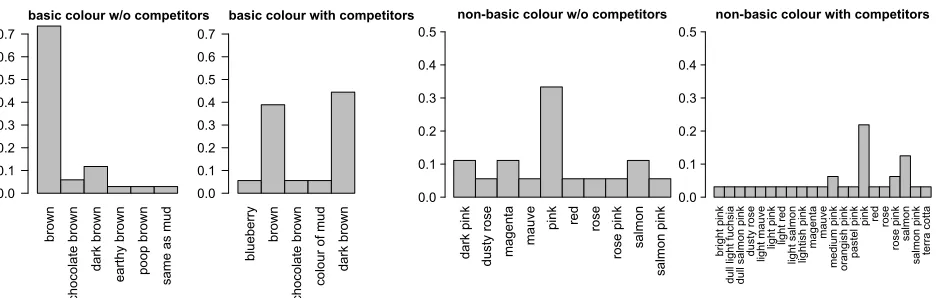
ExpA Generation. ExpA revealed there is high variability in the terms produced to refer to a sin-gle colour. As expected, variability of terms gener-ated for non-basic colours was higher than for ba-sic colours. For non-baba-sic colours, variability of terms in scenes with competitors was higher. Fig-ure 2 shows the different terms produced for a basic colour (‘brown’) and a non-basic colour (‘rose’) in scenes without and with competitors, together with the proportional frequency of each term.
For the brown square target in a scene with-out competitors, the basic-colour term‘brown’was used with high frequency (72% of the time) while any other terms were used 1 or 2 times only. In scenes with competitors, ‘dark brown’ had high-est frequency with ‘brown’ almost as much (43% vs. 40%). For the rose square target in a scene with-out competitors, there was also one term that stood out as the most frequent, ‘pink’, although its fre-quency (30%) is substantially lower to that of the basic-colour ‘brown’. In scenes with competitors there is an explosion in variation, with ‘pink’ still standing out but only with a proportional frequency of 21%.
there is high variability in the terms they choose to do this.
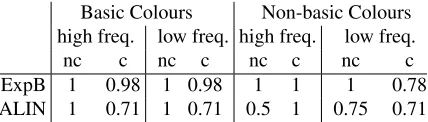
ExpB: Resolution. ExpB showed that reference resolution is almost always successful despite the variation in colour terms observed in ExpA. For the basic colours in scenes with no competitors, partici-pants successfully identified the targets in all cases, while in scenes with competitors they did so 98% of the time. This was the case for both terms with proportionally high and low frequency.
For the non-basic colours in scenes with no com-petitors, the success rate in identifying the target was again 100% for both high and low frequency terms. For scenes with competitors, there were dif-ferences depending on the frequency of the terms used: for high frequency terms there were once more no resolution errors, while the resolution success rate dropped to 78% where we used terms with low proportional frequency scores. A summary of these results is shown in Table 1, together with the success rate of our resolution algorithm ALIN.
Basic Colours Non-basic Colours high freq. low freq. high freq. low freq.
[image:4.612.79.293.362.423.2]nc c nc c nc c nc c ExpB 1 0.98 1 0.98 1 1 1 0.78 ALIN 1 0.71 1 0.71 0.5 1 0.75 0.71
Table 1: Resolution success rate by human participants and ALIN in scenes without and with competitors (nc/c).
5 Discussion
The data we collected allows us to make informa-tive comparisons between humans and our model in collaborative reference tasks. Although we do not believe the data is sufficient for an evaluation, the comparison illuminates how the model can be re-fined and the setup required for a proper evaluation. Regarding resolution, we note that an algorithm that rigidly associates colours and terms would have successfully resolved only 4 of the 29 cases, 3 of which were basic colours with no distractors – a 7.25% success rate. In our scenarios with four po-tential targets, a random algorithm would have an average success rate of 25%. ALIN is closer to our human data (see Table 1), though anomalies exist. One problem is the lack of compositional semantics
in our current model. ALIN failed to resolve com-plex phrases like‘dull salmon pink’and‘deep gray blue’, which were terms produced by humans for non-basic colours with competitors, simply because the terms were not in the agent’s lexicon. Other anomalies seem to be consequences of taking Eu-clidean distances over RGB values, which may be too crude. In the future, our intent is to convert RGB values to Lab values and then use Delta-E values to measure distances. First, however, we need a more sophisticated analysis of the thresholds that we used for ALIN and GENA.
As for generation, given the amount of variation observed in the terms produced by our subjects, it is not clear how human performance ought to be pared to GENA’s. For instance, in scenes with com-petitors, GENA produced ‘reddish brown’ for the basic colour ‘brown’ and‘coral’ for the non-basic colour‘rose’. These did not appear in our human-generated data but still seem to our lights reasonable descriptions. GENA also produced‘gray’to refer to
‘rose’in a different scene, which seems less appro-priate and may be due to our current way of calcu-lating colour distances and setting up the thresholds. We believe that instead of comparing GENA’s output to human output, it makes more sense to eval-uate GENA by testing how well humans can resolve terms produced by it. We intend to carry out this evaluation in the future.
6 Conclusions
We have focused on the specific case of colours where speakers differ in the referring expressions they generate, but addressees are nevertheless able to relax the interpretations of the expressions in or-der to coordinate. We believe this implicit adapt-ability is part of our semantic representation more broadly. The case of colour provides us with a start-ing point for studystart-ing and modellstart-ing computation-ally this flexibility we possess.
Acknowledgements
References
Brent Berlin and Paul Kay. 1967. Universality and evo-lution of basic color terms. Laboratory for Language-Behavior Research.
Brent Berlin and Paul Kay. 1991. Basic color terms: Their universality and evolution. Univ of California Pr.
Herbert H. Clark and Edward F. Schaefer. 1989. Con-tributing to discourse. Cognitive Science, 13(2):259– 294.
Herbert H. Clark and Donna Wilkes-Gibbs. 1986. Refer-ring as a collaborative process. Cognition, 22:1–39. Robert Dale and Ehud Reiter. 1995. Computational
in-terpretations of the Gricean Maxims in the Generation of Referring Expressions. Cognitive Science, 18:233– 266.
Peter G¨ardenfors. 2000.Conceptual Spaces. MIT Press, Cambridge.
Paul Grice. 1975. Logic and conversation. In D. David-son and G. Harman, editors, The Logic of Grammar, pages 64–75. Dickenson, Encino, California.
Gerhard J¨ager. 2009. Natural color categories are convex sets. InLogic, Language and Meaning: 17th Amster-dam Colloquium, AmsterAmster-dam, The Netherlands, De-cember 16-18, 2009, Revised Selected Papers, pages 11–20. Springer.
Robert Krauss and Sidney Weinheimer. 1966. Concur-rent feedback, confirmation, and the encoding of refer-ents in verbal communication. Journal of Personality and Social Psychology, 4(3):343–346.
Kees van Deemter. 2006. Generating referring expres-sions that involve gradable properties. Computational Lingustics, 32(2):195–222.