M D L - b a s e d D C G I n d u c t i o n for N P I d e n t i f i c a t i o n
Miles Osborne
Alfa Informatica, University of Groningen, NL
[email protected]
Abstract
We introduce a learner capable of automatically extend- ing large, manually written natural language Definite Clause Grammars with missing syntactic rules. It is based upon the Minimum Description Length princi- ple, and can be trained upon either just raw text, or else raw text additionally annotated with parsed cor- pora. As a demonstration of the learner, we show how
full
Noun Phrases (NPs that might contain pre or post- modifying phrases and might also be recursively nested) can be identified in raw text. Preliminary results ob- tained by varying the amount of syntactic information in the training set suggests that raw text is less useful than additional NP bracketing information. However, using all syntactic information in the training set does not produce a significant improvement over just brack- eting information.1
I n t r o d u c t i o n
Identification of Noun Phrases (NPs) in free text has been tackled in a number of ways (for example, [25, 9, 2]). Usually however, only relatively simple NPs, such as 'base' NPs (NPs that do not contain nested NPs or postmodifying clauses) are recovered. The motiva- tion for this decision seems to be pragmatic, driven in part by a lack of technology capable of parsing large quantities of free text. With the advent of broad cover- age grammars (for example [15] and attendant efficient parsers [11], however, we need not make this restriction: we now can identify 'full' NPs, NPs that might contain pre and/or post-modifying complements, in free text.
Full NPs m'e more interesting than base NPs to esti- mate:
• They are (at least) context free, unlike base NPs which are finite state. They can contain pre- and post-modifying phrases, and so proper identifica- tion can in the worst case imply full-scale pars- ing/grammar learning.
• Recursive nesting of NPs means that each nominal head needs to be associated with each NP. Base NPs simply group all potential heads together in a flat structure.
As a (partial) response to these challenges, we iden- tify full NPs by treating the task as a special case of full-scale sentential Definite Clause Grammar (DCG) learning. Our approach is based upon the Minimum Description Length (MDL) principle. Here, we do not explain MDL, but instead refer the reader to the liter- ature (for example, see [26, 27, 29, 12, 22]). Although a DCG learning approach to NP identification is far more computationally demanding than any other NP learning technique reported, it does provide a useful test-bed for exploring some of the (syntactic) factors involved with NP identification. By contrast, other ap- proaches at NP identification more usually only con- sider lexical/part-of-speech influences.
In this paper, we consider, from an estimation per- spective, how dependent NPs are upon their (surround- ing) syntactic context. We varied the information con- tent of the training set and measured the effect this had upon NP identification accuracy. Results suggest that:
• Use of any syntactic information, in addition" to raw text during estimation, produces better results than estimation from raw text alone.
• NPs containing an internal annotation (nonterminals in addition to NPs) are harder to estimate than NPs that do not contain these additional nonterminals.
• Training with NP annotated sentences and training with sentences annotated with full sentential parses produce very similar results to each other.
We stress that the last finding is provisional, and further investigation is necessary to verify it.
The structure of the rest of this paper is as follows. Section 2 gives an overview of our approach, whilst sec- tion 3 goes into estimation and modelling details. We
do not s t a r t induction ab initio, but instead base es- timation upon manually written grammars. Section 4 briefly describes the particular g r a m m a r used in this research, whilst section 5 relates our work to others. Section 6 presents an experimental evaluation of our learner. T h e paper ends with a discussion Of our find- ings.
2 O v e r v i e w
Our learner is probabilistic, and starts with a DCG- based language model M0. Parameters are initially es- timated from parsed corpora, annotated in terms of the non-terminal set used by the DCG. It incremen- tally processes each sentence s~ in the list of sentences S o . . . 's# . . . sn. If a sentence s# cannot be generated (the g r a m m a r contained within the model lacks the required rules), we need to find a new model with a high, non- zero posterior probability given the sentences s o . . . s# seen so far. Our (for computational reasons, necessarily suboptimal) approach selects such a model by" carrying out a local search over the space of models with a non- zero posterior probability, given all sentences see so far. We use a MDL-based prior to help us compute a pos- terior probability. Analogously to Pereira and Schabes ( P + S ) [23], we also constrain the search using parsed corpora. Unlike P + S , we not only use parsed corpora to constrain p a r a m e t e r estimation, we also use it to con- strain model selection. We replace M0 with the newly constructed (locally) maximal a posterior model and after processing all sentences in this incremental man- ner, terminate with a model t h a t generates all sentences seen in the training set.
Key aspects of our approach are:
Incremental learning. We only construct rules neces- sary to parse sentences in training set. This reduces the computational burden and enables us to learn with grammars t h a t use large (> 30) feature sets. By contrast, batch approaches that compile-out all rules that can be expressed with a fixed category set and with rules limited to some length can only deal with far smaller feature sets, thereby preventing induction of realistic grammars.
Initialisation with a model containing manually writ- ten rules, with parameters estimated from parsed corpora. This alleviates some of the pitfalls of lo- cal search and, by definition, makes estimation faster (our initial model is already a reasonable estimate). Lari and Young demonstrated this point when they used an Hidden Markov Model as an approximation of a Stochastic Context Free Grammar SCFG [19]. Note that in general any manually written grammar
62
will undergenerate, so there is still a need for new rules to be induced.
• Ability to induce 'fair' models from raw text. We do not select models solely on the basis of likelihood (when training material is limited, such models tend to overfit); instead, we select models in terms of their MDL-based prior probability and likelihood. MDL-
based estimation usually reduces overfitting (since, with limited training material, we select a model that fits th~ training material well, b u t not too well) [22].
• Learning from positive-only data. We do not require negative examples, nor do we require human inter- vention. This enables us to transparently use gram- mar learning as part of s t a n d a r d text parsing.
• Use of parsed corpora allows us to induce models that encode semantic and pragmatic preferences. Raw text is known to underconstrain induction [13] and even with an MDL-based prior, when training upon raw text, we would be unlikely to estimate a model whose hidden variables (grammar rules) resulted in linguistically plausible derivations. Parsed corpora supplies some of this missing information.
3
E s t i m a t i o n Details
Estimation of a model, given a training set of'sentences and an associated set of manually constructed parses, consists of four steps: probabilistic modelling of DCGs, model construction, search (constrained by parsed cor- pora) , and model estimation. We now explain these steps in turn.
P r o b a b i l i s t i c M o d e l l i n g o f D C G s
DCGs in our approach are modelled in terms of a compression-based prior probability and a SCFG-based likelihood probability. The prior assigns high probabil- ity to compact models, and low probabilities to verbose, idiomatic models. As such, it favours simple grammars over more complex possibilities. T h e likelihood proba- bility describes how well we can encode the training set in terms of the model. We now turn to the specifcation of likelihood and prior probabilities in our system.
need to interpret them in a context-free manner. One way to achieve this is as follows. For each category in the g r a m m a r that is distinct in terms of features, invent an atomic non-terminal symbol. With these atomic symbols, create a SCFG by mapping each category in a DCG rule to an atomic symbol, yielding a context free (backbone) grammar, and with this grammar, specify a SCFG, /Vii. Naturally, this is not the most accurate probabilistic model for feature-based grammars, but for the interim, is sufficient (see Abney for a good discus- sion of how one might define a more accurate proba- bilistic model for feature-based grammars [1]).
SCFGs are standardly defined as follows. Let
P(A -~
(~ ] A) be the probability of expanding (backbone) non- terminal symbol A with the (backbone) rule A --+ o when deriving some sentence si. The probability of thejth
derivation of si is defined as the product of the prob- abilities of all backbone rules used in t h a t derivation. T h a t is, if derivation j followed from an application of the rules A~ -~ c~ . . . . , A~ ~ a~,gl
P~eriv(Sz [ M,) = H
P(A~ --+ aJ,)
(1) i = lThe probability of a seiatence is then defined as the sum of the probabilities of all n ways we can derive it:
t l
P~(si
I Mi) = Y~ P~eriv(Si IMi) (2) 3=1Having modelled DCGs as SCFGs, we can immedi- ately specify the likelilmod probability of
Mi
generating a sample of sentencesso... sn,
as:n
P(so... sa I M,) = H Ps(s, I Mi)
(3) j = 0This treats each sentence as being independently gen- erated from each other sentence.
P r i o r P r o b a b i l i t y Specifying a prior for DCGs amounts to encoding the rules and the associated pa- rameters. We encode DCG rules in terms of an integer giving the length, in categories, of the rule (requiring log* (n) bits, where log* is Rissannen's encoding scheme for integers), and a list of t h a t many encoded categories. Each category consists of a list of features, drawn from a finite set of features, and to each feature there is a value. In general, each feature will have a separate set of possible values. Within manually written DCGs, the way a feature is assigned a value is sensitive to the po- sition, in a rule, of the category containing the feature in question. Hence, if we number the categories of a rule. we can work out the probability t h a t a particular
feature, in a given category, will take a certain value. Let
P(v I fO
be the probability t h a t feature f takes the value v, in category i of all rules in the grammar. Each value can now be encoded with a prefix code of - l o g ( P ( v I f i ) bits in length. Encoding a category simply amounts to a (fixed length) sequence of such en- coded features, assuming some canonical ordering upon features. Note we do not learn lexical entries and so not not need to encode them.To encode the model parameters, we simply use Ris- sannen's prefix coding scheme for integers to encode a rule's frequency. We do not directly encode probabili- ties. since these will be inaccurate when the frequency, used to estimate t h a t probability, is low. Rissanuen's scheme has the property t h a t small integers are assigned shorter codes than longer integers. In our context, this will favour low frequencies over highcr ones, which is undesirable, given the fact that we want, for estimation accuracy, to favour higher frequencies. Hence, instead of encoding an integer i in log*(/) bits (as, for exam- ple, Keller and Lutz roughly do [18]), we encode it in log*(Z - i) bits, where Z is a mlmber larger than any frequency. This will mean that higher frequencies are assigned shorter code words, as intended.
The prior probability of a model )IL, containing a DCG G and an associated parameter set is:
P ( M i ) = 2 -(lg(M')+Ip(M')) -t- C (4)
where:
Id
IAM,) = Y .[log*(I r I) + Z
- log(PO' I/,))1 (5)
rEG t = l / E F
is description length of the gramma," and
t A M , ) = l o g ' ( Z - y(,.)) (6)
rEG
is the description length of the paranaeters. C is a con- stant ensuring t h a t the prior sums to one; F is the set of features used to describe categories: ] r ] is the length of a DCG rule r seen
f(r)
times.Apart from being a prior over DCG rules, our scheme has the pleasing property that it assigns longer code words to rules containing categories in unlikely posi- tions t h a n to rules containing categories in expected po- sitions. For example, our scheme would assign a longer list of code words to the categories expressing a rule such as
Det -~ Det N P
than to the list of categories expressing a rule such asN P --+ Det N P .
Also, our coding scheme favours shorter rules t h a n longer rules, which is desirable, given the fact t h a t , generally speak- ing. rules in natural language grammars tend to be short.63
P o s t e r i o r P r o b a b i l i t y In summary, the probability of a model, given a set of training examples is:
P(M,
I S o . . . s , ) =[2- U#{M' )+'P{ M' D +C].H~.=O PS(s~IM.)
P(so...s. )
(7)
M o d e l C o n s t r u c t i o n
For lack of space, we only sketch our model construc- tion strategy. In brief, our approach is (largely) mono- tonic, in t h a t we extend an old model with new rules constructed from pieces of manually written rules, such t h a t the new and old rules result in a parse for the cur- rent sentence (and the old rules alone fail to parse the current sentence). In more detail, whenever we fail to parse a sentence with the manually written DCG, we use an optimised chart parser [10] to construct all lo- cal trees licensed by the manually written grammar. We next consider ways adjacent local trees licensed by man- ually written DCG rules may be combined into larger local trees (ie invent rules whose right hand side con- sists of categories t h a t spell out the mother categories of these adjacent local trees; the left hand side will be one of these right-hand side categories, with the possibility of having its bar level raised). The parser packs all lo- cal trees in space polynomial with respect to sentence length. If, within self-imposed bounds upon compu- tation (for example, limiting the number of local trees joined together), we succeed in constructing at least one tree that spans the entire sentence, we can build a new model by extracting all new rules seen in that tree and adding them to the old model.
Note that periodically, it is useful to prune (and re- normalise) the model of rules seen only once in the pre- viously encountered sequence of sentences. Such pruned rules are likely to have arisen either due to marked con- structions, noise in the training material, or rules t h a t appeared to be promising, but did not receive any sub- sequent support and as such have little predictive util- it.v. Pruning the model is a non-monotonic operation and hard to formally justify, but nevertheless useful. Whitten, Cleary and Bell also comment upon the use- fulness of resetting the model [3].
Our model construction approach has the following properties: rules constructed all encode a version of X - S y n t a x , which weakly constrains the space of pos- sible rules [8, 21]; analyses produced using manually written rules are favoured over those produced using learnt rules (by virtue of computation being resource- bounded): this mirrors the empirical fact t h a t when extending manually written grammars, only a few. rules are necessary, and those required generally 'join' to- gether local trees generated by manually written rules.
64
S e a r c h
Model construction may produce an exponential num- ber of parses for a sentence and for computational rea- sons, we are unable to evaluate all the models encoded within these parses. We therefore use a probabilistic unpacking strategy t h a t efficiently selects the n most likely parses, where n is much less thml the total num- ber of parses possible for some sentence [11]. There is insufficient space here to describe how we rank parses, but the underlying parse selection model is based upon the SCFG used to evaluate models. Currently. it is not lexicalised, so parse selection performance is subject to the well-known limitations of non-lexicalised SCFGs [5]. Whilst estimating models, we simultaneously estimate the parse selection model in terms of tile parse used to produce the model picked. Probabilistic unpacking is crucial to our approach, and it is this that makes our learner computationally feasible.
After extracting n parses, we can then go on to con- struct k I models, evaluate their posterior probabilities, and then select the model that maximises this term. However, as was shown by P-t-S, when training material consists of just (limited quantities) of raw text. classi- cal, single model parameter estimation often results in a model t h a t produces worse parse selection results than when the estimation process is constrained to only con- sider derivations compatible with the parsecl corpora. In our context, we can use parsed corpora to constrain both parameter estimation and also model selection. We simply re-rank the n parses produced during model construction using a tree similarity metric that com- pares how 'close' an automatically constructed parse is to a manually written parse, and take the q parses that all minimise the metric and are all scored equally well [17]. From these q parses we can then build mod- els as usual. When q = 1, there is no need to rely upon MDL-based model selection. Otherwise. when q is greater than one, we have a set of parses, all equally consistent with the manually created tree, and so fall- back upon the usual model selection strate~.v. Our use of parsed corpora differs from P + S ' s in that we use it as a soft constraint: we may still keep parses even if they violate constraints in the manually constructed parse tree. The reason for this decision is that we do not construct all possible parses for a sentence., and so at times may not produce a parse consistent with a manu- ally created parse. Also, it is not clear whether parsed corpora is sufficiently reliable for it to be trusted abso- lutely. Clearly there will be a link between the amount of information present in the parsed corpora mid the quality of the estimated model. In the experimental
section of this paper, we consider this issue.
Estimation
When computing a model's posterior probability, we estimate the description length of features,
P(v
] f,), the model parameters,P(A
-+ a I A) and the likelihood probability,P(so... sn
]Mi)-The feature description length is estimated by count- ing the number of times a given feature takes some value in some category position, and applying a maximal like- lihood estimator to arrive at a probability. The model parameters are estimated by counting the number of times a given backbone rule was seen in the previous n parses just produced, and then again using a maxi- mal likelihood estimator to produce a probability. We estimate, as we cannot afford to globally recompute, the likelihood probability using the following approxi- mations. Only a fixed number of n previously seen sen- tences that cannot be parsed using the manually writ- ten rules are considered in the likelihood computation. We assume that the parses of these sentences remains constant across alternative models, but the derivation probabilities might vary. We also assume that the string probability of each sentence is reasonably well approx- imated by a single parse.
4 T h e G r a m m a r
The grammar we extend with learning, (called the
Tag
Sequence Grammar
[7], or TSG for short) was developed with regard to coverage, and when compiled consists of 455 object rules. It does not parse sequences of words directly, but instead assigns derivations to sequences of part-of-speech tags (using the CLAWS2 tagset [4]). The grammar is relatively shallow, (for example, it does not fully analyse unbounded dependencies) but it does make an attempt to deal with common constructions, such as dates or names, commonly found in corpora, but of little theoretical interest. Furthermore, it integrates into the syntax a text grammar, grouping utterances into units that reduce the overall ambiguity.For the experiments reported here, we manually ex- tended TSG with four extra rules. These extra rules dealt with obvious oversights when parsing the WSJ.
5 R e l a t e d W o r k
Our approach is closely related to Stolcke's model merg- ing work [29]. Apart from differences in prior and likeli- hood computation, the main divergence is that our work is motivated by the need to deal with undergeneration in broad-coverage, manually written natural language grammars (for example [15]). Although we do not go into the issues here, estimation of rules missing from such g-rammars is different from estimating grammars
65
ab initio.
This is because rules missing from any real- istic grammar are all likely to have a low frequency in any given corpus, and so will be harder to differenti- ate from competing, incorrect rules purely on the basis of statistical properties alone. We know of no other work reporting automated extension of broad-coverage grammars using MDL and parsed corpora.One of the anonymous reviewers wanted to know how our work related to Explanation-Based Learning (EBL) [20]. EBL is not concerned with induction of rules: it deals with finding more efficient ways to use existing rules. For example, in NLP, EBL has been used to re- duce the time taken to parse sentences with large gram- mars ([28]). EBL does not extend the coverage of any given grammar, unlike our approach. In our opinion, it would be better to view our learner as all Inductive Logic Programming system specialised for DCG induc- tion.
6 E x p e r i m e n t s
For our experiments we used material supplied by the CoNLL99 workshop organisers. This consisted of 48,224 fully parsed training sentences, and a disjoint set of 984 testing sentences. Both sets were randomly drawn from the parsed section of the Wall Street Jour- nal. The test set came in two versions, differing from each other in how the sentences were marked:up. The first version consisted of sentences with NP bracketings marked (results using this test set are given in table 1). The second version had NP bracketings marked, and within each marked NP, there was an internal parse (results for this version are in table 2). These parses were labelled with Penn Nonterminals. Each test sen- tence was trivially rooted with an S symbol (necessary for the evaluation software). To make this clearer, if an original Wall Street Journal parse, stripped of tags and nonterminal decorations was:
(S (NP (NP Bailey Controls), (VP based (PP in (NP (NP Wickliffe), (NP Ohio)))).) (VP makes (NP computerized industrial controls systcms)).)
the version containing just NP bracketing would be:
(S (NP (NP Bailey Controls), based in (NP (NP Wickliffe), (NP Ohio)),) makes (NP computerized industrial controls systems) .)
whilst the version containing parsed NPs would be:
(S (NP (NP Bailey Controls), (VP based (PP in (NP (NP Wickliffe), (NP Ohio)))),) makes (NP computerized industrial controls systems).)
For computational reasons, we could not deal with all sentences in the training set. and when learning
rules, we limited ourselves to ser/tences with a maxi- mum length of 15 tokens. During evaluation, we used sentences with a m a x i m u m length of 30 tokens. This reduced the training set to 10,249 parsed sentences, and the test set to 739 sentences. Finally, we retagged the CoNLL99 material with the Claws2 tagset (required by TSG). Evaluation was carried out by Parseval (which reports unlabelled bracketing results: we do not r e p o r t labelled results as T S G does not use the Penn Non- terminal set) [16]. Note t h a t evaluation is based upon bracketing, and not word accuracy. For example, if we failed to include one word in a NP that contains four other words, we would have a bracketing accuracy of 0. On the other hand, a word accuracy result would be
80%.
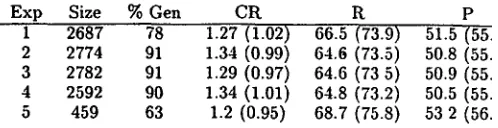
A s a comparison, we evaluated T S G upon the testing material. This is experiment 5 in tables 1 and 2. T h e other four experiments differed from each other in terms of what the learner was trained upon:
1. Just tagged sentences.
2. Tagged Sentences with N P bracketings marked. We reduced WSJ parses to include just their NP brack- etings.
3. Tagged sentences with NPs bracketing a n n o t a t e d with an internal parse. Again, we mapped W S J parses to reduced parses containing just annotated NPs.
4. Tagged sentences with a full Wall Street Journal parse.
For each experiment, we report the size of the final grammar, the percentage of testing sentences covered (assigned a full parse), crossing rates, recall and preci- sion results with respect to testing sentences with NPs bracketed and those containing annotated NPs. For the bracketing task, we m a p p e d full parses, produced by nmdels, to parses just containing NP bracketing. For the aimotation task. we mapped full parses to parses containing just NPs with an internal annotation. Note that within our grammatical framework, the best map- ping is not clear (since parses produced by our models have categories using multiple bar levels, whilst WSJ parses ouly use a single level). As a guess, we treated bar 1 and bar 2 nominal categories as being NPs. This means that our precision results are lowered, since in general, we produce more NPs than would be predicted by a WSJ parse.
In each case. we evaluate the performance of a model in terms of the highest ranked parse, and secondly, in terms of the "best' parse, out of the top 10 parses pro- duced. Here "best' means the parse produced that is
closest, in terms of a weighted sum crossing rates, pre- cision and recall, to the manually selected parse. This final set of results gives an indication of how well our system would perform if it had a much b e t t e r parse selection mechanism. Best figures are marked in paren- theses.
Figure 1 gives our results for the bracketing task, whilst figure 2 gives our results for the a n n o t a t i o n task. Model size and coverage results were id~-ltical for both tests, so the second table omits them.
Exp Size % Gen CR R P
1 2687 78 1.27 (1.02) 66.5 (73.9) 51.5 (55.31 2 2774 91 1.34 (0.99) 64.6 (73.5) 50.8 (55.6: 3 2782 91 1.29 (0.97) 64.6 (73 5) 50.9 (55.6: 4 2592 90 1.34 (1.01) 64.8 (73.2) 50.5 (55.3: 5 459 63 1.2 (0.95) 68.7 (75.8) 53 2 (56.9:
Figure 1: NP Identification Results (Bracketing)
Exp CR R P
1 2.08 (1.52) 57.99 (67.7) 48.1 (54.6) 2 2.27 (1.54) 56.5 (67.0) 46.0 (54.2) 3 2.22 (1.52) 56.5 (66.9) 50.9 (54.2) 4 2.32 (1.63) 56.5 (66.7) 45.4 (53.1) 5 1.85 (1.40) 59.2 (69.1) 51.4 (57.2)
Figure 2: NP Identification Results (Annotation)
Firstly, when compared with other work on NP re- covery, our results are poor. As was mentioned in the search section, this is largely due to our system being based upon a language model that has well known lim- itations. Furthermore, as was argued in the iutroduc- tion, full NPs are by definition harder to identify than base NPs, so we would expect our results to be worse. Secondly, we see that the bracketing task is easier than the annotation task: generally, the results in table 1 are better than the results in table 2. Given the fact that the annotation search space is larger than the brack- eting space, this should come as no surprise. Turning now to the individual experiments, we see that parsed corpora (experiments 2, 3 and 4) is all informative con- straint upon NP induction. Rules learnt using parsed corpora b e t t e r capture regularities than do rules learnt from just raw text (experiment 1). This is shown by the increased coverage results of experiments 2 . 3 and 4 over 1. In terms of crossing rates, recall and precision, no clear story has emerged. Surprisingly, there seems to be minimal difference in coverage when using either anno- t a t e d NPs or full parses. This could be due to a number of reasons, such as WSJ NPs being more reliably an- notated than other phrases, simple artifactual problems
[image:6.612.341.590.196.260.2] [image:6.612.358.563.313.376.2]with the learner, the evaluation metrics being too coarse to show any real differences, etc. Further, qualitative investigation should determine whether there are any differences in the parses that TSG alone cannot assign to sentences.
Due to time constraints, we did not measure statisti- cal significance tests between the various experiments. A later version of this paper (available from the author, [email protected]) will report these tests.
7
Conclusion
We presented an MDL-based incremental DCG learner. Experimental evaluation showed that estimation is pos- sible using just raw sentences, but that better results are possible when additional parsed corpora is used. Evaluation also showed that this parsed corpora need not be that detailed, and that NP bracketing informa- tion produced similar results to using full WSJ parses. This final results seems counterintuitive, and merits fur- ther investigation.
Future work on the learner will be in three main di- rections:
• Abandonment of the SCFG as the basis of the lan- guage model. We are considering either Abney's random fields [1] or Goodman's Probabilistic Fea- ture Grammmars [14] as a replacement. Apart from performance improvements, altering the model class should allow empirical investigation of the MDL claim that model classes can be evaluated in terms of compression. So, if we discover even more com- pact models using (say) Goodman's scheme than we could using our SCFG, we might deduce that this is the case. Naturally: lexicalisation would enter into any scheme entertained.
• Use of semantics in estimation. We have at our dis- posal a large grammar augmented with a composi- tional semantics [15]. Again, this should lead to bet- ter results.
• Prior we!ghting. As is well known, MDL-based learn- ers sometimes improve from weighting the prior with respect to tile likelihood. Schemes, such as Quinlan and Rivest's [24], fall outside of the coding framework and (effectively) replicate the training set. We intend to pursue encoding-based schemes that achieve t h e . same purpose.
Acknowledgments
We would like to thank Erik Tjong Kim Sang for help with organising CoNLL99 and the two anonymous re- viewers for commenting on the paper. This work was supported by the EU Project
Sparkle
LE-2111 m~d tile TMR ProjectLearning Computational Grammars.
References
[1] Steven P. Abney. Stochastic Attribute-Value Grammars.
Computational Linguistics,
23(4):597- 618, December 1997.[2] Shlomo Argamon, Ido Dagan, and Yuval Kry- molowski. A Memory-Based Approach to Learning Shallow Natural Language Patterns. In
Proceedings of the
17 Ihbzternational Con-
ference on Computational
Linguistics,
1998.ht tp: / /xxx.lanl.gov / ps/ cmp-lg[ 9806011.
[3] Timothy C. Bell, John G. Cleary, and Ian H. Wit- ten.
Text Compression.
Advanced Reference Se- ries. Prentice Hall, 1990.[4] Ezra Black, Roger Garside, and Geoffrey Leech, editors.
Statistically driven computer grammars
of English the IBM-Lancaster approach.
Rodopi, 1993.[5] Ezra Black, Fred Jelinek. Jolm Lafferty, and David M. Magerman. Towards History-based Grammars: Using Richer Models for Probabilis- tic Parsing. In
31 st Annual Meeting of the Asso-
ciation for Computational Lmguistzcs,
pages 31- 37, Ohio State University, Columbus, Ohio, USA. June 1993.[6] T. Booth. Probabilistie representation of formal languages. In
Tenth Annual IEEE Symposzum on
Switching and Automata Theory,
October 1969.[7] Ted Briscoe and John Carroll. Automatic Extrac- tion of Subcategorization from Corpora. In
Pro-
ceedings of the 5 th Conference on Applied NLP.
pages 356-363, Washington, DC, 1996.[8] Ted Briscoe and Nick Waegner. Robust Stochastic Parsing Using the Inside-Outside Algo- rithm. In
Proceedings of the A A A I Workshop on
Statistically-based Techniques in Natural Language
Processing,
1992.[9] Claire Cardie and David Pierce. Error-Driven Pruning of Treebank Grammars for Base Noun Phrase Identificatio. In
Proceedings of the
17 thIn-
ternational Conference on Computational Linguis-
tics,
pages 218-224, 1998.[10] John Carroll.
Practical Unification-based Parsing
of Natural Language.
PhD thesis. University of Cambridge, March 1993.[11] John Carroll and Ted Briscoe. Probabilistic nor- malisation and unpacking of packed parse forests for unification-based grammars. In
Proceedings of
I
I
I
I
I
I
I
I
I
I
I
I
I
I
I
I
I
I
I
[12]
[13]
[14]
[15]
[16]
[17]
[18]
[191
[201
[21]
the A A A I Fall Symposium on Probabilistic Ap- proaches to Natural Language, pages 33-38. Cam- bridge, MA, 1992.
Carl de Marcken. Unsupervised Language Acquisi- tion. PhD thesis, MIT, 1996.
E. M. Gold. Language Identification to the Limit. Information and Control, 10:447-474, 1967.
Joshua Goodman. Probabilistic Feature Gram- mars. In 5 th International Workshop on Pars- ing Technologies, MIT, Cambridge, Massachusetts, USA, September 1997.
Claire Grover, Ted Briscoe, John Carroll, and Bran Boguraev. The Alvey Natural Language Tools Grammar (4 ta Release). Technical report, Univer- sity of Cambridge Computer Laboratory, 1993.
Philip Harrison, Steven Abney, Ezra Black, Dan Flickinger, Ralph Grishman Claudia Gdaniec, Donald Hindle, Robert Ingria, Mitch Marcus, Beatrice Santorini, and Tomek Strzalkowski. Eval- uating Syntax Performance of Parser/Grammars of English. In Jeannette G. Neal and Sharon M. Walter, editors, Natural Language Processing Sys- tems Evaluation Workshop, Technical Report RL- TR-91-362, 1991.
Eirik ttektoen. Probabilistic Parse Selection Based on Semantic Cooccurrences. In 5 th International Workshop on Parsing Technologies. pages 113-122, MIT. Cambridge, Massachusetts. USA. September 1997.
Bill Keller and Riidi Lutz. Evolving Stochastic Context-Free Grammars from Examples Using a Minimum Description Length Principle. In Work- sop on Automata Induction, Grammatical Infer- ence and Language Acquisition, Nashville, Ten- nessee, USA, July 1997. ICML097.
K. Lari and S. J. Young. The estimation of stochas- tic context-free grammars using the Inside-Outside Algorithm. Computer Speech and Language, 4:35- 56, 1990.
T. Mitchell, R. Keller, and S. Kedar-Cabelli. Explanation-based generalization: A unifying view. Machine Learning, 1.1:47-80, 1986.
Miles Osborne and Derek Bridge. Learning
unification-based grammars using the Spoken En- glish Corpus. In Grammatical Inference and Ap- plications, pages 260-270. Springer Verlag. 1994.
68
[22] Miles Osborne and Ted Briscoe. Learning Stochas- tic Categorial Grammars. In T. Mark Ellison, ed- itor, CoNLL97, pages 80-87. ACL, July 1997.
[23] Fernando Pereira and Yves Schabes. Inside- outside reestimation from partially bracketed cor- pora. In Proceedings of the 30 th ACL. University of Delaware, Newark, Delaware, pages 128-135, 1992.
[24] J. Ross Quinlan and Ronald L. Rivest. Infer- ring decision trees using the minimtml description length principle. Information and Computation, 80:227-248, 1989.
[25] Lance A. Rarnshaw and Mitchell P. Marcus. Text Chunking Using Transformation-Based Learning,. Ill Proceedings of the 3 "a ACL Workshop on Very Large Corpora, pages 82-94, June 1995.
[26] Jorma Rissanen. Stochastw Complexity in Statis- tical Inquiry. Series in Computer Science -Volume 15. World Scientifc, 1989.
[27] Jorma Rissanen and Eric Sven Ristad. Language Acquisition in the MDL Framework. In Eric Sven Ristad, editor, Language Computation. American Mathemtatical Society, Philedelphia, 1994.
[28] Christer Samuelsson and Manny Rayner. Quan- tiative Evaluation of Explanation-Based Learning as an Optimisation Tool for a Large-Scale Natu- ral Language System. In Proceedings o/the 12 th International Joint Conference on Artificzal Intel- ligence, pages 609-615, 1991.