37
Neural Text Simplification in Low-Resource Conditions
Using Weak Supervision
Alessio Palmero Aprosio
Fondazione Bruno Kessler Trento, Italy
Sara Tonelli
Fondazione Bruno Kessler Trento, Italy
Marco Turchi
Fondazione Bruno Kessler Trento, Italy
Matteo Negri
Fondazione Bruno Kessler Trento, Italy
Mattia Di Gangi
Fondazione Bruno Kessler Trento, Italy
Abstract
Neural text simplification has gained increas-ing attention in the NLP community thanks to recent advancements in deep sequence-to-sequence learning. Most recent efforts with such a data-demanding paradigm have dealt with the English language, for which sizeable training datasets are currently available to de-ploy competitive models. Similar improve-ments on less resource-rich languages are con-ditioned either to intensive manual work to create training data, or to the design of ef-fective automatic generation techniques to by-pass the data acquisition bottleneck. Inspired by the machine translation field, in which syn-thetic parallel pairs generated from monolin-gual data yield significant improvements to neural models, in this paper we exploit large amounts of heterogeneous data to automati-cally select simple sentences, which are then used to create synthetic simplification pairs. We also evaluate other solutions, such as over-sampling and the use of external word em-beddings to be fed to the neural simplification system. Our approach is evaluated on Italian and Spanish, for which few thousand gold sen-tence pairs are available. The results show that these techniques yield performance improve-ments over a baseline sequence-to-sequence configuration.
1 Introduction
Text simplification aims at making a text more readable by reducing its lexical and structural complexity while preserving the meaning. ( Chan-drasekar and Bangalore,1997;Carroll et al.,1998; Vickrey and Koller, 2008; Crossley et al., 2012; Shardlow, 2014). Neural approaches to the task have gained increasing attention in the NLP com-munity thanks to recent advancements of deep,
sequence-to-sequence approaches. However, all recent improvements have dealt with English. The main reason is that such data-hungry approaches require large training sets (in the order of hundred thousand instances) and sizable datasets have been developed and made available only for this lan-guage. Indeed, the only available datasets com-posed of a complex and a simple version of the same document, which are large enough to ex-periment with deep neural systems, are Newsela (Xu et al.,2015) and the aligned version of simple and standard English Wikipedia (Zhu et al.,2010). These data have become the common benchmark for evaluating new approaches to neural text sim-plification. These methods rely on the use of deep reinforcement learning (Zhang and Lapata,2017), memory-augmented neural networks (Vu et al., 2018), the combination of semantic parsing and neural approaches (Sulem et al.,2018) and the per-sonalisation to specific grade levels (Scarton and Specia,2018). Due to data paucity, none of them can be tested on other languages, for which less data-intensive, rule-based solutions have been pro-posed (Brouwers et al., 2012; Bott et al., 2012; Barlacchi and Tonelli, 2013). The main disad-vantage of such solutions, however, is a reduced portability and scalability to new scenarios, which require the creation of new sets of rules each time a new language (or a new domain with specific id-iosyncrasies) has to be covered.
works in other NLP tasks (B´erard et al., 2016; Ding and Balog, 2018), in particular Machine Translation (MT) (Sennrich et al., 2016b). In a nutshell, taking an opposite direction to simplifi-cation, we proceed by i) automatically selecting simple sentences from a large pool of monolin-gual data, and ii) synthetically creating complex sentences. These artificially created sentences will be then used as the “source” side of newdifficult–
simpletraining pairs fed into an MT-like encoder-decoder architecture.
Our hypothesis is that, though sub-optimal due to possible errors introduced in the automatic generation of complex sentences, these training pairs represent useful material for building our sequence-to-sequence text simplification models. Under this hypothesis, any noise in the source side of the pairs can still be treated as an approximation of text difficulty that, paired with its correct sim-plified counterpart, can contribute to model train-ing.
We run our experiments on Italian and Span-ish, two languages for which only small datasets of manually curated simplifications are available. The main contributions of this work are:
• We explore different approaches for aug-menting training data for neural text simpli-fication using weak supervision;
• We test them in under-resourced conditions on Italian and Spanish.
2 Related work
The lack of data for training sequence-to-sequence models is a problem that has been addressed in several NLP tasks. In MT, for instance, syn-thetic parallel data for low-resource settings have been generated by automatically translating sen-tences from the target language into the source lan-guage (Sennrich et al.,2016b,a). In speech trans-lation, recent works (B´erard et al.,2016;Jia et al., 2018) have shown that end-to-end models can be successfully trained on artificialsource audio–
target text pairs built from synthesized speech data and/or machine-translated text.
For keyword-to-question generation, small training data have been first inverted to create a question-to-keyword dataset and then used to ar-tificially generate keywords given a large quantity of questions (Ding and Balog,2018).
In all these tasks, when added to the original data, the synthetic sets always result in signifi-cant improvements in performance. Even if sub-optimal due to variable noise introduced on the source side by automatic processing, large “silver” data provide a valuable additional complement to small “gold” training corpora.
Regarding neural text simplification, we are not aware of previous work on extending small train-ing corpora with synthetic data. Indeed, the lack of training instances has been a major issue in the development of such applications for languages other than English.
3 Neural sentence simplification system
Our sentence simplification approach is based on the attentional encoder-decoder model (Bahdanau et al.,2014) initially proposed for MT. It takes as input a complex sentence and outputs its simpli-fied version (Nisioi et al.,2017). Cast as a (mono-lingual) translation task, it provides a comprehen-sive solution to address both lexical and structural simplification, since the model does not only learn single term replacements, but also more complex structural changes. Initially, a sequence of words is fed to the encoder, which maps it into a se-quence of continuous representations (the hidden states of the encoder) providing increasing lev-els of abstraction. At each time step, based on these continuous representations and the generated word in the previous time step, the decoder gen-erates the next word. This process continues un-til the decoder generates the end-of-sentence sym-bol. This sequence-to-sequence model is extended by adding a pointer-generator network that allows both copying words via pointing to the source sen-tence, and generating words from a fixed vocab-ulary (See et al., 2017). At each time step, the network estimates the probability of generating a word and uses this probability as a gate to de-cide whether to generate or copy the word. To apply this pointer-generator network, a shared vo-cabulary containing all the words in the complex and simple training sentences is used. This archi-tecture is implemented in the OpenNMT platform (Klein et al.,2017).
4 Data augmentation
gold standard data that is used to train and evaluate our pointer-generator network baseline.
To satisfy the need of much larger training sets required to exploit the generalization capabilities of neural approaches,1 we explore three different data augmentation strategies:
Oversampling: In line with the work in MT-related tasks like automatic post-editing ( Chatter-jee et al.,2017), we increase the size of the train-ing set by multiplytrain-ing the whole original traintrain-ing corpus (5and10times) to maximize the use of the few “gold” sentence pairs available.
Simple-to-simple synthetic pairs creation: Starting from large monolingual corpora, we auto-matically extract the simplest sentences using dif-ferent heuristics, and then duplicate them to cre-ate simple-to-simple pairs. These are then used as synthetic data to train the simplification sys-tem. The intuition behind this strategy is to add information that can be beneficial to the creation of better word embedding representations and to introduce a bias in the decoder towards producing simple outputs.
Simple-to-complex synthetic pairs creation: We convert the gold data into a set of simple-to-complex pairs inspired by the work in MT ( Sen-nrich et al., 2016b) and in keyword-to-question (Ding and Balog, 2018), and then use the Open-NMT toolkit to train a “complexifier” system. Then, we run it on the set of simple sentences selected to create the simple-to-simple pairs (see above) to obtain additional simple-to-complex pairs. Finally, we revert the pairs again and use them as synthetic data to train the simplifi-cation system. The intuition behind this strat-egy is to maintain the human-generated simpli-fied sentences in the target side of the parallel data to improve the generation of simplified sen-tences. This comes at the cost of accepting the low quality of automatically “complicated” source sentences. Due to the limited amount of training data available, we do not expect that complicat-ing a sentence is an easier task than makcomplicat-ing it simpler, so the quality of the automatic complex sentences can be limited. With this method, how-ever, we are interested in checking if the neural network approach is able to infer useful
informa-1
In speech recognition and MT, for instance, the impres-sive performance obtained by end-to-end systems is the re-sult of resource-intensive training, respectively on thousands of hours of transcribed speech (Chiu et al.,2018) and tens of millions of parallel sentences (Hassan et al.,2018).
tion from low-quality data when dealing with few gold-standard sentence pairs. We expect that, sim-ilar to MT, a neural simplification model can be trained even if the source data is not of high qual-ity, given that the sentences on the target side are correct.
Additionally, we explore also whether large scale pre-trained embeddings can improve text simplification models. A similar setting was eval-uated on English (Nisioi et al.,2017) and did not yield remarkable improvements. However, our intuition is that pre-trained embeddings may be more beneficial in low-resource conditions, pro-viding additional information that cannot be ex-tracted from small training corpora.
5 Experimental Setup
We run our experiments on two languages, Ital-ian and Spanish. Below, we describe for each lan-guage the gold standard and the simple monolin-gual data extraction process to augment our train-ing data.
5.1 Italian
To obtain the Italian gold standard, we merge three available data sets, namely:
• The SIMPITIKI corpus (Tonelli et al.,2016), a manually curated corpus with 1,166 complex–simple pairs extracted from Italian Wikipedia and from documents in the admin-istrative domain;
• The corpus presented in (Brunato et al., 2015), another manually curated corpus com-prising1,690sentence pairs from the educa-tional domain;
• A subset of the PaCCSS-it corpus (Brunato et al., 2016), which contains 63,000 complex-to-simple sentence pairs automat-ically extracted from the Web. In order to extract only the pairs of higher quality, we pre-processed the corpus by discarding sentence pairs with special characters, mis-spellings, non-matching numerals or dates, and a cosine similarity below0.5.
The final gold standard contains32,210 complex-to-simple pairs.
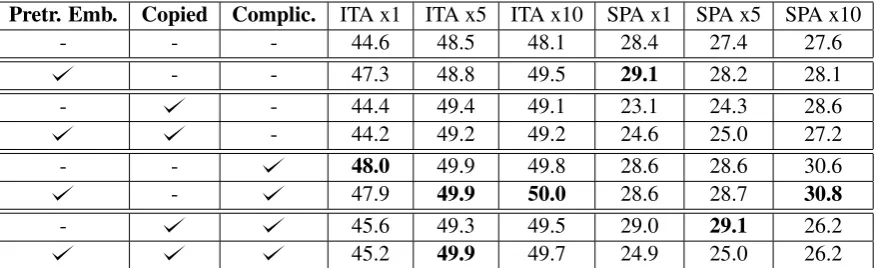
infor-Pretr. Emb. Copied Complic. ITA x1 ITA x5 ITA x10 SPA x1 SPA x5 SPA x10
- - - 44.6 48.5 48.1 28.4 27.4 27.6
- - 47.3 48.8 49.5 29.1 28.2 28.1
- - 44.4 49.4 49.1 23.1 24.3 28.6
- 44.2 49.2 49.2 24.6 25.0 27.2
- - 48.0 49.9 49.8 28.6 28.6 30.6
- 47.9 49.9 50.0 28.6 28.7 30.8
- 45.6 49.3 49.5 29.0 29.1 26.2
[image:4.595.81.519.62.196.2]45.2 49.9 49.7 24.9 25.0 26.2
Table 1: Results of neural simplification experiments on Italian and Spanish data (SARI)
mal language, including Italian Opensubtitles,2 the Pais`a corpus (Lyding et al.,2014), Wikipedia and the collection of Italian laws.3 This merging process results in around 1.3B words and 125M sentences. We rank all sentences by readability level according to the best features described in (Dell’Orletta et al., 2014) and keep the 500,000 most readable (i.e. simplest) sentences to create the synthetic pairs. This process is needed due to the lack of an Italian equivalent of the Sim-ple English Wikipedia,4 which is widely used as a source of simple monolingual data when dealing with English text simplification (Zhu et al.,2010; Woodsend and Lapata,2011). From the large cor-pus described above, before filtering only simple sentences, we also create word embeddings with 300dimensions using word2vec (Mikolov et al., 2013).
5.2 Spanish
The Spanish gold standard is obtained from the Spanish Newsela corpus,5 containing1,221 doc-uments manually annotated by professionals for different proficiency levels. We align complex– simple pairs using the CATS-Align6 tool (ˇStajner et al.,2018) and discard the pairs coupled with an alignment accuracy below0.5. The gold standard contains55,890complex-to-simple pairs.
The set of simple sentences used to create the synthetic pairs is extracted from a large
monolin-2www.opensubtitles.org
3www.gazzettaufficiale.it
4
simple.wikipedia.org/wiki/Simple_
English_Wikipedia.
5newsela.com/data
6
The tool (github.com/neosyon/
SimpTextAlign) includes several lexical and
se-mantic text similarity methods and alignment strategies for simplified text alignment at different text representation levels (paragraph, sentence, and sentence with paragraph pre-alignment).
gual corpus covering different domains, obtained from websites written in simple Spanish for lan-guage learners.7 The documents are then ranked based on the Flesch-Szigriszt readability score for Spanish (Szigriszt, 1993)8 and all sentences be-longing to the most readable ones are included in the set of simple monolingual data (484,325 sim-ple sentences in total, from a set of about 1.2M sentences). For Spanish, we do not rank directly the sentences because there is no specific study to identify metrics at sentence level similar to the one for Italian presented in (Dell’Orletta et al.,2014).
The Spanish embeddings used in the simplifi-cation process are those obtained from the Span-ish Billion Word Corpus, that is widely used in NLP experiments on Spanish (Zea et al., 2016; Quir´os et al.,2016).9 To favour the extraction of word embeddings from simple texts, we increase the Spanish Billion Word Corpus by adding our extracted simple Spanish texts. In total, Spanish word embeddings are extracted from a corpus of nearly1.5B words.
5.3 System configuration
OpenNMT is run on a Nvidia Tesla K80 GPU using stochastic gradient descent (Robbins and Monro, 1951) optimization with learning rate 1. Each run is repeated three times with different seeds, then the average value is considered. Since the source and target languages are the same, in
7
For example www.cuentosinfantiles.net or
www.mundoprimaria.com
8This score is an adaptation of the Flesch Index (Flesch,
1946), which provides a readability measure combining word and sentence length in a 1-100 scale (the closer the score is to 100, the easier the text is to read). The Flesch-Szigriszt adap-tation refines the original Flesch equation by also considering the number of syllables and phrases in the text.
9github.com/uchile-nlp/
the preprocessing phase their vocabulary is shared. We split data into train/dev/test with ratio 90/5/5 respectively. For Italian, this results in a split of29,260/1,475/1,475sentence pairs, while for Spanish it is50,301/2,794/2,795.
6 Evaluation
We report in Table 1 the results of Italian and Spanish text simplification using different settings and data augmentation techniques. For each lan-guage, we evaluate the results using the gold train-ing set as is, and expandtrain-ing it through oversam-pling (i.e. repetition of the same sentence pairs 5 and 10 times). In addition, we evaluate the impact of: i) adding pre-trained word embeddings built on large monolingual corpora (Pretr.Emb),ii) us-ing the simple-to-simple pairs for data augmenta-tion (Copied), andiii)using, for the same purpose, the simple-to-complex synthetic pairs (Complic.). We also explore the addition of different combina-tions of the aforementioned resources. The evalu-ation is performed by computing the SARI score (Xu et al.,2016) on the test set.
Our results show that adding only pre-trained word embeddings trained on large monolingual corpora achieves, in general, better performance than the baseline (max: +2.73 SARI points for Italian, +0.8for Spanish). Our experiments show also that the usefulness of simple-to-simple pairs cannot be generalised: they are beneficial for all results on Italian andSPAx10, while they are harm-ful for SPAx1 and SPAx5. Our intuition is that the copied data pushed the system in the direc-tion of learning to copy the source sentence in the output instead of simplifying it, which can cre-ate some instability in the model during training. The addition of simple-to-simple pairs and of pre-trained word embeddings does not yield large im-provements, confirming the idea that the copied pairs mainly affect the quality of the word em-bedding representations instead of the relation be-tween complex and simple sentences (i.e. atten-tion network).
The largest gains in performance are obtained when using the simple-to-complex synthetic pairs. Both in isolation and when paired with pre-trained embeddings, they make the neural model able to outperform the baseline up to +3.4SARI points. The best results for both languages are obtained by multiplying the training data by 10 and adding the simple-to-complex synthetic data. These
config-urations outperform the standard settings (ITAx1
and SPAx1) by +5.4 SARI points for Italian and and +2.4for Spanish.
When concatenating all the synthetic and real data, and the pre-trained embeddings are used, the performance is comparable with the one obtained using the simple-to-complex synthetic pairs, but at the cost of using a larger quantity of training data. Although we cannot make a direct comparison of the SARI scores across different languages, Ital-ian and Spanish are typologically very similar, and therefore we can argue that our models for neu-ral simplification in Italian works better than the Spanish ones. This may depend on several rea-sons. For Italian, the selection of 500,000 sim-ple sentences is based on sentence-specific fea-tures correlated with high readability, emerged from the analysis in (Dell’Orletta et al.,2014). On the contrary, extracting simple monolingual sen-tences based on the readability score at document level, as we did for Spanish, is more prone to in-consistencies. Other differences may be due to the quality of gold standard data: although the Spanish gold standard is bigger than the Italian one (55,890 complex-simple sentence pairs vs. 32,210pairs respectively), its language is gener-ally more complex, since it contains news articles, while the Italian gold standard includes to a large extent stories for children and textbooks. Besides, while some of the Italian sentences were manually aligned, the Spanish gold data were obtained by automatically extracting complex-to-simple pairs from the Newsela corpus, in which the alignment had been done at document level.
As a comparison, we evaluate on the same test set also the MUSST syntactic simplifier (Scarton et al.,2017), a freely available system implement-ing a set of simplification rules for Italian and Spanish. We obtain 20.16 SARI for Italian and 21.24for Spanish. Our results show that, despite some issues described before, low-resource neu-ral simplification is still a promising research di-rection to pursue, especially with data augmenta-tion. This is particularly true for Spanish MUSST, which includes a richer set of rules than the Italian version, but that achieves nevertheless -9.56SARI points than the best neural model for Spanish.
7 Conclusions
simplifica-tion through weak supervision. Our solusimplifica-tions were evaluated on Italian and Spanish using a sequence-to-sequence approach. Our results show that us-ing external embeddus-ings is generally beneficial in a low-resource setting, since they provide addi-tional information that cannot be extracted from a limited amount of training pairs. Another gain in performance is achieved using complex-to-simple synthetic pairs created with a ‘complexifier’ sys-tem.
In the future, we plan to extend both the lan-guages of the experiments and the data augmenta-tion techniques, for example by applying machine translation to increase the amount of gold sentence pairs across languages, or by using bootstrapping techniques.
Acknowledgments
This work has been partially supported by the Eu-ropean Commission project SIMPATICO (H2020-EURO-6-2015, grant number 692819).
References
Dzmitry Bahdanau, Kyunghyun Cho, and Yoshua Ben-gio. 2014. Neural machine translation by jointly learning to align and translate. arXiv preprint arXiv:1409.0473.
Gianni Barlacchi and Sara Tonelli. 2013. ERNESTA: A Sentence Simplification Tool for Children’s Sto-ries in Italian. InComputational Linguistics and In-telligent Text Processing: 14th International Confer-ence, CICLing 2013, Samos, Greece, March 24-30, 2013, Proceedings, Part II, pages 476–487, Berlin, Heidelberg. Springer Berlin Heidelberg.
Alexandre B´erard, Olivier Pietquin, Laurent Besacier, and Christophe Servan. 2016. Listen and Translate: A Proof of Concept for End-to-End Speech-to-Text Translation. InNIPS Workshop on end-to-end learn-ing for speech and audio processlearn-ing, Barcelona, Spain.
Stefan Bott, Horacio Saggion, and David Figueroa. 2012. A Hybrid System for Spanish Text Simpli-fication. In Proceedings of the Third Workshop on Speech and Language Processing for Assistive Tech-nologies, pages 75–84.
Laetitia Brouwers, Delphine Bernhard, Anne-Laure Ligozat, and Thomas Franc¸ois. 2012. Simplifica-tion syntaxique de phrases pour le franc¸ais (Syntac-tic Simplification for French Sentences) [in French]. InProceedings of the Joint Conference JEP-TALN-RECITAL 2012, volume 2: TALN, pages 211–224. ATALA/AFCP.
Dominique Brunato, Andrea Cimino, Felice Dell’Orletta, and Giulia Venturi. 2016. PaCCSS-IT: A Parallel Corpus of Complex-Simple Sentences for Automatic Text Simplification. InProceedings of the 2016 Conference on Empirical Methods in Natural Language Processing, pages 351–361. Association for Computational Linguistics.
Dominique Brunato, Felice Dell’Orletta, Giulia Ven-turi, and Simonetta Montemagni. 2015. Design and Annotation of the First Italian Corpus for Text Sim-plification. InProceedings of The 9th Linguistic An-notation Workshop, pages 31–41, Denver, Colorado, USA. Association for Computational Linguistics.
John Carroll, Guido Minnen, Yvonne Canning, Siob-han Devlin, and John Tait. 1998. Practical Simplifi-cation of English Newspaper Text to Assist Aphasic Readers. InIn Proc. of AAAI-98 Workshop on Inte-grating Artificial Intelligence and Assistive Technol-ogy, pages 7–10.
Raman Chandrasekar and Srinivas Bangalore. 1997. Automatic induction of rules for text simplification. Knowledge-Based Systems, 10(3):183–190.
Rajen Chatterjee, M. Amin Farajian, Matteo Negri, Marco Turchi, Ankit Srivastava, and Santanu Pal. 2017. Multi-source Neural Automatic Post-Editing: FBK’s Participation in the WMT 2017 APE Shared Task. InProceedings of the Second Conference on Machine Translation, pages 630–638. Association for Computational Linguistics.
Chung-Cheng Chiu, Tara Sainath, Yonghui Wu, Rohit Prabhavalkar, Patrick Nguyen, Zhifeng Chen, An-juli Kannan, Ron J. Weiss, Kanishka Rao, Katya Gonina, Navdeep Jaitly, Bo Li, Jan Chorowski, and Michiel Bacchiani. 2018. State-of-the-art Speech Recognition With Sequence-to-Sequence Models. In Proceedings of the IEEE International Confer-ence on Acoustics, Speech and Signal Processing, (ICASSP) 2018, pages 4774–4778, Calgary, Alberta, Canada.
Scott A. Crossley, David Allen, and Danielle S. McNa-mara. 2012. Text simplification and comprehensible input: A case for an intuitive approach. Language Teaching Research, 16(1):89–108.
Felice Dell’Orletta, Martijn Wieling, Giulia Venturi, Andrea Cimino, and Simonetta Montemagni. 2014. Assessing the Readability of Sentences: Which Cor-pora and Features? In Proceedings of the Ninth Workshop on Innovative Use of NLP for Building Educational Applications.
Heng Ding and Krisztian Balog. 2018. Generat-ing Synthetic Data for Neural Keyword-to-Question Models. In Proceedings of the 2018 ACM SIGIR International Conference on Theory of Information Retrieval, ICTIR, pages 51–58.
Hany Hassan, Anthony Aue, Chang Chen, Vishal Chowdhary, Jonathan Clark, Christian Feder-mann, Xuedong Huang, Marcin Junczys-Dowmunt, William Lewis, Mu Li, Shujie Liu, Tie-Yan Liu, Renqian Luo, Arul Menezes, Tao Qin, Frank Seide, Xu Tan, Fei Tian, Lijun Wu, Shuangzhi Wu, Yingce Xia, Dongdong Zhang, Zhirui Zhang, and Ming Zhou. 2018. Achieving Human Parity on Auto-matic Chinese to English News Translation. ArXiv e-prints arXiv:1803.05567v2.
Ye Jia, Melvin Johnson, Wolfgang Macherey, Ron-J. Weiss, Yuan Cao, Chung-Cheng Chiu, Stella-Laurenzo Ari, and Yonghui Wu. 2018. Leverag-ing Weakly Supervised Data to Improve End-to-End Speech-to-Text Translation. ArXiv e-prints arXiv:1811.02050.
Guillaume Klein, Yoon Kim, Yuntian Deng, Jean Senellart, and Alexander M. Rush. 2017. Open-NMT: Open-Source Toolkit for Neural Machine Translation. InProceedings of ACL.
Verena Lyding, Egon Stemle, Claudia Borghetti, Marco Brunello, Sara Castagnoli, Felice Dell’Orletta, Hen-rik Dittmann, Alessandro Lenci, and Vito Pirrelli. 2014. The PAIS `A Corpus of Italian Web Texts. In Proceedings of the 9th Web as Corpus Workshop, WaC@EACL 2014, Gothenburg, Sweden, April 26, 2014, pages 36–43. Association for Computational Linguistics.
Tomas Mikolov, Ilya Sutskever, Kai Chen, Greg Cor-rado, and Jeffrey Dean. 2013. Distributed Repre-sentations of Words and Phrases and Their Compo-sitionality. InProceedings of the 26th International Conference on Neural Information Processing Sys-tems - Volume 2, NIPS’13, pages 3111–3119, USA. Curran Associates Inc.
Sergiu Nisioi, Sanja Stajner, Simone Paolo Ponzetto, and Liviu P. Dinu. 2017. Exploring Neural Text Simplification Models. InProceedings of the 55th Annual Meeting of the Association for Computa-tional Linguistics, ACL 2017, Vancouver, Canada, July 30 - August 4, Volume 2: Short Papers, pages 85–91. Association for Computational Linguistics.
Antonio Quir´os, Isabel Segura-Bedmar, and Paloma Mart´ınez. 2016. LABDA at the 2016 TASS Chal-lenge Task: Using Word Embeddings for the Senti-ment Analysis Task. InTASS@ SEPLN, pages 29– 33.
Herbert Robbins and Sutton Monro. 1951. A stochastic approximation method. The annals of mathematical statistics, pages 400–407.
Carolina Scarton, Alessio Palmero Aprosio, Sara Tonelli, Tamara Mart´ın Wanton, and Lucia Specia. 2017. MUSST: A Multilingual Syntactic Simplifi-cation Tool. In Proceedings of the IJCNLP 2017, System Demonstrations, pages 25–28. Association for Computational Linguistics.
Carolina Scarton and Lucia Specia. 2018. Learn-ing Simplifications for Specific Target Audiences. In Proceedings of the 56th Annual Meeting of the Association for Computational Linguistics (Volume 2: Short Papers), pages 712–718. Association for Computational Linguistics.
Abigail See, Peter J. Liu, and Christopher D. Man-ning. 2017. Get To The Point: Summarization with Pointer-Generator Networks. InProceedings of the 55th Annual Meeting of the Association for Compu-tational Linguistics (Volume 1: Long Papers), pages 1073–1083. Association for Computational Linguis-tics.
Rico Sennrich, Barry Haddow, and Alexandra Birch. 2016a. Edinburgh Neural Machine Translation Sys-tems for WMT 16. In Proceedings of the First Conference on Machine Translation, pages 371– 376, Berlin, Germany. Association for Computa-tional Linguistics.
Rico Sennrich, Barry Haddow, and Alexandra Birch. 2016b. Improving Neural Machine Translation Models with Monolingual Data. InProceedings of the 54th Annual Meeting of the Association for Com-putational Linguistics (Volume 1: Long Papers), pages 86–96. Association for Computational Lin-guistics.
Matthew Shardlow. 2014. A survey of automated text simplification. International Journal of Advanced Computer Science and Applications(IJACSA), Spe-cial Issue on Natural Language Processing 2014, 4(1).
Elior Sulem, Omri Abend, and Ari Rappoport. 2018.
Simple and Effective Text Simplification Using Se-mantic and Neural Methods. InProceedings of the 56th Annual Meeting of the Association for Compu-tational Linguistics (Volume 1: Long Papers), pages 162–173. Association for Computational Linguis-tics.
Francisco Szigriszt. 1993.Sistemas predictivos de legi-bilidad del lenguaje escrito. Ph.D. thesis, Tesis doc-toral. Madrid: Universidad Complutense de Madrid.
Sara Tonelli, Alessio Palmero Aprosio, and Francesca Saltori. 2016. SIMPITIKI: a Simplification Corpus for Italian. InProceedings of the 3rd Italian Confer-ence on Computational Linguistics (CLiC-it), vol-ume 1749 ofCEUR Workshop Proceedings.
David Vickrey and Daphne Koller. 2008. Apply-ing Sentence Simplification to the CoNLL-2008 Shared Task. InProceedings of the Twelfth Confer-ence on Computational Natural Language Learning, CoNLL, pages 268–272, Manchester, UK.
(LREC 2018), Miyazaki, Japan. European Language Resources Association (ELRA).
Tu Vu, Baotian Hu, Tsendsuren Munkhdalai, and Hong Yu. 2018. Sentence Simplification with Memory-Augmented Neural Networks. InProceedings of the 2018 Conference of the North American Chapter of the Association for Computational Linguistics: Hu-man Language Technologies, Volume 2 (Short Pa-pers), pages 79–85. Association for Computational Linguistics.
Kristian Woodsend and Mirella Lapata. 2011. Learn-ing to Simplify Sentences with Quasi-Synchronous Grammar and Integer Programming. In Proceed-ings of the 2011 Conference on Empirical Methods in Natural Language Processing, pages 409–420, Edinburgh, Scotland, UK. Association for Compu-tational Linguistics.
Wei Xu, Chris Callison-Burch, and Courtney Napoles. 2015. Problems in Current Text Simplification Re-search: New Data Can Help. Transactions of the Association for Computational Linguistics, 3:283– 297.
Wei Xu, Courtney Napoles, Ellie Pavlick, Quanze Chen, and Chris Callison-Burch. 2016. Optimizing Statistical Machine Translation for Text Simplifica-tion. Transactions of the Association for Computa-tional Linguistics, 4:401–415.
Jenny Linet Copara Zea, Jose Eduardo Ochoa Luna, Camilo Thorne, and Goran Glavaˇs. 2016. Spanish NER with Word Representations and Conditional Random Fields. InProceedings of the Sixth Named Entity Workshop, pages 34–40.
Xingxing Zhang and Mirella Lapata. 2017. Sentence Simplification with Deep Reinforcement Learning. In Proceedings of the 2017 Conference on Em-pirical Methods in Natural Language Processing, EMNLP 2017, Copenhagen, Denmark, September 9-11, 2017, pages 584–594. Association for Com-putational Linguistics.