Robust Cross-lingual Hypernymy Detection using Dependency Context
Shyam Upadhyay
1∗, Yogarshi Vyas
2∗, Marine Carpuat
2, Dan Roth
11
Department of Computer and Information Science, University of Pennsylvania, Philadelphia, PA
2Department of Computer Science, University of Maryland, College Park, MD
[email protected], [email protected],
[email protected], [email protected]
Abstract
Cross-lingual Hypernymy Detection involves determining if a word in one language (“fruit”) is a hypernym of a word in another language (“pomme” i.e. apple in French). The abil-ity to detect hypernymy cross-lingually can aid in solving cross-lingual versions of tasks such as textual entailment and event coreference. We propose BISPARSE-DEP, a family of un-supervised approaches for cross-lingual hyper-nymy detection, which learns sparse, bilingual word embeddings based on dependency con-texts. We show that BISPARSE-DEPcan
sig-nificantly improve performance on this task, compared to approaches based only on lexical context. Our approach is also robust, show-ing promise for low-resource settshow-ings: our dependency-based embeddings can be learned using a parser trained on related languages, with negligible loss in performance. We also crowd-source a challenging dataset for this task on four languages – Russian, French, Arabic, and Chinese. Our embeddings and datasets are publicly available.1
1 Introduction
Translation helps identify correspondences in bilingual texts, but other asymmetric semantic re-lationships can improve language understanding when translations are not exactly equivalent. One such relationship is cross-lingual hypernymy – identifying that ´ecureuil(“squirrel” in French) is a kind ofrodent, or ворона(“crow” in Russian) is a kind ofbird. The ability to detect hypernyms across languages serves as a building block in a range of cross-lingual tasks, including Recogniz-ing Textual Entailment (RTE) (Negri et al.,2012,
∗These authors contributed equally.
1https://github.com/yogarshi/ bisparse-dep/
2013), constructing multilingual taxonomies (Fu et al.,2014), event coreference across multilingual news sources (Vossen et al.,2015), and evaluating Machine Translation output (Pad´o et al.,2009).
Building models that can robustly identify hy-pernymy across the spectrum of human languages is a challenging problem, that is further com-pounded in low resource settings. At first glance, translating words to English and then identify-ing hypernyms in a monolidentify-ingual settidentify-ing may pear to be a sufficient solution. However, this ap-proach cannot capture many phenomena. For in-stance, the English wordscook,leaderand super-visor can all be hypernyms of the French word chef, as the French word does not have a exact translation in English covering its possible usages. However, translatingcheftocookand then deter-mining hypernymy monolingually precludes iden-tifying leader or supervisor as a hypernyms of chef. Similarly, language-specific usage patterns can also influence hypernymy decisions. For in-stance, the French wordchroniqueurtranslates to chroniclerin English, but is more frequently used in French to refer to journalists (makingjournalist its hypernym).2
This motivates approaches that directly detect hypernymy in the cross-lingual setting by extend-ing distributional methods for detectextend-ing monolin-gual hypernymy, as in our prior work (Vyas and Carpuat,2016). State-of-the-art distributional ap-proaches (Roller and Erk, 2016; Shwartz et al., 2017) for detecting monolingual hypernymy re-quire syntactic analysis (eg. dependency parsing), which may not available for many languages. Ad-ditionally, limited training resources make unsu-pervised methods more desirable than suunsu-pervised hypernymy detection approaches (Roller and Erk,
2016). Furthermore, monolingual distributional approaches cannot be applied directly to the cross-lingual task, because the vector spaces of two lan-guages need to be aligned using a cross-lingual re-source (a bilingual dictionary, for instance).
We tackle these challenges by proposing BISPARSE-DEP - a family of robust,
unsuper-vised approaches for identifying cross-lingual hy-pernymy. BISPARSE-DEP uses a cross-lingual
word embedding model learned from a small bilin-gual dictionary and a variety of monolinbilin-gual syn-tactic context extracted from a dependency parsed corpus. BISPARSE-DEPexhibits robust behavior
along multiple dimensions. In the absence of a dependency treebank for a language, it can learn embeddings using a parser trained on related lan-guages. When exposed to less monolingual data, or a lower quality bilingual dictionary, BISPARSE
-DEPdegrades only marginally. In all these cases, it compares favorably with models that have been supplied with all necessary resources, showing promise for low-resource settings. We extensively evaluate BISPARSE-DEPon a new crowd-sourced
cross-lingual dataset, with over 2900 hypernym pairs, spanning four languages from distinct fami-lies – French, Russian, Arabic and Chinese – and release the datasets for future evaluations.
2 Related Work
Cross-lingual Distributional Semantics
Cross-lingual word embeddings have been shown to encode semantics across languages in tasks such as word similarity (Faruqui and Dyer, 2014) and lexicon induction (Vuli´c and Moens, 2015). Our works stands apart in two aspects (1) In contrast to tasks involving similarity and synonymy (symmetric relations), the focus of our work is on detectingasymmetricrelations across languages, using cross-lingual embeddings. (2) Unlike most previous work, we use dependency context instead of lexical context to induce cross-lingual embeddings, which allows us to abstract away from language specific word order, and (as we show) improves hypernymy detection.
More closely related is our prior work (Vyas and Carpuat,2016) where we used lexical context based embeddings to detect cross-lingual lexical entailment. In contrast, the focus of this work is on hypernymy, a more well-defined relation than entailment. Also, we improve upon our previ-ous approach by using dependency based embed-dings (§6.1), and show that the improvements hold even when exposed to data scarce settings (§6.3).
The tired traveler roamed the sandy desert, seeking food
det
amod
nsubj dobj
advcl amod
[image:2.595.314.507.65.121.2]det dobj
Figure 2: Example Dependency Tree.
We also do a more comprehensive evaluation on four languages paired with English, instead of just French.
Dependency Based Embeddings In monolin-gual settings, dependency based embeddings have been shown to outperform window based embed-dings on many tasks (Bansal et al., 2014; Hill et al.,2014;Melamud et al.,2016).Roller and Erk (2016) showed that dependency embeddings can help in recovering Hearst patterns (Hearst,1992) like “animals such as cats”, which are known to be indicative of hypernymy. Shwartz et al.(2017) demonstrated that dependency based embeddings are almost always superior to window based em-beddings for identifying hypernyms in English. Our work uses dependency based embeddings in a cross-lingual setting, a less explored research direction. A key novelty of our work also lies in its use of syntactic transfer to derive depen-dency contexts. This scenario is more relevant in a cross-lingual setting, where treebanks might not be available for many languages.
3 Our Approach –
B
IS
PARSE-D
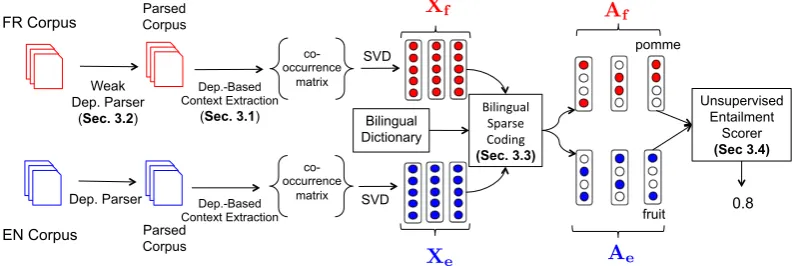
EPWe propose BISPARSE-DEP, a family of
ap-proaches that uses sparse, bilingual, dependency based word embeddings to identify cross-lingual hypernymy.
SVD
Xf Af
SVD
Xe Ae
Bilingual Sparse Coding (Sec. 3.3) Bilingual
Dictionary Weak
Dep. Parser (Sec. 3.2) FR Corpus
Dep. Parser
EN Corpus Parsed Corpus
co-occurrence
matrix Parsed
Corpus
pomme
fruit
Unsupervised Entailment
Scorer (Sec 3.4)
0.8 Dep.-Based
Context Extraction (Sec. 3.1)
Dep.-Based Context Extraction
co-occurrence
[image:3.595.100.499.67.200.2]matrix
Figure 1: The BISPARSE-DEPapproach, which learns sparse bilingual embeddings using dependency based
con-texts. The resulting sparse embeddings, together with an unsupervised entailment scorer, can detect hypernyms across languages (e.g.,pommeis afruit).
3.1 Dependency Based Context Extraction
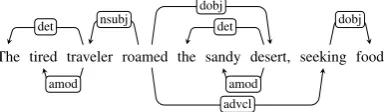
The context of a word can be described in mul-tiple ways using its syntactic neighborhood in a dependency graph. For instance, in Figure2, we describe the context for a target word (traveler) in the following two ways:
• FULLcontext (Pad´o and Lapata,2007;
Ba-roni and Lenci, 2010; Levy and Goldberg, 2014): Children and parent words, concate-nated with the label and direction of the re-lation (eg. roamed#nsubj−1and tired#amod
are contexts fortraveler).
• JOINT context (Chersoni et al.,2016):
Par-ent concatenated with each of its siblings (eg. roamed#desertandroamed#seekingare con-texts fortraveler).
These two contexts exploit different amounts of syntactic information – JOINTdoes not require
la-beled parses, unlike FULL. The JOINT context
combines parent and sibling information, while FULL keeps them as distinct contexts. Both
en-code directionality into the context, either through label direction or through sibling-parent relations. We use word-context co-occurrences generated using these contexts in a distributional semantic model (DSM) in lieu of window based contexts to generate dependency based embeddings.
3.2 Dependency Contexts without a Treebank
Using dependency contexts in multilingual set-tings may not always be possible, as dependency treebanks are not available for many languages. To circumvent this issue, we use related languages to train a weak dependency parser.
We train adelexicalizedparser using treebanks of related languages, where the word form based
features are turned off, so that the parser is trained on purely non-lexical features (e.g. POS tags). The rationale behind this is that related languages show common syntactic structure that can be transferred to the original language, with delex-icalized parsing (Zeman and Resnik, 2008; Mc-Donald et al.,2011,inter alia)being one popular approach.3
3.3 Bilingual Sparse Coding
Given a dependency based co-occurrence matrix described in the previous section(s), we generate BISPARSE-DEPembeddings using the framework
from our prior work (Vyas and Carpuat, 2016), which we henceforth call BISPARSE. BISPARSE
generates sparse, bilingual word embeddings us-ing a dictionary learnus-ing objective with a spar-sity inducingl1penalty. We give a brief overview
of this approach, the full details of which can be found in our prior work.
For two languages with vocabulariesveandvf, and monolingual dependency embeddingsXeand
Xf, BISPARSEsolves the following objective:
argmin Ae,De,Af,Df
ve
X
i=1 1
2||AeiDe
T−X
ei||22+λe||Aei||1
+
vf
X
j=1 1
2||AfjDf
T−X
fj||22+λf||Afj||1
+X
i,j
1
2λxSij||Aei−Afj|| 2
2 (1)
s.t.Ak>0 kDkik22≤1 k∈ {e,f}
are sparse matrices which are bilingual represen-tations in a shared semantic space. The transla-tion matrixS(of sizeve×vf) captures correspon-dences between the vocabularies (of size ve and vf) of two languages. For instance, each row ofS can be a one-hot vector that identifies the word inf
that is most frequently aligned with theeword for that row in a large parallel corpus, thus building a one-to-many mapping between the two languages.
3.4 Unsupervised Entailment Scorer
A variety of scorers can be used to quantify the directional relationship between two words, given feature representations of these words (Lin,1998; Weeds and Weir,2003;Lenci and Benotto,2012). Once the BISPARSE-DEP embeddings are con-structed, we useBalAPinc(Kotlerman et al.,2009) to score word pairs for hypernymy. BalAPinc is based on the distributional inclusion hypothe-sis (Geffet and Dagan, 2005) and computes the geometric mean of 1)LIN(Lin,1998), a symmet-ric score that captures similarity, and 2)APinc, an asymmetric score based on average precision.
4 Crowd-Sourcing Annotations
There is no publicly available dataset to evaluate models of hypernymy detection across multiple languages. While ontologies like Open Multi-lingual WordNet (OMW) (Bond and Foster,2013) and BabelNet (Navigli and Ponzetto,2012) con-tain cross-lingual links, these resources are semi-automatically generated and hence contain noisy edges. Thus, to get reliable and high-quality test beds, we collect evaluation datasets using Crowd-Flower4. Our datasets span four languages from
distinct families - French (Fr), Russian (Ru), Ara-bic (Ar) and Chinese (Zh) - paired with English.
To begin the annotation process, we first pool candidate pairs using hypernymy edges across languages from OMW and BabelNet, along with translations from monolingual hypernymy datasets (Baroni and Lenci, 2011; Baroni et al., 2012;Kotlerman et al.,2010).
4.1 Annotation Setup
The annotation task requires annotators to be flu-ent in both English and the non-English language. To ensure only fluent speakers perform the task, for each language, we provide task instructions in the non-English language itself. Also, we restrict the task to annotators verified by CrowdFlower to have those language skills. Finally, annotators also
4http://crowdflower.com
pair #crowdsourced #pos (= #neg)
French-English 2115 763
Russian-English 2264 706
Arabic-English 2144 691
Chinese-English 2165 806
Table 1: Crowd-sourced dataset statistics. #pos (#neg) denote positives (negatives) in the evaluation set. We deliberately under-sample negatives to have a balanced evaluation set.
need to pass a quiz based on a small amount of gold standard data to gain access to the task.
Annotators choose between three options for each word pair (pf, qe), wherepf is a non-English word andqe is a English word : “pf is a kind of qe”, “qeis a part ofpf” and “none of the above”. Word pairs labeled with the first option are con-sidered as positive examples while those labeled as “none of the above” are considered as nega-tive.5The second option was included to filter out
meronymy examples that were part of the noisy pool. We leave it to the annotator to infer whether the relation holds between any senses ofpf orqe, if either of them are polysemous.
For every candidate hypernym pair (pf, qe), we also ask annotators to judge its reversed and translated hyponympair(qf, pe). For instance, if
(citron, f ood)is a hypernym candidate, we also
show annotators (aliments, lemon) which is a
potential hyponym candidate (potential, because as mentioned in §1, translation need not preserve semantic relationships). The purpose of present-ing the hyponym pair,(qf, pe),is two-fold. First, it emphasizes the directional nature of the task. Second, it identifies hyponym pairs, which we use as negative examples. The hyponym pairs are challenging since differentiating them from hyper-nyms truly requires detecting asymmetry.
gual hypernymy annotator agreement as, to the best of our knowledge, such numbers are not avail-able for existing test sets. Dataset statistics are shown in Table1.
We observed that annotators were able to agree on pairs containing polysemous words where hy-pernymy holds for some sense. For instance, for the French-English pair (avocat,professional), the French wordavocatcan either meanlawyeror av-ocado, but the pair was annotated as a positive example. Hence, we leave it to the annotators to handle polysemy by choosing the most appropri-ate sense.
4.2 Two Evaluation Test Sets
To verify if the crowdsourced hyponyms are chal-lenging negative examples we create two evalua-tion sets. Both share the (crowdsourced) positive examples, but differ in their negatives:
• HYPER-HYPO – negative examples are the
crowdsourced hyponyms.
• HYPER-COHYPO – negative examples are cohyponymsdrawn from OMW.
Cohyponyms are words sharing a common hyper-nym. For instance, bi`ere (“beer” in French) and vodkaare cohyponyms since they share a common hypernym in alcool/alcohol. We choose cohy-ponyms for the second test set because: (a) They require differentiating between similarity (a sym-metric relation) and hypernymy (an asymsym-metric relation). For instance,bi`ereandvodkaare highly similar yet, they do not have a hypernymy relation-ship. (b) Cohyponyms are a popular choice of neg-ative examples in many entailment datasets ( Ba-roni and Lenci,2011).
5 Experimental Setup
5.1 Data and Evaluation SetupTraining BISPARSE-DEP requires a dependency
parsed monolingual corpus, and a translation ma-trix for jointly aligning the monolingual vectors. We compute the translation matrix using word alignments derived from parallel corpora (see cor-pus statistics in Table ??). While we use paral-lel corpora to generate the translation matrix to be comparable to baselines (§5.2), we can obtain the matrix from any bilingual dictionary.
The monolingual corpora are parsed using
Yara Parser (Rasooli and Tetreault, 2015), trained on the corresponding treebank from the Universal Dependency Treebank (McDonald et al., 2013) (UDT-v1.4). Yara Parser was
chosen as it is fast, and competitive with state-of-the-art parsers (Choi et al.,2015). The mono-lingual corpora was POS-tagged using TurboTag-ger (Martins et al.,2013). We induce dependency contexts for words by first thresholding the lan-guage vocabulary to the top 50,000 nouns, verbs and adjectives. A co-occurrence matrix is com-puted over this vocabulary using the context types in§3.1.
Inducing Dependency Contexts The entries of the word-context co-occurrence matrix are re-weighted using Positive Pointwise Mutual Infor-mation (Bullinaria and Levy,2007). The result-ing matrix is reduced to 1000 dimensions usresult-ing SVD (Golub and Kahan, 1965).6 These vectors
are used asXe,Xf in the setup from§3.3to gen-erate 100 dimensional sparse bilingual vectors.
Evaluation We use accuracy as our evalua-tion metric, as it is easy to interpret when the classes are balanced (Turney and Mohammad, 2015). Both evaluation datasets – HYPER-HYPO
and HYPER-COHYPO– are split into 1:2 dev/test
splits.BalAPinchas two tunable parameters - 1) a threshold that indicates theBalAPincscore above which all examples are labeled as positive, 2) the maximum number of features to consider for each word. We use the tuning set to tune the two pa-rameters as well as the various hyper-papa-rameters associated with the models.
5.2 Contrastive Approaches
We compare our BISPARSE-DEP embeddings
with the following approaches:
MONO-DEP (Translation baseline) For word
pair (pf,qe) in test data, we translatepfto English using the most common translation in the transla-tion matrix. Hypernymy is then determined using sparse, dependency based embeddings in English. BISPARSE-LEX (Window context)
Predeces-sor of the BISPARSE-DEP model from our
previ-ous work (Vyas and Carpuat,2016). This model induces sparse, cross-lingual embeddings using window based context.
BIVEC+ (Window context) Our extension of
the BIVECmodel of Luong et al.(2015). BIVEC
generates dense, cross-lingual embeddings using window based context, by substituting aligned word pairs within a window in parallel sentences. By default, BIVEConly trains using parallel data, 6Chosen based on preliminary experiments with
Language Parallel Data #sent. Monolingual Data #sent.
English – – Wackypedia (Baroni et al.,2009) 43M
Arabic NewsCommentary, Wikipedia (ISI (Munteanu and Marcu,2007Tiedemann) ,2012) 1.1M Arabic Gigaword 3.0 (Graff,2007) 17M
Chinese FBIS (LDC2003E14) 9.5M Chinese Gigaword 5.0 (Parker,2011) 58M
French Europarl (Koehn,2005) 2.7M Wikipedia♣ 20M
NewsCommentary, Wikipedia (Tiedemann,2012)
Russian Yandex-1M♠ 1.6M Wikipedia♣ 22M
=www.statmt.org/wmt15/training-parallel-nc-v10.tgz,♣=dumps.wikimedia.org/xxwiki/20161201/
♠=translate.yandex.ru/corpus
Table 2: Training data statistics for different languages. Note that while we use parallel corpora for computing translation dictionaries, our approach does not require it, and can work with any bilingual dictionary.
and so we initialize it with monolingually trained window based embeddings to ensure fair compar-ison.
CL-DEP (Dependency context) The model
from Vuli´c(2017), which induces dense, depen-dency based cross-lingual embeddings by trans-lating syntactic word-context pairs using the most common translation, and jointly training a
word2vecf7 model for both languages. Vuli´c (2017) showed improvements for word similarity and bilingual lexicon induction. We report the first results using CL-DEPon this task.
5.3 Evaluating Robustness ofBISPARSE-DEP
We investigate how robust BISPARSE-DEP is
when exposed to data scarce settings. Evaluating on a truly low resource language is complicated by the fact that obtaining an evaluation dataset for such a language is difficult. Therefore, we simu-late such settings for the languages in our dataset in multiple ways.
No Treebank If a treebank is not available for a language, dependency contexts have to be induced using treebanks from other languages (§3.2), which can affect the quality of the dependency-based embeddings. To simulate this, we train a delexicalized parser for the languages in our dataset. We use treebanks from Slovenian, Ukrainian, Serbian, Polish, Bulgarian, Slovak and Czech (40k sentences) for training the Russian parser, and treebanks from English, Spanish, Ger-man, Portuguese, Swedish and Italian (66k sen-tences) for training the French parser. UDT does not (yet) have languages in the same family as Arabic or Chinese, so for the sake of complete-ness, we train Arabic and Chinese parsers on delexicalized treebanks of the language itself.
Af-7bitbucket.org/yoavgo/word2vecf/
ter delexicalized training, the Labeled Attachment Score (LAS) on the UDT test set dropped by sev-eral points for all languages – from 76.6% to 60.0% for Russian, 83.7% to 71.1% for French, from 76.3% to 62.4% for Arabic and from 80.3% to 53.3% for Chinese. The monolingual corpora are then parsed with these weaker parsers, and co-ocurrences and dependency contexts are computed as before.
Subsampling Monolingual Data To simulate low-resource behavior along another axis, we subsample the monolingual corpora used by BISPARSE-DEP to induce monolingual vectors,
Xe,Xf. Specifically, we learnXe and Xf using progressively smaller corpora.
Quality of Bilingual Dictionary We study the impact of the quality of the bilingual dictionary used to create the translation matrixS. This
exper-iment involves using increasingly smaller parallel corpora to induce the translation dictionary.
6 Experiments
We aim to answer the following questions – (a)
Are dependency based embeddings superior to window based embeddings for identifying cross-lingual hypernymy? (§6.1)(b)Does directionality in the dependency context help cross-lingual hy-pernymy identification? (§6.2)(c)Are our models robust in data scarce settings (§6.3)?(d)Is the an-swer to(a)predicated on the choice of entailment scorer? (§6.4)?
6.1 Dependency v/s Window Contexts
We compare the performance of models de-scribed in §5.2 with the BISPARSE-DEP (FULL
and JOINT) models. We evaluate the models on
the two test splits described in §4.2 – HYPER
Model↓En With→ Ru Zh Ar Fr Avg.
Translation Baseline
MONO-DEP 50.1 52.3 51.8 54.5 52.2 Win. Based
BISPARSE-LEX 56.6 53.7 50.9 52.0 53.3 BIVEC+ 55.8 52.0 51.5 53.4 53.2
Dep. Based
CL-DEP 60.2 54.4 56.7* 53.8 56.3 BISPARSE-DEP(Full) 59.0 55.9 52.6 56.6 56.0 BISPARSE-DEP(Joint) 53.8 57.0* 52.4 59.9* 55.8 BISPARSE-DEP(Unlab) 55.9 51.2 53.3 55.9 54.1
(a) Performance on HYPER-HYPO.
Model↓En With→ Ru Zh Ar Fr Avg.
Translation Baseline
MONO-DEP 58.7 50.0 65.1 56.9 57.7 Win. Based
BISPARSE-LEX 63.8 55.8 65.8 63.2 62.2 BIVEC+ 55.9 64.9 62.2 54.1 58.3
Dep. Based
CL-DEP 56.2 62.7 63.1 61.0 60.0 BISPARSE-DEP(Full) 63.6 67.3 66.8* 66.7* 66.1 BISPARSE-DEP(Joint) 60.6 63.6 65.9 64.9 63.8 BISPARSE-DEP(Unlab) 58.6 66.7 62.4 61.5 62.4
(b) Performance on HYPER-COHYPO.
Table 3: Comparing the different approaches from §5.2with our BISPARSE-DEPapproach on HYPER-HYPO
and HYPER-COHYPO(random baseline= 0.5). Bolddenotes the best score for each language, and the * on the
best score indicates a statistically significant (p<0.05) improvement over the next best score, using McNemar’s test (McNemar,1947). Across both datasets, BISPARSE-DEPmodels outperform window based models and the
translation baseline on an average.
Hyper-Hypo Results Table 3a shows the re-sults on HYPER-HYPO. First, the benefit of
cross-lingual modeling (as opposed to translation) is ev-ident in that almost all models (except CL-DEP
on French) outperform the translation baseline. Among dependency based models, BISPARSE
-DEP (FULL) and CL-DEP consistently
outper-form both window models, while BISPARSE-DEP
(JOINT) outperforms them on all except Russian.
BISPARSE-DEP(JOINT) is the best model overall
for two languages (French and Chinese), CL-DEP
for one (Arabic), with no statistically significant differences between BISPARSE-DEP(JOINT) and
CL-DEP for Russian. This confirms that depen-dency context is more useful than window context for cross-lingual hypernymy detection.
Hyper-Cohypo Results The trends observed on HYPER-HYPO also hold on HYPER-COHYPO i.e.
dependency based models continue to outperform window based models (Table3b).
Overall, BISPARSE-DEP(FULL) performs best
in this setting, followed closely by BISPARSE -DEP(JOINT). This suggests that the sibling
infor-mation encoded in JOINT is useful to distinguish
hypernyms from hyponyms (HYPER-HYPO
re-sults), while the dependency labels encoded in FULL help to distinguish hypernyms from
co-hyponyms. Also note that all models improve sig-nificantly on the HYPER-COHYPO set, suggesting
that discriminating hypernyms from cohyponyms is easier than discriminating them from hyponyms. While the BISPARSE-DEP models were
gen-erally performing better than window models on both test sets, CL-DEPwas not as consistent (e.g.,
it was worse than the best window model on HYPER-COHYPO). As shown byTurney and
Mo-hammad(2015),BalAPincis designed for sparse embeddings and is likely to perform poorly with dense embeddings. This explains the relatively in-consistent performance of CL-DEP.
Besides establishing the challenging nature of our crowd-sourced set, the experiments on HYPER-COHYPOand HYPER-HYPOalso
demon-strate the ability of the BISPARSE-DEPmodels to
discriminate between different lexical semantic re-lations (viz. hypernymy and cohyponymy) in a cross-lingual setting. We will investigate this abil-ity more carefully in future work.
6.2 Ablating Directionality in Context
The context described by the FULL and JOINT
BISPARSE models encodes directional
informa-tion (§3.1) either in the form of label direction (FULL), or using sibling information (JOINT).
Does such directionality in the context help to cap-ture the asymmetric relationship inherent to hy-pernymy? To answer this, we evaluate a third BISPARSE-DEP model which uses UNLABELED
dependency contexts. This is similar to the FULL
context, except we do not concatenate the label of the relation to the context word (parent or chil-dren). For instance, fortravelerin Fig.2, contexts will beroamedandtired.
Experiments on both HYPER-HYPO and
HYPER-COHYPO (bottom row, Tables 3a and 3b) highlight that directional information is indeed essential - UNLABELED almost always performs
worse than FULLand JOINT, and in many cases
Model↓En With→Ru Zh Ar Fr Avg.
Hyper-Hypo
Best Win. 56.6 53.7 51.5 53.4 53.8 Delex. 59.1* 55.1* 54.6* 56.1* 56.2 Best Dep. 60.2 57.0* 56.7* 59.9* 58.5
Hyper-Cohypo
[image:8.595.90.279.63.171.2]Best Win. 63.8 64.9 65.8 63.2 64.4 Delex. 59.4 65.7* 67.5* 66.3* 64.7 Best Dep. 63.6* 67.3* 66.8* 66.7 66.1
Table 4: Robustness in absence of a treebank: The delexicalized model is competitive to the best depen-dency based and the best window based models on both test sets. For each dataset, * indicates a statistically significant (p<0.05) improvement over the next best
model in that column, using McNemar’s test ( McNe-mar,1947).
6.3 Evaluating Robustness ofBISPARSE-DEP No Treebank We run experiments (Table4) for all languages with a version of BISPARSE-DEP
that use the FULL context type for both English
and the non-English (target) language, but the tar-get language contexts are derived from a corpus parsed using a delexicalized parser (§5.3).
This model compares favorably on all language pairs against the best window based and the best dependency based model. In fact, it almost consis-tently outperforms the best window based model by several points, and is only slightly worse than the best dependency-based model.
Further analysis revealed that the good per-formance of the delexicalized model is due to the relative robustness of the delexicalized parser on frequent contexts in the co-occurrence matrix. Specifically, we found that in French and Rus-sian, the most frequent contexts were derived from
amod,nmod,nsubjand dobjedges.8 For
in-stance, the nmod edge appears in 44% of Rus-sian contexts and 33% of the French contexts. The delexicalized parser predicts both the label and di-rection of thenmodedge correctly with an F1 of 68.6 for Russian and 69.6 for French. In contrast, a fully-trained parser achieves a F1 of 76.7 for Rus-sian and 76.8 for French for the same edge.
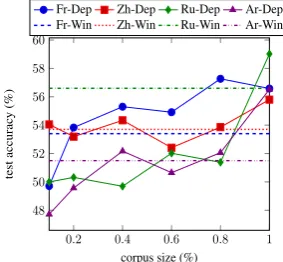
Small Monolingual Corpus In Figure4, we use increasingly smaller monolingual corpora (10%, 20%, 40%, 60% and 80%) sampled at random to induce the monolingual vectors for BISPARSE
-DEP (FULL) model. Trends (Figure 4) indicate
that BISSPARSE-DEP models that use only 40%
of the original data remain competitive with the BISSPARSE-LEXmodel that has access to the full
8Together they make up at least 70% of the contexts.
0.2 0.4 0.6 0.8 1 48
50 52 54 56 58 60
corpus size (%)
test
accurac
y
(%)
[image:8.595.338.480.64.195.2]Fr-Dep Zh-Dep Ru-Dep Ar-Dep Fr-Win Zh-Win Ru-Win Ar-Win
Figure 3: Robustness to Small CorpusFor most lan-guages, BISPARSE-DEPoutperforms the
correspond-ing best window based model for each language on HYPER-HYPO, with about 40% of the monolingual
corpora.
0.2 0.4 0.6 0.8 1 50
52 54 56 58 60
frac. of parallel corpus
test
accurac
y
(%)
Fr-Dep Zh-Dep Ru-Dep Ar-Dep Fr-Win Zh-Win Ru-Win Ar-Win
Figure 4: Robustness to Noisy DictionaryFor most languages, BISPARSE-DEP outperforms the corre-sponding best window based model on HYPER-HYPO,
with increasingly lower quality dictionaries.
data. Robust performance with smaller monolin-gual corpora is helpful since large-enough mono-lingual corpora are not always easily available.
Quality of Bilingual Dictionary Bilingual dic-tionaries derived from smaller amounts of parallel data are likely to be of lower quality than those de-rived from larger corpora. Hence, to analyze the impact of dictionary quality on BISPARSE-DEP
(FULL), we use increasingly smaller parallel cor-pora to induce bilingual dictionaries used as the score matrixS(§3.3). We use the top 10%, 20%, 40%, 60% and 80% sentences from the parallel corpora. The trends in Figure 4 show that even with a lower quality dictionary, BISPARSE-DEP
performs better than BISPARSE-LEX.
6.4 Choice of Entailment Scorer
[image:8.595.338.480.276.408.2]on the choice of the entailment scorer. SLQS is based on the distributional informativeness hy-pothesis, which states that hypernyms are less “in-formative” than hyponyms, because they occur in more general contexts. The informativenessEuof a word uis defined to be the median entropy of its top N dimensions, Eu = medianNk=1H(ck), whereH(ci)denotes the entropy of dimensionci. TheSLQSscore for a pair(u, v)is the relative dif-ference in entropies,
SLQS(u→v) = 1−Eu Ev
Recent work (Shwartz et al., 2017) has found SLQSto be more successful than other metrics in monolingual hypernymy detection.
The trends observed in these experiments are consistent with those in§6.1 – both BISPARSE -DEPmodels still outperform window-based
mod-els. Also, the delexicalized version of BISPARSE
-DEP outperforms the window-based models,
showing that the robust behavior demonstrated in §6.3is also invariant across metrics.
We also found that usingBalAPincled to bet-ter results thanSLQS . For both BISPARSE-DEP
models, BalAPincwins across the board for two languages (Russian and Chinese), and wins half the time for the other two languages compared to SLQS. We leave detailed comparison of these and other scores to future work.
7 Conclusion
We introduced BISPARSE-DEP, a new
distribu-tional approach for identifying cross-lingual hy-pernymy, based on cross-lingual embeddings de-rived from dependency contexts. We showed that using BISPARSE-DEP is superior for the
cross-lingual hypernymy detection task, when compared to standard window based models and a transla-tion baseline. Further analysis also showed that BISPARSE-DEPis robust to various low-resource
settings. In principle, BISPARSE-DEPcan be used
for any language that has a bilingual dictionary with English and a “related” language with a tree-bank. We also introduced crowd-sourced cross-lingual hypernymy datasets for four languages for future evaluations.
Our approach has the potential to complement existing work on creating cross-lingual ontolo-gies such as BabelNet and the Open Multilingual Wordnet, which are noisy because they are com-piled semi-automatically, and have limited lan-guage coverage. In general, distributional ap-proaches can help refine ontology construction for
any language where sufficient resources are avail-able.
It remains to be seen how our approach per-forms for other language pairs beyond simluated low-resource settings. We anticipate that replac-ing our delexicalized parser with more sophis-ticated transfer strategies (Rasooli and Collins, 2017; Aufrant et al., 2016) might be beneficial in such settings.While our delexicalized parsing based approach exhibits robustness, it can bene-fit from more sophisticated approaches for transfer parsing (Rasooli and Collins,2017;Aufrant et al., 2016) to improve parser performance. We aim to explore these and other directions in the future.
Acknowledgments
The authors would like to thank the members of the CLIP lab at the University of Maryland, members of the Cognitive Computation Group at the University of Pennsylvania, and the anony-mous reviewers from EMNLP/CoNLL 2017 and NAACL 2018 for their constructive feedback. YV and MC were funded in part by research awards from Amazon, Google, and the Clare Boothe Luce Foundation. SU and DR were supported by Con-tract HR0011-15-2-0025 with the US Defense Ad-vanced Research Projects Agency (DARPA).
References
Waleed Ammar, George Mulcaire, Miguel Ballesteros, Chris Dyer, and Noah Smith. 2016. Many lan-guages, one parser. Transactions of the Association for Computational Linguistics4:431–444.
Lauriane Aufrant, Guillaume Wisniewski, and Franc¸ois Yvon. 2016. Zero-resource depen-dency parsing: Boosting delexicalized cross-lingual transfer with linguistic knowledge. In Proc. of COLING. The COLING 2016 Organiz-ing Committee, Osaka, Japan, pages 119–130.
http://aclweb.org/anthology/C16-1012.
Mohit Bansal, Kevin Gimpel, and Karen Livescu. 2014. Tailoring continuous word represen-tations for dependency parsing. In Proc. of ACL. Association for Computational Lin-guistics, Baltimore, Maryland, pages 809–815.
http://www.aclweb.org/anthology/P14-2131. Marco Baroni, Raffaella Bernardi, Ngoc-Quynh
Do, and Chung-chieh Shan. 2012. Entail-ment above the word level in distributional semantics. In Proc. of EACL. Association for Computational Linguistics, pages 23–32.
http://www.aclweb.org/anthology/E12-1004. Marco Baroni, Silvia Bernardini, Adriano Ferraresi,
a collection of very large linguistically processed web-crawled corpora.Proc. of LREC.
Marco Baroni and Alessandro Lenci. 2010. Dis-tributional memory: A general framework for corpus-based semantics. Computational Linguistics 36(4):673–721.
Marco Baroni and Alessandro Lenci. 2011. How we BLESSed distributional semantic evaluation. In Proceedings of the GEMS 2011 Workshop.
Francis Bond and Ryan Foster. 2013. Linking and extending an open multilingual word-net. In Proc. of ACL. Association for Com-putational Linguistics, pages 1352–1362.
http://www.aclweb.org/anthology/P13-1133. John A. Bullinaria and Joseph P. Levy. 2007.
Ex-tracting semantic representations from word co-occurrence statistics: A computational study. Be-havior Research Methodspages 510–526.
Vicente Ivan Sanchez Carmona and Sebastian Riedel. 2017. How well can we predict hypernyms from word embeddings? a dataset-centric analy-sis. In Proc. of EACL. Association for Computa-tional Linguistics, Valencia, Spain, pages 401–407.
http://www.aclweb.org/anthology/E17-2064.
Emmanuele Chersoni, Enrico Santus, Alessandro Lenci, Philippe Blache, and Chu-Ren Huang. 2016.
Representing verbs with rich contexts: an evaluation on verb similarity. InProc. of EMNLP. Association for Computational Linguistics, Austin, Texas, pages 1967–1972. https://aclweb.org/anthology/D16-1205.
Jinho D Choi, Joel R Tetreault, and Amanda Stent. 2015. It depends: Dependency parser comparison using a web-based evaluation tool. In Proc. of ACL. Association for Computa-tional Linguistics, Beijing, China, pages 387–396.
http://www.aclweb.org/anthology/P15-1038. Manaal Faruqui and Chris Dyer. 2014.Improving
vec-tor space word representations using multilingual correlation. InProc. of EACL. Association for Com-putational Linguistics, Gothenburg, Sweden, pages 462–471. http://www.aclweb.org/anthology/E14-1049.
Joseph L Fleiss. 1971. Measuring nominal scale agree-ment among many raters. Psychological bulletin 76(5):378.
Ruiji Fu, Jiang Guo, Bing Qin, Wanxiang Che, Haifeng Wang, and Ting Liu. 2014. Learning semantic hierarchies via word embeddings. In Proc. of ACL. Association for Computational Lin-guistics, Baltimore, Maryland, pages 1199–1209.
http://www.aclweb.org/anthology/P14-1113. Maayan Geffet and Ido Dagan. 2005. The
Distribu-tional Inclusion Hypotheses and Lexical Entailment. InProc. of ACL.
Tom Goldstein, Christoph Studer, and Richard Bara-niuk. 2014. A Field Guide to Forward-Backward Splitting with a FASTA Implementation. arXiv eprintabs/1411.3.
Gene Golub and William Kahan. 1965. Calculating the singular values and pseudo-inverse of a matrix. Journal of the SIAM.
David Graff. 2007. Arabic gigaword 3rd edition, LDC2003T40. LDC, University of Pennsylvania.
Marti A. Hearst. 1992. Automatic acqui-sition of hyponyms from large text cor-pora. In Proc. of COLING. Association for Computational Linguistics, pages 539–545.
https://doi.org/10.3115/992133.992154.
Felix Hill, Roi Reichart, and Anna Korhonen. 2014. Simlex-999: Evaluating semantic models with (genuine) similarity estimation. arXiv preprint arXiv:1408.3456.
Philipp Koehn. 2005. Europarl: A parallel corpus for statistical machine translation. InProc. of MT Sum-mit.
Lili Kotlerman, Ido Dagan, Idan Szpektor, and Maayan Zhitomirsky-Geffet. 2009. Directional distribu-tional similarity for lexical expansion. InProc. of the ACL-IJCNLP.
Lili Kotlerman, Ido Dagan, Idan Szpektor, and Maayan Zhitomirsky-Geffet. 2010. Directional distribu-tional similarity for lexical inference. Natural Lan-guage Engineering.
Alessandro Lenci and Giulia Benotto. 2012. Identify-ing hypernyms in distributional semantic spaces. In Proc. of the 6th Workshop on Semantic Evaluation.
Omer Levy and Yoav Goldberg. 2014. Dependency-based word embeddings. In Proc. of ACL. Association for Computational Linguis-tics, Baltimore, Maryland, pages 302–308.
http://www.aclweb.org/anthology/P14-2050.
Dekang Lin. 1998. Automatic retrieval and cluster-ing of similar words. In Proc. of ACL. Associa-tion for ComputaAssocia-tional Linguistics, pages 768–774.
https://doi.org/10.3115/980691.980696.
Thang Luong, Hieu Pham, and Christopher D. Man-ning. 2015. Bilingual word representations with monolingual quality in mind. InProc. of the Work-shop on Vector Space Modeling for NLP.
Andre Martins, Miguel Almeida, and Noah A. Smith. 2013.Turning on the Turbo: Fast Third-Order Non-Projective Turbo Parsers. InProc. of ACL. Associa-tion for ComputaAssocia-tional Linguistics, pages 617–622.
http://www.aclweb.org/anthology/P13-2109.
Zhang, Oscar T¨ackstr¨om, Claudia Bedini, N´uria Bertomeu Castell´o, and Jungmee Lee. 2013. Uni-versal dependency annotation for multilingual pars-ing. InProc. of ACL.
Ryan McDonald, Slav Petrov, and Keith Hall. 2011. Multi-source transfer of delexicalized de-pendency parsers. In Proc. of EMNLP. Associa-tion for ComputaAssocia-tional Linguistics, pages 62–72.
http://www.aclweb.org/anthology/D11-1006.
Quinn McNemar. 1947. Note on the sampling error of the difference between correlated proportions or percentages.Psychometrika12(2):153–157.
Oren Melamud, David McClosky, Siddharth Pat-wardhan, and Mohit Bansal. 2016. The Role of Context Types and Dimensionality in Learn-ing Word EmbeddLearn-ings. In Proc. of NAACL-HLT. Association for Computational Linguis-tics, San Diego, California, pages 1030–1040.
http://www.aclweb.org/anthology/N16-1118.
Dragos Stefan Munteanu and Daniel Marcu. 2007. ISI Arabic-English Automatically Extracted Parallel Text LDC2007T08. LDC, University of Pennsylva-nia.
Roberto Navigli and Simone Paolo Ponzetto. 2012. BabelNet: The automatic construction, evaluation and application of a wide-coverage multilingual se-mantic network. Artificial Intelligence.
Matteo Negri, Alessandro Marchetti, Yashar Mehdad, Luisa Bentivogli, and Danilo Giampiccolo. 2012. Semeval-2012 Task 8: Cross-lingual Textual Entail-ment for Content Synchronization .
Matteo Negri, Alessandro Marchetti, Yashar Mehdad, Luisa Bentivogli, and Danilo Giampiccolo. 2013. Semeval-2013 Task 8: Cross-lingual Textual Entail-ment for Content Synchronization .
Sebastian Pad´o, Michel Galley, Dan Jurafsky, and Chris Manning. 2009. Robust machine translation evaluation with entailment features. In Proceed-ings of the Joint Conference of the 47th Annual Meeting of the ACL and the 4th International Joint Conference on Natural Language Processing of the AFNLP: Volume 1-Volume 1. Association for Com-putational Linguistics, pages 297–305.
Sebastian Pad´o and Mirella Lapata. 2007. Dependency-based construction of semantic space models.Computational Linguistics.
Robert Parker. 2011. Chinese Gigaword 5th Edition, LDC2011T13. LDC, University of Pennsylvania.
Ellie Pavlick, Pushpendre Rastogi, Juri Ganitkevitch, Benjamin Van Durme, and Chris Callison-Burch. 2015. PPDB 2.0: Better paraphrase ranking, fine-grained entailment relations, word embeddings, and style classification. Proceedings of ACL-IJCNLP 2015pages 425–430.
Mohammad Sadegh Rasooli and Michael Collins. 2017. Cross-lingual syntactic transfer with limited resources. Transactions of the Associ-ation for ComputAssoci-ational Linguistics 5:279–293.
https://transacl.org/ojs/index.php/tacl/article/view/922.
Mohammad Sadegh Rasooli and Joel R. Tetreault. 2015. Yara Parser: A Fast and Accurate Depen-dency Parser.CoRRabs/1503.06733.
Stephen Roller and Katrin Erk. 2016. Relations such as Hypernymy: Identifying and Exploiting Hearst Patterns in Distributional Vectors for Lexi-cal Entailment. In Proc. of EMNLP. Association for Computational Linguistics, pages 2163–2172.
http://www.aclweb.org/anthology/D16-1234.
Enrico Santus, Alessandro Lenci, Qin Lu, and Sabine Schulte im Walde. 2014. Chasing hy-pernyms in vector spaces with entropy. In Proc. of EACL. Association for Computational Linguistics, Gothenburg, Sweden, pages 38–42.
http://www.aclweb.org/anthology/E14-4008.
Enrico Santus, Frances Yung, Alessandro Lenci, and Chu-Ren Huang. 2015. EVALution 1.0: an evolving semantic dataset for training and evalu-ation of distributional semantic models. In Pro-ceedings of the 4th Workshop on Linked Data in Linguistics (LDL-2015). Association for Compu-tational Linguistics, Beijing, China, pages 64–69.
http://www.aclweb.org/anthology/W15-4208.
Vered Shwartz, Enrico Santus, and Dominik Schlechtweg. 2017. Hypernyms under siege: Linguistically-motivated artillery for hypernymy detection. In Proc. of EACL. Association for Computational Linguistics, Valencia, Spain, pages 65–75. http://www.aclweb.org/anthology/E17-1007.
J¨org Tiedemann. 2012. Parallel data, tools and inter-faces in OPUS. InProc. of LREC.
Peter D Turney and Saif M Mohammad. 2015. Exper-iments with three approaches to recognizing lexical entailment.Natural Language Engineering.
Piek Vossen, Egoitz Laparra, Itziar Aldabe, and Ger-man Rigau. 2015. Interoperability of cross-lingual and cross-document event detection. InProc. of the 3rd Workshop on EVENTS at the NAACL-HLT.
Ivan Vuli´c. 2017. Cross-lingual syntactically in-formed distributed word representations. In Proc. of EACL. Association for Computational Linguistics, Valencia, Spain, pages 408–414.
http://www.aclweb.org/anthology/E17-2065.
Ivan Vuli´c and Marie-Francine Moens. 2015. Bilin-gual word embeddings from non-parallel document-aligned data applied to bilingual lexicon induc-tion. InProc. of ACL. Association for Computa-tional Linguistics, Beijing, China, pages 719–725.
Yogarshi Vyas and Marine Carpuat. 2016. Sparse Bilingual Word Representations for Cross-lingual Lexical Entailment. Association for Computational Linguistics, San Diego, California, pages 1187– 1197. http://www.aclweb.org/anthology/N16-1142. Julie Weeds and David Weir. 2003. A general
frame-work for distributional similarity. In Proc. of EMNLP. http://www.aclweb.org/anthology/W03-1011.
Daniel Zeman and Philip Resnik. 2008.
Cross-language parser adaptation be-tween related languages. In IJCNLP.