Proceedings of NAACL-HLT 2018, pages 1833–1843
Inducing Temporal Relations from Time Anchor Annotation
Fei Cheng and Yusuke Miyao Research Center for Financial Smart Data
National Institute of Informatics 2-1-2 Hitotsubashi, Chiyoda-ku, Tokyo, Japan
{fei-cheng, yusuke}@nii.ac.jp
Abstract
Recognizing temporal relations among events and time expressions has been an essential but challenging task in natural language process-ing. Conventional annotation of judging tem-poral relations puts a heavy load on annota-tors. In reality, the existing annotated corpora include annotations on only ”salient” event pairs, or on pairs in a fixed window of sen-tences. In this paper, we propose a new ap-proach to obtain temporal relations from abso-lute time value (a.k.a.time anchors), which is suitable for texts containing rich temporal in-formation such as news articles. We start from time anchors for events and time expressions, and temporal relation annotations are induced automatically by computing relative order of two time anchors. This proposal shows sev-eral advantages over the current methods for temporal relation annotation: it requires less annotation effort, can induce inter-sentence re-lations easily, and increases informativeness of temporal relations. We compare the em-pirical statistics and automatic recognition re-sults with our data against a previous tempo-ral relation corpus. We also reveal that our data contributes to a significant improvement of the downstream time anchor prediction task, demonstrating 14.1 point increase in overall accuracy.
1 Introduction
Temporal information extraction is becoming an active research field in natural language process-ing (NLP) due to the rapidly growprocess-ing need for NLP applications such as timeline generation and question answering (Llorens et al., 2015; Meng et al., 2017). It has great potential to create many practical applications. For example, SemEval-2015 Task 4 (Minard et al., SemEval-2015) collects news articles about a target entity and the task required participants automatically ordering the events
in-volving that entity in a timeline. The timeline rep-resentation of news can help people more easily comprehend a mass of information. This work aims to contribute to such timeline applications by extracting temporal information in specific do-mains like news articles.
TimeBank1 (Pustejovsky et al., 2003) is the first widely used corpus with temporal informa-tion annotated in the NLP community. It contains 183 news articles that have been annotated with events, time expressions and temporal relations between events and time expressions. The anno-tation follows the TimeML2 specification (Saurı et al., 2006). Along with the TimeBank and other temporal information corpora, a series of competitions on temporal information extraction (TempEval-1,2,3) (Verhagen et al., 2009, 2010; UzZaman et al., 2012) are attracting growing re-search efforts.
A majority of temporal information corpora adopt temporal links (TLINKs) to encode tem-poral information in documents. A TLINK de-notes a temporal relation between mentions, i.e., events, time expressions and document creation time (DCT) (Setzer, 2002). However, annotat-ing TLINKs is a painful work, because annotation candidates are quadratic to the number of men-tions in a document. The original TimeBank only annotated those “salient” mention pairs judged by annotators, while the definition of “salient” is not necessarily clear. Annotators had to face a complicated task; identify “salient” mention pairs, and label temporal relations. For solving this, many dense annotation schemata are proposed to force annotators to annotate more or even com-plete graph pairs. However, dense annotation is time-consuming and unstable human judgments
1https://catalog.ldc.upenn.edu/LDC2006T08 2http://www.timeml.org/
on “salient” pairs are not improved at all. As a consequence, a high proportion of “vague” or “no-link” pairs appears in these dense corpora such as TimeBank-Dense (Cassidy et al., 2014).
In this work, we propose a new approach to ob-tain temporal relations from time anchors, i.e. ab-solute time value, of all mentions. We assume that a temporal relation can be induced by com-paring the relative temporal order of two time an-chors (e.g. YYYY-MM-DD) in a time axis. We use pre-defined rules (Section 3) to generate tem-poral order (TORDER) relations (e.g. BEFORE, AFTER, SAME DAY, etc.) by taking two anno-tated time anchors as input. This proposal requires the annotation of time anchors, of which the an-notation effort is linear with the number of men-tions. This is the first work to obtain temporal re-lations shifted from the annotation of individual mentions, which is distinguished from most anno-tation work of manually annotating mention pairs. This approach brings several advantages over the current temporal relation annotation. First, as long as time anchors of all mentions in a docu-ment are given, our pre-defined rules can induce the temporal relations for all the quadratic pairs. This skips the step of identifying “salient” pairs. Second, annotating the time anchors is relatively easy, as the annotation work is linear to the num-ber of mentions. Third, the automatic generation rules can provide flexible relation types based on our definition and this increased informativeness might contribute positively to downstream tasks.
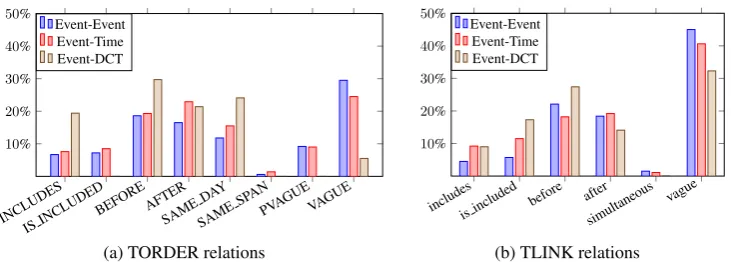
In our first evaluation (Section 4), we compare the correspondence and difference between the new TORDERs and conventional TLINKs. The comparison of empirical statistics shows the new data is label balanced, contains informative rela-tions and reduces “vague” relarela-tions. Besides, the classification performance suggests the new data achieve reasonable accuracy, although accuracy numbers are not directly comparable.
Many text processing tasks are often requiring to know time anchors when events occurred in a timeline. In Section 5, we evaluate the data in a downstream time anchor prediction task (Reimers et al., 2016) by using the temporal relation rec-ognizers separately trained with TORDERs or TLINKs. The main results show that the recog-nizer trained with our TORDERs significantly out-performs the recognizer trained with the TLINKs by 14.1 pointexact matchaccuracy.
2 Background
2.1 Temporal Relation Annotation
TimeBank started a wave of data-driven tempo-ral information extraction research in the NLP community. The original TimeBank only anno-tated relations judged to besalientby annotators and resulted in sparse annotations. Subsequent TempEval-1,2,3 competitions (Verhagen et al., 2009, 2010; UzZaman et al., 2012) mostly relied on TimeBank, but also aimed to improve cover-age by annotating relations between all events and time expressionsin the same sentence. However, most missing relations between mentions in differ-ent sdiffer-entences are not considered.
In order to solve the sparsity issue, re-searchers started the work towards denser anno-tation schema. Bramsen et al. (2006) annotated multi-sentence segments of text to build directed acyclic graphs. Kolomiyets et al. (2012) anno-tated temporal dependency structures, though they only focused on relations between pairs of events. Do et al. (2012) produced the densest annotation and the annotator was required to annotate pairs “as many as possible”. Cassidy et al. (2014) pro-posed a compulsory mechanism to force annota-tors to label every pair in a given sentence win-dow. They performed the annotation (TimeBank-Dense) on a subset (36 documents) of TimeBank, which achieved a denser corpus with 6.3 TLINKs per event and time expression, comparing to 0.7 in the original TimeBank corpus. However, it raises the issue that hand-labeling all dense TLINKs is extremely time-consuming and the unclear defini-tion of “salient” is not improved at all.
2.2 Temporal Relation Classification
The majority of the temporal relation classifiers focus on exploiting a variety of features to improve the performance in TimeBank. Laokulrat et al. (2013) extracted lexical and morphological fea-tures derived from WordNet synsets. Mani et al. (2006); D’Souza and Ng (2013) incorporated se-mantic relations between verbs from VerbOcean.
vectors to improve their classifier.
Inspired by the success of the deep learn-ing work in the similar task: relation extrac-tion, Cheng and Miyao (2017) proposed the short-est dependency path based Bi-directional Long short-term memory (Hochreiter and Schmidhuber, 1997) (Bi-LSTM) to achieve state-of-the-art per-formance in the TimeBank-Dense corpus, which is adopted for the experiments in this paper. There are two reasons to use this classifier: 1) inter-sentence temporal relations are well treated. 2) only word, part-of-speech and dependency rela-tion embeddings are required as input.
2.3 Time Anchor Annotation
A related task: Cross-Document Event Order-ing (Minard et al., 2015) aims to order the events involving a target entity in a timeline given writ-ten news in English. Compared to traditional TLINKs, annotating time anchors of events is in-tuitively more straightforward in such tasks.
Reimers et al. (2016) proposed an annotation scheme, which requires annotators to infer the ex-act time of each individual event. They distin-guished events that occur at aSingle-Dayfrom that span overMulti-Dayby setting the granularity as one day. For Single-Day events, the event time is written in the format ‘YYYY-MM-DD’ when the precise event time can be determined. Otherwise, they required annotators to narrow down the pos-sible time as precisely as pospos-sible. An imprecise
Single-Dayevent can be annotated as a tuple (af-ter, before), e.g. ‘(after 1998-10-02, )’, ‘(, before 2000-01-31)’ or ‘(after 1998-10-02, before 2000-01-31)’. In the case ofMulti-Day, an event is an-notated as a tuple (begin, end), where begin and
endare represented withSingle-Day. For instance of a sentence:
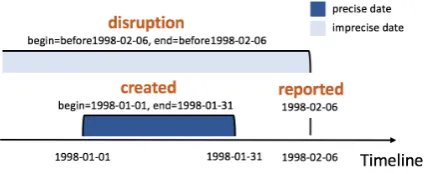
The economycreated jobs at a surpris-ingly robust pace in January, the gov-ernment reported on Friday, evidence that America’s economic stamina has withstood anydisruptioncaused so far by the financial tumult in Asia.
The Multi-Day event created is annotated as
(begin=1998-01-01, end=1998-01-31). The
Single-Day event reported is annotated as the same day as DCT (1998-02-06). The imprecise
[image:3.595.310.524.66.153.2]Multi-Day event disruption is annotated as (be-gin=(, 06), end=(, before1998-02-06)) as the event must have occurred before the
Figure 1: Anchoring events in a timeline
time of this news, but the precisebegin and end
dates cannot be inferred from the text. Time anchors have the capability of anchoring all the events from a document into the same timeline as shown in Figure 1. They annotated the time an-chors of total 1,498 events from 36 documents of TimeBank-Dense.
In temporal information retrieval, Berberich et al. (2010) proposed a four-tuple representa-tion(‘earliest begin’, ‘latest begin’, ‘earliest end’, ‘latest end’) for uncertain time expression (e.g. ‘1990s’) in order to integrate such temporal infor-mation into language model. In the time anchor annotation, an event ‘in 1990s’ will be annotated as aMulti-Dayevent with imprecisebeginandend
points, i.e.(begin=(after 1990-01-01, 31), end=(after 1990-01-01, before1999-12-31)), which is quite similar to their four-tuple rep-resentation.
3 Automatic generation of TORDERs
TimeML states that TLINKs present a temporal relation between event to event, event to time ex-pression, and event to DCT. The sparse TLINK coverage in the majority of temporal information corpora is attributed to the unstable identification of “salient” pairs by human annotators. Denser annotation schemata somehow improved sparse-ness, but the annotation work became very time-consuming. These issues plague the development of temporal information extraction work.
Our temporal order (TORDER) proposal is de-signed with the goal of solving unstable recogni-tion of “salient” pairs and reducing annotarecogni-tion ef-fort. We hypothesize that a temporal relation can be automatically computed by comparing the rela-tive temporal order between two time anchors (e.g.
Annotat-TORDER Condition
Two preciseS1andS2
BEFORE ifS1< S2
AFTER ifS1> S2
SAME DAY ifS1=S2
A preciseS1and an impreciseS2(after2,before2)
BEFORE ifS1≤ after2
AFTER ifS1≥ before2
VAGUE other cases
Two impreciseS1(after1,before1)andS2(after2,before2)
BEFORE ifbefore1≤after2
AFTER ifafter1≥before2
PVAGUE ifbefore1=before2andafter1=after2
VAGUE other cases
Table 1: Definition of the temporal orders between two
Single-Dayevents. ‘<’, ‘>’, ‘=’ denote one event is in
the left of, right of and same position as the other event in a left-to-right time axis.
ing time anchors of individual mentions extremely reduces annotation effort, as it is linear with men-tion numbers. As long as time anchors are given, our pdefined rules can induce the temporal re-lations for all the quadratic pairs, which skips the step of identifying “salient” pairs.
TimeBank contains the normalized date ‘ YYYY-MM-DD’ of time expressions and DCT, but does not include events’ time. Our proposal of induc-ing a TORDER by comparinduc-ing two time anchors requires the time anchor annotation of events in the same granularity as time expressions and DCT. Therefore, annotating the events with ‘ YYYY-MM-DD’ is a reasonable setting and one day is used as the minimal granularity of annotation. We choose the annotation (Reimers et al., 2016) of the day-level time anchors of events as the source of our automatic TORDER generator. In the case that a corpus can provide more specific time informa-tion ‘YYYY-MM-DD, hh-mm-ss’ (e.g. this morn-ing, three o’clock in the afternoon), our TORDER generator can be flexible to handle this informa-tion as long as the time anchors of all meninforma-tions are annotated in the same granularity.
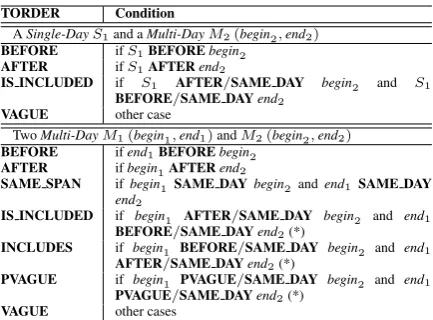
For the clear demonstration of the definition of the auto-generated temporal order, we sepa-rately describe the generation of the pairs with two Single-Day mentions, and the pairs involv-ingMulti-Daymentions. In this paper, TORDER labels are written in the upper-case bold font to be distinguished from TLINK labels written in the lower-case italic font. Table 1 introduces the defi-nition of temporal orders between twoSingle-Day
pairsS1 andS2. PVAGUE(i.e. partially vague) denotes that two imprecise time anchors are equiv-alent. For instance, we cannot induce a clear temporal relation between two events both
occur-TORDER Condition
ASingle-DayS1and aMulti-DayM2(begin2,end2)
BEFORE ifS1BEFOREbegin2
AFTER ifS1AFTERend2
IS INCLUDED if S1 AFTER/SAME DAY begin2 and S1
BEFORE/SAME DAYend2
VAGUE other case
TwoMulti-DayM1(begin1,end1)andM2(begin2,end2)
BEFORE ifend1BEFOREbegin2
AFTER ifbegin1AFTERend2
SAME SPAN ifbegin1 SAME DAYbegin2andend1SAME DAY
end2
IS INCLUDED if begin1 AFTER/SAME DAY begin2 and end1
BEFORE/SAME DAYend2(*)
INCLUDES if begin1 BEFORE/SAME DAY begin2 and end1
AFTER/SAME DAYend2(*)
PVAGUE if begin1 PVAGUE/SAME DAY begin2 and end1
PVAGUE/SAME DAYend2(*)
VAGUE other cases
Table 2: Definition of the temporal orders involving
Multi-DayeventsM(begin, end). ‘*’ denotes exclud-ing theSAME SPANcase in the current condition.
ring on(,before1998-02-06), but nevertheless both events provide partially equivalent date informa-tion‘1998-02-06’. It can possibly provide useful information for the future processes of classifica-tion or time inference.PVAGUEin theMulti-Day
definition takes the same consideration.
In order to introduce the temporal orders in-volving Multi-Day events, a Multi-Day event M is denoted as a tuple of two Single-Day dates
(begin, end). A temporal order between a
Single-DayS1 andMulti-DayM2(begin2, end2)can be derived by computing the temporal order of two
Single-DayS1 and begin2, or S1 andend2 first. All the types of temporal orders involving Multi-Day events are defined in Table 2. One addi-tional INCLUDES relation that Multi-Day event includes aSingle-Dayevent can be obtained by re-versing the symmetric IS INCLUDED.
The example of automatically computing tem-poral orders can be demonstrated by using the events in Figure 1. BothMulti-Day created and disruption are clearly BEFORE the Single-Day
reported, because reported is AFTER the end
dates of created and disruption. The relation between created and disruption is induced as VAGUE, as the imprecisebegin,endofdisruption cannot be determined with a relation tocreated.
[image:4.595.308.525.60.220.2] [image:4.595.72.291.61.184.2]defini-tion. We can easily extend our definition by detect-ing whether two time anchors have the equivalent
beginorendpoints.
Our inducing proposal takes human annotated time expressions and normalized values as inputs to generate TORDER relations as the training data of the next processes (e.g. classification). In the case of processing raw texts, we can perform detection and normalization of time expressions by using existing temporal taggers, e.g. Heidel-Time (Str¨otgen and Gertz, 2015), SUHeidel-Time (Chang and Manning, 2012), etc.
4 Comparison of TORDERs and TLINKs
Fairly evaluating the TORDER’s capability of encoding temporal order information compared to the existing data is difficult but necessary work. This section provides empirical statistics of TORDER and TLINK annotations, and compare the performance of automatic recognition. Addi-tionally, we evaluate these two frameworks in a downstream task performance in Section 5.
4.1 Correspondences and Differences
Our new TORDERs are formally similar to the conventional TLINKs, as both state a temporal relation between two mentions. BEFORE and AFTER represent that one mention occurs before or after in a timeline, which is close to before
and after. INCLUDES and IS INCLUDED are more clearly conditioned as aSingle-Dayor Multi-Day mention occurs during the other Multi-Day
mention, compared to includes and is included. SAME DAY and SAME SPAN are designed for the one-day minimal granularity. Ideally, these two relations will includesimultaneousand other TLINKs with two mentions occurring in the same day. VAGUE and PVAGUE state that our gener-ation rules cannot induce the relgener-ations, similar to
vague(i.e. annotators cannot judge the relations). The one-day minimal granularity is the main reason causing the difference between TORDER and TLINK types. For a sentence:
I went tosleepafter taking abath.
According to the TimeML specification, sleepis obviously after bath. But in the one-day gran-ularity, the relation is shifted to SAME DAY. This brings the obstacle that we cannot mea-sure whether the temporal information encoded in
TORDERs is more informative than TLINKs by directly comparing the classification results.
Our TORDER definition shows the capability of capturing some relations which cannot be encoded by TLINK. For instance:
Stocks rose, pushing the Dow Jones industrial average up 72.24 points, to 8,189.49, leaving the index within 70 points of its record.
These TLINKs among the three events are anno-tated asvaguein TimeBank-Dense, as the annota-tors cannot state their temporal orders. However, we can easily obtain SAME DAY relations, since their day-level time anchors are the same.
Imprecisely represented time anchors (e.g.after YYYY-MM-DD) are the major drawback of losing temporal order information. For instance:
America’s economic stamina has with-stoodanydisruption...
The TLINK betweenwithstoodanddisruptionis annotated asafter. While both of them were anno-tated as the same time anchor(begin=before 1998-02-06, end= before 1998-02-06), our TORDER generator induced a PVAGUE relation and tempo-ral order information is lost.
The hypothesis that our proposal skipping the unstable manual identification of “salient” pairs can reduce the VAGUE relations in the new data. This can be measured by comparing the numbers of the TORDER and TLINK relations on the same mention pairs. If the observation of a part ofvague
INCLUDES ISINCLUDED
BEFORE AFTERSAMEDA Y
SAME SPAN
PVAGUEVAGUE 10%
20% 30% 40% 50%
Event-Event Event-Time Event-DCT
(a) TORDER relations
includesis included before after simultaneous
vague 10%
20% 30% 40% 50%
Event-Event Event-Time Event-DCT
[image:6.595.121.487.61.192.2](b) TLINK relations Figure 2: The label distribution of the TORDER and TLINK relations
b a s i ii v
BEFORE 1486 24 0 22 26 542
AFTER 19 1242 5 26 66 503
SAME DAY 155 93 83 164 343 647
SAME SPAN 4 0 9 5 6 42
INCLUDES 104 61 2 225 25 372
IS INCLUDED 56 71 1 25 214 333
PVAGUE 91 40 41 23 36 336
[image:6.595.71.292.236.342.2]VAGUE 331 261 33 145 136 1464
Table 3: The comparison of the numbers of TORDER and TLINK annotations for the same mention pairs. b:before, a:after, s:simultaneous, i:includes,
ii:is included,v:vague.
4.2 Empirical Comparison
Investigating the quality of auto-generated TORDERs is important to demonstrate the value of this research. In this section, we empirically compare the statistics of the auto-generated TORDERs and human-annotated TLINKs. Theo-retically, a TORDER between two mentions with any distance in a document can be automatically computed. However, it is important to make the new data in a comparable manner to the existing data. In this paper, we follow the process of TimeBank-Dense (Cassidy et al., 2014) to gen-erate the complete graph of the 10,007 mention pairs in the same and adjacent sentences. The TORDER data used in this paper are publicly available3and our scalable generation method can be easily applied for inducing relations of longer distance pairs.
Table 3 shows the comparison between the numbers of the TimeBank-Dense TLINKs and the new TORDERs. One observation as we ex-pected is that our approach captures new relations for a considerable part of the mention pairs that were judged asv(vague) in the human-annotated
3https://github.com/racerandom/temporalorder
TLINKs. 542vaguerelations are induced as AF-TER in the new TORDERs, as well as other rela-tion types. However, a part of non-vagueTLINKs are shifted to VAGUE TORDERs. This matches our description of the imprecise time anchor is-sue. It is a trade-off between the part of mention pairs obtaining richer temporal information and the part of pairs losing information. That is the reason why we need a downstream task (i.e. Time Anchors Prediction in Section 5) to measure how much temporal order information is encoded in TORDERs and TLINKs. The shift of TLINK rela-tions to SAME DAY due to the one-day minimal granularity setting can also be clearly observed.
Event-DCT Event-Time Event-Event
F1 N F1 N F1 N
AFTER 0.585 65 0.509 67 0.426 184
BEFORE 0.659 65 0.452 68 0.488 257
INCLUDES 0.400 38 0.136 27 0.158 105
IS INCLUDED 0 0 0 20 0.077 86
SAME DAY 0.631 82 0.485 56 0.314 131
SAME SPAN 0 0 0 2 0 0
PVAGUE 0 0 0 1 0.149 92
VAGUE 0 18 0.417 119 0.487 335
Overall 0.557 268 0.403 360 0.374 1190 Non-VAGUE 0.597 250 0.390 240 0.351 763
(a) TORDER
Event-DCT Event-Time Event-Event
F1 N F1 N F1 N
after 0.582 68 0.550 64 0.443 223
before 0.612 58 0.331 91 0.465 326
includes 0.170 22 0.290 31 0.126 45
is included 0.559 48 0.338 42 0.099 47
simultaneous 0 0 0 6 0 19
vague 0.433 72 0.557 126 0.6116 530 Overall 0.511 268 0.441 360 0.492 1190 Non-vague 0.539 196 0.378 234 0.395 660
(b) TLINK
Table 4: The classification results of Event-Event, Event-DCT and Event-Time F1-measure on individual relation types and weighted overall F1. ‘N’ denotes the number of the relations in the test split.
4.3 Classification Results
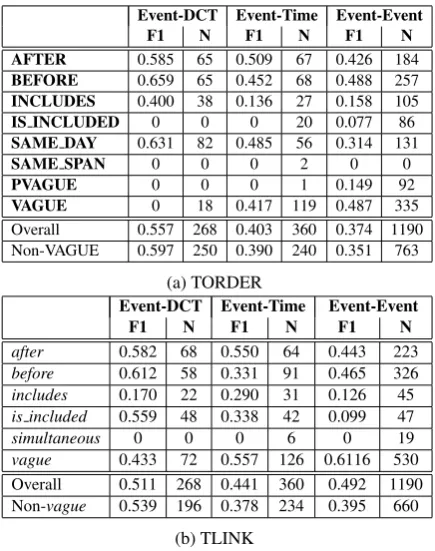
Although the classification results of TORDERs and TLINKs are not directly comparable, they can show some evidence whether TORDERs is functional to provide temporal order information. Table 4 shows the Bi-LSTM classification re-sults with the data split4(Chambers et al., 2014) (27 training/validation documents, 9 testing docu-ments).
The classification system achieves fairly high F1 0.631 in Event-DCT and 0.485 in Event-Time on the SAME DAY temporal orders, which are the main information source to predict the precise time of events. The performance on AFTER, BE-FORE temporal orders are close to the TLINKs in number, but not meaningfully comparable. The high proportion ofvaguein the TLINKs results in biased predictions. When we use a more meaning-ful evaluation ‘Non-vague’ overall, the TLINKs performance drops sharply. Generally, the clas-sification results suggest that our proposal of auto-generated TORDERs has sufficient capability to encode temporal information, which can be well
4https://github.com/nchambers/caevo/blob/master/src/mai n/java/caevo/Evaluate.java
classified from the textual inputs.
5 Evaluation in Time Anchor Prediction
In this section, we describe a two-step system trained with the existing TLINKs and our data to challenge a downstream time anchor prediction task. The different performance can be seen as the evidence whether our auto-generated TORDERs can capture comparable temporal information to the human-annotated TLINKs.
5.1 Task Definition
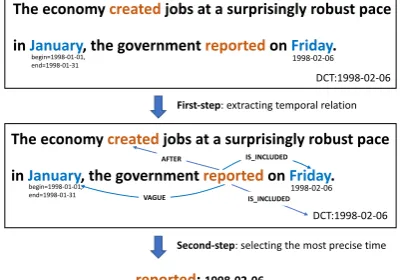
Predicting the time of events from the news ar-ticles is an attractive goal, which is a necessary step towards automatic event timeline extraction. Reimers et al. (2016) bring the task of time anchor prediction, which aims to predict the time anchor of eachSingle-Dayevent given a document. They use a general two-step process to determine the event anchors as shown in Figure 3. Given a set of documents with events and time expressions al-ready annotated, the system first obtains a list of possible times for each event. Then, the most pre-cise time is selected for each event.
A serious issue is that their baseline system still depends on the TimeBank-Dense TLINK classi-fier and the time anchor annotation is only used for the final evaluation. That leaves the space to consider a new method without relying on the human-annotated TLINKs. Our auto-generated TORDERs are a natural alternative to TLINKs to provide the similar temporal order information of mention pairs, but with less annotation efforts. The second-step selection rules just need a slight modification to replace the previous TLINK types with the new TORDER types.
5.2 The Two-step System in Experiments
In this work, we adopt a similar two-step archi-tecture. The first-step temporal order classifier is designed to provide the temporal relations of the mention pairs in a document.
The second-step selects the most precise time by taking all Event-Time and Event-DCT relations of a target event as input. For instance in Figure 3, the second-step received a set of relations e.g.
(is included, DCT),(is included, F riday)and (vague, January) of reported. For the system
[image:7.595.75.293.60.336.2]Event Type Source Exact Partial Exact Partial Exact Partial Exact PartialTORDER Gold TORDER TLINK Gold TLINK
Precise
Event-DCT 0.586 0.866 0.739 0.866 0.387 0.570 0.525 0.545
Event-Time 0.384 0.555 0.577 0.619 0.216 0.288 0.412 0.447
All 0.660 0.870 0.835 0.930 0.444 0.611 0.595 0.617
Imprecise
Event-DCT 0.351 0.631 0.530 0.647 0.234 0.395 0.364 0.449
Event-Time 0.074 0.217 0.119 0.184 0.051 0.133 0.200 0.227
All 0.299 0.642 0.509 0.686 0.252 0.429 0.444 0.517
Overall
Event-DCT 0.482 0.762 0.619 0.769 0.319 0.493 0.454 0.503
Event-Time 0.259 0.419 0.393 0.444 0.149 0.255 0.326 0.358
[image:8.595.80.517.61.210.2]All 0.501 0.769 0.646 0.822 0.360 0.530 0.528 0.573
Table 5: The comparison of the cross-validation performance in the time anchor prediction task. ‘Exact’ and ‘Partial’ denote the two evaluation metrics: exact matchandpartial matchaccuracy. ‘Gold’ denotes the oracle performance of using the gold TORDERs or gold TLINKs as the input of the second-step.
7
The economy createdjobs at a surprisingly robust pace
in January, the government reportedon Friday. begin=1998-01-01,
end=1998-01-31 1998-02-06
DCT:1998-02-06
The economy createdjobs at a surprisingly robust pace
in January, the government reportedon Friday.
DCT:1998-02-06 AFTER
IS_INCLUDED
First-step: extracting temporal relation
begin=1998-01-01,
end=1998-01-31 1998-02-06
Second-step: selecting the most precise time
reported: 1998-02-06
IS_INCLUDED
VAGUE
Figure 3: The two-step process to determine the event anchors proposed in (Reimers et al., 2016).
with the TORDERs, we slightly modified the algo-rithm by replacing the TLINK relations with sim-ilar TORDER relations. SAME DAY replaces si-multaneousto predict precise dates, although their definition is quite different.
5.3 Experiment Settings
We perform a 6-fold cross-validation strategy to predict all the TORDERs and TLINKs of the men-tion pairs in the 36 documents of the TimeBank-Dense corpus. In each run, we split 30 documents for training and validation to predict the other 6 test documents.
We define two evaluation metrics, i.e. Exact Match accuracy and Partial Match accuracy to measure the performance in this task as follows:
exact match=#Number of the exact match predictions #Total number of the test samples
partial match=#Number of the partial match predictions #Total number of the test samples
We define twopartial matchcases: 1) a precise
(1998-02-06) is partial match with an imprecise
(after 1998-02-06), if the date values are the same. 2)(after 1998-02-06)ispartial matchwith(after 1998-02-06, before 1998-02-21), if one is a part of the other.
5.4 Main Results
Table 5 summarizes the main results of the two-step time anchor prediction system trained with TORDER and TLINK data. ‘Precise’, ‘Impre-cise’ and ‘Overall’ denote the results of predicting time anchors of precise events, imprecise events, and overall performance. DCT’ or ‘Event-Time’ denotes the second-step selection takes only Event-DCT or Event-Time pairs as input, which helps us to investigate how much information is provided by the different types of pairs for pre-dicting the final time anchors. The new TORDERs show significantly superior out-performance in all three settings (i.e. only Event-DCT pairs, only Event-Time pairs, or Event-DCT + Event-Time), compared to the TLINKs. With both Event-DCT and Event-Time temporal order information, the system achieves the highest overall exact match
andpartial matchaccuracy.
[image:8.595.88.290.290.430.2]Exact Partial
CAEVO 0.442 0.553
[image:9.595.100.261.62.109.2]Bi-LSTM TLINK 0.437 0.550 Bi-LSTM TORDER 0.586 0.811
Table 6: The comparison to the state-of-the-art dense TLINK classifier
precise events. The reason is that most events re-ported in news articles usually occur in precisely the same day as DCT. Therefore, the TORDER Event-DCT is benefited from the low proportion of vague relations, which sharply outperforms the TLINK Event-DCT by 16.3% overall exact match. However, the contribution of the Event-Time to the overall might be underestimated in this task somehow. The TORDER Event-Time still beats the TLINKs by 11% overallexact match
and 16.4% overall partial match. Furthermore, the Event-Time encoding the temporal informa-tion within 1-sentence window in our experiments can be easily strengthen by our TORDER proposal to introduce more inter-sentence pairs.
5.5 Comparison to a state-of-the-art dense TLINK classifier
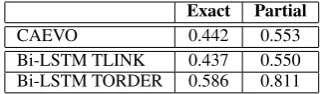
In this section, we perform an additional ex-periment to make a comparison to a system with the first-step replaced by a state-of-the-art dense TLINK classifier CAEVO (Chambers et al., 2014). We adopt the data split setting in Sec-tion 4.3 for three classifiers: CAEVO, Bi-LSTM classifier trained with TLINKs and Bi-LSTM clas-sifier trained with TORDERs.
The results are summarized in Table 6. CAEVO achieves the exact match accuracy slightly bet-ter than the Bi-LSTM model trained with the TLINKs. The Bi-LSTM model trained with the TORDERs sharply outperforms the other two sys-tems by approximate 14% exact match accuracy and approximate 26% inpartial matchaccuracy.
6 Conclusion
In this paper, we propose a new approach to ob-tain temporal relations based on time anchors (i.e. absolute time value) of mentions in news articles. Our pre-defined generation rules can automati-cally induce TORDER relations by comparing the temporal order of two time anchors in a timeline. The requirement of our proposal for annotating time anchors is much easier compared to conven-tional methods, as the annotation effort is linear
with the number of mentions. The TORDER data used in this paper are publicly available. The anal-ysis, empirical comparison and classification re-sults of the new TORDERs and the TimeBank-Dense TLINKs show our new data achieve the low VAGUE proportion, the informative relation types and the balanced label distribution. We perform the second evaluation of using the temporal rela-tion classifier to complete the downstream task of time anchor prediction in news articles. The main results show our TORDERs significantly outper-form the TLINKs in this task, which suggests our proposal has the capability to encode informative temporal order information with less annotation effort.
The main limitation of TORDER is that events are required to be anchored in a timeline. Str¨otgen and Gertz (2016) introduce the highly different characteristics of time expressions in four domains of text. It suggests that our proposal is difficult to be applied in some domains. One possible so-lution is to adopt a hybrid annotation method to annotate a target event towards the most relevant event (TLINK-style), when temporal information is absent in its context. Although this work is mo-tivated for contributing to timeline applications, evaluating this proposal in the temporal question answering is also valuable. SAME DAY could be harmful because this task possibly requires to know the exact order between two events occur-ring on the same day. It is worth conceiving a more general solution to improve the limitations of TORDER in the future work.
Acknowledgments
We would like to thank the anonymous reviewers for their valuable comments and thank Jason Ben-nett for useful discussions and proofreading.
References
James F Allen. 1990. Maintaining knowledge about temporal intervals. In Readings in qualitative rea-soning about physical systems, Elsevier, pages 361– 372.
Klaus Berberich, Srikanta Bedathur, Omar Alonso, and Gerhard Weikum. 2010. A language modeling ap-proach for temporal information needs. In Euro-pean Conference on Information Retrieval. Springer, pages 13–25.
graphs. In Proceedings of the 2006 Conference on Empirical Methods in Natural Language Pro-cessing. Association for Computational Linguistics, pages 189–198.
Taylor Cassidy, Bill McDowell, Nathanael Chambers, and Steven Bethard. 2014. An annotation frame-work for dense event ordering. InProceedings of the 52nd Annual Meeting of the Association for Com-putational Linguistics (Volume 2: Short Papers). Association for Computational Linguistics, Balti-more, Maryland, pages 501–506. http://www.
aclweb.org/anthology/P14-2082.
Nathanael Chambers, Taylor Cassidy, Bill McDowell, and Steven Bethard. 2014. Dense event ordering with a multi-pass architecture. Transactions of the Association for Computational Linguistics 2:273–
284. http://aclweb.org/anthology/Q/
Q14/Q14-1022.pdf.
Angel X. Chang and Christopher Manning. 2012. Sutime: A library for recognizing and normal-izing time expressions. In Nicoletta Calzolari, Khalid Choukri, Thierry Declerck, Mehmet U˘gur Do˘gan, Bente Maegaard, Joseph Mariani, Jan Odijk, and Stelios Piperidis, editors, Proceed-ings of the Eighth International Conference on Language Resources and Evaluation (LREC-2012). European Language Resources Association (ELRA), Istanbul, Turkey, pages 3735–3740. ACL Anthology Identifier: L12-1122. http: //www.lrec-conf.org/proceedings/
lrec2012/pdf/284_Paper.pdf.
Fei Cheng and Yusuke Miyao. 2017. Classifying temporal relations by bidirectional lstm over de-pendency paths. In Proceedings of the 55th An-nual Meeting of the Association for Computa-tional Linguistics (Volume 2: Short Papers). As-sociation for Computational Linguistics, Vancou-ver, Canada, pages 1–6. http://aclweb.org/
anthology/P17-2001.
Quang Xuan Do, Wei Lu, and Dan Roth. 2012. Joint inference for event timeline construction. In Pro-ceedings of the 2012 Joint Conference on Empirical Methods in Natural Language Processing and Com-putational Natural Language Learning. Association for Computational Linguistics, pages 677–687.
Jennifer D’Souza and Vincent Ng. 2013. Classifying temporal relations with rich linguistic knowledge. InProceedings of the 2013 Conference of the North American Chapter of the Association for Compu-tational Linguistics: Human Language Technolo-gies. Association for Computational Linguistics, At-lanta, Georgia, pages 918–927. http://www.
aclweb.org/anthology/N13-1112.
Sepp Hochreiter and J¨urgen Schmidhuber. 1997. Long short-term memory. Neural computa-tion 9(8):1735–1780. https://doi.org/10.
1162/neco.1997.9.8.1735.
Oleksandr Kolomiyets, Steven Bethard, and Marie-Francine Moens. 2012. Extracting narrative time-lines as temporal dependency structures. In Pro-ceedings of the 50th Annual Meeting of the Associ-ation for ComputAssoci-ational Linguistics: Long Papers-Volume 1. Association for Computational Linguis-tics, pages 88–97.
Natsuda Laokulrat, Makoto Miwa, Yoshimasa Tsu-ruoka, and Takashi Chikayama. 2013. Uttime: Tem-poral relation classification using deep syntactic fea-tures. In Second Joint Conference on Lexical and Computational Semantics (* SEM). volume 2, pages 88–92. http://aclweb.org/anthology/
S/S13/S13-2015.pdf.
Hector Llorens, Nathanael Chambers, Naushad Uz-Zaman, Nasrin Mostafazadeh, James Allen, and James Pustejovsky. 2015. Semeval-2015 task 5: Qa tempeval - evaluating temporal information un-derstanding with question answering. In Pro-ceedings of the 9th International Workshop on Semantic Evaluation (SemEval 2015). Association for Computational Linguistics, Denver, Colorado, pages 792–800. http://www.aclweb.org/
anthology/S15-2134.
Inderjeet Mani, Marc Verhagen, Ben Wellner, Chong Min Lee, and James Pustejovsky. 2006. Machine learning of temporal relations. In Pro-ceedings of the 21st International Conference on Computational Linguistics and 44th Annual Meeting of the Association for Computational Linguistics. Association for Computational Linguis-tics, Sydney, Australia, pages 753–760. https:
//doi.org/10.3115/1220175.1220270.
Yuanliang Meng, Anna Rumshisky, and Alexey Ro-manov. 2017. Temporal information extraction for question answering using syntactic dependen-cies in an lstm-based architecture. In Proceed-ings of the 2017 Conference on Empirical Meth-ods in Natural Language Processing. Association for Computational Linguistics, Copenhagen, Den-mark, pages 887–896. https://www.aclweb.
org/anthology/D17-1092.
Anne-Lyse Minard, Manuela Speranza, Eneko Agirre, Itziar Aldabe, Marieke van Erp, Bernardo Magnini, German Rigau, and Ruben Urizar. 2015. Semeval-2015 task 4: Timeline: Cross-document event or-dering. In Proceedings of the 9th International Workshop on Semantic Evaluation (SemEval 2015). Association for Computational Linguistics, Den-ver, Colorado, pages 778–786. http://www.
aclweb.org/anthology/S15-2132.
James Pustejovsky, Patrick Hanks, Roser Sauri, An-drew See, Robert Gaizauskas, Andrea Setzer, Dragomir Radev, Beth Sundheim, David Day, Lisa Ferro, et al. 2003. The timebank corpus. In Cor-pus linguistics. volume 2003, page 40. https:
//catalog.ldc.upenn.edu/LDC2006T08.
Nils Reimers, Nazanin Dehghani, and Iryna Gurevych. 2016. Temporal anchoring of events for the time-bank corpus. In Proceedings of the 54th An-nual Meeting of the Association for Computational Linguistics (Volume 1: Long Papers). Association for Computational Linguistics, Berlin, Germany, pages 2195–2204. http://www.aclweb.org/
anthology/P16-1207.
Roser Saurı, Jessica Littman, Bob Knippen, Robert Gaizauskas, Andrea Setzer, and James Pustejovsky. 2006. Timeml annotation guidelines version 1.2. 1.
Andrea Setzer. 2002. Temporal information in newswire articles: an annotation scheme and cor-pus study.. Ph.D. thesis, University of Sheffield. Jannik Str¨otgen and Michael Gertz. 2015. A
base-line temporal tagger for all languages. In Pro-ceedings of the 2015 Conference on Empirical Methods in Natural Language Processing. Associ-ation for ComputAssoci-ational Linguistics, Lisbon, Por-tugal, pages 541–547. http://aclweb.org/
anthology/D15-1063.
Jannik Str¨otgen and Michael Gertz. 2016. Domain-sensitive temporal tagging. Synthesis Lectures on Human Language Technologies9(3):1–151.
Naushad UzZaman, Hector Llorens, James Allen, Leon Derczynski, Marc Verhagen, and James Pustejovsky. 2012. Tempeval-3: Evaluating events, time expressions, and temporal relations. arXiv
preprint arXiv:1206.5333 http://aclweb.
org/anthology/S/S13/S13-2001.pdf.
Marc Verhagen, Robert Gaizauskas, Frank Schilder, Mark Hepple, Jessica Moszkowicz, and James Pustejovsky. 2009. The tempeval challenge: identifying temporal relations in text.
Lan-guage Resources and Evaluation 43(2):161–
179. https://doi.org/10.1007/
s10579-009-9086-z.
Marc Verhagen, Roser Sauri, Tommaso Caselli, and James Pustejovsky. 2010. Semeval-2010 task 13: Tempeval-2. In Proceedings of the 5th inter-national workshop on semantic evaluation. Asso-ciation for Computational Linguistics, pages 57–
62.http://www.aclweb.org/anthology/