by JOHN J. SCULLY
{Read before the Society on 26th January, 1968)
INTRODUCTION
The problems of the western region of Ireland are numerous and complex. The region comprises the eight seaboard counties from Donegal to Cork and four inland counties Cavan, Roscommon, Longford and Monaghan. In general terms, the western farming problem is due to deficiencies in the agrarian structure of the region. The term "agrarian structure" refers to the relationship between the number of people engaged in agriculture and the available productive resources notably land and capital. In the 12 counties approximately 55 per cent of the active population is engaged in farming. The corresponding figures for the other 14 counties and for the country as a whole are 19 per cent and 33 per cent respectively. The region contains a comparatively large proportion of small, fragmented farms. Many of them are located in remote and relatively inaccessible areas. The soils of the region are generally inferior in quality. The production base on individual farms is low. Investment capital is extremely scarce. Farming systems are often geared neither to the prevailing farm size nor to the market demand. In many areas market outlets for farm produce are limited and marketing organisations are inefficient.
There are relatively few off-farm employment opportunities available in the region. Consequently, the majority of farmers have little or no oppor-tunity to supplement their incomes from sources of employment outside the farm.1 In these circumstances family incomes remain at low levels over
protracted periods.
The Inter-Departmental Committee
In 1961, the Minister for Agriculture set up an informal committee which included representatives of the Departments of Agriculture, Finance, Gaeltacht and Lands, the Central Statistics Office, and An Foras Taluntais "to consider and report on sound and practicable measures to deal with special problems of agriculture" in the West. This committee subsequently made a number of specific suggestions regarding possible solutions to the problem.2 Chief among these were:
1) Greater powers for the Land Commission to enable it to come to grips with the structural problems.
2) Better credit facilities for farmers.
xThe available statistics show that for the country as a whole, 7.1 per cent of all male
farmers have subsidiary occupations. The corresponding figures for the four provinces are: Leinster 4.8 per cent; Munster 4.8 per cent; Connacht 10.5 per cent and Ulster (3 counties) 8.4 per cent.
SOURCE: Central Statistics Office: Census of Population of Ireland 1961, The Stationery Office, Dublin 1963, pp. 132-141 and pp. 152-156.
2Report of the Inter-Departmental Committee on the Problems of Small Western
52
3) Closer liaison between government agencies and the agricultural advisory services.
4) The encouragement of intensive farming systems based on the pro-duction of milk, pigs, poultry and horticultural crops.
5) The development of a comprehensive co-operative system.
6) The provision of special financial assistance from central funds to strengthen the agricultural advisory services.
7) The establishment of county development teams which would include representatives of the various government departments and local authorities.
8) Greater financial assistance from central funds to promote industrial forestry and tourist development.
In 1963, the committee was re-convened to consider the feasibility of pilot area development. Its main recommendations were that:3
1) A pilot area should be established in each of the twelve counties in the western region viz. Galway, Mayo, Leitrim, Roscommon, Sligo, Longford, Donegal, Cavan, Monaghan, Clare, Kerry and West Cork. 2) The Chief Agricultural Officers would be responsible for the selection of the pilot area in each county. The selection of each pilot area would be based on three criteria (a) the area selected should be representative of the larger problem area of the county (b) it should be potentially viable (c) it should "be clearly identifiable, reasonably compact and homogeneous and would provide a basis for whatever form of co-operation it was desirable to develop as time went on".4 A community
consisting of 200 to 400 farmers was suggested as the ideal in this regard.
3) A full-time adviser should be assigned to each pilot area.
4) In the short-term, the programme in each area should be concerned with the development of agriculture, based mainly on existing activities and patterns of production. In the long-term, development activities outside of agriculture should also be considered.
5) The pilot areas would be mainly demonstration areas. Their aim would be to show what can be achieved by community effort in promoting the maximum utilisation of available resources. In time, any worthwhile results emerging from the programme would be applied to other problem areas in the West. For these reasons, it would be wrong to finance the programme on too lavish a scale from State funds.
6) If necessary, loan repayments, including both interest and capital, might be deferred for three years, thus giving individual farmers some breathing space in developing their productive capacity.
7) The Agricultural Credit Corporation would be encouraged to deal sympathetically with loans which are supported by farm develop-ment plans prepared by the pilot area adviser. The adviser would be
8Inter-Departmental Committee on the Problems of Small Western Farms. Report on Pilot Area Development, The Stationery Office, Dublin. (Pr. 7616).
responsible for the supervison of all development programmes, especially those involving borrowed capital.
8) State grants for farm buildings and land reclamation in the pilot areas should be brought up to the level already available to farmers in Gaeltacht areas.5
9) A local committee, consisting of the younger and more enterprising farmers should work with the adviser in the selection and implementa-tion of development projects.
Establishment of Pilot Areas
The first pilot areas were established in Counties Kerry and Sligo in August 1964. The remaining ten areas were established at varying intervals between September 1964 and April 1965. An initial limited survey of 3,911 out of the 4,200 farms in the twelve areas showed that the low income problem is due to a number of factors. Chief among these are:
1) Relatively small farm size, excessive fragmentation and poor soil resources.
2) High age structure of farmers and lack of post-primary education. 3) Inadequate production and unsatisfactory markets.
4) Lack of off-farm employment opportunities. Farm Size, Fragmentation and Soils
In the twelve areas combined, the survey has shown that 35.5 per cent of all farms are less than 25 acres in area. In counties Donegal, Sligo, Longford and Roscommon the proportion of farms falling into this categbry is 63 per cent, 57 per cent, 46 per cent and 38 per cent respectively. Small farm size, of itself, need not necessarily be a serious limiting factor to increased farm production. In the pilot areas, however, and indeed throughout the greater part of the western region the problem is aggravated considerably by the fragmentation of farm holdings and poor soil resources. Table 1 shows that the proportion of fragmented farms varies from a low 13.5 per cent in Donegal to a high 59.7 per cent in Galway.
The-fragmentation problem becomes all the more serious of course as the distance apart of the two main parts of the farm increases. Obviously, it is a very significant barrier to increased farm production in the Clare, Galway and Mayo pilot areas. In Galway, where 59.7 per cent of farms are frag-mented, the distance apart of the two main parts of the farm is more than three-quarters of a mile in roughly 38 per cent of the cases. The correspond-ing figures for Clare, where 55.2 per cent of farms are fragmented, and for Mayo where 50.8 per cent are fragmented, are approximately 67 per cent
TABLE 1
FRAGMENTATION OF FARMS IN PILOT AREAS
All in one holding Two parts Three parts Four Parts Five Parts and over
Totals
Percentage fragmented — in each Pilot area — in the County as
a whole Cavan 156 124 7 — 287 45.6 28.1 Clare 200 128 75 29 14 446 55.2 37.0 Cork 250 81 17 8 13 369 32.2 19.3 Donegal 403 56 5 1 1 466 13.5 31.2 Galway 106 71 47 21 18 263 59.7 50.7 Kerry 138 57 8 3 3 209 34.0 18.4 Leitrim 235 54 8 4 -301 21.9 31.7 Longford 220 69 15 2 1 307 28.3 30.2
DISTRIBUTION OF FARMS ACCORDING TO DISTANCE APART OF THE
Under i mile
Between £ and £ mile * „ i „ 1 „ 1 „ 1 „ H „
H „ 2 „
„ 2 „ 2\ „ „ 2i „ 3 „ Over 3 miles
Totals
Percentage with two main parts over f apart Cavan 3 64 30 _ 23 _ 3 -7 131 25.2 Clare 34 46 2 71 19 40 8 15 11 246 66.7 Cork 51 28 11 7 8 1 6 1 6 119 24.4 Donegal 13 8 16 -15 2 6 -3 63 41.3 Galway 18 41 39 4 27 9 9 6 4 157 37.6 Kerry 17 25 7 3 3 6 2 1 7 71 31.0 Leitrim 10 26 14 -11 _ 2 -3 66 24.2 Longford 27 16 2 17 4 12 2 3 4 87 48.1 Mayo 123 96 17 6 8 250 50.8 35.1 Monaghan 102 52 15 7 8 184 44.6 33.6 Roscommon 178 64 35 10 8 295 -. 39.7 41.9
TWO MAIN FRAGMENTS
and 42 per cent respectively. A regional survey based on a 5 per cent random sample of farms in the 12 counties would appear to indicate that the fragmentation problem is most acute on the smaller farms, 40.6 per cent occurring on farms between 5 and 30 acres, and 73.5 per cent occurr-ing on farms of 50 acres or less (Table 2).6
It is difficult to operate intensive farming systems in these circumstances even under the most favourable soil conditions. As a result, there is much underemployment of labour and the income earning opportunities available to the small-scale farmer are reduced considerably.
Poor soil conditions on small farms add further to the problem and make its solution all the more difficult. The soils in the whole western region are inherently less fertile than those in the remainder of the country. A relatively large amount of land is in need of reclamation of one form or other. To-date progress in land reclamation has generally been satisfactory in the pilot areas. In a number of cases, however, field drainage has been held up because of the prior need for arterial drainage to provide satis-factory outlets. There appears to be no immediate remedy for this situation.
TABLE 2
PERCENTAGE DISTRIBUTION OF FARMS, CLASSIFIED BY THE NUMBER OF SEPARATE PARCLES OF LAND AND BY FARM
SIZE GROUP
FARM SIZE GROUP (ACRES)
No. of Parts in each Holding
2 3 4
5 and over
Total
5-15
6.7 2.2 0.4 1.2
10.5
16-30
20.8 7.0 0.9 1.4
30.1
31-50
22.3 6.3 2.1 2.2
32.9
51-100
11.4 5.0
1.4 2.9
20.7
101-200
2.4 1.3 0.1 0.5
4.3
over 200
0.9 0.3 0.3 0.0
1.5
Total
64.5 22.1 5.2 8.2
100
Age Structure and Education
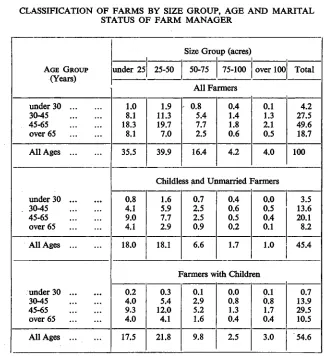
Persistently low farm incomes, coupled with the lack of remunerative off-farm employment opportunities, have led to a progressive decline in the farm population through emigration. The resulting population structure shows a decreasing proportion of young adults and an increasing proportion of family dependants. Table 3 and 4 show that, in the aggregate, the older farmers are mainly concentrated on the smaller farms in the pilot areas. Over 45 per cent of farmers are unmarried. Furthermore, many of 6In the 26 Counties some 33 per cent of all farms are fragmented. The figures for
each province are: Munster, 26.1 per cent; Leinster, 33.3 per cerit; Connacht 41.3 per cent and Ulster (3 counties) 30.9 per cent.
'-Twd-lfre' Western Counties of -Ireland
over" 85
80-84
-75-79"
70-74
65-69
"60-64
50-54
40-44
35^-39 )o-34
25-29
20-24
:15-19
10-14
5- 9
0-4
1951
Males Females
Aggregate Rural Population by- Sex in Quinquennial Age Groups
for 1951 and 1961
Figure 1
1961
Males
(1) 467,084 (2) 405,580 Dependency Ratio: 71.7 The inner shaded area in each (1) Rural Males pyramid represents the married
members of the population.
Pyramid Scale 1" = 16,666 people (3) 872,664
(2) Rural Females
(1) 403,289 (2) 354,943 (3) 758,237 Dependency Ratio: 79•2
over SO
75-79
70-74
60-64
55-59
50-54
40-44
35-39
30-34
25-29
20-24
15-19
10-14
• 5 - 9
0- 4
The' Twelve Western Counties of Ireland • Aggregate of .Land-holders. Families and Employees
by Sex in Quinquennial Age Groups'
Basis: 1$ of Farms over 5 acres.
Figure
2-I
I
Dependency Ratio z 79 % 2
58
the bachelor farmers are now beyond normal marrying age. This ageing farm population appears to be typical of the whole western region as the rural population pyramids and the farm population pyramid based on a 1 per cent sample of farms (1967) clearly show. A comparison of the 1951 and 1961 population pyramids (Figure 1) shows that during the 1950s the proportion of young adults in western rural areas declined significantly. The dependency ratio of the rural population i.e. the number of dependants per 100 persons in the working age groups, increased from 71.7 to 79.2 during the decade.
The 1967 farm population pyramid (Figure 2) based on the Western Farm Survey shows that a considerable erosion is taking place in the 20 to 40 age groups, the most significant decline occurring in the 25 to 30 group. In all cases the decline in the female population is greater than in the case of males. Inevitably, this condition will adversely effect the viability of many farming communities in the western region. Already there is an obvious decline in the number of young children being born. Unless this situation is reversed it is quite likely that the decline in the western farm population will continue well into the years ahead. This being so, it is a relatively safe assumption that, on the aggregate, there will shortly be no real surplus of farm labour in western agriculture.
In more normal situations the reduction of the farm labour force would be regarded as a major prerequisite for national economic growth. This presupposes, however, that the labour displaced from agriculture during the growth Iprocess would be simultaneously absorbed in remunerative non-farm activities. In other words, the growth of the agricultural sector of the economy is, inter alia, dependent on the extent to which the industrial sector can provide the necessary employment opportunities for surplus farm labour. At the same time: the introduction of new farm technology would enable the agricultural sector to play its full role in the growth and development of the economy as a whole.
In the western region, however, there are relatively few off-farm employ-ment opportunities for whatever farm labour exists in surplus quantity. Furthermore, the age structure of the farm population is a major obstacle to the rationalisation of farm structure and the introduction of modern farm technology. Many of the elderly farmers are unable or unwilling to make the necessary improvements in farming to raise incomes to satis-factory levels. Among other things it is difficult to get them to consolidate fragmented holdings, the only logical solution to this problem. They are -reluctant to borrow capital for productive purposes, or to adopt modern farm practices, all of which adds up to the fact that in dealing with an aged farm population the achievement of worthwhile improvements in farming is quite a formidable task. In these circumstances the low income problem is self-perpetuating.
TABLE 3
CLASSIFICATION OF FARMS BY SIZE GROUP, AGE AND MARITAL STATUS OF FARM MANAGER
AGE GROUP (Years) under 30 30-45 45-65 over 65 All Ages under 30 30-45 45-65 over 65 All Ages under 30 30-45 45-65 over 65 All Ages
Size Group (acres)
under 25 41 315 715 318 1,389 33 160 353 160 706 8 155 362 158 683
25-50 50-75 75-100 over 100
All Farmers 75 444 769 276 1,564 30 213 298 98 639 14 56 72 21 163
Childless and Unmarried F
64 231 300 114 709 I 11 213 469 162 855 26 99 96 37 258 13 25 20 6 64
7armers with Childi
4 114 202 61 381 1 31 52 15 99 3 50 83 20 156 armers 1 20 17 4 42 en 2 30 66 16 114 Total 163 1,078 1,937 733 3,911 137 535 786 321 1,779 26 543 1,151 412 2,132
primary standard of education. Despite the intensive advisory efforts in the pilot areas, it is difficult to see any rapid improvements in this situation, given the present relatively high age structure of farmers.
Inadequate production and marketing
60
[image:10.409.42.372.96.453.2]TABLE 4
CLASSIFICATION OF FARMS BY SIZE GROUP, AGE AND MARITAL STATUS OF FARM MANAGER
AGE GROUP (Years) under 30 30-45 45-65 over 65 All Ages under 30 30-45 45-65 over 65 All Ages under 30 30-45 45-65 over 65
All Ages ...
under 25
Size Gro
25-50 50-75
up (acres)
75-100 over 100 Total
All Farmers 1.0 8.1 18.3 8.1 35.5 1.9 11.3 19.7 7.0 39.9 - 0.8 5.4 7.7 2.5 16.4 0.4 1.4 1.8 0.6 4.2 0.1 1.3 2.1 0.5 4.0 4.2 27.5 49.6 18.7 100
Childless and Unmarried Farmers
0.8 4.1 9.0 4.1 18.0 1.6 5.9 7.7 2.9 18.1 0.7 2.5 2.5 0.9 6.6 0.4 0.6 0.5 0.2 1.7 0.0 0.5 0.4 0.1 1.0 3.5 13.6 20.1 8.2 45.4
Farmers with Children
0.2 4.0 9.3 4.0 17.5 0.3 5.4 12.0 4.1 21.8 0.1 2.9 5.2 1.6 9.8 0.0 0.8 1.3 0.4 2.5 0.1 6.8 1.7 0.4 3.0 0.7 13.9 29.5 10.5 54.6
To a large extent this situation could be improved considerably by the more widespread use of co-operative methods. Co-operative purchase of essential inputs and the co-operative use of farm machinery would facilitate the introduction of modern techniques on small farms and provide many low income farmers with access to the market economy. This is an area of action where co-operative societies could perform a very useful function in the West of Ireland. As things stand, however, relatively few of these societies provide farmers even with the basic supplies and services. Their failure to do so is a further factor which militates against the development of western agriculture.
Off-farm employment
A regional economy cannot survive on the basis of farming alone. The maintenance of an adequate population base, which is vital to the survival of all regions, is dependent, therefore, on a substantial development of nonTfarm activities. The development of these activities is very much in its
infancy in the west at present. This is apparent from the continuing emi-gration of young people from the region as a whole.
Thr Pilot area development programme in action
To date, the pilot area development programme has concentrated on establishing the most effective ways and means of solving the local problems in each pilot area. An intensive advisory effort, supplemented in many areas by community action, has generally been very successful in stimulat-ing farm activity. In many pilot areas local voluntary groups work in close association with the adviser. In other areas, the same degree of organisa-tion has not been possible for a number of reasons. But, even in the latter, a much higher than normal amount of group activity is one of the main features of the development effort.
The neighbourhood groups meet regularly during the winter months, generally in the informal atmosphere of the farm kitchen. They serve as educational forums and as media for co-operative activities. Local problems are discussed and solutions are suggested. The initial co-operative activities which have proved to be most successful are those which involved farmers in simple actions designed to improve the welfare of the community. The maxim here is "Learn by doing". In the more successful areas, over 80 per cent of the farmers have participated in group activities.
The neighbourhood group has a number of specific objectives. The farmers meet as a group, they make decisions as a group, they decide on group action and they have the welfare of the neighbourhood uppermost in their minds. Typical examples of group activities are the bulk buying of lime and fertilisers, cleaning joint watercourses, joint field drainage and so on. These are typical examples of what farmers need most in the pilot areas. As such they constitute the logical statring point for co-operative endeavours.
62
adviser, the laggards are encouraged to follow suit. In this way the task of the adviser is made very much easier.
The adviser, of course, has a key role to play in the successful implementa-tion of group activities. His main task involves educaimplementa-tion and organisaimplementa-tion. First of all he has had to accept the farmers at their existing level of under-standing, which in the pilot areas did not include an appreciation even of the primary elements of group decision-making or group action. His initial educational effort aimed at helping farmers to discover their greatest needs and, by dealing with everyday affairs, showing them how to do things which have a real meaning for them and whose benefits could be readily appreciated by them.
In time the adviser helps each group to choose good leaders to serve the community as a whole on the pilot area committee. This is an important aspect of the development process since all development projects derive their initiative and vitality from good leadership.
Here the close parallel between the pilot area development programme and community development is clearly apparent. The pilot area programme can be an effective means of stimulating community self-help. This is the basis of community development. Where an effective pilot area committee, with equally effective local groups, exist, it should be relatively easy to move on from there to set up an active organisation for total economic and social development.
Other Agencies
One of the most important facets of the programme is the co-ordination of activities of government agencies which have a part to play in pilot area development. Local officers of the Land Project and Farm Buildings Sections of the Department of Agriculture and Fisheries, and the Agri-cultural Advisory Services meet regularly to discuss ways of co-operating more fully with one another in implementing the development programme. The increase in the grants for farm buildings and land reclamation are payable only to farmers who agree to work to a farm development plan prepared in consultation with the adviser.
In addition, a Pilot Area Development Team consisting of the Chief Agricultural Officer, the District Officer of the Land Project, the Farm Buildings Inspector, the District Engineer of the Office of Public Works and an Inspector of the Department of Lands, meet quarterly to review progress in the pilot area and to plan future developments. In this respect, it should be noted that a number of full-time officers of the Department of Lands are examining the possibilities of farm consolidation and structural reform in the pilot areas at present. The rationalisation of farm structure must, of necessity, be high on the list of priorities in pilot area development.
Progress made
By the end of 1966, the pilot area programme was approximately two years in operation in 9 of the 12 areas.7 Despite the important structural 7The starting dates in the three other counties were as follows: Donegal, Februare
problems, which still have to be overcome, significant progress has been made in terms of new farm buildings, land reclamation, the use of farm credit and increased livestock numbers.
During the financial year 1965/66, the expenditure on farm building grants in the 12 areas was £70,932. In 1966/67 it was £70,233.8 The
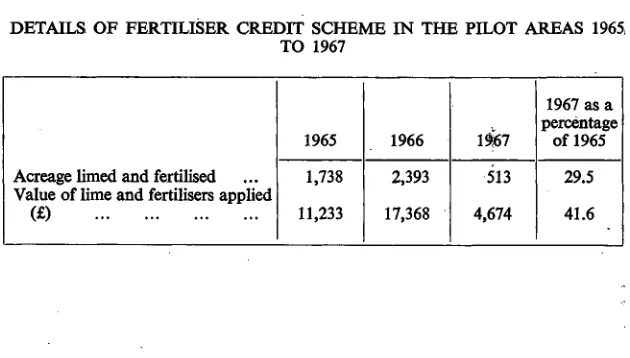
[image:13.409.47.362.414.593.2]corresponding figures for the 26 counties in these two years were £1,826,761 and £1,987,017 respectively. Thus, even when the supplementary grants are taken into account, the average grant per farm was substantially higher among the 4,200 farms in the pilot areas than in the country as a whole. Expenditures on land reclamation and on the Land Project Fertiliser Credit Scheme for the 12-month period ending October 31st in each of the three years 1965, 1966 and 1967 are given in Tables 5 and 6.
TABLE 5
LAND RECLAMATION IN THE PILOT AREAS 1965 TO 1967
Acreage reclaimed Cash Grants paid (£)
Value of supplementary lime and fertilisers (f)1
1965
873 22,297
2,236
1966
1,961 43,731
4,255
1967
3,748 102,757
15,135
1967 as a percentage
of 1965
429.3 460.9
676.9
1In the pilot areas supplementary lime, [phosphate and potash up to a maximum of
£8 per acre are supplied free of charge for application to reclaimed land where the farmer qualifies for the increased reclamation grants.
TABLE 6
DETAILS OF FERTILISER CREDIT SCHEME IN THE PILOT AREAS 1965 TO 1967
Acreage limed and fertilised Value of lime and fertilisers applied
(£)
1965
1,738
11,233
1966
2,393
17,368
1§67
513
4,674
1967 as a percentage of 1965
29.5
41.6
8Three figures include the 50 per cent supplementary grants which are available only
64
Comparable national figures for the Land Project and for the Fertiliser Credit Scheme are given in Tables 7 and 8.
TABLE 7
DETAILS OF LAND RECLAMATION IN THE 26 COUNTIES 1965 TO 1967
Acreage reclaimed Cash grants paid (£)
1965
90,647 1,694,576
1966
72,129 1,553,391
1967
85,824 2,335,061
1967 as a percentage
of 1965
94.7 137.8
Relative to the national figures the progress in land reclamation in the pilot a-reas since 1965 has been substantial. The annual acreage reclaimed increased by more than four times during a period when the national figures declined slightly. However, expenditures under the Land Project Fertiliser Credit Scheme declined sharply in the pilot areas at a time when
TABLE 8
DETAILS OF FERTILISER CREDIT SCHEME IN THE 26 COUNTIES 1965 TO 1967
Acreage limed and fertilised Value of lime and fertilisers applied
(£)
1965
35,240
186,888
1966
49,600
317,467
1967
55,201
357,283
1967 as a percentage
of 1965
156.6
191.2
national expenditures were increasing. Generally speaking, with the excep-tion of two pilot areas, farmers are slow to avail themselves of the credit facilities available under this scheme. During the 3-year period almost 60 per cent of the total expenditure went to the Galway and Mayo pilot areas, while none went to the Donegal, Leitrim and Sligo areas. Among other things, the traditional aversion of low income farmers towards the use of long term credit for productive purposes is possibly a factor to be reckoned with here.
On the other hand during 1965 and 1966, the total farm credit used was £115,200. This was mainly short term credit, involving small loans per farm. Four areas, Cavan, Cork, Galway and Mayo accounted for 56 per cent of the total.
began. The most recent livestock count in these 9 areas was taken during the months of January and February 1967.9 Table 9 gives the total figures
in these 9 areas for the two enumeration periods.
TABLE 9
AGGREGATIVE CHANGES IN LIVESTOCK NUMBERS IN NINE PILOT AREAS 1964 TO 1967
Livestock Category
Milch Cows ... Other Cattle ... Ewes ... Sows
Totals Sept.-Dec. 1964
18,343 24,737 15,690 1,452
Totals Jan.-Feb. 1967
21,072 30,059 14,864 1,390
Percentage Change
14.9 21.5 — 5.3 — 4.3
In the remaining 3 counties the aggregative changes in livestock numbers between February 1966 and February 1967 were as follows:
Milch Cows, 5.6 per cent; Other Cattle, 11.1 per cent; Ewes, 1.5 per cent; Sows, 0.0 per cent.
Between January 1965 and January 1967 the changes in the national livestock population figures were as follows: Milch Cows, 9.1 per cent; Other Cattle (including in-calf heifers), 16.0 per cent; Ewes, 9.8 per cent; Sows, 26.4 per cent.
Although the enumeration periods are not comparable, the progress in the pilot areas would appear to surpass the national figures significantly. Considering the problems of age structure, farm size, fragmentation and so on, this record of progress in the pilot areas between 1964 and 1967 is quite impressive. It should be noted, however, that during the second half of 1966 markets for cattle and sheep were depressed considerably. To a very large extent this affected the progress of the pilot area programme. In a number of areas, farmers were forced by circumstances beyond their control, to sell a greater than normal number of cows in order to pay for essential living expenses. Thus the actual increase in dairy cow numbers would have been much greater had markets remained normal. At the same time, the increase in store cattle would have been less than the figure quoted in Table 9. The replacement of store cattle and sheep by dairy cows on small farms is one of the objectives of the advisory programme in areas where satisfactory outlets for dairy products are available. However, the apparent increase in store cattle numbers was to some extent due to the large "carry-over" of store cattle while the slump in prices lasted. On the other hand, if the initial enumeration period in the nine pilot areas were
9Currently the aim is to have all livestock counts taken during the month of January
66
in the months of January or February, when cattle numbers are perhaps at their lowest point, the increase in milch cows would probably have been greater.
SUMMARY AND CONCLUSIONS
The experiences in the pilot areas point to the following implications for western agricultural development.
1. Despite the successes to date formidable problems still remain to be solved in the pilot areas. The production base is so low in all areas that it is not too difficult to bring about substantial improvements once farmers are motivated to action. There is an amount of good farmland in the West where output can be improved substantially by intensifying farm production. A large number of farmers, however, are economically restricted for many reasons. These vary from small farm size, poor soil resources and geographical location, to age factors and inadequate education, among other things. In all too many cases the low income problem is passed on from one generation to the next and so subsistence farming is perpetuated.
The economic development of these farms requires education and training at the "grass-roots", aided by suitable incentives and pro-grammes for expanding output. Only in this way can the low income problem be contained within the one generation, thus ensuring that the "poverty cycle", which has plagued western agriculture up to the present, will be finally broken.
2. The most pressing problem in all areas is to enable as many farm families as possible to earn satisfactory incomes. This involves an advisory effort extending to all farms in the pilot areas. The needs of individual farmers must receive adequate attention as farm plans are drawn up and short and long term production targets established. Generally speaking, this good work is proceeding satisfactorily in the pilot areas.
3. The ultimate aim of the Pilot Area Development Programme must be the creation of as many viable farms as possible in each area. The individual farmer's criterion of viability, however, depends very much on his age group. Older farmers, for example, tend to compare this year's income with what they had last year. They are likely to be satisfied with a smaller income increase than younger farmers. The latter have alternative opportunities for employment - if not in the West of Ireland, perhaps elsewhere in the country or overseas. For this reason they tend to compare the farm income which they receive with what they can earn outside of farming. They will remain in farming only if it is sufficiently attractive financially for them. In selecting our criterion of viability, therefore, it is the younger rather than the older farmers that we must keep in mind.
Structural reform would appear, therfore, to be an important pre-requisite to the long-term development of the West.
The consolidation of farms, however, usually leads to other require-ments. New buildings, roadways and drainage systems may be needed. Consolidation, therefore, involves detailed forward planning and usually takes considerable time. Furthermore, if the total size of individual farms following consolidation is still insufficient to provide the farm family with a satisfactory means of livelihood, nothing will be gained except a saving of time on the part of the farmer. Where possible, then, consolidation schemes should, if necessary be combined with farm enlargement programmes.
5. The structural problems outlined will undoubtedly affect the survival rate of many western farms. This has two significant implications for the development of the pilot areas:
(a) It is imperative that feasibility of long term investments in farms which will not survive for very long as viable units should be carefully examined. In the pilot areas, for example, the available grants for farm buildings allow the farmer to increase building accommodation at little out-of-pocket cost to himself. Although, this type of investment can be justified within the framework of the pilot area programme, it would be entirely wrong to assume that it should apply to the West as a whole, as it will complicate the problem of structural reform later on.
(b) The second implication is even more fundamental. If the rational-isation of farms in the pilot areas and elsewhere in the West does not match the rate at which farms become vacant, then the total agricultural output of the region may decline. For these reasons structural reform would appear to be more imperative now than in any previous period in the history of western agriculture. 6. Any policy of structural reform must also consider the human
pro-blems of the area. Since a high proportion of the smaller holdings are owned by ageing farmers, many of whom have no successors, the retirement of the latter on pension would appear to be an obvious course of action to follow. This would increase the available supply of land for farm enlargement and the farming community as a whole would benefit as a result.
7. The intensive advisory effort, supplemented by local group activity, has been the most important single factor in each area's success story to date. Undoubtedly, the results would have been more spectacular had the effort not been hampered by the structural problems. 8. The experience in each pilot area shows that the wise use of existing
credit facilities increases farm income substantially.
68
substantially so that their owners, or at least their immediate success-sors, will have at least an even chance of becoming successful com-mercial farmers. This is the principle objective of the Pilot Area Development Programme.
10. In the final analysis the solution of the western farming problem hinges on four important fields of activity (1) the intensification of the advisory services; (2) the rationalisation of farm structure; (3) the retirement of aged farmers and the redistribution of vacated lands and (4) the creation of sufficient off farm employment opportunities to maintain viable rural communities in the region. Off-farm employ-ment is, fundaemploy-mental to the long-term developemploy-ment of the West, because the region will not survive in the absence of a population base sufficient to carry the financial burden of the basic services and facili-ties which every viable region needs. The population pyramids show that the existing farm owners ,i.e. those in the 40 plus age groups, completely outnumber their immediate successors, i.e. those in the 20-40 age groups. As a result there will be much fewer farmers in the next generation and much less opportunities to enter farming for the 0-20 age groups. It is important, therefore, that the decline in the farm population should be offset by an increase in the population of the region as a whole, otherwise the viability of the region will be endangered. Thus regional development must form an integral part of all programmes for national economic development. Only in this way can the survival of relatively remote rural regions be assured.
DISCUSSION
Professor Johnson: I think Dr. Scully is doing a first class job not only in regional administration but in statistical analysis. His paper is an admirable exposition of the present intolerable and perhaps incurable situation. If it lacks anything it is short in historical perspective.
I an not a professional statistician but I am a student of the deep under-lying forces which produce alarming statistics after a decade or two. One of these began in 1934 and was crystallised in the British Agriculture Act of 1947. Already in 1945 I prophesied that if the principle of differential prices for otherwise similar agricultural products continued to operate in the British market it would cause a large scale increase in the export of agricultural producers instead of products. It has done so.
The devil can quote scripture for his purpose and so can I quote statistics. The human population of Belmullet R. D. actually increased horn 13,845 in 1901 to 14,346 in 1911 and so did the population of pigs and poultry. In 1960, pigs and poultry were much less than in 1911 and so too were people. In Swinford R.D. the fall in pigs, poultry and people was catastrophic.
there are now only about 420,000 males engaged in farm work here whereas in 1927 there were nearly 600,000.
The Population Commission has pointed out that the exodus from the land has been particularly heavy from the families of farmers cultivating 30 acres or less. Since 1953 there has actually been a slight increase in the total number of wage-paid employees. This indicates a trend in the direc-tion of relatively large-scale capitalist and mechanised farming and is the obverse of the decline in the numbers engaged in small scale farming.
In 1926, 46.5 per cent of 'persons 14 years and over engaged in farming' engaged on farms of 30 acres and less. The number so engaged was 300,195 In 1951, only 181,920 were engaged on these farms and the percentage was 37.4.
Manpower loss
The total loss of manpower over 14 years of age between these two dates was just short of 160,000 and, of that loss, nearly 120,000 took place from the farms of 30 acres or less.
Evidently ,the economic and demographic climate is unfavourable to the small farm economy that has hitherto been characteristic of our agri-ture. Relatively large-scale farming does indeed show a slight tendency to expand, but here there are important limiting factors.
Any sound long term expansion must depend on more intensive tillage, more intensive cultivation and use of grass in its various forms, &nd this in turn must be associated with an increase in the number and above all in the quality of the cattle that are available for the relavively large-scale farmer.
Time for a change
These cattle are bred for the most part on the small farms and in the dairy districts. Unless a violent break is made with past traditions, there can be no long term improvement in relatively large-scale farming, except by a wholesale improvement in the breeding and rearing of the young cattle which are the raw material of the relatively large farmer. Some of the best farmers are already breeding and rearing their own beef cattle, using specialised beef breeds, and it is arguable that this process should be generalised.
All I am concerned to point out in this article is that there are funda-mental causes which make it difficult for the relatively large-scale farmer rapidly to increase production on a sound long-term basis, and as I hope to show presently, that other important causes make it difficult, if not financially suicidal for the small farmer to increas production at all. Limited British Market
Public discussion in these matters has all along unconsciously assumed that there is an unlimited market for any agricultural produce we can produce and export to Britain. That was so in the past, but since 1934, and especially since 1947, the U.K. market has silted up. and is less receptive of the produce especially of our small scale farmers.
70
John Bull in eggs' there was a chance, and our small farmers (to their credit, be it said) seized it with both hands. Hatcheries sprang up like mushrooms, and the poultry population, which had fallen to about 17 millions during the war, shot up to 22.1 millions in 1949.
The Poultry Tragedy
Between 1947-49, egg production in the U.K. was 18 per cent below prewar. In 1949 we exported 3,?90,000 great hundreds of eggs to the U.K. -a tot-al not f-ar short of our export in 1930.
By 1955-56 egg production in the U.K. was 50 percent above pre-war as a result of an expenditure of £27^ millions of taxpayer's money in subsidising it. In 1955, our export of eggs was down to 393,000 great hundreds.
Our inarticulate small farmers and their wives know quite well when they are beaten by the price-cost ratio, and have very sensibly reacted by allowing poultry population to fall to 16 millions.
Cost of subsidisation
Professor Nash of Aberystwyth has pointed out in an article in Lloyd's Bank Review that nearly £300 million of the taxpayer's money is being spent on subsidising British (and Northern Irish) agricultural production. Of that total, £27j million goes to eggs, £47^ million to pigs and £114 million to milk.
Like egg production, pig production and milk production are now 50 per cent above pre-war in the U.K. Pigs, eggs and milk are the typical products of small and medium sized farms. The U.K. market for these products is no longer what it was.
Wise housewife
What we can do about it, if anything, is another matter, but at least it is quite time that the public and our politicians realised what every house-wife knows (and shapes her actions accordingly).
In the meanwhile, exhortations to increase agricultural production will fall on deaf ears so far as our small farmers are concerned; as for our larger farmers they can only increase production on their farms very slowly indeed."
This situation continued to worsen and I published a letter in the Irish Times on the 8th March 1967 which is also relevant. Here it is:
Agriculture and Industry
"The general opinion in the Republic is that if we can only succeed in accompanying the U.K. into the Common Market we'll be 'on the pig's back'."
gainful occupied population receives one-fifth of the national income and the disparity tends to widen.
Access to the E.E.C. will make us one of the privileged economies which, with apparent success, have based their plans for economic expansion on the feather-bedding of the national agriculture. But it may tend to aggravate the ultimate international problem and make it more difficult to integrate the unprivileged economies of the outside world in a genuine international economy.
When the U.K. adopted genuine Free Trade in the 1840s she created the conditions of agricultural prosperity and economic differentation in the world as a whole, and thus laid the commercial foundations of a complete international economy. All this was sadly interrupted by two world wars. Economic nationalism was an obvious disaster in the inter-war period. Economic Regionalism could develop the same characteristics on a more disastrous scale.
When the present British agricultural policy became crysiallised in 1947 there were 11,000,000 acres of good agricultural land and well over 500,000 agricultural producers in these islands who were literally 'outside the Pale'. Price differentiation in favour of produce produced within the Pale has operated as an invitation to us to export agricultural personnel instead of produce. Agricultural personnel now numbers about 340,000. If our farmers had not been so situated in 1947 it is reasonable to suppose that 'deficiency payments' would have been fixed on a less liberal basis. The 300,000 gilded paupers who own farms in a truncated United King-dom are sitting on a very lucrative band waggon and regularly receive a hand-but of £1,000 per farm from the benevolent U.K. taxpayer. If we had not been outside the Pale the hand-out per farm would have been much less. Our Northern neighbours, who are still within the Pale, should express their gratitude to us by erecting a statue to Patrick Pearse at Stormont side by side with that of Lord Carson! I am not opposed in principle to fixing a floor price for imported agricultural products but it ought to be fixed on a realistic basis which does not encourage uneconomic production anywhere, and it ought to be fixed by international agreement and con-tributed to by the national economies concerned in some equitable proportion.
Any form of economic privilige which ignores the external repercussions of domestic national policy is a disservice to the international economy which is not yet fully restored. No international economy can be soundly based unless its monetary arrangements have a sound commercial foundation".