Morphological Reinflection with Conditional Random Fields and
Unsupervised Features
Ling Liu
Department of Linguistics University of Colorado
Lingshuang Jack Mao Department of Linguistics
University of Colorado
Abstract
This paper describes our participation in theSIGMORPHON2016 shared task on
mor-phological reinflection. In the task, we use a linear-chain conditional random field model to learn to map sequences of input characters to sequences of output charac-ters and focus on developing features that are useful for predicting inflectional behav-ior. Since the training data in the task is limited, we also generalize the training data by extracting, in an unsupervised fashion, the types of consonant-vowel sequences that trigger inflectional behavior, and by ex-tending the available training data through inference of unlabeled morphosyntactic de-scriptions.
1 Introduction
Our approach to the shared task focuses on expand-ing well-known methods to learnexpand-ing inflections. As our starting point, we assume a discriminative model akin to Durrett and DeNero (2013), Nicolai et al. (2015), and the baseline system provided by the organizers of the shared task, all very similar systems at the core. To improve performance and to address the more difficult reinflection tasks in-troduced in the shared task, we explore methods of expanding the training data, performing better alignment on the training data for our discrimina-tive sequence classifier, feature development, and using unsupervised features for better generaliza-tion from training data.
In what follows, we describe a baseline system we developed, the system we actually participated with, and present the results, together with some analysis.
2 Exploratory experiments: a suffix-based baseline
To assess the difficulty of the task and the varia-tion of inflecvaria-tional behavior in the data sets, we ran a preliminary test with the data using a sim-ple, suffix-based inflection strategy to complement the SIGMORPHON baseline. The method simply
learns to transform input word form suffixes to suffixes of inflected forms. It works as follows: from each Levenshtein-aligned example pairx→
ybelonging to some morphosyntactic description (MSD) msource → mtarget, we extract all the possible suffix-based string-to-string mapping rules that describe this mapping. In task 1, where the source MSD is not known, we assume that the source mapping is the lemma form. For exam-ple, if we have seen the example Finnish inflec-tion rakko → rakoitta, going from lemma to pos=N,case=PRIV,num=PL, we extract the fol-lowing alignment, with extra start-of-word and end-of-word markers
< r a k k o _ _ _ _ > < r a k _ o i t t a >
This allows us to extract rules like the fol-lowing for inflecting from the lemma form to
pos=N,case=PRIV,num=PL:
> → itta>
o> → oitta>
ko> → oitta>
kko> → koitta> akko> → akoitta> rakko> → rakoitta>
From this, we devise a simple inflection strat-egy at test time where we always pick the longest matching such rule extracted from all word pairs that pertains to the MSD of the source and the tar-get. The rationale for this baseline is that many
Suff SIGMORPHON baseline baseline
Arabic 48.02 (45.97) 70.30
Finnish 88.36(88.21) 68.27 Georgian 94.09(92.75) 89.83 German 92.24(91.99) 90.36 Hungarian 91.47(87.76) 74.10 Maltese 37.69(36.59) 36.56 Navajo 35.47 (11.33) 71.90
Russian 88.94 (88.18) 90.38
[image:2.595.312.482.60.151.2]Spanish 98.31(98.25) 96.93 Turkish 77.65(76.24) 59.17
Table 1: Results of a simple suffix-based baseline on task 1. Results are on the dev-set, and results in parentheses describe performance on the dev-set duplicates from the training-set removed.
hand-written models of morphology for various languages focus on suffixes to predict morphologi-cal behavior (Détrez and Ranta, 2012). As is seen in table 1, this yields comparably strong results for those languages that have largely suffixing inflec-tions in the shared task (Finnish, Georgian, Ger-man, Hungarian, Spanish). It also identifies the difficult languages of the task for both—-Arabic, Maltese, and Navajo. These are languages that exhibit significant stem-internal alternations and prefixation processes that thus lie outside the scope of this simple method.
3 Sequence labeling
To address the shortcomings of the two baselines tested—that the discriminative classifier-based baseline works well with stem-internal changes but weakly with predominantly suffixing processes, and that the suffix strategy works only with suffix-ing languages—we develop a discriminative con-ditional random field (CRF) model and focus on improving the initial alignment of the input and output to better and more consistently capture pre-fixation and sufpre-fixation.
3.1 Alignment
We use the alignment procedure in the baseline pro-vided by the organizers (Cotterell et al., 2016). This is a one-to-one aligner that learns globally optimal costs for aligning a set of word pairs. We first ran all the word pairs as a batch through this aligner, obtaining a one-to-one alignment of each pair in the entire training data. We also experimented with variants on alignment using Levenshtein distance with a bias toward aligning vowels with vowels
< d ü r f e n > _ _ d ü r f e n g e d u r f t _
<ge d u r f t _ > pos=V,tense=PST lemma
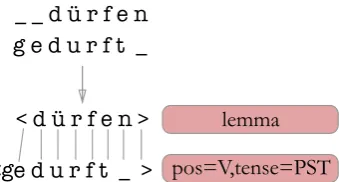
Figure 1: Example of the enforced one-to-many alignment after first aligning input-output pairs one-to-one.
and consonants with consonants, with consistently worse results.
After initial alignment of the input-output pairs, we additionally force a one-to-many alignment of the pairs, with added beginning and end markers< and>. The markers are treated as actual symbols that serve to allow the stems to be entirely aligned on both sides despite possible prefixation and suf-fixation. In performing the alignment we enforce that the input side of the relation always comes in single characters, each of which alternatively map to the empty string, or a sequence. We bias this alignment in such a way that any initial input side zeroes are collapsed with the <-marker and any final output side zeroes are collapsed together with the>-marker. Stem-internal insertion sequences x:y 0 :zare always greedily associated with the leftmost change and becomex:yz. This alignment simplifies the labeling process since each input let-ter is now assigned a label; furthermore, associating prefixes and suffixes with the alignment markers in a predetermined way allows for a consistent model of suffixing and prefixing in the label sequence learning process. This is illustrated in figure 1.
3.2 Labeling
We treat inflection generation as a labeling problem of converting an input sequencex= (x1, . . . , xn)
to an output sequencey= (y1, . . . , yn). After the
forced one-to-many alignment process, we con-vert the output side to a sequence of decisions (y1, . . . , yn) for use in a sequential labeling
[image:2.595.89.275.63.195.2]input, however, the output string itself becomes the label. In figure 1, the output sequence y would be<ge-repeat-u-repeat-repeat-t-∅-repeat. Deci-sion sequences thus reflect the possible choices we have for each input symbol (including the bound-ary markers<and>)—we may repeat the symbol, delete the symbol, or output some other sequence of symbols.
Given input words of the formx= (x1, . . . , xn)
and the corresponding decision sequences y = (y1, . . . , yn)we train a linear-chain CRF (Lafferty
et al., 2001) by L-BFGS (Liu and Nocedal, 1989) usingCRFsuite(Okazaki, 2007).
We model the conditional distribution of the out-put sequence in the standard way as
p(y|x) = Z1expXn
i
φ(yi−1, yi,x, i)
(1)
whereφis a feature function which breaks down intokcomponent functions
φ(yi−1, yi,x, i) =X k
wkfk(yi−1, yi,x, i) (2)
and whereZ is the partition function which nor-malizes the expression to a proper distribution.
4 Features
We use a number of contextual features that look at variable amounts of context at eachxipoint. Apart
from standard local contextual features, we also employ features that refer to contexts as sequences of consonants and vowels (C/V).1 In addition to
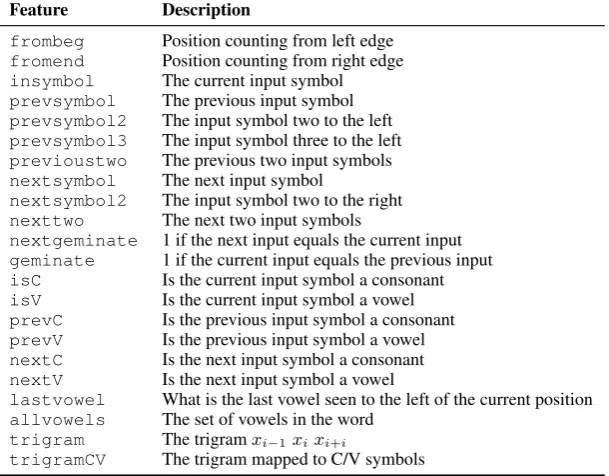
local contextual C/V-features we also employ non-local features such as the types of vowels seen so far in the word and the last vowel seen at the current position, to better capture harmonic processes and Semitic root-and-pattern morphology. An overview of the most important features retained after abla-tion analysis is given in table 2.
5 Evaluation 5.1 Outside data
We separately test the feasibility of our approach against the data set published by Durrett and DeN-ero (2013), five data sets over three languages.
1We used an off-the-shelf algorithm for this purpose
(Hulden, in prep.); there are many highly reliable unsuper-vised methods for extracting vowels and consonants given a corpus of words in an alphabetic writing system (Guy, 1991; Kim and Snyder, 2013; Moler and Morrison, 1983; Sukhotin, 1962).
That work used a similar approach (a semi-Markov CRF), albeit without the unsupervised features, and we improve upon their results that use a factored model, predicting each inflected word separately, as in the shared task, on three out of five data sets. We expect that with sparser, gappier training data— Durrett and DeNero (2013) used full inflection ta-bles for training—our richer, more generic features will allow for better generalization.
5.2 MSD classification (task 3)
For task 3, where we are asked to inflect a word from an unknown source MSD, we first train a multi-class support vector machine (SVM) clas-sifier (using LIBSVM (Chang and Lin, 2011)) to map the source form to an MSD. Each combination of MSDs is taken to represent a separate class—i.e. we treat each unique MSD-string as a class. As features, we use all substrings starting from the left and right edges of the word form in question, a method used successfully in e.g. morphological paradigm classification (Ahlberg et al., 2015). In track 2 (where only task 3 data is used), we train the classifier on only the given output forms and MSDs in the training data. In track 1, we feed the classifier all seen word forms and MSDs from any task whose data can be used.
5.3 Training method
In track 1, we inflect task 1 forms as described above whereas task 2 (arbitrary form to arbitrary form) is addressed by pivoting in two steps via the lemma form by first mapping the input form to the lemma form, and then mapping that form to the target form. We treat task 3 as a more difficult version of task 2; we first identify the unknown MSD of the task 3 input form, after which the procedure reduces to task 2. In the track 2 tasks 2 and 3, where only task-specific training data can be used, we are unable to pivot since form-to-lemma data is not available, and we train a separate CRF for each MSD to MSD mapping. In track 2 task 3, we first train the SVM classifier to identify MSDs, then classify the unknown MSDs of the input form in the training data, producing training data of the same format as in task 2.
Feature Description
frombeg Position counting from left edge fromend Position counting from right edge insymbol The current input symbol prevsymbol The previous input symbol prevsymbol2 The input symbol two to the left prevsymbol3 The input symbol three to the left previoustwo The previous two input symbols nextsymbol The next input symbol
nextsymbol2 The input symbol two to the right nexttwo The next two input symbols
nextgeminate 1 if the next input equals the current input geminate 1 if the current input equals the previous input isC Is the current input symbol a consonant isV Is the current input symbol a vowel prevC Is the previous input symbol a consonant prevV Is the previous input symbol a vowel nextC Is the next input symbol a consonant nextV Is the next input symbol a vowel
lastvowel What is the last vowel seen to the left of the current position allvowels The set of vowels in the word
trigram The trigramxi−1xixi+i
[image:4.595.148.453.66.304.2]trigramCV The trigram mapped to C/V symbols
Table 2: The main feature templates used.
CRF D&DN13 Suffix-rules
[image:4.595.308.515.382.514.2]DE-V 96.14 94.76 91.29 DE-N 83.75 88.31 86.18 ES-V 99.62 99.61 63.95 FI-V 97.18 97.23 72.00 FI-N 92.30 92.14 92.62
Table 3: Our approach on the Durrett and DeN-ero (2013) dataset, comparing our model with that work (D&DN13) and the simple suffix-replacing model introduced earlier.
lemma-to-MSD (track 1) or MSD-to-MSD (track 2), and we settled for using separate models.
6 Results
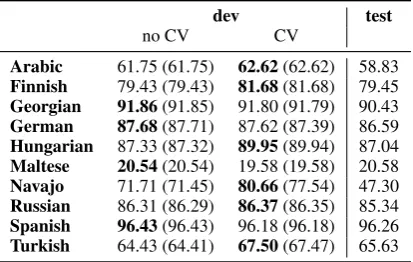
The main results on the development data for task 1 are given in tables 4, 5, and 6. We separately list figures with and without the C/V-features, which re-sulted in an average increase in accuracy of 1.02% (task 1), 1.58% (task 2), and 1.18% (task 3). As the development data includes instances also found in the training data, we separately report the accuracy without such duplicates, given in parentheses, as these results better reflect the performance on the final test data.
7 Discussion
The approach we have used clearly outperforms the baselines provided by the task and our own
dev test
no CV CV
Arabic 74.00 (72.13) 74.63(72.81) 72.42
Finnish 88.86 (88.71) 90.05(89.92) 88.65
Georgian 94.79(93.46) 94.59 (93.22) 93.86
German 92.42 (92.05) 92.61(92.25) 92.64
Hungarian 91.04 (88.74) 93.94(91.28) 91.05
Maltese 42.03(40.81) 41.49 (40.22) 43.49
Navajo 88.01 (65.23) 92.01(63.67) 53.28
Russian 90.44(89.79) 90.13 (89.45) 89.13
Spanish 98.68 (98.63) 98.74(98.70) 98.28
Turkish 85.34 (84.15) 88.91(88.01) 87.39
Table 4: Main results for track 1, task 1.
dev test
no CV CV
Arabic 63.93 (63.93) 65.62(65.62) 62.74
Finnish 79.87 (79.87) 82.00(82.00) 80.19
Georgian 92.37(92.37) 92.25 (92.25) 90.87
German 89.31 (89.31) 89.43(89.43) 88.44
Hungarian 87.50 (87.50) 90.20(90.20) 87.49
Maltese 22.66(22.66) 21.29 (21.79) 22.54
Navajo 70.54 (70.48) 76.67(76.62) 46.13
Russian 87.06(87.06) 86.93 (86.93) 86.71
Spanish 97.43(97.43) 97.12 (97.12) 97.18
[image:4.595.307.514.588.719.2]Turkish 67.12 (67.12) 70.37(70.37) 67.50
dev test
no CV CV
Arabic 61.75 (61.75) 62.62(62.62) 58.83
Finnish 79.43 (79.43) 81.68(81.68) 79.45
Georgian 91.86(91.85) 91.80 (91.79) 90.43
German 87.68(87.71) 87.62 (87.39) 86.59
Hungarian 87.33 (87.32) 89.95(89.94) 87.04
Maltese 20.54(20.54) 19.58 (19.58) 20.58
Navajo 71.71 (71.45) 80.66(77.54) 47.30
Russian 86.31 (86.29) 86.37(86.35) 85.34
Spanish 96.43(96.43) 96.18 (96.18) 96.26
[image:5.595.73.280.63.194.2]Turkish 64.43 (64.41) 67.50(67.47) 65.63
Table 6: Main results for track 1, task 3.
baseline. There is room for improvement, however. We attribute the weak performance on the diffi-cult languages of the task (Arabic, Maltese, and Navajo, in particular) to limitations on the linear-chain CRF model. Because of the immediately local dependency on the previous label, the model is unable to accurately capture multiple disjoint changes in going from word form to word form— something that is present in the Semitic languages of the data sets and Navajo. In the future, we want to experiment with more general CRF models to address this shortcoming (Sutton and McCallum, 2011). We also want to explore techniques for training a single model per part-of-speech instead of a separate model for each inflection type. In our experiments of training single models, this pro-duced no improvement, but it seems that such an approach is indispensable in order to be able to generalize beyond the specific training data given. Consider, for example, seeing the Finnish word talo(‘house’) in itssingularandplural inessives
talossa/taloissaand thesingular abessive,talotta. In a single model, we should be able to infer, with-out ever seeing an inflection of that type, that the
plural abessiveform istaloitta, isolating the plural i-morpheme. However, in a model where each com-plex inflection is learned separately, this cannot be learned without actually seeing an example of the combinationabessiveandplural.2
References
Malin Ahlberg, Markus Forsberg, and Mans Hulden. 2015. Paradigm classification in supervised learn-ing of morphology. InProceedings of NAACL-HLT,
2This work has been partly sponsored by DARPA I20 in
the program Low Resource Languages for Emergent Inci-dents (LORELEI) issued by DARPA/I20 under Contract No. HR0011-15-C-0113.
pages 1024–1029, Denver, Colorado, May–June. As-sociation for Computational Linguistics.
Chih-Chung Chang and Chih-Jen Lin. 2011. LIB-SVM: a library for support vector machines. ACM Transactions on Intelligent Systems and Technology (TIST), 2(3):27.
Ryan Cotterell, Christo Kirov, John Sylak-Glassman, David Yarowsky, Jason Eisner, and Mans Hulden. 2016. The SIGMORPHON 2016 shared task— morphological reinflection. In Proceedings of the 2016 Meeting of SIGMORPHON, Berlin, Germany, August. Association for Computational Linguistics. Grégoire Détrez and Aarne Ranta. 2012. Smart paradigms and the predictability and complexity of inflectional morphology. InProceedings of the 13th EACL, pages 645–653. Association for Computa-tional Linguistics.
Greg Durrett and John DeNero. 2013. Supervised learning of complete morphological paradigms. In
Proceedings of NAACL-HLT, pages 1185–1195. Jacques B.M. Guy. 1991. Vowel identification: an old
(but good) algorithm.Cryptologia, 15(3):258–262. Young-Bum Kim and Benjamin Snyder. 2013.
Unsu-pervised consonant-vowel prediction over hundreds of languages. InProceedings of ACL, pages 1527– 1536, Sofia, Bulgaria, August. Association for Com-putational Linguistics.
John Lafferty, Andrew McCallum, and Fernando C. N. Pereira. 2001. Conditional random fields: Prob-abilistic models for segmenting and labeling se-quence data. In Proceedings of the Eighteenth In-ternational Conference on Machine Learning, pages 282–289.
Dong C. Liu and Jorge Nocedal. 1989. On the limited memory BFGS method for large scale optimization.
Mathematical Programming, 45(1-3):503–528. Cleve Moler and Donald Morrison. 1983. Singular
value analysis of cryptograms. American Mathemat-ical Monthly, pages 78–87.
Garrett Nicolai, Colin Cherry, and Grzegorz Kondrak. 2015. Inflection generation as discriminative string transduction. InProceedings of NAACL-HLT, pages 922–931, Denver, Colorado, May–June. Association for Computational Linguistics.
Naoaki Okazaki. 2007. CRFsuite: a fast implementa-tion of condiimplementa-tional random fields (CRFs).
Boris V. Sukhotin. 1962. Eksperimental’noe vydele-nie klassov bukv s pomoshch’ju EVM. Problemy strukturnoj lingvistiki, pages 198–206.