Rule- and Learning-based Methods
for Bridging Resolution in the ARRAU Corpus
Ina Rösiger
Institute for Natural Language Processing University of Stuttgart, Germany [email protected]
Abstract
We present two systems for bridging reso-lution, which we submitted to the CRAC shared task on bridging anaphora resolution in the ARRAU corpus (track 2): a rule-based approach following Hou et al. (2014) and a learning-based approach. The re-implementation of Hou et al. (2014) achieves very poor performance when being applied to ARRAU. We found that the reason for this lies in the different bridging annotations: whereas the rule-based system suggests many referen-tial bridging pairs, ARRAU contains mostly lexical bridging. We describe the differences between these two types of bridging and adapt the rule-based approach to be able to handle lexical bridging. The modified rule-based ap-proach achieves reasonable performance on all (sub-)tasks and outperforms a simple learning-based approach.
1 Introduction
Bridging (Clark, 1975) is an anaphoric phe-nomenon where the interpretation of a bridg-ing anaphor, sometimes also called associative anaphor (Hawkins, 1978), is based on the non-identical associated antecedent.
The related NLP task of bridging resolution is about linking these anaphoric noun phrases and their antecedents, where both do not refer to the same referent, but are related in a way that is not explicitly stated. Bridging anaphors are thus discourse-new, but dependent on previous context.
(1) The 2018 Winter Olympics was a major multi-sport event held in February 2018 in Pyeongchang County, South Korea.
Ticket prices were announced in April 2016 ...
Full bridging resolution combines two subtasks: (i) detecting bridging anaphors (anaphor
recogni-tion) and (ii) finding an antecedent for given bridg-ing anaphors (anaphor resolution).
Recently, there has only been few work on these tasks (Hou et al., 2014, 2013b,a; Markert et al., 2012; Rahman and Ng, 2012), which is partly due to the lack of annotated data, which makes the application of statistical methods difficult. Most recent work has focused on the corpus ISNotes (Markert et al., 2012), on which Hou et al. (2014)’s rule-based system currently achieves state-of-the-art results.
The first shared task on bridging resolution, co-located with the workshop on computational models of reference, anaphora and coreference (CRAC), deals with the task of bridging anaphora resolution in the RST domain of the ARRAU cor-pus (Poesio and Artstein, 2008). The dataset used in the shared task is part of the second release of the ARRAU corpus (Uryupina et al., to appear).
This paper presents a rule-based and a learning-based system, as submitted to the shared task. We start with a re-implementation of Hou et al. (2014)’s rule-based approach, which we then ap-ply to the ARRAU corpus. Although the approach was designed for the same domain (news), we find that the performance is very poor. Our analysis shows that this is due to two different phenom-ena being defined as bridging, namely referential and lexical bridging. We present the differences between lexical and referential bridging and adapt the rule-based model so that it can also handle lex-ical bridging. We also compare the rule-based ap-proach with a learning-based model which has ac-cess to the same information than the rule-based system. We report the results achieved for bridg-ing anaphora detection, bridgbridg-ing anaphora reso-lution as well as full bridging resoreso-lution on all three domains of the ARRAU corpus: the RST do-main (news), TRAINS (dialogue) and PEAR (nar-ratives). For the shared task’s main focus,
ing anaphora resolution in the RST domain of AR-RAU, i.e. finding an antecedent for a given bridg-ing anaphor, we achieve an accuracy of 39.8%.
Surprisingly, although the rules were designed for the RST domain of ARRAU, they perform even better on the two other domains. The rule-based system outperformed the learning-based one in ev-ery setting.
2 The ARRAU corpus
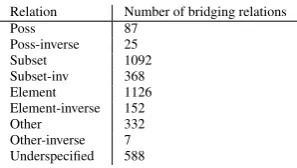
The second release of the ARRAU corpus, first published in Poesio and Artstein (2008), was used as the data basis for the shared task. It is a multi-domain corpus that aims at “providing much needed data for the next generation of coref-erence/anaphora resolution systems” (Uryupina et al., to appear). The current version of the dataset contains 350K tokens and 5512 bridging anaphors. The shared task data comprises text from three domains: RST (newspaper), TRAINS (dialogues) and the PEAR stories (narrative text). Following earlier attempts on the reliable anno-tation of bridging (Poesio, 2004), where it be-came evident that better annotation quality could be achieved by limiting the annotation to the three relations subset, element and poss, most of the bridging relations in ARRAU are of these types, as shown in Table 2. Additionally, compara-tive anaphora are included and marked asother, and bridging cases which do not fit the pre-defined relations, but are obvious cases of bridging, are marked with the relationundersp-rel.
Domain Number of bridging anaphors RST 3777
[image:2.595.72.217.539.582.2]TRAINS 710 PEAR stories 333 Total 5512
Table 1: Number of bridging anaphors in the single do-mains of the ARRAU corpus
Relation Number of bridging relations
Poss 87
Poss-inverse 25 Subset 1092 Subset-inv 368 Element 1126 Element-inverse 152 Other 332 Other-inverse 7 Underspecified 588
Table 2: Bridging relations in ARRAU
3 Bridging definition
Bridging has been studied in many theoretical studies (Clark, 1975; Hawkins, 1978; Hobbs et al., 1993; Asher and Lascarides, 1998) as well as in corpus and computational studies (Fraurud, 1990; Poesio et al., 1997; Vieira and Teufel, 1997; Poe-sio and Vieira, 1998; PoePoe-sio et al., 2004; Nissim et al., 2004; Nedoluzhko et al., 2009; Lassalle and Denis, 2011; Baumann and Riester, 2012; Cahill and Riester, 2012; Markert et al., 2012; Hou et al., 2013b,a; Hou, 2016; Zikánová et al., 2015; Gr-ishina, 2016; Roitberg and Nedoluzhko, 2016; Ri-ester and Baumann, 2017). Unlike in work on coreference resolution, these studies do not follow an agreed upon definition of bridging. Many is-sues have been controversial for a long time, for example whether definiteness should be a require-ment for bridging anaphors, or the restriction to certain pre-defined relations. In this paper, we do not want to go deeper into the definition of bridg-ing, but we would like to discuss one additional aspect that will be relevant in our discussion of the experiments with the ARRAU corpus: the dis-tinction between referential and lexical bridging, inspired by, though different from, the two-level RefLexscheme by Baumann and Riester (2012).
Referential vs. lexical bridging We propose the terms referential and lexical bridging to dis-tinguish two different phenomena which are cur-rently both defined – and annotated – as bridging.
Referential bridging describes bridging on the level of referring expressions, i.e. we are consid-ering bridging anaphors that are truly anaphoric, in the sense that they need an antecedent in order to be interpretable, as in (2). As such, (referential) bridging anaphors are context-dependent expres-sions.
(2) The city is planning a new townhall and
the constructionwill start next week.
Referential bridging is often a subclass of (refer-ential) information status annotation. The corpus ISNotes (Markert et al., 2012) is one example of a corpus which solely includes referential bridging.
[image:2.595.73.222.645.729.2]re-alise that lexical relations are defined as part of the intrinsic meaning of a pair of concepts, thus, abstracting away from specific discourse referents: it is the worddoorwhich is a meronym ofhouse, not some actual physical object or its mental im-age. The proper nounsEurope andSpainare in a meronymic relation and can thus be considered a case of lexical bridging. However, Spain, is not anaphoric, as its interpretation does not depend on the antecedent Europe. Lexical bridging is often annotated when certain pre-defined relations are defined as bridging.
It should be noted that lexical and referential bridging are two different phenomena with com-pletely different properties, although they often co-occur in one and the same expression, such as in (3), where we have a relation of meronymy be-tween the content wordhouse anddoor, but also an anaphoric referring expressionthe dooron the referential level.
(3) a house . . . the door.
The second release of the ARRAU corpus contains instances of both referential and lexical bridg-ing, with the majority of the bridging links be-ing purely lexical bridgbe-ing pairs, i.e. most expres-sions labeled as bridging are actually not context-dependent. This is probably because the focus of the annotation was set on the pre-defined relations. Another relation often brought up in connection with bridging is thesubsetorelement-of relation, which is the most common relation in ARRAU. In principle, an expression referring to an element or a subset of a previously introduced group can be of the referential type of bridging, e.g. in (4).
(4) I saw some dogs yesterday.The small pug
was the cutest.
It should be noted, however, that at the lexical level, subset/element-of pairs have more in com-mon with coreference pairs, e.g. (5), since the lex-ical relation between their head nouns tends to be hypernymy, synonymy or plain word repeti-tion, i.e. relations which are summarised aslexical givennessin Baumann and Riester (2012).
(5) I saw a dog yesterday.The small pugwas very cute.
Finally, the subset relations identified as bridg-ing in ARRAU often comprise cases such as in
(6), where supercomputers priced between [. . . ] is a subset ofsupercomputers. Even if this is jus-tifiable at the lexical level (the concept supercom-puteris lexically given), we should note that there is, once more, no referential bridging involved here, since the expression denoting the subset can be interpreted independently of the context.
(6) Cray Computer also will face intense com-petition, not only from Cray Research, which has about 60 %of the world-wide
supercomputer market and which is ex-pected to roll out the C-90 machine, a di-rect competitor of the Cray-3, in 1991. The new company said it believes there are fewer than 100 potential customers for su-percomputers priced between 15 million and 30 million [. . . ].
Distinguishing referential and lexical cases in AR-RAU automatically is non-trivial, although our as-sumption is that many referential cases of bridging are probably included inundersp-rel.
4 Data preparation
The ARRAU corpus was published in the MMAX format, an XML-based format of different annota-tion layers. We converted the data into our own, CoNLL-12-style format and used the following annotation layers to extract information:
the word level, to obtain the words, document names and word number, the sentence level, to ob-tain sentence numbers, the part-of-speech level to extract POS tags and the phrase level to extract bridging anaphors, their antecedent, the bridg-ing relation, coreference information, as well as the following attributes of the markables: gender, number, person, category, genericity, grammatical function and head word.
A couple of non-trivial issues came up during the preparation of the data: anaphors with multi-ple antecedents, antecedents spanning more than one sentence, empty antecedents and discontinu-ous markables, such as in
(7) those inAsia orEurope seeking foreign stock-exchange.
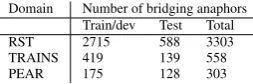
Domain Number of bridging anaphors Train/dev Test Total RST 2715 588 3303 TRAINS 419 139 558 PEAR 175 128 303
Table 3: Number of bridging anaphors in the shared task after filtering out problematic cases.
5 Evaluation scenarios and metrics
We report the performance of our systems for four different tasks.
5.1 Tasks/evaluation scenarios
Full bridging resolution This tasks is about finding bridging anaphors and linking them to an antecedent. Gold bridging anaphors are not given. We use gold markables.
Bridging anaphora resolution (all) This sub-task is about finding antecedents for given bridg-ing anaphors. In this settbridg-ing, we predict an an-tecedent for every anaphor. This is the official task of the shared task.
Bridging anaphora resolution (partial) This subtask is about finding antecedents for given bridging anaphors, but in this case, we only pre-dict an antecedent if we are relatively sure that this is a bridging pair. This means that we miss a number of bridging pairs, but the precision for the predicted pairs is much higher.
Bridging anaphora detection This subtask is about recognising bridging anaphors (without linking them to an antecedent), again using gold markables.
5.2 Evaluation metrics
We report our results in the form of the widely known metrics of precision, recall and F1 mea-sure.
Internal scorer We take coreference chains into account during the evaluation, i.e. the predicted antecedent does not have to be the exact gold an-tecedent to be considered correct, as long as they are in the same coreference chain.
For bridging anaphora resolution (all), i.e. when anaphors are given and one antecedent has to be determined for all anaphors, precision and recall are the same, so in this case we report accuracy.
Official scorer Recently, the official scorer for the evaluation of the shared task has become avail-able, which differs from our internal evaluation in
the handling of some of the special cases (cf. Sec-tion 4 and Table 3). As we ignored these special cases, the official scores will most likely be lower than our own scores, in most of the cases.
In Section 9, we will report the performance us-ing our own and the official scorer script (in the entity setting, which also takes coreference into account).
5.3 Data splits
We design rules and optimise parameters on the training/dev sets of the RST domain, and report performance on the test sets.
6 Applying Hou et al. (2014)’s rule-based system to ARRAU
As a starting point, we adopt the approach by Hou et al. (2014) and re-implement a rule-based sys-tem for full bridging resolution1. The system
con-tains eight rules. The input to the rules are the gold markables. Before applying the rules, we fil-ter out coreferent anaphors, as this increases pre-cision, even with predicted coreference. Each rule then proposes bridging pairs, independently of the other rules. For a more detailed description, please refer to the original paper.
Our implementation achieves comparable re-sults to the original version on ISNotes (Mark-ert et al., 2012), the corpus on which the rules were designed, with an F1 score of 17.8 for full bridging resolution (Hou et al. (2014) report an F1 score of 18.4, but on a different, unknown test-development split).
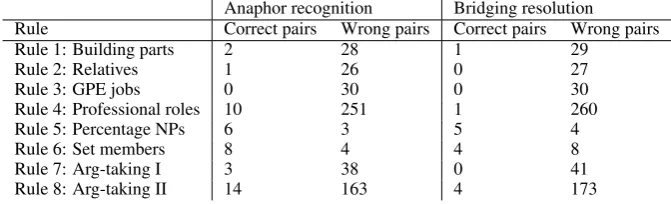
When applying the re-implementation to the complete RST dataset, the performance drops to an F1 score of 0.3 for the task of full bridging res-olution, although both datasets are of the same do-main (WSJ articles). We investigated the reasons for this huge difference and analysed the rules and their predicted bridging pairs. Table 4 shows the rules and their performance on the RST dataset.
We soon realised that the annotations differ quite a lot with respect to the understanding of the category bridging, as described in the section about referential and lexical bridging. We noticed that besides predicting wrong pairs, the original system would suggest bridging pairs which are fine from a referential point of view on bridging, but are not annotated in the corpus, such as in
1The system will be made available: https://
(8) As competition heats up in Spain’s crowded bank market, [...]. The govern-mentdirectly owns 51.4%and ...
(9) I heard fromfriendsyesterday that ...
Additionally, it would miss a lot of lexical bridg-ing pairs, as these often involve mentions with matching heads, which are filtered out in the pre-processing step of the system because they tend to signal coreferent anaphors, such as in
(10) Her husband and older son [...] run a soft-ware company. Certainly life for her has changed considerably since the days in Kiev, when she lived with her parents, her husband and her two sons in a 2 1/2-room apartment. (relation: element-inverse).
This is why the performance is so poor: a lot of referential bridging pairs which are not annotated were predicted, while the system missed almost all cases of lexical bridging.
In the remainder of this section, we give exam-ples of some of the correct and incorrect pairs (ac-cording to the gold standard in ARRAU), as pro-posed by the respective rules. Note that some of the incorrect cases (according to the gold standard) might actually be good bridging pairs.
Rule 1: Building parts
(11) Once inside, she spends nearly four hours measuring and diagramming each room in the 80 year-old house [...] She snaps photos ofthe buckled floors... (correct) (12) And now Kellogg is indefinitely
sus-pending work on what was to be a 1 billion cereal plant. The company said it was delaying construction ... (wrong)
Rule 2: Relatives
(13) I heard fromfriendsthat state farms are subsidized, ... (wrong)
Rule 3: GPE jobs
(14) The fact that New England proposed lower rate increases [...] complicated negations withstate officials(wrong)
It is probably controversial whetherstate officials
should be annotated as bridging, as it can also be a generic reference to the class. However, in this case, it is neither annotated as generic nor as bridg-ing.
Rule 4: Professional roles
(15) Meanwhile
the National Association of Purchasing Management said its latest survey indi-cated ...[]. The purchasing managers, however, also said that orders turned up in October ... (correct)
(16) A series of explosions tore through the huge Phillips Petroleum Co.pred
plastics plant near heregold, injuring more
than a hundred and [...]. There were no immediate reports of deaths, butofficials
said a number of workers ... (different antecedent)
Rule 5: Percentage expressions
(17) Only 19% of the purchasing managers reported better export orders [...]. And
8% said export orders were down ...
(correct)
Rule 6: Set members
(18) Back in 1964, the FBI had
five black agents. Threewere chauffeurs for ... (correct)
(19) ... a substantial number of people will be involved. Some will likely be offered severance package ... (wrong)
Rule 7: Argument-taking I
(20) In ending Hungary’s part of the project,
Parliamentauthorized ... (wrong)
(21) Sales of
information-processing productspred
increased and accounted for 46% of
total salesgold. In audio equipment,sales
rose 13%to ... (different antecedent)
Rule 8: Argument-taking II
(22) As aftershocks shook
Anaphor recognition Bridging resolution Rule Correct pairs Wrong pairs Correct pairs Wrong pairs
Rule 1: Building parts 2 28 1 29
Rule 2: Relatives 1 26 0 27
Rule 3: GPE jobs 0 30 0 30
Rule 4: Professional roles 10 251 1 260
Rule 5: Percentage NPs 6 3 5 4
Rule 6: Set members 8 4 4 8
Rule 7: Arg-taking I 3 38 0 41
[image:6.595.130.466.63.165.2]Rule 8: Arg-taking II 14 163 4 173
Table 4: Applying Hou et al. (2014) on the RST part of the ARRAU corpus
.
(23) Lonnie Thompson, a research scientist at Ohio Statepred gold who dug for and
analyzed the ice samples. To compare temperatures over the past 10,000 years,
researchersanalyzed ... (different antecedent)
7 Rules for lexical and referential bridging in ARRAU
As the rule-based system is very modular, it is easy to design new rules that can also handle lex-ical bridging. We add a number of rather specific rules, which are meant to increase precision, but also include more general rules to increase recall. We also leave in three rules of the original rule-based system: building parts (Rule 1), percentage expressions (Rule 5) as well as set members (Rule 6).
Comparative anaphora While comparative anaphors are a different information status class in ISNotes, the ARRAU corpus contains compar-ative anaphors as a subclass of bridging anaphors, which are labeled asother. For a markable to be considered a comparative anaphor, it must contain a comparative marker2, e.g. two additional rules,
the other country, etc.
We then search for the closest markable which is of the same category than the anaphor and whose head matches its head in the last seven sen-tences. If this search is not successful, we search for an antecedent of the same category than the anaphor in the same and previous sentence. If this fails too, we search for a markable with the same head or a WordNet synonym appearing before the anaphor.
(24) the issue ...other issues in memory
2other, another, similar, such, related, different, same, ex-tra, further, comparable, additional
We exclude a couple of very general terms, such as things, mattersas potential anaphors, as they are typically used non-anaphorically, such as in An-other thing is that ...3.
Subset/Element-of bridging This is a rather general rule to capture mostly lexical bridging cases of the relationssubset/element.
As the anaphor is typically more specific than the antecedent (except for cases of the relation
subset-inverse/element-inverse), it must be modified by either an adjective, a noun or a relative clause. We then search for the clos-est antecedent of the same category with matching heads in the last three sentences.
(25) computers ...personal computers
If this fails, we check whether the head of the anaphor is a country. If so, we look for the clos-est antecedent withcountryornationas its head in the same sentences or the previous five sentences. This is rather specific, but helps to find many pairs in the news domain.
(26) countries...Malaysia
If this also fails, we take the closest WordNet syn-onym of the same category within the last three sentences as the antecedent. Again, we use our small list of general terms to exclude rather fre-quent general expressions, which are typically not of the category bridging.
Time subset For this rule, we list a number of time expressions, such as 1920s, 80s, etc.. The anaphor must have time annotated as its category and must be one of the above mentioned time expressions. We then search for the closest an-tecedent of the same category in the last seven sen-tences for which the decade numbers match.
(27) 1920s ...1929.
(28) the 1950s ...the early 1950s
One anaphora We search for expressions where oneis followed by a common noun. We then re-member the common noun part of the expression, and search for the closest plural entity of the same category whose common noun part matches the common noun part of the anaphor. Taking into ac-count all words with a common noun tag turned out to work better than just comparing the heads of the phrases.
(29) board members ...one board member
If this rule does not apply, we look for anaphor candidates of the pattern one of the N and again search for the closest plural entity for which the common noun parts of the expressions match.
(30) the letters ...one of the letters
As in a few of the other rules, we exclude a couple of very general terms as they typically do not refer back to something that has been introduced before.
Locations In the RST data, a lot of cities or areas are linked to their state/country. We can find these bridging pairs with the WordNet rela-tion partHolonym. To be considered an anaphor, the markable must be of the category space or or-ganization whose size is three words or less (as to exclude modification). We then search for the closest antecedent of the same category that is in a WordNet partHolonym relation with the anaphor.
(31) California ...Los Angeles
(32) Lebanon ...Beirut
Same heads This rule is very similar to the subset/element-of rule, but is designed to find more cases that have not yet been proposed by the subset/element-of rule. For a markable to be con-sidered an anaphor, it must be a singular, short NP (containing four words or less). We then search for the closest plural expression of the same cate-gory whose head matches the head of the anaphor or that is in a WordNet synonym relation with the anaphor’s head, in the last five sentences.
(33) Democrats ...a democrat
If this fails, we look for singular markables with a maximum size of three words which contain an
adjective as anaphor candidates, and then search for a plural antecedent of the same category whose head matches the head of the anaphor or that is in a WordNet synonymy relation with the anaphor’s head, in the last seven sentences.
(34) the elderly ...the young elderly
(35) market conditions ... current market conditions
If this also fails, we look forinverserelations, i.e. a plural anaphor and a singular antecedent of the same category and matching heads/WN syn-onym in the last seven sentences.
(36) an automatic call processor that ...
Automatic call processors
Persons In this rather specific rule, we search for expressions containing an apposition which re-fer to a person, e.g. David Baker, vice president. For this, the anaphor candidate must match such a pattern and be of the category person. As the an-tecedent, we choose the closest plural person NP whose head matches the head of the apposition.
(37) Specialists ... John Williams, a special-ist
The rest This rule is also very specific and aims to resolve occurrences ofthe rest, which, in many cases, is annotated as a bridging anaphor. We thus search for occurrences ofthe rest and propose as an antecedent a number expression within the last three sentences.
(38) 90%of the funds ...The rest
Proposing antecedents for all remaining anaphors For the task of bridging anaphora resolution, i.e. choosing an antecedent for a given anaphor, we need to force the system to propose an antecedent for every bridging anaphor.
This is why we include a couple of rules, which are applied in the order presented here and which propose an antecedent for every anaphor which has not yet been proposed as an anaphor by the other rules.
1. Pronoun anaphors
(39) At a recent meeting of manufacturing executives, ev-erybody I talked with was very positive, he says. Most say they
plan to ...
This is in a way a strange annotation, as pro-nouns should in theory alway be coreferent anaphors, not bridging anaphors. An alterna-tive annotation would be to linktheyback to most, andmostas a bridging anaphor to man-ufacturing executives.
2. WordNet synonyms in the last three sen-tences
(40) The purchasing managers ...
250 purchasing executives
3. Cosine similarity greater than 0.5 in the last seven sentences
This is meant to find more general related cases of bridging. For the cosine similar-ity, we take the word2vec pre-trained vectors (Mikolov et al., 2013).
(41) “Wa” is Japanese for team spirit and Japanese ballplayers have miles and miles of it.A player’s commitment
to practice ...
4. The anaphor is a person and the antecedent is the closest organisation in the last two sen-tences.
5. First word head match
We choose the closest antecedent within the last two sentences, where the anaphor and the antecedent both start with a proper noun.
6. Same category in the last three sentences, choose closest
(42) ... that have funneled money into his campaign. After his decisive primary victory over Mayor Ed-ward I. Koch
7. Global headmatch/WordNet synonyms: global in this case means that we search for an antecedent in the whole document, without a distance restriction.
8. Global same category
9. Choose closest NP as a fallback plan.
8 A learning-based method
To compare the performance of the rule-based sys-tem with a learning-based method, we set up an SVM classifier4, which we provide with the same
information than the rule-based system.
The classifier follows a pair-based approach similar to Soon et al. (2001), where the instances to be classified are pairs of markables. For train-ing, we pair every gold bridging anaphor with its gold antecedent as a positive instance. As a nega-tive instance, we pair every gold bridging anaphor with a markable that occurs in between the gold anaphor and gold antecedent5. During testing, we
pair every markable except the first one in the document with all preceding markables. As the classifier can classify more than one antecedent-anaphor-pair as bridging for one anaphor, we choose the closest antecedent (closest-first decod-ing).
As the architecture of the machine learning is not designed to predict at least one antecedent for every given bridging anaphor, we cannot re-port results for bridging anaphora resolution (all). However, we report results for partial bridging anaphora resolution, where, during training, we pair the gold bridging anaphors with all preceding markables, instead of pairing all markables with all preceding markables.
We define the following features6:
Markable features words in the markable, gold head form, predicted head form, noun type (proper, pronoun, nominal), category, determiner (def, indef, demonstr, bare), number, gender, per-son, nested markable?, grammatical role, generic-ity, partial previous mention?, full previous men-tion?, modified by a comparative marker?, modi-fied by an adjective?, modimodi-fied by one?, modimodi-fied by a number?, lengths in words.
Pair features distance in sentences, distance in words, head match?, modifier match?, Word-Net synonym?, WordWord-Net hyponym?, wordWord-Net
4Using Weka’s SMO classifier with a string to vector filter 5This is a common technique in coreference resolution, to reduce the number of negative instances and help the imbal-ance issue.
anaphor recognition anaphora-res.-all anaphora-res.-partial full bridging resolution
P R F1 P R F1 P R F1
RST
Rule (internal) 29.2 32.5 30.7 39.8 39.8 39.8 63.6 22.0 32.7 18.5 20.6 19.5 Rule (official) - - - 36.5 35.7 36.1 58.4 20.6 30.5 16.8 13.2 14.8
ML (internal) - - - 47.0 22.8 30.7 17.7 20.3 18.6
ML (official) - - - 51.7 16.2 24.7 12.6 15.0 13.7
PEAR
Rule (internal) 75.0 16.0 26.4 28.2 28.2 28.2 69.2 13.7 22.9 57.1 12.2 20.1 Rule (official) - - - 30.5 28.2 29.3 62.5 11.3 19.1 53.1 4.8 8.8
ML (internal) - - - 26.6 5.7 9.4 5.47 12.5 7.61
ML (official) - - - 37.5 4.2 7.6 23.6 7.3 11.2
TRAINS
Rule (internal) 39.3 21.8 24.2 48.9 48.9 48.9 66.7 36.0 46.8 27.1 21.8 24.2 Rule (official) - - - 47.5 47.3 47.4 64.4 36.0 46.2 28.4 11.3 16.2
ML (internal) - - - 56.6 23.6 33.3 10.3 14.6 12.1
[image:9.595.92.506.61.235.2]ML (official) - - - 63.2 12.8 21.3 19.0 11.0 13.9
Table 5: Performance of the different systems on the tests sets of ARRAU, using gold markables (and gold bridging anaphors in the anaphora resolution settings). We report performance using the official and our own internal scorer.
Anaphor recognition Full bridging resolution
Rule Correct pairs Wrong pairs Precision Correct pairs Wrong pairs Precision
1: Building parts 0 0 - 0 0
-2: Percentage 1 0 1.0 1 0 1.0
3: Set members 1 1 0.50 0 2 0.0
4: Comp anaphora 44 16 0.73 26 34 0.43
5: Subset/element 57 247 0.19 34 270 0.11
6: Time subset 3 6 0.33 3 6 0.33
7: One anaphora 0 0 - 0 0
-8: Locations 25 11 0.69 22 14 0.61
9: Head matching 72 236 0.23 42 266 0.14
10: The rest 1 1 0.50 0 2 0.0
11: Person 10 1 0.91 8 3 0.73
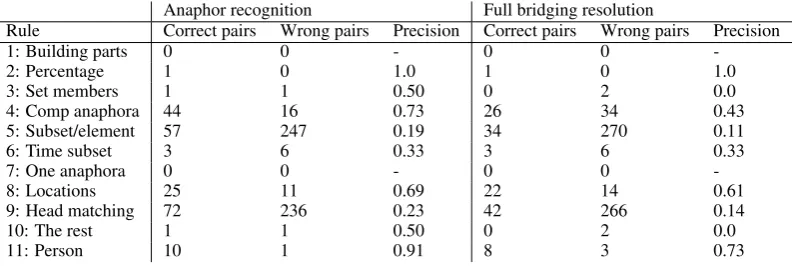
Table 6: Performance of the single rules for full bridging resolution on the test set of RST, using gold markables
meronym?, WordNet partHolonym?, semantic connectivity score, highest semantic connectivity score in document?, cosine similarity.
9 Final performance
Table 5 shows the results of the modified rule-based approach and the learning-rule-based approach for all tasks. It can be seen that the rule-based ap-proach outperforms the learning-based one in ev-ery setting7. Surprisingly, in spite of the fact that
the rules were designed on the training/dev sets of the RST domain, the performance for the PEAR and TRAINS domain is even better in most set-tings. However, these datasets are small, which is why this result should be taken with a grain of salt. Table 6 shows the rules and their performance in the final system for full bridging resolution. Some rules are included which do not predict any pairs because they predicted pairs in the training/dev setting (on which the system was designed).
7We compute significance using the Wilcoxon signed rank test (Siegel and Castellan, 1988) at the 0.01 level.
10 Conclusion
We have presented two systems for full bridging resolution and bridging anaphora resolution. We started with a re-implementation of the state-of-the-art rule-based method by Hou et al. (2014), which did not achieve satisfactory performance when being applied to the ARRAU corpus. We found that the reasons for this lie in the differ-ent bridging annotations. Whereas the rule-based system suggests many referential bridging pairs, ARRAU contains mostly lexical bridging. The adapted rule-based approach achieves reasonable performance on all (sub-)tasks and outperforms a simple learning-based method.
Acknowledgments
[image:9.595.102.499.278.411.2]References
Nicholas Asher and Alex Lascarides. 1998. Bridging.
Journal of Semantics, 15(1):83–113.
Stefan Baumann and Arndt Riester. 2012. Referential and Lexical Givenness: semantic, prosodic and cog-nitive aspects. In Gorka Elordieta and Pilar Prieto, editors, Prosody and Meaning, number 25 in Inter-face Explorations. Mouton de Gruyter, Berlin.
Aoife Cahill and Arndt Riester. 2012. Automati-cally acquiring fine-grained information status dis-tinctions in German. InProceedings of the 13th An-nual Meeting of the Special Interest Group on Dis-course and Dialogue, pages 232–236. Association for Computational Linguistics.
Herbert H. Clark. 1975. Bridging. InProceedings of the 1975 workshop on Theoretical issues in natu-ral language processing, pages 169–174. Associa-tion for ComputaAssocia-tional Linguistics.
Kari Fraurud. 1990. Definiteness and the processing of noun phrases in natural discourse. Journal of Se-mantics, 7(4):395–433.
Yulia Grishina. 2016. Experiments on bridging across languages and genres. In Proceedings of the first Workshop on Coreference Resolution Beyond OntoNotes (NAACL-HLT), pages 7–15, San Diego, USA.
John A Hawkins. 1978. Definiteness and indefinite-ness: A study in reference and grammaticality pre-diction. atlantic highlands.
Jerry R Hobbs, Mark E Stickel, Douglas E Appelt, and Paul Martin. 1993. Interpretation as abduction. Ar-tificial Intelligence, 63:69–142.
Yufang Hou. 2016. Unrestricted Bridging Resolution. Ph.D. thesis.
Yufang Hou, Katja Markert, and Michael Strube. 2013a. Cascading collective classification for bridg-ing anaphora recognition usbridg-ing a rich lbridg-inguistic fea-ture set. InProceedings of the Conference on Em-pirical Methods in Natural Language Processing, pages 814–820, Seattle, USA.
Yufang Hou, Katja Markert, and Michael Strube. 2013b. Global inference for bridging anaphora res-olution. InProceedings of the 2013 Conference of the North American Chapter of the Association for Computational Linguistics: Human Language Tech-nologies, pages 907–917, Atlanta, USA.
Yufang Hou, Katja Markert, and Michael Strube. 2014. A rule-based system for unrestricted bridging reso-lution: Recognizing bridging anaphora and finding links to antecedents. In Proceedings of the Con-ference on Empirical Methods in Natural Language Processing, pages 2082–2093, Seattle, USA.
Emmanuel Lassalle and Pascal Denis. 2011. Leverag-ing different meronym discovery methods for bridg-ing resolution in french. Anaphora Processing and Applications, pages 35–46.
Katja Markert, Yufang Hou, and Michael Strube. 2012. Collective classification for fine-grained information status. InProceedings of the 50th Annual Meeting of the Association for Computational Linguistics: Long Papers-Volume 1, pages 795–804, Jeju Island, Korea. Association for Computational Linguistics. Tomas Mikolov, Kai Chen, Greg Corrado, and Jeffrey
Dean. 2013. Efficient estimation of word represen-tations in vector space.CoRR, abs/1301.3781. Anna Nedoluzhko, Jiˇrí Mírovsk`y, Radek Ocelák, and
Jiˇrí Pergler. 2009. Extended coreferential rela-tions and bridging anaphora in the prague depen-dency treebank. In Proceedings of the 7th Dis-course Anaphora and Anaphor Resolution Collo-quium (DAARC 2009), Goa, India, pages 1–16. Malvina Nissim, Shipra Dingare, Jean Carletta, and
Mark Steedman. 2004. An annotation scheme for information status in dialogue. Proceedings of The fourth international conference on Language Re-sources and Evaluation.
Massimo Poesio. 2004. Discourse annotation and se-mantic annotation in the gnome corpus. In Proceed-ings of the 2004 ACL Workshop on Discourse Anno-tation, DiscAnnotation ’04, pages 72–79, Strouds-burg, PA, USA. Association for Computational Lin-guistics.
Massimo Poesio and Ron Artstein. 2008. Anaphoric Annotation in the ARRAU Corpus. InInternational Conference on Language Resources and Evaluation (LREC), Marrakech, Morocco.
Massimo Poesio, Rahul Mehta, Axel Maroudas, and Janet Hitzeman. 2004. Learning to resolve bridg-ing references. InProceedings of the 42nd Annual Meeting on Association for Computational Linguis-tics, page 143. Association for Computational Lin-guistics.
Massimo Poesio and Renata Vieira. 1998. A corpus-based investigation of definite description use. Com-putational Linguistics, 24(2):183–216.
Massimo Poesio, Renata Vieira, and Simone Teufel. 1997. Resolving bridging references in unrestricted text. InProceedings of a Workshop on Operational Factors in Practical, Robust Anaphora Resolution for Unrestricted Texts, pages 1–6. Association for Computational Linguistics.
Arndt Riester and Stefan Baumann. 2017. The RefLex Scheme – Annotation guidelines. SinSpeC. Work-ing papers of the SFB 732 Vol. 14, University of Stuttgart.
Anna Roitberg and Anna Nedoluzhko. 2016. Bridg-ing corpus for russian in comparison with czech. In
CORBON@ HLT-NAACL, pages 59–66.
Sidney Siegel and N. John Jr. Castellan. 1988. Non-parametric Statistics for the Behavioral Sciences, 2nd edition. McGraw-Hill, Berkeley, CA.
Wee Meng Soon, Hwee Tou Ng, and Daniel Chung Yong Lim. 2001. A machine learning ap-proach to coreference resolution of noun phrases.
Computational linguistics, 27(4):521–544.
Olga Uryupina, Ron Artstein, Antonella Bristot, Fered-erica Cavicchio, Francesca Delogu, Kepa Ro-driguez, and Massimo Poesio. to appear. Annotating a broad range of anaphoric phenomena, in a variety of genres: the arrau corpus. Journal of Natural Lan-guage Engineering.
Renata Vieira and Simone Teufel. 1997. Towards reso-lution of bridging descriptions. In Proceedings of the eighth conference on European chapter of the Association for Computational Linguistics, pages 522–524. Association for Computational Linguis-tics.