Trinity College Dublin
Doctoral Thesis
Personal Privacy and Online Systems
Author:
Pól Mac Aonghusa
Supervisor:
Prof. DouglasLeith
A thesis submitted in fulfillment of the requirements
for the degree of Doctor of Philosophy
in the
School of Computer Science and Statistics
iii
Declaration of Authorship
I declare that this thesis has not been submitted as an exercise for a degree at
this or any other university and it is entirely my own work.
I agree to deposit this thesis in the University’s open access institutional repository
or allow the library to do so on my behalf, subject to Irish Copyright Legislation and
Trinity College Library conditions of use and acknowledgement.
I consent to the examiner retaining a copy of the thesis beyond the examining
v
Acknowledgements
I would like to express my sincere appreciation to Professor Douglas Leith for his
valuable and constructive suggestions during the planning and development of this
research work. His willingness to give his time so generously is very much appreciated.
Finally, I wish to thank my wife, Ann, and my family for their support and
encouragement throughout.
vii
TRINITY COLLEGE DUBLIN
Abstract
School of Computer Science and Statistics
Doctor of Philosophy
Personal Privacy and Online Systems
by Pól Mac Aonghusa
A significant portion of the modern internet is funded by commercial return from
customised content such as advertising where user interests are learned from users’
online behaviour and used to display personalised content. Privacy becomes a concern
when personalisation reveals evidence of learning about sensitive topics a user would
rather keep private. Examples of potentially sensitive topics we consider include
health, finance and sexual orientation.
In this thesis we develop novel technologies allowing users to improve control
over their personal privacy. We consider three aspects of privacy protection here: i)
detecting evidence of unwanted profiling, ii) assessing the potential impact of a threat,
and, iii) a flexible framework to help users to take control the flow of information used
in personalisation.
We model online systems as black-box adversaries with unknown internal workings
but with an objective to maximise commercial utility. In a black-box environment
absolute measures of privacy are problematic and so our formalism builds on a notion
of privacy relative to a baseline. The relative models we develop have the advantage
of being learn-able from observation of the black-box system and so can be readily
im-plemented as practical technologies for privacy threat detection, analysis and privacy
ix
Contents
1 Introduction 1
1.1 Context . . . 2
1.2 Motivation . . . 3
1.3 Scope and Limitations . . . 6
1.4 Contributions and Structure of this Thesis . . . 8
2 Related Work 13 2.1 Data Collection in the Online World . . . 13
2.2 Privacy and Societal Risks of Profiling . . . 15
2.3 Privacy Models and Risk . . . 19
2.4 Privacy and Web-search Profiling . . . 20
3 General Setup 25 3.1 Formal Setup . . . 26
3.1.1 Black-box Models . . . 26
3.1.2 Modelling Interactions . . . 28
3.1.3 Topic Labelling . . . 29
3.1.4 Bag–of–Words Text Model . . . 31
3.2 Experimental Setup . . . 32
3.2.1 General Setup . . . 32
3.2.2 Web Search Assigning Topic Categories and Queries . . . 32
3.2.3 Supplementary Data Sources . . . 35
4.2 Privacy Model . . . 39
4.3 Using Probe Queries to Simplify Estimation . . . 39
4.4 Bayesian Estimator . . . 42
4.5 Example . . . 43
4.6 Experimental Setup . . . 44
4.6.1 Selecting Informative Probe Queries . . . 44
4.6.2 User Click Emulation . . . 46
4.6.3 Web Search Data Collection . . . 47
4.6.4 Feature Selection: Adverts or Links? . . . 48
4.7 Experimental Results . . . 49
4.7.1 Sensitive – Non-sensitive Detection . . . 50
4.7.2 Individual Sensitive Topic Detection . . . 53
4.7.3 Topic Similarity and Topic Confusion . . . 54
4.7.4 You click – therefore – I learn! . . . 57
4.7.5 Time to Learn? . . . 57
4.7.6 Logged-in vs Anonymous . . . 59
4.7.7 Comparison with Other Estimators . . . 60
4.8 Conclusion . . . 62
5 Assessing Threats - Plausible Deniability 65 5.1 Introduction . . . 66
5.2 Plausible Deniability . . . 66
5.2.1 Comparison with Other Anonymity Measures . . . 68
5.2.2 Testing for Plausible Deniability . . . 69
5.3 Implementation . . . 72
5.3.1 The PDEEstimator . . . 72
5.4 Experimental Results . . . 73
5.4.1 Establishing a Baseline . . . 73
5.4.2 The Effect of Random Noise Injection . . . 75
5.4.3 The Effect of Click Strategies . . . 77
xi
6 Reasonable Agency - Privacy by Group Identity 85
6.1 Introduction . . . 86
6.2 Privacy and Threat Model . . . 86
6.2.1 Comparison with Other Privacy Models . . . 88
6.2.2 Other Linking Attacks . . . 90
6.2.3 Providing Personalisation . . . 91
6.2.4 Threat Models . . . 93
6.3 Prototype Implementation . . . 94
6.3.1 Personalisation . . . 94
6.3.2 Estimating Probabilities . . . 95
6.3.3 User Estimate of Privacy Threat . . . 97
6.4 Experimental Setup . . . 99
6.4.1 General Setup . . . 99
6.4.2 Revealing Keyword Pairs . . . 100
6.5 Experimental Evaluation . . . 101
6.5.1 Topic Diversity and User Numbers . . . 101
6.5.2 Personalisation Performance . . . 102
6.5.3 Plausible Deniability . . . 104
6.5.4 Defending Privacy . . . 106
6.6 Discussion . . . 109
7 Conclusions 111 7.1 Discussion . . . 112
7.2 Future Research . . . 113
7.3 Concluding Remarks . . . 115
xiii
List of Figures
1.1 Balancing Personalisation with Privacy. . . 4
1.2 Changes in personalised adverts at successive probe queries for the topic “Cancer”. . . 5
1.3 Structure of this Thesis. . . 8
3.1 Overview of the Basic Black-box Model . . . 27
3.2 Overview of the Proxy Black-box Model . . . 28
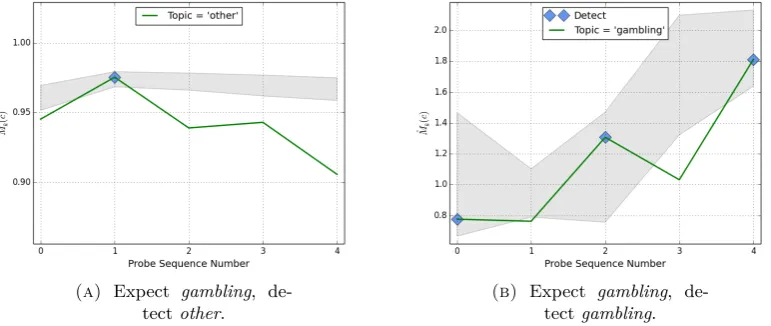
4.1 Illustrating detection of learning for a user session on topicgambling. Shaded areas indicate the confidence interval for Mˆu,k for the other topic in the upper figure, and for thegamblingtopic in the lower figure. Google search engine. . . 50
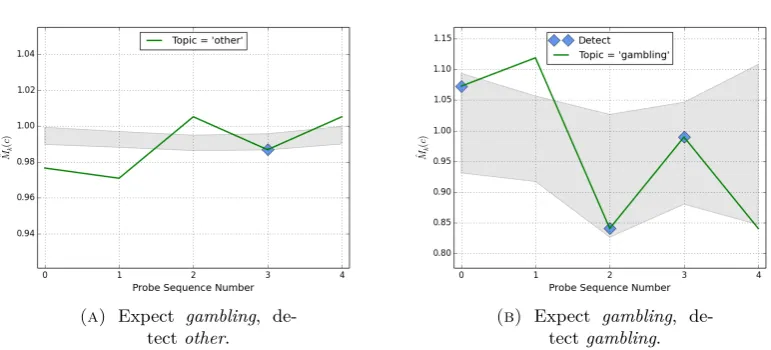
4.2 Illustrating detection of learning for a user session on topicgambling. Shaded areas indicate the confidence interval for Mˆu,k for the other topic in the upper figure, and for thegamblingtopic in the lower figure. Bing search engine. . . 51
4.3 AverageMcu,k(c)measured by topic. . . 56
4.4 AverageMcu,k(c)by topic. Anonymous user, Google test data . . . 60
4.5 Comparison of Naive Bayes, PRI and Support Vector Machine esti-mators. (as Threat Detection Rate by Topic) . . . 61
6.1 Examples of Google Search adverts for individual and shared user profiles. 92
6.2 Frequency of co-occurence of keyword pairs by topic averaged over
6.3 Effect of topic diversity among users on plausible deniability and utility
loss for a single proxy agent with initial fixed topic interest by user
diversity and number of users (A step is an input–output pair event) . 102
6.4 User to Proxy Agent Selection Accuracy (LHS) and Utility Loss (RHS)
averaged over all experimental datasets . . . 103
6.5 Plausible deniability by topic averaged over all datasets, topics, sizes
of proxy agent pool and number of users. Expression (A) indicates use
of (6.20), and Expression (B) use of (6.26) with value of αshown. . . . 105
6.6 Utility Loss averaged over all datasets, topics, sizes of proxy agent
pool and number of users. Expression (A) indicates use of (6.20), and
Expression (B) use of (6.26) with value of αshown. . . 106
6.7 Plausible deniability for different diversity levels in the proxy agent
pool for various topic-to-noise ratios. Results are average by topic and
over all datasets. . . 107
6.8 Utility loss for different diversity levels in the proxy agent pool for
various topic-to-noise ratios. Results are average by topic and over all
xv
List of Tables
3.1 Categories and associated keyword terms . . . 33
3.2 Example query script. Numbers in square brackets indicate line
num-bers for readability. The command !wait n instructs the Python script to wait n seconds. The script is run sequentially and is split
into two columns here to save space. . . 34
4.1 Illustrative example estimator values. . . 43
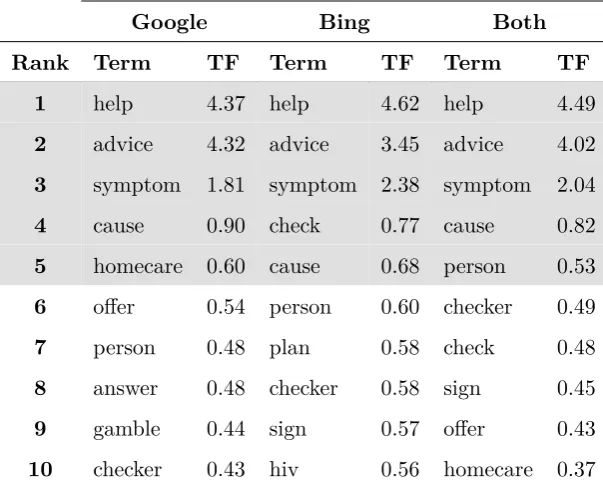
4.2 Top-10 candidate probe terms with term frequency (TF) of occurrence. 46
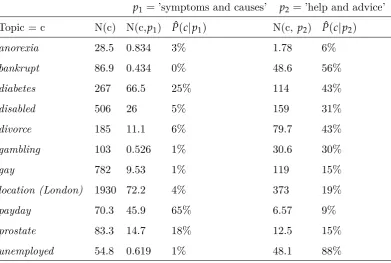
4.3 Approximate result numbers returned by Google on different topics
and for different choices of probe query. Counts are in units of millions. 47
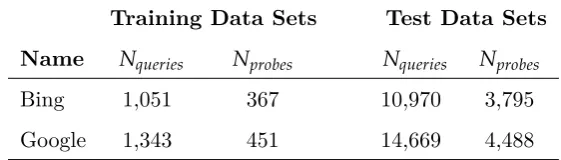
4.4 Summary of training and test data sets. Nqueries is the number of user
search queries and Nprobes the number of probe queries for which data
was collected. . . 48
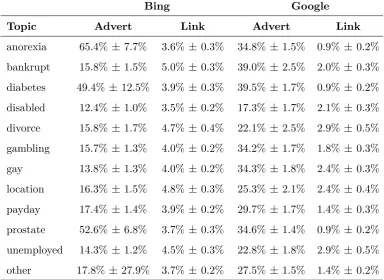
4.5 Average percentage content change per instance of probe query, grouped
by topic and search engine. . . 49
4.6 Measured detection rate of search engine learning of at least one
oc-currence of one or more sensitive topics during a 5 probe session. . . . 52
4.7 Measured detection rate of search engine learning of individual
sensi-tive topics. . . 53
4.8 Percentage increase inMcu,k(c)by topic for click versus non-click. Google search data. . . 57
4.9 Recall rate by probe query excluding successive probe queries – Google. 58
4.10 Estimated probabilities of mis-classification of various lengths and probe
4.11 Measured detection rate of search engine learning for an anonymous
user. . . 59
4.12 Measured detection rate of search engine learning of individual
sensi-tive topics for an anonymous user. . . 61
5.1 Measuredbϵ∗,kfor Reference Topic versus Any Other Topic, reported as “max (median)”, by Probe Query Sequence . . . 72
5.2 Measuredbϵ∗,kfor Reference Topic versus Any Other Topic, reported as “max (median)”, by Probe Query Sequence . . . 74
5.3 Measuredbϵ∗,kfor Reference Topic versus Any Other Topic, reported as “max (median)”, by Probe Query Sequence . . . 76
5.4 Measured Plausible Deniability versus any other tested topics as
prob-ability of interest, by Probe Query Sequence when the true topic of
interest is “Other” with range (µ±3σ) . . . 79 5.4 (Continued) Measured Plausible Deniability versus any other tested
topics as probability of interest, by Probe Query Sequence when the
true topic of interest is “Other” with range(µ±3σ) . . . 80 5.5 Measured Plausible Deniability versus any other tested topics as
prob-ability of interest, by Probe Query Sequence when the true topic of
1
Chapter 1
“I actually think most people don’t want Google to answer their questions.
They want Google to tell them what they should be doing next.”
Eric Schmidt, then Executive Chairman Google LLC, and now of Alphabet, (Jenkins Jr., 2010)
1.1 Context
In the interview quoted above, Eric Schmidt goes on to suggests that because Google
knows “roughly who you are, roughly what you care about, roughly who your friends
are”, its algorithms could helpfully remind you what groceries you need to buy when
passing a shop, (Jenkins Jr., 2010). At first glance this seems like a very useful
trade-off; user data collection allows Google Search to be helpful in a personally aware
way.
In reality, profiling also allows Google to learn about possible user interests,
prefer-ences and behaviours and so display targeted content tuned to attract user attention.
Web search users seem to prefer a degree of personalised content, (Panjwani et al.,
2013). Personalisation can, however, also reveal evidence of bias in the machine
learn-ing algorithms used to recommend content. Studies have shown that Google displayed
ads for high-income jobs preferentially to men much more to women; and that advert
related to arrest records were significantly more likely to appear when searching for
names or college fraternities associated with African Americans, (Damm, 2019; Amit
Datta et al., 2015).
Privacy becomes a concern when personalised content displays evidence of a
pref-erence towards topics a user considers sensitive and so wishes to keep private. The
central question we ask in this thesis is – how can we detect, assess and control
machine learning inference threatening privacy in web search? Our approach is to
analyse inputs to, and outputs from, a search engine for evidence of inference toward
sensitive topics. Rather than askhowa search engine generates personalised content,
we treat search engines as black-boxes with hidden internal workings so that our work
can be compared with verification of fairness and detection of unwanted inference in
1.2. Motivation 3
We take the view that personal privacy is not fixed, but rather it is fundamentally
an ongoing risk management exercise where there are no absolute guarantees. Just
as search engines adapt and learn, individuals must take ongoing responsibility to
adapt, evaluate and manage their own balance between privacy and utility.
Protect-ing user privacy is a practical trade-off between the needs of users to avoid unwanted
personalisation and an Internet business model underpinned by personalisation. In
answering our central question a crucial balance must be struck between empowering
users with capabilities to detect, assess and limit privacy threats arising from
per-sonalisation while recognising the the necessity of maintaining a level of personalised
content to sustain the free-to-use Internet ecosystem.
1.2
Motivation
Our specific interest is in privacy in web search. We are interested in evidence of
unwanted learning only with respect to topics of interest defined by an individual user.
We seek evidence of specific biases in choosing personalised content with respect to
specific, private topics rather than in detection of general learning in the underlying
algorithms employed by the search engine. When a topic is not regarded as private
by a user it is not of interest.
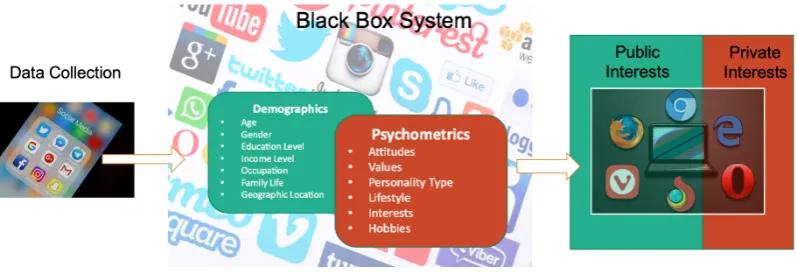
We organise user interests into two categories for the purposes of our analysis
and illustrated in Figure 1.1. The green box on the right of Figure 1.1 represents
the subset of interests that an individual is happy to discuss in public. Privacy is
not a concern when personalised content refers to public topics. There are also topics
where an individual would rather keep her interests private, represented as the red box
on the right of Figure 1.1. When online services respond with personalised content
Figure 1.1: Balancing Personalisation with Privacy.
For illustration purposes, we have included examples of profiling by the online
system in the middle section of Figure 1.1. Our approach, however, is to treat online
services as black-boxes that do not reveal their internal workings except through the
outputs produced by the black-box in response to individual user inputs.
The following informal example of an interaction illustrates potential concerns
with personalisation during a Google Search. The interaction is performed on a
laptop through a standard web browser. Before beginning, we remove obvious traces
of local state such as browser history, cookies and caches. An anonymous user is used
and IP address is constant through the interaction. In this way, observed changes
in personalised content can be reasonably associated with active profiling during the
interaction by Google search. During the interaction we ask a range of uninteresting
queries about everyday topics such as weather, traffic and music to represent public
interests. We mix occasional queries among the public queries about a specific private
topic – “cancer” at intervals of 1 private query to every 2–3 public, uninteresting
queries.
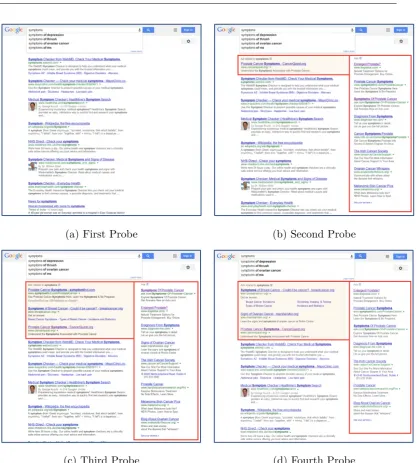
After every fourth private query about cancer, we issue a fixed “probe” query – it is
the query “symptoms” in the example. We choose symptoms because it is sufficiently
generic that Google could associate many medical conditions with it besides cancer.
We compare what adverts appear as a result of the probe query in Figure 1.2.
An inspection of the search results in each of the sub-figures confirms that the
probe query retrieves generic results – mostly related to symptom checkers. By
1.2. Motivation 5
(a) First Probe (b) Second Probe
[image:21.595.90.509.72.536.2](c) Third Probe (d) Fourth Probe
Figure 1.2: Changes in personalised adverts at successive probe queries for the topic “Cancer”.
cancer pervade each response page. Even though queries about cancer are interleaved
with uninteresting queries about everyday topics, the search engine has successfully
identified a sensitive topic among the noise of general queries. Comparing the
non-specific nature of the search results with the non-specific nature of the personalised, advert
content suggests that by analysing personalised content, such as adverts, we might
reasonably hope to spot evidence of profiling with respect to interests we regard as
1.3 Scope and Limitations
Our objective in this research is to demonstrate feasibility and utility of approaches
with the minimum technical overhead. Our choice of underpinning techniques and
technologies is chosen deliberately to be simple to comprehend and to implement.
Accordingly we have chosen a PC-based browser platform for implementation and
experimental evaluation. We elected to avoid mobile devices because of added
com-plexities of implementation and to avoid concerns with hidden tracking and sharing,
(Razaghpanah et al., 2018). We leave consideration of mobile web search to future
research.
It seems reasonable to assume that a for-profit commercial search engine selects
page content to maximise its expected revenue. This means that when a search engine
infers that a particular advertising topic is likely to be of interest to a user, and so
more likely to generate click through and sales, it is obliged to use this information
when selecting which adverts to display. Since a revenue maximising search engine
acts to display adverts associated with topics it detects are most interesting to the
user, the potential exists to detect search engine learning via analysis of changes in
the choice of displayed adverts and to inform the user of this learning.
Conversely, our work excludes the situation where the system does not reveal its
hand through personalised content. The latter could happen when the system is not
capable or is unwilling to personalise its output - for example when the real motive
is data collection for undisclosed background processing or security analysis. These
specific situations are left as cases best addressed by the law and through strong
and active governance. We also exclude situations where hyper-personalisation at
individual level is required, such as systems to support medical consultations, security
or defence.
Our focus here is on privacy concerns arising from inference by the search engine
resulting from explicit user web search interactions. Online systems, including search
engines, gather data from many sources to produce personalised content. We consider
direct identification techniques, such as IP tracing or browser finger-printing to be
1.3. Scope and Limitations 7
for example, also effect personalised content. Simple changes from one IP range to
another can change the advert content of search results as Figure 6.1 in Chapter 6
illustrates. When creating personas for testing purposes we have tried to provide
the minimum possible profiling information required for registration. We specifically
avoided potentially revealing demographic information, such as age and gender for
example, to isolate system learning effects from variations in profile demographics in
so far as possible.
All of the technologies used here were implemented with open source tools and
written in the Python language. The Natural Language Processing Bag-of-Words
model we use is among the simplest possible that facilitates obtaining useful
exper-imental results. More sophisticated language models, for example using n-grams or
word embedding, will likely improve the capabilities of the tools. We focus on
text-based advert content appearing on web search result pages. Our approach is to spot
changes in frequency of occurrence of keyword features associated with topics we have
defined as sensitive. By comparing keyword frequencies with baseline values learned
from training data we hope to detect evidence of bias towards sensitive topics. We
describe the training and verification setup used to learn baseline values of keyword
frequencies in detail in experimental sections.
Exact reproducibility of results from experiment to experiment is difficult in a
dynamic learning environment such as web search so that our results are presented
as average effects over several experimental iterations. Personalised content varies
from iteration to iteration, and in some cases personalised content may not appear at
all. Programatic interaction with a web search engine is technically challenging. Web
search engines have developed a sophisticated array of tools to to detect automated
users. When inspected, a portion of search engine result pages with no personalised
content occurred when our programs activated a search engine feature such as a
CAPTCHA or other challenge. These events happened irregularly, depending on
machine and network load, and so could not be reliably controlled programatically.
When detected, we excluded the corresponding result page from the subsequent
interactions.
Search engines are a convenient and openly available source of personalised
con-tent, but not the only online service that profiles users. A significant portion of
modern online systems profile users to boost commercial return through improved
personalised content. In Chapter 6 we extend our analysis to include openly available
examples data sources for TripAdvisor and Amazon to illustrate how the techniques
we develop can be extended beyond search engines.
[image:24.595.121.509.315.591.2]1.4 Contributions and Structure of this Thesis
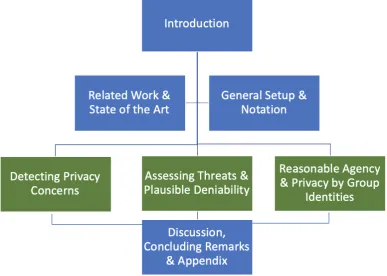
Figure 1.3: Structure of this Thesis.
The main technical content in this thesis are contained in Chapters 4-6.
Prelimi-nary chapters contain introductory material, a perspective of the contribution of this
thesis in the context of related work and state of the art, and a chapter introducing
1.4. Contributions and Structure of this Thesis 9
In Chapter 4 we investigate how a user who, knowing what topics they deem to be
sensitive, can construct a classifier to detect potential privacy concerns by analysing
personalised content appearing on output from a search engine. The formalism we
develop identifies possible privacy concerns relative to a baseline level. The baseline is
learned from training examples such as historical results. In this chapter we develop
the mathematical formalism from which we implement and test a classifier using
both Google and Bing as examples of search engines. The main contributions in this
chapter are
A novel definition of individual privacy we callϵ-Indistinguishabilitythat is
com-patible with existing privacy models and readily implementable as a practical
user technology
An effective method for detection of privacy threats across a sequence of
obser-vations by collecting and comparing responses to a sub-sequence of preselected
probe queries
A fast, scalable estimator of ϵ-Indistinguishability, we callPRI (”PRivacy for
Individuals”).
An extensive measurement campaign showing that evidence of adaptation is
easy to detect for a wide range of sensitive topics.
In Chapter 5 we extend the work in the previous chapter on detecting privacy
concerns to address how to assess the degree of threat associated with a detection.
The privacy model we use is based on plausible deniability of interest in topics. The
formalism we develop is implemented and tested against the Google search engine in
this case. Contributions in this chapter include
A formal definition of Plausible Deniability in web search allowing users to test
if they can reasonably deny their interest in topics they regard as sensitive.
A tool called PDE(“PlausibleDeniability Estimator”) implementing our
Extensive experimental validation that the PDE tool is effective in detecting
threats to Plausible Deniability even when user queries are obfuscated through
injection of high levels of noise.
A novel defence for Plausible Deniability, called the Proxy Topic Defence in this
paper, that is observed to provide protection in 100% of tests.
In Chapter 6 we develop a prototype system demonstrating how a search engine
might provide privacy preserving services to users with minimal disruption. To show
that the prototype can be applied across a broad range of systems we test the
pro-totype using openly available data containing hotel reviews from TripAdvisor and
product reviews from Amazon - in addition to testing with Google Search.
Contri-butions in this chapter include
A novel proxy agent framework we call 3PS for Privacy Preserving Proxy
Service, where a user may protect their interests in sensitive topics from
un-wanted personalisation by submitting queries though a pool of group identities
called Proxy Agents.
A formal definition of personalisation utility and privacy detection in a
plau-sible deniability compatible with the 3PS setting. We show that user privacy
need not come at the cost of reduced utility in personalised services when
ag-gregated group information represented by the proxy agent pool is sufficient for
personalisation.
Privacy preserving algorithm for selecting group membership of proxy agents
users can run locally to find the group identity best matching their interests
without revealing their interests.
An extensive campaign of experimental verification using openly available
data-sets to confirm the privacy guarantees provided by 3PS and that our method
of selecting group membership is both accurate and converges rapidly.
1.4. Contributions and Structure of this Thesis 11
Pól Mac Aonghusa et al. (2016). “Don’t Let Google Know I’m Lonely”. In:
ACM Transactions on Privacy and Security 19.1, pp. 1–25
P Mac Aonghusa et al. (2018). “Plausible Deniability in Web Search; From
Detection to Assessment”. In: IEEE Transactions on Information Forensics
and Security 13.4, pp. 874–887
Pól Mac Aonghusa et al. (2018). “3PS - Online Privacy through Group
13
Chapter 2
Related Work
2.1 Data Collection in the Online World
In 1965 the US Government decided to build the first ever “Data Center” to organise
over 750 million tax returns, 175 million fingerprints of citizens, 14 million records of
civilian security clearance vetting by the Defence Department and 8 million records
of people who applied for Government jobs, into a single search-able database, (Alle
et al., 1966).
In the intervening years since 1965, our ability to collect individual data has
exploded, so that the 1965 project seems modest compared to the scale of today’s
online data collection. It is estimated that in 2016 as much data was produced as in
theentirehistory of humankind up to 2016. By 2026 it is estimated that there will be
150 billion networked measuring sensors – approximately 20 sensors for each person
on the planet – and that by 2026 the amount of data generated on the Internet will
double every 12 hours, (Helbing et al., 2017).
The financial investment required to sustain the levels technology required to
store, organise and process data at this scale has resulted in a situation where a
small number of companies can dominate in specific activities. For example, in 2018,
over 70% of all web searches worldwide are estimated to have been through Google
Search, the nearest competitor, Bing, is estimated to have 7% of web search volumes,
(NetApplications, 2018).
There is pressure on commercial companies to evolve increasingly sophisticated
(Sivakorn et al., 2016). In the case of Google, major algorithm changes such as
Caffeine, (Peng et al., 2010), Social Search, (Heymans, 2009) andSearch Plus, Your
World, (Singhal, 2012), included additional sources of background knowledge from
Social Media, improved filtering of content such asPanda, (Slegg, 2015), to counter
spam and content manipulation. In 2018, an estimated 52.2% of all website traffic
worldwide came from mobile devices, (Statistica, 2019). Google introduced its “Speed
Update” for web search on mobile to all users in July 2018, (Wang et al., 2018), and
within days, announced the inclusion of Mobile Landing Page Speed Score in the
Google Ads, (Osmani et al., 2018).
Much of the free–to–use Internet is free largely because it is under-pinned by a
de facto business model of gathering and analysing data about user interests and
be-haviours to produce targeted commercial content. Some numbers help illustrate how
important targeted commercial content is. Facebook earned an average of US$4.65
per user from personalised content such as advertising and promoted posts in the
second quarter of 2017, according to the Economist (Economist, 2017). By
compari-son, an average of just US$0.08 per user came from direct fees such as payments for
games.
We classify data collection as either implicit or explicit for our purposes here.
Implicit collection includes data gathered without requiring direct user input. For
example, capturing details of the underlying hardware and software by fingerprinting
a device. Implicit data collection activities also include activities such as network
packet inspection and tracing. Mobile devices in particular provide opportunities
for enhancing Geo-location based data collection. Data collected implicitly has been
covered extensively in the research literature and is known to be highly revealing
of individual behaviours, (Bielova, 2017; Binns et al., 2018; Englehardt et al., 2016;
Narayanan et al., 2017). We adopt the approach that implicit data collection is an
inevitable consequence of being online. When implicit data collection effects
person-alisation we assume it manifests through effects observed in personalised output.
Explicit data collection arises through deliberate user actions – such as
2.2. Privacy and Societal Risks of Profiling 15
evidenced by practices such as the use of intrusive pop-ups to force users to consent
to accept cookies since the introduction of GDPR, (Burgess, 2018). We take explicit
data collection arising from deliberate actions of the user as a controllable aspect of
the interaction between user and system. We are interested in understanding how a
user can control explicit data collection to quantify and ultimately regulate personal
profiling by during interactions with learning systems.
2.2 Privacy and Societal Risks of Profiling
Privacy as a normative concept is deeply rooted in economic, legal and philosophical
discussion, (Nissim et al., 2018; Solove, 2006; Swanson, 1992). The literature is vast
and, though interesting, is beyond the scope of our focus here on privacy in the context
of online data collection and subsequent profiling through machine learning. Our
concern is that data collected may be misunderstood, contain errors or be sensitive
to an individual. Processing may introduce errors or be less exact than intended.
Researchers and practitioners are increasingly warning against the naive usage of
internet data collection for profiling, (Olteanu et al., 2018), and documenting the
consequences such as adverts connecting socio-economic status with race, (Speicher
et al., 2018), or adverts associating criminal behaviour with individual ethnicity,
(Sweeney, 2013).
By 1966, the US Government project to collect and process data was dropped
be-cause of concerns about invasion of privacy on what, in 1965, was regarded as a ”vast”
trove of data, (Alle et al., 1966). Today, a small number of commercial companies
dominate data collection and processing on the Internet resulting in so-called “digital
oligarchies”, (Andriole, 2017). When personal data is collected without transparent
purpose it erodes the ability to define the boundaries between what is, and is not,
private. Purposes which, when revealed, can cross the line from “helpful” to
“un-wanted”. This was highlighted in 2017, when an Australian news website revealed
that Facebook offered advertisers the ability to target teenagers suffering “moments
of psychological vulnerability”. By monitoring posts, photographs and interactions
anxious and like a failure”, (Whigham, 2017). Transparency of purpose and
process-ing employed in complex profilprocess-ing algorithms used by online systems speaks directly
to topical concerns with transparency of machine learning in general.
Societal concerns resulting from over-collection and lack of transparency in
col-lection and subsequent processing of data are reflected privacy legislation, such as
the EU GDPR (European Union, 2016). GDPR specifically mandates minimisation
in the collection of, access to, and transparent processing of data as basic principles
of privacy protection. The practical consequences of GDPR are now being felt with
overly broad collection and non-transparent data processing risking exposure to
leg-islative action for commercial companies. In January 2019 the first GDPR fine was
announced in Portugal, (Monteiro, 2019). The majority of the fine was imposed for
breaches of principles of data minimisation and subsequent data processing. Also
in January 2019, the French Data Regulator (CNIL) announced a EUR 50M fine
against Google under GDPR consent rules, (Ram et al., 2019). In this case, lack of
transparency was a principle concern, with CNIL stating that “It is not possible to
be aware of the plurality of services, websites and applications involved in these
pro-cessing operations (Google search, YouTube, Google Home, Google Maps, Playstore,
Google Pictures . . .) and therefore of the amount of data processed and combined”.
Concerns with potential bias in personalisation by machine learning fall into two
broad categories in the literature.
Discrimination Concerns over negative consequences associated with
personalisa-tion on Google Search adverts have been identified over several years (Guha
et al., 2010; Sweeney, 2013). Our work identifies potential grounds for
discrim-ination in Chapter 5 where we find strong evidence of profiling with respect to
health status and sexual orientation. Our findings correspond with recent
re-sults identifying potential bias in online advertising by analyzing explanations
provided by systems for selection of advertising content, (Andreou et al., 2018;
Speicher et al., 2018).
Restriction Restricting access to content via a so-called filter bubble,(Pariser, 2011),
2.2. Privacy and Societal Risks of Profiling 17
bubble, a user cannot access subsets of information because the recommender
system algorithm has decided it is irrelevant for that user. Recent work has
explored algorithmic frameworks to reduce filter bubbles, (Celis et al., 2019),
and towards formalizing notions of fairness in machine learning, (Naudts, 2018).
Detection and assessment of privacy concerns by analysing changes in content
are similar to the techniques used to analyse filter bubbles. Our work here
offers, therefore, a potential, additional perspective on filter bubbles for future
research.
Privacy concerns can be viewed in terms of two major factors – awareness of a
sensitive social situation, and, the ability of an individual to control the social
situa-tion, (Boyd, 2012). The importance of reasonable agency or control over appropriate
flow of information is discussed extensively in the legal and social science fields. The
importance of individual agency over personal information flow was discussed in a
critique of thenothing to hidedefence for widespread surveillance in (Solove, 2007).
Individual privacy and its social consequences are discussed in (Bennett, 2011; Boyd,
2012), where agency or control over appropriate disclosure is identified as a key
con-cern. Recent legislation, such as the General Data Protection Regulation (GDPR),
requires that personal data must be adequate, relevant and limited to what is
neces-sary in relation to the purposes for which those data are processed, (European Union,
2016). In this context, broad collection of user data without transparent purpose in
online interactions with everyday online systems is a particular concern for individual
privacy.
Given concerns with transparency and purpose of data collection, assisting
indi-viduals to detect and assess privacy risks is fundamental to protection. Users are
concerned about their privacy on the Web but do not always reflect this concern in
their online behaviours, (Alessandro Acquisti et al., 2015). In (Pujol et al., 2015),
in-the-wild measurements of user interactions with Ad blocking technologies suggest
that users overwhelmingly accept default settings and do not install updates such as
white-lists. Consequently technologies for user privacy must be effective, but also
proven alert and adaptable in responding to attempts to protect privacy at individual
user level. Stateful (cookie) and stateless (fingerprinting) tracking are widespread on
the web. In (Bielova, 2017; Binns et al., 2018; Englehardt et al., 2016; Narayanan
et al., 2017) separate studies of 1 million websites reveal widespread data exchange
among third parties, stateful tracking from third-party cookie spawning and stateless
fingerprint-based tracking. In (Binns et al., 2018) users are observed to be tracked
by multiple entities in tandem on the web.
We ascribe to the view that personal privacy requires active engagement from
users. In (Ramakrishnan et al., 2001) in concluding remarks, the authors state that
“the ideal deterrents are better awareness of the issues and more openness in how
systems operate in the marketplace. In particular, individual sites should clearly
state the policies and methodologies they employ with recommender systems”.
We propose three principles of personal privacy desirable in interactions with
online systems, comparable with the “Principles for Accountable Algorithms and a
Social Impact Statement for Algorithms” from the ACM FAT/ML website, (FATML,
2019), and intended to be agnostic with respect to implementation choices.
Detection of Privacy Concerns An individual user should be able to detect
evi-dence of unwanted personalisation with respect to topicstheyregard as sensitive.
In particular a user should be allowed to define what they regard as sensitive or
non-sensitive topics without having to share details of their interests with other
parties.
Plausible Deniability of Interests When presented with content regarded as
in-appropriate or discreditable, a user may wish to deny their interest in the
con-tent. A user should be able to assess their ability to plausibly deny interest in
sensitive topics they have defined.
Reasonable Agency A user should be able to exercise reasonable agency over
pri-vacy choices during interactions. Here the requirement is for reasonablecontrol
meaning that the expectation of privacy must be appropriate to the context. A
person registering with an online dating site must accept a reasonable
2.3. Privacy Models and Risk 19
reasonable to say whether their interest is in academic research or in seeking a
date. So that this person can reasonably expect content related to the dating
site - but not related to their personal dating preferences.
2.3 Privacy Models and Risk
We consider a setup where a search engine does not seek to identify users as
individu-als, but rather it seeks to determine likely user interest in topics it deems commercially
valuable. We model machine learning of behaviours, interests and preferences as a
process of labelling an individual with respect to topic categories. Privacy provides
a formal framework to investigate the strength of association between labels and
individuals without requiring knowledge of how the association has arisen. When
evidence of association between labels and individuals is detected it corresponds to
detection of learning in the underlying algorithms employed by the search engine. A
privacy concern isdetected when labels are associated with an individual the
individ-ual regards as sensitive. Quantifying the strength of association with sensitive labels
corresponds toassessingthe degree of risk in potential privacy threats. Detection and
assessment of privacy concerns are therefore related to inference in machine learning,
and more generally to fairness, accountability and transparency in machine learning,
(FATML, 2019), and our contributions can be framed within the broader context
of verification fairness and analysis of inference in machine learning, (Olhede et al.,
2016, 2018).
Our privacy model is based on the notion of plausible deniability. Informally,
user activity observed by the search engine exhibits plausible deniability when, with
high probability, it is consistent with the user being interested in any one of several
topics at least one of which is not sensitive for the user. That is, the patterns of
user activity supports reasonable doubt about the user’s actual interest in a given
sensitive topic. Plausible deniability to counteract the impact of personalisation is
examined in (Cummings et al., 2014) for the case of a privacy aware user who knows
they are being observed. The authors show that, no matter what the behaviour of the
can offer their awareness of privacy concerns as a general alibi to justify any range of
preferences. Technologies enabling plausible deniability for web search are addressed
in the literature. In (Avi Arampatzis et al., 2013) alternative, less revealing queries
are mixed with sensitive topic queries to obfuscate true user interest. In (Arampatzis
et al., 2011) queries with generalised terms are used to approximate the search results
of a true query, which is never revealed.
We will compare privacy models we use to other privacy models in current use.
Two examples we will draw on are k–anonymity and differential privacy. Privacy
as a form of hiding in the crowd, where an attacker cannot associate an
individ-ual with less than k records in a data set, was first formalised as k-anonymization
in (Sweeney, 2000). Since its original introduction a variety of refinements such as
l-diversity, (Machanavajjhala et al., 2006) and t-closeness, (Li et al., 2007), have
ad-dressed weaknesses with the original definition. Differential privacy, (Dwork, 2006),
is a formal framework for privacy preserving statistical queries over databases.
Differ-ential privacy has been criticised, (Bambauer et al., 2013), and implementations have
been criticised for being opaque, (Tang et al., 2017). Differential privacy has been
included in commercial products by Apple, (Apple, 2017) and Google, (Erlingsson
et al., 2014).
2.4 Privacy and Web-search Profiling
Mechanisms for privacy protection from web-search profiling have been extensively
covered in the literature. An early approach is to obfuscate or mask queries from
the system by injecting non-sensitive query terms as “noise” within which to hide
or distort sensitive queries. The essential challenge in this type of approach is to
define a practical method of selecting “noise” query terms to provide a verifiable level
of anonymity while not overly upsetting overall utility,(Domingo-Ferrer et al., 2009;
Howe et al., 2009; Peddinti et al., 2011; Sánchez et al., 2013). Query obfuscation and
masking is addressed in (Ahmad et al., 2016), where user queries are hidden within
a stream of at leastk ‘cover queries’ to provide a form of k-anonymity. PEAS, (Petit
2.4. Privacy and Web-search Profiling 21
between user and query. In (Ahmad et al., 2016) user queries are hidden within a
stream of at leastk ‘cover queries’ to provide a form of k-anonymity. PWS, (Balsa et
al., 2012), and TrackMeNot, (Howe et al., 2009; Peddinti et al., 2011), inject distinct
noise queries into the stream of true user queries during a user query session, seeking
to achieve acceptable privacy while not overly upsetting overall utility.
An alternative approach is to apply encryption and multi-party computation
tech-niques to process sensitive user queries, leveraging techtech-niques from the privacy
pre-serving data mining domain. Protecting users from individual re-identification
of-ten combines encryption, hashing and noise addition on the local user machine. A
common challenge in this type of approach is that it can be computationally
pro-hibitive and require substantial user management for locally maintained dictionaries
of queries, features or URLS accessed by the user. For example, in (Z. Erkin et
al., 2011, 2010), the authors propose to encrypt privacy sensitive data and generate
recommendations by processing them under encryption. Approaches of this type
typ-ically rely on a user, or a learning algorithm, being able to identify which queries are
sensitive, and trust in the service provider to perform query processing under secure
encryption.
In the recommendation systems literature privacy technologies have largely
fo-cused on how to incorporate privacy into the recommendation process itself. In
(Bat-maz et al., 2016), random perturbation of data is used to develop privacy-preserving
frameworks for collaborative filtering methods. In (Boutet et al., 2016), profile
ob-fuscation together with a randomised dissemination protocol are employed. Another
approach is to distribute the recommendation process by including a trusted
inter-mediate agent between user and back-end system, such as (Aïmeur et al., 2008). In
(McSherry et al., 2009), differential privacy is incorporated into the algorithms used
in the Netflix prize competition to produce privacy preserving recommendations. Our
work compliments this body of research in that provide technologies that can verify
the effectiveness of privacy embedded in the recommendation process by monitoring
Raising user awareness has been extensively investigated in the literature. A
sig-nificant body of research exists to capture user activity and then provide feedback on
where information is flowing. Popular browser add-ons, such as Mozilla Lightbeam,
(Mozilla, 2016), and PrivacyBadger, (EFF, 2018), facilitate active user awareness of
possible privacy and consent issues by helping understand where user data is shared
with third parties through the sites they visit. XRay, (Lecuyer et al., 2014), reports
high accuracy in identifying which sources of user data such as email or web search
history might have triggered particular results from online services such as adverts.
Active consensual sharing of personal data is investigated in (Fredrikson et al., 2011)
through an in-browser capability, called RePriv, allowing a user to select which
por-tions of their personal data they wish to share with requesters. Data collection on
mobile devices is also a concern. Tracking or profiled advertising without consent
on the Android platform is addressed in (Razaghpanah et al., 2018), with
undoc-umented services, previously unknown to mainstream advertising and white-listing
services constituted over 10% of third party tracking.
Website proxy services offer privacy preserving access to mainstream search
en-gines on the Internet. Two of the better known are DuckDuckGo hosted in the US
on Amazon Web Services, (Inc, 2018), and StartPage hosted privately in the
Nether-lands, (Holding BV, 2018). Functionally both are similar, encrypting traffic via https,
and employing POST and re-direct techniques to obfuscate requests. Both claim to
relieve so-called filter-bubbles, (Pariser, 2011), by aggregating results from several
source systems. In both DuckDuckGo and StartPage the proxy user profile adopted
by users of both systems is global. Personalised content such as advertising that is
displayed on search result pages is correspondingly generic. The 3PS prototype we
develop in Chapter 6 also provides proxy access to web search, but differs in allowing
a user to dynamically adopt a group profile that is closest in interest to their personal
interests.
In our approach, we regard online systems as black-boxes with unknown internal
workings and state. Modelling a system as a black-box is well established in system
2.4. Privacy and Web-search Profiling 23
2014; Hannák et al., 2017). Grouping users behind intermediate or proxy layers
is a well studied privacy technique. Protecting the sensitivity of user data, and
particularly of user profiles exposed to the online system, by grouping users behind a
proxy layer is defined asLevel 2 Privacy in the classification scheme of online privacy
approaches in (Shen et al., 2007).
Evaluation of privacy technologies in the wild is surprisingly underrepresented
in the literature. Our choice of Google Search as a live target for our work was
motivated by this imbalance by using a live setup where possible. Where evaluations
have been performed, it appears to be largely for direct evaluation of browser privacy
plugins, perhaps reflecting the difficulty of performing these experiments where more
sophisticated setup is required. Effectiveness of privacy defences in the wild was
evaluated by (Peddinti et al., 2011) in the case of TrackMeNot where the authors
demonstrate that by using only a short-term history of search queries it is possible
to break the privacy guarantees of TrackMeNot. In (Ling et al., 2012), the authors
demonstrate an effective attack to detect the communication relationships between
TOR users. The importance of background information in user profiling is explored in
(Petit et al., 2016) where a similarity metric betweenknownbackground information
and queries is shown to identify 45.3% of TrackMeNot and 51.6% of GooPIR queries.
Anti-tracking is an ongoing area of research and recently in (Pan et al., 2015) an
anti-tracking browser called TrackingFree was reported to be effective at disrupting all of
the trackers in the Alexa top-500 list. Self-regulation has also proven problematic, in
(al, 2012), six different privacy tools, intended to limit advertising due to behavioural
profiling, are assessed. The tools assessed implement a variety of tactics including
cookie blocking, site blacklisting and Do-Not-Track (DNT) headers. DNT headers
were found to be ineffective in tests at protecting against adverts based on user
profiling.
We conclude with a cautionary word to the reader. In questions of online privacy,
the adagecaveat emptor (“let the buyer beware”) applies. Examples of
unsubstanti-ated and misleading claims of enhanced individual privacy by providers of technology
evaluation of the claims by providers of such technologies have attracted the
atten-tion of Government, where the need for “Awareness and education of the users …”
is identified in (Santa, 2010) as a key step to building trust and acceptance of
pri-vacy technologies. Our contribution in this work is deliberately structured as formal
followed by experimental. In this way we aim to provide a firm foundation
under-pinning ensuing experimental results, avoiding confusing claims, albeit at the risk of
25
Chapter 3
3.1 Formal Setup
3.1.1 Black-box Models
We consider a setup where users interact with a systemS, such as a search engine,
by issuing a query as input and receiving an output in response. Each interaction
between a user andS consists of an input–output pair, referred to as aninput–output
interaction. We gather a sequence of consecutive input-output interactions between
a user andS into a session. We sometimes refer to the input–output interactions in
a session assteps. To improve readability, set operator notation is sometimes used to
indicate operations on sequences where there is no scope for confusion.
We assume that user inputs and system outputs are each decomposable into
fea-tures. For example, when modelling a user querying movies or hotels the input
features might consist of keywords, or if assigning ratings the features might consist
of integers. An ordered list of features with no duplicate entries is called adictionary.
We let DX and DY denote the dictionary containing valid input features toS, and
valid output features generated by S respectively. Individual features are indicated
thus,θX
i ,i=1, . . .|DX| and θYj , j=1, . . .|DX|so that θiX indicates the ith feature in
DX and θY
j the jth feature in DY. We let X and Y denote the sets of possible valid
inputs and outputs comprised of combinations of features from DX and DY
respec-tively, and the set of valid input–output interactions is Z := X × Y. Input–output interactions may repeat during a session and so sessions are represented assequences
of input–output interactions.
The system S is treated as a black-box with internal state unknown to users.
Our assumption is that S uses its internal state, which includes knowledge of user
interests, when producing personalised outputs for individual users, thereby
poten-tially revealing something about its internal state. Given a sequence of user inputs we
observe corresponding system outputs and try to spot evidence of learning of topics
the user considers private.
3.1. Formal Setup 27
Figure 3.1: Overview of the Basic Black-box Model
Definition 1 (Basic Black-box Model) The Basic Black-box Model consists of
two interacting components {U,S}
• An online systemS for which only inputs to, and outputs from, S are
observ-able to users, while details of the internal workings of S are hidden.
• A set U of users who can submit input to, and receive corresponding output
responses from, S.
We also define aProxy Black-box Model by extending the Basic Black-box Model
whereby users access the system through a pool of group identities referred to as
proxy agents. This is illustrated schematically in Figure 3.2.
Definition 2 (Proxy Black-box Model) The Proxy Black-box Model consists of
three interacting parties denoted {U,P,S} as follows:
• An onlinesystemS for which only inputs to, and outputs from, S are
observ-able while details of the internal workings of S are hidden.
• A setP of Proxy Agents. Proxy agents function as Group Identities, routing
user queries to, and output responses from S. P is sometimes referred to as
the Proxy Agent Pool.
• A setU of userscan submit input to, and receive corresponding output responses
Figure 3.2: Overview of the Proxy Black-box Model
In the Proxy Black-box Model the proxy agent pool is assumed controlled by the
back-end service. One key reason for doing this is to ensure that proxy agents are
recognised as genuine users by the back-end system. If not recognised as bona fide
users the proxy agents may be flagged as a bot or robot and so trigger defences, such
as “captchas”, or even be blocked. Other than acknowledging the proxy agents as
legitimate users, the Proxy Black-box Model is intended to be backwards compatible
not requiring significant engineering changes in the back-end system.
3.1.2 Modelling Interactions
It is convenient to discretise the time variable and a non-negative integerk∈ {1, 2, . . .}
is used to track input–output interactions in both the Basic Black-box Model and
Proxy Black-box Model and refer to input–output interactions atstepk. The sequence
of input–output interactions generated by the users inU to stepk is denoted
Zk = (z1, . . .zk)∪ Z0 (3.1)
wherez1 is the first input–output interaction between users inU and S during the
session andzkis thekth input–output interaction between users andS fork ≥1. The
quantityZ0 denotes prior background knowledge gathered from U at the beginning
3.1. Formal Setup 29
For an individual user labelled withu∈U the sequence of input–output
interac-tions betweenu and S is denoted by
Zu,k = (zu,1, . . .zu,k)∪ Zu,0 (3.2)
where Zu,0 is the background knowledge available about user u at the beginning of the session.
The sequence of input-output interactions submitted to a proxy agent labelled by
p∈P from the set of users inU is denoted Zp,k.
Zp,k = (zp,1, . . .zp,k)∪ Zp,0 (3.3)
whereZp,0 is the background knowledge available to proxy agent p at the beginning of the session.
LetPu⊂P denote the subset of proxy agents used by user uup to step k. The input-output interactions submitted by user u through proxy agent p ∈Pu to step
k are contained in the sub-sequence
Zu,p,k = (z ∈ Zu,k : ιp(z) =1) (3.4)
where indicator functionιpequals1for input-output pairs submitted via proxypand
0otherwise.
3.1.3 Topic Labelling
Each user u has a private labelling function lu : Z −→ C which associates
input-output interactions inZ with topic labels selected from a private, user-defined set of
labelsC = {c0,c1, . . .cK}. Each user can have different labels so that C can change
by user. When necessary we will write Cu when we need to emphasise which user has chosen a particular set of topic. We omit the subscript u from Cu otherwise for notational clarity.
We adopt the convention that the label c0 is identified with a catch-all
topics such as “health” or “finances”. The user labelling function lu is itself private
and labels every input–output interaction in Zu,k, with at least one topic from C. Often we are simply interested in whether an input-output interaction is private or
not for a user, and so we define the indicator functionIu :Z −→ {0, 1}withIu(z) =1
when lu(z) = c, c∈ C \ {c0}, i.e. when an input–output interaction is labelled with a private topic by user u, and Iu(z) = 0 otherwise. We assume that user labelling
functions are well-behaved in the following sense.
Assumption 1 (Meaningful Labelling) An input-output interaction which is
la-belled as non-private by a user is truly non-private for that user e.g. the user would
be content for it to be shared publicly.
Assumption 1 requires users to strike their own balance between utility and privacy
as discussed in the third principle introduced in Section 1. The low risk strategy of
simply labelling every input-output interaction as private implies that the user may
not be able to use the system at all. For example, if the system is a dating service,
the knowledge that a person uses the system necessarily reveals their interest in such
a service. A user choosing to use the system cannot include such system-level topics
in their set of private topics. The implicit statement in Assumption 1 is that users
form an individual judgement regarding the inference capabilities of observers and to
accept a degree of risk associated with this judgement call proving incorrect.
The sequence Zc
u,k := (z ∈ Zu,k : lu(z) = c) denotes the sub-sequence of input–
output interactions the user labels with topic c ∈ C, and, Zsens u,k :=
∪
c∈C\{c0}Z
c u,k
denotes the sub-sequence of input–output interactions labelled as private.
Let Zku,c := (z ∈ Zk : lu(z) = c) and Zku,sens := ∪c∈C\{c0}Z
u,c
k . The sequence
Zu,sens
k contains items from users other thanu. Consequently, whileZ u,sens u,k ⊆ Z
u,sens k ,
it is not generally the case that Zku,sens is a sub-sequence of Zu,k.
When a user decides a topic is private it is a personal decision. We want to
capture the flexibility a user has to choose their own private topics while avoiding
subjective words like “embarrassing” or “awkward” in assigning topics as private. We
will, however, use the term “sensitive topic” to describe topics that the user regards
3.1. Formal Setup 31
regards as sensitive” in favour of the simpler term “sensitive topic”. Describing a
topic as a sensitive topic should be interpreted accordingly, rather than attaching
any subjective or emotional meaning to the term ”sensitive”. We will also use terms
like “sensitive query” to indicate a query about a topic labelled as private by a user.
3.1.4 Bag–of–Words Text Model
We take inputs and outputs to be comprised of text from a natural language, such
as English, and provide some brief background on tools from Natural Language
Pro-cessing we will use later. For a full treatment, using the Python language, see (Bird
et al., 2009).
The first preprocessing step is to extract personalised text appearing on a result
page as a single block of text and tokenise it into individual words by using
white-spaces and punctuation as token separators. Common, uninformative, high-frequency
stop-words are removed and stemming is performed to remove common prefixes and
suffixes. The result is a sequence of tokens or fragments of words occurring in the
original text. We will sometimes refer to tokens as keywords or features. Tokens
extracted from the input are gathered into a dictionary, denoted DX := (θX
1,θ2X, . . .) where θX
j is the jth token in DX. Tokens extracted from the output are added to a
dictionary DY := (θY1,θY2, . . .)and θY
j denotes the jth token in DY.
We adopt a standard bag–of–words language model (Weikum, 2002) where
fea-tures in an input–output interaction are modelled as being drawn independently with
replacement and ignoring order according to the mixture model, (Hofmann et al.,
1998),
P(z∈ Ak|z∈ Bk)
=
|DX|
∑
i=1|DY|
∑
j=1P(z∈ Ak|{θiX,θYj } ∈z)P({θiX,θYj } ∈z|z∈ Bk) (3.5)
whereAk and Bk are sequences of input–output observations.
In the bag–of–words model, an inputxis mapped to a count-vectorϕX(x)∈Z|DX|
where theith componentϕX
featureθX
i in input x. Similarly, output y returned by S in response is mapped to
count-vector ϕY(y) ∈ Z|DY|
. An input–output interaction z = (x,y) is mapped to count-vector(ϕX(x),ϕY(y)).
3.2 Experimental Setup
3.2.1 General Setup
In this section we describe the common experimental setup with Google Search.
Google Search is used as the principal source of data experiments. We also
de-scribe supplementary data sources we make use of occasionally. In Chapter 4 we
also report measurements and experimental results taken from Bing Search. We use
an identical setup for data collection from both Google and Bing Search for direct
comparison purposes. The intention is to provide additional context in Chapter 4 to
illustrate concepts and confirm experimental findings. In Chapter 6 we use
supple-mentary data to show how the techniques there can be extended to systems other
than search engines. We describe these supplementary data sources in more detail in
Section 3.2.3.
Data was collected using Linux virtual machines located in a University
do-main supporting several thousand users. Custom scripts were written to automate
query execution and response collection. These scripts used Python, BeautifulSoup,
(Richardson, 2016), for HTML processing and Phantomjs, (Friesel, 2014) for browser
automation. The Python SciKit toolkit, (Pedregosa et al., 2012), was used for text
preprocessing. Numeric processing was performed using the NumPy numerical
pro-cessing toolkit, (Idris, 2012; Oliphant, 2006).
3.2.2 Web Search Assigning Topic Categories and Queries
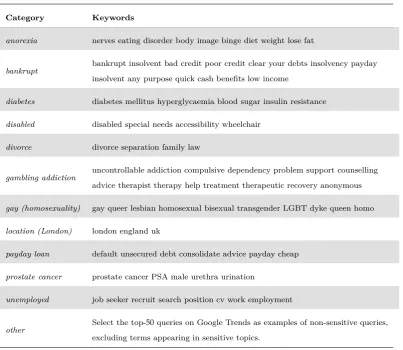
For web search, we select twelve user interest categories to study, detailed in Table 3.1.
Of the eleven sensitive topics, (i) ten are sensitive categories associated with subjects
generally identified as causes of discrimination (medical condition, sexual