Flexible and E
ffi
cient Hypergraph Interactions for Joint Hierarchical and
Forest-to-String Decoding
∗Martin ˇCmejrek†‡
†IBM Prague Research Lab V Parku 2294/4
Prague, Czech Republic, 148 00
Haitao Mi‡ and Bowen Zhou‡
‡IBM T. J. Watson Research Center 1101 Kitchawan Rd
Yorktown Heights, NY 10598
{hmi,zhou}@us.ibm.com
Abstract
Machine translation benefits from system combination. We propose flexible interaction of hypergraphsas a novel technique combin-ing different translation models within one de-coder. We introduce features controlling the interactions between the two systems and ex-plore three interaction schemes of hiero and forest-to-string models—specification, gener-alization, and interchange. The experiments are carried out on large training data with strong baselines utilizing rich sets of dense and sparse features. All three schemes signif-icantly improve results of any single system on four testsets. We find that specification—a more constrained scheme that almost entirely uses forest-to-string rules, but optionally uses hiero rules for shorter spans—comes out as the strongest, yielding improvement up to 0.9 (Ter-Bleu)/2 points. We also provide a
de-tailed experimental and qualitative analysis of the results.
1 Introduction
Recent years have witnessed the success of var-ious statistical machine translation (SMT) mod-els using different levels of linguistic knowledge– phrase (Koehn et al., 2003), hiero (Chiang, 2005), and syntax-based (Liu et al., 2006; Galley et al., 2006). System combination became a promising way of building up synergy from different SMT sys-tems and their specific merits.
Numerous efforts that have been proposed in this field recently can be broadly divided into two
cat-∗M. ˇC and H. M. contributed equally to this work.
egories: Offline system combination (Rosti et al., 2007; He et al., 2008; Watanabe and Sumita, 2011; Denero et al., 2010) aims at producing consensus translations from the outputs of multiple individ-ual systems. Those outputs usindivid-ually contain k-best lists of translations, which only explore a small por-tion of the entire search space of each system. This issue is well addressed in joint decoding (Liu et al., 2009), or online system combination, showing comparable improvements to the offline combina-tion methods. Rather than finding consensus trans-lations from the outputs of individual systems, joint decoding works with different grammars at the de-coding time. Although limited to individual systems sharing the same search paradigm (e.g.left-to-right
or bottom-up), joint decoding offers many
poten-tial advatages: search through a larger space, bet-ter efficiency, features designed once for all subsys-tems, potential cross-system features, online sharing of partial hypotheses, and many others.
Different approaches have different strengths in general–hiero rules are believed to provide reliable lexical coverage, while tree-to-string rules are good at non-local reorderings. Different contexts present different challenges–noun phrases usually follow the adjacency principle, while verb phrases require more challenging reorderings. In this work, we study different schemes of interaction between translation models, reflecting their specific strengths at diff er-ent (syntactic) contexts. We make five new contribu-tions:
First, we propose a framework for joint decod-ing by means of flexible combination of trans-lation hypergraphs, allowing for detailed
trol of interactions between the different sys-tems using soft constraints (Section 3).
Second, we study three interaction schemes– special cases of joint decoding:generalization,
specification, andinterchange(Section 3.3).
Third, instead of using a tree-to-string system, we use a much stronger forest-to-string sys-tem with fuzzy match of nonterminal categories (Section 2.1).
Fourth, we train strong systems on a large-scale data set, and test all methods on four test sets. Experimental results (Section 6) show that our new approach brings improvement of up to 0.9 points in terms of (Ter−Bleu)/2 over the best single system.
Fifth, we conduct a comprehensive experimen-tal analysis, and find that joint decoding actu-ally prefers tree-to-string rules in both shorter and longer spans. (Section 6.3).
The paper is organized as follows: We briefly re-view the individual models in Section 2, describe the method of joint decoding using three alternative interaction schemes in Section 3, describe the fea-tures controlling the interactions and fuzzy match in Section 4, review the related work in Section 5, and finally, describe our experiments and give detailed discussion of the results in Section 6.
2 Individual Models
Our individual models are two state-of-the-art sys-tems: a hiero model (Chiang, 2005), and a forest-to-string model (Mi et al., 2008; Mi and Huang, 2008). We will use the following example from Chinese to English to explain both individual and joint de-coding algorithms throughout this paper.
SStˇaol`unSSSSSSSSh`uiSSSSSzˇenmey`ang discussion/NNSSSwill/VV how/VV
Sdiscuss/VVSSmeeting/NN
There are several possible meanings based on the different POS tagging sequences:
1: NN VV VV:How is the discussion going? 2: VV NN VV:Discuss about the meeting. 3: NN NN VV:How was the discussion meeting? 4: VV VV VV:Discuss what will happen.
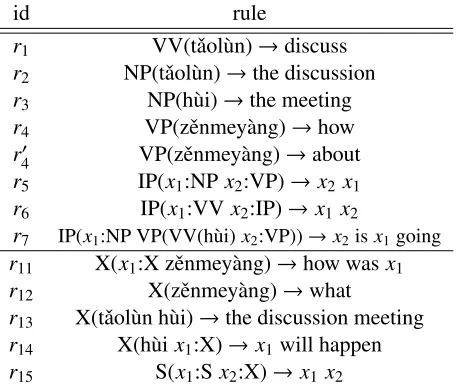
id rule
r1 VV(tˇaol`un)→discuss
r2 NP(tˇaol`un)→the discussion
r3 NP(h`ui)→the meeting
r4 VP(zˇenmey`ang)→how
r04 VP(zˇenmey`ang)→about r5 IP(x1:NP x2:VP)→x2 x1
r6 IP(x1:VVx2:IP)→x1x2
r7 IP(x1:NP VP(VV(h`ui)x2:VP))→x2isx1going r11 X(x1:X zˇenmey`ang)→how wasx1
r12 X(zˇenmey`ang)→what
r13 X(tˇaol`un h`ui)→the discussion meeting r14 X(h`uix1:X)→x1will happen
[image:2.612.312.543.58.251.2]r15 S(x1:Sx2:X)→x1 x2
Table 1: Translation rules. Tree-to-string (r1–r7), hiero (r11–r14), vanilla glue (r15).
IP
x1:NP VP
VV
h`ui
[image:2.612.356.488.316.381.2]x2:VP→x2isx1going
Figure 1: Tree-to-string ruler7.
Table 1 shows translation rules that can generate all four translations. We will use those rules in the following sections.
2.1 Forest-to-string
Forest-to-string translation (Mi et al., 2008) is a lin-guistic syntax-based system, which significantly im-proves the translation quality of the tree-to-string model (Liu et al., 2006; Huang et al., 2006) by using a packed parse forest as the input instead of a single parse tree.
Figure 1 shows a tree-to-string translation rule (Huang et al., 2006), which is a tuple
hlhs(r),rhs(r), ψ(r)i, wherelhs(r) is the source-side tree fragment, whose internal nodes are labeled by nonterminal symbols (like NP and VP), and whose frontier nodes are labeled by source-language words (like “h`ui”) or variables from a setX={x1,x2, . . .}; rhs(r) is the side string expressed in target-language words (like “going”) and variables; and
(a)
IP0,3
VV0,1
tˇaol`un NP0,1
IP1,3
NP1,2
h`ui VV1,2
VP1,3
VP2,3
zˇenmey`ang
Rt
⇒ (b)
IP0,3
X0,2
VV0,1
tˇaol`un NP0,1
IP1,3
NP1,2
h`ui VV1,2
X1,3 VP1,3
VP2,3
zˇenmey`ang X0,3
e5 e6
e7
⇓Rh ⇓
(b0)
IP0,3
X0,2
VV0,1
tˇaol`un NP0,1
IP1,3
NP1,2
h`ui VV1,2
X1,3 VP1,3
VP2,3
zˇenmey`ang X2,3
X0,3
e11
e14
⇒ (c)
IP0,3
X0,2
VV0,1
tˇaol`un NP0,1
IP1,3
NP1,2
h`ui VV1,2
X1,3 VP1,3
VP2,3
zˇenmey`ang X2,3
[image:3.612.77.542.52.381.2]X0,3
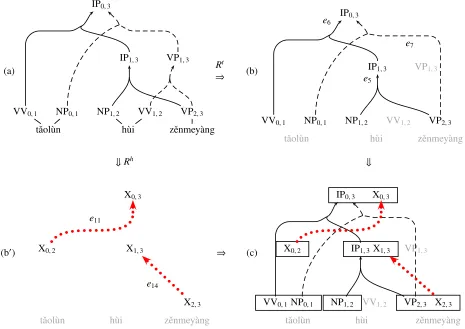
Figure 2: Parse and translation hypergraphs. (a) The parse forest of the example sentence. Solid hyperedges denote the 1-best parse. (b) The corresponding translation forestFt after applying the tree-to-string translation rule setRt.
Target lexical content is not shown. Each translation hyperedge (e.g.e7) has the same index as the corresponding rule
(r7). Gray nodes (e.g. VP1,3) became inaccessible due to the insufficient rule coverage. (b0) The translation forestFh
after applying the hierarchical rule setRhto the input sentence. (c) The combined translation forest Hmobtained by
superimposing b and b0. The nodes within each solid box share the same span. See Figure 3 for an example of the
internal structure of a box. The forest-to-string system can produce the translation 1 (dashed derivation:r2,r4andr7) and 2 (solid derivation:r1,r3,r0
4,r5, andr6). Hierarchical rules generate the translation 3 (r11andr13). The translation
4 is available by using joint decoding at X1,3→IP1,3with the derivation:r1,r6,r12, andr14.
variable xi ∈ X occurs exactly once in lhs(r) and
exactly once inrhs(r). Take the ruler7 in Figure 1
for example, we have:
lhs(r7)=IP(x1:NP VP(VV(h`ui)x2:VP)),
rhs(r7)= x2isx1going,
ψ(r7)={x17→NP,x2 7→VP}.
Typically, a forest-to-string system performs translation in two steps (shown in Figure 2): pars-ing and decodpars-ing. In the parspars-ing step, we convert the source language input into aparse forest(a). In the decoding step, we first convert the parse forest into a
translation forest Ftin (b) by using the fast
pattern-matching technique (Zhang et al., 2009). For exam-ple, we pattern-match the ruler7 rooted at IP0,3, in such a way thatx1spans NP0,1andx2spans VP2,3,
and add a translation hyperedgee7 in (b). Then the decoder searches for the best derivation on the trans-lation forest and outputs the target string.
2.2 Hiero
FN
IP01,3
IP1,3
BBBBSN
X01,3
X1,3
EEEE
scheme interaction edges in supernode
Generalization
IP01,3 X01,3
IP1,3 X1,3
Specification
IP01,3 X01,3
IP1,3 X1,3
Interchange
IP01,3 X01,3
[image:4.612.75.298.60.273.2]IP1,3 X1,3
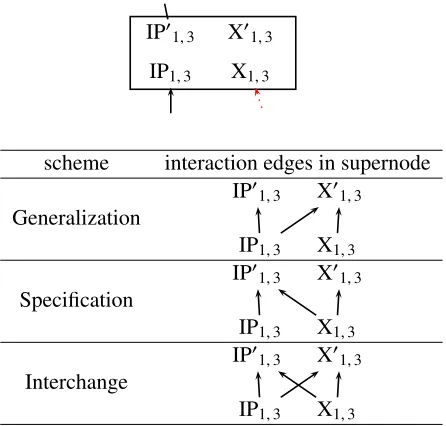
Figure 3: Three interaction schemes for joint decoding. Details of the interaction supernode for span (1,3) shown in Figure 2 (c). Soft constraints control the transitions.
SCFG can be formalized as a set of tuples
hlhs(r),rhs(r), φ(r)i, where lhs(r) is the source-side one-level CFG, whose root is X or S, and whose frontier nodes are labeled by source-language words (like “h`ui”) or variables from a setX= {x1,x2, . . .}; rhs(r) is the side string expressed in target-language words (like “going”) and variables; and
φ(r) is a mapping fromX to nonterminals. Table 1 shows examples of hiero rulesr11–r15.
Although different on source side, hiero decod-ing can be formalized equally as forest-to-strdecod-ing de-coding: First, pattern-match the input sentence into
atranslation forest Fh. For example, since the rule
r11matches “zˇenmey`ang” such thatx1spans the first two words, add a hyperedge e11 in Figure 2 (b0). Then search for the best derivation over the trans-lation forest.
3 Joint Decoding
The goal of joint decoding is to let different MT models collaborate within the framework of a single decoder. This can be done by combining translation hypergraphs of the different models at the decod-ing time, so that online shardecod-ing of partial hypotheses overcomes weaknesses and boosts strengths of the systems combined.
As both forest-to-string and hiero produce trans-lation forests that share the samehypergraph struc-ture, we first formalize the hypergraph, then we in-troduce an algorithm to combine different hyper-graphs, and finally we describe three joint decoding schemes over the merged hypergraph.
3.1 Hypergraphs
More formally, a hypergraph H is a pair hV,Ei, whereVis the set ofnodes, andEthe set of hyper-edges. For a given sentencew1:l = w1. . .wl, each
node v ∈ V is in the form of Yi,j, where Y is a
nonterminal in the context-free grammar1 and i,j, 0 ≤ i < j ≤ l, are string positions in the sentence w1:l, which denote the recognition of nonterminal
Y spanning the substring from positionsithrough j (that is,wi+1. . .wj). Each hyperedgee∈Eis a tuple
htails(e),head(e),target(e)i, where head(e) ∈ V is
theconsequent nodein the deductive step,tails(e)∈
V∗ is the list of antecedent nodes, and target(e) is a list ofrhs(r) for rulesr such that each rule r has the samelhs(r) pattern-matched at the nodehead(e). For example, the hyperedgee7in Figure 2 (b) is
e7=h(NP0,1,VP2,3),IP0,3,(x2isx1going)i,
where we can infer the mapping to be
{x17→NP0,1,x27→VP2,3}.
We also denoteBS(v) to be the set of incoming hyperedgesof nodev, which represent the different ways of derivingv. For example,BS(IP0,3) is a set
ofe7ande6.
There is also a distinguished root node TOP in each hypergraph, denoting the goal item in transla-tion, which is simply TOP0,l.
3.2 Combining Hypergraphs
We enable interaction between translation hyper-graphs, such as hieroFh = hVh,Ehi and forest-to-string Ft = hVt,Eti, on nodes covering the same span (e.g. IP1,3and X1,3 in Figure 2 (c) grouped in a box). We call such groupsinteraction supernodes and show a detailed example of a supernode for span (1,3) in Figure 3.
The combination runs in four steps:
1In this paper, nonterminal labels X and S denote hiero
1. For each nodev = Yi,j,v∈ Vh∪Vt, we create
a new interaction node v0 = Y0i,j with empty
BS(v0). For example, we create two nodes, IP01,3and X01,3, at the top of Figure 3.
2. For each hyperedge e ∈ BS(v), v ∈ Vt∪Vh, we replace eachvintails(e) withv0. For exam-ple, e7 becomes h(NP00,1,VP02,3),IP0,3,(x2 is x1going)i.
3. All the nodes and hyperedges form the merged hypergraphFm, such as in Figure 2 (c).
4. Insertinteraction hyperedgesconnecting nodes within each interaction supernode to make Fm connected again.
In the following subsection we present details of in-teractions and introduce three alternative schemes.
3.3 Three Schemes of Joint Decoding
Interaction hyperedges within each supernode allow the decoder either to stay within the same system (e.g. in hiero using X1,3→X01,3in Figure 3), or to switch to the other (e.g. to forest-to-string using X1,3
→IP01,3).
For example, translation 4 can be produced as follows: The source string “zˇenmey`ang” is trans-lated by the phrase rule r12. The hiero hyperedge e14combines it with the translation of “h`ui”, reach-ing the hiero node X1,3. Using the interaction edge
X1,3 → IP01,3 will switch into the tree-to-string model, so that the translation can be completed with the tree-to-string edgee6that connects it with a par-tial tree-to string translation of “tˇaol`un” done byr1.
In order to achieve more precise control over the interaction between tree-to-string and hiero deriva-tions, we propose the following three basic inter-action schemes: generalization, specification, in-terchange. The schemes control the interaction be-tween hiero and tree-to-string models by means of soft constraints. Some schemes may even restrict certain types of transitions. The schemes are de-picted in Figure 3 and their details are discussed in the following three subsections.
3.3.1 Specification
Thespecificationdecoding scheme reflects the
in-tuition of using hiero rules to translate shorter spans
and tree-to-string rules to reorder higher-level sen-tence structures. In other words, the scheme allows one-way switching from the hiero general nontermi-nal into the morespecificnonterminal of a tree-to-string rule. Transitions in reverse directions are not allowed. This is achieved by insertingspecification
interaction hyperedges eleading from hiero nodes
Xi,j or Si,j into all tree-to-string interaction nodes
Y0i,j within the same supernode.
3.3.2 Generalization
In some translation domains, hiero outperforms tree-to-string systems, as was shown in experiments in Section 6. While local hiero or tree-to-string re-orderings perform well, long distance rere-orderings proposed by tree-to-string may be too risky (e.g. due to parsing errors), so that monotone concatenation of long sequences2is the more reliable strategy. The
generalizationdecoding scheme, complementary to
the specification, is motivated by the idea of incorpo-rating reliable tree-to-string translations for some se-quences into a strong hiero translation system. This is achieved by inserting generalization interaction
hyperedges eleading from tree-to-string nodes Yi,j
nodes intogeneralhiero interaction nodes X0i,jand
S0i,jwithin the same supernode.
3.3.3 Interchange
The interchange decoding scheme is a union of
the two previous approaches. Any derivation can freely combine hiero and tree-to-string productions.
Both specification and generalization interaction
hyperedgesare inserted leading from all hiero and
tree-to-string nodes Xi,j, Si,j, and Yi,jinto all
inter-action nodes X0
i,j, S0i,j, and Y0i,j.
3.4 Fuzzy match
The translation rule set cannot usually cover all hyperedges in the parse forest, thus some nodes become inaccessible in the translation forest (e.g. VP1,3 in Figure 2). However, in the parse forest, as opposed to a 1-best tree, we can find other nodes spanning the same sequence wi:j (e.g. node IP1,3). In order to re-enable inaccessible nodes and to in-crease the variability of the translation forest, we allow reaching them from the other tree-to-string
2Monotone glue is the only possibility for very long spans
nodes within the same interaction node. This can be achieved by adding fuzzy hyperedges between every tree-to-string state Yi,j and a differently
la-beled tree-to-string interaction stateZ0i,j. For
exam-ple, in the span (0,1), we have a fuzzy hyperedge VV0,1 →NP00,1.
While interaction hyperedges combine different translation models, fuzzy hyperedges combine dif-ferent derivations within the same (tree-to-string) model.
4 Interaction Features
Our baseline systems use the log-linear framework to estimate the probability P(D) of a derivation D from features φi and their weights λi as P(D) ∝
exp P
iλiφi. Similarly as Chiang et al. (2009), our
systems use tens of dense (e.g. language models, translation probabilities) and thousands of sparse (e.g. lexical, fertility) features.
The features related to the joint decoding experi-ments are the costs forspecification,generalization,
interchange, and thefuzzy match. Let Lt be the set
of the labels used by the source language parser and Lh ={S,X}be the labels used by hiero.
Thegeneralization feature
φY→Z=|{e;e∈D,∃i,j tails(e)={Yi,j} (1)
∧head(e)=Z0i,j}|
is the total number of generalization hyperedges in D going from tree-to-string states Y ∈ Lt to hiero
statesZ0 ∈Lh.
Thespecification feature
φZ→Y =|{e;e∈D,∃i,j tails(e)={Zi,j} (2)
∧head(e)=Y0i,j}|
is the total number of specification hyperedges inD going from hiero statesZ∈Lhto tree-to-string states
Y0 ∈Lt.
The interchange featureis implemented by en-abling the generalization and specification features at the same time for both tuning and testing.
Thefuzzy match feature
φU→W =|{e;e∈D,∃i,j tails(e)={Ui,j} (3)
∧head(e)=W0i,j}|
is the total number of fuzzy match hyperedges inD going from tree-to-tree statesU∈Ltto tree-to-string statesW0∈Lt.3
We use MIRA to obtain weights for the new fea-tures by tuning on the development set. The num-ber of new parameters to tune can be estimated as
|Lh| × |Lt| for generalization and specification, and
2× |Lh| × |Lt|for interchange. For the fuzzy match of tree-to-string nonterminals we have|Lt| × |Lt| pa-rameters organized as a sparse matrix, since we only consider combinations on nonterminal labels that cooccur in the data.4
5 Related Work
From the previous explorations of online translation model combination, we see the work of Liu et al. (2009) proposing an unconstrained combination of hiero and tree-to-string models as a special configu-ration of our framework, and we also replicate it.
Denero et al. (2010) combine translation mod-els even with different search paradigms. Their ap-proach is different, since their component systems do not interact at decoding time, instead, each of them provides its weighted translation forest first, the forests are then combined to infer a new com-bination model.
6 Experiment
In this section we describe the setup, present results, and analyze the experiments. Finally, we propose fu-ture directions of research.
3Here we allowU=W, which can be viewed in such a way
that exact match is a special case of fuzzy match.
4We also carried out an alternative experiment with only
three fuzzy match features estimated from the training data parse forest by Na¨ıve Bayes by observing all spans in the train-ing data, accumulattrain-ing countsCs(U) andCs(U,W) of
nonter-minals (or pairs of nonternonter-minals) heading the same spans. The first two features (one for each direction) are based on condi-tional probabilities:
φ(U|W)=−log P
s∈spansCs(U,W)
P
s∈spansCs(W)
!
. (4)
The third feature is based on joint probability:
φ(U,W)=−log P
s∈spansCs(U,W)
P
s∈spans,A,B∈LtCs(A,B)
!
. (5)
The average performance drops by 0.1 (Ter-Bleu)/2 points,
System GALE-web P1R6-web MT08 news MT08 web Avg. Bleu (T-B)/2 Bleu (T-B)/2 Bleu (T-B)/2 Bleu (T-B)/2 (T-B)/2
Single
T2S 32.6 11.6 16.9 23.5 37.7 7.8 28.1 14.5 14.4
Hiero 33.7 10.2 17.0 23.1 39.2 6.3 28.8 13.7 13.3
F2S 34.0 10.3 17.3 23.2 39.6 6.3 29.2 13.6 13.4
Joint
Liu:09 34.1 9.7 17.0 23.0 38.8 6.7 29.0 13.2 13.2
Gen. 34.4 9.7 17.8 22.6 40.0 6.1 29.6 13.1 12.9
Spe. 35.1 9.4 18.1 22.2 40.2 5.8 29.6 12.9 12.6
[image:7.612.84.524.57.188.2]Int. 34.9 9.4 17.9 22.3 40.0 6.2 29.6 12.9 12.7
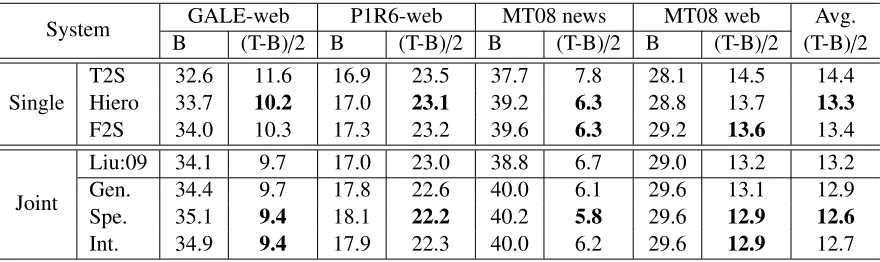
Table 2: All results of single and joint decoding systems.
6.1 Setup
The training corpus consists of 16 million sen-tence pairs available within the DARPA BOLT Chinese-English task. The corpus includes a mix of newswire, broadcast news, webblog and comes from various sources such as LDC, HK Law, HK Hansard and UN data. The Chinese text is seg-mented with a segmenter trained on CTB data using conditional random fields (CRF). Language models are trained on the English side of the parallel cor-pus, and on monolingual corpora, such as Gigaword (LDC2011T07) and Google News, altogether com-prising around 10 billion words.
We use a modified version of the Berkeley parser (Petrov and Klein, 2007) to obtain a parse forest for each training sentence, then we prune it with the marginal probability-based inside-outside algo-rithm to contain only 3nCFG nodes, wherenis the sentence length. Finally, we apply the forest-based GHKM algorithm (Mi and Huang, 2008; Galley et al., 2004) to extract tree-to-string translation rules from forest-string pairs.
In the decoding step, we prune the input hyper-graphs to 10n nodes before we use fast pattern-matching (Zhang et al., 2009) to convert the parse forest into the translation forest.
We tune on 1275 sentences, each with 4 refer-ences, from the LDC2010E30 corpus, initially re-leased under the DARPA GALE program.
All MT experiments are optimized with MIRA (Crammer et al., 2006) to maximize (Ter-Bleu)/2.
We test on four different test sets: GALE-web test set from LDC2010E30 corpus (1239 sentences, 4
references), P1R6-web test set from LDC2012E124 corpus (1124 sentences, 1 reference), NIST MT08 newswire portion (691 sentences, 4 references), and NIST MT08 web portion (666 sentences, 4 refer-ences).
6.2 Results
Table 2 shows all results of single and joint decoding systems. The Bleuscore of the single hiero baseline is 39.2 on MT08-news, showing that it is a strong system. The single F2S baseline achieves compara-ble scores on all four test sets.
Then, for reference, we present results of joint Hi-ero and T2S decoding, which is, to our knowledge, a strong and competitive reimplementaion of the work described by Liu et al. (2009). Finally, we present re-sults of joint decoding of hiero and F2S in three in-teraction schemes: generalization, specification, and interchange.
All three combination schemes significantly im-prove results of any single system on all four test-sets. On average and measured in (Ter-Bleu)/2, our systems improve the best single system by 0.4 (generalization), 0.7 (specification), and 0.6 (inter-change).
The specification comes out as the strongest inter-action scheme, beating the second interchange on 2 testsets by 0.1 and 0.4 (Ter-Bleu)/2 points and on 3 testsets by 0.2 Bleupoints.
6.3 Discussion of Results
ac-Specification Generalization Interchange
X→ ∗ ∗ →X X→ ∗ ∗ →X
VP IP VV NR ADVP QP CC DVP NP P ... CS CP AD VRD PU ADJP DNP PP PRN DP 0.069 0.059 0.053 0.032 0.025 0.023 0.017 0.017 0.017 0.012 ... -0.005 -0.007 -0.011 -0.012 -0.028 -0.028 -0.045 -0.064 -0.069 -0.092 QP PP NN DP NR DNP NP LC DEC DEG ... VV PRN PN BA VP VRD JJ VC DFL PU 0.057 0.054 0.048 0.044 0.034 0.032 0.030 0.025 0.023 0.023 ... -0.010 -0.011 -0.013 -0.015 -0.015 -0.028 -0.035 -0.037 -0.054 -0.073 VV VP NN QP ADVP LCP NP P IP NR ... VSB PN PU M VRD DNP ADJP PP DP PRN 0.062 0.044 0.034 0.025 0.022 0.021 0.018 0.017 0.016 0.016 ... -0.004 -0.004 -0.004 -0.007 -0.014 -0.023 -0.039 -0.058 -0.070 -0.080 NN PP CP LCP DEG DP DEC QP LC NP ... FLR DVP BA JJ AS VRD ADVP PN DFL PU 0.048 0.041 0.035 0.035 0.031 0.028 0.027 0.027 0.021 0.019 ... -0.006 -0.009 -0.010 -0.011 -0.014 -0.017 -0.021 -0.033 -0.038 -0.103
Table 3: Examples of specification, generalization, and interchange weights. POS tags in italics.
0 1 2 3 4 5 6 7 8 9 10 11 12 13 14 15 16 17 18
ADVP CLP ADJP FLR DFL
DP
VCP VSB VRD VCD QP NP DVP DNP LCP PP VP CP PRN
IP
FRAG
[image:8.612.75.535.56.373.2]Average span length
Figure 4: Average span length for selected syntactic la-bels on GALE-web test set.
companying them with our subjective judgements and speculations.
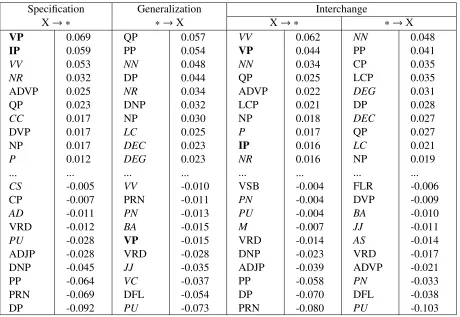
Table 3 shows the specification and generalization features tuned for the three combination schemes, then sorted by their weightsλX→YorλY→X. Features
shown at the top of the table are very expensive (the
#Interactions Generalization Inter. gen.
F2S→glue 5557 4202
F2S→hiero 695 1178
total gen. 6252 5380
Specification Inter. spec.
phrase→F2S 2763 2235
glue→F2S 946 841
hiero→F2S 683 839
total spec. 4392 3915
Table 5: Rule interactions on GALE-web test set.
system tries to avoid them), while inexpensive fea-tures are at the bottom (the system is encouraged to use them).
[image:8.612.74.293.407.570.2]rule type Generalization Specification Interchange
F2S 18,807 58% 19,399 70% 18,400 61%
Hiero 3,730 12% 2,330 8% 3,133 10%
Glue 7,367 23% 571 2% 4,714 16%
Phrase 2,274 7% 5,484 20% 3,868 13%
[image:9.612.167.445.57.144.2]total 32,178 27,784 30,115
Table 4: Rule counts on GALE-web test set.
10^0 10^1 10^2 10^3 10^4
0 5 10 15 20 25 30 35 40 45 50 55 60 65 70
Number of rules
Span length Generalization
F2S Hiero Glue Phrase
10^0 10^1 10^2 10^3 10^4
0 5 10 15 20 25 30 35 40 45 50 55 60 65 70
Number of rules
Span length Specification
F2S Hiero Glue Phrase
10^0 10^1 10^2 10^3 10^4
0 5 10 15 20 25 30 35 40 45 50 55 60 65 70
Number of rules
Span length Interchange
F2S Hiero Glue Phrase
Figure 5: Rule distributions on GALE-web test set.
The third most expensive feature belongs to a part-of-speech tag—the preterminal VV. We may hypothesize that it shows the importance of lexical information for the precision of reordering typically carried out within (parent) VP nodes, and/or the im-portance of POS information for succesful disam-biguation of word senses in translation. Ideally, the system can use a VP rule with a lexicalized VV. Less preferably, the VV part has to be translated by an-other T2S rule (losing the lexical constraint). In the worst case, the system has to use a hiero hypothe-sis to translate the VV part (losing the syntactic con-straint), risking imprecise translation, since the hiero rule is not constrained to senses corresponding to the source POS VV. Again, the high penalty discourages from using the hiero derivation in this context.
On the other hand, the bottom of the table shows labels that encourage using hiero–DP, PP, DNP, ADJP, etc.–shorter phrases that tend to be monotone and less ambiguous.
Similar interpretations seem plausible when ex-amining thegeneralization experiment. Expensive features related to preterminals (NR, NN, CD) may suggest two alternative principles: First, using F2S rules for thes POS categories and then switching to hiero is discouraged, since these contexts are more reliably handled by hiero due to better lexical cover-age and common adjacency in nominal categories. Second, since there is only one attempt to switch from F2S derivation to hiero, letting F2S complete even larger spans (and maybe switching to hiero later) is favorable.
[image:9.612.66.297.174.686.2]Finally, the feature weights tuned for the in-terchange experiment are divided into two sub-columns. Both generalization and specification weights show similar trends as in the previous two interaction schemes, although blurred (VP and IP descending from the absolute top). Since transitions in both ways are allowed, the search space is big-ger and the system may behave differently. It is even possible for a path in the hypergraph to zigzag be-tween F2S and hiero nodes to collect interaction dis-counts, “diluting” the syntactic homogeneity of the hypothesis.
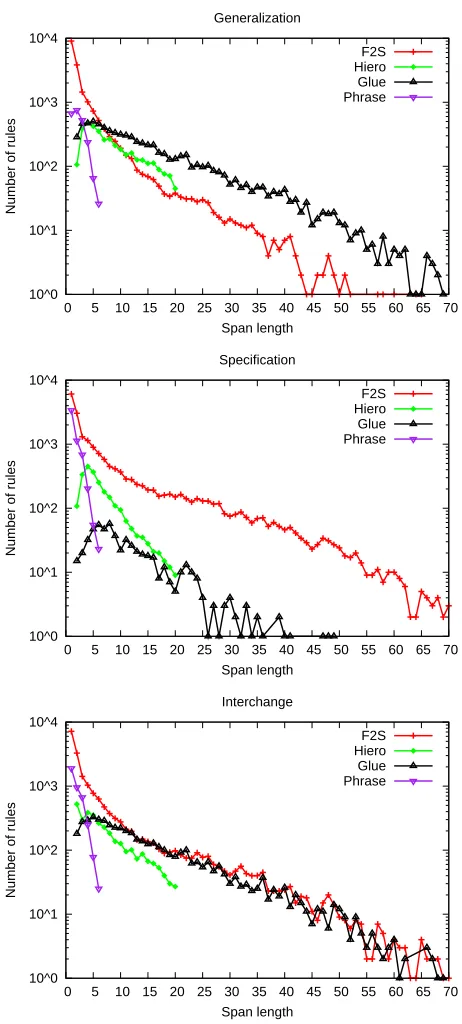
Figure 5 and Tables 4 and 5 show rule distribu-tions, total rule counts, and numbers of interactions of different types for the three interaction schemes on the GALE-web test set. The scope of phrase rules is limited to 6 words. The scope of hiero rules is lim-ited to 20 words by the commonly used maxParse parameter, leaving longer spans to the glue rule.
The trends of F2S and glue rules show the most obvious difference. In the generalization, F2S rules translate spans of up to 50 words. Glue rules pre-vail on spans longer then 7 words. The specification is reversed, pushing the longest scope of hiero and glue rules down to 40 words, completing the longest sentences entirely with F2S. The interchange comes out as a mixture of the previous two trends.
All three schemes prefer using F2S rules at shorter spans, to the contrary of our original assump-tion of phrasal and hiero rules being stronger on lo-cal contexts in general. Here we may refer again to the specification feature weights for preterminals VV, NR, CC and P in Table 3 and to our previously stated hypothesis about the importance of preserving lexical and syntactic context.
Hiero rules usage on longer spans drops fastest for specification, slowest for generalization, and in between for interchange.
It is also interesting to notice the trends on very short spans (2–4 words) shown by rule distributions and reflected in numbers of interaction types. While specification often transitions from a single phrase rule directly into F2S, the interchange has relatively higher counts of hiero rules, another sign of the hiero and F2S interaction.
Synthesizing from several sources of indications is difficult, however, we arrive at the conclusion that joint decoding of hiero and F2S significantly
im-proves the performance. While the single systems show similar performance, their roles are not bal-anced in joint decoding. It seems that the role of hi-ero consists in enabling F2S in most contexts.
We have focused on three special cases of inter-action. We see a great potential in further studies of other schemes, allowing more flexible interaction than simple specification, but still more constrained than the interchange. It seems also promising to re-fine the interaction modeling with features taking into account more information than a single syntac-tic label, and to explore additional ways of parame-ter estimation.
7 Conclusion
We have proposed flexible interaction of
hyper-graphs as a novel technique combining hiero
and forest-to-string translation models within one decoder. We have explored three basic interac-tion schemes—specification, generalization, and
interchange—and described soft constraints
control-ling the interactions. We have carried out experi-ments on large training data and with strong base-lines. Of the three schemes, the specification shows the highest gains, achieving improvements from 0.5 to 0.9 (Ter-Bleu)/2 points over the best single sys-tem. We have conducted a detailed analysis of each system output based on different indications of inter-actions, discussed possible interpretations of results, and finally offered our conclusion and proposed fu-ture lines of research.
Acknowledgments
We thank Jiˇr´ı Havelka for proofreading and help-ful suggestions. We would like to acknowledge the support of DARPA under Grant HR0011-12-C-0015 for funding part of this work. The views, opinions, and/or findings contained in this article/presentation are those of the author/presenter and should not be interpreted as representing the official views or poli-cies, either expressed or implied, of the DARPA.
References
David Chiang. 2005. A hierarchical phrase-based model for statistical machine translation. InProceedings of ACL, pages 263–270, Ann Arbor, Michigan, June. Koby Crammer, Ofer Dekel, Joseph Keshet, Shai
Shalev-Shwartz, and Yoram Singer. 2006. Online passive-aggressive algorithms. Journal of Machine Learning Research, 7:551–585.
John Denero, Shankar Kumar, Ciprian Chelba, and Franz Och. 2010. Model combination for machine transla-tion. InIn Proceedings NAACL-HLT, pages 975–983. Michel Galley, Mark Hopkins, Kevin Knight, and Daniel
Marcu. 2004. What’s in a translation rule? In Pro-ceedings of HLT-NAACL, pages 273–280.
Michel Galley, Jonathan Graehl, Kevin Knight, Daniel Marcu, Steve DeNeefe, Wei Wang, and Ignacio Thayer. 2006. Scalable inference and training of context-rich syntactic translation models. In Proceed-ings of COLING-ACL, pages 961–968, Sydney, Aus-tralia, July.
Xiaodong He, Mei Yang, Jianfeng Gao, Patrick Nguyen, and Robert Moore. 2008. Indirect-HMM-based hy-pothesis alignment for combining outputs from ma-chine translation systems. InProceedings of EMNLP, pages 98–107, October.
Liang Huang, Kevin Knight, and Aravind Joshi. 2006. Statistical syntax-directed translation with extended domain of locality. InProceedings of AMTA, pages 66–73.
Philipp Koehn, Franz Joseph Och, and Daniel Marcu. 2003. Statistical phrase-based translation. In Proceed-ings of NAACL, pages 127–133.
Yang Liu, Qun Liu, and Shouxun Lin. 2006. Tree-to-string alignment template for statistical machine trans-lation. InProceedings of COLING-ACL, pages 609– 616.
Yang Liu, Haitao Mi, Yang Feng, and Qun Liu. 2009. Joint decoding with multiple translation models. In
Proceedings of ACL-IJCNLP, pages 576–584, August. Haitao Mi and Liang Huang. 2008. Forest-based transla-tion rule extractransla-tion. InProceedings of EMNLP, pages 206–214.
Haitao Mi, Liang Huang, and Qun Liu. 2008. Forest-based translation. InProceedings of ACL: HLT, pages 192–199.
Slav Petrov and Dan Klein. 2007. Improved inference for unlexicalized parsing. In Proceedings of HLT-NAACL, pages 404–411.
Antti-Veikko Rosti, Spyros Matsoukas, and Richard Schwartz. 2007. Improved word-level system com-bination for machine translation. In Proceedings of ACL, pages 312–319, Prague, Czech Republic, June. Taro Watanabe and Eiichiro Sumita. 2011. Machine
translation system combination by confusion forest. In
Proceedings of ACL 2011, pages 1249–1257.