A Study on Bootstrapping Bilingual Vector Spaces from Non-Parallel Data
(and Nothing Else)
Ivan Vuli´c and Marie-Francine Moens
Department of Computer Science KU Leuven
Celestijnenlaan 200A Leuven, Belgium
{ivan.vulic,marie-francine.moens}@cs.kuleuven.be
Abstract
We present a new language pair agnostic ap-proach to inducing bilingual vector spaces from non-parallel data without any other re-source in a bootstrapping fashion. The pa-per systematically introduces and describes all key elements of the bootstrapping procedure: (1) starting point or seed lexicon, (2) the confi-dence estimation and selection of new dimen-sions of the space, and (3) convergence. We test the quality of the induced bilingual vec-tor spaces, and analyze the influence of the different components of the bootstrapping ap-proach in the task of bilingual lexicon extrac-tion (BLE) for two language pairs. Results re-veal that, contrary to conclusions from prior work, the seeding of the bootstrapping pro-cess has a heavy impact on the quality of the learned lexicons. We also show that our ap-proach outperforms the best performing fully corpus-based BLE methods on these test sets.
1 Introduction
Bilingual lexicons serve as an indispensable source of knowledge for various cross-lingual tasks such as cross-lingual information retrieval (Lavrenko et al., 2002; Levow et al., 2005) or statistical machine translation (Och and Ney, 2003). Additionally, they are a crucial component in cross-lingual knowledge transfer, where the knowledge about utterances in one language may be transferred to another. The utility of the transfer or annotation projection by means of bilingual lexicons has already been proven in various tasks such as semantic role labeling (Pad´o and Lapata, 2009; van der Plas et al., 2011), parsing
(Zhao et al., 2009; Durrett et al., 2012; T¨ackstr¨om et al., 2013b), POS tagging (Yarowsky and Ngai, 2001; Das and Petrov, 2011; T¨ackstr¨om et al., 2013a), etc. Techniques for automatic bilingual lexicon ex-traction (BLE) from parallel corpora on the basis of word alignment models are well established (Och and Ney, 2003). However, due to a relative scarce-ness of parallel data for many language pairs and domains, alternative approaches that rely on compa-rable corpora have also gained much interest (e.g., Fung and Yee (1998); Rapp (1999)).
The models that rely on non-parallel data typ-ically represent each word by a high-dimensional vector in a feature vector space, where the dimen-sions of the vector are itscontext features. The con-text features are typically words co-occurring with the word in a predefined context.1 The similar-ity of two words,wS
1 given in the source language
LS with vocabulary VS and wT2 in the target
lan-guageLT with vocabularyVT is then computed as
sim(wS
1, w2T) = SF(cv(wS1), cv(wT2)). cv(w1S) =
[scS
1(c1), . . . , scS1(cN)] is a context vector for w1S
withN context featuresck, wherescS1(ck)denotes
the score forwS
1 associated with context featureck
(similar forwT
2). SF is a similarity function (e.g.,
cosine, the Kullback-Leibler divergence, the Jaccard index) operating on the context vectors (Lee, 1999). When operating with 2 languages, the context fea-tures cannot be compared directly. Therefore, in order to compare the feature vectors cv(wS
1) and
cv(wT
2), the context features need to span a shared
1The context may be a document, a paragraph, a window of
predefined size around each occurrence ofwSi inCS, etc. For
an overview, see, e.g., (Tamura et al., 2012).
bilingual vector space. The standard way of build-ing a bilbuild-ingual vector space is to use bilingual lex-icon entries(Rapp, 1999; Fung and Cheung, 2004; Gaussier et al., 2004) as dimensions of the space. However, there seems to be an apparent flaw in logic, since the methods assume that there exist readily available bilingual lexicons that are then used to induce bilingual lexicons! Therefore, the fo-cus of the researchers has turned to designing BLE methods that do not rely on any external translation resources such as machine-readable bilingual lex-icons and parallel corpora (Haghighi et al., 2008; Vuli´c et al., 2011).
In order to circumvent this issue, one line of re-cent work aims to bootstrap high-quality bilingual vector spaces from a small initial seed lexicon. The seed lexicon is constructed by harvesting identical or similarly spelled words across languages (Koehn and Knight, 2002; Peirsman and Pad´o, 2010), and it spans the initial bilingual vector space.The space is then gradually enriched with new dimensions/axes during the bootstrapping procedure. The bootstrap-ping process has already proven its validity in induc-ing bilinduc-ingual lexicons for closely similar languages such as Spanish-Portuguese or Croatian-Slovene (Fiˇser and Ljubeˇsi´c, 2011), but it still lacks further generalization to more distant language pairs.
The main goal of this paper is to shed new light on the bootstrapping approaches to bilingual lexicon extraction, and to construct a language pair agnos-tic bootstrapping method that is able to build high-quality bilingual vector spaces that consequently lead to high-quality bilingual lexicons for more dis-tant language pairs where orthographic similarity is not sufficient to seed bilingual vector spaces. We aim to answer the following key questions:
• How to seed bilingual vector spaces besides us-ing only orthographically similar words? • Is it better to seed bilingual spaces with
trans-lation pairs/dimensions that are frequent in the corpus, and does the frequency matter at all? Does the size of the initial seed lexicon matter? • How to enrich bilingual vector spaces with only highly reliable dimensions in order to prevent semantic drift?
With respect to these questions, the main contribu-tions of this article are:
• We present a complete overview of the frame-work of bootstrapping bilingual vector spaces from non-parallel data without any additional resources. We dissect the bootstrapping pro-cess and describe all its key components. • We introduce a new way of seeding the
boot-strapping procedure that does not rely on any orthographic clues and that yields bilingual vector spaces of higher quality. We analyze the impact of different seed lexicons on the quality of induced bilingual vector spaces.
• We show that in the setting without any ex-ternal translation resources, our bootstrapping approach yields lexicons that outperform the best performing corpus-based BLE methods on standard test datasets for 2 language pairs.
2 Boostrapping Bilingual Vector Spaces: A General Overview
This section presents the complete bootstrapping procedure that starts with an initial seed lexicon which spans the initial bilingual vector space, while as the output in each iteration of the procedure it pro-duces an updated bilingual vector space that can be used to extract a bilingual lexicon.
2.1 General Framework
We assume that we are solely in possession of a (non-parallel) bilingual corpus C that is composed of a sub-corpusCSgiven in the source languageLS,
and a sub-corpusCT in the target languageLT. All
word types that occur inCSconstitute a setVS. All
word types inCT constitute a setVT. The goal is to
build a bilingual vector space using only corpusC.
Assumption 1. Dimensions of the bilingual vector
space are one-to-one word translation pairs. For in-stance, dimensions of a Spanish-English space are pairs like (perro, dog), (ciencia, science), etc. The
one-to-one constraint (Melamed, 2000), although not valid in general, simplifies the construction of the bootstrapping procedure. Z denotes the set of translation pairs that are the dimensions of the space.
Computing cross-lingual word similarity in a
bilingual vector space.Now, assume that our
bilin-gual vector space consists of N one-to-one word translation pairsck = (cSk, cTk), k = 1, . . . , N. For
each wordwS
that word with each wordwT
j ∈ VT by computing
the similarity between their context vectorscv(wS i )
andcv(wT
j), which are actually their representations
in theN-dimensional bilingual vector space.
The cross-lingual similarity is computed follow-ing the standard procedure (Gaussier et al., 2004): (1) For each source word wS
i ∈ VS, build its N
-dimensional context vector cv(wS
i ) that consists of
association scoresscS
k(cSk), that is, we compute the
strength of association with the “source” part of each dimension ck that constitutes the N-dimensional
bilingual space. The association is dependent on the co-occurrence ofwS
i andcSk in a predefined context.
Various functions such as the log-likelihood ratio (LLR) (Rapp, 1999; Ismail and Manandhar, 2010), TF-IDF (Fung and Yee, 1998), or pointwise mu-tual information (PMI) (Bullinaria and Levy, 2007; Shezaf and Rappoport, 2010) are typically used as
weighting functions to quantify the strength of the association.
(2) Repeat step (1) for each target wordwT j ∈ VT
and build context vectors cv(wT
j) that consist of
scoresscT k(cTk).
(3) Since cS
k and cTk address the same dimension
ck in the bilingual vector space for each k =
1, . . . , N, we are able to compute the similarity be-tweencv(wS
i )andcv(wTj)using any similarity
mea-sure such as the Jaccard index, the Kullback-Leibler or the Jensen-Shannon divergence, the cosine mea-sure, or others (Lee, 1999; Cha, 2007).
The similarity score for two words wS
i and wTj
issim(wS
i , wTj). For each source wordwSi, we can
build aranked listRL(wS
i )that consists of all words
wT
j ∈ VT ranked according to their respective
sim-ilarity scoressim(wS
i , wTj). In the similar fashion,
we can build a ranked listRL(wT
j ), for each target
word wT
j. We call the top scoring target word wTj
for some source wordwS
i itstranslation candidate,
and write T C(wS
i) = wjT. Additionally, we label
the ranked listRL(wS
i)that is pruned at positionM
asRLM(wSi).
Bootstrapping. The key idea of the bootstrapping
approach relies on an insight that highly reliable translation pairs(wS
1, wT2)that are encountered
us-ing theN-dimensional bilingual vector space might be added as new dimensions of the space. By adding
these new dimensions, it might be possible to extract more highly reliable translation pairs that were pre-viously not used as dimensions of the space, and the iterative procedure repeats until no new dimensions are found. The induced bilingual vector space may then be observed as a bilingual lexiconper se, but it may also be used to find translation equivalents for other words which are not used to span the space.
Algorithm 1:Bootstrapping a bilingual vector space
Input : Bilingual corpusC=CS∪ CT
Initialize: (1) Obtain a one-to-one seed lexicon. The
entries from the lexicon are initial dimensions of the space:Z0; (2)s= 0;
Bootstrap:
repeat
1: For eachwSi ∈VS: computeRL(wSi)usingZs;
2: For eachwT
j ∈VT: computeRL(wjT)usingZs;
3: For eachwSi ∈VSandwjT∈VT: score each
translation pair(wSi, T C(w S
i))and(T C(w T j), w
T j)
and add them to apool of candidate dimensions; 4: Choosethe best candidatesfrom the pool and add them as new dimensions:Zs+1← Zs∪ {best};
5: Resolve collisions inZs+1;
6:s←s+ 1;
untilno new dimensions are found (convergence);
Output: One-to-one translation pairs→Dimensions of a
bilingual vector spaceZf inal
The overview of the procedure as given by alg. 1 reveals these crucial points in the procedure: (Q1) how to provide initial dimensions of the space? (the initialization step), (Q2) how to score each trans-lation pair, estimate their confidence, and how to choose the best candidates from the pool of candi-dates? (steps 3 and 4), and (Q3) how to resolve potential collisions that violate the one-to-one con-straint? (step 5). We will discuss (Q1) and (Q2) in more detail later, while we resolve (Q3) following a simple heuristic as follows:
Assumption 2. In case of collision,
dimen-sions/pairs that are found at later stages of the boot-strapping process overwrite previous dimensions.
2.2 Initializing Bilingual Vector Spaces
Seeding or initializing a bootstrapping procedure is often a critical step regardless of the actual task (McIntosh and Curran, 2009; Kozareva and Hovy, 2010), and it decides whether the complete process will end as a success or a failure. However, Peirsman and Pad´o (2011) argue that the initialization step is not crucial when dealing with bootstrapping bilin-gual vector spaces. Here, we present two different strategies of initializing the bilingual vector space.
Identical words and cognates. Previous work
re-lies exclusively on identical and similarly spelled words to build the initial set of dimensions Z0 (Koehn and Knight, 2002; Peirsman and Pad´o, 2010; Fiˇser and Ljubeˇsi´c, 2011). This strategy yields promising results for closely similar language pairs, but is of limited use for other language pairs.
High-frequency seeds. Another problem with
us-ing only identical words and cognates as seeds lies in the fact that many of them might be infrequent in the corpus, and as a consequence the expressiveness of a bilingual vector space might be limited. On the other hand, high-frequency words offer a lot of evidence in the corpus that could be exploited in the boot-strapping approach. In order to induce initial trans-lation pairs, we rely on the framework of multilin-gual probabilistic topic modeling(MuPTM) (Boyd-Graber and Blei, 2009; De Smet and Moens, 2009; Mimno et al., 2009; Zhang et al., 2010), that does not require a bilingual lexicon, it operates with non-parallel data, and is able to produce highly confident translation pairs for high-frequency words (Mimno et al., 2009; Vuli´c and Moens, 2013).2 Therefore, we can construct the initial seed lexicon as follows: (1) Train a multilingual topic model on the corpus. (2) Obtain one-to-one translation pairs using any of the MuPTM-based models of cross-lingual similar-ity, e.g., (Vuli´c et al., 2011; Vuli´c and Moens, 2013). (3) Retain only symmetric translation pairs. This step ensures that only highly confident pairs are used as seed translation pairs.
(4) Rank translation pairs according to their fre-quency in the corpus and use a subset of the most
2
One can also use other models that are similar to MuPTM such as (Haghighi et al., 2008; Daum´e III and Jagarlamudi, 2011) to produce the initial seed lexicon, but that analysis is beyond the scope of this work.
frequent symmetric pairs as seeds.
2.3 Estimating Confidence of New Dimensions
Another crucial step in the bootstrapping proce-dure is the estimation of confidence in a translation pair/candidate dimension. Errors in the early stages of the procedure may negatively affect the learning process and even cause semantic drift (Riloff and Shepherd, 1999; McIntosh and Curran, 2009). We therefore impose the constraint which requires trans-lation pairs to besymmetricin order to qualify as po-tential new dimensions of the space. In other words, given the current set of dimensions Zs, a
transla-tion pair(wS
i , wTj)has a possibility to be chosen as
a new dimension from the pool of candidate dimen-sions if and only if it holds: T C(wS
i ) = wTj and
T C(wT
j) = wiS. Thissymmetry constraint should
ensure a relative reliability of translation pairs. In each iteration of the bootstrapping process, we may add all symmetric pairs from the pool of candi-dates as new dimensions, or we could impose addi-tional selection criteria that quantify the degree of confidence in translation pairs. We are then able to rank the symmetric candidate translation pairs in the pool of candidates according to their confidence scores (step 3 of alg. 1), and choose only the best
Bcandidates from the pool in each iteration (step 4) as done in (Thelen and Riloff, 2002; McIntosh and Curran, 2009; Huang and Riloff, 2012). By picking only a subset of theB most confident candidates in each iteration, we hope to further prevent a possibil-ity of semantic drift, i.e., “poisoning” the bootstrap-ping process that might happen if we include incor-rect translation pairs as dimensions of the space.
In this paper, we investigate 3 different confidence estimation functions:3
(1) Absolute similarity score. Confidence of a
translation pairCF(wS
i , T C(wSi))is simply the
ab-solute similarity valuesim(wS
i, T C(wiS))
(2) M-Best confidence function. It contrasts the
score of the translation candidate with the average score over the first M most similar words in the ranked list. The larger the difference, the more con-fidence we have in the translation candidate. Given a wordwS
i ∈ VS and a ranked listRLM(wSi), the 3A symmetrized version of the confidence functions is
average score of the bestM words is computed as:
simM(wiS) =
1
M
X
wT
j∈RLM(wSi)
sim(wS i, wjT)
The final confidence score is then:
CF(wSi, T C(wSi)) =sim(wiS, T C(wSi))−simM(wSi)
(3)Entropy-based confidence function. We adapt
the well-known entropy-based confidence (Smith and Eisner, 2007; Tu and Honavar, 2012) to this par-ticular task. First, we need to define a distribution:
p(wTj|wiS) = e
sim(wS i,wTj)
P wT
l∈VTe
sim(wS i,wlT)
The confidence function is then minus the entropy of the probability distributionp:
CF(wSi, T C(wSi)) = X
wT l∈VT
p(wTl |wSi) logp(wTl |wiS)
3 Experimental Setup
Data collections. We investigate our bootstrapping
approach on the BLE task for 2 language pairs: Spanish-English (ES-EN) and Italian-English (IT-EN), and work with the following corpora previ-ously used by Vuli´c and Moens (2013): (i) a col-lection of 13, 696 Spanish-English Wikipedia arti-cle pairs (Wiki-ES-EN), (ii) 18, 898 Italian-English Wikipedia article pairs (Wiki-IT-EN).4
Following (Koehn and Knight, 2002; Haghighi et al., 2008; Prochasson and Fung, 2011; Vuli´c and Moens, 2013), we use TreeTagger (Schmid, 1994) for POS-tagging and lemmatization of the corpora, and then retain only nouns that occur at least 5 times in the corpus. We record the lemmatized form when available, and the original form otherwise. Our fi-nal vocabularies consist of 9, 439 Spanish nouns and
4Vuli´c and Moens (2013) also worked with Dutch-English
(NL-EN), but we have decided to leave out the results obtained for that language pair due to space constraints, high similarity between the two languages, and the fact that the results obtained for that language pair are qualitatively similar to the results we report for ES-EN and IT-EN. Hence including the results for NL-EN would not contribute to the paper with any new impor-tant insight and conclusion.
12, 945 nouns for ES-EN, and 7, 160 Italian nouns and 9, 116 English nouns for IT-EN.
Ground truth. The goal of the BLE task is to
ex-tract a bilingual lexicon of one-to-one translations. In order to test the quality of bilingual vector spaces induced by our bootstrapping approach, we evaluate it on standard 1000 ground truth one-to-one trans-lation pairs built for the Wiki-ES-EN and Wiki-IT-EN datasets (Vuli´c and Moens, 2013). Note that we do not explicitly test the bilingual vector space as a bilingual lexicon, but rather its ability to find semantically similar words and translations also for words that are not used as dimensions of the space (see sect. 2.1).
Evaluation metrics. We measure the performance
on the BLE task using a standard Top M accuracy (AccM) metric. It denotes the number of source
wordswS
i from ground truth translation pairs whose
list RLM(wiS) contains the correct translation
ac-cording to our ground truth over the total number of ground truth translation pairs (=1000) (Gaussier et al., 2004; Tamura et al., 2012).5 Additionally, we report the mean reciprocal rank (MRR) scores (Voorhees, 1999) for some experimental runs.
Multilingual topic model. We utilize a
straightfor-ward multilingual extension of the standard Blei et al.’s LDA model (Blei et al., 2003) calledbilingual LDA(Mimno et al., 2009; Ni et al., 2009; De Smet and Moens, 2009). BiLDA training follows the pro-cedure from (Vuli´c and Moens, 2013), that is, the training method is Gibbs sampling with the number of topics set toK = 2000. Hyperparameters of the model are set to standard values (Steyvers and Grif-fiths, 2007):α= 50/Kandβ= 0.01.
Building initial seed lexicons. To produce the lists
of one-to-one translation pairs that are used as seeds for the bootstrapping approach (see sect. 2.2), we experiment with the TopicBCand the ResponseBC
methods from (Vuli´c and Moens, 2013), which are the MuPTM-based models of cross-lingual seman-tic similarity that obtain the best results in the BLE task on these datasets. In short, theTopicBCmethod computes the similarity of two words according to the similarity of their conditional topic distributions (Griffiths et al., 2007; Vuli´c et al., 2011) using
5We can build a one-to-one bilingual lexicon by harvesting
one-to-one translation pairs(wiS, T C(wSi)), and the quality of
the Bhattacharyya coefficient (BC) (Kazama et al., 2010) as the similarity function. ResponseBC is a second-order similarity method. It first computes initial similarity scores between all words cross-lingually and monocross-lingually using the cross-lingual topical space and, in the second step, it computes the similarity between 2 words as the similarity between their word vectors that now contain the initial word-to-word similarity scores with all source and target words. The similarity function is again BC.
We use these models of similarity as a black box to acquire seeds for the bootstrapping approach, but we encourage the interested reader to find more de-tails about the methods in the relevant literature. These two models also serve as ourbaseline models, and our goal is to test whether we are able to obtain bilingual lexicons of higher quality using bootstrap-ping that starts from the output of these models.
Weighting and similarity functions. We have
experimented with different families of weighting (e.g., PMI, LLR, TF-IDF, chi-square) and similar-ity functions (e.g., cosine, Dice, Kullback-Leibler, Jensen-Shannon) (Lee, 1999; Turney and Pantel, 2010). In this paper, we present results obtained by positive pointwise mutual information (PPMI)
(Niwa and Nitta, 1994) as a weighting function, which is a standard choice in vector space seman-tics (Turney and Pantel, 2010), and (combined with cosine) yields the best results over a group of seman-tic tasks according to (Bullinaria and Levy, 2007). We use a smoothed version of PPMI as presented in (Pantel and Lin, 2002; Turney and Pantel, 2010). Again, based on the results reported in the relevant literature (Bullinaria and Levy, 2007; Laroche and Langlais, 2010; Turney and Pantel, 2010), we opt for the cosine similarity as a standard choice forSF. We have also experimented with different window sizes ranging from 3 to 15 in both directions around the pivot word, but we have not detected any major qualitative difference in the results and their inter-pretation. Therefore, all results reported in the paper are obtained by setting the window size to 6.
4 Results and Discussion
4.1 Are Seeds Important?
In recent work, Peirsman and Pad´o (2010; 2011) report that “the size and quality of the (seed)
lex-icon are not of primary importance given that the bootstrapping procedure effectively helped filter out incorrect translation pairs and added more newly identified mutual nearest neighbors.” According to their findings, (1) noisy translation pairs are cor-rected in later stages of the bootstrapping process, since the quality of bilingual vector spaces gradu-ally increases, (2) the size of the seed lexicon does not matter since the bootstrapping approach is able to learn translation pairs that were previously not present in the seed lexicon. Additionally, they do not provide any insight whether the frequency of seeds in the corpus influences the quality of induced bilin-gual vector spaces. In this paper, we question these claims with a series of BLE experiments.
All experiments conducted in this section do not rely on any extra confidence estimation except for the symmetry constraint, that is, in each step we en-rich the bilingual vector space with all new symmet-ric translation pairs (see alg. 1 and sect. 2.3).
Exp. I: Same size, different seedings? The goal
of this experiment is to test whether the quality of seeds plays an important role in the bootstrapping approach. We experiment with 3 different seed lex-icons: (1) Following (Peirsman and Pad´o, 2010; Fiˇser and Ljubeˇsi´c, 2011), we harvest identically spelled words across 2 languages and treat them as one-to-one translations. This procedure results in 459 seed translation pairs for ES-EN, and 431 pairs for IT-EN (SEED-ID), (2) We obtain symmet-ric translation pairs using theTopicBCmethod (see sect. 3) and use 459 pairs that have the highest fre-quency in the Wiki-EN corpus as seeds for ES-EN (similarly 431 pairs for IT-ES-EN) (SEED-TB), (3) As in (2), but we now use theResponseBCmethod to acquire seeds (SEED-RB). The frequency of a one-to-one translation pair is simply computed as the ge-ometric mean of the frequencies of words that con-stitute the translation pair.
0.2 0.4 0.6 0.8
Acc
M
0 1 2 3 4 5 6 7 8 9 10 11 12 13 14 15 Iteration
Acc1(SEED-ID)
Acc1(SEED-TB)
Acc1(SEED-RB)
Acc10(SEED-ID)
Acc10(SEED-TB)
Acc10(SEED-RB)
(a) Spanish to English
0.2 0.4 0.6 0.8
Acc
M
0 1 2 3 4 5 6 7 8 9 10 11 12 13 14 15 Iteration
Acc1(SEED-ID)
Acc1(SEED-TB)
Acc1(SEED-RB)
Acc10(SEED-ID)
Acc10(SEED-TB)
Acc10(SEED-RB)
(b) Italian to English
500 750 1000 1250 1500 1750
Num
b
er
of
dimensions
0 1 2 3 4 5 6 7 8 9 10 11 12 13 14 15 Iteration
SEED-ID (ES-EN) SEED-TB (ES-EN) SEED-RB (ES-EN) SEED-ID (IT-EN) SEED-TB (IT-EN) SEED-RB (IT-EN)
[image:7.612.80.533.50.187.2](c) # Dimensions over iterations
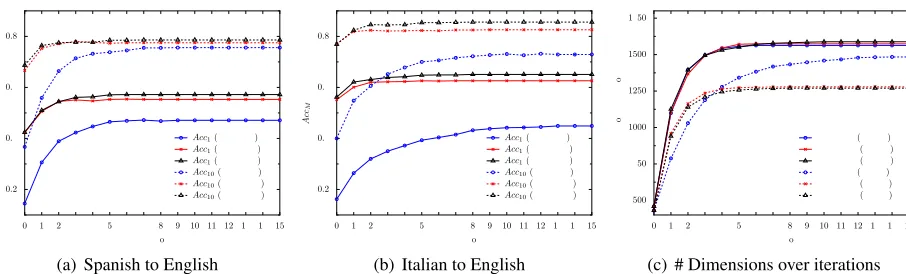
Figure 1: Results with 3 different seeding methods as starting points of the bootstrapping process: (i) identical words only (SEED-ID), (ii) theTopicBCmethod (SEED-TB), (iii) theResponseBCmethod (SEED-RB). (a)AccM scores for
ES-EN; (b)AccM scores for IT-EN; (c) the number of dimensions in the space with the 3 different seeding methods
in each iteration for ES-EN and IT-EN. The bootstrapping procedure typically converges after a few iterations.
0 0.2 0.4 0.6 0.8 1
Acc
M
0 1 2 3 4 5 6 7 8 9 10 Iteration
Acc1(HF-SEED)
Acc1(MF-SEED)
Acc1(LF-SEED)
Acc10(HF-SEED)
Acc10(MF-SEED)
Acc10(LF-SEED)
(a) Spanish to English
0 0.2 0.4 0.6 0.8 1
Acc
M
0 1 2 3 4 5 6 7 8 9 10 Iteration
Acc1(HF-SEED)
Acc1(MF-SEED)
Acc1(LF-SEED)
Acc10(HF-SEED)
Acc10(MF-SEED)
Acc10(LF-SEED)
(b) Italian to English
Figure 2: Results on the BLE task with SEED-RB when using seed translation pairs of different frequency: (i) high-frequency (HF-SEED), (ii) medium-high-frequency (MF-SEED), (iii) low-high-frequency (LF-SEED).
prominent in the first few iterations, when the ap-proach learns more new dimensions (see fig. 1(c)). (ii)The seeding method is important. A bootstrap-ping approach that starts with a better seed lexicon is able to extract bilingual lexicons of higher quality as reflected inAcc1scores. Although the
bootstrap-ping approach seems more beneficial when dealing with noisier seed lexicons (226% increase in terms of Acc1 for ES-EN and 177% increase for IT-EN
when starting with SEED-ID, compared to 35% in-crease for ES-EN, and 15% for IT-EN with SEED-RB), when starting from a noisy seed lexicon such as SEED-ID the method is unable to reach the same level of performance. Starting with SEED-ID, the approach is able to recover noisy dimensions from an initial bilingual vector space, but it is still unable to match the results that are obtained when starting from a better initial space (e.g., SEED-RB).
(iii) SEED-RB produces slightly better results than SEED-TB (e.g., the finalAcc1 of 0.649 for
SEED-RB compared to 0.626 for SEED-TB for IT-EN, and 0.572 compared to 0.553 for ES-EN). This finding is in line with the results reported in (Vuli´c and Moens, 2013) where ResponseBCproved to be a more ro-bust and a more effective method when applied to the BLE task directly. In all further experiments we useResponseBCto acquire seed pairs, i.e., the seed-ing method is SEED-RB.
Exp. II: Does the frequency of seeds matter? In
[image:7.612.140.475.254.403.2]pairs (although potentially correct one-to-one trans-lations) do not occur in the corpus and in the con-texts of other words frequently enough, and are therefore not sufficient to extract reliable new di-mensions of the space.
To test the hypothesis, we again obtain all sym-metric translation pairs usingResponseBCand then sort them in descending order based on their fre-quency in the corpus. In total, we retrieve a sorted list of 2031 symmetric translation pairs for ES-EN, and 1689 pairs for IT-EN. Following that, we split the list in 3 parts of equal size: (i) the top third com-prises translation pairs with the highest frequency in the corpus (HF-SEED), (ii) the middle third com-prises pairs of “medium” frequency (MF-SEED), (iii) the bottom third are low-frequency pairs (LF-SEED). We then use these 3 different seed lexicons of equal size to seed the bootstrapping approach. Fig. 2(a) and 2(b) show the progress of the boot-strapping process using these 3 seed lexicons. We again observe several interesting phenomena: (i)High-frequency seed translation pairs are better seeds, and that finding is in line with our hypothesis. Although the bootstrapping approach again displays a positive trend regardless of the actual choice of seeds (we observe an increase even when using LF-SEED), high-frequency seeds lead to better overall results in the BLE task. Besides its high presence in contexts of other words, another advantage of high-frequency seed pairs is the fact that an initial sim-ilarity method will typically acquire more reliable translation candidates for such words (Pekar et al., 2006). For instance,89.5%of ES-EN pairs in HF-SEED are correct one-to-one translations, compared to 65.1% in MF-SEED, and 44.3% in LF-SEED. (ii) The difference in results between HF-SEED and MF-SEED is more visible inAcc1scores. Although
both seed lexicons for all test words provide ranked lists which contain words that exhibit some semantic relation to the given word, the reliability and the fre-quency of translation pairs are especially important for detecting the relation of cross-lingual word syn-onymy, that is, the translational equivalence that is exploited in building one-to-one bilingual lexicons.
Exp. III: Does size matter? The following
exper-iment investigates whether bilingual vector spaces may be effectively bootstrapped from small high-quality seed lexicons, and if larger seed lexicons
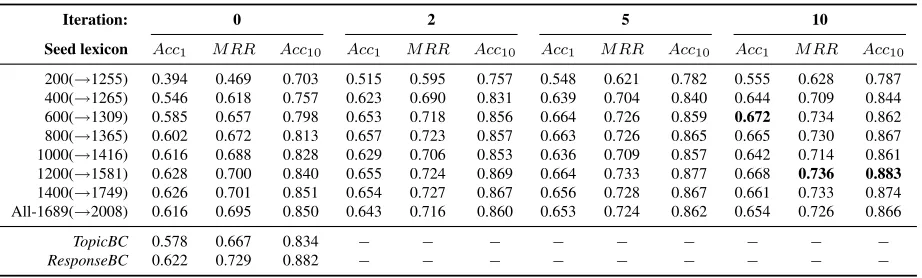
necessarily lead to bilingual vector spaces of higher quality as reflected in BLE results. We again retrieve a sorted list of symmetric translation pairs as in Exp. II. Following that, we build seed lexicons of vari-ous sizes by retaining only the first N pairs from the list, where we varyN from 200 to 1400 in steps of 200. We also use the entire sorted list as a seed lexicon (All), and compare the results on the BLE task with the results obtained by applying the Re-sponseBCandTopicBCmethods directly (Vuli´c and Moens, 2013). The results are summarized in tables 1 and 2. We observe the following:
(i) If we provide a seed lexicon with sufficient en-tries, the bootstrapping procedure provides compa-rable results regardless of the seed lexicon size, al-though results tend to be higher for larger seed lex-icons (e.g., compare results when starting with 600 and 1200 lexicon entries). When starting with the size of 600, the bootstrapping approach is able to find dimensions that were already in the seed lexi-con of size 1200. The lexi-consequence is that, although bootstrapping with a smaller seed lexicon displays a slower start (see the difference in results at iteration 0), the performances level after convergence. (ii) Regardless of the seed lexicon size, the boot-strapping approach is valuable. It consistently im-proves the quality of the induced bilingual vector space, and consequently, the quality of bilingual lex-icons extracted using that vector space. The positive impact is more prominent for smaller seed lexicons, i.e., we observe an increase of 78% for ES-EN when starting with only 200 seed pairs, compared to an increase of 15% when starting with 800 seed pairs, and 10% when starting with 1400 seed pairs. (iii) The bootstrapping approach outperforms Re-sponseBCandTopicBCin terms ofAcc1andM RR
scores for both language pairs when the seed lexi-con provides a sufficient number of entries. How-ever, in terms ofAcc10, TopicBCandResponseBC
still exhibit comparable (for IT-EN) or even better (ES-EN) results. Both TopicBC and ResponseBC
Iteration: 0 2 5 10
Seed lexicon Acc1 M RR Acc10 Acc1 M RR Acc10 Acc1 M RR Acc10 Acc1 M RR Acc10
200(→1617) 0.274 0.352 0.525 0.446 0.534 0.713 0.481 0.569 0.753 0.488 0.576 0.752 400(→1563) 0.416 0.499 0.663 0.518 0.602 0.774 0.542 0.620 0.787 0.545 0.625 0.788 600(→1554) 0.459 0.539 0.707 0.550 0.630 0.787 0.573 0.650 0.803 0.578 0.654 0.802 800(→1582) 0.494 0.572 0.728 0.548 0.631 0.799 0.563 0.644 0.802 0.567 0.646 0.806 1000(→1636) 0.516 0.591 0.744 0.563 0.644 0.805 0.578 0.656 0.813 0.581 0.658 0.817 1200(→1740) 0.536 0.613 0.764 0.586 0.661 0.804 0.588 0.664 0.812 0.591 0.667 0.814 1400(→1888) 0.536 0.620 0.776 0.583 0.659 0.808 0.589 0.666 0.815 0.588 0.666 0.818 All-2031(→2437) 0.543 0.625 0.785 0.589 0.667 0.813 0.597 0.675 0.818 0.599 0.677 0.820
TopicBC 0.433 0.576 0.843 − − − − − − − − −
[image:9.612.77.538.233.372.2]ResponseBC 0.517 0.635 0.891 − − − − − − − − −
Table 1: ES-EN: Results with different sizes of the seed lexicon. The number in the parentheses denotes the number of dimensions in the bilingual space after the bootstrapping procedure converges. The seeding method is SEED-RB.
Iteration: 0 2 5 10
Seed lexicon Acc1 M RR Acc10 Acc1 M RR Acc10 Acc1 M RR Acc10 Acc1 M RR Acc10
200(→1255) 0.394 0.469 0.703 0.515 0.595 0.757 0.548 0.621 0.782 0.555 0.628 0.787 400(→1265) 0.546 0.618 0.757 0.623 0.690 0.831 0.639 0.704 0.840 0.644 0.709 0.844 600(→1309) 0.585 0.657 0.798 0.653 0.718 0.856 0.664 0.726 0.859 0.672 0.734 0.862 800(→1365) 0.602 0.672 0.813 0.657 0.723 0.857 0.663 0.726 0.865 0.665 0.730 0.867 1000(→1416) 0.616 0.688 0.828 0.629 0.706 0.853 0.636 0.709 0.857 0.642 0.714 0.861 1200(→1581) 0.628 0.700 0.840 0.655 0.724 0.869 0.664 0.733 0.877 0.668 0.736 0.883
1400(→1749) 0.626 0.701 0.851 0.654 0.727 0.867 0.656 0.728 0.867 0.661 0.733 0.874 All-1689(→2008) 0.616 0.695 0.850 0.643 0.716 0.860 0.653 0.724 0.862 0.654 0.726 0.866
TopicBC 0.578 0.667 0.834 − − − − − − − − −
ResponseBC 0.622 0.729 0.882 − − − − − − − − −
Table 2: IT-EN: Results with different sizes of the seed lexicon. The number in the parentheses denotes the number of dimensions in the bilingual space after the bootstrapping procedure converges. The seeding method is SEED-RB.
are therefore not always able to push the real cross-lingual synonyms higher in the ranked list of seman-tically similar words, while the window-based boot-strapping approach is better tailored to model the relation of cross-lingual synonymy, i.e., to extract one-to-one translation pairs (as reflected in Acc1
scores). A similar conclusion for monolingual set-tings is drawn by Baroni and Lenci (2010).
(iv) Since our bootstrapping approach utilizes Re-sponseBC orTopicBCas a preprocessing step, it is obvious that the approach leads to an increased com-plexity. On top of the initial complexity of Respon-seBC and TopicBC, the bootstrapping method re-quires|VS||VT|comparisons at each iteration, but
given the fact that eachwS
i ∈VS may be processed
independently of any otherwS
j ∈VS in each
itera-tion, the bootstrapping method is trivially paralleliz-able. That makes the method computationally fea-sible even for vocabularies larger than the ones re-ported in the paper.
4.2 Is Confidence Estimation Important?
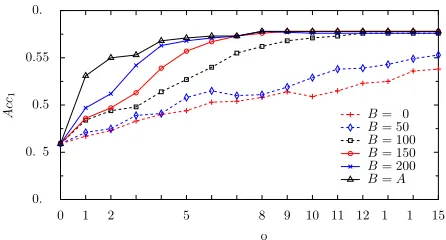
According to the results from tables 1 and 2, re-gardless of the seed lexicon size, the bootstrapping approach does not suffer from semantic drift, i.e., if we seed the process with high-quality symmetric translation pairs, it is able to recover more pairs and add them as new dimensions of the bilingual vector space. However, we also study the influence of ap-plying different confidence estimation functions on top of the symmetry constraint (see sect 2.3), but we do not observe any improvement in the BLE results, regardless of the actual choice of a confidence esti-mation function. The only observed phenomenon, as illustrated by fig. 3, is the slower convergence ratewhen setting the parameterBto lower values.
0.4 0.45 0.5 0.55 0.6
Acc
1
0 1 2 3 4 5 6 7 8 9 10 11 12 13 14 15 Iteration
B= 30
B= 50
B= 100
B= 150
B= 200
[image:10.612.72.295.53.173.2]B=All
Figure 3: The effect of learning rateBon bootstrapping. Language pair: ES-EN, seed lexicon: SEED-RB with 600 pairs, confidence function: symmetrized M-Best.
when starting with 600 entries for ES-EN, the final bilingual vector space consists of only 1554 pairs, while the total number of ES nouns is 9439). One line of future work will address the construction of bootstrapping algorithms that also enable the usage of highly reliable asymmetric pairs as dimensions, and the confidence estimation functions might have a more important role in that setting.
5 Conclusion
We have presented a new bootstrapping approach to inducing bilingual vector spaces from non-parallel data, and have shown the utility of the induced space in the BLE task. The approach is fully corpus-based and, unlike previous work, it does not rely on the availability of machine-readable translation dictio-naries or predefined concept categories. We have systematically described, analyzed and evaluated all key components of the bootstrapping approach. Re-sults reveal that, contrary to conclusions from prior work, the initialization of the bilingual vector space is especially important. We have presented a novel approach to initializing the bootstrapping procedure, and have shown that better results in the BLE task are obtained by starting from seed lexicons that com-prise highly reliable high-frequent translation pairs. The bootstrapping framework presented in the pa-per is completely language pair independent, which makes it effectively applicable to any language pair. In future work, we will investigate other models of similarity besidesTopicBCandResponseBC(e.g, the method from (Haghighi et al., 2008)) that could be used as preliminary models for constructing an initial bilingual vector space. Furthermore, we plan
to study other confidence functions and explore if asymmetric translation candidates could also con-tribute to the bootstrapping method. Finally, we also plan to test the robustness of our fully corpus-based bootstrapping approach by porting it to more lan-guage pairs.
Acknowledgments
We would like to thank the anonymous reviewers for their useful suggestions. This research has been car-ried out in the framework of the TermWise Knowl-edge Platform (IOF-KP/09/001) funded by the In-dustrial Research Fund, KU Leuven, Belgium.
References
Marco Baroni and Alessandro Lenci. 2010. Distribu-tional memory: A general framework for corpus-based semantics. Computational Linguistics, 36(4):673– 721.
David M. Blei, Andrew Y. Ng, and Michael I. Jordan. 2003. Latent Dirichlet Allocation. Journal of
Ma-chine Learning Research, 3:993–1022.
Jordan Boyd-Graber and David M. Blei. 2009. Multilin-gual topic models for unaligned text. InProceedings of UAI, pages 75–82.
John A. Bullinaria and Joseph P. Levy. 2007. Extract-ing semantic representations from word co-occurrence statistics: A computational study. Behavior Research
Methods, 39(3):510–526.
Sung-Hyuk Cha. 2007. Comprehensive survey on distance/similarity measures between probability den-sity functions. International Journal of Mathematical
Models and Methods in Applied Sciences, 1(4):300–
307.
Dipanjan Das and Slav Petrov. 2011. Unsupervised part-of-speech tagging with bilingual graph-based projec-tions. InProceedings of ACL-HLT, pages 600–609. Hal Daum´e III and Jagadeesh Jagarlamudi. 2011.
Do-main adaptation for machine translation by mining un-seen words. InProceedings of ACL-HLT, pages 407– 412.
Wim De Smet and Marie-Francine Moens. 2009. Cross-language linking of news stories on the Web using in-terlingual topic modeling. InProceedings of the CIKM
2009 Workshop on Social Web Search and Mining,
pages 57–64.
Greg Durrett, Adam Pauls, and Dan Klein. 2012. Syntac-tic transfer using a bilingual lexicon. InProceedings
Darja Fiˇser and Nikola Ljubeˇsi´c. 2011. Bilingual lexicon extraction from comparable corpora for closely related languages. InProceedings of RANLP, pages 125–131. Pascale Fung and Percy Cheung. 2004. Mining very-non-parallel corpora: Parallel sentence and lexicon ex-traction via bootstrapping and EM. InProceedings of
EMNLP, pages 57–63.
Pascale Fung and Lo Yuen Yee. 1998. An IR approach for translating new words from nonparallel, compara-ble texts. InProceedings of COLING, pages 414–420. ´
Eric Gaussier, Jean-Michel Renders, Irina Matveeva, Cyril Goutte, and Herv´e D´ejean. 2004. A geometric view on bilingual lexicon extraction from comparable corpora. InProceedings of ACL, pages 526–533. Thomas L. Griffiths, Mark Steyvers, and Joshua B.
Tenenbaum. 2007. Topics in semantic representation.
Psychological Review, 114(2):211–244.
Aria Haghighi, Percy Liang, Taylor Berg-Kirkpatrick, and Dan Klein. 2008. Learning bilingual lexicons from monolingual corpora. In Proceedings of ACL, pages 771–779.
Ruihong Huang and Ellen Riloff. 2012. Bootstrapped training of event extraction classifiers. InProceedings
of EACL, pages 286–295.
Azniah Ismail and Suresh Manandhar. 2010. Bilin-gual lexicon extraction from comparable corpora using in-domain terms. In Proceedings of COLING, pages 481–489.
Jun’ichi Kazama, Stijn De Saeger, Kow Kuroda, Masaki Murata, and Kentaro Torisawa. 2010. A Bayesian method for robust estimation of distributional similar-ities. InProceedings of ACL, pages 247–256.
Philipp Koehn and Kevin Knight. 2002. Learning a translation lexicon from monolingual corpora. In Pro-ceedings of the ACL Workshop on Unsupervised Lexi-cal Acquisition, pages 9–16.
Zornitsa Kozareva and Eduard H. Hovy. 2010. Not all seeds are equal: Measuring the quality of text min-ing seeds. InProceedings of NAACL-HLT, pages 618– 626.
Audrey Laroche and Philippe Langlais. 2010. Revisiting context-based projection methods for term-translation spotting in comparable corpora. In Proceedings of
COLING, pages 617–625.
Victor Lavrenko, Martin Choquette, and W. Bruce Croft. 2002. Cross-lingual relevance models. InProceedings of SIGIR, pages 175–182.
Lillian Lee. 1999. Measures of distributional similarity. InProceedings of ACL, pages 25–32.
Gina-Anne Levow, Douglas W. Oard, and Philip Resnik. 2005. Dictionary-based techniques for cross-language information retrieval. Information Processing and
Management, 41(3):523–547.
Tara McIntosh and James R. Curran. 2009. Reducing se-mantic drift with bagging and distributional similarity.
InProceedings of ACL, pages 396–404.
I. Dan Melamed. 2000. Models of translational equiv-alence among words. Computational Linguistics, 26(2):221–249.
David Mimno, Hanna M. Wallach, Jason Naradowsky, David A. Smith, and Andrew McCallum. 2009. Polylingual topic models. InProceedings of EMNLP, pages 880–889.
Xiaochuan Ni, Jian-Tao Sun, Jian Hu, and Zheng Chen. 2009. Mining multilingual topics from Wikipedia. In
Proceedings of WWW, pages 1155–1156.
Yoshiki Niwa and Yoshihiko Nitta. 1994. Co-occurrence vectors from corpora vs. distance vectors from dictio-naries. InProceedings of COLING, pages 304–309. Franz Josef Och and Hermann Ney. 2003. A
system-atic comparison of various statistical alignment mod-els. Computational Linguistics, 29(1):19–51.
Sebastian Pad´o and Mirella Lapata. 2009. Cross-lingual annotation projection for semantic roles. Journal of Artificial Intelligence Research, 36:307–340.
Patrick Pantel and Dekang Lin. 2002. Discovering word senses from text. InProceedings of KDD, pages 613– 619.
Yves Peirsman and Sebastian Pad´o. 2010. Cross-lingual induction of selectional preferences with bilin-gual vector spaces. In Proceedings of NAACL-HLT, pages 921–929.
Yves Peirsman and Sebastian Pad´o. 2011. Semantic re-lations in bilingual lexicons. ACM Transactions on Speech and Language Processing, 8(2):article 3. Viktor Pekar, Ruslan Mitkov, Dimitar Blagoev, and
An-drea Mulloni. 2006. Finding translations for low-frequency words in comparable corpora. Machine Translation, 20(4):247–266.
Emmanuel Prochasson and Pascale Fung. 2011. Rare word translation extraction from aligned comparable documents. InProceedings of ACL, pages 1327–1335. Reinhard Rapp. 1999. Automatic identification of word translations from unrelated English and German cor-pora. InProceedings of ACL, pages 519–526.
Ellen Riloff and Jessica Shepherd. 1999. A corpus-based bootstrapping algorithm for semi-automated semantic lexicon construction. Natural Language Engineering, 5(2):147–156.
Helmut Schmid. 1994. Probabilistic part-of-speech tag-ging using decision trees. InInternational Conference
on New Methods in Language Processing.
Daphna Shezaf and Ari Rappoport. 2010. Bilingual lex-icon generation using non-aligned signatures. In
David A. Smith and Jason Eisner. 2007. Bootstrapping feature-rich dependency parsers with entropic priors.
InProceedings of EMNLP-CoNLL, pages 667–677.
Mark Steyvers and Tom Griffiths. 2007. Probabilistic topic models. Handbook of Latent Semantic Analysis, 427(7):424–440.
Oscar T¨ackstr¨om, Dipanjan Das, Slav Petrov, Ryan Mc-Donald, and Joakim Nivre. 2013a. Token and type constraints for cross-lingual part-of-speech tagging.
Transactions of ACL, 1:1–12.
Oscar T¨ackstr¨om, Ryan McDonald, and Joakim Nivre. 2013b. Target language adaptation of discrimina-tive transfer parsers. InProceedings of NAACL-HLT, pages 1061–1071.
Akihiro Tamura, Taro Watanabe, and Eiichiro Sumita. 2012. Bilingual lexicon extraction from comparable corpora using label propagation. In Proceedings of
EMNLP-CoNLL, pages 24–36.
Michael Thelen and Ellen Riloff. 2002. A bootstrap-ping method for learning semantic lexicons using ex-traction pattern contexts. InProceedings of EMNLP, pages 214–221.
Kewei Tu and Vasant Honavar. 2012. Unambiguity reg-ularization for unsupervised learning of probabilistic grammars. InProceedings of EMNLP-CoNLL, pages 1324–1334.
Peter D. Turney and Patrick Pantel. 2010. From fre-quency to meaning: vector space models of semantics.
Journal of Artifical Intelligence Research, 37(1):141– 188.
Lonneke van der Plas, Paola Merlo, and James Hender-son. 2011. Scaling up automatic cross-lingual seman-tic role annotation. InProceedings of ACL-HLT, pages 299–304.
Ellen M. Voorhees. 1999. The TREC-8 question answer-ing track report. InProceedings of TREC, pages 77– 82.
Ivan Vuli´c and Marie-Francine Moens. 2013. Cross-lingual semantic similarity of words as the similarity of their semantic word responses. InProceedings of
NAACL-HLT, pages 106–116.
Ivan Vuli´c, Wim De Smet, and Marie-Francine Moens. 2011. Identifying word translations from comparable corpora using latent topic models. InProceedings of
ACL-HLT, pages 479–484.
David Yarowsky and Grace Ngai. 2001. Inducing mul-tilingual POS taggers and NP bracketers via robust projection across aligned corpora. In Proceedings of
NAACL, pages 200–207.
Duo Zhang, Qiaozhu Mei, and ChengXiang Zhai. 2010. Cross-lingual latent topic extraction. InProceedings
of ACL, pages 1128–1137.